中美贸易谈判

Search documents
贵金属日评:中美贸易谈判的不确定性支撑贵金属价格-20251021
Hong Yuan Qi Huo· 2025-10-21 01:52
Group 1: Report Industry Investment Rating - No information provided about the report industry investment rating [1] Group 2: Core Viewpoint of the Report - Uncertainties in China-US trade negotiations support precious metal prices. Concerns about the weakening US job market increase the expectation of future interest rate cuts by the Fed and a possible halt to balance - sheet reduction. Geopolitical conflicts in regions like Russia - Ukraine and the Middle East, expansion expectations of fiscal deficits in many countries, and continuous gold purchases by central banks globally support precious metal prices in the medium - to - long - term, but potential negative factors such as the alleviation of the US credit crisis and the end of the federal government shutdown should be watched [1] Group 3: Summary by Relevant Catalogs Precious Metal Market Data - **Gold**: In the Shanghai market, the closing price of Shanghai Gold was 973.70 yuan/gram, with a change of - 22.20 compared to the previous day. The trading volume of spot沪金T+D was 71850.00, and the position was 258232.00. In the international market, the closing price of COMEX gold futures active contract was 4267.90 dollars/ounce, and the inventory was 39107098.30 troy ounces. The holding amount of SPDR gold ETF was 41.50 tons [1] - **Silver**: In the Shanghai market, the closing price of Shanghai Silver was 11779.00 yuan/ten grams, and the trading volume of spot沪银T+D was 1249250.00. In the international market, the closing price of COMEX silver futures active contract was 47.52 dollars/ounce, and the inventory was 506467618.32 troy ounces. The holding amount of iShare silver ETF was 487.19 tons [1] Important Information - The US listed rare earths, fentanyl, and soybeans as the three major issues in China - US economic and trade consultations. The White House economic advisor said the US government shutdown might end this week. Japan's Liberal Democratic Party and the Japan Innovation Party signed a coalition - governing document, and Takamachi Sanae is likely to become the Japanese prime minister. Vietnam's real estate market has a "trillions - level" problem [1] Trading Strategy - It is advisable to lay out long positions after price corrections. For London gold, pay attention to the support level around 3900 - 4100 and the resistance level around 4383 - 4778. For Shanghai gold, focus on the support level around 890 - 930 and the resistance level around 1000 - 1100. For London silver, watch the support level around 42 - 48 and the resistance level around 57 - 68. For Shanghai silver, pay attention to the support level around 9800 - 10800 and the resistance level around 13000 - 14800 [1]
宁证期货今日早评-20251021
Ning Zheng Qi Huo· 2025-10-21 01:34
1. Report Industry Investment Ratings No specific industry investment ratings are provided in the report. 2. Core Views of the Report - Overall, the market is complex and volatile, with different commodities showing various trends influenced by factors such as supply - demand, geopolitics, and macro - economic conditions. For example, the US government shutdown and geopolitical events impact the oil market, while cost and demand factors affect the prices of industrial products like coke and steel [1][5]. 3. Summary by Commodity Crude Oil - In September, the output of industrial crude oil above designated size was 17.77 million tons, a year - on - year increase of 4.1%, and the growth rate was 1.7 percentage points faster than that in August. From January to September, the output was 162.63 million tons, a year - on - year increase of 1.7%. The EU plans to gradually stop importing Russian oil and gas by January 1, 2028. The US government shutdown continues, pressuring the crude oil market. Supply - demand and geopolitical factors suppress oil prices, and the progress of Sino - US trade negotiations needs to be followed [1]. Coke - Independent coke enterprises' average profit per ton of coke this week is - 13 yuan/ton, with a capacity utilization rate of 74.24% (a decrease of 0.94%), and the daily coke output is 65.29 million tons (a decrease of 0.83 million tons). Supply is tightened due to negative profits and factors like environmental protection and maintenance. Although iron - water production declines slightly, there is still rigid demand. As the peak season ends, both supply and demand weaken, but the iron - water output is relatively stable, so the coke price is expected to remain stable [1]. PX - The operating rates of Asian and domestic PX decreased month - on - month. The domestic PX load decreased by 0.81% to 87.4%, and the Asian PX load increased by 0.96% to 77.92%. This week's PX output was 733,100 tons, a decrease of 69,000 tons from last week. The PX - N average was 225.68 dollars/ton, an increase of 6.9 dollars/ton month - on - month. Asian PX device maintenance is limited, and the load is expected to remain at a relatively high level. PXN is under pressure, and PX is expected to fluctuate weakly [3]. Rubber - The price of Thai raw material rubber latex is 54.1 Thai baht/kg, and the cup - lump rubber price is 50.2 Thai baht/kg. The price of Hainan rubber latex for full - latex production is 14,500 yuan/ton, and for concentrated latex production is 15,400 yuan/ton. As of October 19, 2025, the total inventory of natural rubber in Qingdao was 437,500 tons, a decrease of 18,600 tons from the previous period, a decline of 4.07%. Overseas weather improvement pressures raw material prices, and the decline in synthetic rubber prices also affects natural rubber prices. The inventory in Qingdao port is decreasing slightly, and the tight spot circulation limits the decline of rubber prices. Recently, macro - factors have a greater impact than fundamentals, and caution is recommended. The progress of Sino - US trade negotiations needs to be followed [3]. Iron Ore - The total inventory of imported iron ore in 47 ports is 14.96187 million tons, an increase of 320,790 tons month - on - month. The daily ore - handling volume is 3.2932 million tons, a decrease of 122,200 tons. The inventory of coarse powder, lump ore, and pellet increased, while the inventory of fine powder decreased. The number of ships in port increased by 23 to 127. The iron ore market is transitioning from "strong supply and demand" to "strong supply and weak demand", and port inventory accumulation pressure is gradually realized. An oscillating and bearish approach is recommended, and the actual iron - water production of steel mills should be focused on. If the iron - water production drops rapidly, the downward space of ore prices may be opened. Attention should be paid to market expectations before two important macro - meetings in October [4]. Rebar - On October 20, domestic steel market prices fluctuated. The ex - factory price of billets in Tangshan Qian'an remained stable at 2,920 yuan/ton. One steel mill raised the ex - factory price of construction steel by 20 yuan/ton, and three steel mills maintained stable operations. The average price of 20mm grade - 3 earthquake - resistant rebar in 31 major cities was 3,217 yuan/ton, an increase of 2 yuan/ton from the previous trading day. Domestic steel demand is weak, and steel mills continue to control production. The supply and demand are both weak. The raw material market is differentiated, with iron ore and scrap steel prices under pressure, and coke starting the second round of price increases due to rising coking coal prices. In the short term, the market is mixed, and steel prices may adjust weakly and narrowly [5]. Live Pigs - In the third week of October, the national pig - grain ratio was 5.22, a month - on - month decrease of 4.40%; the national pig - feed ratio was 4.56, a month - on - month decrease of 5.00%. According to current prices and costs, the expected profit per head of piglets in the fattening mode is - 281.88 yuan. The average price of live pigs continued to decline this week. Yesterday, the national live - pig price adjusted stably and strongly. Recently, the number of pigs for secondary fattening has increased significantly, and the willingness of farmers to hold prices is strong. After the price remained low, it rebounded slightly, and the market has improved compared with the previous period. In the short term, live - pig futures prices have stopped falling and stabilized, but there is insufficient momentum for a sharp rise, and they will fluctuate at the bottom [5]. Palm Oil - As of October 17, 2025 (week 42), the commercial inventory of palm oil in key regions was 575,700 tons, an increase of 28,100 tons from last week, an increase of 5.13%; a year - on - year increase of 59,800 tons, an increase of 11.59%. According to ITS data, Malaysia's palm oil product exports from October 1 - 20 were 1.044784 million tons, an increase of 3.44% from the same period last month. The export growth rate of Malaysian palm oil in October decreased significantly, indicating weak export momentum. India's import demand has been basically released before the Diwali Festival, so the demand in October is likely to decline. In China, there was a large - scale arrival of goods last week, and the arrivals are concentrated recently, putting pressure on prices. Short - term operation suggestions are to maintain low - buying and sell at high prices [7]. Soybeans - In week 42 of 2025, the soybean inventory of major domestic oil mills increased, while the soybean meal inventory and unexecuted contracts decreased. The soybean inventory was 7.687 million tons, an increase of 29,400 tons from last week, an increase of 0.38%, and a year - on - year increase of 1.6575 million tons, an increase of 27.49%. The soybean meal inventory was 976,200 tons, a decrease of 102,900 tons from last week, a decrease of 9.54%, and a year - on - year increase of 39,000 tons, an increase of 4.16%. The spot market of imported soybeans is strong, and farmers sell a limited amount of newly harvested crops. Strong domestic demand offsets the pressure caused by continuous trade tensions. In the short term, soybean futures (No. 2) will oscillate and stabilize, and follow - up attention should be paid to macro - news. The domestic new - season soybean market is stable and may have room for an increase [8]. Plastic - The mainstream price of North China LLDPE was 7,073 yuan/ton, a decrease of 5 yuan/ton from the previous day. The weekly output of LLDPE was 308,600 tons, a decrease of 3.23%. The inventory of production enterprises was 188,200 tons, a week - on - week increase of 21.89%. The daily production profit of oil - based LLDPE was - 73 yuan/ton. The average operating rate of downstream polyethylene products in China increased by 3.3% week - on - week, with the overall operating rate of agricultural film increasing by 7.3% and the operating rate of PE packaging film decreasing by 0.7%. The supply of LLDPE has decreased, but the market spot is sufficient, and there is supply pressure. The social sample warehouse inventory is at a relatively high level. The demand of downstream factories is growing slowly, and the purchasing enthusiasm is weak. The cost - end support is loosening. It is expected that the L2601 contract will oscillate in the short term, with the upper pressure at the 6,930 level. Observation is recommended until further stabilization [9]. PVC - In September, the PVC export volume was 346,400 tons, a year - on - year increase of 24.53%. The price of East China SG - 5 type PVC was 4,600 yuan/ton, remaining unchanged from the previous day. The PVC capacity utilization rate was 76.69%, a week - on - week decrease of 5.94%. The PVC social inventory was 1.0338 million tons, a month - on - month decrease of 0.24%. The average profit of national calcium - carbide - based PVC production enterprises was - 713 yuan/ton, and that of ethylene - based PVC production enterprises was - 552 yuan/ton. The operating rate of domestic PVC pipe sample enterprises was 40.43%, a month - on - month increase of 1.3%. PVC supply has decreased from a high level. It is expected that some device maintenance will end this week, and the output is expected to increase, with overall supply expected to rise. Domestic and foreign demand is showing a stable and rising trend, and PVC social inventory has decreased slightly. Recently, cost support is weak. It is expected to oscillate in the short term, with the lower support of the 01 contract at the 4,665 level. Observation or short - term buying on dips is recommended [10]. Soda Ash - The national mainstream price of heavy - soda ash is 1,271 yuan/ton, and the price has been weak recently. The weekly output of soda ash is 740,500 tons, a month - on - month decrease of 3.93%. The total inventory of soda ash manufacturers is 1.7005 million tons, a week - on - week increase of 2.45%. The operating rate of float glass is 76.35%, a week - on - week increase of 0.34 percentage points. The average price of national float glass is 1,223 yuan/ton, a decrease of 8 yuan/ton from the previous day. The total inventory of national float glass sample enterprises is 64.2756 million weight boxes, a month - on - month increase of 2.31%. The float - glass operating rate is relatively stable, but inventory has increased. The demand in the East China market is weak, and with the impact of low - price foreign goods, enterprise shipments are significantly restricted, and the spot trading atmosphere is dull. The domestic soda - ash market is oscillating, and the price is running stably. Supply remains at a high level, downstream demand is average, and the purchasing sentiment is cautious, mainly for rigid - demand replenishment. It is expected that the 01 contract of soda ash will oscillate in the short term, with the lower support at the 1,190 level. Observation or short - term buying on dips is recommended [11][12]. Short - Term Treasury Bonds - Most money - market interest rates have risen. The weighted average interest rate of inter - bank pledged repurchase for the 1 - day variety decreased by 0.55 BP to 1.314%, the 7 - day variety increased by 2.47 BP to 1.4332%, the 14 - day variety increased by 4.15 BP to 1.4983%, and the 1 - month variety remained unchanged at 1.5%, reaching a new low in more than a month. The money supply has tightened slightly, which is negative for short - term bonds. In the fourth quarter, there are both loose liquidity and stock - market disturbances. The positive factors for treasury - bond futures are increasing, but they may still oscillate in the medium term [12]. Silver - The Sino - US sides are about to return to the negotiation table. The tariff disturbance factor has weakened, which is positive for risk appetite. Silver fluctuates passively following gold. After the US government's normal operation is restored, attention should be paid to the impact of economic data. The market has fully priced in the Fed's interest - rate cut in October, and silver faces further correction risks. The impact of gold on silver should be followed [12]. Gold - The longer the US government shutdown lasts, the stronger the market's risk - aversion sentiment. After the government resumes operation, the economic data also worries the market, and the risk - aversion sentiment has pushed gold to a new high. It is not recommended to chase the rise of precious metals, and observation is advisable. Attention should be paid to the fluctuation of the US dollar index and its impact on gold [13].
商品日报20251021-20251021
Tong Guan Jin Yuan Qi Huo· 2025-10-21 01:14
Report Industry Investment Rating No relevant content provided. Core Viewpoints of the Report - Overseas risk appetite has recovered, while A-shares have continued to shrink in volume. The US government shutdown may end this week, and the market's concerns about the fiscal deadlock have eased. The US stock market has risen, and the price of gold has increased by over 2%. In China, the GDP in the third quarter increased by 4.8% year-on-year, laying a foundation for achieving the annual target. The A-share market has closed higher with shrinking volume, and the style has significantly shifted to dividend value. [2][3] - The price of precious metals has reached a new high, driven by the strong expectation of further interest rate cuts by the Federal Reserve and continuous hedging demand. The silver squeeze may end. The price of copper has rebounded due to China's stable economic growth. The price of aluminum has fluctuated due to stable macro and fundamental factors. The price of alumina has shown a weak oscillation due to the interaction between supply pressure and cost support. The price of zinc has slightly shifted upward due to the easing of trade tensions. The price of lead has oscillated at a high level due to tight regional supply. The price of tin has consolidated at a high level due to weak supply and demand. The price of industrial silicon has oscillated as demand awaits recovery. The price of lithium carbonate has oscillated due to the interweaving of long and short factors. The price of nickel has oscillated strongly due to the warm macro expectation. The prices of soda ash and glass have faced pressure due to the weakening of fundamentals. The price of steel has oscillated under pressure due to weak terminal data. The price of iron ore has oscillated weakly due to reduced arrivals and shipments. The price of soybean meal has oscillated weakly due to the progress of Brazilian soybean sowing and sufficient domestic supply. The price of palm oil has oscillated widely due to the narrowing increase in export demand. [4][6][8][9][10][12][15][16][18][20][23][24][25][26][29] Summary by Relevant Catalogs 1. Metal Main Varieties Yesterday's Trading Data - This section presents the closing data of major futures markets for various metals, including copper, aluminum, alumina, zinc, lead, nickel, tin, gold, silver, steel, iron ore, coking coal, and coke, covering information such as closing prices, price changes, price change percentages, trading volumes, and positions. [31] 2. Industrial Data Perspective - This part provides detailed industrial data for multiple metals, including copper, nickel, zinc, lead, aluminum, alumina, tin, and precious metals, such as contract prices, inventory changes, spot premiums and discounts, and price ratios between domestic and international markets. [32][35]
研究所晨会观点精萃-20251021
Dong Hai Qi Huo· 2025-10-21 01:03
Macroeconomic and Financial Analysis - Market concerns about trade tensions have eased, leading to an overall increase in global risk appetite. Domestically, economic growth has accelerated, and the softening of the US President's trade stance, along with the introduction of multiple industry stability - growth plans, has boosted domestic risk appetite. The short - term upward macro - drive has strengthened, and attention should be paid to the progress of Sino - US trade negotiations and the implementation of domestic incremental policies [2]. - For assets: The stock index is expected to fluctuate in the short term, and it is advisable to be cautiously bullish. Treasury bonds are expected to fluctuate in the short term, and it is advisable to wait and see. In the commodity sector, the black metal market is expected to fluctuate in the short term, and it is advisable to wait and see; the non - ferrous metal market is expected to fluctuate in the short term, and it is advisable to be cautiously bullish; the energy and chemical market is expected to fluctuate in the short term, and it is advisable to wait and see; precious metals are expected to fluctuate strongly at a high level in the short term, and it is advisable to be bullish [2]. Stock Index - Driven by sectors such as coal and gas, airport shipping, and consumer electronics, the domestic stock market has risen. The acceleration of domestic economic growth, the softening of the US President's trade stance, and the introduction of multiple industry stability - growth plans have boosted domestic risk appetite. The short - term upward macro - drive has strengthened, and attention should be paid to the progress of Sino - US trade negotiations and the implementation of domestic incremental policies. It is advisable to be cautiously bullish in the short term [3]. Precious Metals - The precious metals market declined on Monday. The main contract of Shanghai Gold closed at 970.32 yuan/gram, down 1.63%; the main contract of Shanghai Silver closed at 11742 yuan/kilogram, down 3.99%. Spot gold broke through the record high of last Friday, driven by the expectation of further US interest rate cuts and continuous hedging demand. It is expected to fluctuate strongly at a high level in the short term, and the medium - to - long - term upward trend remains unchanged. It is advisable for short - term bulls to continue holding or reducing positions on rallies, and to buy on dips in the medium - to - long - term [3]. Black Metals Steel - On Monday, the domestic steel market continued to be weak, and market trading volume remained low. The overall economic downward pressure is still large, and market risk - aversion sentiment has increased. The real demand for steel is still weak, but it improved slightly last week. The inventory of five major steel products decreased by 18.46 tons week - on - week, and apparent consumption increased by 139 tons. Supply is likely to decline further as steel mill profits narrow. There is no trending market in the steel market, with upward movement restricted by the supply - demand pattern and downward movement supported by costs. In the short term, the upward and downward space is limited [4]. Iron Ore - On Monday, the spot and futures prices of iron ore both weakened. The molten iron output has been declining for three consecutive weeks but remains at a high level of 240 tons. The logic of compressed steel mill profits continues, and molten iron output is expected to decline further. Steel mill raw material replenishment has temporarily ended. Global iron ore shipments increased by 126 tons this week, while arrivals decreased by 526.4 tons week - on - week. Port inventory increased by 253.77 tons last week. It is advisable to take a bearish view on iron ore prices in the later stage [5]. Silicon Manganese/Silicon Iron - On Monday, the spot and futures prices of silicon manganese and silicon iron rebounded slightly. The output of five major steel products has declined for two consecutive weeks, reducing the demand for ferroalloys. The price of silicon manganese 6517 in the northern market is 5600 - 5650 yuan/ton, and in the southern market is 5650 - 5700 yuan/ton. Manganese ore prices continue to be weak. The national capacity utilization rate of silicon manganese increased slightly, and daily output increased. The price of 72 - grade silicon iron in the main production area is 5100 - 5200 yuan/ton, and 75 - grade is 5800 - 6100 yuan/ton. The price of 75B silicon iron tendered by Hebei Steel in October decreased compared with the previous round. The silicon iron and silicon manganese futures prices are expected to continue to fluctuate within a range [6]. Soda Ash - On Monday, the main contract of soda ash was weak. Supply is in the capacity - release period, with plans for capacity release in the fourth quarter, maintaining a loose supply pattern. Although the anti - involution policy is clear, there is no clear industry document yet, and the price is dragged down by supply - side contradictions in the medium - to - long - term. It is advisable to take a bearish view in the medium - to - long - term [7]. Glass - On Monday, the main contract of glass fluctuated weakly. Glass production increased slightly, and the number of production lines remained stable. As the "Golden September and Silver October" period ends, downstream procurement has slowed down. Although there is some policy support, overall demand is difficult to increase significantly. It is advisable to conduct short - term range operations [7]. Non - Ferrous Metals and New Energy Copper - The US dollar declined last week due to dovish remarks from Powell, increased expectations of Fed rate cuts, and the alleviation of fiscal risk concerns in Japan and France. The suspension of Indonesia's second - largest copper mine has exacerbated the global copper shortage, supporting futures prices. However, the suspension is temporary, and production will resume in the middle of next year. Next year is a year of high copper supply, with an expected output growth rate of 5% (optimistic estimate) or 3% (neutral estimate), and the growth rate will fall below 2% after 2027. There is also a risk of the Panama copper mine restarting. Domestic refined copper de - stocking is less than expected, and social inventory is at a relatively high level. Domestic electrolytic copper production remains high, and demand is facing challenges. US copper inventory is high, restricting future import demand. Copper prices are expected to remain high and fluctuate [8]. Aluminum - On Monday, Shanghai aluminum fluctuated narrowly. The outer market is stronger than the inner market, resulting in a low internal - external price difference, which supports the inner market. Domestic aluminum fundamentals are not good, with slow de - stocking of social inventory and high aluminum rod inventory. London aluminum inventory has decreased recently, and overseas demand is not good. If institutions continue to withdraw aluminum from LME warehouses, it will support aluminum prices. Aluminum prices are expected to fluctuate within a range in the short term [9]. Tin - On the supply side, Indonesia has transferred six previously seized tin smelters to a state - owned enterprise, which plans to increase refined tin output. However, the crackdown on illegal tin mining and the adjustment of the mining approval cycle have exacerbated the global tin shortage in the short term. After the maintenance of large - scale smelters in Yunnan ended, the smelting start - up rate returned to over 50%. On the demand side, the start - up rate of tin solder remains low, and the improvement in downstream and terminal orders is limited. Traditional industries such as consumer electronics and home appliances have weak demand, and photovoltaic demand has declined. Tin prices are at a historical high, which suppresses physical demand. Weekly inventory decreased by 769 tons to 7017 tons. Tin prices are expected to remain high and fluctuate [10]. Lithium Carbonate - On Monday, the main contract of lithium carbonate rose 0.05%. The current supply and demand of lithium carbonate are both increasing, with strong demand in the peak season and continuous de - stocking of social inventory. The fundamentals are improving marginally, and the downward space is limited. The market is expected to fluctuate strongly, and attention should be paid to the upper pressure range [11]. Industrial Silicon - On Monday, the main contract of industrial silicon rose 0.88%. Weekly production reached a new high, but there was no inventory accumulation during the wet season. Attention should be paid to the resumption of production in the north. The 2511 contract faces the pressure of digesting warehouse receipts. The market is expected to fluctuate within a range, and attention should be paid to the cash - flow cost support of large manufacturers [11]. Polysilicon - On Monday, the main contract of polysilicon fell 3.66%. The number of warehouse receipts is increasing, and there will be concentrated cancellations in November, bringing selling pressure. The current situation of high supply and low demand continues. Attention should be paid to the implementation of storage purchase news and the support of spot prices [12][13]. Energy and Chemicals Crude Oil - Against the background of the easing of Sino - US tensions, oil prices declined slightly. The long - expected supply surplus is gradually emerging, and the tanker carrying capacity has reached a recent high. Oil prices will continue to test the lower support in the near future [14]. Asphalt - As oil prices continue to test the lower support, asphalt also has the risk of breaking through the support level. The basis remains low, and the actual shipping volume is low. The pressure of factory inventory accumulation continues, and social inventory is being depleted in the East China region. Profits have recovered slightly, and production has increased significantly, leading to an increase in supply pressure. In the later stage, oil prices will be affected by OPEC+ production increases, and asphalt may face challenges due to increased inventory pressure. Attention should be paid to the support of crude oil costs [14]. PX - Due to the continuous decline of crude oil prices and weak polyester demand, PX prices have followed the downward trend. Although the high start - up rate of PTA provides some demand support, PX is expected to continue to fluctuate weakly in October due to the overall decline of the polyester sector [14]. PTA - Driven by the decline of crude oil prices, the overall energy and chemical sector has declined. Downstream start - up rates are low, orders are scarce, and terminal start - up rates are below the historical average. PTA processing fees have declined, and port and factory inventories are accumulating. The basis has decreased, and short - term trading should focus on short - selling on rallies [15]. Ethylene Glycol - After breaking through the previous low, the port inventory of ethylene glycol has rebounded. With the expectation of new production capacity coming on - stream, ethylene glycol prices will remain low. Downstream start - up rates are weak, and both overseas and domestic demand are sluggish. In October, inventory will continue to accumulate, and prices will remain low. If oil prices continue to decline, there is still a risk of further decline [15]. Short - Fiber - Short - fiber has adjusted following the polyester sector and is expected to continue to fluctuate weakly in the near future. Terminal orders have increased seasonally but with limited amplitude. The increase in short - fiber start - up rates has led to limited inventory accumulation. Further inventory depletion depends on the continuous improvement of terminal orders. In the medium - term, short - selling on rallies may be considered [15]. Methanol - This week, methanol supply has decreased in the short term, and olefin demand remains high, leading to a slight reduction in inventory and an improvement in the short - term supply - demand structure. However, traditional downstream demand is weak, and there are plans for many plants to restart, increasing supply pressure. High inventory and external factors such as tariff upgrades restrict price increases. Methanol prices are expected to fluctuate in the short term [16]. PP - The supply growth rate of the PP market continues to be higher than demand, and inventory levels are high, putting pressure on the market. The decline of crude oil prices has weakened cost support, expanding the downward price space. Attention should be paid to the recovery of downstream demand [17]. LLDPE - This week, the supply of polyethylene has increased, and inventory has accumulated significantly, suppressing prices. Demand is divided, with the start - up rate and orders of agricultural film improving, but the overall downstream start - up rate is still slow to increase. The decline of crude oil prices has weakened cost support, and the polyethylene market will be under pressure in the short term [17]. Urea - The daily output of urea is between 18.1 - 19.1 tons. Industrial procurement is stable, and agricultural demand is recovering after rainfall. Exports are shrinking after the window period closes. The market is cautious, and purchases are mainly made at low prices. The short - term market may be stable after a period of stalemate, but there is still a risk of decline in the later stage [17]. Agricultural Products US Soybeans - The release of USDA reports has been postponed, and concerns about Sino - US soybean trade continue, making the export prospects of US soybeans unclear. However, domestic crushing consumption provides some support. The new - season harvest situation of US soybeans is unknown. The sowing of Brazilian soybeans is progressing smoothly, and the weather conditions in the core production areas of Argentina are good. The CBOT soybean market is expected to remain stable with narrow fluctuations. Attention should be paid to the dynamics of Sino - US soybean trade [18]. Soybean and Rapeseed Meal - Domestic downstream phased replenishment has increased, and soybean meal inventory has decreased significantly. As of October 17, 2025, soybean inventory in major oil mills increased slightly week - on - week and significantly year - on - year, while soybean meal inventory decreased week - on - week and increased year - on - year. Apparent consumption of soybean meal increased significantly. Currently, oil mill profits are generally in the red, increasing their willingness to support spot prices. Although the expected arrival of soybeans in the fourth quarter is sufficient, there may be a supply gap before the new - season South American soybeans are available in the first quarter of next year. After the short - term over - decline, soybean meal prices are expected to stabilize and fluctuate. Rapeseed meal supply is tight due to low factory start - up rates, and the market is in a state of weak supply and demand, with inventory decreasing slightly [19]. Soybean and Rapeseed Oil - Soybean oil has entered the peak season, but trading volume has not changed significantly. The inverted price difference between domestic and foreign soybean and palm oil provides some consumption expectations. The basis of first - grade soybean oil in Zhangjiagang has increased. For rapeseed oil, before the supply of Australian rapeseed and direct imports of Russian oil increases, the de - stocking market supports the stability of the spot basis. As of October 17, 2025, soybean oil commercial inventory decreased week - on - week and increased year - on - year, while rapeseed oil inventory decreased [20]. Palm Oil - A large amount of palm oil arrived in China last week, and the arrival is concentrated recently, leading to an increase in commercial inventory. Malaysian palm oil exports have increased at a slower rate. As of October 17, 2025, domestic palm oil commercial inventory increased week - on - week and year - on - year [20][21]. Corn - The bumper harvest of corn in the Northeast and North China has come onto the market. The harvest weather is not conducive to storage, and farmers are eager to sell due to profitable prices, causing a significant seasonal impact on the market. Currently, corn trading at the grassroots level and ports is light, and the willingness of channels and downstream feed mills to build long - term inventories is still weak. However, the current price is close to the planting cost, and high - quality corn is in short supply. As the temperature drops, farmers may be more reluctant to sell, which will slow down the price decline [21]. Pigs - After the festival, the process of reducing production and inventory has accelerated, and pig prices have fallen to a new low this year, resulting in widespread losses in breeding profits. Recently, the price difference between fat and lean pigs and some regional restocking have supported the market, increasing the reluctance of small - scale farmers to sell and pressuring the market. Large - scale farms plan to increase the pace of slaughter, but supply is expected to decrease in late October, which will stabilize the extreme downward risk of pig prices. The far - month futures are slightly at a premium. Unless there is a significant increase in demand beyond the seasonal norm, it is difficult for pig prices to recover significantly. Attention should be paid to the impact of extreme weather on pig farming in North China this year [22].
暴力反弹!右侧机会到了?
Ge Long Hui· 2025-10-21 00:55
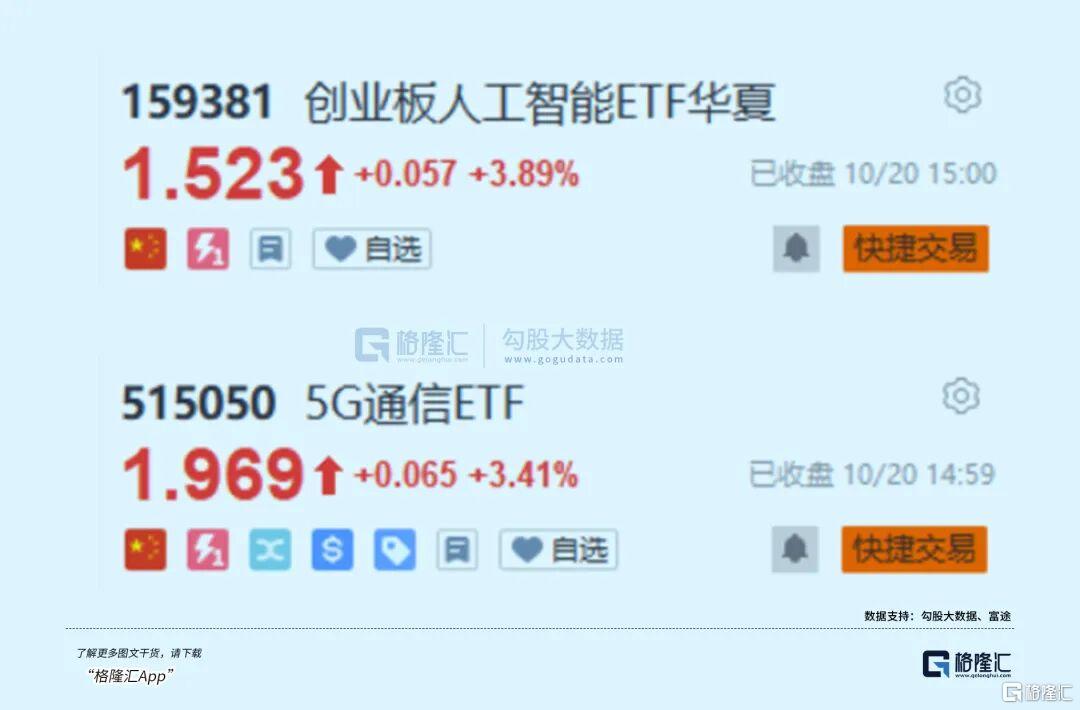
Core Viewpoint - The recent signals from U.S. President Trump regarding trade talks have positively influenced market sentiment, leading to a rebound in the AI computing sector and overall market indices [1][2][5]. Market Performance - A-shares saw a collective rise, with the Shanghai Composite Index up 0.63%, Shenzhen Component up 0.98%, and ChiNext Index up 1.98% [1]. - The AI computing sector, particularly the ETFs with over 50% CPO content, experienced significant gains, with the Huaxia AI ETF (159381) and 5G Communication ETF (515050) rising by 3.89% and 3.41% respectively [1][2]. Industry Trends - Demand for 1.6T optical modules is on the rise, with industry forecasts increasing total demand from 10 million to 20 million units by 2026 [4]. - The global Ethernet optical module market is expected to grow significantly, with a projected market size of $18.9 billion in 2026, reflecting a 35% year-on-year increase [4]. Company Developments - Zhongji Xuchuang has begun shipping 1.6T optical modules and anticipates continued mass production in the coming quarters [5]. - The PCB market is experiencing a supply shortage driven by AI-related demand for high-speed optical modules, particularly for products rated at 800G and above [5]. - TSMC reported a third-quarter revenue of NT$989.92 billion, a 30.3% year-on-year increase, and a net profit of NT$452.3 billion, marking a record high with a 39.1% increase [6]. Investment Opportunities - The Huaxia AI ETF (159381) and 5G Communication ETF (515050) are highlighted as stable investment tools, with the former focusing on AI and the latter on the 5G communication industry [10][12]. - The Huaxia AI ETF has seen a net inflow of 280 million yuan this year, with a 53% increase in share growth, indicating strong investor interest [14]. Future Outlook - The AI industry is expected to maintain high growth, with upcoming quarterly reports likely to validate the sector's robust performance [6][7]. - The upcoming events, including trade negotiations and financial reports, are anticipated to provide further investment opportunities in the technology sector [7][15].

Morris: If you want the growth, you have to accept the volatility
Youtube· 2025-10-20 13:18
Core Viewpoint - The current market environment is characterized by anticipated volatility due to various factors including US-China trade talks and domestic lending concerns, with a generally positive long-term outlook for the US economy despite short-term fluctuations [1][2]. Market Volatility and Economic Outlook - The potential for increased volatility is acknowledged, particularly in light of the US-China trade discussions and upcoming economic data releases, which are causing investor concern [1][2]. - The outlook for the US economy remains positive, with expectations of growth supported by increased lending for manufacturing and AI development, although this growth may come with accompanying volatility [2]. Government Shutdown Impact - The ongoing government shutdown is expected to create some market volatility, but historically, such shutdowns have not had a significant long-term impact on the markets [3][4]. - While there may be short-term nervousness and a slight increase in demand for gold and treasuries, the overall effect on the markets is not viewed as a primary concern [4]. Earnings Season Insights - Earnings season shows a divergence in performance, with the "Magnificent Seven" tech stocks expected to see a 15% year-over-year earnings increase, while the remaining 493 companies are projected to grow by just under 7% [5][6]. - Broader tech sector earnings are estimated to rise by 17%, contrasting with a mere 2% growth for the rest of the market, indicating a significant disparity in performance [6][7]. - The non-tech sectors, particularly value and goods producers, are facing challenges due to tariffs, leading to depressed earnings growth compared to earlier expectations [7][8]. Investment Strategy - The current investment strategy favors US equities, particularly within the NASDAQ, due to superior earnings growth potential in the tech sector [8][9]. - A wait-and-see approach is suggested for other market segments to recover from tariff impacts before considering them as attractive investment opportunities [9].
音频 | 格隆汇10.20盘前要点—港A美股你需要关注的大事都在这
Ge Long Hui A P P· 2025-10-19 23:23
Group 1 - China's corporate income tax from January to September increased by 0.8% year-on-year, while personal income tax rose by 9.7% [2] - The stamp duty on securities transactions in China reached 144.8 billion yuan from January to September, a year-on-year increase of 103.4% [2] - Zijin Mining reported a net profit of 17.056 billion yuan for the third quarter, a year-on-year increase of 52.25% [2] - Zijin Mining's net profit for the first three quarters was 37.864 billion yuan, reflecting a year-on-year growth of 55.45% [3] - China Life Insurance expects a net profit increase of 50%-70% year-on-year for the first three quarters [2] Group 2 - Silan Microelectronics plans to invest 20 billion yuan to build a 12-inch high-end analog integrated circuit chip manufacturing line [2] - The investment in silver bars is in high demand, leading to some stores in China's "Silver Capital" running out of stock [2] - Meituan saw net buying from southbound funds, while Alibaba experienced significant net selling, and there was a continued reduction in holdings of SMIC [2]




X @外汇交易员
外汇交易员· 2025-10-17 23:31
Trade Relations - The US has confidence in returning to a mutually beneficial position with China [1] - Tariffs at 100% are unsustainable, driven by China's actions [2] - A fair agreement with China is necessary [2] Negotiation Stance - China has been seeking an advantage [2] - The US aims to have a good relationship with China [2]
美抛出更大筹码,换中方在稀土让步,中国这一关,美国恐怕过不了
Sou Hu Cai Jing· 2025-10-17 05:11
Core Viewpoint - The U.S. government is attempting to pressure China into concessions in the rare earth sector by proposing an extension of the tariff "truce," but this strategy may not succeed in overcoming China's firm stance [1][3][4] Group 1: U.S. Strategy and Actions - U.S. Treasury Secretary Yellen proposed extending the tariff truce to negotiate concessions from China regarding rare earth exports, which are crucial for various industries [1][3] - The U.S. has shown increased anxiety in its negotiations, as evidenced by the lack of public announcements regarding upcoming talks, indicating a potential shift in strategy [1][3] - The U.S. is also seeking discussions on China's soybean purchases, highlighting its reliance on the Chinese market [1][3] Group 2: China's Response and Position - China has demonstrated a strong unwillingness to compromise, implementing stricter rare earth export controls and imposing special port fees on U.S. vessels [4] - The Chinese government has maintained a consistent message of resolving disputes through dialogue, which the U.S. has often overlooked [4] - China's firm stance is further illustrated by its actions against U.S. companies, such as investigations into Qualcomm, signaling a robust response to U.S. pressures [4]