中央经济工作会议召开

Search documents
管涛:从兼顾内外均衡角度理解人民币汇率政策 | 马年大咖谈
Di Yi Cai Jing· 2026-02-18 00:23
Core Viewpoint - The appreciation of the RMB has significant tightening effects on the macro economy, especially in the context of a large trade surplus and net external debt position of the private sector in China [1][5]. Group 1: Economic Policy and Macro Environment - The Central Economic Work Conference emphasizes the continuation of proactive macro policies to stabilize employment, enterprises, markets, and expectations, aiming for qualitative and effective economic growth [1]. - The meeting highlights the need to maintain the RMB exchange rate at a reasonable and balanced level for the fourth consecutive year, indicating the importance of external and internal economic balance [1][2]. Group 2: Trade Surplus and External Balance - China's current account surplus reached a record $734.9 billion last year, a 73.4% increase year-on-year, with a surplus-to-GDP ratio of 3.5%, up 1.3 percentage points from the previous year [1]. - The trade surplus is driven by strong export competitiveness and a stable position in global supply chains, despite a significant drop in exports to the U.S. by 20% [2][3]. Group 3: Market Dynamics and Exchange Rate Management - The decline in China's export market share to 14.36% and a drop in global import market share to 9.69% indicate challenges in maintaining external competitiveness [3]. - The shift from net external debt to net external assets in the private sector means that RMB appreciation could lead to a reduction in private sector foreign exchange income and assets, complicating exchange rate management [4][5]. Group 4: Policy Recommendations - The report suggests a multi-faceted approach to manage exchange rates, including deepening market-oriented reforms and enhancing monitoring of cross-border capital flows to prevent excessive appreciation of the RMB [5]. - It advocates for targeted fiscal and monetary policies to stimulate domestic demand and promote a consumption-driven economic model, aiming to balance savings and investments [5].
国家机器如何运转?中国政治经济底层逻辑学习笔记(中篇)
Sou Hu Cai Jing· 2026-02-04 07:47
Group 1 - The article discusses the complex dynamics of China's central government, emphasizing the interplay between various departments such as the National Development and Reform Commission (NDRC), the Ministry of Finance (MOF), and the People's Bank of China (PBOC) in macroeconomic policy-making [2][3][22] - It highlights the NDRC's dual powers of planning and approval, which are crucial for project legitimacy and funding, making it a key player in economic development [8][11][12] - The MOF's role as the budgetary authority is underscored, detailing its responsibilities in managing fiscal balance and debt issuance, which are critical during economic stimulus discussions [15][16][18] Group 2 - The article outlines the decision-making process within the central government, detailing the five critical stages from policy initiation to final approval, emphasizing the importance of inter-departmental negotiations [26][30][34] - It introduces the new mechanism of consistency evaluation for macroeconomic policies, aimed at preventing conflicting policies that could harm economic stability [40][41][70] - The central government's economic work meeting emphasizes the need for proactive fiscal and monetary policies to address current economic challenges, including maintaining a reasonable fiscal deficit and supporting domestic demand [69][90]

2025年四季度刊:国资国企热点政策分析
KPMG· 2026-01-23 01:48
Policy Framework - The "14th Five-Year Plan" emphasizes high-quality development, focusing on modern industrial systems, technological self-reliance, and green transformation[4] - Key tasks include expanding domestic demand, deepening reform and opening up, and ensuring national security[4] Technology and Industry Integration - The State-owned Assets Supervision and Administration Commission (SASAC) aims to enhance the integration of technological and industrial innovation through high-quality supply and efficient transformation[6] - Focus areas include identifying bottlenecks in industrial chains and fostering collaboration with external institutions[10] Scene Cultivation and Application - The government has outlined 22 economic and social application scenarios across five categories to accelerate scene cultivation and large-scale application[17] - Emphasis on creating high-value application scenarios and integrating major projects as testing grounds for new technologies[18] Economic Work Priorities - The 2026 economic work plan highlights eight key tasks, including innovation-driven growth and maintaining stability while pursuing progress[25] - SASAC's focus will be on high-quality development, enhancing cooperation, and fostering new productive forces[25] State-Owned Enterprise Reform - The reform aims to deepen the role of state-owned enterprises (SOEs) in driving economic growth and enhancing their core competitiveness[26] - Strategies include optimizing state capital layout and breaking down internal barriers to promote the flow of production factors[26]
【权威访谈:开局“十五五”】加快高水平科技自立自强 引领发展新质生产力
Yang Shi Wang· 2026-01-17 12:08
《2025年全球创新指数报告》显示,中国已有24个集群进入全球百强创新集群,位居世界之首。中央经 济工作会议提出,要建设北京(京津冀)、上海(长三角)、粤港澳大湾区国际科技创新中心。阴和俊 介绍,围绕这一重大战略部署,科技部将推动京津冀、沪苏浙皖优势互补,凝聚合力,打造科技强国重 要战略支点。 教育、科技、人才是中国式现代化的基础性、战略性支撑。"十五五"规划建议明确指出,一体推进教育 科技人才发展,促进科技自主创新和人才自主培养良性互动,加快建设国家战略人才力量。 央视网消息(新闻联播):"十五五"规划建议提出,加快高水平科技自立自强,引领发展新质生产 力。"十五五"开局之年,我国科技工作将如何整体布局、系统推进,培育壮大新动能?来看总台记者对 科技部部长阴和俊的专访。 近期召开的中央经济工作会议明确将"坚持创新驱动,加紧培育壮大新动能"作为2026年经济工作八项重 点任务之一。阴和俊介绍,科技部将锚定科技强国战略目标,坚持创新驱动,加强战略规划、政策措 施、重大任务、科研力量、资源平台、区域创新等方面统筹,发挥新型举国体制优势,强化央地协同、 部门联动,充分调动各类创新主体积极性,提升国家创新体系整体效能 ...
LME暂停KZ及YP锌交割,沪锌突破25000元
Zhong Xin Qi Huo· 2026-01-15 11:14
1. Report Industry Investment Rating - Not provided 2. Core View of the Report - In the short term, there is upward room for zinc ingot prices, and the overall base metal sector is strong. With the potential fermentation of the Fed's policy damage and weak - dollar expectations, it will provide support for zinc prices. However, in the medium - to - long term, global zinc production is still increasing, and the supply of zinc ingots at home and abroad is expected to be excessive in 2026. The short - term zinc price may fluctuate at a high level, and shorting should be cautious. The recommended price range is adjusted to 22,000 - 26,000 yuan/ton [2][4] 3. Summary by Relevant Catalogs Latest Dynamics and Reasons - The Shanghai zinc price has broken through 25,000 yuan/ton, and the LME zinc price has broken through $3,000/ton. The driving factors include: the long - opened Chinese zinc export window from early October to mid - December 2025, the slow recovery of domestic zinc ingot supply after the LME price settlement, the significant rise of other base metals attracting capital attention to zinc, and the LME's suspension of KZ and YP zinc交割 from April 14, 2026. In 2024, Korea Zinc and Young Poong's zinc production was 1.03 million tons and 0.21 million tons respectively, accounting for 9% of the global total. If the suspension is long - term and overseas zinc smelters have production problems in 2026, LME zinc inventory will not significantly recover. But the LME plans to limit members with large positions in near - month contracts, so the squeeze - out pressure on LME zinc is expected to be low [2] Fundamental Situation - Macro - wise, the Fed's policy and weak - dollar expectations are still fermenting, and the central economic work conference set a positive tone. Overall, the macro - expectation is stable. Supply - side, after the LME price settlement, the Shanghai - LME ratio has risen, the zinc concentrate import window has opened, the decline of imported zinc concentrate has slowed, and domestic zinc concentrate production has stabilized. Zinc smelters' raw material inventory and zinc concentrate port inventory are okay, so the decline in zinc ingot production may ease. The domestic zinc ingot export window has closed, but previously locked - price zinc ingots will still be exported, and it takes time for zinc concentrate imports to significantly increase. So, the domestic zinc ingot supply cannot be significantly loosened in the short term. Demand - side, with the arrival of the downstream consumption off - season, terminal demand remains weak, but some enterprises have pre - holiday stocking needs, so the decline in zinc ingot demand may not be obvious. In short, the domestic zinc ingot social inventory is still decreasing [3] Summary and Strategy - Short - term: Zinc prices may fluctuate at a high level, and shorting should be cautious. The price reference range is adjusted to 22,000 - 26,000 yuan/ton. It is recommended to buy copper and aluminum and short zinc in far - month contracts, and close the cross - period and cross - market arbitrage positions when domestic zinc ingot exports basically end. - Long - term: After overseas zinc smelters increase production smoothly and the US dollar index stabilizes, the cross - market long - arbitrage strategy can be re - entered [4]
商务部部长王文涛:释放消费潜力活力,以高水平开放赢得战略主动
Xin Lang Cai Jing· 2026-01-15 11:14
Group 1: Core Insights - The "14th Five-Year Plan" emphasizes the importance of building a strong domestic market and expanding high-level opening-up, with specific measures to boost consumption and promote trade innovation [1][2] - The Ministry of Commerce aims to achieve a retail sales total of over 50 trillion yuan for the year, with a 4.0% growth in social retail sales in the first eleven months [2][3] Group 2: Consumption Strategies - Focus on cultivating service consumption and optimizing trade-in policies, with a target to enhance green and smart product consumption by 2026 [3][4] - The strategy includes promoting service consumption in key areas such as transportation, home services, and entertainment, while also enhancing offline retail experiences [3][4] Group 3: Downstream Market Activation - The strategy targets lower-tier markets, which account for 70% of the population and 60% of social retail, by improving circulation facilities and market environments [4] - The Ministry plans to host significant promotional events like the "Lego New Year" to stimulate consumption during the Spring Festival [4] Group 4: Trade Innovation Development - The Ministry of Commerce identifies three pillars for trade development: goods trade, service trade, and digital trade, in response to global trade slowdowns [5][6] - Emphasis on market diversification, promoting balanced trade development, and enhancing service trade through policy improvements and international cooperation [6][7] Group 5: High-Level Opening-Up Initiatives - The Ministry plans to expand autonomous opening in various service sectors and enhance the operational policies of the Hainan Free Trade Port [8][9] - Active participation in global economic governance through APEC and WTO meetings, promoting multilateralism and free trade [9]
坚持创新驱动,加紧培育壮大新动能——访科技部党组书记、部长阴和俊
Jing Ji Ri Bao· 2026-01-14 22:09
Core Viewpoint - The article emphasizes the importance of accelerating high-level technological self-reliance and innovation as a key driver for high-quality economic development in China during the "14th Five-Year Plan" period, with a focus on integrating technological and industrial innovation [1][2]. Group 1: Technology Innovation Strategies - The Ministry of Science and Technology will focus on strategic planning, policy measures, major tasks, research capabilities, resource platforms, and regional innovation to enhance the overall effectiveness of the national innovation system [2][3]. - A comprehensive national technology innovation plan will be developed to implement key tasks and major initiatives for the "14th Five-Year Plan" period, ensuring a systematic approach to future technological work [3]. - The ministry aims to strengthen the role of enterprises in technological innovation, promote the transformation of major technological achievements, and foster a collaborative development between technological and industrial innovation [3][6]. Group 2: Regional Innovation Centers - The construction of international technology innovation centers in Beijing (Jing-Jin-Ji), Shanghai (Yangtze River Delta), and the Guangdong-Hong Kong-Macao Greater Bay Area is aimed at enhancing original innovation capabilities, high-end industry leadership, and talent aggregation [4][5]. - The strategy includes leveraging the leading roles of Beijing and Shanghai to promote collaborative synergies among the regions, ensuring a cohesive approach to technological innovation and resource sharing [5][6]. Group 3: Education and Talent Development - The integration of education, technology, and talent development is identified as a foundational support for modernization, with plans to enhance coordination and collaboration among these sectors [3][4]. - The ministry will focus on cultivating top-tier talent and innovation teams through major technological tasks, emphasizing the importance of practical experience in education [3][6]. Group 4: Enterprise Innovation Support - The ministry will strengthen the decision-making role of enterprises in technological innovation and enhance financial support for technology-driven small and medium-sized enterprises [6]. - Policies will be implemented to improve tax incentives for research and development, encouraging enterprises to increase their R&D investments [6]. - The ministry will support enterprises in undertaking national research tasks and facilitate the establishment of innovation consortia involving various stakeholders [6].
地缘避险情绪升温,BCOM指数权重调整启动
Hua Tai Qi Huo· 2026-01-08 02:56
Report Industry Investment Rating No relevant content provided. Core Viewpoints - Policy expectations are swinging back and forth. After a series of important domestic meetings and the Fed's return to a "restrictive" stance in December, there are risks of policy expectation swings both at home and abroad, with asset sentiment deviating from the macro situation. Future commodity prices will be determined by supply - side risks and loose monetary policies due to global geopolitical instability [1]. - There is a certain divergence in domestic and foreign economic outlooks. Overseas economic sentiment has been declining since October, while China's exports and new orders remain positive. China's November economic data was under pressure, but the official manufacturing and non - manufacturing PMIs in December returned to the expansion range [2]. - For commodity investment, focus on high - certainty sectors such as non - ferrous metals and precious metals. There are also opportunities for low - valued commodities to make up for price increases. In the energy sector, pay attention to the growth expectation of crude oil supply after the US "temporary management" of Venezuela. In the chemical industry, focus on the "anti - involution" space of some varieties. For agricultural products, pay attention to weather expectations and short - term pig diseases [3]. Summary by Related Catalogs Market Analysis - Policy expectations are unstable. After the Central Economic Work Conference in December and the 2026 People's Bank of China Work Conference in January, there are uncertainties in domestic and foreign policies. The Fed has internal differences. Geopolitical tensions during the New Year's Day holiday have increased supply - side risks for commodities [1]. - On January 7, the A - share market showed mixed performance. The semiconductor industry chain was active, and the coal sector had a strong performance. In the commodity futures market, many contracts such as nickel, coke, and coking coal reached the daily limit [1]. Domestic and Foreign Economic Data - Overseas economic sentiment has been declining since October, while China's November foreign trade growth rebounded. China's November economic data was under pressure, but the December official manufacturing and non - manufacturing PMIs returned to the expansion range. The US November non - farm payrolls recovered but were still weak, and the unemployment rate reached a four - year high [2]. Commodity Investment - Focus on non - ferrous metals and precious metals. Among non - ferrous metals, aluminum is a good choice. In the energy sector, pay attention to the situation in Venezuela and Iran. In the chemical industry, focus on the "anti - involution" space of methanol, PTA, etc. For agricultural products, pay attention to weather and pig diseases. There are opportunities to buy precious metals at low prices, but short - term silver risks have increased [3]. Strategy - For commodities and stock index futures, consider buying on dips in stock index futures, precious metals, and non - ferrous metals [4]. Key News - China's central bank increased its gold reserves for the 14th consecutive month in December. On January 8, the central bank carried out a 1.1 trillion - yuan buy - out reverse repurchase operation. The US Supreme Court will rule on the tariff issue on January 9. Trump announced that Venezuela will transfer 30 - 50 million barrels of oil to the US [6].
财政、货币政策协同发力 经济延续复苏态势
Zheng Quan Ri Bao· 2026-01-04 23:19
Core Viewpoint - In 2026, China's economy is expected to experience a structural adjustment with a focus on sustainable growth, supported by proactive fiscal and monetary policies [2][3][4]. Economic Growth and Indicators - The overall economic performance in 2025 laid a solid foundation for 2026, with GDP growth expected around 5.1% for 2025 [2]. - The Purchasing Managers' Index (PMI) for December 2025 showed manufacturing PMI at 50.1%, non-manufacturing PMI at 50.2%, and a composite PMI at 50.7%, indicating a recovery in economic sentiment [2]. Structural Adjustments - The "three new economies" (new industries, new business formats, new models) are projected to surpass the real estate economy in GDP contribution for the first time in 2026 [3]. - The focus for 2026 will shift towards structural adjustments rather than just quantitative growth, with policies aimed at enhancing consumption patterns and boosting consumer confidence [3]. Fiscal Policy - The central economic work conference emphasized the continuation of a more proactive fiscal policy, with specific measures including the issuance of long-term special bonds and consumer subsidies [4]. - The first batch of 62.5 billion yuan in special bonds was allocated before the New Year to support consumption during peak seasons [4]. Monetary Policy - The People's Bank of China is expected to implement interest rate cuts of up to 0.3 percentage points in 2026, with potential adjustments occurring before the Spring Festival [5]. - Structural monetary policies will focus on directing financial resources towards technology innovation, manufacturing upgrades, and supporting small and micro enterprises [5][6]. Policy Coordination - Recent policies are designed to address current economic challenges, such as weak domestic demand, while also laying the groundwork for long-term development through investments in new productive forces and social welfare [6]. - The coordinated approach of fiscal and monetary policies aims to stimulate domestic demand and accelerate industrial upgrades [6].
晶采观察丨新一年4个关键词,关乎每个奋斗的你我
Yang Guang Wang· 2026-01-03 07:46
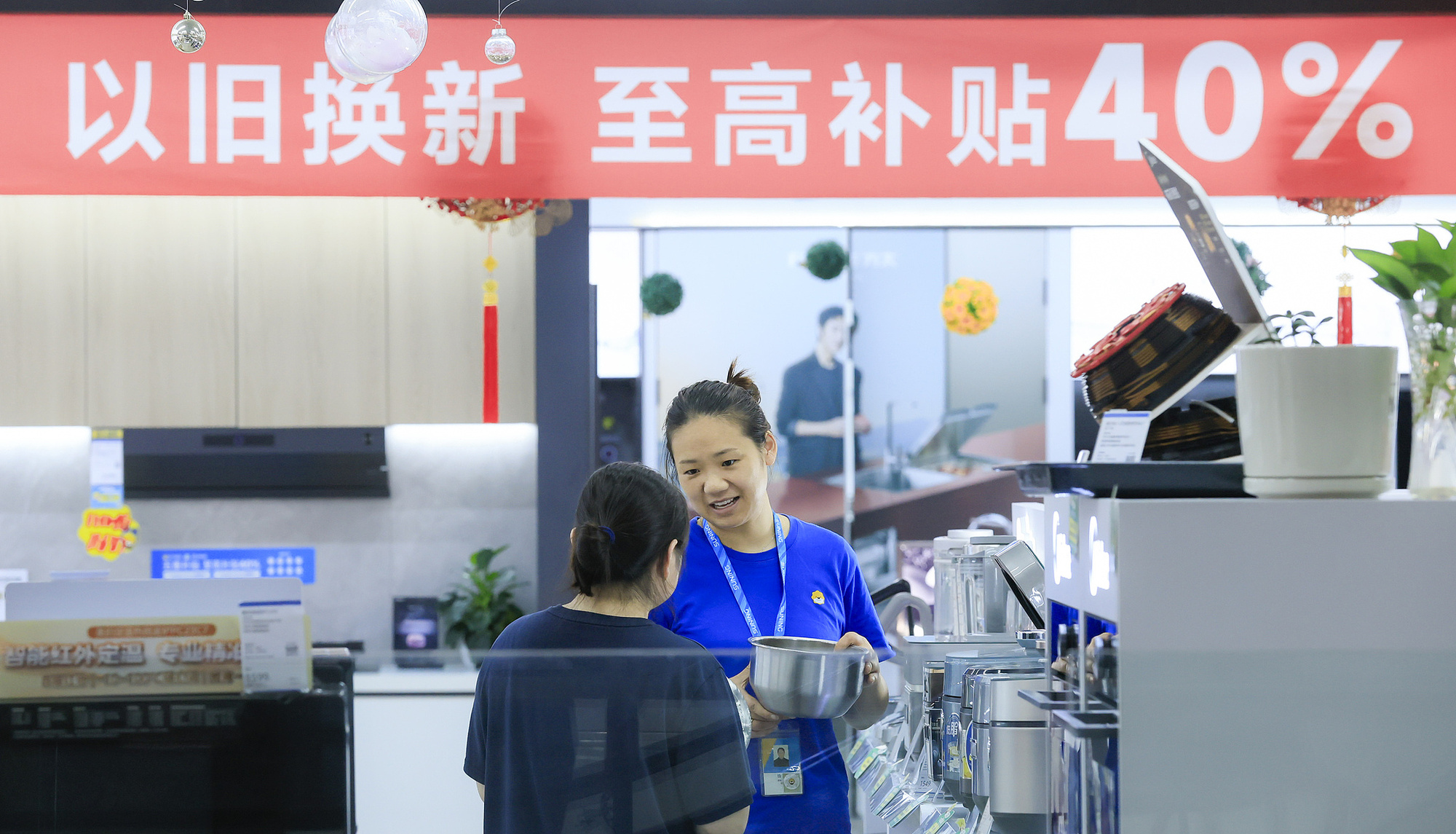
江苏淮安:市民选购家电 由此,今年的工作重点清晰可见:一方面深入开展提振消费专项行动,制定城乡居民增收计划,切实提升居民消费能力与意愿;另一方面,持续扩大优质商 品和服务供给,优化落实"两新"政策,同时清理消费领域的不合理限制,充分释放服务消费潜力,推动消费市场实现高质量扩容提质。值得关注的是,2026 年"两新"政策优化实施方案已正式发布。国家已向地方提前下达2026年第一批超长期特别国债资金计划,规模达625亿元,专项用于支持消费品以旧换新, 助力保障元旦、春节等消费旺季的市场需求。 0:00 刷到这条的朋友,先给自己点个赞!2025奋力奔跑,2026全新启程!这4个核心关键词、四大重点任务,找准方向,咱们一起冲。 首先需要明确的是,过去五年的发展历程极不寻常,取得的成绩来之不易。2026年作为"十五五"规划的开局之年,中国经济该如何谋篇布局、精准发力?答 案已清晰明确。中央经济工作会议作出系统部署,明确将坚持内需主导列为今年经济工作的首要任务。这一战略部署,深刻印证了"十五五"时期建设强大国 内市场的要义——不仅是我国扩大内需的坚实支撑,更是驱动全球经济增长的关键动能。 具身智能机器人吸引众多参观者 科 ...