
交运

Search documents
全市场最大的中证全指自由现金流ETF——自由现金流ETF基金(159233)有望成为价值风格下的优质选择
Sou Hu Cai Jing· 2025-06-05 04:03
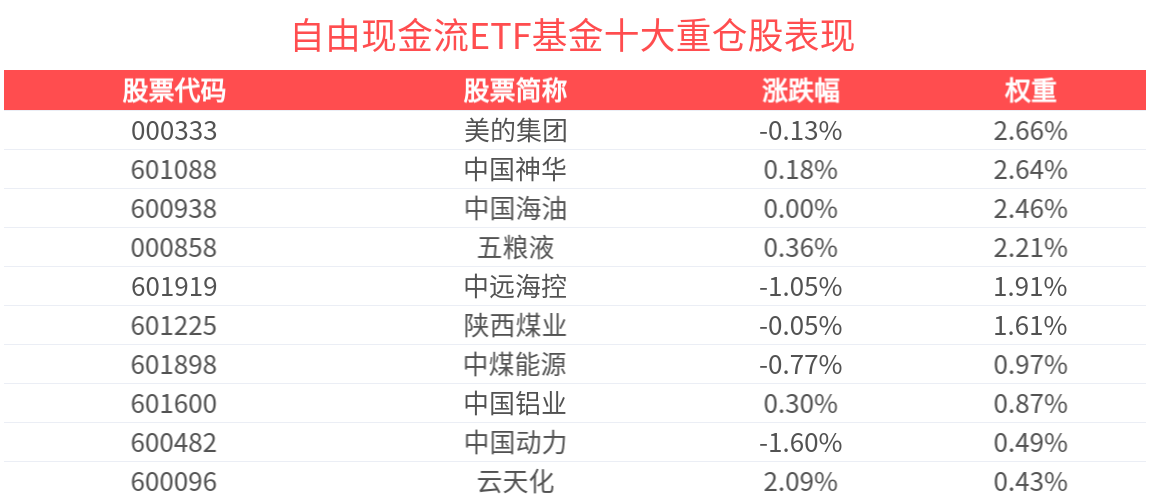
Core Viewpoint - The performance of the CSI All Share Free Cash Flow Index (932365) has shown a slight decline, with a focus on companies with strong cash flow generation capabilities, reflecting a trend towards stability in uncertain market conditions [1][2]. Group 1: Index Performance - As of June 5, 2025, the CSI All Share Free Cash Flow Index (932365) decreased by 0.18%, with mixed performance among constituent stocks [1]. - Leading gainers included Yiming Pharmaceutical (002826) up 10.00%, and Jin Hong Group (603518) up 9.99%, while Debon Logistics (603056) led the declines at 9.84% [1]. Group 2: ETF Fund Insights - The Free Cash Flow ETF Fund (159233) is closely tracking the CSI All Share Free Cash Flow Index, which selects 100 companies with high free cash flow rates to reflect the overall performance of companies with strong cash flow generation [2]. - The Free Cash Flow ETF Fund had a trading volume of 2.27% and a turnover of 16.18 million yuan, with an average daily turnover of 83.39 million yuan over the past week [1]. Group 3: Investment Rationale - Analysts highlight several reasons for investing in the Free Cash Flow Index: focusing on "stable cash cows" in uncertain markets, avoiding financial statement embellishments, and seeking quality in a low-interest-rate environment [1]. - The index shows a more balanced industry distribution, with significant representation from sectors such as home appliances, oil and petrochemicals, transportation, food and beverage, and coal [1]. Group 4: Top Holdings - As of May 30, 2025, the top ten weighted stocks in the CSI All Share Free Cash Flow Index accounted for 65.68% of the index, including Midea Group (000333) and China Shenhua (601088) [2][4]. - The weightings of the top stocks vary, with Midea Group at 2.66% and China Shenhua at 2.64%, indicating a concentration in a few key players [4].

端午假期消费数据如何?
China Post Securities· 2025-06-04 03:00
-17% -12% -7% -2% 3% 8% 13% 18% 23% 28% 2024-06 2024-08 2024-10 2025-01 2025-03 2025-06 社会服务 沪深300 证券研究报告:社会服务|点评报告 行业投资评级 强于大市|维持 | 行业基本情况 | | --- | | 收盘点位 | | 8037.22 | | --- | --- | --- | | 52 | 周最高 | 9343.57 | | 52 | 周最低 | 5985.5 | 行业相对指数表现(相对值) 资料来源:聚源,中邮证券研究所 研究所 交运数据:小个位数增长。据中国交通报数据,2025 年 5 月 31 日至 6 月 2 日(端午节假期期间),预计全社会跨区域人员流动量累 计 6.57 亿人次,日均 2.19 亿人次,同比去年端午增长 3.0%。其中, 铁路客运量日均同比增长2.3%,公路人员流动量日均同比增长3.14%, 水路客运量日均同比下降 1.65%,民航客运量日均同比增长 1.22%。 出入境:小个位数增长。据国家移民管理局数据,今年端午节假 期全国边检机关共计保障 590.7 万人次中外人员出入境, ...
国内高频 | 汽车销量持续走强(申万宏观·赵伟团队)
赵伟宏观探索· 2025-05-29 23:00
Industrial Production - Industrial production remains stable, with a slight year-on-year decrease in blast furnace operating rates by 0.4 percentage points to 2.1% [1][4] - Chemical production shows marginal recovery, with soda ash, PTA, and polyester filament operating rates increasing by 0.1, 0.7, and 0.8 percentage points respectively [1][17] - The operating rate of automotive semi-steel tires has slightly decreased by 0.2 percentage points to -2.6% [1][17] Construction Industry - Construction activity has weakened, with significant declines in grinding and cement shipment rates, down 1.1 percentage points to -4.6% and 1 percentage point to -8% respectively [1][29] - The asphalt operating rate has notably decreased by 8.8 percentage points to -2% [1][41] - Cement average prices continue to decline [1][29] Downstream Demand - New housing transactions show marginal improvement, with average daily transaction area increasing by 14.2% year-on-year to 0.9%, particularly in first and second-tier cities [2][53] - Automotive sales remain strong, with retail and wholesale volumes increasing by 15.4% to 28.5% and 21.4% to 22.1% respectively [2][80] - Port cargo throughput related to exports has improved, while container shipping prices show mixed performance [2][89] Price Trends - Prices of agricultural and industrial products have generally declined, with pork, vegetables, fruits, and eggs decreasing by 0.2%, 1.1%, 1.5%, and 1.3% respectively [2][99] - The South China industrial product price index has decreased by 1%, with energy and chemical prices down by 1.3% and metal prices down by 0.6% [2][111]

热点思考 | 就业“新趋势”?(申万宏观·赵伟团队)
赵伟宏观探索· 2025-05-29 23:00
Core Viewpoint - The article discusses the new trends in employment and wage data for urban employees in 2024, highlighting shifts from high salary pursuits to a focus on reducing work intensity and improving work-life balance [1]. Group 1: Employment Trends - Employment is shifting from a focus on high salaries to a trend of "anti-involution," where workers prefer industries with shorter working hours and higher hourly wages. This change has been observed since 2021, contrasting with the pre-2019 trend of concentrating on high-paying sectors [2][9]. - The average annual wage growth for urban non-private sector employees has slowed to 2.8% in 2024, down from a peak in 2021, with significant declines in sectors like information technology and finance [2][9]. - Industries such as transportation and light manufacturing have shown resilience in wage growth due to direct revenue increases, with transportation revenue growth exceeding 8% in 2024 [2][21]. Group 2: Regional Wage Convergence and Employment Shifts - There is a convergence in wage growth between eastern and western regions of China, with the wage growth gap narrowing from 0.8 percentage points in 2019 to 0.5 percentage points in 2024 [4][53]. - Employment in the service sector is increasingly migrating to the central and western regions, while production-related jobs continue to flow into the eastern regions. This trend is supported by stronger wage growth in the service sector in these areas [4][75]. - The service consumption pattern is shifting from local to cross-province, further concentrating service sector employment in the central and western regions, driven by faster consumption growth in these areas [5][80]. Group 3: Wage Growth in Private and Flexible Employment - Wages in the private sector have generally lagged behind those in the non-private sector, but certain industries within the private sector, such as education and retail, have experienced higher wage growth [6][96]. - New forms of flexible employment, such as ride-hailing and delivery services, have seen significant wage increases, with average monthly salaries for these roles reaching 10,506 yuan, surpassing traditional employment salaries [7][114]. - The work intensity for new flexible employment roles is higher, with average weekly working hours for platform workers reaching 54.3 hours, indicating a trade-off between higher pay and increased workload [7][122].

"见微知著”系列专题之七:就业"新趋势”?
Shenwan Hongyuan Securities· 2025-05-29 14:52
Group 1: Employment Trends - In 2024, the average annual salary for urban non-private sector employees is 124,000 yuan, reflecting a decrease of 6.8 percentage points since 2021, now at a growth rate of 2.8%[3] - Employment is shifting from high-salary industries to sectors with shorter working hours and higher hourly wages, indicating a trend towards "anti-involution" since 2021[4] - The transportation and service industries have seen a reduction in weekly working hours by 4.2 and 3.6 hours respectively, while hourly wages increased by 3.9 and 3.6 yuan/hour, suggesting improved job attractiveness[4] Group 2: Regional Wage Convergence - From 2019 to 2023, the wage growth in the eastern region was 7.5%, compared to 7.1% in the central and western regions, with the gap narrowing from 0.8 percentage points in 2019 to 0.5 percentage points in 2023[5] - The wage growth in the central and western regions has shown resilience, with the central region's wage growth remaining stable at around 7.1%[5] - Employment in the service sector is increasingly migrating to the central and western regions, with the proportion of employees in accommodation and retail sectors decreasing from 20.8 and 10.1 percentage points below the eastern region to 18.2 and 9 percentage points respectively[6] Group 3: Private and Flexible Employment - The average salary growth for private sector employees is lower than that of non-private sector employees, but certain sectors like education and retail services have seen higher growth rates of 8.9% and 5.3% respectively[7] - The concentration of small and medium enterprises in the service sector has led to better salary growth in private units compared to non-private units[10] - New flexible employment roles, such as ride-hailing drivers and delivery personnel, have higher average monthly salaries of 10,506 yuan, significantly above traditional employees' 8,910 yuan, despite longer working hours[10]
国内高频 | 汽车销量持续走强(申万宏观·赵伟团队)
申万宏源宏观· 2025-05-29 09:45
Industrial Production - Industrial production remains stable, with blast furnace operating rates showing resilience, down 0.4 percentage points year-on-year to 2.1% [1][4] - Chemical production is marginally improving, with soda ash, PTA, and polyester filament operating rates increasing by 0.1, 0.7, and 0.8 percentage points year-on-year to -4.7%, 5.4%, and 4.1% respectively [1][17] - The operating rate of automotive semi-steel tires has slightly decreased, down 0.2 percentage points year-on-year to -2.6% [1][17] Construction Industry - Construction activity has weakened, with significant declines in grinding and cement shipment rates, down 1.1 percentage points to -4.6% and 1 percentage point to -8% year-on-year respectively [1][29] - The asphalt operating rate has notably decreased, down 8.8 percentage points year-on-year to -2% [1][41] Downstream Demand - New housing transactions have shown marginal improvement, with the average daily transaction area increasing by 14.2% year-on-year to 0.9%, particularly in first and second-tier cities [2][53] - Automotive sales continue to strengthen, with retail and wholesale volumes increasing by 15.4% to 28.5% and 21.4% to 22.1% year-on-year respectively [2][80] Price Trends - Prices of agricultural and industrial products have generally declined, with pork, vegetables, fruits, and eggs decreasing by 0.2%, 1.1%, 1.5%, and 1.3% respectively [2][99] - The South China industrial product price index has decreased by 1% week-on-week, with energy and chemical prices down 1.3% and metal prices down 0.6% [2][111] Transportation and Logistics - National freight volumes have rebounded, with rail freight volume and highway truck traffic increasing by 0.6% to 1% and 2.1% to 1% year-on-year respectively [2][63] - Port cargo throughput has also improved, up 2.1% year-on-year to 5.4%, while container throughput has slightly decreased by 0.5% to 6.1% [2][63] Consumer Behavior - Movie attendance and box office revenue have increased by 9.5% to -37.1% and 8% to -38.4% year-on-year respectively [2][80] - The overall consumer sentiment appears to be improving, as indicated by the increase in various consumption metrics [2][80]

A股自由现金流收益率持续提升,鹏华现金流ETF中证全指发行正当时
Zhong Guo Jing Ji Wang· 2025-05-27 07:55
Group 1 - The A-share market is showing positive changes, with overall profit growth turning positive and free cash flow yield steadily increasing, driven by policy effects and technological innovation trends [1] - The ongoing issuance of the Penghua Cash Flow ETF provides investors with a strong tool to seize market opportunities [1] - Free cash flow is a crucial indicator in financial analysis and value assessment, indicating a shift from scale expansion to high-quality operations among companies [1] Group 2 - The Penghua Cash Flow ETF tracks the CSI All Index Free Cash Flow Index, which selects 100 companies with high free cash flow rates, reflecting the performance of companies with strong cash flow generation capabilities [2] - The index has a large-cap value style, with over 40% of its constituent stocks having a market capitalization exceeding 500 billion [2] - The index has shown outstanding historical performance, with returns of 32.33% and 112.92% over the past three and five years, respectively, compared to the CSI 300's returns of -3.95% and 0.07% [2] Group 3 - Penghua Fund has been an innovator in the index investment field, expanding its ETF product layout while enhancing services in strategy development, portfolio optimization, and risk management [3] - The launch of the Penghua Cash Flow ETF is a continuation of its strategy in the Smart Beta space, reinforcing its position as a provider of index investment solutions [3] - The competition in the ETF market is intensifying, and leading institutions with comprehensive research and investment capabilities are expected to continue to excel [3]
光大证券晨会速递-20250522
EBSCN· 2025-05-22 01:14
Macro Analysis - In April 2025, fiscal revenue and expenditure improved, with notable highlights including accelerated fiscal spending, particularly in infrastructure-related areas [2] - Fiscal revenue showed marginal improvement compared to Q1, with tax revenue recovering while non-tax revenue growth slowed [2] - The land market showed signs of improvement, supported by the issuance of new special bonds, leading to significant enhancements in government fund income and expenditure [2] Coal Industry - In 2024, coal companies are expected to see a decline in operating revenue and a decrease in operating cash flow, with significant net outflows in investment cash flow [3] - Financing cash flow continues to show net outflows, with high leverage levels and increasing debt, yet overall debt repayment capacity remains strong [3] - Profitability for coal companies in 2025 is anticipated to be constrained, but there is still support for overall profitability, with relatively ample operating cash flow [3] Bond Market - In April 2025, the total bond custody volume saw a slight increase month-on-month, with all types of bonds showing net increases [4] - Policy banks significantly reduced their bond custody volume, while other major institutions in the bond market increased their holdings [4] - The balance of repurchase bonds decreased seasonally, leading to a decline in the bond market leverage ratio [4] Restaurant Industry - The restaurant industry is expected to recover, with a gradual increase in market activity observed in Q1 2025 compared to the entire year of 2024 [5] - The number of restaurant outlets has increased, particularly in first-tier cities, driven by policy stimuli that are likely to enhance demand [5] - There is a notable trend towards affordable dining options, with high opening rates for essential and low-cost categories, indicating a continued focus on supply chain-related stocks [5] Power AI Industry - Vertiv plans to launch an 800 VDC power product series in the second half of 2026, supporting NVIDIA's computing platform [6] - This announcement aligns with market trends regarding AI data center power solutions, further validating the HVDC industry trajectory [6] - Recommended stocks to watch include Zhongheng Electric, Hewei Electric, Shenghong Co., Sifang Co., Magmi Tech, Kehua Data, and Keda [6] Transportation Industry - Recent easing of trade tensions between the US and China is expected to sustain the recovery in container shipping demand [9] - The average freight rates for US West and East Coast routes have increased significantly, with rates reaching 3091 and 4069 USD/FEU, respectively, reflecting a rise of 31.7% and 22.0% [9] Real Estate Company - Huafa Co. maintains stable dividend payouts while being cautious in investment and construction, with a notable decline in settlement resources [10] - The projected net profit for 2025-2027 is estimated at 820 million, 960 million, and 1.12 billion CNY, respectively, with corresponding PE ratios of 17, 15, and 12 times [10] - As a local leading state-owned enterprise, Huafa Co. has a solid financial position and focuses on quality land reserves in core cities, maintaining an "increase" rating [10]
长城基金廖瀚博:关注由需求增长驱动的投资机会
Xin Lang Ji Jin· 2025-05-20 05:31
长城基金廖瀚博认为,目前资本市场进入了国家层面非常重视的阶段,政策在持续出台给予呵护,这是 对资本市场的极大利好。落到投资上,在新质生产力发展的过程中,可积极关注由需求增长驱动的投资 机会,比如AI、人形机器人等细分领域。 廖瀚博在投资领域耕耘多年,具备卖方和买方研究双重背景,研究覆盖了汽车、电器、新能源、交运等 多个行业,积累了扎实的投研能力,并通过自我进化、能力拓圈,形成了"泛制造+核心消费+核心科 技"能力圈。 "我不会刻意追逐市场热点,而是在市场关注度较低的领域中挖掘有变化、有成长性且被低估被忽略的 品种,在深入研究后买入持有,耐心等待成长的兑现和估值的回归。"廖瀚博介绍。 回顾2025年一季度,A股市场震荡上行,科技板块和制造板块涨幅领先,其中代表性板块是人形机器人 和国产算力。DeepSeek的出现使大模型平权成为可能,国内云厂商加大资本开支,带动国产算力,特 别是AIDC相关产业的景气提升。海外某车企宣布2025年开始量产人形机器人,国内机器人厂商开始崭 露头角,机器人产业真正进入发展的元年。 展望后市,廖瀚博表示,将重点关注两大方向:一是潜在需求增长的细分领域,关注行业卡位较好、竞 争壁垒较高 ...
转债市场点评:轮动加速,主线掘金
GUOTAI HAITONG SECURITIES· 2025-05-19 11:04
Core Insights - The report suggests that the easing of the US-China tariff friction creates a favorable window for bullish investments, recommending a dual focus on "technology growth + consumer recovery" [1][16] - The report highlights that the market's response to tariff impacts has been relatively quick and fully priced in compared to previous trade tensions, indicating a more resilient market sentiment [13][12] Market Overview - Following the easing of tariff tensions, the equity market has shown signs of recovery, with major indices surpassing their levels from early April. The Shanghai Composite Index, CSI 300, and the Wind All A Index have all exceeded their April 2 levels as of May 16 [4][9] - The report notes that the convertible bond market has rebounded quickly, with the median price recovering from 115 yuan on April 7 to 120.13 yuan, indicating improved valuation attractiveness compared to early April [14][15] Investment Strategy - The report recommends prioritizing convertible bonds with lower absolute prices, especially those with high export revenue exposure, to hedge against potential volatility in the market [16][18] - It emphasizes that the themes of self-sufficiency and domestic demand are strong investment lines, alongside the potential resurgence of investment opportunities in humanoid robots, AI, and low-altitude economy sectors as market risk appetite improves [1][18] Sector Performance - The report observes a divergence in performance between large-cap and small-cap indices, with large-cap indices performing better in the wake of tariff easing, while small-cap indices experienced some pullback [6][7] - The transportation sector has led gains in the wake of tariff easing, with financial sectors and domestic demand-related stocks also showing strong performance [6]