农业

Search documents
一周观点:防御当先,静候良机-20251124
Huafu Securities· 2025-11-24 05:07
Group 1 - The report highlights a combination of strong non-farm payrolls and dovish Federal Reserve actions as illogical, suggesting that the resulting decline in U.S. markets may become a norm in the upcoming quarter [3][9] - The ongoing technological revolution may face a "bubble burst" moment, emphasizing the need to monitor whether technology positively impacts demand [3][9] - Market sentiment is expected to remain weak in the short term, recommending a cautious approach to positioning and waiting for better opportunities [3][9] Group 2 - Fiscal stimulus is anticipated to be a primary support mechanism for the U.S. economy moving forward [3][9] - The allocation towards the energy sector is seen as a response to overheating expectations regarding U.S. AI investments, suggesting a focus on short to medium-term trading strategies [3][9] - Long-term optimism is expressed for sectors such as insurance, anti-involution industries, Chinese internet companies, and military trade [3][9] Group 3 - In September, the U.S. non-farm payrolls exceeded expectations with an addition of 119,000 jobs, significantly higher than the anticipated 51,000 [8] - The unemployment rate in September rose to 4.4%, up from 4.3% in the previous month, indicating a healthy increase in labor force participation [8][10] - The report notes that the increase in labor force participation suggests more individuals are entering the job market, which may lead to a temporary rise in unemployment rates as they seek employment [8][10]
研究所晨会观点精萃:美联储官员放鸽,提振全球风险偏好-20251124
Dong Hai Qi Huo· 2025-11-24 02:20
Report Industry Investment Rating No relevant information provided. Core View of the Report The recent market trading logic mainly focuses on domestic incremental stimulus policies, the quality of economic growth, and changes in the Fed's monetary policy expectations. The short - term macro upward drive has weakened, with the stock index oscillating in the short term. Attention should be paid to the domestic economic growth situation and the implementation of domestic incremental policies. Different asset classes have different trends and operational suggestions: the stock index and various commodity sectors are in short - term oscillations, and cautious observation is recommended; the national debt is in short - term oscillations, and cautious long - positions are advised [2][3]. Summary by Directory Macro Finance - **Stock Index**: Affected by sectors such as lithium - battery, semiconductor chips, and artificial intelligence, the domestic stock market fell sharply. The slowdown of China's economic data in October and the Fed's previous hawkish signals and then dovish remarks have affected market sentiment. The short - term macro upward drive has weakened, and the stock index is in short - term oscillations. Short - term cautious observation is recommended [3]. - **Precious Metals**: The precious metals market rose slightly on Friday night. Due to the dovish remarks of Fed official Williams, the market's expectation of a December interest rate cut increased. The short - term precious metals are oscillating, and the medium - to - long - term upward pattern remains unchanged. Short - term cautious observation and medium - to - long - term buying on dips are recommended [3]. Black Metals - **Steel**: The domestic steel spot market rebounded slightly on Friday, while the futures price continued to be weak. The LPR rate remained unchanged, and the real demand improved, with the inventory of five major steel products decreasing. The supply increased after the end of environmental protection restrictions in the north. The price does not have the condition for a deep decline, but the short - term upward space is limited. An interval oscillation approach is recommended [4]. - **Iron Ore**: The iron ore spot price fell slightly on Friday, and the futures trend was relatively strong. The production of five major steel products increased, but the proportion of profitable steel mills decreased. The global iron ore shipment volume increased, and the arrival volume decreased. The port inventory continued to decline. The key factor determining the price is the process of the decline in hot metal production and when it bottoms out. Short - term interval oscillation is expected [5]. - **Silicon Manganese/Silicon Iron**: The spot prices of silicon iron and silicon manganese were flat on Friday, and the futures prices continued to be weak. The demand for ferroalloys was acceptable. The supply of manganese ore was tight, and the prices of raw materials for silicon iron were stable. The operating rates and daily outputs of both decreased. The futures prices are expected to continue to oscillate in the interval [6]. - **Soda Ash**: Due to the decline in cost - end prices, the soda ash futures contract was weak last week. The supply decreased slightly due to some device overhauls, but the overall supply pressure remained. The demand for heavy soda was stable, and the demand for light soda slightly recovered. It is expected to oscillate in the short term and be bearish in the medium - to - long - term [7]. - **Glass**: The glass futures contract was weak last week. The glass production decreased due to some device cold repairs, and there is still a cold - repair expectation at the end of the year. The demand weakened, and the inventory increased. The overall supply - demand situation is weak, and it is expected to run weakly in the short term [7]. Non - ferrous Metals and New Energy - **Copper**: Macroscopically, the Fed has internal differences, and the expectation of a December interest rate cut has significantly declined. The US copper inventory is at a historical high, and the domestic refined copper de - stocking is less than expected. The suspension of Indonesia's second - largest copper mine supports the price to some extent. There is a risk of the copper price breaking down in the short term [8][9]. - **Aluminum**: The price of Shanghai aluminum fluctuated greatly on Friday, affected by the decline in the external market and weak bulk sentiment. Although NVIDIA's performance exceeded expectations, concerns about the AI bubble still exist. The downstream replenished inventory at low prices, but the inventory is still at a high level. The aluminum price may have a large correction [9]. - **Tin**: The supply has recovered from the overhaul, and the production of Myanmar's Wa State is expected to increase. The demand is weak, and the social inventory has increased for three consecutive weeks. The tin price is at a high level, and the downstream purchasing is cautious. In the short - to - medium - term, the tin price has support below but is pressured above, and it is expected to oscillate at a high level [10]. - **Lithium Carbonate**: The production of lithium carbonate has reached a new high, and the ore end is actively raising prices. The current supply and demand are both strong, and the social inventory is continuously decreasing. Due to the increase in trading fees and position limits by the exchange and macro - negative impacts, short - term short - selling is recommended, and long - term long - positions should wait for the market to stabilize [11]. - **Industrial Silicon**: The weekly production has decreased, and the number of open furnaces has decreased. The supply and demand are both weak after the end of the wet season. The cost support has weakened, and the market is expected to continue to oscillate. Interval operation is recommended [11]. - **Polysilicon**: The inventory is at a high level, and the policy expectation supports the spot price, but the terminal demand is weak. It is expected to oscillate in a high - level interval, and interval operation is recommended [12]. Energy and Chemical Industry - **Crude Oil**: Affected by the decrease in the probability of interest rate cuts and the possible restart of Russia - Ukraine peace talks, the oil price has dropped significantly. The strength of refined oil products may support the oil price. The long - term bearish pressure remains, and short - term attention should be paid to the impact of the interest - rate cut path on risk assets [14]. - **Asphalt**: The asphalt futures price followed the decline of the oil price. The social and factory inventories are slightly decreasing, but the demand is in the off - season, and the market transaction is sluggish. The profit has increased slightly, and the over - supply pressure is high. Attention should be paid to the recent fluctuations in the oil price [14]. - **PX**: The overseas refined oil market is strong, and the supply of PX is strongly supported. The PXN spread has slightly rebounded, and PX is still in a tight supply situation. Short - term attention should be paid to the cost of crude oil, overseas oil - blending, and import situations [14]. - **PTA**: The PTA price has slightly rebounded following PX. The raw material price has increased due to possible impacts on imports from Japan. The downstream demand is more resilient than expected, and the inventory accumulation rate has decreased. It may continue to be in a relatively strong oscillation pattern in the short term [15]. - **Ethylene Glycol**: The port inventory has significantly increased, the downstream operation rate has decreased, and the supply pressure is high. The futures price is still testing the bottom support, and short - term low - buying is not recommended [15]. - **Short - fiber**: The short - fiber oscillates following the polyester sector in the short term, but the later pressure is large. The terminal orders are seasonally declining, and the inventory is slightly increasing. Medium - term short - selling following the polyester sector is recommended [15]. - **Methanol**: The demand has slightly increased, and the inventory has slightly decreased, but the overall inventory pressure is still high. The cost pressure has increased, and the price is expected to be weak in the short term [16]. - **PP**: The contradiction in polypropylene lies in the supply side. The production is increasing, and the demand is expected to weaken with the approach of the traditional off - season. The price is expected to continue to decline [16]. - **LLDPE**: The core contradiction in the polyethylene market is the continuous accumulation of supply pressure. The downstream demand support will gradually weaken, and the cost support is insufficient. The price is expected to continue to be under pressure [17]. - **Urea**: The supply of urea remains high, with agricultural demand in the off - season and industrial procurement continuing. The factory inventory is decreasing, and the port inventory is increasing. The cost has strong support. The price is expected to be strong in the long - term but limited in the upward space [17]. Agricultural Products - **US Soybeans**: The US biodiesel policy news has a negative impact on the US soybean price. Although China's procurement provides some support, there are still doubts about the procurement speed. South American soybean planting is delayed due to irregular rainfall, increasing weather risk pricing [18]. - **Soybean and Rapeseed Meal**: The supply and demand of domestic soybean and soybean meal are loose, with high arrivals, high operation rates, and high inventories. The soybean meal may have a phased correction, and the rapeseed meal is affected by the soybean meal [18]. - **Edible Oils**: The phased negative factors for edible oils have increased. The supply of domestic soybean oil is strong and the demand is weak, the supply of rapeseed oil is becoming more relaxed, and the export of palm oil has declined. The prices of various edible oils are under pressure [19]. - **Corn**: Farmers' willingness to sell at low prices is average, and the price is stable. The demand from deep - processing enterprises and feed enterprises is different, and the phased bullish logic remains, but the upward space is limited [19]. - **Pigs**: Although the consumption has increased after the cooling, the supply is still strong and the demand is weak. The price has stabilized recently, but if there is a short - term consumption boost, the selling pressure may increase, and the rebound may not last long [19][20].
高盛闭门会-中国市场在盘整非慢牛趋势逆转,基于十五五规划的选股策略
Goldman Sachs· 2025-11-24 01:46
Investment Rating - The report indicates a positive investment outlook for sectors aligned with the "14th Five-Year Plan," highlighting a focus on emerging industries with significant policy support [1][5][6]. Core Insights - The report emphasizes that active investment strategies outperform passive ones, with the past decade's performance of the Chinese Embassy Index at an annualized return of only 2.2%, significantly lower than GDP growth [1][3]. - Emerging industries supported by the Five-Year Plan have yielded an average return of 40% over the past five years, surpassing the CSI 300 Index, which remained flat during the same period [3][5]. - The report identifies 35 sub-industries with a total market capitalization of $13 trillion as investment targets under the "14th Five-Year Plan," based on a detailed analysis of 400 policy-related statements [5][6]. Summary by Sections Investment Strategy - A flagship investment portfolio has been constructed, consisting of 50 stocks across 21 sectors, including artificial intelligence, advanced manufacturing, and clean energy, with a growth of 36% over the past year, outperforming the MSCI China Index by 13 percentage points [1][6][8]. - The selection criteria for stocks include growth expectations of over 20% in sales or earnings within two years, a PEG ratio below 2.5, and a focus on high-quality companies [6][7]. Market Opportunities - The report highlights that the Asian market is more susceptible to policy support, with a focus on small to medium-sized tech hardware and semiconductor companies in the onshore market, while offshore markets are directed towards large internet companies and undervalued firms [7][8]. - Domestic consumption is a key priority in the Five-Year Plan, with significant potential in sectors like tourism, entertainment, and new consumption themes, which are expected to benefit from policy backing [9][10]. Policy Impact - The inclusion of anti-pollution measures in the Five-Year Plan is projected to enhance corporate earnings by approximately 1.5% over the next five years, particularly benefiting heavily impacted sectors such as chemicals and metals [11][12]. - The report suggests that the next significant policy clarity will emerge during the March meetings, which will be crucial for adjusting investment strategies [12].
【环球财经】俄劳动力短缺降至2023年水平
Xin Hua Cai Jing· 2025-11-24 00:40
Core Insights - The labor shortage issue in Russia has eased, with the personnel supply rate dropping to -25.7 points in Q3, returning to 2023 levels [1] - The agricultural and water supply sectors continue to face the most severe labor shortages [1] - The Central Bank of Russia predicts that by the end of 2025, companies will tighten their hiring plans and be more cautious in assessing the need for new employees [1] - Employers are adopting a more cautious approach to salary increases, with plans to raise salaries by only 0.8% in Q4, primarily targeting specific skilled professionals [1] - Most companies are not considering adjustments to the salaries of all employees at this time [1] - The Russian labor market is expected to be overheated in 2024, with unemployment rates hitting historical lows [1] - As economic growth slows, the demand for labor is decreasing [1]
湖北发布“十五五”发展新蓝图 12项重点任务推动“基本建成支点”
Chang Jiang Shang Bao· 2025-11-24 00:32
Core Objectives - Hubei has set a strategic goal for the next five years to accelerate the establishment of a significant strategic support point for the rise of the central region [3][4] - The overall target emphasizes the continuity and stability of Hubei's strategic deployment for support point construction [3] Development Strategies - Hubei plans to implement "seven major strategies" and enhance "seven capabilities" to achieve greater results in five key areas [4] - The province aims to solidify its economic foundation, promote technological innovation, and deepen the integration of innovation and industry [7][10] Economic Growth and Achievements - During the "14th Five-Year" period, Hubei's economic total surpassed 5 trillion and 6 trillion yuan, achieving its planning goals a year ahead of schedule [5] - The province has effectively responded to various risks and challenges, making significant progress in support point construction [5][6] Key Tasks and Focus Areas - The provincial government has outlined 12 key tasks, including building a modern industrial system, promoting agricultural modernization, and enhancing infrastructure [7][8] - Specific initiatives include optimizing regional economic layout, expanding high-level openness, and ensuring social welfare improvements [7][9] Regional Collaboration - The plan emphasizes regional collaboration and strategic synergy with other areas to promote balanced and coordinated high-quality development [9] - Hubei will support the development of key cities like Wuhan, Xiangyang, and Yichang as regional centers [9] Agricultural Development - Hubei is hosting the 2025 Agricultural Expo to showcase its advancements in modern agriculture and promote brand awareness [11][12] - The expo will feature a comprehensive display of agricultural innovations and aims to enhance consumer experience and market connections [12][14] Financial Support for Agriculture - Hubei has initiated various financial reforms to activate rural assets and provide diverse financing channels for agricultural entities [15] - The province is focusing on facilitating the listing of agricultural companies to enhance industry upgrades and attract investment [15]


调研|在新疆产业链上游,保险如何成为风险治理的“前置力量”
Xin Lang Cai Jing· 2025-11-24 00:23
Core Viewpoint - The article highlights the shift in risk management practices in Xinjiang, where insurance is increasingly integrated into the entire industrial chain, moving from post-disaster compensation to proactive risk prevention and management [1][15]. Risk Management Shift - Risk management is transitioning from post-disaster compensation to pre-disaster prevention, with insurance now embedded in various stages of the industrial chain [1]. - In Akesu, a pilot project for hail prevention nets was initiated, with a total investment of 16.6 million yuan, where 60% is funded by insurance and 40% by farmers [2][5]. Agricultural Risk Mitigation - The Akesu region has established a "meteorology + insurance" mechanism to enhance disaster prevention, with a total investment of 140 million yuan from 2021 to 2024 for agricultural disaster reduction [5][6]. - The average annual occurrence of hail disasters in Akesu is 28.5 times, causing over 300 million yuan in economic losses each year [5][6]. Comprehensive Risk Control in Industries - Insurance is extending beyond agriculture to processing and manufacturing, creating a comprehensive risk control system across the entire industrial chain [6][9]. - In the cotton industry, policy-based agricultural insurance covers 80% of premiums, while commercial income insurance protects against price and yield fluctuations [6][9]. Technological Integration in Risk Management - A textile company in Kuqa has implemented infrared temperature monitoring systems to prevent fire risks associated with cotton storage [7]. - The insurance company conducts pre-insurance assessments and ongoing inspections to identify risks and assist in emergency planning [7]. Public Service and Tourism Safety - In the tourism sector, a unified insurance product called "Anxin Tour" has been introduced to cover all tourists in Kashgar, funded by the government [10][14]. - Safety islands equipped with emergency facilities have been established in popular tourist areas to enhance visitor safety [13][14]. Conclusion on Insurance Evolution - The integration of insurance with risk management, monitoring, and emergency systems is making risk management more proactive and precise [15]. - The evolving role of insurance is becoming a critical component in building resilience within industrial chains, indicating a broader trend in risk governance [15].

一颗苹果激活川西羌寨 新农人“流量”变山乡“增量”
Zhong Guo Xin Wen Wang· 2025-11-24 00:20
Core Insights - The article highlights the transformation of Anxiang Village in Sichuan, where local farmers, led by young entrepreneur Wang Guangqiang, are leveraging e-commerce and live streaming to enhance apple sales and improve their livelihoods [1][3][5] Group 1: Agricultural Development - Anxiang Village produces 5 to 6 million pounds of sugar heart apples annually, with every household involved in cultivation [1] - Wang Guangqiang's initiative has led to the sale of 40,000 pounds of apples through pre-orders, significantly boosting local farmers' confidence and income [3][5] - The introduction of reflective film in orchards has improved the quality of apples, increasing the rate of premium fruit [5] Group 2: E-commerce and Marketing - Wang Guangqiang gained over 300,000 followers on social media by sharing motivational content and showcasing local products, which opened new sales channels [3] - The village has seen a peak of over 4,000 visitors for apple picking in a single day, indicating a successful integration of tourism and agriculture [7] - The team is implementing a "one county, one product" strategy to promote various local specialties, enhancing the overall market presence of the region [7] Group 3: Community Impact - The arrival of young entrepreneurs has visibly transformed Anxiang Village, with local women actively participating in apple sorting and processing [5] - The economic uplift from apple sales has led to a doubling of income for local farmers, showcasing the positive impact of modern agricultural practices [5][7] - Cultural elements are being incorporated into product packaging and marketing, attracting tourists and enhancing the village's cultural identity [7]

A股分析师前瞻:更多是短期扰动,中国资产已调整出性价比?
Xuan Gu Bao· 2025-11-23 13:49
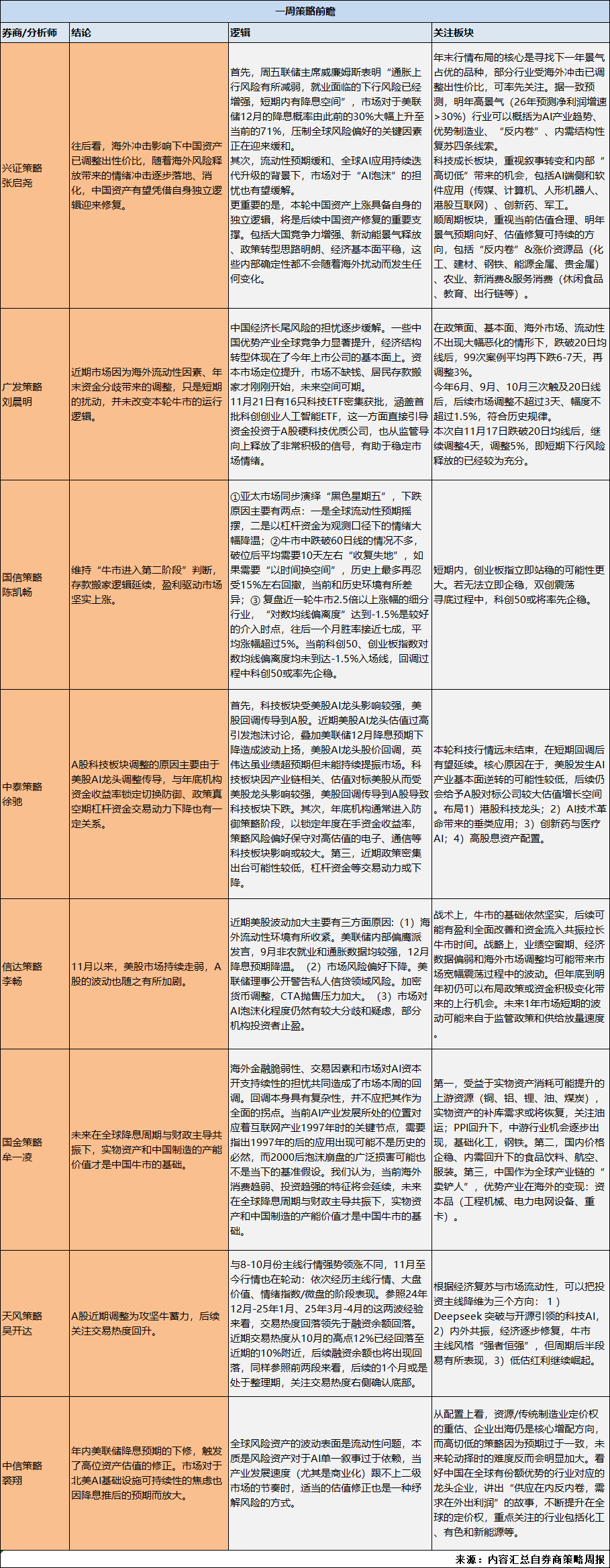
Core Viewpoint - The consensus among brokerage strategy analysts indicates a rebound in the market, as multiple factors that led to last week's stock index adjustments have improved over the weekend [1] Group 1: Market Sentiment and Economic Indicators - The market's perception of the Federal Reserve's potential interest rate cuts has shifted significantly, with the probability of a rate cut in December rising from 30% to 71%, alleviating global risk aversion [1] - The expectation of liquidity improvement and the ongoing iteration of global AI applications are likely to ease concerns regarding an "AI bubble" [2] - The internal logic supporting the rise of Chinese assets remains strong, driven by enhanced national competitiveness, the release of new economic momentum, clear policy transformation, and stable economic fundamentals [2][3] Group 2: Sector Focus and Investment Opportunities - Analysts suggest focusing on sectors that are expected to outperform in the coming year, particularly those benefiting from high growth forecasts, such as AI, advanced manufacturing, and structural recovery in domestic demand [3] - The approval of 16 technology ETFs, including those focused on AI, is expected to guide capital towards high-quality technology companies in the A-share market, providing a positive regulatory signal [2][3] - The technology sector's recent adjustments are attributed to the influence of U.S. AI leaders and year-end institutional fund strategies, but the overall tech market is expected to continue its upward trajectory post-correction [2][4] Group 3: Long-term Market Outlook - The current market adjustments are viewed as short-term disturbances that do not alter the underlying bull market logic, with expectations of continued capital inflow and improved earnings across sectors [3][4] - The potential for a significant reversal in the fundamentals of the AI industry in the U.S. is considered low, which should provide substantial valuation growth opportunities for comparable companies in China [4] - The overall sentiment indicates that the market is not lacking in liquidity, and the concerns regarding long-tail risks in the Chinese economy are gradually easing [3][4]
年末重新增配A股迎来契机?投资主线有哪些?十大券商策略来了
Feng Huang Wang· 2025-11-23 13:21
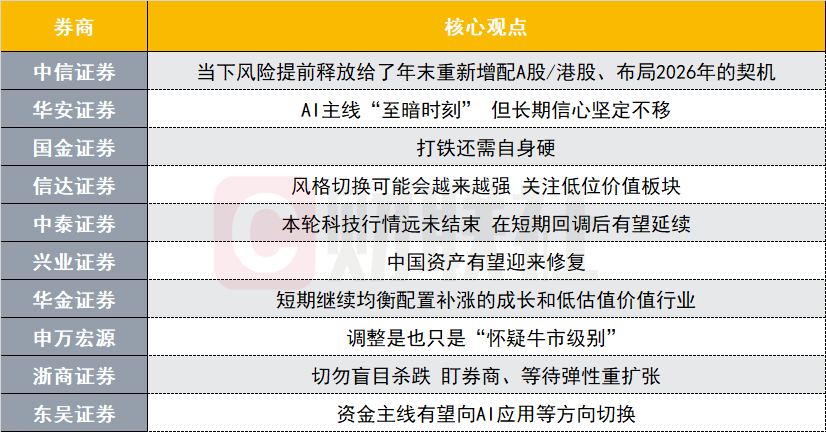
Core Viewpoints - Current risk release provides an opportunity for reallocating A-shares and Hong Kong stocks by year-end and planning for 2026 [2] - The AI sector is experiencing a "darkest hour," but long-term confidence remains unwavering [4] - The adjustment phase is merely a "doubtful bull market level" [11] Industry Insights - Focus on resource and traditional manufacturing opportunities, particularly in chemicals, non-ferrous metals, and new energy [3] - The AI industry is expected to continue its growth trajectory, with significant valuation growth potential for A-share companies [8] - The market is likely to experience a style switch, with increasing attention on low-valued sectors [6] Investment Recommendations - Emphasize sectors benefiting from physical asset consumption, such as upstream resources (copper, aluminum, lithium, oil, coal) and midstream industries [5] - Maintain a balanced allocation between growth sectors and undervalued value industries, particularly in the consumer sector as year-end approaches [10] - Focus on AI applications and sectors closely related to the "14th Five-Year Plan," such as hydrogen energy, nuclear energy, and quantum technology [14]



高频数据 | 周度跟踪
Xin Lang Cai Jing· 2025-11-22 10:10
Price-Related Summary - The Nanhua Agricultural Products Index is at 1,045.84, down 16.48 from last week [3] - Brent crude oil futures settled at $63.38 per barrel, an increase of $0.37 from last week, while WTI crude oil settled at $59.00 per barrel, up $0.31 [3] - Average wholesale prices for vegetables decreased by ¥0.04 per kg, fruits by ¥0.01 per kg, pork by ¥0.15 per kg, beef by ¥0.25 per kg, and lamb by ¥0.40 per kg [3] Industrial-Related Summary - The Nanhua Industrial Products Index is at 3,456.21, down 66.82 from last week [14] - Glass futures closed at ¥987 per ton, down ¥45 per ton, and coking coal futures closed at ¥1,103 per ton, down ¥89 per ton [14] - The blast furnace operating rate is recorded at 82.17%, a decrease of 2.08% from last week, while the operating rate for petroleum asphalt is at 24.80%, down 4.20% [14] Real Estate Investment Summary - The land transaction area in 100 major cities is approximately 13,497,800 square meters, an increase of 7,013,200 square meters from last week [21] - The transaction area of commercial housing in 30 major cities is about 1,725,600 square meters, up 330,500 square meters from last week [21] - The second-hand housing listing price index is recorded at 148.80, down 0.26, with the decline rate less than the previous week [21] Transportation and Retail Summary - Subway passenger volumes increased significantly, with Beijing, Shanghai, Guangzhou, and Shenzhen showing changes of -1.16%, 2.41%, 4.17%, and 1.91% respectively [31] - Box office revenue reached ¥656 million, an increase of ¥444 million from last week [31] - Retail sales of passenger cars totaled 67,312 units, up 21,256 units from last week [31] - The number of domestic flights executed was 86,716, an increase of 822 from last week [31]