
化工品

Search documents
能源化策略日报:乌克兰停?协议短期难以达成,化?供需偏弱?预期较好,期价延续震荡-20251230
Zhong Xin Qi Huo· 2025-12-30 01:56
1. Report Industry Investment Rating The report does not mention the industry investment rating. 2. Core Viewpoints of the Report The chemical industry is in an overall oscillatory pattern. Geopolitical factors such as the Russia - Ukraine conflict and the situation in Venezuela continue to disturb the crude oil market. Although China's crude oil imports are at a record high and there are expectations of improved demand, the supply - surplus pattern in the crude oil market still exerts downward pressure. Most chemical products are in a state of oscillation due to factors like high inventory of liquid chemicals and the weak - reality and strong - expectation situation in some regions [2]. 3. Summary According to Relevant Catalogs 3.1 Market Outlook - The chemical industry as a whole is oscillating. The inventory of most liquid chemicals increased on Monday, especially pure benzene. The 05 main contract is far from the delivery time, and the weak spot supply - demand situation has limited immediate negative impact on the futures price. High crude oil imports in China and good refined oil profits may lead to high refinery operation before and after the Spring Festival, which is a concern for the chemical industry [2]. 3.2 Variety Analysis 3.2.1 Crude Oil - **Viewpoint**: Geopolitical factors in Russia - Ukraine and Venezuela continue to disturb, and oil prices continue to oscillate. - **Main Logic**: The postponed EIA data shows inventory accumulation in US crude oil and refined products. Although the global crude oil inventory pressure has weakened in the past two weeks, the subsequent inventory accumulation expectation is still strong. Geopolitical factors are the core of supply expectations, but there is a lack of marginal drivers for both long and short positions. - **Outlook**: There is still significant downward pressure in the next quarter under the supply - surplus situation, but short - term geopolitical disturbances make the decline unsmooth, so it is regarded as oscillatory [6]. 3.2.2 Asphalt - **Viewpoint**: Asphalt futures prices rise following crude oil. - **Main Logic**: OPEC + increased production in December, and the expectation of raw material supply interruption drives the rise. However, the supply - demand is weak, inventory is accumulating, and the high - valuation is being adjusted. - **Outlook**: The absolute price of asphalt is over - estimated [8]. 3.2.3 High - Sulfur Fuel Oil - **Viewpoint**: High - sulfur fuel oil futures prices decline following crude oil. - **Main Logic**: Although there are expectations of heavy - oil shortage, the demand outlook is suppressed by high - floating storage in the Asia - Pacific and the substitution of fuel - oil power generation by other energy sources. In addition, the refinery processing demand is weak in the off - season. - **Outlook**: Supply - demand is weak [8]. 3.2.4 Low - Sulfur Fuel Oil - **Viewpoint**: Low - sulfur fuel oil oscillates weakly. - **Main Logic**: It is affected by factors such as the decline in shipping demand, green - energy substitution, and high - sulfur substitution. It has a supply - increase and demand - decline trend, but the current valuation is low and it follows the movement of crude oil. - **Outlook**: It follows the fluctuation of crude oil [10]. 3.2.5 PX - **Viewpoint**: The monthly spread weakens ahead of the price, and the short - term price adjusts downward. - **Main Logic**: International oil prices are consolidating, and some long - position funds take profits before the holiday. There are also expectations of increased supply due to the expansion of PX production benefits. - **Outlook**: The short - term price is expected to adjust downward. Pay attention to the support around 7000 - 7100 [11]. 3.2.6 PTA - **Viewpoint**: It follows the cost to adjust downward in the short term. - **Main Logic**: The upstream PX adjusts downward, and although the supply - demand pattern changes little, the supply pressure will gradually return with the restart of some devices. - **Outlook**: The price follows the cost to adjust and oscillate, and the processing fee runs within a range [11]. 3.2.7 Pure Benzene - **Viewpoint**: The weak reality still suppresses, and the market oscillates. - **Main Logic**: The spot price is slightly supported by downstream export orders and high overseas prices, but the high inventory and weak demand limit the price increase. The far - month contract has the expectation of supply - demand improvement. - **Outlook**: The inventory - accumulation pressure is being realized, and the trading is mainly based on reality [14]. 3.2.8 Styrene - **Viewpoint**: Short - term sentiment dominates the market, and attention is paid to the sustainability of export transactions. - **Main Logic**: The cost support is weak, but there are positive factors such as export expectations and the impact of device maintenance. However, there is a possibility of negative feedback from downstream devices. - **Outlook**: It is about to turn to inventory accumulation, and the export transactions stimulate the rebound periodically [16]. 3.2.9 Ethylene Glycol - **Viewpoint**: The reduction in polyester production is gradually realized, and the driving force is general. - **Main Logic**: The price is in a narrow - range consolidation, with continuous inventory accumulation and slow reduction in domestic supply. Overseas imports are expected to decrease in February, and domestic supply will be alleviated in March. - **Outlook**: The short - term price is in a range, and the long - term inventory - accumulation pressure limits the rebound height [18]. 3.2.10 Short - Fiber - **Viewpoint**: The adjustment range is limited, and the processing fee stops falling in the short term. - **Main Logic**: The upstream cost adjusts downward, but the adjustment range of short - fiber is limited. Due to the off - season, the sales are average. - **Outlook**: The price follows the upstream to adjust, and the processing fee stops falling in the short term [20]. 3.2.11 Polyester Bottle Chips - **Viewpoint**: It follows the upstream cost to adjust downward. - **Main Logic**: The upstream raw material futures decline, and the price of bottle chips follows. The trading atmosphere is weak, and the fundamentals are slightly weak. - **Outlook**: The absolute value follows the raw material, and the processing fee is under some pressure [21]. 3.2.12 Methanol - **Viewpoint**: The weak reality in coastal areas contrasts with the strong expectation, and inland areas offer discounts before the festival. Methanol is generally regarded as oscillatory. - **Main Logic**: There is a significant difference between coastal and inland areas. Inland prices decline due to pre - holiday sales pressure, while coastal areas have the expectation of reduced imports. - **Outlook**: The trading logic in coastal areas dominates in the short term, and it is regarded as oscillatory [23]. 3.2.13 Urea - **Viewpoint**: There is no new positive news, and urea is weakly consolidating. - **Main Logic**: The daily production is high, and there is no new positive news in demand, especially in exports. The market is in a stalemate. - **Outlook**: There is supply pressure in the long term and no new positive news in demand. It may decline slightly [24]. 3.2.14 LLDPE - **Viewpoint**: Both long and short positions are cautious before the festival, and LLDPE is regarded as oscillatory. - **Main Logic**: The oil price oscillates, and LLDPE's own fundamentals have some support, but the demand is in the off - season. - **Outlook**: It oscillates in the short term [25]. 3.2.15 PP - **Viewpoint**: The basis support is limited, and PP is regarded as oscillatory. - **Main Logic**: PDH profits are under pressure, the oil price oscillates, and the demand is in the off - season with high inventory pressure. - **Outlook**: It oscillates in the short term [26]. 3.2.16 PL - **Viewpoint**: Supported by the expectation of PDH maintenance, PL oscillates. - **Main Logic**: The expectation of PDH maintenance has a boosting effect, but the downstream demand is in the off - season. - **Outlook**: It oscillates in the short term [27]. 3.2.17 PVC - **Viewpoint**: The market sentiment weakens, and PVC declines. - **Main Logic**: Macro - level factors have a certain impact, and although the supply - demand expectation improves, the high - inventory pressure still exists. - **Outlook**: The market sentiment fades, and PVC may oscillate [28]. 3.2.18 Caustic Soda - **Viewpoint**: With low valuation and weak expectation, caustic soda is in an oscillatory state. - **Main Logic**: Macro - level factors affect the market, and the supply - demand is still in a state of oversupply. - **Outlook**: The market sentiment affects the market, and it may oscillate due to low valuation [30]. 3.3 Variety Data Monitoring 3.3.1 Energy - Chemical Daily Indicator Monitoring - **Inter - period Spread**: Different varieties have different inter - period spread values and changes, such as Brent's M1 - M2 spread being 0.42 with a change of 0.02, and PX's 1 - 5 month spread being - 66 with a change of - 24 [32]. - **Basis and Warehouse Receipts**: Different varieties have different basis and warehouse - receipt data, such as asphalt's basis being - 88 with a change of - 13 and a warehouse receipt of 20840 [33]. - **Inter - variety Spread**: Different varieties have different inter - variety spread values and changes, such as 1 - month PP - 3MA being - 233 with a change of - 21 [35]. 3.3.2 Chemical Basis and Spread Monitoring The report only mentions the names of various varieties for basis and spread monitoring but does not provide specific data and analysis. 3.4 Commodity Index - **Comprehensive Index**: The comprehensive index of commodities is 2339.89, down 0.59%; the 20 - commodity index is 2687.93, down 0.42%; the industrial - product index is 2258.87, down 0.70% [279]. - **Energy Index**: The energy index on December 29, 2025, is 1088.67, with a daily decline of 1.40%, a 5 - day decline of 0.99%, a 1 - month decline of 4.21%, and a year - to - date decline of 11.34% [281].
光大期货1229热点追踪: PX冲高回落,关注下游负反馈情况
Xin Lang Cai Jing· 2025-12-29 07:33
Core Viewpoint - PX prices have experienced a significant pullback after a week of continuous increase, with a maximum daily decline exceeding 3%, leading the decline among chemical products [3][7]. Price Movement - The recent price drop is attributed to a decline in crude oil prices, despite ongoing geopolitical issues that have not escalated further [3][7]. - The market is reacting to the reality of oversupply in crude oil and rising inventories, which has lowered the cost line for chemical products, impacting previously high PX and PTA prices [3][7]. Fundamental Analysis - As of December 26, China's PX operating load is at 88.2%, an increase of 0.1 percentage points from the previous period [3][7]. - The total PX imports to mainland China in November 2025 are approximately 817,000 tons, reflecting a 1% decrease month-on-month and a 16.3% decrease year-on-year [3][7]. - Weekly PX prices have continued to rise, with PXN significantly expanding, and an increase in the restart of domestic and international facilities [3][7]. Industry Dynamics - The downstream TA processing fees have also recovered, with increased facility changes; however, the terminal market is under significant pressure [3][7]. - There is a growing contradiction between the unilateral price increase of upstream raw materials and the cost transmission issues faced by downstream yarn and fabric manufacturers due to weak orders [3][7]. - The compression of profits in the polyester segment is becoming evident, with potential further declines in polyester operating loads due to production cut plans from the three major polyester manufacturers [3][7]. Market Sentiment - The ongoing battle between current realities and future expectations remains a focal point for market participants, with caution advised regarding the potential for PX prices to retreat after reaching highs [3][7].


国投期货综合晨报-20251226
Guo Tou Qi Huo· 2025-12-26 06:03
Oil - The external market was closed due to the Christmas holiday, while domestic oil prices fluctuated. Russian Black Sea port attacks and adverse weather have slowed repair progress, leading to a 14-month low in Kazakhstan's December CPC mixed oil exports. Despite a decline in drilling and fracturing activities in the US shale oil industry, US crude oil production remains high due to production adjustments lagging behind. Geopolitical tensions between the US and Venezuela have raised concerns about oil supply disruptions, but the overall market fundamentals remain loose, suggesting a shift in market focus from geopolitical issues to a long-term supply-demand balance that may lead to a downward adjustment in price levels [1]. Precious Metals - The external market was closed for Christmas, while domestic gold and silver continued a strong trend. The adjustment of minimum opening quantities and trading limits by the Guangqi Exchange has occurred. The prospect of Federal Reserve easing and geopolitical risks have supported the strength of precious metals, with various types reaching new highs, leading to increased market volatility and the need for position control [2]. Copper - The Shanghai copper night market opened high, briefly rising to 98,000. Domestic spot divergence signals have strengthened, with Shanghai and Guangdong discounts expanding to 330 and 185 yuan respectively. SMM social warehouse increased by 25,200 tons to 193,600 tons. Short-term domestic supply and demand pressures may lead to greater adjustment pressure on copper prices, but tight raw material supply may transmit to domestic refined copper, benefiting exports. It is recommended to take profits on previous long positions or adjust the holding position to 95,000 [3]. Aluminum - The Shanghai aluminum market showed a strong fluctuation. The fundamental contradictions in the aluminum market are limited, with social warehouses fluctuating narrowly and apparent demand year-on-year being weak, leading to an expansion of spot discounts. The macro sentiment continues to drive precious metals and various non-ferrous metals to new highs, with Shanghai aluminum primarily following the upward trend and testing previous high resistance levels [4]. Alumina - Alumina production capacity is at a historical high, with a persistent oversupply situation and rising industry inventories. The average complete cost in Shanxi and Henan is 2,850-2,900 yuan, while the spot index has dropped to around 2,700 yuan, indicating profitability at cash cost calculations. A Guinea mining company has lowered its first-quarter long-term contract price by $5, suggesting potential for cost reduction in alumina. The weak trend in alumina is expected to continue before any significant production cuts, with a larger basis for spot price declines [5]. Zinc - Shanghai zinc operates independently with narrow fluctuations, supported by a strong bottom. The domestic consumption outlook for January is not pessimistic, and the price range is expected to rise from December, projected between 22,800-23,800 yuan/ton [7]. Lead - The market remains at a low level, with domestic aluminum social inventories below 20,000 tons and trading activity being average. The import window remains open, with overseas pressure continuing to transmit to the domestic market. Shanghai aluminum is still in a cost and consumption tug-of-war, with a price range expected between 17,000-17,500 yuan/ton [8]. Nickel - The Shanghai nickel market has seen a pullback, with active trading and significant stop-losses leading to market consolidation. Recent news from the Indonesian nickel ore conference has sparked market interest, with a significant reduction in nickel ore quotas for 2026. Current spot prices for high nickel iron are at 888 yuan per nickel point, with upstream price rebounds weakening support, leading to a cautious short-term outlook [9]. Lithium Carbonate - Lithium carbonate opened low and rose, with active market trading. Battery-grade lithium carbonate prices exceeded 110,000 yuan, with a price difference of 2,650. Despite high prices, market confidence in maintaining these levels is low, leading to limited trading enthusiasm. Total market inventory decreased by 1,000 tons to 110,400 tons, with downstream inventory also declining. The latest Australian mining price is $1,385, maintaining strong pricing. The overall market fundamentals for lithium carbonate remain strong, with short positions under pressure [11]. Polysilicon - Polysilicon futures surged above 60,000 yuan/ton. Expectations for tighter industry production quotas in 2026 and collective production cut plans from some companies have strengthened market sentiment. Current mainstream transaction prices are stable between 51,000-53,000 yuan/ton, primarily driven by replenishment demand. Recent increases in silver prices have pushed up non-silicon costs for battery cells, with pressures transmitted upward. The market is advised to monitor the effectiveness of breaking through the 60,000 yuan/ton level [12]. Steel - Steel prices continued to decline, with a slight drop in rebar demand and a small increase in production. Hot-rolled demand is recovering, with inventory reduction accelerating. Iron water production continues to decline, gradually alleviating supply pressure, while steel mill profits are marginally improving. The overall market sentiment remains cautious, with limited rebound momentum expected [13][14]. Iron Ore - Iron ore prices fluctuated overnight, with strong global shipments expected as year-end mine output increases. Domestic port arrivals are also strong, leading to significant inventory accumulation. Demand remains low in the off-season, but previous reductions in iron water production have stabilized prices. The overall fundamentals for iron ore are loose, with short-term price movements expected to remain volatile [14]. Urea - Urea production companies are significantly reducing inventory, leading to improved market sentiment and transactions. Daily production continues to decline due to environmental restrictions, with slight adjustments in industrial downstream demand. The short-term market for urea is expected to strengthen [22]. Methanol - Methanol prices slightly declined overnight due to recovering import unloading speeds and weakening inland demand, leading to significant port inventory accumulation. The overall market is expected to remain weak in the short term, with potential upward drivers in the medium to long term [23]. PX & PTA - PX prices continue to rise, with PTA following suit. Short-term PX supply is expected to increase due to plant restarts, while downstream demand may decline around the Spring Festival. Overall, the strong expectations for PX remain, with limited upward space in the short term [28].
芳烃日报:产业链边际虽有改善,但淡季存需求疲软预期-20251225
Guan Tong Qi Huo· 2025-12-25 11:45
Report Industry Investment Rating - Not provided Core Viewpoints - The marginal improvement in the aromatics industry chain is observed, but there are expectations of weak demand during the off - season [1] Summary by Relevant Catalogs Fundamental Analysis Pure Benzene - Production profits: Caprolactam -350 yuan/ton (-40), phenol - acetone -927 yuan/ton (+0), aniline 789 yuan/ton (+178), adipic acid -1018 yuan/ton (-11) [1] - Operating rates: Caprolactam 69.20% (-5.37%), phenol 76.00% (-3.50%), aniline 61.35% (-14.59%), adipic acid 59.60% (+0.40%) [1] - Due to tariff issues, South Korea's exports of pure benzene to China increased, with concentrated arrivals of imports, leading to significant port inventory pressure. However, subsequent inventory accumulation will gradually slow down, and currently, there is a pattern of strong supply and weak demand [1] Styrene - From December 12th to 18th, China's total styrene factory output was 34.68 tons, a 2.38% increase from the previous period, and the factory capacity utilization rate was 69.13%, a 1.02% increase month - on - month [2] - The consumption of EPS, PS, and ABS downstream of styrene was 26.18 tons, a 3.89% decrease month - on - month [2] - Styrene factory inventory was 17.10 tons, a 4.23% decrease from the previous week. As of December 22nd, the inventory in East China's ports was 13.93 tons, a 3.41% increase from the previous week, and the inventory in South China's ports was 1.1 tons, a 26.67% decrease from the previous week [2] - As of December 17th, the non - integrated profit of styrene was -203 yuan/ton, and the integrated profit was 421.08 yuan/ton [2] - There were many styrene overhauls in the fourth quarter, and port inventory was depleted. However, according to industry past rules, there is a high possibility of seasonal inventory accumulation from January to March [2] Macroeconomic Analysis - The National Development and Reform Commission and the Ministry of Commerce issued the "Catalogue of Industries Encouraging Foreign Investment (2025 Edition)", guiding foreign investment in advanced manufacturing and modern services, which will come into effect on February 1st, 2026 [3] - In November, the country's total electricity consumption was 835.6 billion kWh, a year - on - year increase of 6.2% [3] Futures and Spot Market Analysis Pure Benzene - Pure benzene continued its overall volatile trend during the day, with significant upward pressure. Due to inventory pressure from concentrated imports, it still showed a pattern of strong supply and weak demand. It should be treated with a volatile mindset, and attention should be paid to the support near the previous low [4] Styrene - Styrene continued its rebound trend, closing up 1.67%. It initially broke through the 60 - day moving average on the daily line, but considering the seasonal inventory accumulation period in the first quarter of next year, the upward space is currently limited. Continue to observe the pressure of the 20 - day moving average on the weekly line, and the industry can pay attention to hedging opportunities [4]
关注上游价格分化,中游开工淡季
Hua Tai Qi Huo· 2025-12-25 01:51
Report Summary Industry Investment Rating No industry investment rating information is provided in the report. Core Viewpoint The report focuses on the differentiation of upstream prices and the off - season of mid - stream operations, presenting the latest developments in the production and service industries, as well as the trends in upstream, mid - stream, and downstream sectors [1][3][4][5]. Summary by Section 1. Middle - view Event Overview - **Production Industry**: The Ministry of Transport plans to launch a special action to improve and upgrade highway service areas next year, with the primary task of enhancing charging service capabilities and promoting the construction and renovation of charging facilities [1]. - **Service Industry**: Beijing relaxes non - Beijing household purchase conditions and supports multi - child family housing needs; the central bank conducts 400 billion yuan of MLF operations, with a net injection of 100 billion yuan this month, and has increased MLF operations for 10 consecutive months [2]. 2. Industry Overview - **Upstream**: International crude oil prices have recently declined, and liquefied natural gas prices continue to fall; PTA prices have risen significantly, while polyethylene prices have slightly declined [3]. - **Mid - stream**: Chemical product operating rates remain low, power plant coal consumption has increased, and asphalt operating rates for infrastructure have declined [4]. - **Downstream**: The sales of commercial housing in first, second, and third - tier cities continue to pick up, while the number of domestic flights has decreased [5]. 3. Key Industry Price Indicators - **Agriculture**: On December 24, the spot price of corn was 2,241.4 yuan/ton (- 0.19% year - on - year), eggs were 6.3 yuan/kg (- 4.26% year - on - year), palm oil was 8,520 yuan/ton (0.71% year - on - year), cotton was 15,217.5 yuan/ton (0.50% year - on - year), and pork was 17.4 yuan/kg (- 0.91% year - on - year) [39]. - **Non - ferrous Metals**: On December 24, the spot price of copper was 94,853.3 yuan/ton (2.88% year - on - year), zinc was 23,250 yuan/ton (1.14% year - on - year), aluminum was 21,883.3 yuan/ton (0.57% year - on - year), nickel was 130,800 yuan/ton (11.92% year - on - year), and the second - listed aluminum was 17,118.8 yuan/ton (1.86% year - on - year), and rebar was 3,229.3 yuan/ton (0.81% year - on - year) [39]. - **Ferrous Metals**: On December 24, the spot price of iron ore was 810.6 yuan/ton (1.08% year - on - year), wire rod was 3,475 yuan/ton (1.83% year - on - year), and glass was 13.3 yuan/square meter (- 0.75% year - on - year) [39]. - **Non - metals**: On December 24, the spot price of natural rubber was 14,983.3 yuan/ton (- 0.77% year - on - year), the China Plastic City price index was 756 (- 0.07% year - on - year) [39]. - **Energy**: On December 24, the spot price of WTI crude oil was 58.4 US dollars/barrel (5.90% year - on - year), Brent crude oil was 62.4 US dollars/barrel (5.87% year - on - year), liquefied natural gas was 3,424 yuan/ton (- 5.47% year - on - year), coal was 802 yuan/ton (- 0.37% year - on - year) [39]. - **Chemical Industry**: On December 24, the spot price of PTA was 4,970.5 yuan/ton (7.44% year - on - year), polyethylene was 6,430 yuan/ton (- 2.82% year - on - year), urea was 1,755 yuan/ton (2.33% year - on - year), and soda ash was 1,225.7 yuan/ton (0.23% year - on - year) [39]. - **Real Estate**: On December 11, the building materials composite index was 115.1 points (- 0.68% year - on - year), and the national concrete price index was 90.4 points (- 0.06% year - on - year) [39].
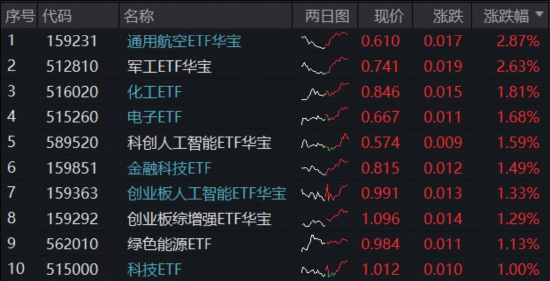
沪指六连阳,主力狂买两大赛道!商业航天领涨两市,军工ETF(512810)阶段新高,涨价潮引爆
Xin Lang Ji Jin· 2025-12-24 11:42
Group 1: Market Overview - The market is experiencing heightened activity, particularly in the commercial aerospace and semiconductor sectors, with significant capital inflows [1][2] - As of the market close, the electronic and defense industries saw net inflows of 223.63 billion and 159.59 billion yuan, respectively, leading the industry rankings [1][3] - The overall market indices showed a collective increase, with the Shanghai Composite Index closing at 3940 points after six consecutive days of gains [4] Group 2: Sector Performance - The General Aviation ETF (159231) and Military Industry ETF (512810) both rose over 2.6%, reflecting strong investor interest [1] - The Chemical ETF (516020) saw a nearly 2% increase, driven by rising prices of MDI and lithium carbonate, indicating a robust performance in the chemical sector [2][11] - The Military Industry ETF experienced a significant surge, with main funds net buying nearly 160 billion yuan, marking it as a leading sector in the market [5][9] Group 3: Commercial Aerospace Insights - China's commercial aerospace sector is projected to undergo a transformation with scalable commercial value, aiming for 100 launches per year by 2030 at a cost of approximately 100 million yuan per launch, potentially reaching an annual output value of 85 billion yuan [1][7] - The commercial aerospace market in China is expected to grow from approximately 0.38 trillion yuan in 2015 to between 7 trillion and 10 trillion yuan by 2030, with a compound annual growth rate of about 22% [7] Group 4: Semiconductor Sector Developments - The semiconductor sector is highlighted by the anticipated delivery of H200 chips by Nvidia to Chinese customers before the Spring Festival, which is expected to stimulate demand [1][16] - The semiconductor industry is experiencing a price increase cycle, driven by dual demand from smartphones and servers, with significant upgrades expected in storage capacities [17][20] Group 5: Investment Opportunities - The Military Industry ETF (512810) is noted for its exposure to 24 commercial aerospace concept stocks, making it an efficient tool for investors looking to capitalize on military and aerospace opportunities [7] - The Chemical ETF (516020) is recommended for its potential to benefit from a recovery in the chemical sector, with a focus on high-quality stocks in the industry [15][14] - The Electronic ETF (515260) is positioned to benefit from trends in AI and semiconductor demand, making it a strategic investment choice [20][19]
供应压力持续,盘面偏弱震荡
Hua Tai Qi Huo· 2025-12-24 05:26
1. Report's Industry Investment Rating - Not provided in the given content 2. Core Viewpoints of the Report - The propylene market faces continuous supply pressure and weakens in a volatile manner. The overall propylene production remains high, and the supply pressure persists. Although the overall downstream operation has slightly increased, the cost pressure restricts the demand recovery, and the demand support is limited. Recently, the cost - end support has strengthened, and attention should be paid to the shutdown of PDH plants in the future [2] 3. Summary According to the Directory 3.1 Market News and Key Data - **Propylene**: The closing price of the propylene main contract is 5,632 yuan/ton (-15), the spot price in East China is 5,850 yuan/ton (-75), the spot price in North China is 5,810 yuan/ton (-80), the basis in East China is 218 yuan/ton (-60), the basis in North China is -114 yuan/ton (-118), the operating rate is 74% (+0%), the difference between China's propylene CFR and Japan's naphtha CFR is 202 US dollars/ton (-9), the difference between propylene CFR and 1.2 propane CFR is 50 US dollars/ton (-4), the import profit is -320 yuan/ton (+4), and the in - plant inventory is 46,560 tons (+600) [1] - **Propylene Downstream**: The operating rate of PP powder is 37% (-2.62%), and the production profit is -80 yuan/ton (+80); the operating rate of propylene oxide is 76% (+0%), and the production profit is -276 yuan/ton (-30); the operating rate of n - butanol is 78% (+9%), and the production profit is 336 yuan/ton (+100); the operating rate of octanol is 82% (+5%), and the production profit is 545 yuan/ton (+58); the operating rate of acrylic acid is 79% (+0%), and the production profit is 372 yuan/ton (+28); the operating rate of acrylonitrile is 81% (+0%), and the production profit is -466 yuan/ton (+91); the operating rate of phenol - acetone is 76% (-4%), and the production profit is -902 yuan/ton (+25) [1] 3.2 Market Analysis - **Supply Side**: The overall propylene production remains at a high level. The short - term loss and maintenance of PDH are not obvious, and some integrated enterprises stop PP production and release propylene. The commercial sales volume of propylene may continue to increase, and the supply pressure persists [2] - **Demand Side**: The overall downstream operation has slightly increased. Among them, the operating rate of butanol - octanol has increased the most due to the restart of maintenance plants, while the operating rate of phenol - acetone has decreased significantly. Due to serious profit inversion, the main PP powder plants have reduced production or stopped production, and the operating rate of the main downstream PP powder has continued to decline. The operating rate of propylene oxide remains stable. In the future, the cost pressure on the downstream will still restrict the demand recovery, and the demand support for propylene is limited [2] - **Cost Side**: The international oil price has rebounded recently, and the price of propane in the overseas market has also increased. Recently, the cost - end support has strengthened, and attention should be paid to the shutdown of PDH plants [2] 3.3 Strategy - **Unilateral**: Adopt a wait - and - see attitude. As the supply and demand remain loose and the downstream support weakens, the market will mainly fluctuate weakly in the short term. Wait for marginal plant maintenance [3] - **Inter - period**: No strategy provided - **Inter - variety**: No strategy provided
综合晨报-20251224
Guo Tou Qi Huo· 2025-12-24 02:43
Report Industry Investment Ratings No relevant content provided. Core Views of the Report - Geopolitical tensions around Venezuela and Ukraine have caused a pulse - like "risk premium" in the oil market, but the substantial global supply tightening due to Venezuela's supply disruption is expected to be limited. Geopolitical premiums tend to provide short - term rebound momentum for oil prices [1]. - The strong GDP data in the US third - quarter initially caused a decline in precious metals, but geopolitical risks have strengthened the upward trend of precious metals, and attention should be paid to capital movements [2]. - Most commodities are in a state of complex supply - demand and market sentiment, with many showing range - bound oscillations. Some commodities are affected by geopolitical factors, while others are influenced by seasonal demand, cost changes, and policy expectations. Summaries by Commodity Categories Energy - **Crude Oil**: Geopolitical tensions drive price rebounds, but supply tightening is limited. US shale oil production remains high despite reduced drilling and fracturing activities [1]. - **Fuel Oil & Low - Sulfur Fuel Oil**: Fuel oil demand lacks upward drivers, and the trading focus is on supply disruptions. High - sulfur fuel oil is supported by geopolitical factors in the short - term but faces a supply - surplus situation in the medium - term. Low - sulfur fuel oil is expected to be weak due to refinery device changes [19]. - **Asphalt**: Weekly shipments are at a low level, and inventories are accumulating. Geopolitical factors may provide short - term cost - side support, but the price will eventually be pressured by supply - demand looseness [20]. Metals - **Precious Metals**: Gold has reached a new high, and geopolitical risks have strengthened the upward trend of precious metals. Attention should be paid to capital movements during the Christmas holiday [2]. - **Base Metals** - **Copper**: The price has reached a new high. In the first quarter of next year, the market is pricing in the tight supply at the mine end in advance. There may be short - term adjustments, but the long - position demand for the first - quarter contract remains strong [3]. - **Aluminum**: The fundamentals are not prominent, and it mainly follows the upward trend of other metals. Long - positions can be held with the 40 - day moving average as support [4]. - **Cast Aluminum Alloy**: It has difficulty following the upward trend at high levels, and the price difference with Shanghai aluminum remains around 1,000 yuan [5]. - **Alumina**: The production capacity is at a historical high, the supply - surplus pattern is hard to change, and the inventory is rising [6]. - **Zinc**: The price is in a rebound trend, and it is expected to oscillate between 22,800 - 23,800 yuan/ton [7]. - **Lead**: The price is expected to oscillate between 16,700 - 17,300 yuan/ton, and inventory pressure needs to be monitored [8]. - **Tin**: The price has declined. The supply is expected to turn around in the first quarter of 2026, and high prices are suppressing consumption. Attention should be paid to the risk at high levels [9]. - **Industrial Silicon**: The price is oscillating strongly due to the expected production cuts at the end of the month, but the demand is under pressure, and the upward space is limited [10]. - **Ferroalloys** - **Manganese Silicon**: The price is oscillating. Manganese ore prices have increased slightly, and it is recommended to buy on dips [16]. - **Silicon Iron**: The price is rising. Supply has decreased significantly, and demand remains resilient. It is recommended to buy on dips [17]. Building Materials - **Steel Products** - **Rebar & Hot - Rolled Coil**: The price has declined at night. Rebar demand has recovered slightly, and inventory is decreasing. Hot - rolled coil supply and demand are both decreasing, and inventory reduction is accelerating. The overall market is in range - bound oscillations [12]. - **Iron Ore**: The price has declined. Supply is expected to be strong, and demand is weak. The market is expected to oscillate in the short - term [13]. - **Coke**: The price is oscillating strongly. The third - round price cut has been implemented, and the price is likely to oscillate [14]. - **Coking Coal**: The price is oscillating widely. Production has decreased slightly, and the price is likely to oscillate after repairing the discount [15]. - **Glass**: The price is oscillating. Inventory is increasing, and demand is insufficient. It is recommended to wait and see in the short - term [30]. Chemicals - **Polyolefins** - **Polypropylene & Plastic & Propylene**: The supply is relatively abundant, and demand is weak. The market is cautious, and the supply - demand contradiction is difficult to improve in the short - term [25]. - **PVC & Caustic Soda**: PVC is oscillating strongly, with supply pressure easing and demand remaining low. Caustic soda is also oscillating strongly, with high supply pressure and limited demand growth [26]. - **Aromatics** - **Pure Benzene**: The price is oscillating weakly. Supply and demand pressure may ease, and it is recommended to consider long - short spreads in the medium - term [23]. - **Styrene**: Supply and demand are expected to increase, but supply may increase more than demand. The support from pure benzene is limited [24]. - **Others** - **PX & PTA**: PX prices have risen due to supply reduction expectations. PTA supply may increase, and downstream demand is expected to decline [27]. - **Ethylene Glycol**: The price has declined significantly. Supply is expected to increase in the long - term, and the price is under pressure [28]. - **Short - Fiber & Bottle Chip**: Raw material prices are squeezing profits. Short - fiber supply - demand is relatively good in the long - term, and bottle - chip has over - capacity problems [29]. - **Urea**: The market is affected by export quota rumors, and the supply - surplus pattern continues. The price is oscillating in a range [21]. - **Methanol**: The short - term price may oscillate weakly, and there is an upward driver in the long - term. Attention should be paid to the 5 - 9 spread [22]. Agricultural Products - **Oilseeds and Oils** - **Soybean & Soybean Meal**: The开机率 of domestic oil mills has increased, and soybean meal inventory is expected to rise. The trading logic focuses on US soybean exports and South American weather [33]. - **Soybean Oil & Palm Oil**: Palm oil is rebounding, and soybean oil has declined after rising. Attention should be paid to fundamental changes [34]. - **Rapeseed Meal & Rapeseed Oil**: The domestic oil mill is not operating, and imports have been announced. The price is expected to oscillate in the short - term [35]. - **Soybean No. 1**: The price is stable and strong due to the premium in the auction [36]. - **Grains** - **Corn**: The price is slowly declining. Supply - demand mismatch has eased, and the futures price is expected to oscillate weakly [37]. - **Egg**: The futures market shows a near - weak and far - strong pattern. It is recommended to consider the 2 - 4 or 2 - 5 spread strategy [39]. - **Cotton**: The price is rising. US cotton sales data is good, and domestic cotton inventory is relatively low. It is recommended to buy on dips [40]. - **Sugar**: International supply is sufficient, and domestic production progress and expectations vary by region. Attention should be paid to subsequent production [41]. - **Apple**: The price is oscillating. Demand is in the off - season, and the market is bearish [42]. - **Timber**: The price is at a low level. Supply is decreasing, demand in the off - season is okay, and inventory is low. It is recommended to wait and see [43]. - **Pulp**: The price is oscillating. Port inventory is decreasing, and the price is supported. It is recommended to wait and see or trade short - term [44]. Financial Products - **Stock Index**: A - share indexes rose, and the risk appetite of equity assets has been supported. Attention should be paid to the rotation and repair opportunities of low - level sectors [45]. - **Treasury Bond**: Treasury futures rose. The long - term interest rate has risen significantly, and the yield curve is likely to steepen [46]. Shipping - **Container Freight Index (European Line)**: The spot market is in a game between strong expectations and weak reality. Near - month contracts are expected to oscillate around the spot price [18].
大越期货PTA、MEG早报-20251224
Da Yue Qi Huo· 2025-12-24 01:31
CONTENTS 目 录 交易咨询业务资格:证监许可【2012】1091号 PTA&MEG早报-2025年12月24日 大越期货投资咨询部 金泽彬 投资咨询资格证号:Z0015557 联系方式:0575-85226759 重要提示:本报告非期货交易咨询业务项下服务,其中的观点和信息仅作参考之用,不构成对任何人的投资建议。 我司不会因为关注、收到或阅读本报告内容而视相关人员为客户;市场有风险,投资需谨慎。 1 前日回顾 2 每日提示 3 4 今日关注 基本面数据 5 1、基本面:昨日PTA期货震荡收涨,现货市场商谈氛围一般,现货基差走弱,贸易商商谈为主,少量聚酯工厂递盘。12月货在 主流在01贴水17成交,个别在01贴水18,价格商谈区间在4905~5000。1月货下主流在05贴水75成交,个别在05贴水73成交。今 日主流现货基差在01-17。中性 5、主力持仓:净多 多增 偏多 6、预期:近期PTA装置变动较少,供需格局预期尚可,期货盘面则跟随成本端大幅上行,预计短期内PTA现货价格跟随成本端震 荡运行,现货基差区间波动。关注油价走势及下游负荷。 2、基差:现货4955,05合约基差-127,盘面升水 中性 ...
化工日报:EG主港延续累库,供应回升下仍承压-20251223
Hua Tai Qi Huo· 2025-12-23 03:05
化工日报 | 2025-12-23 单边:中性。当前EG价格筑底阶段,但投产压力较大,随着港口库存的回升,场内货源流动性增加,1~2月累库 压力仍偏大,需要进一步减产平衡 跨期:无 跨品种:无 风险 EG主港延续累库,供应回升下仍承压 核心观点 市场分析 期现货方面:昨日EG主力合约收盘价3735元/吨(较前一交易日变动-3元/吨,幅度-0.08%),EG华东市场现货价3615 元/吨(较前一交易日变动-10元/吨,幅度-0.28%),EG华东现货基差-4元/吨(环比+12元/吨)。 生产利润方面:据隆众数据,乙烯制EG生产毛利为-98美元/吨(环比-6美元/吨),煤基合成气制EG生产毛利为-987 元/吨(环比-8元/吨)。 库存方面:根据 CCF 每周一发布的数据,MEG 华东主港库存为84.4万吨(环比+2.5万吨);根据隆众每周四发布 的数据, MEG 华东主港库存为61.7万吨(环比-13.8万吨)。据CCF数据,上周华东主港计划到港总数11.1万吨, 副港到港量3万吨;本周华东主港计划到港总数11.8万吨,副港到港量2.7万吨,整体中性略偏高,预计主港将平衡 略累。 整体基本面供需逻辑:供应端,随 ...