
有色

Search documents
全品种价差日报-20250530
Guang Fa Qi Huo· 2025-05-30 02:10
Report Summary 1. Report Industry Investment Rating There is no information provided regarding the report's industry investment rating. 2. Core View of the Report There is no clear core view presented in the provided content. The document mainly lists the spot prices, futures prices, basis, basis rates, historical quantiles, and other data of various commodities and financial products. 3. Summary by Related Catalogs Metals - **Ferroalloys**: For 72 - silicon - iron qualified blocks (SF507), the spot price is 5322, the basis is 376, and the basis rate is 93.30%. For 6517 - silicon - manganese (SM509), the spot price is 5530, the basis is 240, and the basis rate is 4.34% [1]. - **Steel Products**: The spot price of HRB400 20mm in Shanghai for rebar (RB2510) is 2978, and the futures price is 3120 with a basis of 142 and a basis rate of 4.77%. For hot - rolled coil (HC2510), the spot price is 3110, the futures price is 3200, the basis is 90, and the basis rate is 2.89% [1]. - **Iron Ore and Coking Coal**: The spot price of 62.5% Brazilian mixed powder (BRBF) from Vale at Rizhao Port for iron ore (I2509) is 707, with a basis of 10.07%. For coke (J2509), the spot price is 1332, and the basis rate is 4.95%. For coking coal (JM2509), the spot price is 759, and the basis rate is 23.19% [1]. - **Non - ferrous Metals**: For copper (CU2507), the spot price is 78485, the futures price is 78130, the basis is 355, and the basis rate is 0.45%. For aluminum (AL2507), the spot price is 20380, the futures price is 20200, the basis is 180, and the basis rate is 0.89% [1]. Precious Metals - For gold (AU2508), the spot price is 764.3, the futures price is 762.5, the basis is - 1.8, and the basis rate is - 0.24%. For silver (AG2508), the spot price is 8224.0, the futures price is 8202.0, the basis is - 22.0, and the basis rate is - 0.27% [1]. Agricultural Products - For soybean meal (M2509), the spot price is 2962.0, the futures price is 2820, the basis is - 142.0, and the basis rate is - 4.79%. For soybean oil (Y2509), the spot price is 7960, the futures price is 7724.0, the basis is 236.0, and the basis rate is 3.06% [1]. Energy and Chemicals - For paraxylene (PX509), the spot price is 7111.1, the futures price is 6788.0, the basis is 323.1, and the basis rate is 4.76%. For PTA (TA509), the spot price is 4860.0, the futures price is 4814.0, the basis is 46.0, and the basis rate is 0.96% [1]. Financial Products - For CSI 300 index futures (IF2506), the spot price is 3858.7, the futures price is 3832.8, the basis is - 25.9, and the basis rate is - 0.68%. For SSE 50 index futures (IH2506), the spot price is 2690.9, the futures price is 2673.6, and the basis rate is - 0.65% [1].
日度策略参考-20250529
Guo Mao Qi Huo· 2025-05-29 05:34
1. Report Industry Investment Ratings - **Bearish**: Stainless steel, silicon metal, lithium carbonate, coke [1] - **Bullish**: Corn (mid - term), urea [1] - **Sideways**: Index futures, gold, silver, electrolytic aluminum, alumina, nickel, ferronickel, stainless steel (short - term), rebar, hot - rolled coil, iron ore, ferroalloys, ferrosilicon, glass, soda ash, palm oil, soybean oil, rapeseed oil, cotton, sugar, soybeans, pulp, live pigs, crude oil, fuel oil, asphalt, natural rubber, BR rubber, PTA, ethylene glycol, short - fiber, styrene, PE, BPP, PVC, caustic soda, LPG, container shipping [1] 2. Core Views - The current market is affected by multiple factors such as weak economy, asset shortage, global trade frictions, and policy changes. Different varieties show different trends due to their specific supply - demand relationships, cost factors, and market sentiment [1]. - For most commodities, short - term trends are often influenced by immediate news and short - term supply - demand imbalances, while long - term trends are determined by fundamental supply - demand structures and macro - economic conditions [1]. 3. Summary by Industry Macro - finance - **Index futures**: Lack of driving factors, likely to continue weak sideways movement [1] - **Bond futures**: Asset shortage and weak economy are favorable, but short - term interest rate risks from the central bank suppress upward movement [1] - **Gold**: Short - term sideways, long - term upward logic remains solid [1] - **Silver**: Short - term high - level sideways, limited upward space in the medium term [1] Non - ferrous metals - **Copper**: Supply disturbances in Congo (Kinshasa) increase concerns about supply shortages [1] - **Aluminum**: Low inventory supports prices in the short term, but upward space is limited as prices rise [1] - **Alumina**: Spot prices are rising, and the downward momentum of futures prices is weakening [1] - **Nickel**: Short - term weak sideways after price decline, long - term surplus pressure exists. Pay attention to inventory changes [1] - **Stainless steel**: Short - term weak sideways, long - term supply pressure remains. Pay attention to steel mill production schedules [1] - **Tin**: Supply recovery expectations are strengthening, and prices have significantly corrected in the short term [1] Ferrous metals - **Rebar**: In the window period from peak to off - peak season, cost is loose, and supply - demand is loose, with no upward driving force [1] - **Hot - rolled coil**: Potential risk of weakening exports, cost is loose, and supply - demand is loose, with unclear price rebound drivers [1] - **Iron ore**: Expectation of peak iron - making output, but no new stories on the supply side. Pay attention to steel pressure [1] - **Ferroalloys**: Short - term supply - demand balance, high warehouse receipt pressure [1] - **Ferrosilicon**: Cost is affected by thermal coal, but production cuts in the production area make supply - demand tight [1] - **Glass**: Supply - demand is weak, and prices may weaken due to the rainy season [1] - **Soda ash**: Short - term demand is okay, but medium - term supply is excessive, and prices are under pressure [1] - **Coking coal and coke**: Supply - demand is relatively excessive. Coking coal provides positive arbitrage and selling hedging opportunities when the futures price is at a premium. Coke is bearish [1] Agricultural products - **Palm oil**: Limited upward driving force, expected to maintain range - bound movement [1] - **Soybean oil**: Argentine weather impact is limited, and there is arrival pressure. It is recommended to wait and see [1] - **Rapeseed oil**: Concerns about supply shortage, and it is possible to consider long - volatility strategies [1] - **Cotton**: Short - term affected by trade negotiations and weather, long - term affected by macro uncertainties. Domestic cotton prices are expected to be weak sideways [1] - **Sugar**: Brazilian sugar production is expected to reach a record high, and the production volume may exceed expectations if crude oil is weak [1] - **Corn**: Medium - term supply - demand is expected to be tight, but short - term upward space is limited. It is recommended to buy on dips [1] - **Soybeans**: Short - term no obvious bullish drivers, expected to maintain range - bound movement. Long opportunities for M11 and M01 can be considered [1] - **Pulp**: Port inventory is rising, and demand is weak. It is expected to move sideways [1] - **Logs**: Supply is loose, demand is weak. It is recommended to hold short positions or short on rebounds [1] - **Live pigs**: Inventory is recovering, and the futures price is at a discount. The futures price is expected to be stable [1] Energy and Chemicals - **Crude oil and fuel oil**: Affected by the progress of the US - Iran nuclear agreement negotiation, OPEC+ production increase, and summer consumption season [1] - **Asphalt**: Cost drag, inventory accumulation, and slow demand recovery [1] - **Natural rubber**: Futures - spot price difference has returned, affected by exchange policies, and inventory has decreased [1] - **BR rubber**: Short - term sideways, long - term downward pressure due to weak demand [1] - **PTA**: Supply - demand tension has been relieved, and short - fiber cost is closely related [1] - **Ethylene glycol**: Continuing to reduce inventory, and the impact of polyester production cuts is ongoing [1] - **Short - fiber**: Cost is closely related to PTA, and the tight situation has been alleviated [1] - **Styrene**: Speculative demand is weakening, inventory is rising, and the spot - futures price gap persists [1] - **Urea**: High daily production, increased short - term export demand expectations, and a possible rebound [1] - **Methanol**: High domestic production, increasing arrivals, and entering the inventory accumulation phase. The market is expected to be weak sideways [1] - **PE**: Seasonal demand is weakening, and prices are weak sideways [1] - **BPP**: Maintenance support is limited, and prices are weak sideways [1] - **PVC**: Fundamentals are weak, but there is short - term rebound due to macro - level positives [1] - **Caustic soda**: Low inventory, sufficient orders, and subsequent trends depend on the alumina market [1] - **LPG**: Prices are weak, with narrow - range fluctuations, and are expected to be weak sideways [1] - **Container shipping**: Strong expectations but weak reality. It is recommended to be cautious when short - selling during the price - support period. Light - position long positions can be considered for peak - season contracts, and arbitrage opportunities exist [1]
市场环境因子跟踪周报(2025.05.23):市场缩圈,小盘调整风险增加-20250528
HWABAO SECURITIES· 2025-05-28 13:13
- The report tracks various market environment factors, including stock market factors, commodity market factors, options market factors, and convertible bond market factors[1][3][6] Stock Market Factors 1. **Factor Name**: Market Style - **Construction Idea**: The factor tracks the performance of different market styles, such as large-cap vs. small-cap and value vs. growth[10] - **Construction Process**: The factor is constructed by analyzing the performance and volatility of different market styles. For example, the large-cap style is compared to the small-cap style, and the value style is compared to the growth style[10] - **Evaluation**: The large-cap value style is currently dominant, with increased volatility in both large-cap vs. small-cap and value vs. growth styles[10][12] 2. **Factor Name**: Market Structure - **Construction Idea**: The factor examines the structure of the market by analyzing industry index excess return dispersion, component stock rise ratio, and industry rotation speed[10] - **Construction Process**: The factor is constructed by measuring the dispersion of excess returns among industry indices, the proportion of rising component stocks, and the speed of industry rotation[10] - **Evaluation**: The dispersion of industry index excess returns and the proportion of rising component stocks have decreased, while the speed of industry rotation has also decreased[10][12] 3. **Factor Name**: Market Activity - **Construction Idea**: The factor tracks market activity by analyzing market volatility and turnover rate[11] - **Construction Process**: The factor is constructed by measuring the volatility and turnover rate of the market[11] - **Evaluation**: Market volatility remains low, and the turnover rate continues to decline[11][12] Commodity Market Factors 1. **Factor Name**: Trend Strength - **Construction Idea**: The factor tracks the strength of trends in different commodity sectors[25] - **Construction Process**: The factor is constructed by analyzing the trend strength in sectors such as energy, metals, and agriculture[25] - **Evaluation**: The energy and metals sectors show strong trends, while the trend strength in the precious metals sector is rising[25][29] 2. **Factor Name**: Basis Momentum - **Construction Idea**: The factor tracks the momentum of the basis in different commodity sectors[25] - **Construction Process**: The factor is constructed by measuring the basis momentum in sectors such as energy, metals, and agriculture[25] - **Evaluation**: Except for the agricultural sector, which has low basis momentum, other sectors have high basis momentum[25][29] 3. **Factor Name**: Volatility - **Construction Idea**: The factor tracks the volatility levels in different commodity sectors[25] - **Construction Process**: The factor is constructed by measuring the volatility levels in sectors such as energy, metals, and agriculture[25] - **Evaluation**: The energy sector has high volatility, while the metals and agricultural sectors have low volatility[25][29] 4. **Factor Name**: Liquidity - **Construction Idea**: The factor tracks the liquidity levels in different commodity sectors[25] - **Construction Process**: The factor is constructed by measuring the liquidity levels in sectors such as energy, metals, and agriculture[25] - **Evaluation**: Liquidity levels have decreased across all sectors[25][29] Options Market Factors 1. **Factor Name**: Implied Volatility - **Construction Idea**: The factor tracks the implied volatility levels of different options[35] - **Construction Process**: The factor is constructed by measuring the implied volatility levels of options on indices such as the SSE 50 and CSI 1000[35] - **Evaluation**: Implied volatility levels for both the SSE 50 and CSI 1000 options are rising[35] 2. **Factor Name**: Skewness - **Construction Idea**: The factor tracks the skewness of different options[35] - **Construction Process**: The factor is constructed by measuring the skewness of call and put options on indices such as the SSE 50 and CSI 1000[35] - **Evaluation**: The skewness of both call and put options on the SSE 50 has decreased, while the skewness of put options on the CSI 1000 remains higher than that of call options[35] Convertible Bond Market Factors 1. **Factor Name**: Valuation - **Construction Idea**: The factor tracks the valuation levels of convertible bonds[36] - **Construction Process**: The factor is constructed by measuring the premium rates of convertible bonds[36] - **Evaluation**: The premium rates of convertible bonds have slightly decreased, and the market activity has weakened[36] Factor Backtesting Results 1. **Market Style Factor**: Large-cap value style is dominant, with increased volatility in both large-cap vs. small-cap and value vs. growth styles[10][12] 2. **Market Structure Factor**: Decreased dispersion of industry index excess returns, decreased proportion of rising component stocks, and decreased speed of industry rotation[10][12] 3. **Market Activity Factor**: Low market volatility and declining turnover rate[11][12] 4. **Trend Strength Factor**: Strong trends in the energy and metals sectors, rising trend strength in the precious metals sector[25][29] 5. **Basis Momentum Factor**: High basis momentum in all sectors except agriculture[25][29] 6. **Volatility Factor**: High volatility in the energy sector, low volatility in the metals and agricultural sectors[25][29] 7. **Liquidity Factor**: Decreased liquidity levels across all sectors[25][29] 8. **Implied Volatility Factor**: Rising implied volatility levels for both SSE 50 and CSI 1000 options[35] 9. **Skewness Factor**: Decreased skewness for both call and put options on the SSE 50, higher skewness for put options on the CSI 1000 compared to call options[35] 10. **Valuation Factor**: Slightly decreased premium rates for convertible bonds, weakened market activity[36]
宝城期货品种套利数据日报-20250528
Bao Cheng Qi Huo· 2025-05-28 02:32
1. Report Industry Investment Rating No relevant information provided. 2. Core View The report presents the basis, price spreads, and other data of various commodities including power coal, energy chemicals, black metals, non - ferrous metals, agricultural products, and stock index futures on different dates from May 21 to May 27, 2025, offering data support for investors to analyze market trends and arbitrage opportunities. 3. Summary by Directory 3.1 Power Coal - The basis of power coal from May 21 to May 27, 2025, was - 190.4 yuan/ton, and the spreads of 5 - 1, 9 - 1, and 9 - 5 were all 0 [2]. 3.2 Energy Chemicals 3.2.1 Energy Commodities - For INE crude oil, the basis on May 27, 2025, was - 7.49 yuan/ton, showing a change compared to previous days. The basis of fuel oil was not available on May 27, and the crude oil/asphalt ratio was 0.1302 [6]. 3.2.2 Chemical Commodities - **Basis**: The basis of various chemicals such as natural rubber, methanol, PTA, etc., had different values on different dates. For example, the basis of natural rubber on May 27 was - 95 yuan/ton [11]. - **Inter - month Spreads**: Different inter - month spreads (5 - 1, 9 - 1, 9 - 5) were presented for chemicals like natural rubber, methanol, and PTA [11]. - **Inter - commodity Spreads**: Spreads such as LLDPE - PVC, LLDPE - PP, etc., also showed variations on different dates [11]. 3.3 Black Metals - **Basis**: The basis of rebar, iron ore, coke, and coking coal had different values on different dates. For example, the basis of rebar on May 27 was 140.0 yuan/ton [16]. - **Inter - month Spreads**: Different inter - month spreads were presented for rebar, iron ore, coke, and coking coal [16]. - **Inter - commodity Spreads**: Ratios such as rebar/iron ore, rebar/coke, and coke/coking coal, as well as the spread of rebar - hot - rolled coil, were provided [16]. 3.4 Non - ferrous Metals 3.4.1 Domestic Market - The domestic basis of copper, aluminum, zinc, etc., had different values on different dates. For example, the basis of copper on May 27 was 370 yuan/ton [24]. 3.4.2 London Market - Data on LME spreads, Shanghai - London ratios, CIF prices, domestic spot prices, and import profit and loss were provided for copper, aluminum, zinc, etc. For example, the LME spread of copper on May 27 was 40.08 [31]. 3.5 Agricultural Products - **Basis**: The basis of soybeans, soybean meal, soybean oil, etc., had different values on different dates. For example, the basis of soybean No.1 on May 27 was - 64 yuan/ton [40]. - **Inter - month Spreads**: Different inter - month spreads were presented for various agricultural products [40]. - **Inter - commodity Spreads**: Ratios such as soybean No.1/corn, soybean oil/soybean meal, etc., were provided [40]. 3.6 Stock Index Futures - **Basis**: The basis of CSI 300, SSE 50, CSI 500, and CSI 1000 had different values on different dates. For example, the basis of CSI 300 on May 27 was 30.20 [48]. - **Inter - month Spreads**: Different inter - month spreads (next - current, current - quarter - current, etc.) were presented for CSI 300, SSE 50, CSI 500, and CSI 1000 [48].
ETF复盘0527|两市成交额跌破万亿大关,创新药再度爆发
Sou Hu Cai Jing· 2025-05-27 10:46
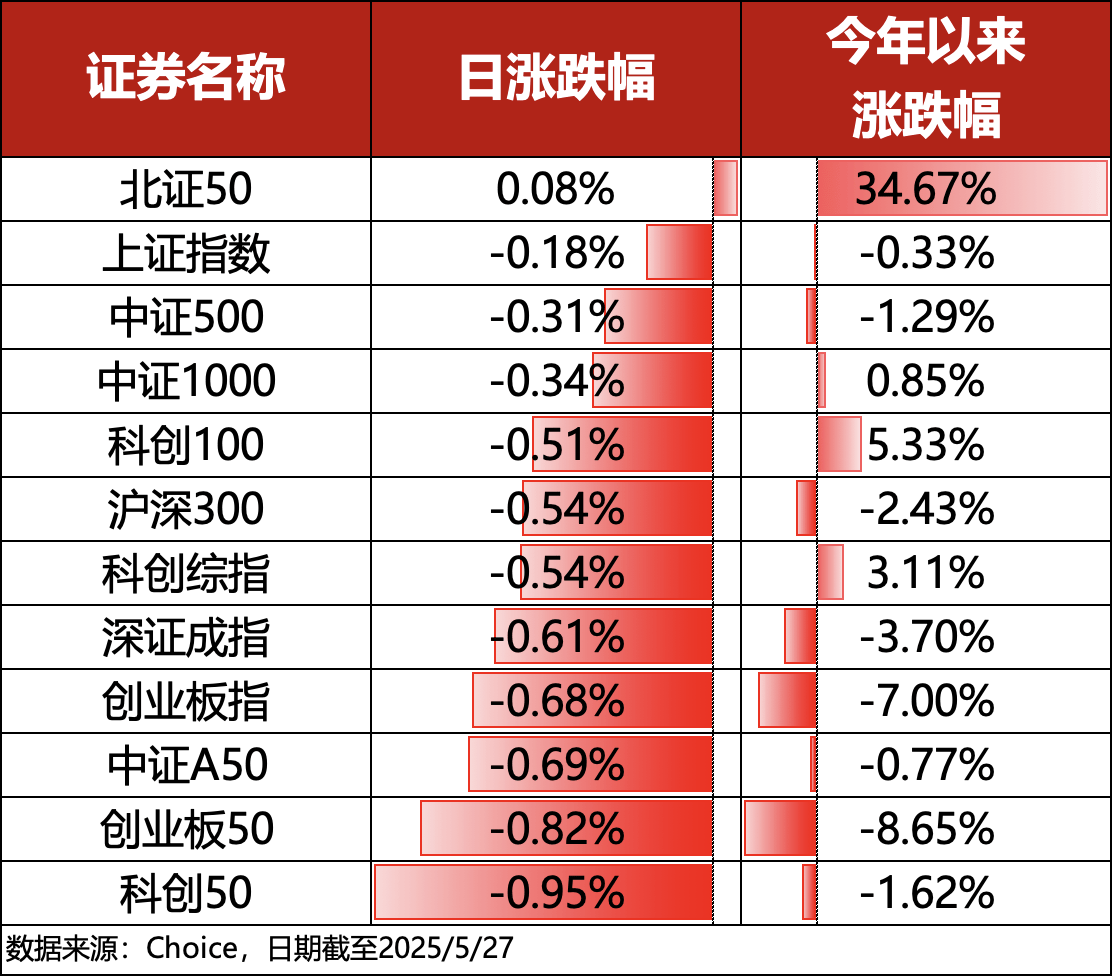
Market Overview - On May 27, A-shares experienced a collective pullback, with the Shanghai Composite Index down by 0.18%, Shenzhen Component Index down by 0.61%, and ChiNext Index down by 0.68%. Only the North Securities 50 Index saw a slight increase of 0.08% [1] - The total trading volume in the Shanghai and Shenzhen markets fell below 1 trillion RMB, amounting to 998.93 billion RMB [2] Index Performance - The North Securities 50 Index has increased by 34.67% year-to-date, while the Shanghai Composite Index has decreased by 0.33% [2] - Other indices such as the Shenzhen Component Index and ChiNext Index have seen declines of 3.70% and 7.00% respectively this year [2] Sector Performance - In sector performance, textiles and apparel (1.30%), pharmaceuticals (0.97%), and beauty care (0.88%) showed the highest gains, while sectors like non-ferrous metals (-2.06%), electronics (-1.28%), and automotive (-1.05%) faced the largest declines [7] Hong Kong Market - The main indices in the Hong Kong market experienced varying degrees of increase, with the Hang Seng Technology Index leading with a rise of 0.48%. Southbound funds recorded a net inflow of 11.975 billion HKD [5][6] Industry Highlights - The 2025 American Society of Clinical Oncology (ASCO) annual meeting will take place from May 30 to June 3, showcasing over 70 research results from Chinese pharmaceutical companies, highlighting the growth and competitiveness of domestic innovative drugs in the global market [8] - The Beijing Stock Exchange has revised its major asset restructuring review rules, introducing a "small and fast" review mechanism and simplified restructuring procedures, which are expected to enhance the efficiency of mergers and acquisitions for listed companies [9]

A股自由现金流收益率持续提升,鹏华现金流ETF中证全指发行正当时
Zhong Guo Jing Ji Wang· 2025-05-27 07:55
Group 1 - The A-share market is showing positive changes, with overall profit growth turning positive and free cash flow yield steadily increasing, driven by policy effects and technological innovation trends [1] - The ongoing issuance of the Penghua Cash Flow ETF provides investors with a strong tool to seize market opportunities [1] - Free cash flow is a crucial indicator in financial analysis and value assessment, indicating a shift from scale expansion to high-quality operations among companies [1] Group 2 - The Penghua Cash Flow ETF tracks the CSI All Index Free Cash Flow Index, which selects 100 companies with high free cash flow rates, reflecting the performance of companies with strong cash flow generation capabilities [2] - The index has a large-cap value style, with over 40% of its constituent stocks having a market capitalization exceeding 500 billion [2] - The index has shown outstanding historical performance, with returns of 32.33% and 112.92% over the past three and five years, respectively, compared to the CSI 300's returns of -3.95% and 0.07% [2] Group 3 - Penghua Fund has been an innovator in the index investment field, expanding its ETF product layout while enhancing services in strategy development, portfolio optimization, and risk management [3] - The launch of the Penghua Cash Flow ETF is a continuation of its strategy in the Smart Beta space, reinforcing its position as a provider of index investment solutions [3] - The competition in the ETF market is intensifying, and leading institutions with comprehensive research and investment capabilities are expected to continue to excel [3]
长江期货市场交易指引-20250527
Chang Jiang Qi Huo· 2025-05-27 02:08
1. Report Industry Investment Ratings Macro Finance - **Stock Index**: Defensive Observation [1][5] - **Treasury Bonds**: Bullish in the short - term, expected to fluctuate upwards [1][5] Black Building Materials - **Rebar**: Temporarily Observation, expected to fluctuate [7] - **Iron Ore**: Expected to fluctuate weakly [1][7] - **Coking Coal and Coke**: Expected to fluctuate [1][9] Non - Ferrous Metals - **Copper**: Cautious trading within a range [1][12] - **Aluminum**: Observation [1][13] - **Nickel**: Observation or shorting on rallies [1][15] - **Tin**: Trading within a range [1][17] - **Gold**: Building long positions on dips after full price corrections [1][19] - **Silver**: Trading within a range [1][19] Energy and Chemicals - **PVC**: Expected to fluctuate weakly, focus on the 5000 level pressure [1][21] - **Soda Ash**: Observation, expected to fluctuate weakly [1][33] - **Caustic Soda**: Expected to fluctuate weakly, temporarily focus on the 2550 level pressure [1][23] - **Rubber**: Expected to fluctuate weakly, focus on the 15300 level pressure [1][25] - **Urea**: Expected to fluctuate weakly [1][28] - **Methanol**: Expected to fluctuate widely, reference range 2200 - 2380 [1][29] - **Plastic**: Expected to fluctuate widely, reference range 6950 - 7350 [1][31] Cotton Textile Industry Chain - **Cotton and Cotton Yarn**: Expected to rebound with fluctuations [1][35] - **Apple**: Expected to fluctuate [1][35] - **PTA**: Trading within the range of 4650 - 4900 [1][36] Agricultural and Livestock - **Live Pigs**: Expected to fluctuate weakly [1][39] - **Eggs**: Shorting on rallies [1][40] - **Corn**: Trading within the range of 2300 - 2360, long on dips at the lower end of the range [1][41] - **Soybean Meal**: Short - term trading within the range of 2860 - 3000, long on dips after mid - June [1][43] - **Oils and Fats**: Shorting on rallies with caution [1][43] 2. Core Views The report provides investment strategies and market outlooks for various futures products. It analyzes the impact of multiple factors such as macro - economy, policies, supply - demand fundamentals, and international trade on different futures markets. For most products, the market shows a trend of fluctuation, and the investment strategies mainly include observation, trading within a range, and short - term or long - term trading based on price levels and market trends [1][5][7]. 3. Summaries by Catalog Macro Finance - **Stock Index**: Due to factors like domestic market rotation, weak main - line driving force, and insufficient trading volume, the stock index may fluctuate weakly. It is recommended to take a defensive observation stance [5]. - **Treasury Bonds**: After the previous negative factors reached a peak, the bond market began to recover. Although investors are still cautious, it is expected to fluctuate upwards in the short - term [5]. Black Building Materials - **Rebar**: With falling apparent demand, rising production, and slowing inventory depletion, and considering low valuation and weakening demand, it is expected to fluctuate weakly [7]. - **Iron Ore**: Affected by macro - sentiment and coal price decline, although there are factors such as potential production increase of Australian mines and decreasing inventory, the iron ore 09 contract is expected to fluctuate, and it is recommended to observe [7][8]. - **Coking Coal and Coke**: Both coking coal and coke face supply - demand contradictions. Coking coal is affected by production restrictions, inventory accumulation, and weak demand; coke is affected by reduced demand from steel mills and price cuts. They are expected to fluctuate [9][10][11]. Non - Ferrous Metals - **Copper**: Despite weakening support from fundamentals, the copper price is still expected to fluctuate before the holiday due to factors such as mine - end interference, supply - demand situation, and inventory levels. It is recommended to trade cautiously within a range [12]. - **Aluminum**: With the change in the situation of Guinea's mining licenses, the price of alumina has risen. The production capacity of electrolytic aluminum is increasing, while the downstream demand may weaken. It is recommended to observe [13][14]. - **Nickel**: Although the cost is firm, there is a long - term supply surplus. It is expected to fluctuate weakly, and it is recommended to observe or short on rallies [15][16]. - **Tin**: With factors such as changes in production and consumption, and the impact of tariff policies, the price is expected to fluctuate, and it is recommended to trade within a range [17]. - **Gold and Silver**: Affected by factors such as Moody's downgrade of the US sovereign credit rating, Fed policies, and inflation data, the prices are expected to fluctuate strongly. It is recommended to build long positions on dips [19]. Energy and Chemicals - **PVC**: With high inventory, weak demand, and the impact of tariffs, although the short - term tariff situation has improved, the price is expected to fluctuate weakly. It is necessary to continue to pay attention to macro - news [21][22]. - **Caustic Soda**: In June, there may be a situation of weak supply and demand. The medium - term supply is relatively sufficient, and the demand growth is limited. It is expected to fluctuate weakly [25]. - **Rubber**: With slow raw material supply increase in the short - term and weak downstream demand, the price is expected to fluctuate weakly [26]. - **Urea**: With high supply, weak agricultural and industrial demand, and increasing inventory, the price is expected to fluctuate weakly. It is recommended to short on rallies [28]. - **Methanol**: With relatively abundant supply and weak downstream demand, it is expected to fluctuate widely. It is necessary to pay attention to multiple factors such as macro - changes and device maintenance [29][30]. - **Plastic**: With reduced supply due to maintenance and weak downstream demand, it is expected to fluctuate widely. It is necessary to pay attention to downstream demand and other factors [31][32]. - **Soda Ash**: Although the spot price is firm, the futures price is under pressure due to insufficient expected maintenance. It is expected to fluctuate weakly, and it is recommended to observe [33]. Cotton Textile Industry Chain - **Cotton**: Although the global supply - demand is still loose, due to the progress of Sino - US trade negotiations, the cotton price is expected to rebound with fluctuations [35]. - **Apple**: With stable market transactions and clear fruit - setting and bagging situations, the price is expected to fluctuate at a high level [35][36]. - **PTA**: Affected by the decline in oil prices and the weakening of supply - demand fundamentals, the price is under short - term pressure and is expected to fluctuate within a range [36][37]. Agricultural and Livestock - **Live Pigs**: In the short - term, due to the game between supply and demand, the price is expected to fluctuate at a low level. In the long - term, due to the increase in supply, the price is under pressure. It is recommended to short on rallies at resistance levels [39]. - **Eggs**: In the short - term, the egg price is supported by the approaching Dragon Boat Festival, but the supply is large, and the price is under pressure. In different periods, different investment strategies are recommended [40]. - **Corn**: In the short - term, the price is supported by reduced grassroots grain sources. In the long - term, although the supply - demand is tightening, the price increase is limited by substitutes. It is recommended to trade within a range and long on dips [41]. - **Soybean Meal**: In the short - term, due to factors such as sufficient supply, it is expected to fluctuate at a low level. In the long - term, due to cost increase and weather factors, it is expected to be bullish. It is recommended to trade within a range and long on dips after mid - June [43]. - **Oils and Fats**: In the short - term, the price is expected to fluctuate due to the game of multiple factors. In the long - term, it is expected to decline first and then rebound. It is recommended to short on rallies with caution [43][48].
金属周期品高频数据周报:氧化铝价格创近2个月来新高-20250526
EBSCN· 2025-05-26 09:41
Investment Rating - The report maintains an "Overweight" rating for the steel and non-ferrous metals sectors [5]. Core Insights - The report highlights that the aluminum oxide price has reached a two-month high, indicating potential upward trends in metal prices [1][2]. - The construction and real estate sectors are experiencing significant declines, with new construction area down by 23.80% year-on-year from January to April 2025 [1][24]. - The report notes a strong correlation between liquidity indicators and stock market performance, particularly the M1 and M2 growth rate differential [11][20]. Liquidity Analysis - The M1 and M2 growth rate differential was -6.5 percentage points in April 2025, a decrease of 1.10 percentage points month-on-month [11][20]. - The BCI small and medium enterprise financing environment index for May 2025 is at 49.09, up 2.20% from the previous month [11][20]. - The London gold spot price increased by 4.86% week-on-week [11]. Infrastructure and Real Estate Chain - The cumulative year-on-year new construction area for national real estate from January to April 2025 is down 23.80% [1][24]. - The national real estate sales area for the same period is down 2.80% year-on-year, with a slight improvement of 0.2 percentage points from the previous month [24]. - The report indicates that the national cement price index has decreased by 2.07% week-on-week, reflecting pressures in the construction materials market [62]. Industrial Chain Insights - The report notes that the operating rate for semi-steel tires is at a five-year high, indicating robust demand in the industrial sector [2][72]. - The price of tungsten concentrate has reached its highest level since 2011, while aluminum oxide prices have also hit a two-month high [2][2]. - The report provides insights into various commodity price movements, including a 0.84% increase in aluminum prices and a 0.88% decrease in copper prices [2][9]. Valuation Metrics - The report states that the PB ratio for the steel sector relative to the broader market is currently at 0.53, with historical highs reaching 0.82 [4]. - The report suggests that the profitability of the steel sector is expected to recover to historical average levels, driven by regulatory changes and market dynamics [4]. Export Chain Analysis - The new export orders PMI for China in April 2025 is at 44.70%, down 4.3 percentage points month-on-month, indicating weakening export demand [3][3]. - The report highlights that the CCFI composite index for container shipping rates has increased by 0.23% week-on-week, reflecting some resilience in logistics [3].
2025【ESG先锋60】评选正式启动,探寻可持续发展领航者
Sou Hu Cai Jing· 2025-05-26 06:30
Core Viewpoint - The article emphasizes the importance of ESG (Environmental, Social, and Governance) principles in driving sustainable development and high-quality economic growth in various industries, particularly in China [2][3]. Group 1: ESG and Industry Impact - Companies across multiple sectors, including finance, energy, healthcare, and technology, are exploring new development models and value creation paths under the guidance of ESG principles [2]. - The integration of ESG concepts aligns with China's transition to high-quality development, providing new momentum and pathways for companies to overcome traditional growth bottlenecks [2]. Group 2: 2025 ESG Pioneer 60 Selection - The 2025 ESG Pioneer 60 selection aims to identify and recognize companies and individuals actively engaged in ESG practices, showcasing their dual economic and social value [3]. - The selection process will be rigorous, involving market indicators, public voting, and expert reviews to ensure fairness and social value in the results [3][4]. Group 3: Award Categories - The awards include various categories such as Annual Environmental Responsibility Excellence Award, Annual Social Responsibility Excellence Award, and Annual ESG Green Finance Award, recognizing contributions to ESG from multiple dimensions [4][6][7]. Group 4: Participation and Timeline - The selection is open to a wide range of industries, with nearly 100 sectors eligible to participate, regardless of ownership type or company size, as long as they demonstrate outstanding ESG performance [5][9]. - The application process is open until November 11, with the final award list to be announced in December, encouraging companies to participate through self-nomination or third-party recommendations [9].

制造业“绿”发展 经济社会转型步伐在加快
Zheng Quan Ri Bao· 2025-05-25 16:11
Core Viewpoint - The State Council's approval of the "Green Low-Carbon Development Action Plan for Manufacturing Industry (2025-2027)" aims to promote deep green transformation in traditional industries, facilitating a shift from "scale speed" to "quality efficiency" in manufacturing [1][2]. Group 1: Policy Implementation and Industry Transformation - The manufacturing sector has made significant progress in green transformation due to the introduction of various supportive policies, with a target for notable achievements by 2030 [2]. - By 2024, the number of national-level green factories reached 6,430, contributing approximately 20% to the total manufacturing output value, an increase of 2 percentage points from the previous year [2]. - The emphasis on accelerating green upgrades in key industries, such as steel, chemicals, and construction materials, is expected to lead to increased investments in technology upgrades and energy-saving measures [3][4]. Group 2: Industry-Specific Developments - As of April 20, 2025, 189 steel enterprises have completed or partially completed ultra-low emission modifications, with 141 fully achieving these upgrades, impacting a crude steel capacity of approximately 591 million tons [4]. - The steel industry is enhancing its competitiveness through equipment updates and green technology modifications, which are essential for building a green manufacturing system [4]. Group 3: Future Policy Directions - The Ministry of Industry and Information Technology (MIIT) plans to establish a comprehensive green low-carbon development mechanism, including the formulation of carbon footprint accounting standards and promoting clean hydrogen applications in the industrial sector [5][6]. - Future policies are expected to focus on refining standards for energy efficiency, carbon emissions, and green manufacturing, which will guide the green low-carbon development of the manufacturing industry [6]. - Financial policies are suggested to support enterprises in green technology research and development, energy-saving projects, and green upgrades, encouraging the adoption of advanced green technologies [6].