建材

Search documents
金鹰基金:重磅举动轮番出台提振经济复苏信心 A股涨势加速冲关压力位
Xin Lang Ji Jin· 2025-07-28 06:16
Group 1 - The A-share market has accelerated its upward trend, with the Shanghai Composite Index breaking through the 3600-point mark and average daily trading volume rising to 1.86 trillion yuan [1] - The overall market style is characterized by a performance hierarchy: cyclical > growth > financial > consumer sectors [1] - Recent policy announcements and national strategic plans have boosted economic recovery confidence, with the upcoming Politburo meeting expected to play a crucial role in market performance [1] Group 2 - The Jin Ying Fund suggests a balanced allocation to mitigate potential volatility, particularly in the financial sector due to the upcoming Stablecoin regulations [2] - In the technology growth sector, interest in AI applications and the semiconductor industry is expected to rise following the World Artificial Intelligence Conference [2] - Despite a potential decrease in "anti-involution" enthusiasm due to falling futures prices, related policies are likely to continue, with sectors like photovoltaic and building materials still worth monitoring [2]
股指周报:国内外宏观密集出炉,市场避险情绪升温-20250728
Zheng Xin Qi Huo· 2025-07-28 05:51
Report Industry Investment Rating No information provided in the given text. Core Viewpoints - **Macro**: The US tariff exemption extension is entering its final week, and negotiations with countries like the EU, India, and Mexico are in a tense phase, with uncertainties regarding potential tariff counter - measures. Overseas is in a week of intensive macro - events, including the Fed's interest - rate meeting and key economic data releases. China will hold a Politburo meeting, and attention should be paid to economic work guidance and PMI data to confirm economic recovery. The real estate sales remain at a low level, the service industry is structurally differentiated and has declined due to summer heat, and the manufacturing's rush - to - export phase is ending, posing potential downward pressure on the Q3 economy. However, anti - involution policies are expected to gradually reverse deflation [4]. - **Funds**: Domestic liquidity is generally loose but marginally tightening. Bond market redemptions are flowing into the stock market, providing incremental funds. Overseas financial conditions have improved, with a decline in the real interest rate of US bonds, leading to foreign capital inflows into the domestic stock market. Passive ETF shares are being re - increased, equity financing such as IPOs has cooled, margin trading funds are continuously flowing in, and the pressure of restricted - share unlocks has increased, overall favoring liquidity [4]. - **Valuation**: After a short - term rebound, the valuations of various indices are still at a historically neutral - to - high level. The stock - bond yield spreads at home and abroad have further declined, making the attractiveness of allocation funds average [4]. - **Strategy**: The current valuations of broad - based indices are not cheap, and the foreign - capital risk premium index has dropped to a low level. The pressure of US tariff policies may resurface. Considering that the stock market has prematurely priced in macro - expectations, the market is expected to oscillate, reach a peak, and then correct in the next 1 - 2 weeks when positive factors are realized or fall short of expectations. It is recommended to reduce long positions in stock indices after sharp rallies this week or use out - of - the - money put options to protect against black - swan risks. In terms of style, hold long positions in IC and IM, or conduct an arbitrage strategy of going long on IM and short on IF [4]. Summary by Directory 1. Market Review - **Stock Indices**: In the past week, the Science and Technology Innovation 50 Index led the gains, while the German stock market led the losses. The week - on - week changes of major indices are as follows: the Shanghai Composite Index rose 1.67%, the Hang Seng China Enterprises Index rose 1.83%, the Shenzhen Component Index rose 2.33%, and the ChiNext Index rose 2.76%, among others [8][9]. - **Sectors**: Coal led the gains, and banks led the losses. Coal > Steel > Non - ferrous metals > Building materials... > Electric power and public utilities > Communications > Comprehensive finance > Banks [12]. - **Futures**: The basis rates of the four major stock index futures (IH, IF, IC, and IM) changed by 0.21%, 0.09%, - 0.39%, and - 0.31% respectively, with IH reaching par and the discounts of IC and IM slightly widening. The inter - period spread rates (current and next month) of the four major stock index futures changed by - 0.3%, - 0.25%, - 0.19%, and - 0.25% respectively, and the inter - period discounts of the four major futures began to widen. The inter - period spread rates (next quarter and current month) changed by - 0.21%, - 0.61%, - 1.32%, and - 1.81% respectively, with the long - term discounts of the four major futures widening significantly [19]. 2. Fund Flows - **Margin Trading and Market - Stabilizing Funds**: Last week, margin trading funds flowed in 39.65 billion yuan, reaching a total of 1.94 trillion yuan. The proportion of margin trading balance to the circulating market value of the Shanghai and Shenzhen stock markets remained unchanged at 2.26%. The scale of passive stock ETF funds was 3.17358 trillion yuan, an increase of 74.43 billion yuan from the previous week, and the share was 198.619 billion shares, with a net subscription of 290 million shares from the previous week [22]. - **Industrial Capital**: In July, the cumulative equity financing was 45.49 billion yuan, with 6 cases. Among them, IPO financing was 20.92 billion yuan, private placement was 24.58 billion yuan, and convertible bond financing was 8.79 billion yuan. The market value of stock market unlocks last week was 86.84 billion yuan, a significant increase of 58.38 billion yuan from the previous week [26]. 3. Liquidity - **Monetary Injection**: Last week, the central bank's OMO reverse - repurchase matured at 1.7268 trillion yuan, with a reverse - repurchase injection of 1.6563 trillion yuan, resulting in a net monetary withdrawal of 7.05 billion yuan. The MLF was injected with 400 billion yuan in July and matured at 300 billion yuan, with continuous monthly net injections for 5 months. Overall, the liquidity supply was neutral but marginally tightening [28]. - **Fund Prices**: The DR007, R001, and SHIBOR overnight rates changed by 14.5bp, 6.4bp, and 5.8bp respectively, reaching 1.65%, 1.55%, and 1.52%. The issuance rate of inter - bank certificates of deposit rebounded by 2.1bp, and the CD rate issued by joint - stock banks rebounded by 4.1bp to 1.67%. The fund supply tightened marginally, debt financing demand declined, but the real - economy financing demand recovered, and the fund prices generally rebounded slightly [34]. - **Term Structure**: Last week, the yields of 10 - year, 5 - year, and 2 - year Treasury bonds changed by 6.7bp, 6bp, and 5.2bp respectively; the yields of 10 - year, 5 - year, and 2 - year China Development Bank bonds changed by 8.9bp, 9.5bp, and 6.6bp respectively. The yield term structure continued to steepen, and the credit spreads between Treasury bonds and China Development Bank bonds widened at both the long and short ends, indicating a return of broad - credit expectations [38]. - **Sino - US Interest Rate Spread**: As of July 25, the US 10 - year Treasury yield changed by - 4.0bp to 4.40%, the inflation expectation changed by 3.0bp to 2.44%, and the real interest rate changed by - 7.00bp to 1.96%. The Sino - US interest rate spread inversion narrowed by 10.79bp to - 266.61bp, and the offshore RMB appreciated by 0.19% [41]. 4. Macroeconomic Fundamentals - **Real Estate Demand**: As of July 24, the weekly trading area of commercial housing in 30 large - and medium - sized cities was 1.531 million square meters, showing a seasonal improvement from the previous week's 1.372 million square meters but still at a relatively low level compared to the same period. Second - hand housing sales declined seasonally, reaching the lowest level in nearly seven years. The real estate market sales generally returned to a low level, and attention should be paid to whether the Politburo meeting will propose signals to boost the real estate market [44]. - **Service Industry Activities**: As of July 25, the daily average subway passenger volume in 28 large - and medium - sized cities dropped significantly to 81.84 million person - times, a 1.2% decrease from the same period last year but a 21.8% increase from 2021. The Baidu congestion delay index of 100 cities decreased slightly from the previous week, indicating that the service industry's economic activities were cooling down [48]. - **Manufacturing Tracking**: Due to the anti - involution policy, the overall capacity utilization rate of the manufacturing industry declined. The capacity utilization rates of steel mills, asphalt, cement clinker enterprises, and coking enterprises changed by - 0.08%, - 4%, - 0.26%, and 0.44% respectively. The average operating rate of the chemical industry chain related to external demand changed by 0.01% from the previous week. Overall, the domestic and foreign demand trends of the manufacturing industry improved marginally, and it has entered the seasonal peak season [52]. - **Goods Flow**: The goods and people flow remained at a relatively high level. The postal express and civil aviation sectors showed a significant weekly decline, while railway transportation rebounded slightly, which may be related to the rush - to - export. There is a risk of a second seasonal decline from August to September [56]. - **Exports**: As the rush - to - export after the Sino - US trade talks is nearing its end, the port cargo throughput and container throughput have increased significantly. There is a risk of a second decline from August to September when the 90 - day tariff exemption period ends [61]. - **Overseas**: With the US Markit manufacturing PMI preliminary value in July falling back into the contraction range and the US durable goods orders data dropping more than expected, the financial market has revised its expectations for the Fed's interest - rate path. The market expects 2 interest rate cuts in 2025, with a reduction of 25 - 50bp, and the probability of a September rate cut has increased to 61.9% [63]. 5. Other Analyses - **Valuation**: The stock - bond risk premium was 3.07%, a 0.15% decrease from the previous week, at the 58.5% quantile. The foreign - capital risk premium index was 3.99%, a 0.05% decrease from the previous week, at the 21.2% quantile. The valuations of the Shanghai 50, CSI 300, CSI 500, and CSI 1000 indices were at the 81.1%, 76.8%, 87.3%, and 71.4% quantiles of the past 5 years respectively, and their relative valuation levels were not low [66][71]. - **Quantitative Diagnosis**: According to seasonal laws, the stock market is in a period of seasonal shock - driven growth and structural differentiation in July. The growth style is relatively dominant, and the cyclical style first rises and then falls. There are opportunities to go long on IC and IM on pullbacks and short on IF and IH on sharp rallies [74]. - **Financial Calendar**: China will release July's manufacturing and service industry PMI and industrial enterprise profits, which will help confirm economic recovery. Overseas, attention should be paid to the US non - farm payroll report, job vacancies, manufacturing PMI, PCE inflation data, and the Fed's interest - rate meeting [76].
保证持股稳定性!六大机构A股最新研判来了
天天基金网· 2025-07-28 05:14
Core Viewpoint - The article highlights the recent performance of the A-share market, with major indices showing significant gains, and suggests a focus on stability in stock holdings while avoiding frequent trading [1][7]. Market Performance - The Shanghai Composite Index, Shenzhen Component Index, and ChiNext Index rose by 1.67%, 2.33%, and 2.76% respectively over the past week, with the Shanghai Composite Index surpassing the 3600-point mark, reaching a new high for the year [1]. Investment Opportunities - Institutions recommend focusing on sectors such as large infrastructure, technology, and cyclical industries, while also paying attention to emerging themes like brain-computer interfaces, commercial aerospace, controllable nuclear fusion, and 3D printing [2][9]. Industrial Profit Trends - In June, the profit decline for industrial enterprises narrowed, with manufacturing profits turning from a 4.1% decline in May to a 1.4% increase in June. The total profit for large industrial enterprises was 715.58 billion yuan, a year-on-year decrease of 4.3%, but the decline was 4.8 percentage points less than in May [3]. Government Support for Consumption - The Ministry of Finance announced the allocation of 690 billion yuan from the third batch of special bonds to support the replacement of consumer goods, with a total of 300 billion yuan planned for this initiative [4]. Technological Advancements - Shanghai is accelerating the development of a leading high-level autonomous driving zone, with plans to deploy 500 data collection ride-hailing vehicles and collect over 10 million data clips within the year [5]. Sector-Specific Insights - Short-term fluctuations are expected in sectors that have seen significant gains, and it is advised to maintain a balanced allocation between A-shares and H-shares, with a focus on technology indices [7]. - The current market is characterized by a "rotation and rebound" feature, with particular attention on the electronics and machinery sectors for potential rebound opportunities [8]. - The outlook for the A-share market suggests that profitability and return on equity (ROE) are expected to stabilize, supporting an upward shift in index levels, with a focus on cyclical sectors and technology growth areas [9][10]. Resource Sector Outlook - Resource stocks are anticipated to continue their upward trend in the third quarter, supported by solid fundamentals and favorable fiscal policies that may enhance asset recovery in midstream industries [11]. Focus on Technology and Consumption - As the index approaches its high for the year, there may be a shift in funds towards lower-performing sectors, with technology and consumption being highlighted as key areas of focus [12].


市场围绕热点题材炒作
Guo Mao Qi Huo· 2025-07-28 05:11
1. Report Industry Investment Rating No relevant content provided. 2. Core Views of the Report - A - share mid - year report performance pre - announcements show a sequential improvement but a slight year - on - year decline. Industry differentiation is significant, with non - bank finance and non - ferrous metals leading, while the real estate industry chain is under pressure [3]. - The market is mainly trading on the "anti - involution" policy expectations. The July Politburo meeting is yet to be held, and the market is concerned about the policy focus in the second - half economic work [3]. - The US Treasury Secretary said that China - US economic and trade officials will conduct the third round of trade consultations in Stockholm, Sweden. - The liquidity is relatively abundant, with the A - share margin trading balance increasing and the trading volume rising. The short - term upward speed of the stock index may slow down, showing a volatile pattern [3]. 3. Summary by Relevant Catalogs 3.1 Part One: Main Views and Strategy Overview - **Influence Factors and Their Driving Forces** - **Economic and Corporate Earnings**: Neutral. As of July 21, about 28.6% of A - share companies (1547) disclosed their 2025 mid - year report pre - announcements, with a pre - joy rate of 43.7%. Non - bank finance and non - ferrous metals have strong performance expectations, while the real estate industry chain is sluggish [3]. - **Macro Policy**: Neutral - bullish. The market is highly concerned about whether the upcoming policies signal a new round of supply - side reform. The July Politburo meeting is awaited for policy focus [3]. - **Overseas Factors**: Neutral. The US Treasury Secretary announced China - US trade consultations [3]. - **Liquidity**: Bullish. The A - share margin trading balance increased, and the trading volume rose [3]. - **Investment Views and Trading Strategies** - **Investment View**: Adjust and go long. The short - term upward speed of the stock index may slow down due to the ebb of hot topics [3]. - **Trading Strategy**: Unilateral: Adjust and go long. Risk concerns include domestic policies and overseas geopolitical factors [3]. 3.2 Part Two: Stock Index Market Review - **Index Performance**: Last week, the CSI 300 rose 1.69% to 4127.2; the SSE 50 rose 1.12% to 2795.5; the CSI 500 rose 3.28% to 6299.6; the CSI 1000 rose 2.36% to 6706.6 [5]. - **Industry Index Performance**: In the Shenwan Primary Industry Index, building materials (8.2%), steel (7.7%), non - ferrous metals (6.7%), building decoration (5.6%), and real estate (4.1%) led the gains last week, while only banking (- 2.9%), communication (- 0.8%), and public utilities (- 0.3%) declined [9]. - **Futures Volume and Open Interest**: The trading volume and open interest of some stock index futures changed. For example, the trading volume of CSI 300 futures increased by 3.80%, and the open interest increased by 2.76% [13]. - **Contract Premium and Discount**: As of July 25, the annualized discounts and premiums of different contracts of various stock index futures varied [15]. - **Cross - variety Spread**: The CSI 300 - SSE 50 spread was at the 86.1% historical quantile level, and the CSI 1000 - CSI 500 spread was at the 61.7% historical quantile level [19]. 3.3 Part Three: Stock Index Influence Factors - Liquidity - **Central Bank Operations**: The central bank conducted 1656.3 billion yuan of reverse repurchase operations this week, along with 400 billion yuan of MLF and 100 billion yuan of treasury cash fixed - deposit operations. The net investment for the whole week was 10.95 billion yuan [26]. - **Market Liquidity Indicators**: As of July 24, the A - share margin trading balance was 1935.73 billion yuan, an increase of 39.32 billion yuan from the previous week. The margin trading volume accounted for 11.3% of the total market trading volume, at the 96.4% quantile level in the past decade. The average daily trading volume last week increased by 277.84 billion yuan compared with the previous week [32]. 3.4 Part Four: Stock Index Influence Factors - Economic Fundamental and Corporate Earnings - **Macroeconomic Indicators**: In June 2025, China's GDP growth rate was 5.2%, industrial added value increased by 6.8% year - on - year, and other economic indicators showed different trends [35]. - **Industry - specific Economic Data**: The real estate industry showed a decline in investment, while the manufacturing and consumer industries had their own characteristics. For example, the manufacturing industry maintained a certain growth rate, and the consumer industry had different performances in various sub - sectors [35][38][39]. - **PMI Data**: In June 2025, the manufacturing PMI was 49.7, and the non - manufacturing PMI was 50.5, showing marginal improvements in some sub - indicators [42]. - **Earnings Indicators of Major Broad - based Indexes**: The year - on - year growth rates of net profit attributable to shareholders and ROE of major broad - based indexes varied [47]. - **Financial Data of Shenwan Primary Industry Index**: The profitability of different industries in the Shenwan Primary Industry Index showed significant differences, with some industries having high growth rates and others in decline [48]. 3.5 Part Four: Stock Index Influence Factors - Policy Drive - **Recent Macro - policy Trends**: A series of meetings and policies have been introduced, including the Central Financial and Economic Commission meeting emphasizing the governance of low - price and disorderly competition, and the Central Urban Work Conference focusing on urban development transformation. A package of financial policies has also been announced to support the economy [52][53]. 3.6 Part Five: Stock Index Influence Factors - Overseas Factors - **US Economic Data**: In June 2025, the US manufacturing PMI was 49%, the non - manufacturing PMI was 50.8%, the unemployment rate was 4.1%, and the number of new non - farm jobs was 147,000. The PCE and CPI also showed different trends [60][63]. - **Trump Team's Statements and Actions**: Trump has proposed a series of tariff policies, which have had a certain impact on international trade relations. There have also been legal disputes over tariff policies [69][71][73]. 3.7 Part Six: Stock Index Influence Factors - Valuation - As of July 25, 2025, the rolling price - to - earnings ratios of the CSI 300, SSE 50, CSI 500, and CSI 1000 were 13.5 times, 11.4 times, 30.7 times, and 41.3 times respectively, at the 73.7%, 81.5%, 71.6%, and 63.9% quantile levels in the past decade [76].
联合解读反内卷最新进展
2025-07-28 01:42
Summary of Key Points from Conference Call Records Industry Overview - The conference call discusses the "anti-involution" policy in China, aimed at improving the Producer Price Index (PPI) and industrial enterprise profits, thereby enhancing the macroeconomic environment. This policy is expected to benefit from global inflation and the depreciation of the US dollar [1][2][3]. Core Insights and Arguments - **PPI Improvement**: Significant improvement in PPI is anticipated in the first half of next year, with a possibility of turning positive in the second half, which may shift trading strategies from a "barbell" approach to an "inflation" strategy [1][3]. - **Currency Trends**: The US dollar is expected to continue its depreciation, with the Federal Reserve likely to cut interest rates, while Europe and Japan may end their rate cuts or increase rates. The Chinese yuan may strengthen beyond 7 [1][4]. - **Foreign Investment**: If domestic demand in China is boosted and price recovery expectations are clear, foreign capital may significantly enter the A-share market, favoring leading blue-chip stocks, but this would be unfavorable for the bond market [1][4]. - **Market Dynamics**: The anti-involution policy has triggered two waves of market trends, driven by PPI recovery, improved macroeconomic conditions, global inflation, and the interaction of domestic and foreign capital markets [1][5]. - **Policy Differences**: The anti-involution approach differs from previous supply-side reforms by addressing not only production capacity but also corporate behavior, local government actions, and industry self-regulation [1][8]. Important but Overlooked Content - **Debt Market Pressure**: The bond market is facing adjustment pressure due to heightened risk appetite and historically high valuations. Short-term, the bond market may experience a rebound after a sharp decline, but caution is advised against chasing prices during rebounds [1][12][13]. - **Cement Industry Response**: The cement industry is implementing measures such as capacity replacement and staggered production to address the anti-involution challenge, with expectations of an 8%-12% decline in supply this year [3][19]. - **Pork Industry Adjustments**: The pork industry is undergoing supply-side reforms, with major companies like Muyuan actively reducing breeding stock, which is expected to drive up pork prices and impact the Consumer Price Index (CPI) positively [3][25][26]. - **Environmental Regulations**: New environmental standards in the pig farming sector are seen as a means to control production capacity without significant resource consumption, which could also positively affect CPI [27]. Conclusion - The anti-involution policy is a multifaceted approach aimed at stabilizing and improving various sectors of the economy, with significant implications for asset prices, foreign investment, and market dynamics. The bond market, cement industry, and pork sector are particularly highlighted for their responses to these policies.
短期3600点附近或仍有反复,科技成长股或存在结构性机会
British Securities· 2025-07-28 00:57
Market Overview - The A-share market is currently experiencing fluctuations around the 3600-point level, reflecting increased divergence between bulls and bears [2][16][17] - The market is likely to enter a period of consolidation, with the index expected to oscillate around 3600 points to digest accumulated pressure [17] - Short-term market sentiment is influenced by profit-taking and external disturbances, while medium-term trends remain upward due to policy support and industry upgrades [5][17] Sector Performance - The semiconductor and AI application sectors have shown strength, indicating a potential shift towards technology stocks, particularly among small and mid-cap growth stocks [1][16] - The "Yalu River Downstream Hydropower" concept stocks have experienced significant volatility, with a recent pullback after a period of strong performance [11] - The healthcare sector, particularly innovative drugs and medical devices, is expected to see continued growth due to favorable policy changes and an aging population [10] Investment Strategy - Short-term strategies should focus on avoiding high-flying stocks and selectively reducing positions in sectors that have seen substantial gains, such as the Yalu River hydropower concept [3][17] - Mid-term investments should target growth sectors with elastic potential, including AI infrastructure, innovative pharmaceuticals, and humanoid robotics, driven by both policy and technological advancements [3][17] - The cultural media sector is also highlighted as a potential area for investment, particularly in gaming and interactive content, benefiting from advancements in AI technology [9] Economic Indicators - The report emphasizes the importance of monitoring tariff negotiations and the overall liquidity environment, which are expected to positively influence the A-share market [3][17] - The upcoming fiscal policy window in Q3 and the timing of the Federal Reserve's monetary policy shift are critical factors to watch for market direction [3][17]
西藏日喀则国际陆地港——打造高质量发展新引擎(辉煌60载 魅力新西藏)
Ren Min Ri Bao· 2025-07-27 22:05
Group 1: Overview of the International Land Port - The Xigaze International Land Port officially opened its customs inspection facility in August 2024, enabling efficient customs clearance for up to 300 export vehicles daily, significantly enhancing Tibet's connection to international markets [1][2] - The modern facility integrates customs declaration, inspection, transfer, loading, storage, and consolidation functions, reducing the average container transportation cost by nearly 2000 yuan [1][2] Group 2: Simplification of Customs Processes - The implementation of advanced container inspection systems has streamlined customs processes, allowing for quick and efficient clearance without the need for secondary inspections [2] - The strategic location of the land port, being only 5 kilometers from the city center and 50 kilometers from the airport, facilitates rapid access to key border ports [2] Group 3: Shift in Export Goods - The types of goods exported through the land port have shifted from traditional items like furniture and clothing to new categories such as electric vehicles, lithium batteries, and photovoltaic products [3] - Over 1,000 electric vehicles were transported from Shanghai to the land port between March and May, showcasing the effectiveness of the rail-road intermodal transport model [3] Group 4: Development of New Industrial Ecosystems - The rapid development of the land port has led to the establishment of over 150 registered enterprises across various sectors, including food processing, construction materials, logistics, and clean energy [4] - The port has attracted 53 investment projects, with 48 already under construction, totaling an investment of 3.302 billion yuan and creating 2,369 jobs [4] Group 5: Expansion of E-commerce and International Competitiveness - The land port is accelerating the construction of bonded warehouses and export supervision warehouses to enhance cross-border e-commerce capabilities [5] - Companies are utilizing the bonded warehouse model to streamline customs procedures, reduce financial pressure, and improve cargo turnover efficiency [5] Group 6: Regional Economic Impact - The land port has significantly improved the region's openness and economic cooperation, aiding Tibet's integration into the Belt and Road Initiative [6]
风险偏好抬升 资金流向释放新信号
Zhong Guo Zheng Quan Bao· 2025-07-27 21:07
Market Overview - The market sentiment has significantly improved, driven by major positive developments in the infrastructure sector, leading to substantial gains in various building materials and rare earth-related ETFs [1][2] - The trading volume of broad-based ETFs tracking indices like CSI A500, CSI 300, and STAR Market 50 has been notably high, with CSI A500 ETFs exceeding 120 billion yuan in total trading volume [2] ETF Performance - Several ETFs related to building materials, rare earths, and mining sectors saw significant price increases, with some rare metal-themed ETFs rising over 10% [1] - The Hong Kong securities ETF recorded a weekly trading volume exceeding 100 billion yuan, with its size doubling from 100 billion to 200 billion yuan in just 15 trading days [2] Fund Flows - There has been a clear shift in capital flows, with many credit bond ETFs experiencing net outflows, while equity products, particularly industry-themed ETFs, saw net inflows [3][4] - Notably, the Hong Kong securities ETF had a net inflow of 37.62 billion yuan, indicating a strong preference for equity investments over lower-risk products [3] Sector Insights - The performance of various sectors has shown significant divergence, with metals, non-bank financials, and banks leading in gains, while coal, food and beverage, and real estate sectors lagged [4] - The "anti-involution" policy is expected to enhance competition quality and improve pricing, benefiting midstream manufacturing and upstream raw materials sectors [4][5] Future Outlook - The recovery of domestic demand is anticipated, supported by ongoing infrastructure investments and local government debt initiatives [5][6] - The continuous iteration of AI models and their increasing application penetration are expected to enhance production and operational efficiency, presenting rich investment opportunities in sectors like innovative pharmaceuticals and high-end manufacturing [5][6]
行业比较周跟踪:A股估值及行业中观景气跟踪周报-20250727
Shenwan Hongyuan Securities· 2025-07-27 11:26
Valuation Summary - The overall PE of the A-share market is 20.2 times, positioned at the historical 82nd percentile [2][5] - The PE of the Shanghai 50 Index is 11.4 times, at the historical 59th percentile [2][5] - The PE of the ChiNext Index is 34.8 times, at the historical 20th percentile [2][5] - The PE of the Science and Technology Innovation 50 Index is 146.2 times, at the historical 100th percentile [2][5] Industry Valuation Comparison - Industries with PE valuations above the historical 85th percentile include Real Estate, Steel, Building Materials, Electric Equipment (Photovoltaic Equipment), National Defense and Military Industry, Aviation and Airports, Light Industry Manufacturing, Chemical Pharmaceuticals, and IT Services [2][6] - The Passenger Vehicle industry has a PB valuation above the historical 85th percentile [2][6] - The Shipping and Port industry has both PE and PB valuations below the historical 15th percentile [2][6] Industry Midstream Prosperity Tracking New Energy - Photovoltaics: The price of polysilicon futures increased by 15.2% to 50,000 yuan, while the price of silicon wafers rose by 10.5% [2] - Battery materials: The prices of cobalt and nickel increased by 2.3% and 2.6%, respectively, while lithium prices saw increases of 7.1% for lithium hexafluorophosphate and 9.0% for lithium carbonate [2] Financial Sector - Insurance: The cumulative year-on-year growth of various insurance premiums was 5.3% for the first half of 2025, with an expected further reduction in the preset interest rate for life insurance products [3] Real Estate Chain - Steel: The spot price of rebar rose by 5.4%, and the futures price increased by 6.6% [3] - Cement: The national cement price index fell by 1.5% due to weak demand [3] Consumer Sector - Pork: The average price of live pigs decreased by 0.8%, while the wholesale price of pork increased by 1.0% [3] - Alcohol: The wholesale price index for liquor remained stable, with a slight decrease in the price of Moutai [3] Midstream Manufacturing - Excavators: Sales of excavators increased by 13.3% year-on-year in June 2025, with domestic sales up by 6.2% and exports up by 19.3% [3] Technology TMT - Optical Communication Modules: Exports decreased by 11.2% year-on-year, with a significant drop in export prices [3] Cyclical Industries - Precious Metals: COMEX gold and silver prices fell by 0.5% and 0.3%, respectively [3] - Coal: The price of thermal coal rose by 1.7%, while coking coal prices increased by 9.5% [3]
上游资源品相关ETF全线爆发 银行类ETF小幅回调
Sou Hu Cai Jing· 2025-07-27 10:35
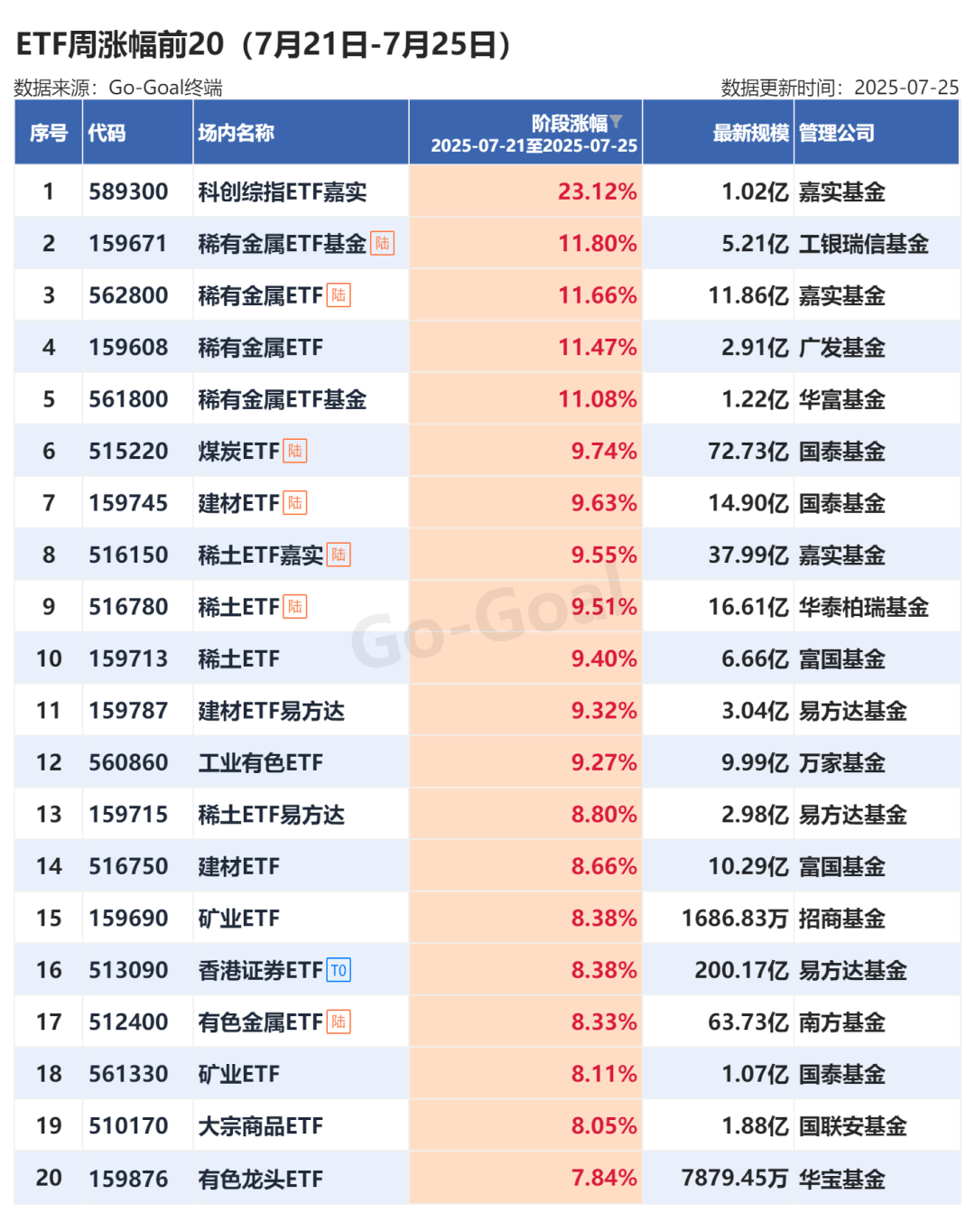
Market Performance - The A-share market saw all three major indices rise, with the Shanghai Composite Index increasing by 1.67%, the Shenzhen Component Index by 2.33%, and the ChiNext Index by 2.76% [1] - The Sci-Tech 50 Index led the market with a weekly increase of 4.63%, driven by technology stocks such as semiconductors and AI [1] ETF Market Trends - The ETF market displayed a pattern of "debt fund hedging + Hong Kong stock technology attracting capital," with a total net inflow of 18.18 billion yuan [4] - Rare metals and rare earth-related ETFs continued to perform well, with coal and building materials ETFs rising nearly 10% as part of a "anti-involution" trend [1] - In contrast, several bank-related ETFs experienced a decline of around 3% [1] Fund Flows - Stock ETFs saw a net outflow of 54.5 billion yuan, while industry ETFs recorded a net inflow of 116.59 billion yuan [4] - Cross-border ETFs had a net inflow of 102.55 billion yuan, benefiting from the recent capital inflow into the Hong Kong market [4] - Bond ETFs experienced a net inflow of 91.82 billion yuan [4] Upcoming ETF Issuances - Six new ETFs are set to be issued next week, including Hong Kong Stock Connect Consumer ETF and Hong Kong Stock Connect Technology ETF [4]