
地产

Search documents
联合国贸发会议报告显示——全球投资仍未走出低谷
Jing Ji Ri Bao· 2025-11-16 22:07
Core Insights - Global investment conditions remain sluggish in the first half of 2025, with foreign direct investment (FDI) declining by 3% for the third consecutive year, influenced by escalating global trade tensions, geopolitical risks, and corporate reassessment of supply chain vulnerabilities [1][2] Group 1: Greenfield Investment - Greenfield investment, a key indicator of new capital expenditure and future production capacity, has significantly contracted, with a 17% decrease in global projects. Developed and developing countries saw declines of 20% and 12%, respectively [2] - Manufacturing greenfield projects experienced the most substantial drop, with a 26% reduction, particularly in sectors related to global supply chains such as electronics, machinery, automotive, and textiles [2] - The decline in greenfield investment is attributed to rising U.S. tariff barriers, which have adversely affected manufacturing investments in countries like Vietnam, India, Brazil, and South Africa [2] Group 2: International Project Financing - International project financing, primarily in infrastructure sectors like power, renewable energy, transportation, and communication, has seen a significant decline due to high global interest rates and increased geopolitical risks [3] - Renewable energy project numbers fell by 9%, while other power projects saw a 38% drop in quantity and a 52% decrease in value, indicating a weak performance across various sectors [3] - Domestic financing is replacing international financing, with domestic project financing increasing by 39% in quantity and 29% in value, highlighting a shift as international capital withdraws [3] Group 3: Cross-Border Mergers and Acquisitions - Cross-border M&A activity has decreased sharply, with total deal value dropping from $448 billion in 2024 to $172 billion in the first half of 2025. The U.S. and U.K. experienced declines of 33% and 59%, respectively [4] - Service and manufacturing sectors saw significant reductions in M&A activity, with service sector deals down by 25% and manufacturing by 12% [4] - The increase in divestitures and withdrawals has led to greater instability in M&A activities in developing countries [4] Group 4: Sustainable Development Goals - Investment related to the United Nations Sustainable Development Goals has faced pressure, with project numbers declining by 10% and investment amounts down by 7% in key areas such as renewable energy, infrastructure, and health [4] - The shrinking number of projects and the reduced average size of individual projects further weaken the capital formation capacity of developing countries in critical sustainable development sectors [4] Group 5: Future Investment Trends - The global investment landscape is expected to become more "regionalized" and "friendshored," with investments increasingly flowing between politically friendly nations, shifting from a globalized to a group-based approach [5] - Manufacturing sectors related to supply chains will continue to face challenges, with developed countries likely to repatriate critical manufacturing processes [5] - Digital economy and artificial intelligence are projected to be the only bright spots for global investment growth, driven by strategic emphasis on AI and semiconductor development, as well as intensified technological competition among nations [5]
周期论剑- 跨年行情布局确定性及弹性
2025-11-16 15:36
Summary of Key Points from Conference Call Records Industry Overview - The conference call discusses the Chinese market, focusing on various sectors including technology, manufacturing, aviation, oil shipping, chemicals, and consumer goods [1][4][5][6]. Core Insights and Arguments 1. **Market Outlook**: The index is expected to rise to 4,200-4,300 points from December to February, driven by product structure adjustments and increased capital inflow, alongside supportive policies from the upcoming "15th Five-Year Plan" [1][3]. 2. **Valuation Expansion**: The Chinese market is currently in a valuation expansion phase, with reduced fears of sanctions due to changing perceptions of US-China relations and rationalized economic policies [4][6]. 3. **Sector Recommendations**: - **Technology Sector**: Focus on AI, internet, new energy vehicles, electronic semiconductors, and media communications [5]. - **Manufacturing**: Global expansion in power equipment, machinery, and auto parts [5]. - **Aviation**: Strong fundamentals with record high passenger load factors and low ticket prices, indicating a potential super cycle [10]. - **Oil Shipping**: Record high freight rates expected to lead to the highest profits in a decade due to OPEC production increases and geopolitical factors [11]. - **Chemicals**: Optimism for leading companies benefiting from supply-side optimization and cost advantages [3][16]. - **Consumer Goods**: Opportunities in food, beverages, and retail sectors, particularly for companies with low stock and strong fundamentals [7][30]. Additional Important Insights 1. **Economic Recovery**: The upcoming year is expected to show a high probability of economic recovery, particularly in traditional sectors like cyclical and consumer goods [6]. 2. **Investment Strategies**: Investors are advised to focus on companies with low stock prices and strong fundamentals, especially in the consumer goods sector [7][9]. 3. **Brokerage Role**: Brokerages are anticipated to play a crucial role in market advancement, especially as capital market reforms progress [8]. 4. **Metal Industry Outlook**: Positive expectations for the metal sector, with industrial metals likely to benefit from global liquidity and emerging demands from AI infrastructure and new energy vehicles [18][19]. 5. **Chemical Industry Trends**: The chemical sector has seen significant supply-side optimization, with leading companies expected to benefit from a recovery in demand and pricing [13][14][16]. 6. **Oil Market Dynamics**: Current oil market conditions show a supply surplus, but OPEC's cautious production increases are expected to support prices in the medium term [24]. Conclusion The conference call highlights a generally optimistic outlook for the Chinese market across various sectors, with specific recommendations for investment opportunities in technology, aviation, oil shipping, chemicals, and consumer goods. The anticipated economic recovery and supportive policies are expected to drive market performance in the coming months.
宏观经济周度高频前瞻报告:经济周周看:本周经济景气度延续回落-20251116
ZHESHANG SECURITIES· 2025-11-16 14:17
Economic Indicators - The GDP weekly high-frequency prosperity index as of November 15 is 4.7%, slightly down from the revised 4.8% of the previous week, indicating a slowdown in economic growth[1] - The industrial weekly prosperity index is at 8.1%, down from 8.2% the previous week, while the service industry index is at 3.0%, down from 3.1%[9] Production Sector - Both service and industrial high-frequency indicators have declined compared to the previous week[12] - The average daily output of key iron-making enterprises has increased, indicating some recovery in industrial production[12] Demand Side - Domestic demand remains weak, while external demand shows resilience, with container throughput for exports increasing to 680.9 thousand TEUs, up from 671.8 thousand TEUs the previous week[53] - The consumer high-frequency index has slightly risen to 2.9%, up from 2.6% the previous week, reflecting a modest recovery in consumer activity[9] Real Estate Market - The weekly sales of commercial housing in 30 major cities increased to 146 million square meters, a 7% rise from the previous week, but down 34% year-on-year[45] - The land transaction area decreased significantly, with 631 million square meters sold, down 195.3 million square meters from the previous week[45] Price Trends - Consumer goods prices remained stable, while industrial goods prices showed signs of recovery, with the agricultural wholesale price index rising by 0.37% week-on-week[57] - The average price of pork decreased by 0.19% week-on-week, while the prices of key vegetables and fruits saw slight increases of 0.14% and 0.54%, respectively[63]
荀玉根最新演讲:这轮行情远未结束 四季度看“老登资产” 未来20年继续拥抱权益
智通财经网· 2025-11-14 13:37
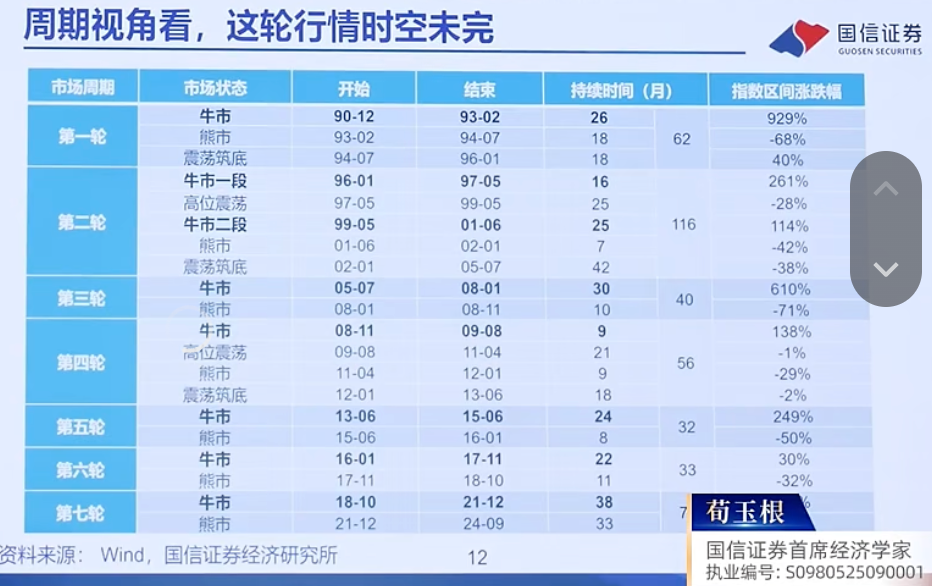
Group 1 - The core viewpoint is that the current market uptrend is driven by a persistent and potentially increasing policy easing environment [3][5][17] - The stock market has shown a significant divergence from economic performance this year, indicating that policies have effectively targeted current economic issues [4][10] - The contribution of a few leading companies to the overall market performance is notable, with five companies in the CSI 300 index contributing 22% to its gains [7][26] Group 2 - The upcoming five years are crucial for establishing a modern industrial system, with a focus on technological innovation [8][32] - The proportion of technology in the economy is expected to surpass that of consumption for the first time, marking a significant shift in economic structure [9][34] - The stock market's recovery is anticipated to boost consumer confidence and spending, which is currently low compared to developed countries [13][15] Group 3 - The current market is believed to be in the second phase of a bull market, characterized by gradual improvement in fundamentals [6][25] - Historical patterns suggest that the current bull market, which began in September 2024, has not yet reached its full potential [18][20] - The technology sector is expected to continue its upward trajectory, driven by the ongoing AI revolution and its applications [29][31] Group 4 - The concept of "old economy assets" is highlighted, suggesting that sectors like real estate and liquor, which have underperformed, may see a resurgence [35][39] - The long-term outlook for the equity market remains optimistic, with expectations of higher returns as the economy transitions to higher value-added industries [40][48] - The importance of aligning investment strategies with long-term economic trends is emphasized, particularly in the context of China's evolving industrial landscape [46][47]

宏观点评:10月经济全面降温的背后-20251114
GOLDEN SUN SECURITIES· 2025-11-14 11:40
Economic Overview - In October, industrial added value increased by 4.9% year-on-year, down from 6.5% in the previous period[1] - Retail sales grew by 2.9% year-on-year, slightly lower than the previous value of 3.0%[1] - From January to October, fixed asset investment decreased by 1.7%, compared to a decrease of 0.5% previously[1] External Demand - October export growth significantly declined, marking the lowest level since March due to base disturbances and falling export prices[2] - The decline in external demand is exacerbated by the misalignment of new consumer electronics product launches[3] Internal Demand - Real estate investment fell by 14.7% year-on-year, worsening from a previous decline of 13.9%[1] - Infrastructure investment showed a slight increase of 1.5%, down from 3.3% previously, while narrow infrastructure investment fell by 0.1%[1] Investment Trends - Manufacturing investment decreased by 2.7% year-on-year, down from 4.0% previously, with October showing a significant drop of 6.7%[1] - The overall investment landscape indicates a broad decline across real estate, infrastructure, and manufacturing sectors[3] Consumption Patterns - Consumer spending continues to decline, with retail sales growth at 2.9%, marking five consecutive months of decline[5] - The impact of the "trade-in" policy is diminishing, particularly in sectors like home appliances and automobiles[5] Policy Outlook - Achieving the annual GDP growth target of 5% is deemed feasible, with a required growth rate of 4.4% in Q4[4] - Short-term policies are expected to intensify, focusing on accelerating existing measures and preparing for next year's economic layout[4] Employment Situation - The urban survey unemployment rate slightly decreased to 5.1%, down by 0.1 percentage points from the previous value[44] Risks - Potential risks include changes in policy strength, overseas economic conditions, and geopolitical conflicts, which could lead to unexpected outcomes[8]
美联储预防式降息周期下的全球大类资产前景|财富与资管
清华金融评论· 2025-11-14 09:09
Core Viewpoint - The article discusses the initiation of a new preventive interest rate cut cycle by the Federal Reserve, predicting a further decline in U.S. Treasury yields, continued support for U.S. equities, particularly in technology and interest-sensitive sectors, a potential upward trend in the U.S. dollar index, and the ongoing long-term bull market for gold [2][3]. Group 1: Federal Reserve's Interest Rate Policy - The Federal Reserve has begun a new preventive interest rate cut cycle, with a 25 basis point cut in September and October 2025, indicating a shift in monetary policy focus towards employment risks over inflation risks [3][5]. - The Fed's adjustment of its monetary policy framework at the Jackson Hole meeting in August 2025 allows for a more flexible approach to inflation, suggesting that past high inflation levels will not heavily influence future policy decisions [5]. - The Fed's baseline assumption is that tariff-induced inflation is "one-time," which implies that even if inflation data rises in the coming months, the Fed will prioritize employment and economic stability over immediate inflation concerns [5][6]. Group 2: Economic Forecasts and Inflation - The Fed's updated economic forecasts indicate a slight increase in the Personal Consumption Expenditures (PCE) index for 2025 and 2026, reflecting ongoing inflationary pressures primarily driven by tariffs [6]. - The Fed anticipates three interest rate cuts in 2025, an increase from previous forecasts, but expects only one cut in 2026 and 2027, indicating a slow overall pace of rate reductions under the preventive cut framework [6]. Group 3: Historical Context of Rate Cuts - The article categorizes the Federal Reserve's rate cut cycles since the 1990s into two types: emergency cuts and preventive cuts, with the latter characterized by slower and smaller reductions in response to marginal economic declines [8][10]. - Historical examples of preventive cuts include the 1995-1996 cycle to address economic slowdown, the 1998 cycle to mitigate risks from the Asian financial crisis, and the 2019 cycle to counteract trade war impacts [10][11]. Group 4: Asset Price Reactions - U.S. Treasury yields typically decline significantly before the first rate cut, with a more pronounced drop in yields during preventive cut cycles compared to emergency cuts, as market expectations adjust ahead of official policy changes [13]. - U.S. equities tend to perform well during preventive cut cycles due to improved economic fundamentals and increased investor risk appetite, contrasting with the poorer performance seen during emergency cut cycles where economic conditions are more dire [14].

宏观日报:上游原材料价格分化-20251114
Hua Tai Qi Huo· 2025-11-14 05:52
Industry Overview Upstream - Prices of aluminum and copper in the non - ferrous metals sector have rebounded; international oil prices and liquefied natural gas prices are fluctuating [2] Midstream - In the chemical industry, PX prices are rising, while the operating rates of PTA and polyester are low; power plant coal consumption has decreased [3] Downstream - In the real estate sector, the sales of commercial housing in second - and third - tier cities have seasonally increased slightly; in the service industry, the film box office is in the off - season, and the number of domestic flights has seasonally increased slightly [3] Macroeconomic Events Production Industry - China is designing a new rare - earth export licensing system, and the Ministry of Commerce will carry out export control work on rare - earth related items in accordance with laws and regulations [1] Service Industry - In the first ten months of 2025, the cumulative increase in social financing scale was 30.9 trillion yuan, 3.83 trillion yuan more than the same period last year; RMB loans increased by 14.97 trillion yuan. At the end of October, M2 balance was 335.13 trillion yuan, a year - on - year increase of 8.2%; M1 balance was 112 trillion yuan, a year - on - year increase of 6.2%; M0 balance was 13.55 trillion yuan, a year - on - year increase of 10.6%. The narrowing gap between M1 and M2 indicates positive signals such as increased business activity and improved consumer demand [1] Key Industry Price Indicators | Industry | Indicator | Price | YoY | | --- | --- | --- | --- | | Agriculture | Spot price of corn | 2161.4 yuan/ton | 0.40% | | | Spot price of eggs | 6.5 yuan/kg | 1.25% | | | Spot price of palm oil | 8710.0 yuan/ton | 0.11% | | | Spot price of cotton | 14819.5 yuan/ton | - 0.29% | | | Average wholesale price of pork | 18.1 yuan/kg | - 0.60% | | Non - ferrous metals | Spot price of copper | 87301.7 yuan/ton | 1.59% | | | Spot price of zinc | 22618.0 yuan/ton | 0.63% | | | Spot price of aluminum | 21933.3 yuan/ton | 2.60% | | | Spot price of nickel | 121150.0 yuan/ton | - 0.03% | | | Spot price of aluminum | 17606.3 yuan/ton | 1.51% | | Ferrous metals | Spot price of rebar | 3133.0 yuan/ton | 0.00% | | | Spot price of iron ore | 794.7 yuan/ton | - 0.08% | | | Spot price of wire rod | 3302.5 yuan/ton | - 0.08% | | | Spot price of glass | 14.0 yuan/square meter | - 1.06% | | Non - metals | Spot price of natural rubber | 14883.3 yuan/ton | 1.82% | | | China Plastics City Price Index | 772.0 | - 0.58% | | Energy | Spot price of WTI crude oil | 58.5 dollars/barrel | - 1.86% | | | Spot price of Brent crude oil | 62.7 dollars/barrel | - 1.28% | | | Spot price of liquefied natural gas | 4206.0 yuan/ton | - 1.91% | | | Coal price | 834.0 yuan/ton | 1.21% | | Chemical | Spot price of PTA | 4591.6 yuan/ton | 0.67% | | | Spot price of polyethylene | 6988.3 yuan/ton | 0.02% | | | Spot price of urea | 1630.0 yuan/ton | 2.03% | | | Spot price of soda ash | 1214.3 yuan/ton | 0.89% | | Real estate | Cement price index | 136.4 | - 0.16% | | | Building materials composite index | 112.3 points | 0.42% | | | Concrete price index | 90.8 points | - 0.14% | [38]
A股:创10年新高了!大家做好准备,不出意外,周五大盘将迎来新的拐点
Sou Hu Cai Jing· 2025-11-13 17:16
Group 1 - The A-share market has reached a ten-year high, with the Shanghai Composite Index closing at 4029.50 points, up 0.73%, and significant trading volume returning to the 2 trillion yuan level [1] - Northbound capital continues to show a net inflow, which is expected to support heavyweight sectors, indicating strong market liquidity [2][7] - The current market structure of "weak adjustment + high turnover" differs from traditional sharp declines, as funds rotate between sectors, providing a stable foundation for a gradual market uptrend [3] Group 2 - Market hotspots are diversifying, with sectors like energy storage and non-ferrous metals showing strength, while the camping economy concept has sparked a surge in small-cap growth stocks [5] - Some heavyweight sectors, such as securities, liquor, banking, and real estate, are currently in a low position and may become key drivers for the index if capital flows back into them [6][11] - On Friday, it is anticipated that the market will experience a combination of "heavyweight support + thematic rotation," with a focus on the capital flow in sectors like securities, liquor, banking, and real estate [11][13] Group 3 - The securities sector has not yet started but has reached a new high, and concentrated capital could accelerate the index towards 4500 points [8] - The liquor sector has undergone sufficient adjustment, and a return of capital could create a demonstration effect within the consumer sector [9] - The banking sector is seeing increased attention due to rising interest rate policy expectations, while the real estate sector has strong policy catalyst expectations that could lead to sudden opportunities [10]
收息新选择,更真实指标,自由现金流率当前是多少?
Mei Ri Jing Ji Xin Wen· 2025-11-13 15:28
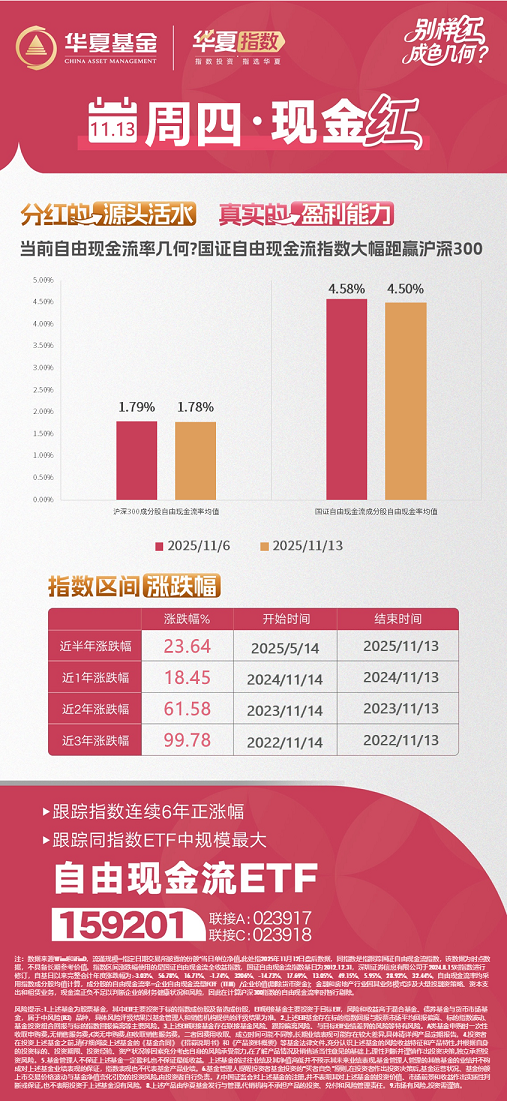
Core Insights - Free cash flow (FCF) is a reliable and unembellished financial metric that reflects a company's true earnings after covering essential expenses like rent, salaries, and capital expenditures. It is considered a more accurate representation of a company's financial health compared to traditional profit statements [1] - The calculation of free cash flow is straightforward: operating cash flow minus capital expenditures. This cash can be utilized flexibly for shareholder dividends or reinvestment in new projects, making it a vital indicator of a company's financial capability [1] - Different industries exhibit significant variations in free cash flow due to differing capital expenditure requirements, particularly in capital-intensive sectors like banking and real estate, which are often excluded from free cash flow analyses [1] Industry Analysis - The current cash flow rate of the National Securities Free Cash Flow Index component stocks is being tracked, indicating a focus on this metric for investment decisions [1] - The index has shown a substantial increase over the past two years, with a growth rate of 61.58% and a remarkable 99.78% increase over the last three years, highlighting the positive trend in free cash flow among the tracked companies [3]
2026年A股策略展望:“小登”时代,牛途仍在
Guoxin Securities· 2025-11-13 09:23
Group 1 - The current bull market is in its second phase, transitioning from emotional drivers to fundamental ones, with a focus on technology as the main theme [1][11][19] - The bull market is characterized by a significant structural differentiation between "small-cap" and "large-cap" assets, with "small-cap" stocks outperforming [30][21] - The technology sector is expected to lead the market, with specific attention on AI applications, robotics, smart driving, and AI in life sciences [2][57][68] Group 2 - The report highlights that the bull market's main line is technology, with significant contributions from major tech companies, particularly in AI and semiconductor sectors [2][63] - Historical bull markets have shown that the main line often correlates with industry cycles, where sectors with high revenue growth tend to outperform [58][60] - The report emphasizes the importance of understanding the differentiation between "old economy" and "new economy" stocks, with a recommendation to maintain exposure to dividend-paying assets amidst a backdrop of financial asset scarcity [2][30][10] Group 3 - The report discusses the impact of macroeconomic policies, including fiscal and monetary measures, on market performance, particularly in relation to the "14th Five-Year Plan" and its focus on high-quality development and technological self-reliance [17][18] - The analysis indicates that the market's valuation structure is healthier compared to previous bull markets, with a lower percentage of stocks trading at high price-to-book ratios [21][25] - The report notes that the trend of "deposit migration" is ongoing, with a shift in funds towards higher-yielding assets as traditional deposit rates decline [35][39]