
TMT

Search documents
A股成交跌破两万亿,风格转换或贯穿第四季度
Di Yi Cai Jing Zi Xun· 2025-10-16 11:02
Core Viewpoint - The A-share market is experiencing a volume contraction, indicating a potential shift to a consolidation phase, with high dividend sectors showing strength while previously strong tech stocks are undergoing corrections [1][2][3] Market Performance - The Shanghai Composite Index closed at 3916 points, up 0.1%, while the Sci-Tech Innovation 50 Index fell by 0.94% to 1416.58 points [1] - Trading volume in the Shanghai and Shenzhen markets fell below 1.95 trillion yuan, marking the first time since August 12 that it dropped below 2 trillion yuan [1] Sector Analysis - High dividend sectors such as insurance, banking, coal, and shipping are leading the gains, while some tech stocks, particularly in AI and solid-state batteries, are experiencing pullbacks [1][2] - The market is seeing a shift in focus from previously strong sectors like AI and solid-state batteries to more traditional industries that remain undervalued [1][4] Investor Sentiment - Market participants are exhibiting cautious sentiment, leading to reduced trading activity and a need for new leading sectors to emerge [2][3] - The current volume contraction is viewed as a potential indicator of market bottom, but requires consideration of other factors such as fundamentals and technical analysis [2] Future Outlook - The fourth quarter is expected to see a style shift towards high dividend sectors, contrasting with the stagnation observed in the third quarter [4] - As quarterly reports are released, sectors like banking and insurance are anticipated to show strong performance due to their high earnings certainty, while consumer sectors may also see some recovery [4][5] - The market is likely to experience a transition from growth to value investing, with low-valued sectors presenting opportunities for valuation recovery [5]
A股成交跌破两万亿
Di Yi Cai Jing Zi Xun· 2025-10-16 09:33
Market Overview - A-shares continue to experience reduced trading volume, with the Shanghai Composite Index closing at 3916 points, up 0.1%, and the Sci-Tech Innovation 50 Index down 0.94% at 1416.58 points [2] - Trading volume in the Shanghai, Shenzhen, and Beijing markets fell below 1.95 trillion yuan, marking the first time since August 12 that it has dropped below 2 trillion yuan [2] Sector Performance - High dividend sectors such as insurance, banking, coal, and shipping have shown strong performance, while some previously strong tech stocks have experienced corrections [2] - The demand for adjustment in high-valuation sectors like artificial intelligence, solid-state batteries, and non-ferrous metals is noted, with traditional industries remaining undervalued and offering high dividend yields [2][3] Market Sentiment - Market participants are exhibiting cautious sentiment, leading to reduced trading activity as they await the emergence of new leading sectors [3] - The current market environment is characterized by a potential shift in market style, with high dividend sectors expected to perform strongly in the fourth quarter, contrasting with the stagnation seen in the third quarter [6] Future Outlook - Analysts suggest that the fourth quarter may see a style shift towards value sectors such as banking, coal, and liquor, which have shown strong performance, while technology and non-ferrous metals may continue to experience adjustments [6][7] - The focus on low-valuation, high-dividend sectors indicates a potential for valuation recovery, especially as the market's attention shifts towards policy expectations and valuation levels [6][7]


私募下半年以来累计调研1.85万次,除了TMT,还在关注哪些方向?
Xin Lang Cai Jing· 2025-10-16 03:04
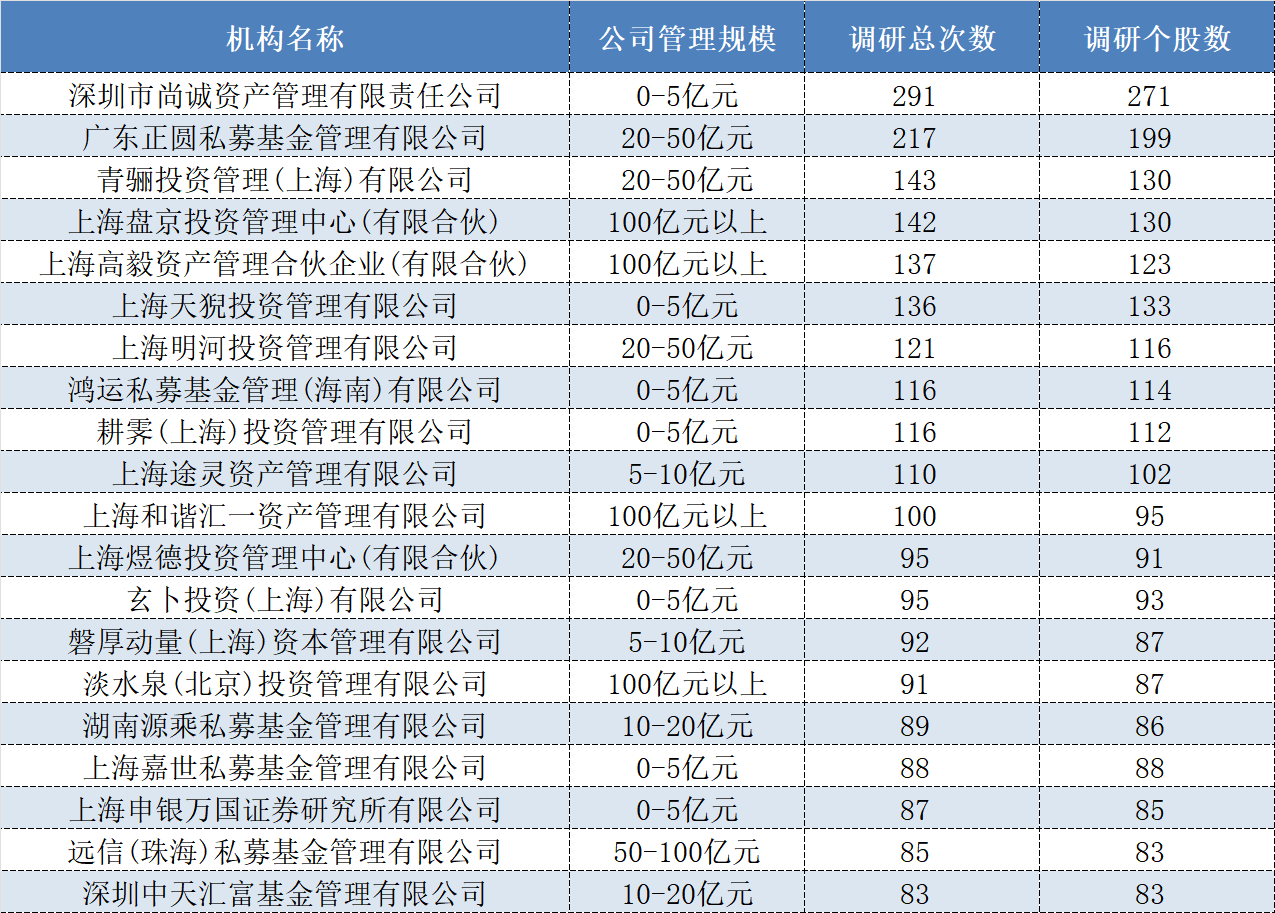
Core Insights - The article highlights the active engagement of private equity firms in conducting research on listed companies, with a total of 2712 private equity firms researching 1490 stocks, resulting in 18,500 research instances since the beginning of the second half of the year [1][4]. Group 1: Private Equity Research Activity - The most active private equity firms include Shenzhen Shangcheng Asset Management with 291 research instances and Guangdong Zhengyuan Private Equity with 217 instances, covering 271 and 199 stocks respectively [2][1]. - Other notable firms include Qingli Investment and Pankin Investment, with 143 and 142 research instances respectively, both covering 130 stocks [1][2]. - A total of 45 private equity firms conducted between 50 to 100 research instances during the same period [1]. Group 2: Focus Areas of Research - The TMT (Technology, Media, and Telecommunications) sector is a primary focus, with 384 stocks researched, accounting for 25.77% of the total [4]. - Within the TMT sector, the electronics and computer industries had 207 and 118 stocks researched respectively, while the telecommunications and media sectors had fewer stocks at 38 and 21 [4]. - Other sectors with significant research interest include machinery and pharmaceuticals, with 200 and 179 stocks researched respectively [5]. Group 3: Market Performance - The average increase in the 31 Shenwan primary industry indices since the beginning of the second half of the year is 15.13% [5]. - Specific indices in the TMT sector, such as telecommunications, electronics, and power equipment, have seen increases exceeding 40% [5]. - The machinery and basic chemicals sectors also performed well, with increases of 24.16% and 16.47% respectively [5]. Group 4: Stock Performance - Among the 1490 stocks researched, 558 stocks saw price increases between 0%-20%, while 406 stocks increased between 20%-50%, together making up 64.7% of the total [7]. - A total of 44 stocks experienced price increases exceeding 100%, and 154 stocks increased between 50%-100% [7]. - Five stocks attracted over 100 private equity firms for research, including Maiwei Biotech and Mindray Medical, with respective price increases of 66.97% and 3.14% [8].





长城基金汪立:下一个十年,重点关注以人工智能为代表的创新科技领域
Xin Lang Ji Jin· 2025-10-15 08:10
Core Insights - The Shanghai Composite Index reached a peak of 6124 points 18 years ago, and while it has not returned to this level, the performance of the Wind Ordinary Equity Fund Index and Wind Hybrid Equity Fund Index has doubled during this period, highlighting a significant contrast in investment performance [1][2] Group 1: Market Performance and Investment Logic - The differing performance between the Shanghai Composite Index and equity fund indices is attributed to varying market conditions over the years, with structural opportunities being present even during periods of market stagnation [2] - Public funds have demonstrated a clear ability to identify and capitalize on structural opportunities, adapting their investment styles in response to economic trends, such as favoring technology growth during the rise of mobile internet and focusing on new energy and semiconductor sectors under the "dual carbon" initiative [2][3] Group 2: Historical Lessons for Asset Allocation - Historical analysis of bull and bear markets suggests that distinguishing between speculative trends and long-term investment value is crucial for successful asset allocation [3] - A shift from a "casino mentality" of chasing market trends to a "shareholder mentality" focused on value and industry trends is essential for achieving excess returns [3] Group 3: Future Investment Opportunities - The next decade is expected to see core investment opportunities emerge in innovative technology sectors such as artificial intelligence, new energy, and biotechnology, driven by China's transition to high-quality economic development [4] - The AI revolution, exemplified by the launch of OpenAI's ChatGPT, is anticipated to create new paradigms across various industries, with ongoing advancements in technology and policy support expected to enhance investment prospects in this area [4] Group 4: Outlook for Equity Markets and Fund Investment - Future performance of equity markets will depend on three key factors: the strength of policy support, the sustainability of market bullish sentiment, and new catalysts in the technology sector [5] - Recent market rallies have been significantly influenced by policy measures and the influx of high-risk capital, indicating that continued bullish sentiment will be a driving force for market growth [5]
策略日报:“旧”势力的反击-20251014
Tai Ping Yang Zheng Quan· 2025-10-14 14:41
Group 1: Macro Asset Tracking - The bond market is expected to stabilize in the short term but will continue to decline in the long term, with a target near the low point of September 30, 2024 [3][13][9] - The stock market shows no significant signs of weakness, and the current stable volume and breakthrough of long-term resistance suggest that even if the market performs poorly in the next quarter, it will only provide short-term support for the bond market [3][13] - The outlook for the stock market indicates a breakthrough in the index, with commodities poised for a rebound, while the bond market is expected to experience fluctuations around the annual line for about one quarter before continuing to decline [3][13] Group 2: Stock Market Insights - The "old" forces represented by coal and banks are pushing back against the "new" forces represented by technology, with high absorption rates and volatility in technology making it difficult to achieve excess returns [4][15] - The absorption rate for technology remains high, currently above 30%, indicating insufficient time and space for a decline from high levels, with expectations that the "old" forces will regain market attention in the coming quarter [4][15] - Key sectors such as banks, coal, and insurance are leading the market, while the TMT sector has seen significant adjustments [4][15] Group 3: U.S. Stock Market Outlook - The overall risk appetite in the market is declining, which may impact the U.S. stock market; however, the healthy fundamentals of the U.S. economy and ample monetary policy space suggest that the U.S. market will maintain relative strength compared to other markets [5][20] - The VIX index is a critical indicator, and a strategy of "buy the dip" remains effective when the VIX exceeds 30 [5][21] Group 4: Foreign Exchange Market Analysis - The onshore RMB against the USD reported at 7.1403, showing an increase of 83 basis points, with expectations for the USD to continue its strong performance in the near term [6][26] - The euro is expected to decline against the USD, while the RMB is anticipated to maintain wide fluctuations [6][26] - The recent rise in the USD index has surpassed the previously indicated strong point of 99, with expectations that the upward movement will exceed market expectations [6][26][27] Group 5: Commodity Market Trends - The Wenhua Commodity Index has decreased by 0.62%, with all sectors except precious metals showing poor performance; copper and crude oil have significantly declined [7][30] - Investors are advised to set stop-loss levels and approach short positions cautiously due to the weak trends in copper and crude oil [7][30]
金融市场流动性与监管动态周报:四季度风格日历效应如何?-20251014
CMS· 2025-10-14 12:42
Group 1 - The report indicates that in the past 15 years (2010-2024), the probability of large-cap style outperforming in October is relatively high, with a 67% chance of outperforming the broad market index [9][4]. - Value style has a slightly higher probability of outperforming growth style, with a 53% chance of outperforming the broad market index [9][4]. - The main drivers for significant style shifts in the fourth quarter typically include policy changes, disruptions in strong sector logic, or new developments that reinforce other sector logics [4][22]. Group 2 - In terms of liquidity, the report notes that the central bank conducted a net withdrawal of 15,263 billion yuan in the week of October 6-12, with a future expectation of 10,210 billion yuan in reverse repos [26][29]. - The report highlights that the average weekly trading volume in the A-share market increased to 22,704.16 billion yuan, indicating heightened market activity [4][37]. - The net inflow of financing funds reached 473.1 billion yuan, marking a shift from previous net outflows [4][37]. Group 3 - The report identifies that financial real estate and TMT sectors have historically performed well in the fourth quarter, with financial style appearing superior in 4 out of the past 15 years [17][18]. - The report also notes that large-cap style has a higher occurrence rate, appearing in 9 out of the past 15 fourth quarters [18][21]. - The technology leader index has the highest probability of outperforming the broad market index at 62%, with an average return of 3.58% [21][22]. Group 4 - The report mentions that the market sentiment has shown increased trading activity in financing funds, with the proportion of financing transactions in the A-share market rising to 13.9% [46][48]. - The VIX index has increased, indicating a decline in market risk appetite, with the Nasdaq and S&P 500 indices also experiencing declines [48][49]. - The report highlights that the demand for funds has decreased, with no IPO financing in the week of October 9-10, and a reduction in planned share reductions by major shareholders [41][42].
【策略月报】重磅会议将至,政策催化与风格变化——2025年10月资产配置报告
华宝财富魔方· 2025-10-14 10:00
分析师: 蔡梦苑 登记编号:S0890521120001 分析师:郝一凡 登记编号:S0890524080002 分析师:刘 芳 登记编号:S0890524100002 | | 就业市场持续降温,中美关税博弈增加 | | --- | --- | | | > 就业市场持续降温,通胀符合预期 | | | ◆ 劳动力市场持续降温。美国8月非农就业仪增2.2万人、远低于预期及7月修正值(7.9万)。6月数据下修至减少1.3万、失业率升 | | 海外宏观 | 至4.3%,反映劳动力市场压力加剧。美国8月0P1同比上涨2.9%,环比上涨0.4%,显示出通胀温和回升的态势。 | | | > 中美近期关税博弈增加 | | | ◆ 美国总统特朗普10月10日在社交媒体威胁从11月1日起对华加征100%关税。其背后有两方面原因:一来、随着美联储进入降息周期 | | | 特朗普认为具备了更多应对潜在经济冲击的政策底气:二来,当前突陈关税税率未达其预期,也为其继续加码创造了条件。 | | | ◆ 考虑到全面实施100%关税将在执行层面面临巨大阻力,该政策最终完全落地的可能性有限。 | | | 经济运行承压,政策加码可能性上升,关注中 ...

风险事件扰动下的应对思路
2025-10-13 14:56
Summary of Conference Call Records Industry or Company Involved - The records primarily discuss the **A-share market** and various **industries** including **technology**, **pharmaceuticals**, **military**, **insurance**, and **consumer goods**. Core Points and Arguments Market Trends and Economic Outlook - The A-share market has seen a cumulative increase of over **20%** since late June, with main sectors performing even better, although there is a need to be cautious of profit-taking and potential risks [1][5] - The domestic capacity cycle is approaching a turning point, and combined with anti-involution policies, there is an expectation of upward profit elasticity from year-end to next year [1][5] - The overall funding environment remains positive, with a shift of household savings towards equity markets due to low deposit rates and low returns from real estate investments [5] Sector-Specific Insights - The **pan-technology sector** is entering an earnings disclosure period in October, facing pressure from price-performance ratios [3][4] - The **AI industry** is experiencing accelerated trends, benefiting certain segments despite a decline in the overseas computing supply chain's component performance [3][8] - The **pharmaceutical industry** is showing signs of recovery, particularly in innovative drugs and medical devices, with a **45%** year-on-year increase in global pharmaceutical investment in Q3 [9][10] - The **military and aerospace sectors** have shown significant improvement in data, with notable increases in revenue for key companies [9] - The **insurance sector** has seen a rebound in premium income and stable growth in property insurance, with investment returns performing well since September 2024 [10] Consumer Goods Recovery - The recovery in consumer goods is gradual, with improvements noted in essential and mass consumer products such as dairy, dining condiments, and beauty care [7] - The retail price of milk has turned positive year-on-year, indicating a stabilization in the consumer goods sector [7] Investment Recommendations - Suggested investment strategies include diversifying portfolios while focusing on sectors with strong performance potential such as **AI**, **semiconductors**, **upstream materials**, and **communication equipment** [5][11] - Caution is advised regarding the uncertainties stemming from US-China trade tensions, with recommendations to hold gold as a neutral option and consider low-beta dividend stocks for more cautious strategies [5] Other Important but Possibly Overlooked Content - The **TMT sector** has shown a slight decline in sentiment over the past three months, but strong demand persists in certain areas like communication equipment and data centers [3][8] - The **engineering machinery** and **building materials** sectors are showing signs of recovery, with notable increases in sales data during traditionally slow months [6] - The overall industry and non-financial industry sentiment indices have declined, but there are still strong upward trends in specific sectors like AI and resource materials [6]
投资需要回归常识!这本书教你何时买,买什么,怎么配
雪球· 2025-10-13 13:00
Overall Introduction - The book introduces market rules, asset allocation logic, and strategies for different asset classes, including stocks, bonds, and commodities, while addressing practical issues faced by investors [4]. Core Views - The book proposes three dimensions to assess the market: policy, economy, and inflation, which are used to determine market conditions [7]. - Economic cycles are divided into six stages, each with corresponding asset preferences, ranging from bonds in the early slowdown to cash and commodities in the stagflation phase [11][12][13][39]. - Effective asset allocation strategies include the Permanent Portfolio, All Weather Portfolio, and Global Market Portfolio, emphasizing diversification and risk management [14][15][16]. Current Situation - Current policies are characterized as accommodative, with indicators such as M1 growth increasing from 0.39% in January to 5.96% in August [33]. - Economic recovery is weak, with industrial value-added growth declining from 7.7% to 5.2% [37]. - The market is likely in a transition between the late slowdown phase and the early recovery phase, suggesting a preference for small-cap growth stocks [39][40]. Investment Insights - Long-term asset allocation is crucial for sustained success, with diversified strategies proven to provide stable returns [44]. - A balanced stock-bond allocation is suitable for most investors, allowing for flexibility in extreme market conditions [45]. - Simplifying investment approaches and focusing on fundamental market principles can lead to better outcomes [47][48].

事件点评:策略类●短期贸易摩擦难改A股慢牛趋势
Huajin Securities· 2025-10-12 09:10
Group 1 - The core viewpoint of the report indicates that the long-term trend of a slow bull market in A-shares remains unchanged, despite short-term pressures from trade tensions [1][8] - The report highlights that the structural recovery of A-share profits and potential credit recovery are key factors supporting the slow bull trend [8][13] - Short-term adjustments in A-shares are viewed as opportunities for low-position layouts, with limited adjustment pressure on the fundamentals [13][20] Group 2 - The report discusses the reasons behind the current round of US-China tariff tensions, including China's restrictions on rare earth exports and the ongoing negotiation dynamics [7][8] - It notes that the potential imposition of additional tariffs by the US may serve as a countermeasure against China's export controls on rare earths, reflecting a strategic negotiation tactic [7][8] - The report emphasizes that the impact of tariffs on exports is expected to be less severe than in previous instances, due to an optimized export structure and resilient domestic consumption and investment [13][20] Group 3 - The industry allocation analysis suggests a balanced style in the short term, while the technology sector remains favored in the medium to long term [15][20] - The report indicates that sectors such as large finance, rare earths, agriculture, and innovative pharmaceuticals may perform relatively well in the short term due to their defensive attributes [20][22] - It also highlights that the technology sector, particularly in areas like artificial intelligence and robotics, continues to receive policy support and is expected to maintain a favorable position in the long term [16][22]