
消费

Search documents
转债事件点评:把握跨年行情布局时机
GUOTAI HAITONG SECURITIES· 2025-12-15 14:44
1. Report's Investment Rating for the Industry - No information provided about the industry investment rating in the report 2. Core Viewpoints of the Report - The convertible bond market is expected to remain volatile and consolidate in the short term and is likely to warm up and rebound near the year - end. It is recommended to have a balanced allocation for both offense and defense. Short - term market adjustments due to liquidity disturbances can be seen as layout opportunities. The focus of convertible bond layout should be on two main lines: defensive bottom - position varieties and technology - growth sectors with policy support and industrial trends. Additionally, consumer - related convertible bonds are also worthy of attention [2][4][12] 3. Summary According to the Directory 3.1 Convertible Bond Weekly Strategy - **Stock Market Performance**: From December 8th to 12th, the A - share market showed a volatile and differentiated pattern, with the growth style significantly outperforming. The ChiNext Index had the best performance, rising 2.74%, the Shenzhen Component Index rose 0.84%, and the Shanghai Composite Index slightly fell 0.34%. The trading volume of the Shanghai and Shenzhen stock markets increased, with the daily average trading volume reaching 1.95 trillion yuan. Technology - growth sectors represented by commercial aerospace, CPO, and controlled nuclear fusion led the gains, while traditional sectors such as coal, petroleum and petrochemicals, and real estate performed poorly [6] - **Convertible Bond Market Performance**: The convertible bond market rose slightly, and the valuation continued to recover. The CSI Convertible Bond Index rose 0.20%, and the convertible bond equal - weighted index rose 0.09%, outperforming the convertible bond underlying stock equal - weighted index which fell 0.94%. The market internal structure was highly differentiated, with high - price, low - premium convertible bonds performing relatively well, while double - low and low - price convertible bonds pulled back. Small - cap and large - cap convertible bonds rose, while mid - cap convertible bonds fell. The median convertible bond parity price decreased 1.61% to 99.60 yuan, the median convertible bond price decreased 0.63% to 130.78 yuan, and the median conversion premium rate increased 1.21 percentage points to 32.71% [9] - **Market Outlook**: In the second half of December, the convertible bond market is expected to remain volatile and consolidate in the short term and may warm up and rebound near the year - end. After the Fed's interest - rate cut in December, the positive policy tone of the Central Economic Work Conference for 2026, and the policies to promote the entry of long - and medium - term funds into the market are expected to bring incremental funds. The market is likely to be mainly volatile in the short term, with limited room for a sharp decline. As institutional funds start to plan for 2026 at the end of the month, market sentiment is expected to improve, and trading volume may gradually pick up. A cross - year offensive is expected to start near the end of December [11][12] - **Investment Strategy**: It is recommended to have a balanced allocation for both offense and defense. Short - term market adjustments due to liquidity disturbances can be seen as layout opportunities. The focus of convertible bond layout should be on two main lines: one is the bottom - position varieties with defensive attributes, such as relatively low - price convertible bonds below 125 yuan, or large - cap convertible bonds or financial convertible bonds with sound fundamentals; the other is the technology - growth sectors with policy support and industrial trends, such as commercial aerospace, artificial intelligence, and semiconductors. After adjustments, some convertible bonds in these sectors have regained elasticity and are more suitable for offensive strategies. In addition, after three years of adjustment, the consumer sector has low valuations and positions, and consumer - related convertible bonds are worthy of attention due to the year - end consumption peak season and potential policy stimuli [12]
[12月15日]指数估值数据(指数调仓落地,估值更新;债基适合定投吗?)
银行螺丝钉· 2025-12-15 14:03
Market Overview - The overall market experienced a decline, closing at 4.2 stars [1] - Large-cap stocks slightly decreased, while small-cap stocks saw a more significant drop [2] - Recently underperforming value styles showed an overall increase today [3] - Indices related to dividends and cash flow rose [4] - Growth styles, which had been strong recently, faced a notable decline today [5] - The market has been in a sideways trend for the past two to three months, characterized by style rotation between growth and value [6] Valuation Insights - Last Friday marked the index rebalancing day for December, and the valuations observed today reflect data post-rebalancing [7] - Most indices related to dividends, value, and low volatility saw a slight decrease in valuations after the rebalancing [8] Policy Impact - New policies aimed at boosting domestic demand were announced, leading to a general rise in consumption-related indices [9] Hong Kong Market - The Hong Kong stock market experienced a significant rise last Friday but saw a decline today [10] - Technology indices in Hong Kong returned to undervalued status after today's drop [11] Investment Strategies - Dollar-cost averaging (DCA) can serve two purposes: saving money and reducing cost volatility [12][16] - DCA is effective in lowering costs during downturns, allowing for potential profits without needing to return to previous price levels [18][20] - The bond fund category is vast, with varying levels of volatility [21] - Long-term pure bond investments are more effective for DCA, especially during high-value investment phases [25] Bond Market Dynamics - Bond markets can experience bear markets, as seen from 2016 to 2018 and 2020 to 2021 [27] - Rising interest rates post-bond declines can enhance the attractiveness of long-term pure bonds [28] - The investment value of long-term pure bonds increases when the 10-year government bond yield is low [30][33] Investment Products - Besides long-term pure bond funds, there are also secondary bond funds and mixed-asset funds that primarily invest in bonds with some equity exposure [35] - These mixed products often include low-volatility dividend stocks and high free cash flow stocks [36] - The current year has been favorable for mixed-asset funds, with notable performance [37] Upcoming Events - A live session is scheduled to discuss personal pension investments and index fund selection on December 16 [40]

加大金融支持,提振消费再升级
Datong Securities· 2025-12-15 13:11
Market Review - The equity market showed mixed performance last week, with the North Certificate 50 index rising the most by 2.79%, while the Shanghai Composite Index fell by 0.34% [5][6] - The bond market saw a collective decline in both short and long-term interest rates, with the 10-year government bond yield decreasing by 0.84 basis points to 1.840% [10][13] - The fund market reflected the equity market's influence, with the equity fund index increasing by 0.71% and the secondary bond fund index rising by 0.06% [16] Equity Product Allocation Strategy Event-Driven Strategy - The joint announcement by three departments to boost consumption suggests a focus on consumer-related funds such as Jiashi New Consumption A and Industrial Bank New Generation Consumption [18] - The release of the "Action Plan for Enhancing Elderly Care Service Capacity" indicates potential investment in the healthcare sector, with funds like Jiashi Mutual Selection A and Penghua Medical Innovation A being highlighted [19] - The opening of the "Robot World" emphasizes investment opportunities in AI and robotics, with funds like Huaxia Intelligent Manufacturing Upgrade A and Jiashi Frontier Innovation being recommended [20] Asset Allocation Strategy - The overall strategy suggests a balanced core plus a barbell approach, focusing on dividend and technology sectors, with recommended funds including Anxin Dividend Selection A and Jiashi Hong Kong Internet Core Assets [21][26] - The dividend assets are highlighted for their value in a low-interest-rate environment, supported by national policies encouraging regular dividends from companies [21] - The technology growth direction is emphasized due to government support and the global trend towards AI development, making tech companies increasingly attractive [22][23] Stable Product Allocation Strategy - The analysis indicates a continued net injection by the central bank, maintaining a loose monetary environment, which is favorable for the bond market [27] - Recent CPI and PPI data show a slight increase in consumer prices, while the Federal Reserve's recent rate cut aligns with expectations for a supportive monetary policy [28] - Recommended products include short-term bond funds like Nord Short Bond A and Guotai Lianan Medium and Short Bond A, with a focus on maintaining a conservative risk profile [33]
中国续当全球经济“稳定器”
Guo Ji Jin Rong Bao· 2025-12-15 10:51
Group 1 - China's strong export performance provides greater space for policy operations, with fiscal efforts expected to play a key role in addressing global economic uncertainties [1][6] - The Central Economic Work Conference outlined key tasks for 2026, emphasizing the need for a strong domestic market, innovation-driven growth, and coordinated development [3][4] - The focus on domestic demand indicates a potential reduction in external contributions to economic growth, necessitating macro policies aimed at boosting consumption and investment [4] Group 2 - The monetary policy will continue to be moderately accommodative, with the central bank likely to implement gradual interest rate cuts and reserve requirement ratio reductions [5] - Structural monetary policies will be optimized to support key sectors such as technology innovation, manufacturing upgrades, and green development [5] - The fiscal policy will remain proactive, with an emphasis on maintaining necessary fiscal deficits and optimizing expenditure structures to address local fiscal challenges [5] Group 3 - Global monetary policy paths are diverging, with the U.S. Federal Reserve recently lowering interest rates while other major economies like the Eurozone and the UK are expected to maintain or even increase rates [7][11][12] - Emerging markets may benefit from a weaker dollar and potential further rate cuts by the Federal Reserve, creating more room for local central banks to implement supportive monetary policies [14] - The economic outlook for emerging markets varies, with some countries like Brazil and India expected to maintain robust growth due to strong domestic demand [14]
ETF盘中资讯 保险投资政策优化!中国平安涨近4%创阶段新高!香港大盘30ETF(520560)近5日吸金4349万元
Jin Rong Jie· 2025-12-15 06:15
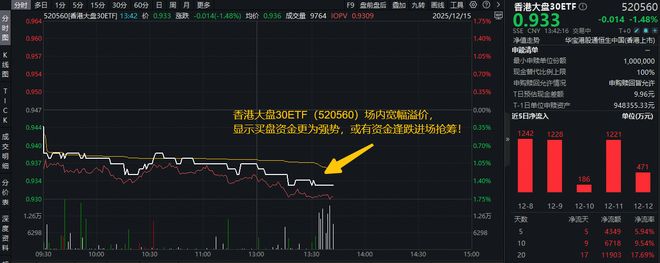
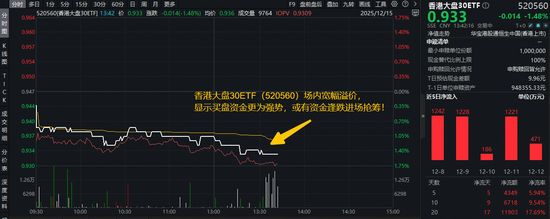
Core Viewpoint - The Hong Kong stock market is experiencing a pullback, with the Hang Seng Technology Index dropping over 2%, while the Hong Kong Large Cap 30 ETF (520560) shows strong buying interest despite market corrections, indicating potential investment opportunities in the sector [1][3]. Market Performance - On December 15, all three major indices in the Hong Kong stock market retreated, with the Hang Seng Technology Index falling more than 2% [1]. - The Hong Kong Large Cap 30 ETF (520560) saw a price decline of 1.48%, but it exhibited a wide premium in the market, suggesting strong buying momentum [1]. - Over the past five days, the Hong Kong Large Cap 30 ETF has attracted a net inflow of 43.49 million yuan, and in the last 20 days, it has accumulated a total of 119 million yuan, reflecting positive sentiment towards the future performance of Hong Kong stocks [1]. Sector Analysis - The insurance sector in Hong Kong showed resilience, with China Ping An rising nearly 4% to reach a new high, and China Life increasing by over 1% [1]. - In the consumer sector, Yum China and Anta Sports both rose by over 1%, leading the gains [1]. - Conversely, leading innovative pharmaceutical company BeiGene fell nearly 7%, while technology leaders like SMIC and Kuaishou dropped over 2%, negatively impacting index performance [1]. Regulatory Changes - The National Financial Regulatory Administration has announced adjustments to the risk factors for insurance companies, which will enhance the capacity for insurance capital to enter the market [3]. - The adjustments include a reduction in risk factors for investments in the CSI 300 Index, the CSI Dividend Low Volatility 100 Index, and STAR Market stocks, potentially releasing a minimum capital of approximately 19.8 billion yuan, which could lead to an additional 72.6 billion yuan in stock investments if fully utilized [3]. Investment Strategy - Analysts suggest that the adjusted valuation of Hong Kong stocks presents better opportunities, particularly in technology and dividend sectors, with a focus on core assets for long-term investment [3]. - The "barbell strategy" is recommended, combining stable value assets with growth-oriented assets in the Hong Kong market [3]. - The dividend yield of Hong Kong stocks is noted to be higher than that of A-shares, with the banking sector in Hong Kong yielding 6.1% compared to 4.3% in A-shares, indicating greater investment value [3]. ETF Overview - The Hong Kong Large Cap 30 ETF (520560) is highlighted as the first in the market to adopt a "technology + dividend" barbell strategy, comprising 30 major Hong Kong stocks, including high-growth tech companies like Alibaba and Tencent, as well as stable dividend payers like China Ping An and China Construction Bank [4].

保险投资政策优化!中国平安涨近4%创阶段新高!香港大盘30ETF(520560)近5日吸金43...
Xin Lang Cai Jing· 2025-12-15 06:03
来源:新浪基金 1、港股红利方面,中金公司指出,港股股息率高于A股(以银行板块为例,港股银行板块股息率为 6.1%,高于A股银行板块的4.3%),港股投资价值或更高。 2、港股科技方面,从千问、灵光等国产大模型带动AI应用叙事美联储降息周期持续层面来看,对于港 股科技股中长期投资价值有望日益凸显。 看好港股科技但又希望降低波动?也可以关注全市场首只——香港大盘30ETF(520560)及其联接基金 【联接A(LOF)501301;联接C 006355】,自带"科技+红利"哑铃策略,一基荟萃30只港股通中资大 盘股,重仓股既有阿里巴巴、腾讯控股等高弹性科技股,又囊括了建设银行、中国平安等稳健高股 息"T+0机制"交易灵活,是港股长期配置的理想底仓工具。 消息面上,国家金融监督管理总局发布《关于调整保险公司相关业务风险因子的通知》,进一步释放险 资入市空间。对保险公司投资沪深300指数成分股、中证红利低波动100指数成分股以及科创板股票的风 险因子进行下调。 中信建投证券表示,与2023年9月下调股票投资风险因子相比,此次调整新增了对股票持仓时间的门槛 限制,有助于引导险资强化长期投资。根据测算,预计合计释放最低 ...
保险投资政策优化!中国平安涨近4%创阶段新高!香港大盘30ETF(520560)近5日吸金4349万元
Xin Lang Cai Jing· 2025-12-15 05:54
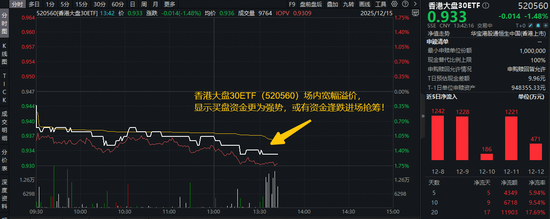
Market Overview - On December 15, Hong Kong's three major indices all retreated, with the Hang Seng Tech Index dropping over 2% [1] - The Hong Kong Large Cap 30 ETF (520560), which employs a "Tech + Dividend" strategy, also saw a price decline of 1.48% amid market consolidation [1] - Notably, the ETF exhibited a wide premium in the market, indicating strong buying interest, suggesting that funds may be looking to enter the market on dips [1] Fund Flows - The Hong Kong Large Cap 30 ETF (520560) experienced a net inflow of funds totaling 43.49 million yuan over the past five days, and a cumulative inflow of 119 million yuan over the last 20 days, reflecting positive sentiment towards the future performance of Hong Kong stocks [1][3] - The insurance sector showed resilience, with China Ping An rising nearly 4% to reach a new high, and China Life increasing over 1% [1] Sector Performance - In the consumer sector, Yum China and Anta Sports both rose over 1%, leading the gains [1] - Conversely, the innovative drug leader BeiGene fell nearly 7%, while tech leaders SMIC and Kuaishou dropped over 2%, negatively impacting index performance [1] Regulatory Changes - The National Financial Regulatory Administration announced adjustments to risk factors for insurance companies, further opening up investment space for insurance capital [3][8] - The adjustments are expected to release a minimum of 19.8 billion yuan in capital, which could potentially lead to an additional 72.6 billion yuan in stock investments if fully allocated [3][8] Investment Strategy - Analysts suggest that the adjusted risk factors enhance the cost-effectiveness of Hong Kong stocks, with opportunities in both tech and dividend sectors [3][8] - GF Securities recommends employing a "barbell strategy," focusing on stable value assets for long-term allocation while also considering growth assets with solid industrial logic [3][8] - The dividend yield of Hong Kong stocks is noted to be higher than that of A-shares, with the banking sector yielding 6.1% compared to 4.3% for A-shares, indicating greater investment value in Hong Kong [3][8] ETF Characteristics - The Hong Kong Large Cap 30 ETF (520560) and its linked funds are highlighted as ideal long-term investment tools, combining high-volatility tech stocks like Alibaba and Tencent with stable, high-dividend stocks such as China Construction Bank and China Ping An [4][9]
宏观经济周报-20251215
工银国际· 2025-12-15 04:59
Economic Indicators - The ICHI Composite Economic Index has stabilized near expansion territory, indicating a recovery in economic activity[1] - The Consumer Sentiment Index remains at the upper end of the expansion range, reflecting a rebound in consumer spending[1] - The Investment Sentiment Index shows significant recovery, approaching the neutral line, supported by infrastructure and manufacturing investments[1] Inflation and Prices - November 2025 CPI increased by 0.7% year-on-year, with core CPI rising 1.2%, indicating ongoing recovery in consumer spending[2] - Food prices have shifted from decline to increase, contributing significantly to the CPI rise[2] - November 2025 PPI decreased by 2.2% year-on-year, but the decline in some sectors has narrowed, reflecting improvements in competition and capacity optimization[2] Global Economic Context - As of December 6, 2025, initial jobless claims in the U.S. rose to 236,000, the largest weekly increase since March 2020, influenced by seasonal factors[5] - The U.S. unemployment rate has increased to 4.4%, indicating a softening labor market amid rising costs and demand pressures[7] - Mexico's new tariff law, effective 2026, will impose higher tariffs on imports from China and other non-free trade agreement countries, potentially impacting trade dynamics[6]
11月社融数据解读
2025-12-15 01:55
Summary of Conference Call Notes Industry Overview - The conference call discusses the financial data and economic conditions in China, particularly focusing on the banking sector and macroeconomic indicators [1][2][3]. Key Points and Arguments 1. **Loan Growth and Economic Trends** - In January, new loans amounted to 5.1 trillion yuan, indicating a typical credit peak season, but a slight decrease in loan growth is expected in the coming months, aligning with nominal economic growth trends [1][9]. - The demand for household credit remains weak due to multiple factors including a sluggish real estate market, stock market volatility, and declining consumer data [1][10]. 2. **Monetary Supply and Policy Environment** - M1 money supply growth has decreased to 4.9% year-on-year, while M2 growth remains stable at 8%, reflecting a relatively stable policy environment with no urgent need for adjustments [1][4]. - The central bank's financial data shows a year-on-year growth in social financing scale of 8.5%, with loan growth at 6.3%, indicating a stable overall performance but with some discrepancies from market expectations [2]. 3. **ETF Fund Flows and Market Sentiment** - Dividend ETFs continue to attract funds for low-positioning, while the technology sector shows weak liquidity. The CSI 500 ETF saw a net inflow close to 10 billion yuan, while tech-themed ETFs like AI, military, and semiconductors experienced significant net outflows [1][5][6]. - The banking sector is experiencing a daily net outflow of about 500 million yuan, but its fundamental improvement is considered highly certain, suggesting potential investment value [6]. 4. **Future Market Expectations** - An interest rate hike is anticipated around mid-2026 to address potential economic downturn risks. The banking sector's fundamentals are improving, but the overall upward potential is limited to about one or two percentage points [7][8]. - The consumer sector remains a market highlight, and the performance of innovative pharmaceutical stocks in Hong Kong is also noted [8]. 5. **Investment Policy and Economic Recovery** - Attention is required on the implementation of policies from the Central Economic Work Conference, particularly regarding "investment stabilization." Current market reactions are relatively muted, and there is a lack of new directions to boost investment growth [11]. - The potential for large-scale infrastructure projects or new monetary tools to support the economy is acknowledged, but the effectiveness may not match past initiatives like the 4 trillion yuan stimulus plan [11]. 6. **Market Dynamics and Risks** - The overall economic activity is showing signs of weakening, which is viewed as a healthy adjustment. The stock market requires strong policy signals to break out of its current stagnation [12]. - The impact of US-China competition is discussed, indicating that China is not at a disadvantage, which supports the RMB exchange rate and foreign capital allocation [13]. Additional Important Insights - The early loan disbursement by banks in October rather than December may influence corporate project growth [3]. - The current financial data suggests that without unexpected policy support, the stock market may struggle to maintain upward momentum [12]. - The debt market may see recovery opportunities following the Central Financial Conference, as high interest rates currently hinder fiscal debt issuance costs [12].
中泰国际每日晨讯-20251215
ZHONGTAI INTERNATIONAL SECURITIES· 2025-12-15 01:50
Market Overview - On December 12, the Central Economic Work Conference emphasized the need for internal strengthening to address external challenges and to continue implementing a moderately loose monetary policy[1] - The Hang Seng Index rose by 446 points (1.8%) to close at 25,976 points, with a peak increase of 475 points during the day[1] - The Hang Seng Technology Index increased by 103 points (1.9%) to close at 5,638 points, with total market turnover expanding to HKD 242.7 billion[1] - Southbound capital experienced a net outflow of HKD 5.29 billion[1] Sector Performance - Gold prices increased, with Zijin Mining (2899 HK) rising by 3.6%, Shandong Gold (1787 HK) and Zhaojin Mining (1818 HK) both up by 3.4%[1] - Consumer stocks performed well, with Mengniu Dairy (2319 HK) up 2.7%, Nongfu Spring (9633 HK) up 2.2%, and Haidilao (6862 HK) up 2.9%[1] - Technology stocks also saw gains, with Alibaba (9988 HK) and Tencent (700 HK) rising by 2.3% and 2.4%, respectively[1] U.S. Market Dynamics - Despite interest rate cuts, U.S. tech stocks continued to decline, with the Nasdaq Composite falling by 245 points (0.5%) to close at 48,458 points[2] - The S&P 500 index dropped by 73 points, closing at 6,827 points, while long-term bond yields rose to 4.189%[2] Macroeconomic Indicators - As of the end of November, China's broad money supply (M2) stood at CNY 336.99 trillion, growing by 8% year-on-year, slightly below the market expectation of 8.2%[3] - Narrow money supply (M1) reached CNY 112.89 trillion, with a year-on-year growth of 4.9%, also below the expected 5.7%[3] - The loan balance grew by 6.4% year-on-year, down from the previous 6.5%[3] Industry Insights - In the automotive sector, stocks related to smart driving performed well, with Xiaoma Zhixing (2026 HK) up 4.9% and Horizon Robotics (9660 HK) up 3.8%[4] - The energy/utilities sector saw traditional power equipment stocks rise, with Dongfang Electric (1072 HK) increasing by 16.8% over the week[4] - The pharmaceutical sector remained stable, with WuXi AppTec (2359 HK) and WuXi Biologics (2269 HK) showing solid performance despite potential regulatory challenges[5]