
多晶硅

Search documents
特变电工(600089.SH):公司多晶硅产能被收购的消息不属实
Ge Long Hui· 2025-11-04 07:48
格隆汇11月4日丨特变电工(600089.SH)在投资者互动平台表示,公司多晶硅产能被收购的消息不属实。 ...

建信期货多晶硅日报-20251104
Jian Xin Qi Huo· 2025-11-04 02:05
1. Report Industry Investment Rating - No relevant information was provided in the document. 2. Core Viewpoints of the Report - The polysilicon market is in a state of supply - demand imbalance, with the supply exceeding demand. The terminal demand is in a post - "rush installation" weak period. The market focus is on whether the fourth - quarter policies can be implemented and their actual effects, but the short - term is mostly affected by news. The 01 contract has a significant premium and is expected to run cautiously and strongly within the range [4]. 3. Summary According to Relevant Catalogs 3.1 Market Performance and Outlook - The polysilicon main contract price opened low and went high. The PS2601 contract closed at 56,065 yuan/ton, with a 0.18% increase. The trading volume was 215,288 lots, and the open interest was 143,844 lots, with a net increase of 1,488 lots [4]. - The spot price of polysilicon: the transaction price range of n - type re - feedstock was 49,000 - 55,000 yuan/ton, with an average transaction price of 53,200 yuan/ton, remaining flat compared to the previous period. The transaction price range of n - type granular silicon was 50,000 - 51,000 yuan/ton, with an average transaction price of 50,500 yuan/ton, also remaining flat [4]. - In the fourth quarter, the estimated polysilicon output is 382,000 tons, with an average monthly output of 127,300 tons. The output in October was higher than expected at 137,000 tons. The significant profit recovery suppresses the willingness to actively reduce production. The current monthly output can meet the terminal demand of 68.5GW, and the supply - demand imbalance remains [4]. 3.2 Market News - On November 03, the number of polysilicon warehouse receipts was 9,590 lots, remaining unchanged from the previous trading day [5]. - In September 2025, the newly installed photovoltaic capacity was 9.66GW, a 31.25% increase compared to the previous month. From January to September, the cumulative newly installed photovoltaic capacity was 240.27GW [5]. - On October 27, Daquan Energy announced that its third - quarter revenue reached 1.773 billion yuan, a 24.75% year - on - year increase, and the net profit was 73.479 million yuan. The first - three - quarter revenue was 3.243 billion yuan, a 46.00% year - on - year decrease, and the net loss was 1.073 billion yuan [5]. - On October 25, Tongwei Co., Ltd. (600438) disclosed its 2025 third - quarter report. In the third quarter, the company's operating income was 24.091 billion yuan, a slight 1.57% year - on - year decrease. The net loss attributable to shareholders of the listed company narrowed, with a year - on - year loss reduction of 62.69% and a quarter - on - quarter loss reduction of 86.68%, indicating a positive impact of the industry environment repair on the company's profitability [5].
有色金属基础周报:宏观情绪降温,有色金属整体回归震荡-20251103
Chang Jiang Qi Huo· 2025-11-03 06:12
1. Report Industry Investment Rating No relevant content provided. 2. Core Views of the Report - Copper prices reached a record high this week and then declined. Although the long - term demand outlook for copper is optimistic due to factors such as tight copper concentrate supply and increasing demand from computing power construction, short - term high prices are suppressing downstream demand. It is expected that copper prices will remain in a high - level oscillation in the short term, with the main contract of Shanghai Copper operating in the range of 85,000 - 89,000. It is recommended to exit long positions at high levels or conduct short - term trading within the range [2]. - Aluminum prices are in a high - level upward oscillation. However, as the rainy season in Guinea ends and alumina prices weaken, there is downward pressure on ore prices. The operating capacity of alumina has decreased, and the inventory has increased. The operating capacity of electrolytic aluminum has increased slightly. It is recommended to reduce positions and take profits at high levels for aluminum - related products [2]. - Zinc prices are in a relatively strong oscillation. Although the processing fees of zinc ore have decreased, the production enthusiasm of smelters is high, and the output of refined zinc is expected to remain at a high level. Terminal consumption is weak, and inventory is at a high level. It is expected that Shanghai Zinc will maintain an oscillation, with the main contract operating in the range of 21,800 - 23,000, and it is recommended to conduct range trading [2]. - Lead prices are in a sideways oscillation. Supply is decreasing, but downstream procurement is cautious due to high prices. Considering the strong production and consumption demand and the temporary truce in the Sino - US trade war, lead prices may continue to rise after consolidation. It is recommended to go long at low levels within the range of 17,100 - 17,800 [2]. - Nickel prices are in an intra - range oscillation and decline. The cost of the nickel industry is relatively stable, but the nickel market remains in a surplus situation, with continuous inventory accumulation. It is recommended to hold short positions at high levels, with the main contract of Shanghai Nickel operating in the range of 119,000 - 123,000; for stainless steel, it is also recommended to hold short positions at high levels, with the main contract operating in the range of 12,400 - 12,900 [3]. - Tin prices are in a high - level oscillation and overall upward trend. Although tin ore supply is expected to improve, downstream consumption is weak. It is recommended to conduct range trading, with the reference operating range of the Shanghai Tin 12 contract being 275,000 - 295,000, and it is necessary to continue to pay attention to supply resumption and downstream demand recovery [3]. - Industrial silicon prices are in an oscillatory adjustment. The production and inventory of industrial silicon and related products such as polysilicon and organic silicon have changed. It is recommended to conduct range trading or wait and see, and pay attention to the implementation of the polysilicon storage platform and production reduction [3]. - Lithium carbonate prices are in a wide - range oscillation. The supply and demand are in a tight balance, and downstream demand is strong. It is recommended to trade cautiously and pay attention to the progress of mining certificates in Yichun and the resumption of production of the Ningde Jianxiawo lithium mine [3]. 3. Summary by Relevant Catalogs 3.1 Macro - From October 27th to November 2nd, important economic data were released. China's industrial enterprise profits in September increased by 21.6% year - on - year, and the profits of high - tech manufacturing and equipment manufacturing showed good growth. The Sino - US leaders held a meeting, and the Sino - US economic and trade teams reached a consensus on tariff and export control measures. China's official manufacturing PMI in October dropped to 49, while the non - manufacturing index rose to 50.1. The Federal Reserve cut interest rates by 25 basis points, and the eurozone's GDP in the third quarter increased by 0.2% quarter - on - quarter, exceeding expectations. The US Senate passed a resolution to terminate Trump's comprehensive tariff policy, but it is expected to face difficulties in the House of Representatives [11][12][13][14][15][16][17]. 3.2 Copper - Price trend: Reached a record high and then declined, expected to be in a high - level oscillation in the short term [2]. - Fundamental factors: Supply of copper concentrate is tight, but short - term high prices are suppressing downstream demand, and inventory is accumulating [2]. - Investment advice: Exit long positions at high levels or conduct short - term trading within the range [2]. 3.3 Aluminum - Price trend: High - level upward oscillation, with the oscillation range broken through [46]. - Fundamental factors: The rainy season in Guinea ends, alumina prices weaken, the operating capacity of alumina decreases, and the inventory increases. The operating capacity of electrolytic aluminum increases slightly, and downstream demand is affected by the transition from peak to off - peak season [2]. - Investment advice: Reduce positions and take profits at high levels [2]. 3.4 Zinc - Price trend: Relatively strong oscillation [2]. - Fundamental factors: Zinc ore processing fees have decreased, smelter production enthusiasm is high, terminal consumption is weak, and inventory is at a high level [2]. - Investment advice: Conduct range trading [2]. 3.5 Lead - Price trend: Sideways oscillation [2]. - Fundamental factors: Supply is decreasing, downstream procurement is cautious due to high prices, but production and consumption demand are strong [2]. - Investment advice: Go long at low levels within the range [2]. 3.6 Nickel - Price trend: Intra - range oscillation and decline [3]. - Fundamental factors: The cost of the nickel industry is relatively stable, but the nickel market is in a surplus situation, with continuous inventory accumulation [3]. - Investment advice: Hold short positions at high levels [3]. 3.7 Tin - Price trend: High - level oscillation and overall upward trend [3]. - Fundamental factors: Tin ore supply is expected to improve, but downstream consumption is weak [3]. - Investment advice: Conduct range trading [3]. 3.8 Industrial Silicon - Price trend: Oscillatory adjustment [3]. - Fundamental factors: The production and inventory of industrial silicon and related products have changed, and the production of polysilicon is expected to decrease in November [3]. - Investment advice: Conduct range trading or wait and see [3]. 3.9 Lithium Carbonate - Price trend: Wide - range oscillation [3]. - Fundamental factors: Supply and demand are in a tight balance, downstream demand is strong, and there are uncertainties in mining certificates [3]. - Investment advice: Trade cautiously [3].
工业硅期货周报-20251103
Da Yue Qi Huo· 2025-11-03 06:08
1. Report Industry Investment Rating - Not provided in the report 2. Core Viewpoints of the Report - For industrial silicon, the 01 contract showed an upward trend this week, with the Monday opening price at 8950 yuan/ton and the Friday closing price at 9100 yuan/ton, a weekly increase of 1.68%. It is expected that next week, the supply-side production schedule will increase, demand recovery will be at a low level, cost support will rise, and the market will likely experience a bearish oscillatory adjustment [4]. - For polysilicon, the 01 contract also showed an upward trend this week, with the Monday opening price at 52510 yuan/ton and the Friday closing price at 56410 yuan/ton, a weekly increase of 7.43%. It is expected that next week, the supply-side production schedule will continue to decrease, overall demand will show a continuous decline, cost support will remain stable, and the market will likely experience a bullish oscillatory adjustment [7]. 3. Summary by Relevant Catalogs 3.1 Review and Outlook 3.1.1 Industrial Silicon - **Supply**: This week, the industrial silicon supply was 100,000 tons, a month-on-month decrease of 0.99%. The sample enterprise output was 48,725 tons, a month-on-month decrease of 2.36%. The expected monthly operating rate is 69.23%, an increase of 7.29 percentage points from the previous month [4]. - **Demand**: This week, the industrial silicon demand was 87,000 tons, a month-on-month decrease of 7.44%, and demand remained weak. In terms of polysilicon, the inventory was 261,000 tons, at the same level as the historical average. In terms of organic silicon, the inventory was 56,300 tons, lower than the historical average, and the production was in a loss state. In terms of aluminum alloy, the inventory of aluminum alloy ingots was 73,500 tons, higher than the historical average [5]. - **Cost**: The production loss of oxygenated 553 silicon in Xinjiang was 3144 yuan/ton, and the cost support increased during the dry season [5]. - **Inventory**: The weekly social inventory was 558,000 tons, a month-on-month decrease of 0.18%. The weekly sample enterprise inventory was 168,100 tons, a month-on-month increase of 0.24%. The weekly major port inventory was 124,000 tons, a month-on-month increase of 0.81% [10]. 3.1.2 Polysilicon - **Supply**: Last week, the polysilicon output was 28,200 tons, a month-on-month decrease of 4.40%. The forecasted production schedule for November is 120,100 tons, a month-on-month decrease of 10.37% from the previous month [7]. - **Demand**: Last week, the silicon wafer output was 14.24GW, a month-on-month decrease of 3.32%. The battery cell output decreased month-on-month, and the component production was profitable but also showed a downward trend [7]. - **Cost**: The average cost of N-type polysilicon in the industry was 37,990 yuan/ton, and the production profit was 14,260 yuan/ton [7]. - **Inventory**: The weekly inventory was 261,000 tons, a month-on-month increase of 1.16%, at a neutral level compared to historical periods [8]. 3.2 Fundamental Analysis - **Price - Basis and Delivery Spread**: The report shows the historical trends of the SI main contract basis, the price difference between East China 421 and 553 silicon, etc., reflecting the price relationship between the spot and futures markets and different grades of silicon [15]. - **Inventory**: It presents the historical trends of industrial silicon inventory, including delivery warehouse and port inventory, SMM sample enterprise inventory, and registered warrant volume, which helps to understand the supply and demand situation in the market [17]. - **Production and Capacity Utilization**: It shows the historical trends of industrial silicon production, monthly production by specification, and capacity utilization rate, as well as the operating rate trends of sample enterprises in different regions, reflecting the production status of the industry [20]. - **Cost - Sample Region Trends**: It shows the historical trends of cost and profit for 421 silicon in Sichuan, 421 silicon in Yunnan, and oxygenated 553 silicon in Xinjiang, reflecting the cost - profit situation of different regions and specifications [27]. - **Supply - Demand Balance**: The report provides the weekly and monthly supply - demand balance tables for industrial silicon, showing the supply, demand, import, export, and balance situations, which helps to understand the overall supply - demand relationship in the market [29][32]. - **Downstream Industries** - **Organic Silicon**: It includes the price, production, import - export, and inventory trends of DMC, as well as the price trends of downstream products such as 107 glue, silicone oil, etc., reflecting the operating conditions of the organic silicon industry [35][37]. - **Aluminum Alloy**: It shows the price, supply, inventory, production, and demand (related to the automotive and wheel hub industries) trends of aluminum alloy, reflecting the operating conditions of the aluminum alloy industry [44][48]. - **Polysilicon**: It includes the price, production, inventory, supply - demand balance, and the trends of downstream silicon wafers, battery cells, photovoltaic components, and related accessories, reflecting the operating conditions of the polysilicon industry and its downstream industries [52][55]. 3.3 Technical Analysis - **Industrial Silicon (SI)**: The main 01 contract showed an upward trend this week. Technical indicators such as moving averages were used, and it is expected that next week, the market will likely experience a bearish oscillatory adjustment [74][75]. - **Polysilicon (PS)**: The main 01 contract showed an upward trend this week. Technical indicators such as moving averages were used, and it is expected that next week, the market will likely experience a bullish oscillatory adjustment [76][77].
《特殊商品》日报-20251103
Guang Fa Qi Huo· 2025-11-03 05:58
Group 1: Glass and Soda Ash Report Industry Investment Rating Not provided Core Viewpoints - For soda ash, the post - National Day price has been weakly oscillating, with low demand and obvious over - supply. The mid - term demand is expected to remain at the previous rigid level. It is recommended to take profit on previous short positions and wait for shorting opportunities on rebounds. [1] - For glass, the weekend news of production line shutdown in Shahe may have a positive impact on the market sentiment. Although there is still some peak - season demand expectation in November, the industry still needs capacity clearance in the long - term. It is recommended to close previous short positions and look for short - term long opportunities. [1] Summary by Directory - **Prices and Spreads**: Glass and soda ash spot prices in different regions remained unchanged on November 3, 2025. Glass 2505 decreased by 0.88%, and Glass 2509 increased by 0.08%. Soda ash 2505 decreased by 0.60%, and Soda ash 2509 increased by 0.08%. [1] - **Supply**: Soda ash's weekly output decreased by 1.71% to 75.76 tons, and its operating rate decreased by 1.72% to 86.89%. Floating - glass daily melting volume remained unchanged, while photovoltaic daily melting volume decreased by 0.84%. [1] - **Inventory**: Glass factory inventory increased by 4.72% to 65790,000 weight - cases, soda ash factory inventory increased by 2.54% to 1.702 million tons, and soda ash delivery - warehouse inventory decreased by 3.18% to 676,900 tons. [1] - **Real Estate Data**: New construction area increased by 0.09%, construction area decreased by 2.43%, completion area decreased by 0.03%, and sales area decreased by 6.50%. [1] Group 2: Natural Rubber Report Industry Investment Rating Not provided Core Viewpoints - In the short - term, rubber prices are under pressure due to the Fed's hawkish stance on December's interest - rate cut. The prices may decline further if raw - material supply is smooth; otherwise, they are expected to oscillate between 15,000 - 15,500. [2] Summary by Directory - **Prices and Spreads**: Most natural rubber spot prices decreased on October 31, 2025. The 9 - 1 spread decreased by 6.67%, the 1 - 5 spread increased by 22.22%, and the 5 - 9 spread decreased by 16.67%. [2] - **Fundamentals**: In August, Thailand's production decreased by 0.43%, Indonesia's decreased by 4.30%, India's increased by 11.11%, and China's increased. Tire production in August increased by 9.10%, and tire exports in September decreased by 10.65%. [2] - **Inventory Changes**: Bonded - area inventory decreased by 1.20%, and natural - rubber factory - warehouse futures inventory increased by 4.73%. [2] Group 3: Logs Report Industry Investment Rating Not provided Core Viewpoints - Although the log futures price is at a relatively low level and the import cost provides some support, the market is still expected to oscillate at the bottom due to the weak supply - demand situation. [3] Summary by Directory - **Prices and Spreads**: On October 31, 2025, most log futures prices changed slightly. The 11 - 01 spread decreased by 22.0, and the 11 - 03 spread decreased. [3] - **Supply**: From October 27 to November 2, 2025, the number of pre - arriving New Zealand log ships at 13 Chinese ports increased by 33% week - on - week, and the arrival volume increased by 19%. [3] - **Demand**: As of October 24, the national coniferous log inventory decreased by 80,000 cubic meters week - on - week, and the daily log delivery volume increased by 120,000 cubic meters. [3] Group 4: Industrial Silicon Report Industry Investment Rating Not provided Core Viewpoints - In November, the industrial silicon market still faces inventory pressure. Although supply may decline slightly and demand may remain stable, the flow of warehouse receipts to the spot market will increase supply. The price is expected to oscillate at a low level, with a main range of 8,500 - 9,500 yuan/ton. [5] Summary by Directory - **Prices and Spreads**: On October 31, 2025, most industrial silicon spot prices remained stable or increased slightly. The 2511 - 2512 spread decreased by 8.86%, and the 2601 - 2602 spread increased by 300.00%. [5] - **Fundamentals**: In October, the national industrial silicon production increased by 7.46%, the national operating rate increased by 10.86%. Organic silicon DMC production decreased by 0.29%, and polysilicon production increased by 3.08%. [5] - **Inventory Changes**: Most industrial silicon inventories decreased slightly, with the social inventory decreasing by 0.18% and the warehouse - receipt inventory decreasing by 0.33%. [5] Group 5: Polysilicon Report Industry Investment Rating Not provided Core Viewpoints - In November, the polysilicon market is expected to be in a situation of weak supply and demand, with a high - level range - bound oscillation. Investment strategies include short - term long positions in futures, selling put options, and buying ETFs or related stocks. [6] Summary by Directory - **Prices and Spreads**: On October 31, 2025, polysilicon spot prices decreased slightly, and the futures price increased by 2.66%. The month - to - month spreads changed to varying degrees. [6] - **Fundamentals**: Weekly silicon - wafer production decreased by 3.33%, and polysilicon production decreased by 4.41%. Monthly polysilicon production increased by 3.08%, and the net export volume decreased by 56.83%. [6] - **Inventory Changes**: Polysilicon inventory increased by 1.16%, silicon - wafer inventory increased by 2.49%, and polysilicon warehouse receipts increased by 2.79%. [6]
黑色建材日报-20251103
Wu Kuang Qi Huo· 2025-11-03 04:21
1. Report Industry Investment Rating No information provided in the given content. 2. Core Views of the Report - The overall atmosphere in the commodity market was weak last Friday, with the prices of finished steel products showing a volatile trend. With the gradual implementation of the Fed's easing expectations and the positive signals released by the Sino-US summit, the market sentiment and capital environment are expected to improve. The steel consumption side may gradually recover in the future, but the demand is still weak in the short term [2]. - For the black sector, the report maintains a non - pessimistic view. It believes that finding callback positions to do rebounds may have higher cost - effectiveness than shorting. The current macro factors are more important price - influencing factors than the weak fundamentals [11]. - Regarding manganese silicon, if the black sector strengthens, pay attention to potential disturbances in the manganese ore end, which may drive the manganese silicon market. Otherwise, it is expected to follow the black sector's trend. Silicon iron is also likely to follow the black sector, with low operational cost - effectiveness [11]. 3. Summary According to Relevant Catalogs 3.1 Steel Products 3.1.1 Market Quotes - The closing price of the rebar main contract was 3106 yuan/ton, unchanged from the previous trading day. The registered warehouse receipts were 124,240 tons, with no change. The main contract position was 1.87945 million lots, a decrease of 15,466 lots. The Tianjin aggregated price of rebar was 3190 yuan/ton, a decrease of 10 yuan/ton; the Shanghai aggregated price was 3230 yuan/ton, unchanged [1]. - The closing price of the hot - rolled coil main contract was 3308 yuan/ton, a decrease of 10 yuan/ton (- 0.30%). The registered warehouse receipts were 98,537 tons, a decrease of 298 tons. The main contract position was 1.470219 million lots, a decrease of 3067 lots. The Lecong aggregated price of hot - rolled coils was 3320 yuan/ton, a decrease of 20 yuan/ton; the Shanghai aggregated price was 3330 yuan/ton, unchanged [1]. 3.1.2 Strategy Views - The supply and demand of rebar both increased, and the inventory continued to decline, showing a neutral performance overall. The demand for hot - rolled coils continued to recover, but the production was still high, and the inventory, although decreasing, remained at a relatively high level [2]. 3.2 Iron Ore 3.2.1 Market Quotes - The main contract of iron ore (I2601) closed at 800.00 yuan/ton, with a change of - 0.31% (- 2.50). The position changed by - 11,268 lots to 540,300 lots. The weighted position was 921,900 lots. The price of PB fines at Qingdao Port was 803 yuan/wet ton, with a basis of 54.36 yuan/ton and a basis rate of 6.36% [4]. 3.2.2 Strategy Views - On the supply side, the overseas iron ore shipment volume continued to increase, with Australia remaining flat, Brazil increasing, and non - mainstream countries slightly decreasing. The near - end arrival volume was at a low level this year. On the demand side, the average daily hot metal output decreased, the number of overhauled blast furnaces was much larger than that of restarted ones, and the steel mill profitability reached a new low this year. The port inventory continued to increase, and the steel mill inventory declined. The iron ore demand continued to weaken, and the inventory pressure remained [5]. 3.3 Manganese Silicon and Silicon Iron 3.3.1 Market Quotes - On October 31, the main contract of manganese silicon (SM601) closed down 1.20% at 5772 yuan/ton. The spot price of 6517 manganese silicon in Tianjin was 5700 yuan/ton, with a converted basis of 5890 yuan/ton, a decrease of 20 yuan/ton compared with the previous day, and a premium of 118 yuan/ton over the futures [7]. - The main contract of silicon iron (SF601) closed down 0.90% at 5500 yuan/ton. The spot price of 72 silicon iron in Tianjin was 5530 yuan/ton, with a premium of 30 yuan/ton over the futures [9]. 3.3.2 Strategy Views - The fundamentals of manganese silicon are still not ideal and lack major contradictions. Potential drivers may come from the manganese ore end. Silicon iron's supply - demand fundamentals have no obvious contradictions and drivers and are likely to follow the black sector's trend [11]. 3.4 Industrial Silicon and Polysilicon 3.4.1 Market Quotes - The closing price of the main contract of industrial silicon (SI2601) was 9100 yuan/ton, a decrease of 0.60% (- 55). The weighted contract position changed by - 16,059 lots to 408,543 lots. The spot price of non - oxygenated 553 in East China was 9300 yuan/ton, unchanged; the 421 market price was 9700 yuan/ton, unchanged, with a basis of - 200 yuan/ton for the main contract [13]. - The closing price of the main contract of polysilicon (PS2601) was 56,410 yuan/ton, an increase of 2.66% (+ 1460). The weighted contract position changed by + 9166 lots to 258,099 lots. The average price of N - type granular silicon was 50.5 yuan/kg, unchanged; the average price of N - type dense material was 51 yuan/kg, unchanged; the average price of N - type re - feeding material was 52.25 yuan/kg, a decrease of 0.05 yuan/kg, with a basis of - 4160 yuan/ton for the main contract [16]. 3.4.2 Strategy Views - For industrial silicon, the supply - side pressure persists. Although the production in the southwest region is decreasing during the dry season, the production in the northwest region is increasing. The demand support is weakening. It is expected to fluctuate in the short term [14]. - For polysilicon, with some production capacity starting maintenance, the supply - demand pattern may improve marginally, but the short - term de - stocking amplitude is expected to be limited. The policy expectations have a strong impact on prices [17]. 3.5 Glass and Soda Ash 3.5.1 Market Quotes - The glass main contract closed at 1083 yuan/ton on Friday, a decrease of 0.73% (- 8). The price of large - size glass in North China was 1130 yuan, unchanged; the price in Central China was 1120 yuan, unchanged. The weekly inventory of float glass sample enterprises was 65.79 million cases, a decrease of 823,000 cases (- 1.24%) [19]. - The soda ash main contract closed at 1225 yuan/ton on Friday, a decrease of 0.81% (- 10). The price of heavy soda ash in Shahe was 1175 yuan, a decrease of 10 yuan. The weekly inventory of soda ash sample enterprises was 1.702 million tons, a decrease of 10,000 tons (- 1.24%), with the heavy soda ash inventory decreasing by 48,100 tons and the light soda ash inventory increasing by 48,000 tons [21]. 3.5.2 Strategy Views - For glass, the supply is loose, the enterprise inventory is accumulating, the demand recovery is slow, and the price is expected to remain weak. Attention should be paid to the production line operation in the Shahe area [20]. - For soda ash, affected by the weak glass market, the price is under pressure. The cost increase forms a certain bottom support, but the de - stocking process is slow. It is expected to continue a narrow - range shock in the short term [22].
“弱现实”与“强预期”博弈 多晶硅市场涨势能否延续?
Qi Huo Ri Bao· 2025-11-02 23:36
上周,多晶硅期货连续5个交易日收涨。10月31日,主力PS2601合约报收56410元/吨,周度涨幅为 7.43%。 中信建投期货分析师刘佳奇也认为,短期来看,上述消息虽能提振市场情绪,但对多晶硅价格的影响有 限,后市仍需关注"反内卷"的相关动态。中信建投期货团队预测,如果17家光伏龙头企业的收储工作进 展顺利,那么多晶硅承债式收购将使被收购方出清43万~48万吨产能。在类似自律框架安排下,基金平 台公司成员会主动出清约100万吨产能,最终实现140万吨以上的产能出清,留下约200万吨产能。 据了解,当前多晶硅市场仍处于供需错配格局。供应方面,据PVinfolink的数据,9月,全球多晶硅产量 为13.18万吨,月度排产量重新攀升至13万吨上方,预计10月全球排产量为13.34万吨,环比小幅增加。 需求方面,自"5·31"抢装潮后,光伏新增装机量开始下降,6月至9月光伏新增装机量在10GW/月波动。 数据显示,9月,光伏新增装机量为9.66GW,环比增加31.40%,同比则减少53.75%。库存方面,截至 10月30日,多晶硅期、现总库存为30.103万吨。 刘佳奇认为,后期多晶硅市场将呈供需双减状态。在枯水 ...
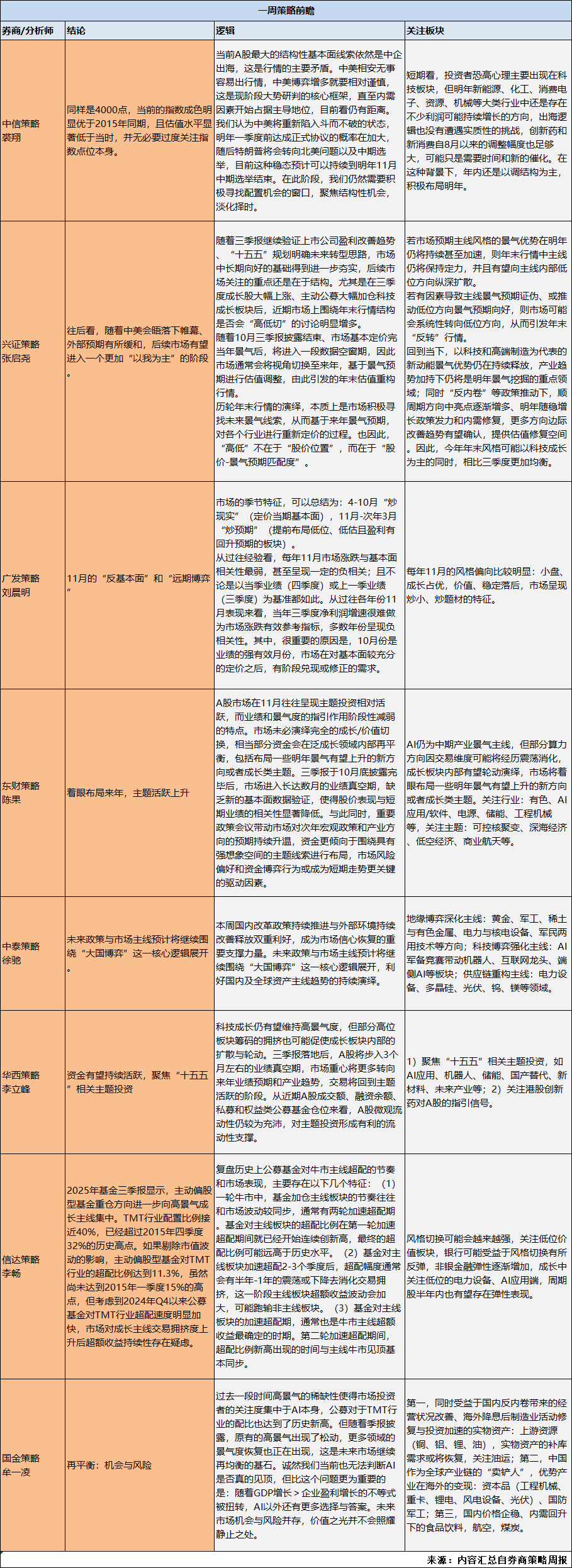
A股分析师前瞻:历史上的11月风格更偏向炒小、炒题材?
Xuan Gu Bao· 2025-11-02 13:55
Group 1 - The core viewpoint of the articles discusses the historical market trends in November and year-end, highlighting a shift from "pricing current fundamentals" from April to October to "pricing expectations" from November to March of the following year [1][5] - Historical data indicates that the correlation between market performance in November and fundamentals is weak, often showing a negative correlation, as October is a strong earnings month leading to a need for market correction [1][5] - The market style in November tends to favor small-cap and growth stocks while value and stability lag behind, reflecting a trend of speculative investments in smaller themes [1][5] Group 2 - The year-end market performance is characterized by a search for future economic clues, leading to a revaluation of various industries based on next year's economic expectations [2][3] - The technology and high-end manufacturing sectors are expected to continue their growth momentum, becoming key areas for economic exploration in the coming year [2][3] - The "anti-involution" policies are expected to enhance cyclical sectors, with more areas showing marginal improvement trends, providing room for valuation recovery [2][3] Group 3 - The market is anticipated to enter a more balanced phase with a focus on technology growth, compared to the previous quarter [3] - The scarcity of high-growth sectors has led to increased investor focus on AI, with public funds heavily weighted towards the TMT sector, reaching historical highs [3][6] - As earnings reports conclude, the market is expected to shift focus towards next year's performance expectations and industry trends, leading to a more active thematic investment phase [5][6]

大全能源(688303):多晶硅价格回升+成本显著下行,Q3实现扭亏为盈
Minsheng Securities· 2025-11-02 09:12
Investment Rating - The report maintains a "Recommended" rating for the company [4][7]. Core Views - The company achieved a turnaround in Q3 2025, reporting a net profit of 0.73 billion yuan, driven by rising polysilicon prices and effective cost control measures [1][2]. - The company has a strong financial structure with a low debt ratio of 8.20%, providing resilience against industry cycles [3]. - The company is positioned as a leading player in the polysilicon sector, with good cost control and financial strength expected to help it navigate through market fluctuations [4]. Summary by Sections Financial Performance - For Q1-Q3 2025, the company reported revenues of 3.243 billion yuan, a year-on-year decrease of 46.00%, and a net loss of 1.073 billion yuan [1]. - In Q3 2025, the company achieved revenues of 1.773 billion yuan, a year-on-year increase of 24.75% and a quarter-on-quarter increase of 214.93% [1][2]. - The company's polysilicon production for Q1-Q3 2025 was 81,500 tons, down 52.3% year-on-year, while sales were 88,500 tons, down 36.4% year-on-year [2]. Cost Management - The company has successfully reduced unit costs, with Q3 2025 unit costs at 46.04 yuan/kg and cash costs at 34.63 yuan/kg, reflecting a quarter-on-quarter decrease of 20.8% and an increase of 11.1%, respectively [2]. Future Outlook - The company expects Q4 2025 polysilicon production to be between 39,500 and 42,500 tons, with an annual production forecast of 121,000 to 124,000 tons for 2025 [2]. - Revenue projections for 2025-2027 are 5.167 billion, 8.478 billion, and 10.746 billion yuan, respectively, with net profits expected to be -999 million, 1.420 billion, and 2.223 billion yuan [4][6].

工业硅成本抬升,多晶硅关注收储进展
Dong Zheng Qi Huo· 2025-11-02 08:43
Industry Investment Rating - Industrial silicon: Oscillation; Polysilicon: Oscillation [5] Core Viewpoints - After the previous hedging, the price decline of industrial silicon is unlikely to cause production cuts or shutdowns in the short term, but the price needs to exceed 10,000 yuan/ton to bring significant supply increments during the dry season or the next wet season. Therefore, it is more cost-effective to go long on industrial silicon at low prices [4]. - In November, polysilicon officially enters the critical point of the game between policy and fundamentals. Currently, policy trading may still outweigh fundamental trading. Those who hold long positions can continue to hold, while those chasing long positions face greater risks. They can consider buying call options to participate in the subsequent policy game [4]. Summary by Directory 1. Industrial Silicon/Polysilicon Industry Chain Prices - This week, the Si2601 contract of industrial silicon increased by 180 yuan/ton to 9,100 yuan/ton. The SMM spot price of East China oxygenated 553 increased by 100 yuan/ton to 9,450 yuan/ton, and the price of Xinjiang 99 increased by 100 yuan/ton to 8,800 yuan/ton. The PS2601 contract of polysilicon increased by 4,105 yuan/ton to 56,410 yuan/ton. The average transaction price of N-type re-feeding material of polysilicon remained unchanged at 53,200 yuan/ton [11]. 2. Industrial Silicon Cost Increase, Polysilicon Focus on Storage Progress - **Industrial Silicon**: This week, the main futures contract of industrial silicon fluctuated strongly. Xinjiang opened 1 new furnace, while Yunnan and Sichuan reduced 3 and 6 furnaces respectively. Northern large factories may continue to resume production, while southern silicon factories are expected to significantly reduce production at the end of October. It is estimated that the number of operating furnaces in Yunnan will drop to about 20 and that in Sichuan will drop to only 18 in November. The SMM industrial silicon social inventory decreased by 0.1 million tons month-on-month, while the sample factory inventory increased by 0.04 million tons. Downstream maintains rigid demand purchases. When the market declines, aluminum factories actively place orders, and the basis of low-grade industrial silicon has strengthened. During the rising stage, it is in the state of inventory consumption. After updating the balance sheet, it is estimated that industrial silicon will have difficulty in destocking in November and will destock about 1 million tons in December [2][13]. - **Organic Silicon**: This week, the price of organic silicon decreased slightly. Some devices of several companies were under maintenance or shut down. The overall enterprise start-up rate this week was 68.63%, the weekly output of organic silicon was 45,400 tons, a month-on-month increase of 0.89%, and the inventory was 44,100 tons, a month-on-month increase of 2.56%. It is expected that the price of organic silicon will fluctuate weakly [13][14]. - **Polysilicon**: This week, the main futures contract of polysilicon rose significantly. Spot prices are under pressure. Leading manufacturers maintain the price of dense re-feeding material above 53 yuan/kg, and downstream mainly purchase special doping materials at 49 - 50 yuan/kg. Considering the coming dry season, it is estimated that the polysilicon production schedule will drop to 115,000 tons in November. As of October 30, the factory inventory of polysilicon enterprises was 261,000 tons, a month-on-month increase of 3,000 tons, and the raw material inventory of downstream crystal pulling factories was 218,000 tons, a month-on-month decrease of 4,000 tons. In November, polysilicon officially enters the critical point of the game between policy and fundamentals. If the platform company is successfully established and the storage details are implemented, the polysilicon price is expected to stabilize or even rise. Otherwise, the spot price may be under pressure [3][15]. - **Silicon Wafer**: This week, the price of silicon wafers decreased. The decline is related to overproduction. It is estimated that silicon wafer enterprises will reduce production from November. Whether the silicon wafer price can stabilize depends on whether the silicon material on the cost side continues to strongly support the price and the production reduction plan in November [16]. - **Battery Cell**: This week, the price of battery cells decreased. Overseas demand declined, and the mainstream transaction price of M10 battery cells continued to drop. The production schedule decline is not obvious. Due to the exemption of basic tariffs in India for Southeast Asian origins, the M10 battery is under pressure. The high price of G12 batteries has not been widely accepted by the component side, and the price is expected to decline. The G12R model continues to have an oversupply situation, and the future price is still not optimistic. Battery factories are under increasing cost pressure due to the sharp rise in silver paste prices and are now near cash losses [17]. - **Component**: This week, the component price remained basically stable. Some centralized procurement projects have a demand for high-power components above 700W, and leading component factories have raised their quotes. It is estimated that the domestic component production schedule will be 44.4GW in November, a month-on-month decrease of 1GW. There are concerns that the component production schedule will drop significantly in December. It is expected that the component price will fluctuate in the short term, and attention should be paid to whether there are demand-side policies in the future [18]. 3. Investment Advice - **Industrial Silicon**: After the previous hedging, it is more cost-effective to go long on industrial silicon at low prices [4][19]. - **Polysilicon**: Those who hold long positions can continue to hold, while those chasing long positions face greater risks. They can consider buying call options to participate in the subsequent policy game [4][19]. 4. Hot News Summary - **Hoshine Silicon Industry**: On October 30, it released its Q3 2025 report. The company achieved an operating income of 5.43 billion yuan, a year-on-year decrease of 23.51%. The net profit attributable to shareholders of the listed company was 75.6675 million yuan, a year-on-year decrease of 84.12%. Although it is still in negative growth year-on-year, the single-quarter profit index has turned positive compared with the loss situation in the first half of the year [20]. - **Daqo New Energy**: In Q3, the company achieved an operating income of 1.7726423 billion yuan, a year-on-year increase of 24.75%. The net profit attributable to shareholders of the listed company was 73.479 million yuan. Based on the current market dynamics, product prices, and market trends, combined with the progress of the annual routine maintenance plan, the company expects the polysilicon production in Q4 to be 39,500 - 42,500 tons, and the expected annual production in 2025 to be 121,000 - 124,000 tons [20]. - **Longi Green Energy**: On October 30, it released its Q3 2025 report. The company's operating income in the first three quarters of 2025 was 50.914 billion yuan, a year-on-year decrease of 13.10%. The net profit attributable to the parent company was a loss of 3.403 billion yuan [21]. 5. Industry Chain High-Frequency Data Tracking - **Industrial Silicon**: Relevant charts show the spot prices, weekly production, and inventory data of industrial silicon [23][26][29]. - **Organic Silicon**: Relevant charts show the spot price, weekly profit, factory inventory, and weekly production data of DMC in organic silicon [33][34]. - **Polysilicon**: Relevant charts show the spot price, weekly gross profit, factory weekly inventory, and enterprise weekly production data of polysilicon [36][39]. - **Silicon Wafer**: Relevant charts show the spot price, profit calculation, factory weekly inventory, and enterprise weekly production data of silicon wafers [41][46]. - **Battery Cell**: Relevant charts show the spot price, profit calculation, export factory weekly inventory, and enterprise monthly production data of battery cells [47][52][53]. - **Component**: Relevant charts show the spot price, profit calculation, finished product inventory, and enterprise monthly production data of components [55][61][62].