
房地产业

Search documents
1月份中国采购经理指数有所回落
Guo Jia Tong Ji Ju· 2026-02-02 01:05
Group 1: Manufacturing Sector - The manufacturing Purchasing Managers' Index (PMI) decreased to 49.3% in January, indicating a decline in economic sentiment compared to the previous month [1][2] - The production index remained above the critical point at 50.6%, suggesting continued expansion in manufacturing production, while the new orders index fell to 49.2%, indicating a drop in market demand [2] - Large enterprises maintained a PMI of 50.3%, indicating ongoing expansion, while small and medium-sized enterprises saw declines in their PMIs to 48.7% and 47.4%, respectively [3] - High-tech manufacturing continued to lead with a PMI of 52.0%, reflecting a positive development trend in this sector [3] - The price indices for major raw materials and factory prices rose to 56.1% and 50.6%, respectively, indicating an overall improvement in market price levels [2] Group 2: Non-Manufacturing Sector - The non-manufacturing business activity index fell to 49.4%, reflecting a decrease in overall economic sentiment in this sector [1][4] - The service industry business activity index was at 49.5%, with significant activity in financial services, while the real estate sector's index dropped below 40.0%, indicating weak sentiment [4] - The construction industry experienced a notable decline, with its business activity index at 48.8%, influenced by adverse weather and the upcoming holiday [4] - Despite the decline in current activity, the service industry business activity expectation index rose to 57.1%, indicating increased confidence among service sector enterprises [4] Group 3: Composite PMI - The composite PMI output index was recorded at 49.8%, showing a slight decrease from the previous month, indicating a general slowdown in production and business activities [1][5] - The manufacturing production index and non-manufacturing business activity index were 50.6% and 49.4%, respectively, contributing to the overall composite PMI output index [5]
1月制造业生产保持扩张 金融市场活跃度较高
Zhong Guo Zheng Quan Bao· 2026-02-01 20:53
● 本报记者 连润 国家统计局1月31日发布的数据显示,1月份,制造业采购经理指数(PMI)为49.3%,比上月下降0.8个 百分点,其中,生产指数为50.6%,高于临界点,制造业生产保持扩张。非制造业商务活动指数为 49.4%,从行业看,货币金融服务、资本市场服务、保险等行业商务活动指数均高于65.0%,金融市场 活跃度较高。 出厂价格指数升至临界点以上 "1月份,部分制造业行业进入传统淡季,加之市场有效需求仍显不足,制造业PMI为49.3%,景气水平 较上月下降。"国家统计局服务业调查中心首席统计师霍丽慧表示。 从分项指数看,价格指数双双回升。霍丽慧分析,1月份,受近期部分大宗商品价格上涨等因素影响, 主要原材料购进价格指数和出厂价格指数分别为56.1%和50.6%,比上月上升3.0个和1.7个百分点,其中 出厂价格指数近20个月来首次升至临界点以上,制造业市场价格总体水平改善。 从非制造业看,霍丽慧表示,1月份,受建筑业等行业景气度下降等因素影响,非制造业商务活动指数 为49.4%,比上月下降0.8个百分点,非制造业总体景气水平有所回落。(下转A02版) 高技术制造业持续领跑。1月份,高技术制造业PMI ...
1月制造业PMI为49.3% 出厂价格指数近20个月来首次升至临界点以上
Xin Lang Cai Jing· 2026-02-01 13:07
Group 1 - In January, the manufacturing Purchasing Managers' Index (PMI) decreased to 49.3%, indicating a decline in economic sentiment [1] - The non-manufacturing business activity index fell to 49.4%, reflecting a decrease in overall economic activity [1] - The comprehensive PMI output index also dropped to 49.8%, showing a general downturn in economic conditions [1] Group 2 - The decline in manufacturing PMI is attributed to seasonal factors, as many industries enter a traditional off-peak period in January [2] - The PMI index is affected by a high base effect from December 2025, which saw a significant increase, thus impacting January's figures [2] - Weak internal investment and consumption demand, along with high external uncertainties, are major factors dragging down the manufacturing sector [2] Group 3 - The raw material purchase price index rose to 56.1%, while the factory price index increased to 50.6%, marking the first time in nearly 20 months that the factory price index exceeded the critical point [3] - The difference between the raw material purchase price index and the factory price index indicates a transfer of profits upstream [3] - Recent structural policies aimed at supporting small and medium enterprises and technology firms are expected to take time to positively impact the manufacturing sector [3] Group 4 - The non-manufacturing business activity index's decline is influenced by the downturn in industries such as construction, with the index falling to 49.4% [4] - The real estate sector's business activity index dropped below 40.0%, indicating a weak overall sentiment in that industry [4] - Financial services and capital market services showed higher activity levels, with indices above 65.0%, reflecting a more active market [4] Group 5 - The overall macroeconomic sentiment is declining due to seasonal fluctuations, high previous month bases, and insufficient effective demand from the real estate market [5] - The manufacturing production index is expected to decline significantly in February due to the extended Spring Festival holiday [5] - Future manufacturing sentiment will be influenced by export growth, real estate market trends, and the timing and intensity of growth-stimulating policies [5]
兼评1月PMI数据:开年PMI边际放缓
KAIYUAN SECURITIES· 2026-02-01 07:12
chence@kysec.cn 证书编号:S0790524020002 制造业:PMI 再度转弱,生产与需求均下行 (1)需求下行叠加高基数拖累,制造业景气度降至荣枯线下。1 月制造业 PMI 为 49.3%、环比下行了 0.8 个百分点,明显弱于季节性规律。此前我们曾指出"12 月工作日数同比增加 2 天,作为环比指标的 PMI 读数会出现一定改善",实际 上经济改善幅度可能有限,但这形成了较高的基数并拖累 1 月 PMI 表现。分行 业来看,农副食品加工、铁路船舶航空航天设备等产需指数位于高景气区间, 油煤加工、汽车等行业则相对承压。 (2)有色原油涨价提振工业原材料价格,预计 1 月 PPI 同比延续回升。1 月 PMI 原材料购进价格为 56.1%,较前值上升了 3.0 个百分点;PMI 出厂价格为 50.6%, 较前值上升了 1.7 个百分点。根据高频指标,我们预计 1 月 PPI 环比可能在 0.3% 左右、同比为-1.3%左右。 2026 年 02 月 01 日 开年 PMI 边际放缓 宏观研究团队 ——兼评 1 月 PMI 数据 何宁(分析师) 陈策(分析师) hening@kysec.cn ...
宏观经济周报:中国央行的量价平衡术-20260201
Guoxin Securities· 2026-02-01 05:06
Monetary Policy Insights - The discussion around the establishment of a new price-based overnight tool by the People's Bank of China (PBOC) is driven by the need to enhance guidance on overnight market interest rates[1] - The transition from quantity-based to price-based monetary policy aims to strengthen the role of interest rate signals[1] - The current monetary policy in China is characterized by a balance of quantity and price, with the 7-day reverse repo rate serving as the short-term policy rate[2] Economic Indicators - Fixed asset investment has decreased by 3.80% year-on-year[3] - Retail sales have shown a modest increase of 0.90% year-on-year[3] - Exports have increased by 6.60% year-on-year, indicating some resilience in external demand[3] Market Trends - The overnight interest rates have shown increased volatility, often approaching the upper and lower bounds of the current interest rate corridor[1] - The banking system in China has not yet formed a "sufficient reserve system," which is crucial for effective price-based monetary control[2] - The real estate market shows signs of recovery, with both new and second-hand home transactions increasing, although inventory pressure remains high with a sales-to-inventory ratio of 127.8, a historical high[40][41] Risks and Challenges - There are significant uncertainties in overseas markets that could impact domestic economic stability[2] - The overall economic recovery is still hindered by weak production, insufficient consumer demand, and high inventory levels, indicating that a comprehensive recovery will take time[13]
国泰海通:1月PMI淡季回落,价格回升
Ge Long Hui· 2026-02-01 03:53
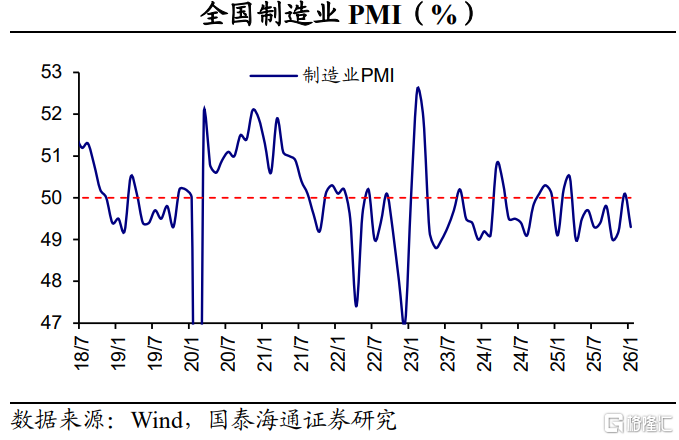
本文来自格隆汇专栏:梁中华宏观研究 作者: 侯欢、梁中华 投资要点 本月制造业PMI淡季回落,需求待提振,扩产较谨慎。受大宗商品涨价影响,价格指数明显回升。此外,服务业景气平稳,建筑业活 跃度还需政策呵护。 2026年1月份,制造业PMI为49.3%,比上月下降0.8个百分点。建筑业商务活动指数为48.8%,比上月下降4.0个百分点;服务业商务活 动指数为49.5%,比上月下降0.2个百分点。 制造业PMI:淡季回落。为了缓解春节假期因素的扰动,国泰海通证券把本月PMI与近年春节前一个月对比。结果发现,本月PMI不及 近年同期平均水平,降幅强于季节性。一方面,企业规模分化加剧,大型企业PMI仍位于扩张区间, 中、小型企业PMI在收缩区间低位 运行。另一方面,经济结构转型加快。高技术制造业PMI连续两个月位于较高水平,装备制造业保持在扩张区间。相比之下,消费品 行业和高耗能行业处于收缩区间,景气水平有所回落。 需求有待提振,扩产较为谨慎。2026年1月份,生产指数为50.6%,虽然高于临界点,但是比上月下降1.1个百分点,除了淡季因素的影 响,还与需求的回落有关。同期,新订单、新出口订单指数分别为49.2%、4 ...


2026年1月PMI点评:节前景气回落,结构分化加剧
Orient Securities· 2026-01-31 23:30
Economic Indicators - The Manufacturing PMI for January 2026 is at 49.3%, falling below the expansion threshold of 50.1%[7] - The Production and New Orders PMI are recorded at 50.6% and 49.2% respectively, both showing significant declines from previous levels[7] Sector Performance - High-tech manufacturing PMI stands at 52%, slightly down from 52.5%, but remains near the second-highest level since the implementation of equal tariff policies in April 2025[7] - The construction sector's activity has slowed significantly, with the PMI dropping below 40% due to adverse weather and the upcoming holiday[7] Demand Dynamics - New Orders PMI has seen a year-on-year decline, marking the second-lowest drop for this period, indicating insufficient domestic demand[7] - New Export Orders PMI decreased by 1.2 percentage points to 47.8%, influenced by prior export surges and trade policy adjustments from key partners[7] Price Trends - Major raw material purchase price index and factory price index have risen to 56.1% and 50.6% respectively, indicating a return to expansion after 20 months[7] - Prices in the non-ferrous metal sector are driving overall price increases, while sectors with weak internal demand, like wood processing, show price contraction[7] Future Outlook - The report suggests that geopolitical changes and investment demand in technology will continue to drive global capital expenditure and commodity prices, particularly in non-energy commodities[7] - The ongoing contradiction of strong supply versus weak demand in the domestic market remains a critical issue, with the ability of upstream prices to transmit to downstream still uncertain[7]
2026 年 1 月 PMI 数据点评:PMI 淡季回落,价格回升
GUOTAI HAITONG SECURITIES· 2026-01-31 13:34
Group 1: Manufacturing PMI Insights - In January 2026, the manufacturing PMI was 49.3%, a decrease of 0.8 percentage points from the previous month[9] - The production index was 50.6%, down 1.1 percentage points, indicating cautious expansion due to demand decline[16] - New orders and new export orders indices were 49.2% and 47.8%, respectively, both declining by 1.6 and 1.2 percentage points[16] Group 2: Price and Inventory Trends - The main raw materials purchase price index rose to 56.1%, an increase of 3.0 percentage points, while the factory price index reached 50.6%, marking the first time in 20 months above the critical point[19] - Raw material inventory and finished goods inventory indices were 47.4% and 48.6%, respectively, indicating a decrease in raw material stock[21] Group 3: Non-Manufacturing Sector Performance - The service sector's business activity index was stable at 49.5%, with significant divergence among industries[22] - The construction sector's business activity index fell to 48.8%, down 4.0 percentage points, reflecting seasonal slowdowns[24] Group 4: Economic Outlook and Risks - The macroeconomic policy is expected to be more proactive, with a focus on boosting overall demand and ensuring spending increases[27] - A risk remains in the real estate sector, where demand needs to be stimulated[28]
年初产需降温——1月PMI数据解读【陈兴团队·华福宏观】
陈兴宏观研究· 2026-01-31 10:27
Group 1 - The manufacturing PMI in January recorded a decline to 49.3%, which is 0.8 percentage points lower than the previous month and below the median level of the past five years [4][3] - Key sub-indices such as new orders, production, raw material inventory, and employment all showed a decrease, indicating a cooling in both supply and demand [4][2] - The new orders index fell to 49.2%, down 1.6 percentage points from the previous month, while the production index decreased to 50.6%, down 1.1 percentage points [6][4] Group 2 - The price index has risen significantly due to recent increases in commodity prices, with the raw material purchase price index at 56.1%, down 3.0 percentage points, and the factory price index at 50.6%, up 1.7 percentage points [8][3] - The construction industry has seen a notable decline, with the new orders index dropping significantly, leading to a business activity index of 48.8%, the lowest since April 2020 [9][3] - The non-manufacturing business activity index fell to 49.4%, with the service sector also experiencing a slight decline, indicating overall weak economic conditions [9][12]

1月份中国采购经理指数有所回落 专家称后市回稳具备基础
Zheng Quan Ri Bao· 2026-01-31 04:28
国家统计局服务业调查中心首席统计师霍丽慧解读时表示,1月份,部分制造业行业进入传统淡季,加 之市场有效需求仍显不足,制造业PMI为49.3%,景气水平较上月下降。 制造业采购经理指数有所下降 生产继续保持扩张 1月31日,国家统计局服务业调查中心和中国物流与采购联合会发布中国采购经理指数。数据显示,1月 份,制造业采购经理指数、非制造业商务活动指数和综合PMI产出指数分别为49.3%、49.4%和49.8%, 比上月下降0.8个、0.8个和0.9个百分点,经济景气水平有所回落。 企业预期保持乐观。生产经营活动预期指数为52.6%,继续高于临界点。从行业看,农副食品加工、食 品及酒饮料精制茶等行业生产经营活动预期指数连续两个月位于56.0%以上较高景气区间,相关企业对 近期行业发展信心较强。 展望后市,文韬预计,2月份,受春节假期影响,制造业运行或继续有所放缓。随着春节过后经济社会 回归正常运行,在"十五五"规划布局启动、中央经济工作会议部署落实的带动下,制造业将继续稳定扩 张,高质量发展向深向实。 非制造业商务活动指数有所回落 金融市场活跃度较高 1月份,受建筑业等行业景气度下降等因素影响,非制造业商务活动指 ...