潮玩

Search documents
2024年初来首次回购!泡泡玛特盘初拉升涨超8% 大摩:泡泡玛特增长逻辑明确
Xin Lang Cai Jing· 2026-01-20 01:36
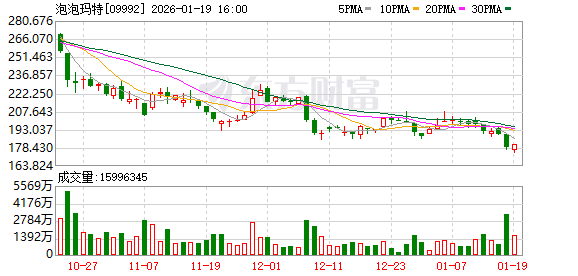
行情图 热点栏目 自选股 数据中心 行情中心 资金流向 模拟交易 客户端 1月20日消息,泡泡玛特盘初拉升一度涨超8%,现报194.5港元。泡泡玛特股价自2025年8月下旬触及 339.8港元高点后,便开启持续下行走势。 | 09992 泡泡玛特 | | | | --- | --- | --- | | 194.500↑+13.700 +7.58% | | 交易中 01/20 09:35 | | * | | ● 快捷交易 | | 最高价 195.700 | 开盘价 190.200 | 成交量 599.18万 | | 最低价 190.200 | 昨收价 180.800 | 成交额 11.6亿 | | 平均价 193.583 | 市德率TTM 35.10 | 总市值 2609.3亿元 | | 振 幅 3.04% | 市盈率(静) 77.31 | 总股本 13.42亿 | | 换手率 0.45% | 市净率 16.775 | 流通值 2609.3亿 | | 52周最高 339.800 | 委 比 -40.81% | 流通股 13.42亿 | | 52周最低 90.112 | 量 比 21.83 | 每 手 200股 ...



泡泡玛特高开逾5% 近两年来首次回购股份 涉资2.51亿港元
Zhi Tong Cai Jing· 2026-01-20 01:34
Core Viewpoint - Pop Mart (09992) has initiated a share buyback program, signaling strong growth and financial health, which may attract more investors [1] Group 1: Share Buyback Announcement - Pop Mart announced a share buyback of 1.4 million shares at a cost of HKD 251 million, with prices ranging from HKD 177.7 to HKD 181.2 per share [1] - This marks the company's first share repurchase since early 2024, indicating a strategic move to enhance shareholder value [1] Group 2: Financial Performance and Projections - Morgan Stanley projects that Pop Mart will achieve a net profit of RMB 12.6 billion by 2025, reflecting strong growth drivers and a clear long-term strategy [1] - As of the end of last year, Pop Mart had RMB 20 billion in net cash, demonstrating ample financial resources to provide returns to shareholders [1]
泡泡玛特高开5.2% 昨日耗资2.5亿港元回购 大摩料吸引等待催化剂的投资者
Ge Long Hui· 2026-01-20 01:34
Core Viewpoint - Pop Mart (9992.HK) has initiated a share buyback program, signaling strong growth and financial health, which may attract more investors [1] Group 1: Share Buyback Announcement - On January 20, Pop Mart announced a buyback of 1.4 million shares at a cost of HKD 251 million, with prices ranging from HKD 177.7 to HKD 181.2 per share [1] - This marks the first share buyback since early 2024, indicating a strategic move to enhance shareholder value [1] Group 2: Financial Performance and Projections - Morgan Stanley projects that Pop Mart's net profit will reach RMB 12.6 billion by 2025, reflecting strong growth drivers and a clear long-term strategy [1] - As of the end of last year, Pop Mart had RMB 20 billion in net cash, demonstrating ample financial resources to provide returns to shareholders [1]
港股异动 | 泡泡玛特(09992)高开逾5% 近两年来首次回购股份 涉资2.51亿港元
智通财经网· 2026-01-20 01:33
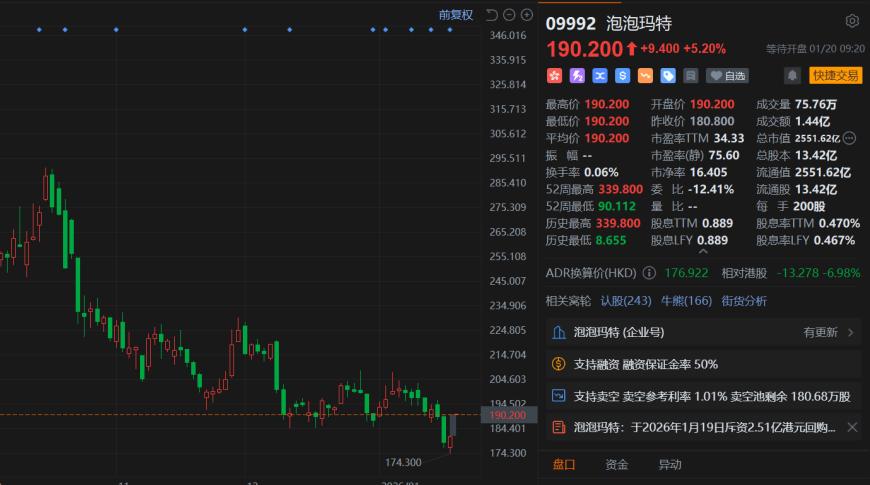
消息面上,泡泡玛特发布公告称,于2026年1月19日,公司斥资2.51亿港元回购140万股股份,每股回购 价177.7-181.2港元。摩根士丹利称,泡泡玛特自2024年初以来首次回购股份,预计能够吸引更多投资者 的关注,特别是那些等待股价催化剂的投资者。目前泡泡玛特增长强劲,驱动因素清晰,长期逻辑明 确。预计泡泡玛特2025年净利润达126亿元人民币,且在去年末有200亿元的净现金,表明公司拥有充足 的财务资源给股东带来更多回报。 泡泡玛特(09992)高开逾5%,截至发稿,涨5.2%,报190.2港元,成交额1.44亿港元。 ...
港股股票回购一览:44只个股获公司回购
Jin Rong Jie· 2026-01-20 01:16
Group 1 - On January 19, a total of 44 Hong Kong stocks were repurchased by companies, with 4 stocks having repurchase amounts exceeding 10 million HKD [1] - The companies with the largest repurchase amounts on January 19 were Pop Mart, Xiaomi Group-W, and Sunny Optical Technology, with repurchase amounts of 251 million HKD, 146 million HKD, and 78.81 million HKD respectively [1] - As of January 19, 102 Hong Kong stocks have been repurchased this year, with 6 stocks having cumulative repurchase amounts exceeding 100 million HKD [1] Group 2 - The companies with the highest cumulative repurchase amounts this year are Tencent Holdings, Xiaomi Group-W, and Sunny Optical Technology, with repurchase amounts of 6.358 billion HKD, 1.606 billion HKD, and 536 million HKD respectively [1]
摩根士丹利:泡泡玛特2024年初来首次回购 料吸引等待催化剂的投资者
Jin Rong Jie· 2026-01-20 00:56
本文源自:金融界AI电报 摩根士丹利称,泡泡玛特自2024年初以来首次回购股份,预计能够吸引更多投资者的关注,特别是那些 等待股价催化剂的投资者。分析师Dustin Wei等在报告中指出,目前泡泡玛特增长强劲,驱动因素清 晰,长期逻辑明确;预计泡泡玛特2025年净利润达126亿元人民币,且在去年末有200亿元的净现金,表 明公司拥有充足的财务资源给股东带来更多回报;和以往一样,公司未对回购设定目标规模和时间表, 而是根据市场情况评估。 ...
布鲁可股东将股票由中国国际金融香港证券转入高盛(亚洲)证券 转仓市值5.45亿港元
Zhi Tong Cai Jing· 2026-01-20 00:22
Group 1 - The core viewpoint of the article highlights that Broco (00325) is benefiting from the growth of the Chinese潮玩 (trendy toy) industry, as it is a leading company in the building block toy segment [1] - On January 19, Broco's shares were transferred from China International Capital Hong Kong Securities to Goldman Sachs (Asia) Securities, with a market value of HKD 545 million, representing 3.13% of the total shares [1] - Huaxin Securities has issued a report stating that Broco will continue to benefit from industry expansion and its ongoing collaboration with new IPs, leading to steady revenue growth, maintaining a "buy" investment rating [1]
见证文化与经济的交响共鸣
Jing Ji Ri Bao· 2026-01-19 22:10
Core Insights - The cultural consumption wave in 2025 has significantly reshaped the economic landscape, with notable achievements in film, micro-short dramas, and merchandise, indicating a robust integration of culture into the economy [1][11]. Group 1: Film Industry - The film industry saw a remarkable growth in 2025, with total box office revenue reaching 51.83 billion yuan, a year-on-year increase of 21.95%, and domestic films accounting for 79.67% of the box office [1]. - "Nezha: Birth of the Demon Child" emerged as a cultural symbol, showcasing the strength of Chinese film production and creativity, and contributing to both social and economic benefits through its historical narratives [1]. - The success of popular IPs like "Boonie Bears" and "Detective Chinatown" has stabilized the market, serving as a solid foundation for the industry [1]. Group 2: Television and Micro-Short Dramas - High-quality television dramas have gained market traction due to their depth and artistic quality, with shows like "Silent Glory" and "In the Name of Law" achieving both high ratings and critical acclaim [2]. - The micro-short drama market reached 67.79 billion yuan in 2025, reflecting significant growth and structural optimization, driven by platforms that emphasize quality content [2]. Group 3: Cultural Integration and IP Development - Cultural consumption is increasingly intertwined with various industries, with successful IPs like "Nezha" activating a complete industrial chain from content development to merchandise sales, potentially reaching a sales scale of 100 billion yuan [3]. - The transformation of IPs into multi-dimensional symbols, such as "Wang Wang Mountain," illustrates the shift from traditional production to "IP ecosystem operators," enhancing the cultural industry's contribution to the economy [3]. Group 4: Technological Innovation - Technology, including AI and big data, has become a core driver of cultural innovation, reshaping production and consumption methods in the industry [4]. - AI integration in film production has improved efficiency and expanded artistic expression, with companies like Yu Wen Group leveraging AI to accelerate the transformation of literary IPs into visual media [5]. Group 5: Cultural Consumption Ecosystem - The integration of cultural experiences into broader consumption patterns has led to the emergence of a complex consumption ecosystem, with local sports events generating significant economic benefits [7]. - The concept of "ticket root economy" has evolved, linking cultural events to tourism and local economies, as seen with the success of films like "Chang'an 30,000 Miles" driving tourism in related locations [9]. Group 6: Global Expansion of Cultural Products - The cultural export landscape has evolved, with Chinese films and micro-short dramas achieving significant international success, exemplified by "Nezha" topping global animation box office charts [11]. - The overseas market for micro-short dramas generated $1.525 billion in revenue from January to August 2025, marking a nearly twofold increase year-on-year [11]. Group 7: Cultural Heritage and Technology - Technological advancements have revitalized cultural heritage, with initiatives in various provinces using digital technologies to enhance the presentation and preservation of cultural assets [6]. - The development of smart museums and virtual archaeological sites has transformed static cultural artifacts into interactive experiences, expanding the reach and impact of cultural heritage [6].
文化情感科技勾勒消费新维度
Bei Jing Shang Bao· 2026-01-19 15:17
Group 1: Cultural and Creative Industry Insights - The CEO of HERE Qimeng Island Group emphasized that trendy toys have become symbols connecting diverse cultures, with the company's original IP "WAKUKU" gaining significant attention in the market [2] - The company has launched an overseas expansion plan, achieving positive responses in Southeast Asia and North America, with over 75 million interactions on social media platforms in North America [2] - The cultural IP "Younli" series and "WAKUKU" limited edition have been well-received, showcasing the ability to convey cultural depth through contemporary design [2] Group 2: Retail and Experience Innovation - Qimeng Island is focusing on building offline experience stores in Beijing, prioritizing emotional connections and immersive environments over mere consumption functions [3] - The company aims to deepen experience innovation and expand cross-industry collaborations to integrate into the industry ecosystem [3] Group 3: Cultural Integration in Business - Beijing Zhonghai Dajixiang's VP highlighted the importance of deeply integrating culture with business to create cultural super IPs that can serve as benchmarks for physical commerce [5] - The Dajixiang project emphasizes cultural preservation while adapting to modern trends, featuring public cultural exhibition spaces and diverse cultural activities [6] Group 4: Emotional Consumption Trends - The founder of Beijing Huajiang Cultural Group noted that the sports industry is becoming a significant commercial opportunity, with substantial market potential in various revenue streams [8] - The company has successfully combined the "Bing Dwen Dwen" mascot with Chinese zodiac culture, generating over 300 million yuan in retail sales from the "Zodiac Dwen Dwen" series [8] Group 5: AI and Digital Transformation in Business - Ningbo Bank's platform has served over 161,000 enterprises, providing comprehensive services and solutions, including AI-driven tools to help brands expand their market reach [11] - The bank is transitioning from a traditional funding provider to a resource integrator, enhancing its service offerings to support various industries [12] Group 6: Trends in Fashion and Consumer Behavior - The essence of successful fashion products lies in cultural resonance, emotional connections, and innovative expressions, with a focus on creating immersive experiences for consumers [14] - Weibo IN has successfully engaged users through limited edition releases and immersive events, demonstrating the combination of product scarcity, emotional resonance, and community engagement [15] Group 7: Pet Industry Growth Potential - The pet market in Beijing shows a high proportion of pet owners, with significant growth potential as the pet penetration rate is only about 12%, compared to over 50% in developed countries [16] - Future strategies in the pet market should focus on storytelling and creating engaging consumption environments that resonate with local preferences [16] Group 8: Retail Transformation Strategies - Yonghui Supermarket is implementing a comprehensive transformation strategy to enhance customer experience, with an 80% SKU turnover rate and the introduction of over 30 new convenience services [17] - The supermarket aims to develop its private label products and improve service quality to meet the demands of young families [17] Group 9: Cultural Heritage and Commercial Innovation - The chairman of Beijing Jingxi Shadow Play Cultural Park plans to innovate the commercial model of shadow play art, aiming to engage more children with this cultural heritage [18] - The company has successfully integrated shadow play with modern technology, achieving over 65 billion views through collaborative campaigns [18]
泡泡玛特 斥资2.51亿港元回购
Zhong Guo Ji Jin Bao· 2026-01-19 14:57
Core Viewpoint - Pop Mart has initiated a share buyback of 1.4 million shares for approximately HKD 251 million after experiencing a significant decline in stock price over the past five months [2][5]. Group 1: Share Buyback Details - On January 19, Pop Mart announced the repurchase of 1.4 million shares at a price range of HKD 177.7 to HKD 181.2 per share [2][4]. - Following the buyback, the total number of issued shares (excluding treasury shares) will decrease from 1,342,943,150 to 1,341,543,150 [4]. Group 2: Market Performance and Analysis - Since reaching a high of HKD 339.8 in late August 2025, Pop Mart's stock has declined over 43%, with its market capitalization shrinking from over HKD 400 billion to HKD 242.8 billion [5]. - Analyst Jeff Zhang from Morningstar noted a potential slowdown in domestic revenue growth for Pop Mart in Q4 2025, citing inventory buildup of certain Labubu products as an indicator of waning interest in older products [5]. - Despite concerns over short-term revenue fluctuations, Zhang maintains a fair value estimate of HKD 280 for Pop Mart, suggesting that the current valuation is attractive [5].