
农产品

Search documents
中新网:延吉海关推动吉林企业拓展韩国市场
Sou Hu Cai Jing· 2026-01-28 06:42
Group 1 - The core point of the article highlights the significant impact of the China-South Korea Free Trade Agreement (FTA) on trade facilitation, with the Yanji Customs issuing nearly 2,000 certificates of origin over the past five years, valued at approximately 560 million yuan, effectively reducing trade costs for enterprises engaging with South Korea [1][3][4] Group 2 - Yanji Customs has focused on key areas such as machinery imports and specialty agricultural exports, optimizing customs supervision and services to accelerate the benefits of the FTA [3] - The customs authority has provided one-on-one policy guidance, enabling companies to utilize tariff reductions effectively, exemplified by a local company saving 44,000 yuan in taxes through zero-tariff clearance for imported machinery parts [3] - The implementation of a "single window" and smart customs initiatives has improved trade facilitation, reducing the time and costs associated with customs clearance and certificate application processes [3] Group 3 - Yanji Customs is committed to deepening the implementation of FTA policies and enhancing customs facilitation measures to support Jilin enterprises in integrating more deeply into China-South Korea economic and trade cooperation [4]


破“内卷”通壁垒 广东政协委员多维度支招民企高质量出海
Zhong Guo Xin Wen Wang· 2026-01-28 06:15
Group 1 - The core discussion during the Guangdong Two Sessions focused on the high-quality overseas expansion of enterprises and the development of the private economy, with proposals aimed at transforming Guangdong into a global hub for new productive forces [1] - According to Ernst & Young, China's total foreign direct investment exceeded $160 billion in the previous year, marking a 10% year-on-year increase, indicating robust growth in overseas investments by Chinese enterprises [1] Group 2 - Medium-sized enterprises face challenges such as insufficient internationalization capabilities, high compliance risks, and fragmented service systems, necessitating the establishment of a "new productive force output base" to support their overseas expansion [2] - Suggestions include creating a collaborative platform for overseas expansion based on the Belt and Road Initiative, forming an "overseas alliance" for key industries, and standardizing overseas business practices to enhance brand recognition [2] Group 3 - Leveraging the unique advantages of Macau in design, quality control, and international certification can add high value to products from Guangdong's county-level industries, promoting a "cross-border e-commerce + industrial belt" model [3] - The proposal includes establishing a policy coordination list for cross-border e-commerce and extending logistics subsidies and rent reductions to rural areas in Guangdong [3] Group 4 - The integration of over 8,000 professionals from Hong Kong and Macau in the Greater Bay Area is crucial for enhancing overseas expansion efficiency, but challenges such as qualification recognition and public service gaps remain [3] - Recommendations include creating a dynamic recognition list for professionals from Hong Kong and Macau and optimizing tax policies to facilitate talent mobility [3] Group 5 - The various proposals from committee members complement each other, emphasizing the need for institutional innovation to address development challenges and strengthen the foundation for overseas expansion [4]
连续第三周资金大幅流入大宗商品,高度集中于贵金属和农产品
Hua Er Jie Jian Wen· 2026-01-28 04:48
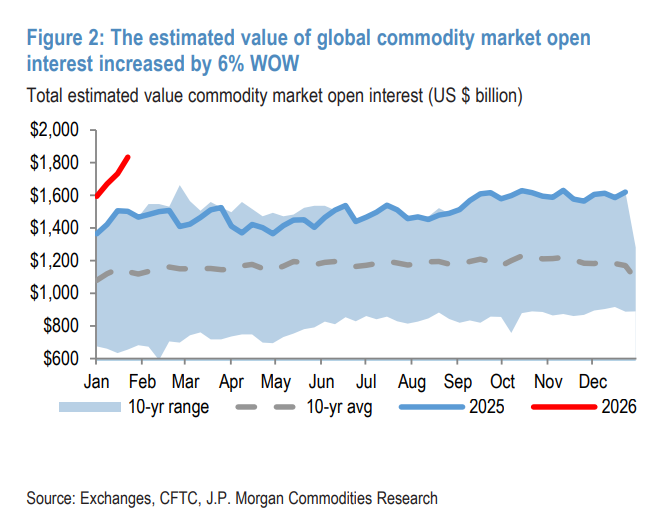
Core Insights - Global commodity markets are experiencing significant capital inflows, with a focus on precious metals and agricultural products, leading to a record high in open interest value [1][4] - As of January 23, 2023, the total value of open interest in global commodity markets increased by nearly 6% week-over-week, reaching $1.83 trillion [1] - Precious metals, particularly gold, are attracting substantial investment, with gold alone seeing a net inflow of approximately $158 billion [4] Group 1: Precious Metals - Precious metals are the primary beneficiaries of recent capital inflows, with a net inflow of about $36 billion in the week, and gold's price increased by approximately 8% [4] - The total value of open interest in the precious metals market surged by 16% week-over-week, amounting to $433 billion, making it the largest contributing sector [4] - The structural logic for gold remains clear, with analysts favoring gold over silver due to potential volatility in silver prices [5] Group 2: Energy and Natural Gas - The energy market's open interest value grew by 4.8% week-over-week, reaching $700 billion, driven by geopolitical factors and supply disruptions [8] - Despite a net outflow of about $2.5 billion in natural gas contracts, prices surged by approximately 70% due to severe cold weather in North America and Europe [8] - European natural gas inventory levels are historically low, contributing to rising prices amid increased heating demand [8] Group 3: Agricultural Products - The agricultural sector also saw increased investment, with open interest value rising by 2.4% to approximately $337 billion, driven by net inflows of $8.9 billion [11] - Price increases in grains, oilseeds, and livestock markets offset declines in soft commodities, indicating a robust interest in agricultural products [11] Group 4: Base Metals - The base metals market's open interest value increased by 2% week-over-week to $258.4 billion, although the sector experienced a net outflow of $400 million [15] - Despite inflows in copper and lead, overall outflows in other base metals led to a cautious outlook on copper prices due to rising inventory levels [15] - Investor positions in base metals are stabilizing, but some commodities are nearing "overheated" conditions, suggesting potential for a slowdown in buying momentum [15]


银河期货每日早盘观察-20260128
Yin He Qi Huo· 2026-01-28 04:34
银河期货研究所 2026 年 1 月 28 日 0 / 49 期 货 眼 ·日 迹 每日早盘观察 研究所 期货眼·日迹 | 股指期货:压力有所减轻 4 | | --- | | 国债期货:股债跷跷板 5 | | 蛋白粕:供应仍有压力 | 盘面走势偏强 6 | | --- | --- | | 白糖:外盘走势现分歧,郑糖底部震荡 6 | | | 油脂板块:油脂有所分化 7 | | | 玉米/玉米淀粉:北港现货稳定,盘面偏弱震荡 8 | | | 生猪:出栏压力增加 | 现货震荡运行 9 | | 花生:花生现货稳定,花生盘面底部震荡 10 | | | 鸡蛋:临近节前备货,蛋价有所上涨 10 | | | 苹果:节前走货尚可,苹果价格坚挺 11 | | | 棉花-棉纱:整体变化不大 | 棉价有所支撑 12 | | 钢材:需求边际转弱,钢价延续震荡 14 | | --- | | 双焦:基本面乏善可陈,关注资金扰动 14 | | 铁矿:终端需求低位,矿价震荡运行 15 | | 铁合金:估值偏低存在修复需求,短期震荡偏强 16 | | 金银:特朗普"暗示"弱美元,金银维持强势 17 | | --- | | 铂钯:美元信任危机 贵 ...
综合晨报-20260128
Guo Tou Qi Huo· 2026-01-28 02:56
Group 1: Energy and Metals Crude Oil - Nighttime oil prices rebounded significantly, with Brent crude approaching $67 per barrel and NTI close to $63 per barrel. Winter storms led to a maximum daily production loss of 2 million barrels in the US, about 15% of the national output. API inventory data showed a drawdown in crude oil, which was bullish. However, the inventory pressure in the global crude oil market in January 2026 was significant, and the long - term factor suppressing oil price increases was the loose supply - demand situation [2]. Precious Metals - The US dollar index hit a four - year low overnight, and precious metals continued to perform strongly. Gold had a solid logic, while silver and platinum had high volatility risks. Attention was paid to the Middle East situation and the Fed meeting guidance [3]. Copper - Copper prices oscillated overnight, but recovered losses in the US session. The LME spot discount widened to $93. Market focus shifted to geopolitical issues, the potential US government "shutdown" at the end of the month, and internal US conflict risks. Copper prices were expected to oscillate at a high level with a tendency to adjust [4]. Aluminum - Shanghai aluminum oscillated at a high level overnight. Spot premiums and discounts in East China, Central China, and Foshan were - 170 yuan, - 280 yuan, and 165 yuan respectively. Geopolitical games made the financial market sentiment fluctuate. Attention was paid to whether the high - level oscillation range could form a directional breakthrough [5]. Cast Aluminum Alloy - Cast aluminum alloy followed the fluctuations of Shanghai aluminum, with low market activity. Due to macro - driving and high prices, the seasonal spread between cast aluminum alloy and Shanghai aluminum would be weaker than in previous years [6]. Alumina - The operating capacity of domestic alumina remained high, with an increase in maintenance but no long - term production cuts. The alumina balance was in significant surplus. The cash cost support might be below 2,500 yuan. Alumina needed large - scale production cuts to stabilize, and short - selling on rallies was recommended when the basis was low [7]. Zinc - The external market strengthened, driving the domestic market up. The import loss of zinc ingots expanded to over 2,500 yuan per ton. Domestic traders' price - supporting sentiment rose again, and the spot premium stopped falling. High natural gas prices in Europe and the US and low TC pushed up overseas zinc smelting costs, supporting zinc prices at a high level. However, the consumption off - season still restricted the price, and zinc was expected to oscillate between 24,000 - 25,000 yuan per ton before the Spring Festival [8]. Lead - Transportation in Central and East China recovered, and primary lead smelters resumed production in late January. With insufficient downstream demand, Shanghai lead prices fell. The import profit of lead ingots narrowed to 86 yuan per ton. As lead prices dropped to 17,000 yuan, downstream inventory - building willingness increased. The refined - scrap spread was 100 yuan per ton, and the loss of recycled lead expanded. Shanghai lead was expected to oscillate between 16,800 - 17,000 yuan per ton [9]. Nickel and Stainless Steel - Shanghai nickel oscillated at a high level with active trading. After the increase in stainless steel spot prices, downstream buyers were cautious, and actual transactions were weak. The inventory of pure nickel increased by 2,700 tons to 66,000 tons, nickel - iron inventory was 29,300 tons, and stainless steel inventory was basically stable at 844,000 tons. Caution was advised due to the market's fear of high prices [10]. Tin - Overnight, the price fluctuations of domestic and international tin increased. Shanghai tin rose and then fell, with strong volume - price guidance. There had been tin ingot trading on the Indonesian exchange this month, and the domestic tin concentrate processing fee increased slightly. The tin market was closely related to silver prices, and the technical pattern was still intact. Cautious trading was recommended [11]. Lithium Carbonate - Lithium carbonate prices rose again, but market trading declined. Exchange policies affected market participation. High prices might have led to the closing of many hedging positions, with strong spot and speculative long positions being dominant, and the持仓 structure was fragile. The total market inventory decreased by 800 tons to 109,000 tons. The overall de - stocking speed slowed down. Lithium carbonate futures were in high - level oscillation, with high short - term uncertainty [12]. Polysilicon - Polysilicon futures oscillated upward, but the spot price declined. The average spot price of N - type re -投料 was 52,500 yuan per ton, down 1,500 yuan per ton from the previous day. The futures - spot spread narrowed. Battery cell prices dropped to 0.47 yuan/W, approaching the cash cost. Battery cell manufacturers were cautious about increasing production in February, mainly focusing on de - stocking. The acceptance of polysilicon price increases by downstream was low, and polysilicon had high inventory pressure. The upward space of polysilicon prices was expected to be limited [13]. Industrial Silicon - The supply of industrial silicon decreased, with production cuts in Inner Mongolia and planned cuts by large factories in Xinjiang at the end of the month. The demand in each sector was weak. The production of polysilicon in February might fall to 90,000 tons. The weekly operating rate of organic silicon was stable at around 66%. The operating rate of recycled aluminum alloy was expected to decline. Industrial silicon inventory increased to 556,000 tons. The industrial silicon market was driven by production cut expectations, and attention was paid to whether it could break through 9,000 yuan per ton. It was expected to oscillate [14]. Group 2: Steel and Related Products Rebar and Hot - Rolled Coil - Steel prices oscillated weakly overnight. In the off - season, the apparent demand for rebar decreased, production increased, and inventory accumulated. The demand and production of hot - rolled coil both declined slightly, and inventory continued to decrease. Steel mill profits were poor, and downstream acceptance ability was insufficient. The resumption of blast furnace production slowed down, and hot metal production stabilized. Domestic demand was weak, and steel exports remained high. The spot supply - demand contradiction was not significant, and the market sentiment was volatile. The market was expected to oscillate in a range [15]. Iron Ore - Iron ore prices weakened overnight. Global shipments increased and were stronger than the same period last year. Vale's reservoir had an accident. Domestic arrivals decreased from the high level, and port inventory accumulated significantly. Terminal demand was low in the off - season, and hot metal production was affected by the accident and remained low. Steel mills' imported ore inventory increased but was still at a low level. The iron ore market was generally loose, but considering the phased inventory - building demand, the price was expected to continue to oscillate [16]. Coke - Coke prices declined during the day. The first round of price increase was shelved, coking profits were average, and daily production decreased slightly. Coke inventory increased slightly, and traders' purchasing willingness was general. The carbon element supply was abundant, and downstream hot metal production was at an off - season level. It was necessary to observe whether winter inventory - building continued. Steel mills had a strong desire to suppress raw material prices. Coke futures were at a premium, and the price was likely to oscillate downward in the short term [17]. Coking Coal - Coking coal prices declined during the day. The prices of most imported coals increased, providing some support to domestic coal prices. The Mongolian coal customs clearance volume was 1,402 tons. The production of coking coal mines increased slightly, and the spot auction transactions were at a high level. Terminal inventory increased significantly. The total coking coal inventory increased slightly. The carbon element supply was abundant, and downstream hot metal production was at an off - season level. It was necessary to observe whether winter inventory - building continued. Steel mills had a strong desire to suppress raw material prices. Coking coal futures were at a premium to Mongolian coal, and the price was likely to oscillate downward in the short term [18]. Silicomanganese - Silicomanganese prices declined during the day. Manganese ore spot prices decreased. Manganese ore port inventory might start to accumulate slowly. The mine's shipping volume increased month - on - month, but the mine cost was higher than in previous years, and the price - concession space was limited. Hot metal production was at a seasonal low. The weekly production of silicomanganese changed little. Silicomanganese inventory decreased slightly. Short - selling on rallies was recommended due to oversupply and the influence of "anti - involution" policies [19]. Ferrosilicon - Ferrosilicon prices declined during the day. The power cost in some production areas decreased, but the semi - coke price increased slightly. The main production areas were still in a loss. Hot metal production was at an off - season level. The export demand was over 30,000 tons, with a marginal impact. The production of magnesium metal increased month - on - month, and the secondary demand increased marginally. The overall demand was still resilient. Ferrosilicon supply changed little, and inventory decreased slightly. Short - selling on rallies was recommended due to oversupply and the influence of "anti - involution" policies [20]. Group 3: Shipping and Fuels Container Freight Index (European Line) - In the spot market, Maersk's new cabin quotes for Week 7 - Week 9 were 1,200/1,900/2,000 and 1,260/1,995/2,100, with some routes slightly lower than the previous period. Facing the pre - holiday return cargo pressure, spot quotes continued to decline. The new threat from the Houthi rebels in the Red Sea had limited impact on near - month contracts, and the impact on far - month contracts was also expected to be limited. Before the Spring Festival, the market lacked driving forces and was expected to oscillate. After the festival, the focus would be on whether the export tax rebate "roll - back" policy could trigger "rush shipments" and its actual implementation [21]. Fuel Oil and Low - Sulfur Fuel Oil - Driven by geopolitical factors, bad weather in North America, and the fire at a Kazakhstani oil field, the cost of crude oil increased, driving fuel oil prices up. The uncertainty of the Middle East geopolitical situation provided support for high - sulfur fuel oil. The congestion at the Singapore port made the spot market slightly tight, making fuel oil perform relatively strongly in the oil product system. For low - sulfur fuel oil, the supply in Singapore was previously tight but the spot structure changed from premium to discount, indicating a marginal relief of the tight situation. The strengthening of diesel cracking supported the strengthening of low - sulfur cracking. In the medium term, the supply was expected to increase slightly. Fuel oil was expected to continue to oscillate strongly following crude oil, but the differentiation between high - and low - sulfur fundamentals still existed [22]. Asphalt - Nighttime oil prices rose sharply, and asphalt followed. Kpler data showed that the shipment of Venezuelan oil to China had decreased significantly since January, and refineries were expected to face problems such as increased costs of alternative raw materials in the later part of the first quarter. The cost - end support made asphalt oscillate strongly [23]. Group 4: Chemicals Urea - The spot prices of urea in the mainstream regions were stable with a slight increase. Before the Spring Festival, the industrial downstream demand was expected to decline, and the large - scale spring plowing fertilizer - stocking demand had not started, with only sporadic purchases. The supply pressure remained, and the snow and rain weather affected the transportation in some inland markets. However, downstream enterprises had inventory - building needs before the festival, and the price would continue to fluctuate within a range [24]. Methanol - The overseas methanol plant operating rate remained low, and the coastal demand decreased. The concentrated unloading of foreign vessels led to a slight increase in port inventory. The Ningbo Fude MTO plant restarted over the weekend, but the olefin plants of Sierbang and Shandong Hengtong stopped. The high port inventory might suppress the market. The short - term geopolitical situation was still highly uncertain, and the market was expected to oscillate firmly [25]. Pure Benzene - The import volume of traditional benzene increased, and the inventory at Jiangsu ports increased slightly. The profit of downstream styrene improved, and the operating rate increased, driving up the demand for pure benzene. The short - term geopolitical situation and cost fluctuations were large, and the market might be under pressure as the supply increased [26]. Styrene - The cost end continued to provide support. In terms of supply - demand fundamentals, although some plants resumed production, the domestic supply still decreased, and the downstream demand decreased steadily. As the pre - Spring Festival stocking period was coming to an end, the price was under short - term pressure [27]. Polypropylene, Plastic, and Propylene - The futures of polypropylene and plastic showed a strong performance, and local downstream inventory - building drove up the buying enthusiasm. Propylene enterprises' inventory was at a low level, and the offers were raised to different extents. The actual order auction premiums were obvious, and the transaction center increased significantly. The futures of plastic and polypropylene showed a top - divergence pattern. For polyethylene, the production enterprise's plant maintenance decreased, and the import resources arrived successively, increasing the market supply pressure. The downstream factories were gradually on holiday, and the production load decreased. For polypropylene, the rising propane and international oil prices strengthened the cost support, and the enterprise's ex - factory prices were continuously raised, boosting the market's high - price atmosphere. However, the new orders were insufficient, and the downstream enterprises were more resistant to high - price raw materials [28]. PVC and Caustic Soda - PVC prices oscillated overnight. The factory inventory decreased, but the social inventory increased, and the overall inventory still had pressure. The number of maintenance increased slightly, and the operating rate decreased slightly. The export orders were good, but the domestic demand was average. The calcium carbide price decreased, weakening the cost support. PVC was expected to reduce production capacity this year, and with possible rush exports, the price center was expected to rise. Caustic soda prices oscillated overnight. The purchase price of liquid caustic soda for Shandong alumina decreased. The industry inventory fluctuated slightly and remained at a high level. The liquid chlorine price was strong, and the profit of chlor - alkali integration was acceptable. The caustic soda operating rate was high. The downstream alumina operating rate remained high, with rigid demand, but the industry was generally in a loss, and it was necessary to continue to track whether there would be production cuts; non - aluminum demand was mainly for rigid purchases. The industry was in a situation of high operating rate and high inventory, and the profit of chlor - alkali integration was expected to be further compressed [29]. PX and PTA - The chemical market declined yesterday, and PX and PTA partially gave back their recent gains. However, the overnight oil price increase slowed down their adjustment. Polyester de - stocked smoothly before the Spring Festival. PX would have new capacity in the second half of the year, while PTA had none, so they were recommended for long - position allocation in the first half of the year. However, the current demand was declining, and there was an expectation of inventory accumulation around the Spring Festival, with a weak reality. In the second quarter, based on the PX maintenance and polyester production increase expectations, opportunities for long - position allocation of PX processing margin on dips and positive spreads after the spread decline could be considered, but it needed the cooperation of downstream demand. Attention should be paid to the post - festival PX and polyester balance [30]. Ethylene Glycol - The port inventory increased on Monday compared with last Thursday, and there was an expectation of continuous inventory accumulation around the Spring Festival. Ethylene glycol faced resistance at the 4,000 - yuan integer level and fell back. In the second quarter, there were expectations of concentrated maintenance and demand recovery, and the supply - demand situation might improve temporarily. However, due to capacity growth, ethylene glycol was still under long - term pressure, and it was recommended to focus on band trading [31]. Short - Fiber and Bottle - Grade PET - Short - fiber enterprises had a high operating rate and low inventory. However, the downstream orders were weak, and the profit was thin. As the Spring Festival approached, textile enterprises would gradually go on holiday, and the terminal production tended to stop. Short - fiber prices followed the raw material adjustment. The operating rate of bottle - grade PET decreased, and the processing margin improved under the low - load and relatively low - inventory situation. In the short term, it followed the raw material adjustment and declined. In the medium term, attention should be paid to the post - Spring Festival inventory performance, and spread opportunities could be considered. In the long term, there was still capacity pressure [32]. Group 5: Building Materials Glass - Glass prices oscillated overnight. The spot price center slightly increased, and the inventory fluctuated slightly. As the downstream was about to go on holiday, there might be inventory accumulation pressure. All three types of fuel production lines were in a loss, and the production capacity changed little recently. The processing orders were still sluggish, with southern orders better than northern ones. As the downstream was approaching the holiday, glass might experience seasonal inventory accumulation, but the current valuation was low, and it might fluctuate with the macro - sentiment. Attention should be paid to the subsequent production capacity changes [33]. 20 - Rubber, Natural Rubber, and Butadiene Rubber - International crude oil futures prices rose, and the prices of raw materials in the Thai market varied. The global natural rubber supply entered the production - reduction period, with the Vietnamese production area gradually stopping production. The operating rate of domestic butadiene rubber plants slightly decreased last week, while the operating rate of upstream butadiene plants increased again. The operating rate of domestic all - steel tires slightly decreased, and the operating rate of semi - steel tires continued to increase significantly. The finished - product inventory of Shandong tire enterprises continued to increase. The total natural rubber inventory in Qingdao slightly decreased to 584,400 tons, the social inventory of Chinese butadiene rubber increased to 15,600 tons, and the
农产品早报-20260128
Yong An Qi Huo· 2026-01-28 01:26
Group 1: Report Information - Report Title: Agricultural Products Morning Report [1] - Report Date: January 28, 2026 [1] - Report Team: Agricultural Products Team of the Research Center [1] Group 2: Corn/Starch Corn - **Price Data**: From January 21 - 27, 2026, prices in Changchun remained at 2190, in Jinzhou at 2300, in Weifang increased by 10 to 2270, and in Shekou remained at 2440. The basis increased by 10 to 17, and the trade profit and import profit changed to 0 - 325 [2]. - **Market Analysis**: Market sentiment was slightly disturbed this week. Port spot prices first declined and then rose, remaining at last week's level. In the short - term, due to the strong price - holding and reluctance to sell in the producing areas, supply increase is limited. With low inventory in the channels and downstream stocking expectations, corn prices are expected to be moderately strong. In the long - term, focus on structural changes, import policies, and domestic auction policies [2]. Starch - **Price Data**: From January 21 - 27, 2026, prices in Heilongjiang remained at 2750, in Weifang at 2820. The basis increased by 58 to 155, and the processing profit decreased by 2 to - 92 [2]. - **Market Analysis**: The deep - processing industry is stable with a slight increase in the startup rate. Downstream seasonal stocking has accelerated inventory reduction. In the short - term, festival stocking expectations and inventory reduction support strong enterprise quotes. In the long - term, focus on downstream consumption rhythm, and whether inventory continues to decline after the seasonal peak will be the key factor for starch pricing [3] Group 3: Sugar - **Price Data**: From January 21 - 27, 2026, prices in Liuzhou decreased by 10 to 5330, in Nanning remained at 5270, in Kunming decreased by 10 to 5155. The basis decreased by 6 to 162, the import profit from Thailand decreased by 22 to 156, from Brazil decreased by 22 to 333, and the number of warehouse receipts increased by 322 to 14169 [4]. - **Market Analysis**: In the international market, for the 25/26 sugar - crushing season, major northern hemisphere producers are expected to increase production. In the domestic market, short - term raw sugar supply pressure is reduced, and the futures price can refer to the domestic sugar spot price. In the long - term, if the global sugar market surplus intensifies, the futures price will decline to the out - of - quota import cost [4]. Group 4: Cotton/Cotton Yarn Cotton - **Price Data**: From January 21 - 27, 2026, the price of 3128 cotton decreased by 25 to 15535, the import profit increased, and the number of warehouse receipts + forecasts increased by 183 to 11313 [4]. - **Market Analysis**: The low initial inventory offsets most of the production increase. With the expansion of domestic textile production, good downstream profits, and favorable domestic consumption - promotion policies, cotton demand is expected to improve. Also, the planting area in Xinjiang will decrease in the new season, so cotton is suitable for long - term investment [4]. Cotton Yarn - **Price Data**: From January 21 - 27, 2026, the import profit of Vietnamese yarn decreased by 3 to - 163, and the 32S spinning profit increased by 27 to - 801 [4]. Group 5: Eggs - **Price Data**: From January 21 - 27, 2026, prices in Hebei increased by 0.11 to 3.84, in Liaoning by 0.11 to 3.78, in Shandong by 0.10 to 4.00, in Henan by 0.10 to 4.10, in Hubei by 0.09 to 3.93. The basis increased by 70 to 580 [5]. - **Market Analysis**: Recent Spring Festival stocking has boosted the spot price, and the pace of culling laying hens has slowed. In the first half of the week, sales were fast, but later, the terminal's acceptance of high prices was limited. If the spot price drops and stimulates farmers to cull old hens, it will be beneficial to the egg price in the second quarter; otherwise, the capacity reduction will slow down, and the second - quarter contract will be under pressure [6] Group 6: Apples - **Price Data**: From January 21 - 27, 2026, the price of Shandong 80 first - and second - grade apples remained at 8900.00. The 1 - month basis decreased by 30 to 631.00, the 5 - month basis decreased by 38 to - 604.00, and the 10 - month basis decreased by 47 to 523.00 [9]. - **Market Analysis**: The trading atmosphere in the late - Fuji apple producing areas is still light. Traders are less active in purchasing from fruit farmers. High - quality apples maintain stable prices, while the prices of medium - and low - quality apples have loosened. As of January 22, 2026, the national cold - storage inventory ratio is about 48.01%, 2.11 percentage points lower than last year. The cold - storage capacity ratio decreased by 1.77 percentage points this week, and the inventory removal rate is 14.06% [10] Group 7: Pigs - **Price Data**: From January 21 - 27, 2026, prices in Henan Kaifeng remained at 13.13, in Hubei Xiangyang decreased by 0.05 to 12.90, in Shandong Linyi decreased by 0.10 to 13.07, in Anhui Hefei decreased by 0.20 to 13.50, in Jiangsu Nantong decreased by 0.15 to 13.35. The basis increased by 180 to 1845 [10]. - **Market Analysis**: The weekend spot price first strengthened and then weakened. Farmers are reluctant to sell at low prices, but it is difficult to maintain high prices. The overall enthusiasm of small - scale farmers for slaughter is average. With the approaching Laba Festival, the demand in the north is supported. Before the Spring Festival, both supply and demand are expected to increase, and there may still be short - term supply - demand mismatches. The medium - term pressure remains, and there is support for a long - term inflection point. The futures market sentiment fluctuates greatly. Pay continuous attention to the slaughter rhythm, epidemics, and policies [10]
申万期货品种策略日报-油脂油料-20260128
Shen Yin Wan Guo Qi Huo· 2026-01-28 01:15
1. Report Industry Investment Rating - No relevant information provided 2. Core Viewpoints - Protein meal: Night trading of soybean and rapeseed meal showed a strong and volatile trend. Brazilian soybean harvesting rate reached 2.3% as of January 17th. Positive Sino - US talks boosted expectations for US soybean exports. The upcoming biofuel policy from the US EPA also lifted demand expectations, leading to a rebound in US soybean futures prices. However, high domestic soybean meal inventories and expected high - yield in South America will continue to pressure prices [3] - Oils and fats: Night trading of oils and fats was strong, with palm oil leading the increase. Malaysia's palm oil exports were strong in January, and production decreased month - on - month. With the reduction of Malaysian palm oil tariffs, future export expectations improved. Malaysian palm oil entered a destocking cycle during the production - reduction season, which supported palm oil prices. The upcoming US biofuel policy details are expected to support soybean oil. Tight rapeseed oil supply will continue to support prices, and short - term oils and fats are expected to remain strongly volatile [3] 3. Summary by Related Catalogs Domestic Futures Market - **Prices and Changes**: The previous day's closing prices of soybean oil, palm oil, and rapeseed oil futures were 8258, 9238, and 9326 respectively. The price changes were 32, 146, and - 19, with percentage changes of 0.39%, 1.61%, and - 3.15% respectively. For soybean meal and rapeseed meal futures, the closing prices were 2766 and 2410, with changes of - 3 and 10, and percentage changes of - 0.11% and 0.42% respectively. The peanut futures price was 8844, with a change of 26 and a percentage change of 0.29% [2] - **Spreads and Ratios**: For example, the Y9 - 1 spread of soybean oil changed from 16 to 22, the P9 - 1 spread of palm oil changed from 42 to 104. The M9 - 1 spread of soybean meal changed from - 47 to - 48, and the RM9 - 1 spread of rapeseed meal changed from 64 to 69. The M - RM09 spread was 566, and the M/RM09 ratio was 1.25 [2] International Futures Market - **Prices and Changes**: The previous day's closing prices of BMD palm oil, CBOT soybeans, CBOT US soybean oil, and CBOT US soybean meal were 4172 ringgit/ton, 1068 cents/bu, 54.40 cents/lb, and 294 dollars/ton respectively. The price changes were 51.0, 7.5, 0.6, and - 0.2, with percentage changes of 1.24%, 0.71%, 1.10%, and - 0.07% respectively [2] Domestic Spot Market - **Prices and Changes**: The spot prices of Tianjin and Guangzhou first - grade soybean oil were 8700 and 8780 respectively, with percentage changes of 0.00% and 0.23%. The spot prices of Zhangjiagang and Guangzhou 24° palm oil were 9170, with a percentage change of 1.55%. The spot prices of Zhangjiagang and Fangchenggang third - grade rapeseed oil were 10130 and 10150, with percentage changes of 1.40% and 0.89% [2] - **Basis and Spreads**: The spot basis for Tianjin and Guangzhou first - grade soybean oil was 442 and 522 respectively. The spot basis for Zhangjiagang and Guangzhou 24° palm oil was - 68. The spot basis for Zhangjiagang and Fangchenggang third - grade rapeseed oil was 804 and 824. The spot spread between Guangzhou first - grade soybean oil and 24° palm oil changed from - 280 to - 260 [2] Import Profit and Pressure - The import profit of near - month Malaysian palm oil was - 184 (previously - 121), near - month US Gulf soybeans was - 184 (previously - 205), near - month Brazilian soybeans was 51 (previously 17), near - month US West soybeans was - 150 (previously - 168), near - month Canadian crude rapeseed oil was 634 (previously 655), and near - month Canadian rapeseed was 509 (previously 484) [2] Warehouse Receipts - The current warehouse receipts for soybean oil, palm oil, and rapeseed oil were 26,210, 948, and 625 respectively. For soybean meal, it was 32,428. For rapeseed meal and peanuts, it was 0. The previous values were 26,525, 1,148, 625, 32,428, 0, and 0 respectively [2] Industry Information - Malaysian palm oil production from January 1 - 25, 2026: The yield per unit decreased by 15.28% month - on - month, the oil extraction rate increased by 0.11% month - on - month, and the production decreased by 14.81% month - on - month. In Argentina, the corn sowing progress was 93.1%, and the soybean sowing progress was 96.2%. The US Department of Agriculture predicted Argentina's corn production at 53 million tons and soybean production at 48.5 million tons [3]
中信建投期货:1月28日农产品早报
Xin Lang Cai Jing· 2026-01-28 01:12
热点栏目 自选股 数据中心 行情中心 资金流向 模拟交易 客户端 玉米:中性 1.昨日到车612车,较前一日减少119车,预计作业量4.3万吨;火车到货46节(约2760吨),港口作业轮船5艘,整体高位看多情绪高涨,虽然价格上方明 显,但周内暂无回落迹象,周内仍将维持高位震荡运行 2.北方四港库存合计149.7万吨,周度上调14.5万吨,北方港口库存继续上调,而南方港口库存出现去化,区域间库存结构分化明显。一方面北方到港压力 仍在,另一方面南方饲料需求与补库行为对价格形成一定支撑,区域价差对盘面形成扰动但尚未构成明确方向性指引。 豆粕:中性 3.2025进口玉米264.87万吨,同比下降80.58%。进口供给明显收缩。进口替代压力减弱,对国内玉米形成中期支撑,但短期市场已部分消化该利多,边际影 响趋弱。 观点总结:玉米03主力观察2250附近的支撑,上方维持2330。 1.缺乏边际驱动,CBOT大豆震荡运行。预报显示未来一周巴西大部降雨形势良好,有利于作物生长;阿根廷科尔多瓦省降水有利于改善土壤墒情,但圣 菲省以及布宜诺斯艾利斯省大部仍然仅有零星降雨,关注干旱发展的可能性; 2.国内油厂大豆、豆粕呈现季节性去 ...


美元走弱,金价再创新高
Dong Zheng Qi Huo· 2026-01-28 01:10
特朗普最新表态对于弱势美元较为满意,市场风险偏好上升, 美元指数明显走弱。 宏观策略(股指期货) 12 月规上工企利润同比增 5.3% 综 A 股震荡缩量上涨,市场仍有一定韧性,但逻辑主线近期较为混 乱,投机情绪主导行情。未来随着监管层持续加码,我们认为 风格差异或将收敛。仍建议均衡配置各股指多头。 日度报告——综合晨报 美元走弱,金价再创新高 [T报ab告le_日R期an:k] 2026-01-28 宏观策略(外汇期货(美元指数)) 美国消费者信心跌至 2014 年以来低点 合 宏观策略(黄金) 晨 CME 调整白银保证金 报 金价再度上涨创新高,主要受到美元指数大跌的驱动,一方面 是市场对美元信用的担忧持续强化,对黄金储备需求增加。一 方面是日本有联合干预外汇市场的预期,美元大跌利多黄金 有色金属(锡) Alphamin 2025 年锡矿产量 18,576 吨 印尼拟出台锡的最低成本价格机制 能源化工(原油) API 美国原油库存下降 油价上涨,因供应扰动因素支撑油价。 未获得东证期货书面授权,任何人不得对本报告进行任何形式的发布、复制。本报告的信息均来源于 公开资料,我公司对这些信息的准确性和完整性不作 ...
外媒:中国在加下大单
Huan Qiu Shi Bao· 2026-01-28 01:07
Core Viewpoint - China has finalized agreements to import up to 10 ships of Canadian canola, which will help alleviate market supply tensions, following Canadian Prime Minister Mark Carney's visit to China [1] Group 1: Trade Agreements - During Carney's visit, a preliminary trade agreement was reached where China will lower tariffs on Canadian canola, while Canada will reduce tariffs on Chinese electric vehicles [1] - The canola shipments are expected to be delivered between February and April, with each ship carrying approximately 65,000 tons, totaling around 650,000 tons, which accounts for over 10% of China's total canola imports for 2024 [1] Group 2: Market Impact - The ease of importing Canadian canola into the Chinese market has been noted, with crushing companies already pre-booking these shipments [1] - Canola, also known as rapeseed, is processed into edible oil, and the remaining high-protein meal is widely used as livestock feed [1] Group 3: Government Statements - The Chinese Ministry of Commerce indicated that it will consider Canada's reasonable requests within the framework of rules and will make final decisions based on facts and evidence regarding the canola trade agreement [1]