
半导体

Search documents
投资策略周报:进一步健全中长期资金入市机制,夯实“慢牛”基础-20260315
HUAXI Securities· 2026-03-15 12:01
Market Review - Geopolitical risks remain a significant disturbance in global capital markets, with concerns over the prolonged US-Iran situation pushing oil prices above $100 per barrel, leading to a rise in domestic black commodities. Major global stock indices experienced a decline, while the A-share Shenzhen Component Index and Hong Kong's Hang Seng Tech Index saw slight increases. The total trading volume in the A-share market remained around 2.5 trillion yuan, showing a marginal decline from the previous week. Sectors with HALO trading attributes outperformed, driven by high oil prices boosting coal energy demand and the surge in wind and thermal power stocks due to synergies with computing power and energy exports [1][2][3]. Market Outlook - The evolution of the mechanism for long-term capital entering the market is crucial for solidifying the foundation of a "slow bull" market. The impact of the US-Iran conflict on global markets is shifting from short-term risk aversion to stagflation trading, with high oil prices delaying expectations for Federal Reserve rate cuts. In contrast, the A-share market is currently in a phase of consolidation within a "slow bull" trend, demonstrating strong independence due to domestic energy security fundamentals, a domestic investor structure, and effective market stabilization mechanisms. The policy shift from "guiding" to "establishing mechanisms" for long-term capital entry indicates its importance in stabilizing the capital market. The focus areas for the market include the evolving impact of geopolitical conflicts, energy price trends, and the anticipated adjustments in Federal Reserve policies [2][3][4]. A-Share Market Resilience - The A-share market has shown notable resilience, with the Shenzhen Component Index and Shanghai Composite Index declining less than 2% amid the escalating US-Iran conflict and global market pressures. This resilience is attributed to several factors: the diversification of China's crude oil imports, which mitigates the impact of supply disruptions; the predominance of domestic individual and institutional investors, limiting foreign influence; and proactive regulatory measures that have reinforced the "slow bull" foundation prior to the current geopolitical tensions [3][4]. Policy Support and Long-Term Capital - The top-level design emphasizes the establishment of a market mechanism and ecosystem that supports long-term investments, enhancing the inherent stability and vitality of the capital market. The policy trajectory has evolved from encouraging long-term capital entry to ensuring that such capital is willing to invest, stay, and grow. By the end of 2025, various long-term funds held approximately 23 trillion yuan of A-share circulating market value, reflecting a 36% increase from the beginning of the year. This progress indicates significant advancements in long-term capital market entry, with the potential for increased stabilization efforts from long-term funds in response to external disturbances [4][5]. Sector Focus and Investment Recommendations - The report suggests focusing on sectors that benefit from rising prices, such as non-ferrous metals and chemicals, as well as those related to domestic computing power synergies and high-end manufacturing, including new energy and electricity. Additionally, sectors supported by industrial policies and showing upward trends in economic conditions, such as semiconductors, AI applications, machinery, and new energy (batteries, photovoltaic equipment), are highlighted as areas of interest [5].
博通产业链:解耦的意义
GOLDEN SUN SECURITIES· 2026-03-15 11:37
Investment Rating - The report recommends a "Buy" rating for key companies in the Broadcom supply chain, including Zhongji Xuchuang, Xinyi Sheng, and Tianfu Communication [10]. Core Insights - Broadcom's collaboration with CSPs to develop customized ASIC/XPU breaks the closed monopoly of Nvidia's "GPU+InfiniBand" system, promoting an "open decoupled" network ecosystem, which is significant in the era of CSP-led capital expenditures [1][20]. - The importance of decoupling is highlighted as CSPs transition from "passive procurement" to "self-definition" of chips, allowing for better negotiation power and integrated design optimization [3][22]. - The report emphasizes the shift in the optical communication industry from reliance on a single giant to a dual market driven by both CSPs and Nvidia, expanding growth opportunities [11][23]. Summary by Sections Investment Strategy - The report suggests focusing on the Broadcom supply chain, particularly on companies like Zhongji Xuchuang, Xinyi Sheng, Tianfu Communication, and others in the optical communication sector [14][21]. Market Review - The communication sector has seen a decline, with quantum communication performing relatively well, indicating a mixed market sentiment [16][19]. Broadcom Supply Chain - Broadcom is positioned as a global leader in communication semiconductors, with significant partnerships in the XPU space, suggesting a robust growth trajectory for its partners [2][6]. CSP-led Capital Expenditure - The report outlines how CSPs are now defining their chip requirements, moving away from standardized products, which enhances their bargaining power and allows for tailored solutions [3][22]. Key Companies - The report identifies several key players in the optical communication space, including: - Zhongji Xuchuang: A leading global optical module manufacturer [2][21]. - Xinyi Sheng: Recognized as a core supplier of optical communication chips [22]. - Tianfu Communication: A leader in upstream optical devices [22]. - Other notable mentions include Youxun Co., Dongtian Micro, Shijia Photon, and Guangku Technology [2][21].


行业比较周跟踪:A股估值及行业中观景气跟踪周报-20260315
Shenwan Hongyuan Securities· 2026-03-15 11:25
Investment Rating - The report does not explicitly provide an investment rating for the industry analyzed [1]. Core Insights - The report highlights the valuation comparisons across various indices and sectors, indicating that the overall market is at historical high percentiles for certain metrics, suggesting potential overvaluation in some areas [2][5][6]. - The report identifies specific industries with high PE and PB ratios, indicating sectors that may be overvalued, such as real estate and semiconductor industries, while also pointing out sectors like securities and food and beverage that are undervalued [2][7]. Valuation Summary Overall Market Valuation - The CSI All Share Index (excluding ST stocks) has a PE of 22.5x and a PB of 1.9x, positioned at the 82nd and 50th historical percentiles respectively [2]. - The Shanghai Composite Index has a PE of 11.5x and a PB of 1.3x, at the 58th and 37th historical percentiles [2]. - The ChiNext Index has a PE of 40.9x and a PB of 5.6x, at the 35th and 64th historical percentiles [2]. Industry Valuation Comparisons - Industries with PE ratios above the 85th historical percentile include real estate, automation equipment, retail, and IT services [2]. - Industries with PB ratios above the 85th historical percentile include electronics (semiconductors) and telecommunications [2]. - Industries with both PE and PB ratios below the 15th historical percentile include securities, food and beverage, medical services, and white goods [2]. Sector-Specific Insights New Energy - In the photovoltaic sector, polysilicon prices have shown mixed trends, with futures prices increasing by 8.0% while spot prices decreased by 3.1% [2]. - The battery materials market is experiencing price fluctuations, with lithium hexafluorophosphate down by 5.5% and lithium carbonate up by 2.7% [2]. Technology (TMT) - The Philadelphia Semiconductor Index rose by 1.8%, while the Taiwan Semiconductor Index fell by 1.1% [3]. Real Estate Chain - The steel market saw a 1.1% increase in spot prices for rebar, while cement prices decreased by 0.4% [3]. Consumer Sector - The average price of live pigs fell by 2.3%, and the wholesale price of pork dropped by 4.6% [3]. Midstream Manufacturing - Excavator sales decreased by 10.6% year-on-year in February, but exports increased by 38.8% [3]. Cyclical Industries - Brent crude oil prices increased by 11.3%, reaching $103.89 per barrel, marking a significant rise since the beginning of the year [3].
系好安全带,最重磅的都在这一周:中美会谈、美日欧央行决议、AI大会和巨头财报
华尔街见闻· 2026-03-15 10:37
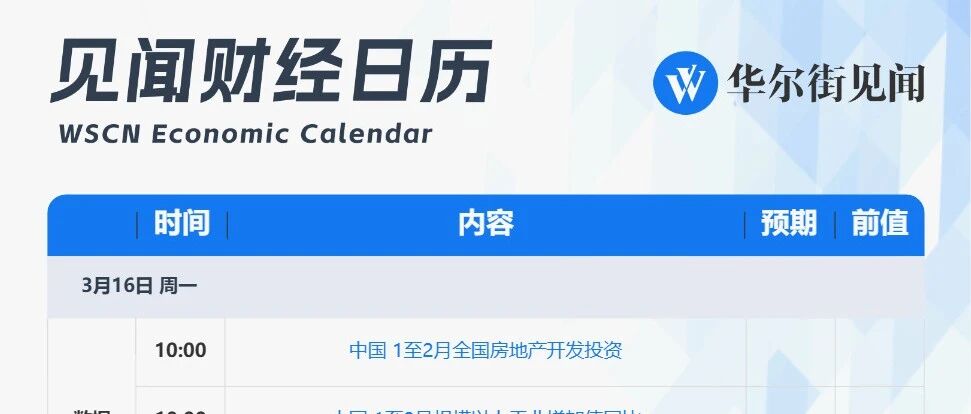
Core Viewpoint - The article highlights the key economic events and data releases for the week of March 16-22, focusing on the U.S.-China trade negotiations, macroeconomic data validation, central bank decisions, and significant corporate earnings reports. Economic Indicators - The U.S. Federal Reserve, European Central Bank, and Bank of Japan are expected to announce interest rate decisions on March 19, with the Fed likely to maintain rates but indicate only one rate cut for the year, a significant shift from previous expectations [11]. - China's industrial production, retail sales, and investment data for January-February are set to be released on March 16, with expectations of retail sales growth between 1.6% and 2.5% and industrial output growth around 5.2% [13][14]. Key Events - U.S.-China trade talks are scheduled from March 14-17, led by Vice Premier He Lifeng, focusing on economic issues of mutual concern [15][16]. - The Nvidia GTC conference and the Optical Fiber Communication Conference (OFC) will take place from March 16-19, showcasing advancements in AI and optical interconnect technologies [17][19]. - Japan plans to release approximately 80 million barrels of strategic oil reserves starting March 16 to mitigate supply risks [27]. Corporate Earnings - Major companies such as Tencent, Alibaba, and Micron Technology are set to report earnings, with a focus on overseas expansion and cloud business growth for Tencent and Alibaba [30][31]. - Micron's earnings will provide insights into the global semiconductor cycle, as it is considered a bellwether for the industry [31]. Geopolitical Context - The geopolitical landscape is complicated by Japan's oil reserve release and the upcoming meeting between Japanese Prime Minister Fumio Kishida and former U.S. President Donald Trump [10][23]. - The European Council will discuss the Middle East and the Russia-Ukraine situation during its meeting on March 19-20 [25].


港股周报:大厂加速布局OpenClaw产品,关注腾讯、阿里财报AIAgent叙事进展-20260315
Guolian Minsheng Securities· 2026-03-15 10:12
Market Overview - The Hang Seng Index fell by 1.13% while the Hang Seng Tech Index rose by 0.62% during the week of March 9-13, 2026[5] - The net buying of Hong Kong Stock Connect reached 46.5 billion HKD, indicating a recovery in market sentiment[5] AI Industry Insights - The AI hardware infrastructure remains highly valued, with companies like SMIC and Hua Hong benefiting from rising foundry prices[5] - The demand for AI applications is accelerating, with significant increases in API call volumes for models like MiniMax M2.5 and DeepSeek V3.2, which saw week-on-week increases[5] - Tencent Cloud announced a price increase for its AI models, with some prices rising over 400%[5] Investment Recommendations - Focus on platform-based internet companies like Tencent and Alibaba, which have advantages in data, scenarios, and platform capabilities[5] - Monitor AI ecosystem companies such as Kuaishou and Bilibili, which are expected to benefit from the growing AI landscape[5] - Pay attention to the autonomous driving sector, with companies like XPeng Motors and NIO showing strong growth potential[5] Risks - Geopolitical risks may impact overseas revenues and competitiveness[30] - Regulatory risks in the internet sector could affect industry performance[30] - Consumer recovery may not meet expectations, impacting stock prices[30]
未来10年,这18个赛道将带来48万亿美元收入
创业家· 2026-03-15 10:08
Group 1 - The core viewpoint of the article is that McKinsey's report identifies 18 industry sectors likely to reshape the global business landscape by 2040, predicting revenues between $29 trillion and $48 trillion, contributing 18-34% to global GDP growth [2] Group 2 - E-commerce is expected to account for 27%-38% of global retail revenue by 2040, up from approximately 20% currently, driven by market expansion in developing countries and growth in new product categories in developed nations [3][4] - Significant investments are anticipated in customer acquisition and last-mile delivery within the e-commerce sector [5] Group 3 - Electric vehicles (EVs) are projected to exceed 50% of global passenger car sales by 2040, with advancements in battery technology and smart algorithms being key influencing factors [6][7] Group 4 - Cloud services are becoming increasingly essential as businesses require higher storage and computing capabilities, particularly with the rise of AI products that demand substantial computational power [9][10] Group 5 - The semiconductor industry is expected to grow at a compound annual growth rate (CAGR) of 6%-8% over the next decade, driven by demand across various sectors including computing, automotive, and industrial electronics [11] Group 6 - AI software services are rapidly evolving, with a growing number of users adopting AI assistants, leading to a competitive race among companies to develop advanced foundational models and applications [12][13] Group 7 - Digital advertising is expanding in value as more people access the internet, with improvements in algorithms enhancing platforms' abilities to target customers and track advertising costs [14][15] Group 8 - Streaming video platforms are expected to seek new revenue models due to increased investments in customer acquisition and content production, with projections indicating over 1 billion households subscribing to long-form video services by 2040 [17][18] Group 9 - Shared autonomous vehicles may account for 25%-51% of shared mobility revenue by 2040, although the realization of this future may take longer than anticipated [19][20] Group 10 - The space economy is emerging, with advancements in reusable rocket technology paving the way for more cost-effective space travel and operations [21][22] Group 11 - Cybersecurity is becoming a priority for businesses, with direct economic losses from cybercrime estimated at $950 billion in 2020, and indirect losses potentially reaching $4-6 trillion [24][25] Group 12 - Battery technology has seen significant advancements, with energy density increasing threefold over the past decades, driven by the demand from electric vehicles and energy storage solutions [26][27] - By 2040, electric vehicles are expected to represent over 80% of the battery market [28] Group 13 - The video game industry is projected to have 40% of the global population as players by 2030, with mobile and cloud gaming driving substantial market growth [29][30] Group 14 - Robotics is evolving with AI integration, leading to expectations that humanoid robots will become "ultimate intelligent agents" in the future [33][34] Group 15 - Biotechnology is accelerating in applications such as agriculture and alternative proteins, driven by breakthroughs in gene editing technologies [37] Group 16 - Modular construction methods are improving efficiency in building production, although global adoption remains limited [38] Group 17 - Nuclear fission power is being reconsidered as a supplement to renewable energy, with commitments from over 20 countries to double nuclear energy output by 2050 [40] Group 18 - Innovations in air transportation, including electric vertical takeoff and landing vehicles, are expected to transform the sector, contingent on regulatory progress [41][42] Group 19 - The prevalence of obesity is projected to rise from 15% in 2020 to 24% by 2035, creating a significant market opportunity for effective weight loss treatments [43][44]

A股投资策略周报:油价大涨和美国私募信贷市场对流动性以及A股的影响-20260315
CMS· 2026-03-15 10:02
Group 1 - The report highlights that the ongoing geopolitical tensions, particularly the US-Iran conflict, have shifted market focus towards supply security and strategic resources, leading to a transition from risk aversion to concerns about re-inflation [1][4] - Rising oil prices are expected to reinforce inflation expectations, suppressing the prospects for interest rate cuts by the Federal Reserve, which will impact market risk appetite and keep the A-share market in a state of fluctuation, with a clear structural differentiation benefiting resource sectors [1][6] - The report notes that the Producer Price Index (PPI) has narrowed its year-on-year decline to -0.9%, and the continued rise in oil prices is anticipated to accelerate the timeline for PPI turning positive, historically favoring value-oriented market styles post PPI recovery [6][44] Group 2 - The private credit market has seen an increase in risk events since 2025, including localized defaults and redemption pressures, which have contributed to market sentiment suppression and significant declines in private investment firms' stock prices [5][43] - The report indicates that the redemption pressure in the private credit sector is currently manageable, as most private credit funds are structured to minimize liquidity mismatches, with a significant portion of their assets locked in for long durations [34][35] - The private credit market has a high exposure to the technology sector, particularly AI, which creates a feedback loop between the development of AI and the stability of the private credit market, necessitating caution regarding potential AI bubble risks [39][43]
电子行业周报:GTC大会召开在即,关注美光3月18日业绩-20260315
SINOLINK SECURITIES· 2026-03-15 09:20
Investment Rating - The industry is rated positively, with a focus on AI core computing hardware, PCB, and semiconductor equipment, indicating a bullish outlook for the upcoming periods [4][26]. Core Insights - The upcoming GTC 2026 conference by NVIDIA is expected to highlight advancements in AI infrastructure and new hardware for AI applications, which will drive demand for computing power [1][4]. - The demand for storage chips is anticipated to rise, with Micron's earnings report on March 18 being a key indicator of potential overperformance in the sector [1][4]. - The semiconductor industry is experiencing a significant increase in demand for general AI GPUs and ASICs, with major companies like TSMC and NVIDIA ramping up capital expenditures [1][4]. - The geopolitical situation, particularly the potential long-term blockade of the Strait of Hormuz, may impact the Asian semiconductor industry, leading to supply constraints and increased costs [1][4]. Summary by Sections 1. Consumer Electronics - The expansion of AI applications in consumer electronics is expected, particularly in the Apple supply chain and smart glasses, driven by advancements in AI models and processing capabilities [5]. - AI mobile applications are projected to grow, with a focus on products like foldable phones and AI glasses [5]. 2. PCB - The demand for copper-clad laminates is increasing, with a high level of industry activity driven by automotive and industrial applications, alongside AI growth [6]. - The PCB industry is maintaining a high level of demand, with expectations of price increases for raw materials [6]. 3. Components - The AI data center sector is expected to drive demand for passive components, particularly MLCCs, as mobile applications increase their usage [18]. - LCD panel prices are stabilizing, while OLED production is ramping up, with domestic manufacturers gaining ground in the supply chain [19]. 4. IC Design - The storage sector is entering an upward cycle, with expectations of price increases for DRAM driven by cloud service providers expanding their data center capacities [20][22]. - Companies like Zhaoyi Innovation are positioned to benefit from the rising demand for storage solutions across various applications [31]. 5. Semiconductor Equipment - The semiconductor equipment sector is experiencing robust growth, with significant capital investments and advancements in technology [23][24]. - Companies like North Huachuang and Zhongwei are expanding their product offerings in semiconductor manufacturing equipment [28][29]. 6. Overall Industry Outlook - The overall sentiment for the AI and electronics sectors remains positive, with expectations of continued growth despite short-term geopolitical challenges [1][4][26]. - Key companies to watch include Shenghong Technology, North Huachuang, and Zhaoyi Innovation, which are well-positioned to capitalize on the ongoing trends in AI and semiconductor demand [27][30][33].
申万宏源策略十五五规划解读:新增“新型基础设施建设+新产业赛道”十五五将带来哪些投资机会
Shenwan Hongyuan Securities· 2026-03-15 08:44
Core Insights - The report outlines the investment opportunities arising from the "New Infrastructure Construction + New Industry Tracks" as part of the 14th Five-Year Plan, emphasizing a shift towards green and low-carbon development [1][2] - The 14th Five-Year Plan maintains a five-part framework, with a focus on economic development, innovation, social welfare, security, and green low-carbon initiatives, addressing current development pain points [1][3] - The report highlights the introduction of new independent chapters in the 14th Five-Year Plan, clarifying policy direction and enhancing strategic priorities, particularly in modern industry and digitalization [1][2] Investment Opportunities - The new infrastructure construction focuses on five key areas: integrated computing networks, satellite internet, information communication networks, data infrastructure, and low-altitude infrastructure [1][3] - The new industry tracks include ten core areas such as integrated circuits, embodied intelligence, biomanufacturing, new batteries, commercial aerospace, domestic large aircraft, low-altitude equipment, green hydrogen, brain-computer interfaces, and high-end medical devices [1][3] - Specific tasks for each track are outlined, such as enhancing advanced manufacturing capabilities in integrated circuits and accelerating the development of key technologies in biomanufacturing [1][3][7] Policy Adjustments - The report notes a significant shift in policy focus from energy consumption control to direct carbon emission management, with new measures for carbon footprint accounting and product carbon emission limits [2][3] - The financial sector is transitioning from supply-side reforms to a "Financial Power Strategy," emphasizing the need for deeper investment and financing reforms to support the real economy [2][3] - The report emphasizes the importance of high-level opening-up strategies, with a focus on expanding service industry openness and promoting the internationalization of the Renminbi [3][2] Traditional Infrastructure - The traditional infrastructure section retains focus on transportation, energy, and water networks, with specific policy adjustments to enhance the national comprehensive transportation network and new energy systems [1][3] - Key projects include the construction of major clean energy bases and the expansion of natural gas pipelines to support energy transition goals [1][3][8] Technological Advancements - The report highlights the need for breakthroughs in high-end materials, basic components, software, and industrial machinery to strengthen the industrial supply chain [4][7] - Emphasis is placed on advancing artificial intelligence, quantum technology, and biotechnology as part of the frontier technology initiatives [12][14]
宏观周度述评系列:地缘政治冲突框架下资产定价的四个阶段-20260315
GF SECURITIES· 2026-03-15 08:32
Group 1: Geopolitical Conflict Stages - The first stage is the "emotional shock stage," where risk-averse trading dominates, leading to a short-term market reaction, typically lasting 1-3 trading days[9] - The second stage is the "differentiated response stage," where risk-averse trading continues alongside event-driven trading, with markets beginning to distinguish between affected sectors[10] - The third stage is the "impact attenuation stage," where risk-averse and event-driven trading persist, but the focus shifts to recovery trades and new mainline trades as geopolitical risks decrease[11] - The fourth stage is the "new framework formation stage," where geopolitical impacts are largely priced in, leading to a new market equilibrium and consensus on new mainline trades[12] Group 2: Market Performance and Trends - Global stock markets are under pressure, with MSCI developed markets down 1.46% and emerging markets down 1.40%[15] - The 10-year U.S. Treasury yield has risen to 4.3%, with a significant sell-off in bonds leading to a 1.23% decline in the Bloomberg Global Bond Index[19] - Brent crude oil prices surged by 11.27% to $103.14 per barrel, driven by geopolitical risk premiums and supply-demand imbalances[17] - The A-share market saw a slight decline of 0.48%, with the ChiNext and dividend indices leading gains amid a backdrop of rising PPI and export recovery[14] Group 3: Economic Indicators - March PPI is expected to rise by 0.8% month-on-month, marking a year-on-year increase of 0.3% for the first time in 42 months[4] - Estimated actual GDP growth for March is 4.67% year-on-year, with nominal GDP growth at 5.97%[4] - The nominal GDP growth for the first quarter is projected to be 5.24%, indicating a recovery trend in economic activity[21]