
航空

Search documents
陈果:春季行情演化论与内需机会探讨
Xin Lang Cai Jing· 2025-12-21 13:25
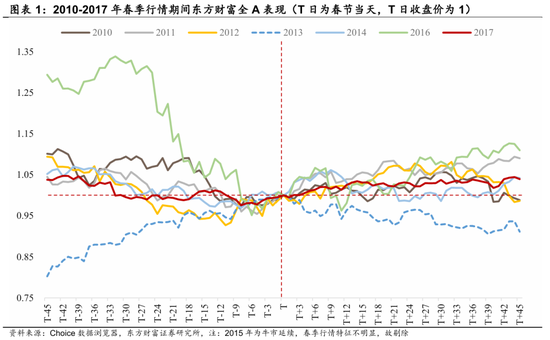
Core Viewpoint - The spring market has evolved through three stages, with the current phase characterized by a strong inclination for investors to "run ahead" and a focus on domestic demand sectors, particularly non-durable consumer goods [2][3][29]. Group 1: Market Dynamics - Recent trends indicate an increase in US Treasury yields and the Bank of Japan's interest rate hike, which may impact market stability [1][41]. - A significant inflow of capital into the A500 ETF, exceeding 30.8 billion, suggests strong buying interest from institutional investors, particularly insurance funds and major brokerages [41]. - The private equity sector shows a high risk appetite, with the stock private equity position index reaching 83.69%, indicating a bullish sentiment despite recent market corrections [41]. Group 2: Spring Market Evolution - The spring market can be divided into three phases: the calendar effect phase (before 2017), the "run ahead" phase (2018-2023), and the reflexive phase (2024-2025) [2][28][29]. - The current reflexive phase is marked by a consumption of incremental capital, making the market vulnerable to sharp corrections in the face of negative news [29][37]. - Historical data shows that sectors with lower performance in the previous year often experience a rebound, driven by year-end portfolio rebalancing and stronger policy expectations [20][31]. Group 3: Focus on Domestic Demand - Domestic demand sectors, particularly retail, beauty care, and social services, have shown significant gains, supported by government policies aimed at boosting consumption [17][18]. - The central economic work conference emphasizes the importance of domestic demand, which is expected to drive recovery and improve economic structure in the medium to long term [25][31]. - The gradual appreciation of the RMB is anticipated to enhance purchasing power and stimulate domestic consumption, further supporting the domestic demand sectors [25][31].

国金策略:单一产业叙事能够带来的收益已经越来越不稳定和难以把握 抓住行情的窄幅波动期布局2026年新主线
Sou Hu Cai Jing· 2025-12-21 12:44
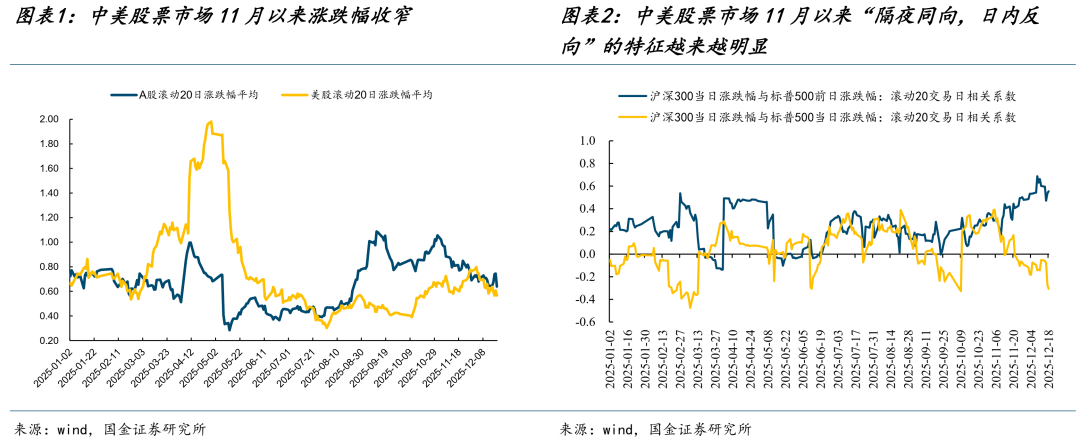
Group 1 - The market status indicates an increased correlation between the US and Chinese markets, with the 20-day rolling correlation of the CSI 300 and S&P 500 rising above the 90th percentile, reflecting a new normal of "overnight alignment and intraday reversal" [2][10][13] - The US core CPI has decreased to 2.6%, the lowest in three and a half years, while the unemployment rate has risen to 4.6%, primarily due to increased labor participation and temporary unemployment, indicating a stable economic environment without significant inflationary pressures [2][10][13] - China's economic fundamentals show a combination of corporate profit bottoming out and a decline in domestic demand, which opens a window for further policy support [2][10][13] Group 2 - The AI industry chain is experiencing a divergence, with broader AI-related assets (copper, lithium, aluminum, energy storage, and electrical equipment) performing better than core AI assets (computing chips, optical modules, PCB) [3][24][25] - Investors are becoming less tolerant of the contradiction between aggressive capital expenditures and the lack of revenue growth in companies within the AI industry chain, leading to a negative correlation between stock performance and capital expenditure as a percentage of revenue [3][24][25] - Commodity prices for copper, aluminum, tin, and lithium carbonate have been rising since late October, driven by demand from AI investments, with near-term contracts for copper and tin outperforming longer-term contracts [3][24][25] Group 3 - The concept of "expanding domestic demand" is emphasized as a strategic move, with a focus on increasing consumer demand supported by income growth and effective investment [4][31][32] - The government plans to enhance the second distribution of income by increasing minimum pension standards and implementing childcare subsidies, while future efforts may focus on optimizing the first distribution through wage reforms [4][31][32] - Historical examples from Japan and the US illustrate that income growth leads to increased service and new-type consumption, suggesting that China's current income growth initiatives could similarly boost consumer spending [4][31][32] Group 4 - The current market environment, characterized by limited macro elasticity and increased industry differentiation, suggests a shift in investment strategy towards tangible demand and domestic policy benefits as the new focus for 2026 [5][42][43] - Recommendations include investing in industrial resource products (copper, aluminum, tin, lithium, crude oil) that benefit from AI investment and global manufacturing recovery, as well as sectors poised for recovery in consumer spending (airlines, hotels, duty-free, food and beverages) [5][42][43] - Non-bank financial institutions (insurance, brokerage) are expected to benefit from capital market expansion and a rebound in long-term asset returns, alongside opportunities in China's equipment export chain and manufacturing sectors [5][42][43]
国金证券:迎接2026:告别单一叙事
Xuan Gu Bao· 2025-12-21 10:21
Group 1: Market Status - The correlation between A-shares and U.S. stocks has increased, with the 20-day rolling correlation of the CSI 300 and S&P 500 rising above the 90th percentile for the year, indicating a new normal of "overnight alignment, intraday reversal" [1][5][38] - Both the U.S. and China are in a phase characterized by limited upward elasticity and reduced downward risk, akin to a "Goldilocks" scenario, with the U.S. core CPI dropping to 2.6%, the lowest in three and a half years [1][8][9] - In China, corporate profitability has bottomed out, and the weakening of domestic demand creates a favorable environment for subsequent policy support [1][8] Group 2: AI Industry Chain - The investment in the AI industry chain is showing two key characteristics: broader macro effects benefiting "pan-AI" assets (copper, lithium, aluminum, energy storage, and electrical equipment) outperforming core AI assets (computing chips, optical modules, PCB) [2][17] - Investors are becoming less tolerant of the contradiction between aggressive capital expenditures and the lack of revenue growth in companies within the AI industry chain, leading to a negative correlation between stock performance and capital expenditure as a percentage of revenue [2][17][18] Group 3: Understanding "Expanding Domestic Demand" - The "income increase" plan aims to enhance net transfer payments to residents by 2025, with a focus on improving initial distribution through wage reforms, particularly in state-owned enterprises [3][25] - The expansion of consumption tax and adjustments in corporate income tax rates are expected to be seen in 2026, which may further stimulate domestic consumption [3][25][28] Group 4: Investment Strategy for 2026 - The current market conditions suggest a shift from a single industry narrative to a dual focus on "physical demand stimulation" and "domestic policy benefits," with recommendations to invest in industrial resource products (copper, aluminum, lithium, oil) and sectors benefiting from consumer recovery (airlines, hotels, food and beverages) [4][38] - Non-bank financial institutions (insurance, brokerage) are expected to benefit from capital market expansion and a bottoming out of long-term asset returns [4][38] - Opportunities are identified in China's equipment export chain and sectors showing signs of recovery in domestic manufacturing [4][38]

缩量蓄势延续,逢低布局春季行情
Haitong Securities International· 2025-12-21 09:35
Investment Focus - The report indicates that the Chinese market is transitioning from the late stage of a rebound to a phase of range-bound consolidation, with limited downside remaining and opportunities to buy on dips [1][7] - Domestic-demand consumption is highlighted as a sector likely to benefit from supportive factors, potentially delivering relative outperformance in a choppy market [1][7] - The Hang Seng Index fell by 1.1%, the Hang Seng Tech Index declined by 2.8%, while the Shanghai Composite was broadly flat, indicating mixed performance across indices [1][7] Overseas Market Insights - The US November CPI came in significantly below expectations, leading to a stable US dollar and a slight decline in US Treasury yields by about 5 basis points, with the probability of a January rate cut rising to 22% [2][8] - The Bank of Japan raised rates by 25 basis points, with a cautious outlook on future tightening, as the 10-year JGB yield approached 2% [2][9] Market Dynamics - A-share average daily turnover decreased to RMB 1.76 trillion, while Hong Kong market turnover fell below HKD 200 billion, indicating a contraction in trading volumes [4][11] - In A-shares, equity ETFs (excluding broad market ETFs) recorded a net inflow of RMB 3.1 billion, suggesting early bottom-fishing activity [4][12] - In Hong Kong, short-selling turnover rose to 20%, and southbound inflows slowed, although there was a net inflow of HKD 16.3 billion this week [4][13] Sector Performance - Retail, aviation, and tourism sectors performed relatively well, with expectations of rotation towards food & beverages and livestock in the next phase [5][14] - The insurance sector within non-bank financials showed strong performance, which could help drive a rebound in broker stocks [5][14] - Technology remains an important sector for positioning into the spring rally, particularly in the Hang Seng Tech and domestic computing power segments [5][16] Thematic Developments - Tesla reached new record highs, with autonomous driving gaining momentum supported by policy tailwinds, indicating potential for continued growth [5][16]
中信证券:推动人民币升值的因素逐渐增多
Xin Lang Cai Jing· 2025-12-21 07:19
炒股就看金麒麟分析师研报,权威,专业,及时,全面,助您挖掘潜力主题机会! 来源:中信证券研究 文|裘翔 高玉森 陈泽平 刘春彤 张铭楷 陈峰 推动人民币升值的因素逐渐增多,市场关注度也开始升温,投资者要逐步适应在一个人民币持续升值的 环境下去做资产配置。从过去20年间7轮人民币升值周期来看,汇率并不是主导行业配置的决定性因 素。然而,部分行业在持续升值预期形成的初期确实会有更好表现,市场可能会复制这样的肌肉记忆, 同时从成本收入分析来看,约19%的行业会因为升值带来利润率提升,这些行业也会逐步被投资者重视 起来。此外,为抑制过快单边升值趋势而做出的政策应对,反而是影响行业配置的更重要因素。行业配 置上,在人民币持续升值的背景下,可以关注短期肌肉记忆驱动、利润率变化驱动以及政策变化驱动三 条线索,我们在本期聚焦详细梳理了潜在受益行业。 推动人民币持续升值的因素逐渐增多, 市场关注度也开始升温 我们认为投资者要逐步开始适应在一个人民币持续升值的环境下去做资产配置。今年前11个月中国的累 计贸易顺差达到1.076万亿美元,同比增长21.7%,创历史新高。更重要的是出口企业的结汇意愿开始不 断上升,今年10月顺差转化 ...

前11个月上海进出口值增长5.7%
Xin Lang Cai Jing· 2025-12-20 20:03
Core Insights - Shanghai's import and export value reached 4.1 trillion yuan in the first 11 months of the year, a year-on-year increase of 5.7%, surpassing the national average growth rate by 2 percentage points [1] - Exports amounted to 1.83 trillion yuan, growing by 11.2%, while imports totaled 2.27 trillion yuan, with a growth of 1.6% [1] - November saw record monthly exports, with a total of 1.87 trillion yuan, marking an 18.2% increase, and imports at 200.9 billion yuan, up by 4.4% [1] Trade Partners and Market Diversification - The EU remains the largest trading partner for Shanghai, with import and export growth accelerating by 1.1 percentage points in the first 11 months [1] - Significant growth in trade with emerging markets such as ASEAN, the Middle East, and Africa, indicating effective market diversification [1] Export Dynamics - Machinery and electrical products accounted for 65.4% of total exports, with a value of 1.19 trillion yuan, reflecting a growth of 6.3% [2] - The export of "new three samples" products, particularly hybrid vehicles, surged by 174.8% to 25.72 billion yuan, showcasing strong demand [2] - The export of liquid cargo ships increased by 130.5% to 34.24 billion yuan, driven by the green low-carbon trend [2] Import Trends - High-tech product imports reached 737.21 billion yuan, growing by 6.3%, with notable increases in semiconductor manufacturing equipment (35.4%), computers and components (24%), and aircraft (74.3%) [2] - The import of raw materials such as metal ores and copper products also saw growth, indicating active manufacturing sector activities [2] - Consumer market vitality is reflected in the increased imports of various consumer goods, including fruits, dairy products, toys, and sports equipment [2]
坚定看好多重催化下的航空,关注单票收入同比改善的快递
ZHONGTAI SECURITIES· 2025-12-20 14:55
Investment Rating - The report maintains a rating of "Buy" for several key companies in the aviation and logistics sectors, including China Southern Airlines, Spring Airlines, and SF Express [2]. Core Insights - The aviation sector is expected to benefit from multiple catalysts, including the recovery of passenger demand and improved ticket pricing due to high load factors and regulatory support [4][6]. - The logistics and express delivery industry is experiencing a divergence in growth rates, with a focus on improving operational quality through policies aimed at reducing "involution" and the adoption of automation technologies [6][7]. Summary by Sections Aviation Sector - The report highlights the positive impact of the national strategy to expand domestic demand, which is expected to drive up airline stock prices. For instance, companies like China Eastern Airlines and China Southern Airlines saw stock increases of 12.48% and 13.60%, respectively [4]. - Key metrics for airlines from December 15 to December 19 include average daily flights and aircraft utilization rates, with notable year-on-year increases in flight numbers for several airlines [4]. - The report emphasizes the long-term growth potential of the aviation sector, driven by a combination of recovering demand, regulatory support for pricing, and a gradual recovery in aircraft utilization rates [6]. Logistics and Express Delivery - The express delivery sector is witnessing a mixed trend in volume and pricing, with November data showing a year-on-year increase in delivery volumes for some companies while others face declines [6]. - The report notes that the integration of Danbird Logistics into Shentong Express is expected to enhance scale and operational efficiency [6]. - The "anti-involution" policy is anticipated to improve profitability across the express delivery industry, with a focus on enhancing service quality and pricing strategies [6][7]. Infrastructure - The report suggests that the infrastructure sector, particularly highways, remains stable with consistent cash dividends and ongoing expansion projects [6]. - Data from December 8 to December 14 indicates a slight decline in freight traffic on highways and railways, but overall port throughput showed a year-on-year increase [6]. Shipping and Trade - The shipping sector is experiencing fluctuations in freight rates, with oil shipping showing strength while dry bulk rates are declining. The report suggests that geopolitical factors may reshape global shipping dynamics [7]. - The report recommends monitoring companies in the shipping sector for potential investment opportunities, particularly those positioned to benefit from seasonal demand increases [7].





釜山会晤不到24小时,美国又出尔反尔?执意对华进行301调查
Sou Hu Cai Jing· 2025-12-20 07:50
Core Viewpoint - The recent U.S.-China meeting in Busan yielded positive outcomes, including the cancellation of the 10% "fentanyl tariff" and a pause on several unilateral measures against Chinese goods and enterprises. However, the U.S. continues its Section 301 investigation into China's compliance with the Phase One trade agreement, casting a shadow over the improving economic relations between the two countries [1][3]. Group 1 - The U.S. Trade Representative stated that despite a temporary truce in the trade war, the investigation into China's adherence to the Phase One trade agreement will proceed [1]. - The Section 301 investigation encompasses nearly all major areas of U.S.-China trade, creating uncertainty about which industries may be targeted next [3]. - The U.S. has not lifted tariffs imposed on China, which has limited its own export capabilities, as acknowledged by executives from companies like Ford [3][5]. Group 2 - The U.S. manufacturing sector's decline has hindered its ability to provide sufficient goods for Chinese procurement, with significant purchases primarily in energy and agricultural products rather than manufactured goods [5]. - The change in U.S. administration from Trump to Biden has led to a continuation of tariffs and investigations against China, complicating economic cooperation [5]. - External factors, such as the COVID-19 pandemic and safety issues with Boeing's 737 Max, have further impacted trade dynamics and procurement from the U.S. [5][7]. Group 3 - The U.S. aims to maintain the Section 301 investigation to leverage more negotiation power against China, potentially leading to increased trade friction [7]. - China's commitment to defending its interests remains strong, indicating that the U.S. should reconsider its approach to containing China's development [7].

The Big 3: DAL, TSLA, AEO
Youtube· 2025-12-19 18:00
Group 1: Market Overview - The overall sentiment remains bullish as the market approaches the midterms, with expectations of rate cuts and declining oil prices contributing to optimism [2][3] - The S&P 500 is projected to potentially reach 7000, although this may not occur within the current year [3][4] - The AI sector continues to attract attention, alongside renewed interest in space exploration, particularly with discussions around returning to the moon [4] Group 2: Airline Industry - Delta Airlines has shown a significant increase of approximately 16.5% this year, with a focus on its performance as the holiday travel season approaches [5][6] - The stock broke through a critical resistance level of around 69-70, entering a consolidation phase, which may lead to further gains as earnings are expected in mid-January [6][7] - Technical indicators suggest potential upward movement, with a bullish setup if the stock surpasses resistance near 72.34 [12] Group 3: Tesla - Tesla reached a new record high, with speculation that its performance is linked to the anticipated SpaceX IPO and ongoing media attention surrounding Elon Musk [14][15] - The stock has shown volatility but remains a strong performer, with significant trading volume and positive momentum indicators [18][21] - Key resistance levels are identified around 500, with potential for further gains if this level is breached [18][20] Group 4: Retail Sector - American Eagle has experienced a remarkable increase of 35-36% in December, driven by strong financial performance and positive market sentiment [25][29] - The stock has shown a consistent upward trend, with a critical resistance level at 30 that, if surpassed, could indicate continued bullish momentum [27][28] - The return to denim has been highlighted as a significant factor in the company's recent success, aligning with current retail trends [28][29]




海南封关正式启动 如何影响你我?哪些产业将受益
2 1 Shi Ji Jing Ji Bao Dao· 2025-12-19 15:27
Core Insights - Hainan Free Trade Port officially commenced full island closure operations on December 18, marking a new phase in its development and positioning as a significant gateway for China's new era of opening up [1] Group 1: Policy and Economic Impact - The "zero tariff" policy has been significantly expanded, with the range of zero-tariff goods increasing to approximately 6,600 tax items, resulting in 74% of imported goods entering Hainan being exempt from import duties, VAT, and consumption tax [1] - The closure is seen as a new starting point for industrial upgrades, with Hainan aiming to develop a modern industrial system characterized by its unique advantages [1] Group 2: Industry Focus and Investment Opportunities - Key industries targeted for development include tourism, modern services, high-tech industries, and tropical agriculture, with a focus on enhancing and upgrading these sectors [2] - Investment opportunities are identified in modern service industries such as tourism, exhibition, transportation, and finance, as well as in specialized sectors like marine economy, aerospace, duty-free shopping, and high-end healthcare [2] Group 3: Beneficiary Companies - Companies with significant foreign trade operations in Hainan will benefit from the zero-tariff and export tax rebate policies [2] - Infrastructure companies involved in the development of the free trade port will also see advantages from the associated construction projects [2] - Tourism-related companies are expected to gain from the expanded duty-free shopping incentives, enhancing consumer attraction [2] Group 4: Stock Performance of Relevant Companies - Hainan Airlines, a major carrier in Haikou, has seen a year-to-date increase of 2.94% with a market capitalization of 75.68 billion [3] - China Duty Free Group, dominating 85% of the duty-free market in Hainan, has experienced a 21.44% increase in stock value, with a total market cap of 163.06 billion [3] - Hainan Airport, operating three major private airports, has reported a 24.07% increase in stock performance, with a market cap of 53.58 billion [3]
