Qi Huo Ri Bao

Search documents
强预期与弱现实激烈博弈 多晶硅将以宽幅震荡运行为主
Qi Huo Ri Bao· 2025-12-02 04:37
自11月下旬以来,在减产和政策消息的影响下,多晶硅期货价格重心逐渐上移,目前主力合约期价逼近 60000元/吨大关。预计后期在"强预期"与"弱现实"的激烈博弈下,多晶硅期货将以宽幅震荡行情为主。 此外,上周光伏组件生产成本下降,现货价格持平。据Mysteel数据,截至11月28日,光伏组件(N型 585W)市场均价为0.68元/瓦,环比持平;即期生产成本为0.715元/瓦,环比下降0.011元/瓦;即期单瓦净利 润为-0.035元。 首先,硅片环节:高库存压制价格,行业进入主动减产调整期。为应对供需失衡,11月宁夏、云南、浙 江等地多家企业陆续减产。据SMM数据,11月国内硅片产量为54.37GW,环比下滑10.35%。但供应收 缩未能扭转市场颓势,在海外需求萎缩、外协代工订单减少的背景下,硅片库存持续累积。据SMM数 据,截至11月27日,国内硅片库存已攀升至19.5GW,周环比增加4.17%。为缓解库存压力,企业提升出 货意愿,头部厂商带头下调报价,11月各尺寸硅片均价已跌破现金成本,其中N型210R的价格压力最为 突出。进入12月,企业减产幅度扩大且年内生产配额基本完成,硅片定价逐步转向成本逻辑。鉴于需 ...
全球铝土矿供应链进入重塑期
Qi Huo Ri Bao· 2025-12-02 01:57
Core Insights - The global bauxite supply chain is undergoing a structural transformation driven by resource nationalism, high foreign dependency of China, and oversupply in downstream alumina [1][2][3] Group A: Structural Changes in Global Supply and Demand - The core contradiction in the market has shifted from short-term supply-demand balance to a supply chain resilience crisis influenced by geopolitical and industrial policies [2] - Guinea, as the largest and fastest-growing supply source, has seen a 38.2% increase in bauxite imports to China from January to October 2025, accounting for over 70% of total imports [3] - Guinea's government is transitioning from encouraging mineral exports to enforcing local processing, which will fundamentally alter global bauxite trade flows and pricing mechanisms [3][4] Group B: Challenges in Traditional Supply Sources - Australia faces dual challenges of aging infrastructure and rising energy costs, impacting its cost competitiveness in the bauxite market [4] - Emerging supply countries like Indonesia and Tanzania are hindered by fluctuating ore grades, inadequate infrastructure, and regulatory instability, making them unreliable alternatives to Guinea [4] Group C: Demand Dynamics in China - China's bauxite consumption reached 222 million tons from January to October 2025, with imports making up 77.23% of this demand, indicating a heavy reliance on foreign sources [4] - The structural imbalance in China's aluminum industry is evident, with planned alumina capacity additions significantly outpacing those for electrolytic aluminum, leading to long-term oversupply in the alumina market [5] Group D: Inventory Trends and Implications - As of November 2025, China's port inventory of bauxite exceeded 22 million tons, a year-on-year increase of approximately 50.7%, reflecting a supply surplus and weak demand [6][7] - High inventory levels serve as both a buffer against supply shocks and a warning signal of underlying demand issues, impacting financial costs for companies [7] Group E: Long-term Cost Structure Changes - Resource nationalism is reshaping the global mineral resource value distribution, leading to an upward shift in long-term cost structures for bauxite [8][9] - New costs, including localization premiums and ESG compliance costs, are being integrated into the traditional mining cost structure, affecting pricing dynamics [8][9] Group F: China's Strategic Responses - China is focusing on resource security through domestic resource development and increasing recycling efforts, aiming for a 3%-5% growth in domestic bauxite resources by 2027 [12] - The strategy also includes diversifying import sources and investing in alumina production facilities in resource-rich countries like Guinea, which may shift dependency from bauxite to alumina [12][13] Group G: Future Market Dynamics - The competitive landscape will shift from supply assurance to cost competition, with companies possessing stable, low-cost bauxite resources or integrated supply chains gaining a competitive edge [13]
预计玉米后市维持高位震荡
Qi Huo Ri Bao· 2025-12-02 00:31
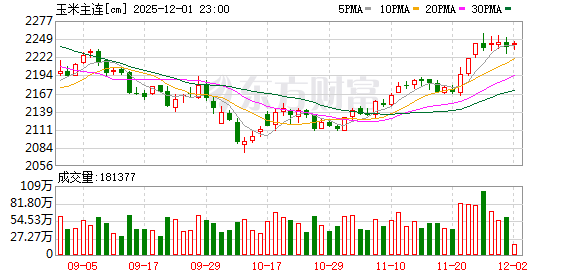
Core Viewpoint - The recent increase in domestic corn prices is primarily driven by a reduction in market supply, influenced by farmers' reluctance to sell due to lower temperatures in Northeast China, which is expected to gradually change as prices rise [2][3][4]. Group 1: Price Trends and Influencing Factors - Corn prices have been on the rise since November, with the main contract increasing by 7.78% over a month and a half, following a period of price decline earlier in the year [3]. - The official procurement plan initiated by the China Grain Reserves Corporation on October 16, with a purchase price of 2.06 yuan per kilogram, indicated a potential price bottom for corn [3]. - The increase in trade contract execution demand and the "north grain south transport" strategy have contributed to heightened demand, exacerbating supply shortages at northern ports [3][4]. Group 2: Farmer Behavior and Market Dynamics - Farmers are exhibiting strong reluctance to sell due to the onset of winter and rising planting costs, hoping to achieve better prices to cover increased costs for the next planting season [4]. - Prices in major production and sales areas have risen significantly, with Harbin's second-grade grain price increasing by 50 yuan per ton to 2110 yuan per ton, and prices in other regions also showing substantial increases [4]. Group 3: Regional Supply and Demand Conditions - The quality of local corn in regions like North and East China is poor, leading to increased demand for Northeast corn, which is of better quality and lower price [5]. - The reduction in corn imports, which are expected to be significantly below the 7.2 million ton tariff quota, has led to a shift from foreign trade to domestic trade, accelerating the market's grain turnover [6]. Group 4: Future Market Outlook - The market is expected to maintain high price fluctuations due to ongoing farmer reluctance to sell, tight transportation capacity, and trade merchants' expectations of price increases [7]. - Key factors to monitor include weather conditions in Northeast production areas, merchant selling rhythms, market purchasing sentiment, and policy adjustments [7].

LPG期货价格难以持续上涨?
Qi Huo Ri Bao· 2025-12-02 00:24
Core Viewpoint - LPG futures prices have shown significant volatility in November, with a notable increase followed by a brief correction, ultimately closing higher than market expectations, although a decline was observed on the following Monday [1]. Supply and Demand Dynamics - The LPG market in the Far East is experiencing a supply contraction due to maintenance in Kuwait and reduced propane supply from Saudi Arabia, alongside delays in vessel arrivals [1]. - Demand is rising in Japan, South Korea, and India, with strong procurement needs from China's PDH plants and robust MTBE exports supporting butane demand [1][2]. - November domestic LPG supply is projected at 2.2 million tons, a decrease of 190,000 tons from October, with imports around 2.7 million tons, down 220,000 tons [2]. Price Influences - The upcoming December Saudi Contract Price (CP) is expected to rise by $10 to $20 per ton, which is driving up spot prices as import costs increase [1][2]. - Analysts express caution regarding the sustainability of the recent price increases, attributing them to short-term supply-demand dynamics rather than long-term trends [2]. Future Outlook - Continuous monitoring of domestic chemical demand and Middle Eastern gas field restarts is essential, as a 5% decrease in PDH operating rates could lead to an overall decline in domestic demand [3]. - The future trajectory of LPG futures will be influenced by multiple factors, including crude oil prices, U.S. supply and demand, and winter heating needs in the Northern Hemisphere, with a low likelihood of sustained price increases [3].
行业经营稳健!前10个月期货公司营收、净利润“双增”
Qi Huo Ri Bao· 2025-12-01 23:53
中期协12月1日公布的数据显示,10月,全国150家期货公司营业收入33.06亿元,净利润8.64亿元。据期 货日报记者统计,今年1—10月,期货公司累计营业收入341.79亿元,累计净利润97.13亿元,均较去年 同期实现增长。 格林大华期货副总经理王骏表示,从单月来看,10月期货公司营业收入和净利润分别较去年同期减少 7.05亿元和3.15亿元。这主要是受当月交易量下降与去年同期高基数叠加的影响。具体来看,2024年10 月,金融期货市场交易活跃,成交量同比增长108.94%。今年10月,金融期货交易活跃度回归常态。同 时,大宗商品价格陷入窄幅震荡,能源、农产品等主要品种波动幅度收窄,市场交易积极性下降。此 外,国庆、中秋长假效应也在一定程度上影响了市场活跃度。 屈晓宁告诉记者,前10个月,上市公司参与期货套期保值的数量仍在增加,相关品种的产业参与度也持 续提升,产业和机构客户运用期货市场进行风险管理的积极性越来越高。 展望2025年最后一个月,王骏判断,12月期货公司展业将面临机遇与挑战交织的局面。年末通常是企业 套期保值需求集中释放的时期,大宗商品贸易商为锁定年度利润,可能加大套保操作力度,有望带动市 ...

突然崩了!全线暴跌,超27万人爆仓!白银,再创新高
Qi Huo Ri Bao· 2025-12-01 23:53
Cryptocurrency Market - The cryptocurrency market experienced a significant sell-off, with Bitcoin dropping nearly 8% and Ethereum falling close to 10%, leading to a reduction in their price declines by the time of reporting [1] - Over the past 24 hours, a total of 272,437 individuals faced liquidation in the cryptocurrency market, with a total liquidation amount of $993 million [3] - Major cryptocurrencies such as Solana and XRP also saw declines of over 10%, with Solana down 12.1% and XRP down 10.8% [2] Stablecoin Assessment - S&P Global Ratings downgraded the stability assessment of the largest stablecoin, USDT, to the lowest level, warning that a decline in Bitcoin prices could lead to insufficient collateral for the token [4] - Analysts noted that the downgrade of USDT's rating, along with warnings from the People's Bank of China, has heightened investor concerns regarding the cryptocurrency market [4] Macro Economic Factors - The potential increase in interest rates by the Bank of Japan has led to a rise in the two-year Japanese government bond yield to its highest level since 2008, contributing to downward pressure on risk assets, including cryptocurrencies [5] - Analysts suggest that the rising yield on Japanese government bonds may accelerate the unwinding of yen carry trades, which historically tends to depress valuations of global risk assets, including cryptocurrencies [5] Silver Market - Silver prices reached a new historical high, with spot silver rising over 4% to $58.67 per ounce, driven by a tightening supply in the physical market and a favorable macroeconomic environment [5] - Analysts expect silver prices to continue to rise due to ongoing supply constraints and potential trade policy restrictions, which may enhance its performance compared to gold [5]
供需矛盾持续 生猪产能去化缓慢
Qi Huo Ri Bao· 2025-12-01 23:25
Core Viewpoint - The pig market is experiencing a prolonged period of oversupply, leading to significant price declines and deep losses for producers, with the current average price of live pigs falling nearly 30% year-on-year [2][5]. Group 1: Market Dynamics - The shift in trading focus from the 2601 to the 2603 futures contract indicates a temporary easing of pressure on near-term contracts, but the overall rebound remains weak due to ongoing supply-demand imbalances [1]. - As of the end of November, the average price of live pigs in China is between 11.4 to 11.7 yuan per kilogram, reflecting a substantial year-on-year decrease [2]. - The current pig production capacity reduction is slow, with only about 800,000 fewer breeding sows in the year, despite a recent decline in the breeding sow population below 40 million for the first time in 15 months [2][3]. Group 2: Production Capacity Challenges - The slow pace of capacity reduction is attributed to three main factors: the resilience of large-scale farms, incomplete capacity reduction among smallholders, and an increase in the number of heavier pigs being raised [2][3]. - Large-scale farms are less inclined to reduce production due to their financial and technical advantages, with a slight increase in breeding sow numbers in certain regions [2]. - Smallholder farmers are hesitant to reduce their herds, hoping for a rebound in prices due to seasonal demand, which has led to a lack of significant capacity reduction [2][5]. Group 3: Supply Pressure and Market Expectations - The phenomenon of secondary fattening has intensified supply pressures, with a notable increase in the proportion of heavier pigs being sold, exacerbating the oversupply situation [4][5]. - Producers are facing a "price inversion" situation where the cost of fattening exceeds the selling price, leading to increased losses [4]. - The expectation of a recovery in demand has not materialized, with consumer spending on dining out at a 15-month low, further complicating the market dynamics [5]. Group 4: Policy and Regulatory Environment - The current regulatory framework aims to balance long-term production capacity control with short-term market stabilization measures, but the effectiveness of these policies is limited by the deep supply-demand imbalance [6][7]. - The Ministry of Agriculture has set a target for breeding sow numbers and will implement counter-cyclical management to address significant deviations from this target [7]. - The temporary meat storage policy is intended to provide short-term market support, but its impact is minimal due to limited storage capacity and the time lag in implementation [7][8]. Group 5: Future Outlook - The effects of production capacity adjustments are expected to manifest in 10 to 12 months, while immediate price pressures can only be temporarily alleviated through storage policies [8]. - Without a substantial recovery in consumer demand, the overall weak market conditions in the pig industry are likely to persist [8].
期债 面临回调
Qi Huo Ri Bao· 2025-12-01 18:37
Economic Overview - The domestic economic growth target for this year is around 5%, with GDP growth rates for the first three quarters recorded at 5.4%, 5.2%, and 4.8%, indicating manageable pressure to meet the annual target [1] - Investment remains a crucial driver of domestic economic growth, although fixed asset investment from January to October totaled 408.914 billion yuan, reflecting a year-on-year decline of 1.7% [1] - Consumption is identified as a key growth point for the future, with China's consumption accounting for only 40% of GDP compared to over 60% in developed countries, suggesting significant potential for growth [1] - Retail sales of consumer goods from January to October reached 412.1685 billion yuan, showing a year-on-year increase of 4.3% [1] - Exports have performed better than expected, with cumulative export value from January to October at 308.4707 billion USD, up 5.3% year-on-year [1] Monetary Policy Insights - The central bank plans to maintain a moderately loose monetary policy and ensure relatively loose social financing conditions, adapting to economic and financial changes [2] - The likelihood of a rate cut in December is low, as indicated by recent central bank operations, including the rollover of 1 trillion yuan in medium-term lending facilities (MLF) and increased reverse repos [2] - The one-year Loan Prime Rate (LPR) remains unchanged at 3% and the five-year LPR at 3.5%, suggesting limited room for further policy adjustments [2][3] Market Outlook - The current economic environment presents several risks and challenges, with a complex external environment that requires further consolidation of the economic recovery [4] - There is strong demand for government bonds, and the overall strong trend in government bonds is expected to continue [4] - Short-term prospects indicate a reduced probability of interest rate cuts, which may lead to a correction in government bond futures [4]
中国11月RatingDog制造业PMI49.9 年末供需侧或阶段性发力
Qi Huo Ri Bao· 2025-12-01 09:43
而月内报告新业务增长的样本企业表示,原因包括新产品问世和海外需求改善。事实上,新出口订单录 得8个月来最快增速,这与企业致力拓业并取得成效有关。 自6月份后,制造业采购量首次出现下降,惟降幅仅算轻微。企业反映,鉴于新业务增速放缓,所以相 应减少对生产资料的采购。由于采购减少,加上与供应商沟通改善,11月份供应商交期缩短。与此同 时,由于生产投入品的补库存速度放缓,采购库存在7个月来首次下降。 整体来看,11月RatingDog中国制造业PMI表现由扩张转为收缩。各分项中,新出口订单的回暖并没有 带动制造业延续扩张。展望未来,考虑到冲刺全年5%增长目标的需要,年末供需侧或存在阶段性发力 可能,预计12月PMI将呈现弱扩张态势。 期货日报网讯(记者肖佳煊)12月1日,最新PMI数据显示,中国11月RatingDog制造业PMI为49.9,较前值 50.6下滑。第四季度中期,中国制造业景气有所减弱。 RatingDog报告显示,11月新订单增速降至接近停滞,产量也随之停止扩张,唯出口订单仍能恢复增 长。新业务增长减弱,中国制造商因此降低用工量和采购量,谨慎控制库存。 ...
申万期货:鸡蛋“保险+期货”助力广西南宁乡村振兴
Qi Huo Ri Bao· 2025-12-01 05:07
Core Viewpoint - The collaboration between Shenwan Hongyuan Futures Co., Ltd. and Ping An Property & Casualty Insurance Co., Ltd. aims to provide price risk protection for egg producers in Nanning, Guangxi, through an "insurance + futures" model, ensuring a nominal principal of over 120 million yuan [1][2]. Group 1: Project Implementation - The "insurance + futures" project was launched in Jiangnan District, Nanning, to protect 0.5 tons of eggs from price fluctuations, which directly impact the income of egg producers [1]. - The project leverages the advantages of risk management in the futures market to mitigate the risk of falling egg prices, thereby safeguarding the income of egg production enterprises [1]. Group 2: Financial Support and Risk Management - The project received strong support from the local government, with Shenwan Futures and Ping An Insurance utilizing futures options to transfer risk and ensure financial stability for egg producers [1]. - During the insurance period, Ping An Insurance purchases over-the-counter options from Shenwan Futures for full risk transfer, while Shenwan Futures hedges the egg price risk in the futures market [1]. Group 3: Impact and Future Plans - The successful implementation of this project demonstrates the effective risk management role of futures and options, enhancing the economic benefits for local egg producers and supporting the development of the egg industry in Nanning [2]. - The project serves as a model for the "insurance + futures" approach, raising awareness among local egg producers about managing price risks and contributing to the sustainable development of the egg industry in Guangxi [2]. - Shenwan Futures plans to expand the "insurance + futures" model to more regions and products, further supporting the agricultural sector and rural revitalization strategy [2].