
MEITUAN(03690)

Search documents
美团外卖官宣周杰伦为新代言人,主打“1对1急送”
2 1 Shi Ji Jing Ji Bao Dao· 2025-12-18 15:05
Group 1 - Meituan announced Jay Chou as its brand ambassador and launched two advertisement campaigns themed "Ordering Takeout in Winter, Still Meituan Fast" [2] - The core selling points of the promotional campaign are "1-on-1 urgent delivery" and "average speed increase of 20 minutes" [2] - The second advertisement features Jay Chou in a scarf and sweater, evoking nostalgia among viewers with the phrase "Wow, that was fast," reminiscent of the past "held in the palm of your hand" advertisement [2] Group 2 - In the third-quarter conference call, Meituan disclosed that its market share in the food delivery sector is steadily recovering [3] - CEO Wang Xing stated that the losses in the food delivery business peaked in the third quarter of 2025, with significant losses still possible in the fourth quarter [3] - Following the Double 11 shopping festival, Meituan plans to adjust its investment strategy to maintain its leading position without engaging in a price war, despite a decrease in subsidy intensity [3]

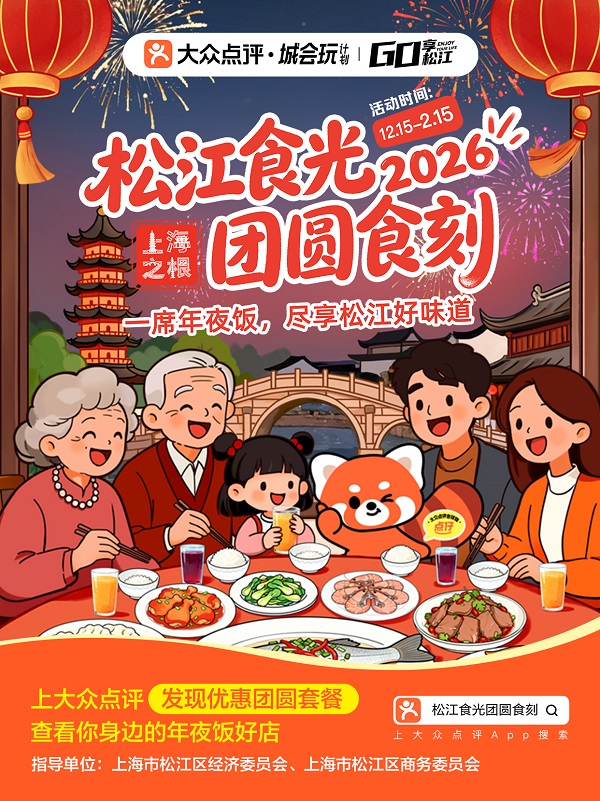
“松江食光·团圆食刻”系列活动×大众点评激发区域“年味”消费活力
Zhong Guo Shi Pin Wang· 2025-12-18 14:26
Core Viewpoint - The "Songjiang Food Light · Reunion Food Moment" food festival aims to boost the local dining industry and enhance consumer engagement through a dedicated reservation channel on Meituan and Dazhongdianping platforms, promoting traditional New Year meals and family gatherings [1][3][10]. Group 1: Event Overview - The food festival is part of the "Songjiang Food Light" carnival series, designed to promote local culinary culture and stimulate consumption in the dining sector [3][10]. - The event runs from now until February 15, allowing consumers to access a special reservation channel for New Year meals and family dinners [1][3]. Group 2: Features and Offerings - The festival integrates 35 brands and 44 restaurants, offering a variety of price points and meal options, including discounts and promotional offers to attract consumers [3][9]. - A "Songjiang Reunion Food Map" has been created, featuring various culinary segments such as farmhouse feasts and exquisite gatherings, highlighting local specialties and guiding consumers in their dining choices [3][4]. Group 3: Targeted Dining Experiences - Dazhongdianping recommends restaurants catering to different dining needs, including traditional farmhouse dishes, high-end banquet options, and family-friendly meal packages [4][6]. - The festival emphasizes creating memorable dining experiences for families and friends, enhancing the festive atmosphere [4][10]. Group 4: Economic Impact - The festival aims to increase the visibility of local merchants and drive foot traffic, thereby enhancing sales and brand influence in the region [9][11]. - The initiative is part of a broader strategy to integrate cultural, tourism, and commercial activities, fostering a vibrant local economy and enhancing the area's cultural image [10][11].
1000余餐饮大牌开出1万多家美团卫星店
Bei Jing Shang Bao· 2025-12-18 14:02
Core Insights - Meituan announced the completion of innovative store types in collaboration with over 1,000 brands by 2025, aiming to establish 10,000 satellite stores in communities, serving over 100 million consumers [1] Group 1: Business Strategy - The restaurant market is undergoing significant changes, prompting Meituan to enhance its store type innovation and support policies for merchants in 2026 [1] - Meituan's satellite store support policies for 2026 will be more comprehensive than in 2025, including new store type explorations with quality brands and opening fund rewards [1] Group 2: Market Coverage - The satellite store initiative covers various dining categories, including Chinese cuisine, Western food, and hot pot, featuring renowned brands such as Sichuan Restaurant and Xian Catering Group [1] - Haidilao has launched a sub-brand "Xiafan Hot Pot Dishes," opening over 1,400 satellite stores, while Muwu BBQ has adapted to late-night and casual dining needs with 50-square-meter community and street-side stores, achieving an average payback period of just 6 months [1]
南向资金今日成交活跃股名单(12月18日)
Zheng Quan Shi Bao Wang· 2025-12-18 13:46
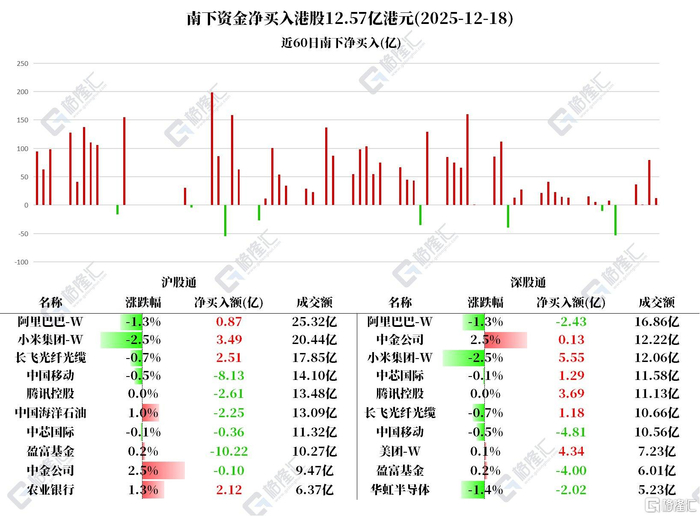
今日上榜个股中,小米集团-W、长飞光纤光缆、腾讯控股等8只股同时上榜港股通(深)、港股通 (沪)成交活跃股, 小米集团-W合计成交额32.50亿港元,成交净买入9.04亿港元,长飞光纤光缆合计 成交额28.51亿港元,成交净买入3.70亿港元。盈富基金合计成交额16.28亿港元,成交净卖出14.22亿港 元,中国移动合计成交额24.67亿港元,成交净卖出12.94亿港元。 从连续性进行统计, 有3只股获南向资金连续3天以上净买入,连续净买入天数较多的有小米集团-W、 美团-W、腾讯控股,连续净买入天数分别为15天、7天、3天。以其间净买入金额统计,净买入金额最 多的是小米集团-W,合计净买入为147.52亿港元,其次是美团-W合计净买入为59.92亿港元,腾讯控股 合计净买入为7.63亿港元。有2只股获连续净卖出,净卖出金额居前的有中国移动、中国海洋石油等, 合计净卖出金额分别为28.86亿港元、20.91亿港元。(数据宝) 12月18日南向资金成交活跃股 12月18日恒生指数上涨0.12%,南向资金全天合计成交金额为734.95亿港元,其中,买入成交373.76亿 港元,卖出成交361.19亿港元,合计净买 ...
港股通(沪)净卖出10.95亿港元





Zheng Quan Shi Bao Wang· 2025-12-18 13:46
Group 1 - The Hang Seng Index rose by 0.12% on December 18, closing at 25,498.13 points, with a net inflow of HKD 1.257 billion through the southbound trading channel [1] - The total trading volume for the southbound trading on December 18 was HKD 73.495 billion, with a net buying of HKD 1.257 billion [1] - In the Shanghai-Hong Kong Stock Connect, the trading volume was HKD 41.595 billion with a net selling of HKD 1.095 billion, while in the Shenzhen-Hong Kong Stock Connect, the trading volume was HKD 31.899 billion with a net buying of HKD 2.353 billion [1] Group 2 - The most actively traded stock in the Shanghai-Hong Kong Stock Connect was Alibaba-W, with a trading volume of HKD 25.332 billion, followed by Xiaomi Group-W and Changfei Optical Fiber with trading volumes of HKD 20.444 billion and HKD 17.850 billion, respectively [1] - In terms of net buying, Xiaomi Group-W led with a net inflow of HKD 3.49 billion, despite its closing price dropping by 2.47% [1] - The stock with the highest net selling was the Tracker Fund of Hong Kong, with a net outflow of HKD 1.022 billion, while its closing price increased by 0.16% [1] Group 3 - In the Shenzhen-Hong Kong Stock Connect, Alibaba-W also topped the trading volume with HKD 16.861 billion, followed by CICC and Xiaomi Group-W with HKD 12.220 billion and HKD 12.060 billion, respectively [2] - Xiaomi Group-W recorded the highest net buying in the Shenzhen-Hong Kong Stock Connect with HKD 5.55 billion, while its closing price also fell by 2.47% [2] - The stock with the largest net selling in this connect was China Mobile, with a net outflow of HKD 4.81 billion, and its closing price decreased by 0.47% [2]
美团推出虚拟人视频生成模型LongCat-Video-Avatar
Bei Jing Shang Bao· 2025-12-18 13:03
Core Viewpoint - Meituan has released and open-sourced a virtual human video generation model called LongCat-Video-Avatar, which enhances action realism, long video stability, and identity consistency compared to its predecessor [1] Group 1: Product Development - LongCat-Video-Avatar is an upgraded model based on LongCat-Video, focusing on optimizing core pain points in practical applications [1] - The model was developed in response to the needs identified in the InfiniteTalk and LongCat-Video projects [1] Group 2: Community Engagement - In August, Meituan's open-sourced InfiniteTalk project attracted the participation of hundreds of thousands of developers globally [1] - The LongCat team open-sourced the LongCat-Video model at the end of October, emphasizing long video generation capabilities [1]
资金动向 | 北水单日扫货小米超9亿港元,连续6日减持中海油
Ge Long Hui A P P· 2025-12-18 12:23
Group 1 - On December 18, southbound funds net bought Hong Kong stocks worth 1.257 billion HKD, with significant purchases in Xiaomi Group (903 million HKD) and Meituan (434 million HKD) [1] - Xiaomi Group has seen continuous net buying for 15 days, totaling 14.75053 billion HKD, while Meituan has experienced net buying for 7 days, totaling 5.99241 billion HKD [1] - Major net selling was observed in the Tracker Fund of Hong Kong (14.22 billion HKD) and China Mobile (12.94 billion HKD) [1] Group 2 - Xiaomi Group announced a share buyback of 1.51 million HKD for 3.75 million shares at a price range of 40.12-40.24 HKD per share [3] - Meituan's LongCat team launched an open-source SOTA-level virtual human video generation model, enhancing capabilities in video generation and stability [3] - Tencent Holdings repurchased shares worth approximately 640 million HKD, and Goldman Sachs maintains a "buy" rating with a target price of 770 HKD, citing Tencent Cloud's expansion into key international markets [3]
又一巨头藏不住了!靠捡漏狂揽5.2万亿,抄美团后路收割下沉用户
Sou Hu Cai Jing· 2025-12-18 11:13
Core Viewpoint - Pinduoduo, after ten years in the market, adopts a low-profile strategy amidst fierce competition in the internet sector, focusing on supply chain, logistics, and technology rather than engaging in direct confrontations with competitors [2][57]. Group 1: Company Milestones and Strategy - Pinduoduo celebrates its tenth anniversary with minimal fanfare, contrasting with other companies that typically hold grand celebrations [4]. - The company acknowledges a slowdown in growth and lack of sustainable profits during its earnings call, which raises questions about its future strategy [6]. - Pinduoduo employs a "flanking strategy" in the competitive landscape, particularly in the national subsidy war, adapting its approach to secure subsidies and maintain competitive pricing [8][10]. Group 2: Market Adaptation and Innovations - Pinduoduo shifts from a "light operation" model to establish subsidiaries aimed at securing subsidy qualifications and lowering prices on key products [11]. - The company capitalizes on the shift in subsidy focus from large appliances to fast-moving consumer goods, reinforcing its reputation for low prices [13]. - A new smart coupon system is being tested to retain potential buyers by offering targeted discounts based on user behavior [15][16]. Group 3: Expansion and Growth - Pinduoduo's "Westward Plan" aims to penetrate previously underserved regions, enhancing its logistics capabilities and expanding its market reach [18]. - The unexpected rise of "Duoduo Grocery" fills the market gap left by competitors, leading to significant growth in community group buying [20][22]. - By September 2024, "Duoduo Grocery" achieves a GMV close to 300 billion yuan, with growth rates exceeding 60% [26]. Group 4: International Strategy - Pinduoduo's international platform, Temu, expands rapidly, covering nearly 90 countries and achieving a revenue target of $90 billion for 2024 [30][32]. - Temu's strategy includes aggressive subsidies in European markets to attract price-sensitive consumers, while also focusing on compliance and local operations [35][37]. Group 5: Financial Performance and Industry Impact - Pinduoduo's financial outlook shows a profit exceeding 100 billion yuan in 2024, with a strong cash reserve of over 400 billion yuan, positioning it well against industry risks [43]. - The company's strategies have disrupted the e-commerce landscape, forcing competitors like Alibaba and JD to adopt low-price strategies [45]. - The community group buying sector is transformed, with "Duoduo Grocery" emerging as a dominant player following the exit of Meituan [47].


智通港股通活跃成交|12月18日
智通财经网· 2025-12-18 11:00
| 公司名称 | 成交金额 | 净买入额 | | --- | --- | --- | | 阿里巴巴-W(09988) | 25.32 亿元 | +8733.76 万元 | | 小米集团-W(01810) | 20.44 亿元 | +3.49 亿元 | | 长飞光纤光缆(06869) | 17.85 亿元 | +2.51 亿元 | | 中国移动(00941) | 14.10 亿元 | -8.13 亿元 | | 腾讯控股(00700) | 13.48 亿元 | -2.61 亿元 | | 中国海洋石油(00883) | 13.09 亿元 | -2.25 亿元 | | 中芯国际(00981) | 11.32 亿元 | -3627.61 万元 | | 盈富基金(02800) | 10.27 亿元 | -10.22 亿元 | | 中金公司(03908) | 9.47 亿元 | -1033.08 万元 | | 农业银行(01288) | 6.37 亿元 | +2.12 亿元 | 深港通(南向)十大活跃成交公司 智通财经APP获悉,2025年12月18日当天,阿里巴巴-W(09988)、小米集团-W(01810)、长飞光纤光 ...
南向资金 | 小米集团-W获净买入9.04亿港元

Di Yi Cai Jing· 2025-12-18 10:23
南向资金今日净买入12.57亿港元,小米集团-W、美团-W、长飞光纤光缆净买入额位列前三,分别获净 买入9.04亿港元、4.34亿港元、3.70亿港元。净卖出方面,盈富基金、中国移动、中国海洋石油分别遭 净卖出14.22亿港元、12.94亿港元、2.25亿港元。 (本文来自第一财经) ...