KWEICHOW MOUTAI(600519)

Search documents
食品饮料行业2025年四季度基金持仓分析:食饮板块超配比例略有回升,乳品、预加工食品等获得增持
Guoxin Securities· 2026-01-25 12:49
Investment Rating - The food and beverage industry maintains an "Outperform" rating [4][5]. Core Insights - The food and beverage sector's fund holding ratio is 4.48%, with a slight decrease of 0.25 percentage points from the previous quarter, ranking eighth among Shenwan's primary industries. The sector continues to be overweight, with an overweight ratio increasing by 0.02 percentage points [1][11]. - The white liquor sector remains the most heavily weighted, but its overweight ratio has decreased. Conversely, the dairy, snacks, and seasoning sectors have seen an increase in fund holding ratios [2][16]. - Key individual stocks such as Kweichow Moutai and Wuliangye have seen a decrease in their heavy holding ratios, while Yuran Dairy and Angel Yeast have received increased allocations [3][27]. Summary by Sections Fund Holdings Analysis - The food and beverage industry has a fund holding ratio of 4.48%, with a total heavy holding market value of approximately 117.8 billion yuan. The sector's overweight ratio is 0.64%, indicating a maintained overweight status [1][11]. Subsector Analysis - The white liquor sector's fund holding ratio is 3.32%, with an overweight ratio of 0.84%. Excluding Kweichow Moutai, the ratio drops to 1.84% with an overweight ratio of 0.85%. The dairy sector's fund holding ratio has increased to 0.25%, ranking third among subsectors [2][16][17]. Individual Stock Analysis - Kweichow Moutai's heavy holding ratio has decreased to 1.47%, despite an increase in the number of funds holding it to 296. Other major stocks in the white liquor sector, such as Wuliangye and Shanxi Fenjiu, have also seen declines in their heavy holding ratios [3][27][28].




食品饮料行业 2025 年四季度基金持仓分析:食饮板块超配比例略有回升,乳品、预加工食品等获得增持
Guoxin Securities· 2026-01-25 12:40
Investment Rating - The food and beverage industry maintains an "Outperform" rating [4][5][35] Core Views - The food and beverage sector's fund holding ratio is 4.48%, with a slight decrease of 0.25 percentage points from the previous quarter, ranking eighth among Shenwan's primary industries. The sector continues to be overweight, with an overweight ratio increasing by 0.02 percentage points [1][11] - The white liquor sector remains the most heavily weighted, but its overweight ratio has decreased. Conversely, the dairy, snacks, and seasoning sectors have seen an increase in fund holding ratios [2][16] - Key individual stocks such as Kweichow Moutai and Wuliangye have seen a decrease in their heavy holding ratios, while Yuran Dairy and Angel Yeast have received increased allocations [3][27] Summary by Sections Fund Holdings Analysis - The food and beverage industry has a fund holding ratio of 4.48%, with a total institutional heavy holding market value of approximately 117.8 billion yuan [1][11] - The white liquor sector's fund holding ratio is 3.32%, while the ratio excluding Kweichow Moutai is 1.84% [2][16] Subsector Performance - White liquor: Fund holding ratio decreased by 0.37 percentage points to 3.32%, with an overweight ratio down to 0.84% [2][16] - Dairy: Fund holding ratio increased by 0.10 percentage points to 0.25%, with an overweight ratio up to -0.16% [17] - Snacks: Fund holding ratio increased by 0.03 percentage points to 0.22%, with an overweight ratio up to 0.12% [17] Individual Stock Analysis - Kweichow Moutai's heavy holding ratio decreased to 1.47%, despite an increase in the number of funds holding it to 296 [3][27] - Wuliangye's heavy holding ratio decreased to 0.41%, with a reduction in the number of funds holding it [3][27] - Yuran Dairy's heavy holding ratio increased to 0.07%, indicating a positive shift in fund allocations [3][27]
马年生肖茅台“错版”包装3月起自营门店可更换
Xin Jing Bao· 2026-01-25 12:15
Core Viewpoint - The company has announced a solution for the packaging error of the 53-degree 500ml Guizhou Moutai liquor (Year of the Horse), allowing consumers to exchange the incorrect packaging starting from March 2026 [2][3]. Group 1: Packaging Error and Correction - The packaging of the 53-degree 500ml Guizhou Moutai liquor was found to have a typo, where "昴" (mǎo) was incorrectly written as "昂" [2]. - The company confirmed the error on January 22 and has since corrected the packaging, with production set to resume on January 23, 2026 [2][3]. - A comprehensive review of the systemic issues behind the error has been conducted, aiming to optimize processes and improve management [2]. Group 2: After-Sales Service and Consumer Options - The after-sales solution includes a replacement service available until December 31, 2026, at all Moutai self-operated stores [3]. - Consumers can exchange the original product and receipt for the corrected version or receive a new inner box starting from March 2026 [3]. - The company is also developing a "pen tool" to allow consumers to correct the typo themselves, with further design and testing underway [3]. Group 3: Market Response and Pricing - The secondary market has seen listings for the incorrect version of the Moutai liquor priced between 2200 to 3800 yuan per bottle, significantly above the original price of 1899 yuan [3]. - The wholesale reference price for the Year of the Horse classic version remains stable at 2180 yuan per bottle [3].
公募去年四季度亏超千亿终结七连盈,科技周期成加仓核心
Di Yi Cai Jing· 2026-01-25 12:00
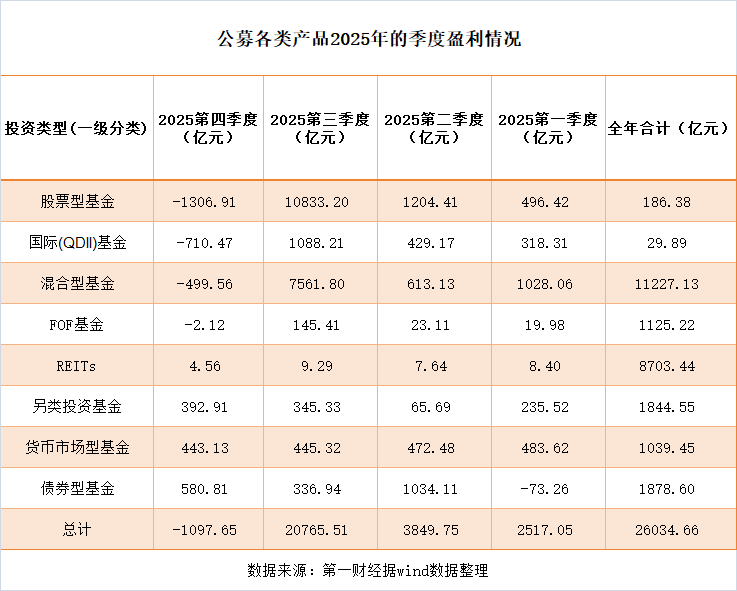
Core Insights - The public fund industry in China achieved a record profit of 2.6 trillion yuan in 2025, recovering from a cumulative loss of 1.87 trillion yuan from 2022 to 2023 [1][2] - Despite a loss of approximately 110 billion yuan in Q4 2025, the overall annual performance marked a significant recovery for the industry [2][3] Fund Performance - In Q4 2025, public funds reported a total loss of 1,097.65 billion yuan, ending a streak of seven consecutive profitable quarters [2][3] - Equity funds were the hardest hit, with a combined loss of 1,306.91 billion yuan in Q4, while mixed funds lost 499.56 billion yuan [3][4] - For the entire year, equity funds still managed to generate a profit of 1.99 trillion yuan, despite the Q4 downturn [4] Product Categories - QDII funds and FOF funds also faced losses in Q4, amounting to 710.47 billion yuan and 2.12 billion yuan respectively, but ended the year with profits of 1,125.22 billion yuan and 186.38 billion yuan [4] - Fixed-income products, including bond and money market funds, contributed significantly to profits, with bond funds earning 580.81 billion yuan and money market funds 443.13 billion yuan [4] Fund Company Performance - Among 167 fund companies, 108 reported positive profits, with over 60% achieving profitability [5] - Notable performers included Guotou Ruijin Fund, which led the industry with a profit of 72.82 billion yuan [5] Stock Holdings Adjustments - Public funds increased their holdings in 83 new stocks by the end of Q4 2025, with a focus on technology and cyclical sectors [7] - Ningde Times remained the top holding stock, despite a reduction of 1,993 million shares, while Zhongji Xuchuang became the most held stock among active funds [10][11] Sector Focus - The communication sector, particularly in optical modules, saw increased institutional investment, with Zhongji Xuchuang and Xinye Technology becoming top holdings [10] - The top three sectors for public fund investments were electronics, power equipment, and communication, with significant capital allocated to these areas [13]



湖北和广东调研反馈、周观点:啤酒推新蓄力,烘焙旺季稳健-20260125
GOLDEN SUN SECURITIES· 2026-01-25 11:22
Investment Rating - The report maintains an "Accumulate" rating for the food and beverage industry [5] Core Insights - The upcoming Spring Festival is expected to boost sales in the liquor sector, with Moutai leading the industry towards an unexpected improvement. Short-term focus should be on the demand for the Spring Festival, while medium-term investments should target leading brands across various price segments [1] - In the beer segment, new product launches are being prepared, with a focus on high-growth channels and consumer trends towards personalized and diversified consumption [2] - The baking sector is showing stable performance, with companies like Lihigh Foods preparing for the sales peak and benefiting from favorable policies regarding cream products [3] Summary by Relevant Sections Liquor Sector - The Spring Festival is driving demand, with Moutai expected to lead the market. Key short-term stocks include Guizhou Moutai, Guo Jiu Gong Jiu, and others, while medium-term focus should be on Wuliangye and Shanxi Fenjiu [1] Beer Sector - Current beer sales are in a low season, but new product launches and high growth in instant retail channels are promising. Companies like Chongqing Beer are launching new 1L cans to meet consumer preferences [2] Food Sector - Lihigh Foods is preparing for the sales peak with a focus on quality over quantity, while Anqi Yeast is benefiting from declining sugarcane prices, enhancing profit margins [3] - Yizhi Konjac is experiencing rapid demand growth, with a stable supply chain and product innovation driving its market position [4]





32万家街边烟酒店,被年轻人砸了铁饭碗
商业洞察· 2026-01-25 09:23
Core Viewpoint - The article discusses the dramatic decline of tobacco and liquor stores in China, highlighting the shift in consumer behavior and the impact of regulatory changes on the industry [5][12]. Group 1: Current Market Dynamics - On the first day of 2026, the limited stock of Feitian Moutai sold out within half an hour, contrasting sharply with the decline of tobacco stores [7][9]. - The number of tobacco stores in China decreased by approximately 19% in 2025, equating to the closure of around 320,000 stores [9][26]. - Over the past five years, more than 1.3 million tobacco stores have shut down, averaging nearly 900 closures per day [9][28]. Group 2: Historical Context and Business Model - Tobacco stores emerged in the 1990s, primarily run by local farmers, and became a staple in many communities [14][15]. - Traditionally, these stores relied heavily on local corporate purchases for revenue, with over 60% of sales coming from business clients [17][19]. - Before 2021, tobacco stores could achieve monthly profits of around 50,000 yuan, leveraging their tobacco licenses as a significant asset [21]. Group 3: Factors Contributing to Decline - The strictest alcohol regulations in history have severely impacted business, with some regions reporting an 80% drop in liquor sales [21][23]. - Changing consumer preferences, particularly among younger generations, have led to a decline in both alcohol consumption and smoking rates [30][36]. - The rise of national chain liquor stores has further squeezed the market for traditional tobacco shops, with many stores now operating at a loss [39][42]. Group 4: Industry Transformation and Adaptation - Many tobacco store owners are now pivoting to adapt to changing market conditions, focusing on lower-cost liquor and community services [56][59]. - Some stores are leveraging online platforms to increase sales, with online orders accounting for up to 35% of their business [62]. - Innovative adaptations include transforming stores into community hubs or integrating new product lines like craft beer and low-alcohol beverages [64][67]. Group 5: Broader Industry Implications - The decline of tobacco stores reflects a broader trend of industry consolidation and transformation across various sectors, including pharmacies and beauty brands [70][72]. - The article emphasizes that industries must adapt to survive in an era where information asymmetry is diminished by the internet [72][73].

食品饮料行业:25Q4持仓分析:白酒再降,大众品回暖
GF SECURITIES· 2026-01-25 09:12
Investment Rating - The industry investment rating is "Buy" [2] Core Insights - The food and beverage sector's heavy stockholding ratio continues to decline, with a slight recovery in the allocation of consumer goods [6][14] - The white liquor sector has seen a slight decrease in stockholding ratios, while consumer goods have shown some recovery [6][31] - The report highlights a potential for recovery in the white liquor sector after a four-year adjustment period, with expectations for both valuation and performance to stabilize [6][31] Summary by Sections 1. Fund Holding Overview - As of Q4 2025, the food and beverage sector's heavy stockholding ratio is 6.1%, down 0.3 percentage points from Q2 2025, with a total market value of 43.998 billion CNY [14][21] - The allocation of active equity funds in the food and beverage sector has decreased to 32.3%, while passive funds have increased to 63.3% [21][22] 2. Sub-industry Holding Analysis (1) White Liquor Sector - The heavy stockholding ratio for white liquor has decreased to 5.1%, with an allocation of +2.7 percentage points [31][33] - Active equity funds' heavy stockholding ratio for white liquor is 2.9%, down 0.3 percentage points [31][33] (2) Consumer Goods - The heavy stockholding ratio for consumer goods has increased to 0.97%, but remains in a low allocation state [47][51] - Key sub-sectors such as dairy and seasoning products have shown a recovery in stockholding ratios [47][51] 3. Individual Stock Analysis - Among the top 20 heavy stocks, only Kweichow Moutai remains in the food and beverage sector, dropping from second to fourth place [6][31] - The report recommends several stocks for investment, including Kweichow Moutai, Luzhou Laojiao, and Yili [6][31] 4. Sector Overview - The report indicates that the food and beverage sector is experiencing a recovery phase, with expectations for moderate price increases in 2026 [6][31] - The report emphasizes the importance of new products and channels for individual stock performance [6][31]
行业周报:春节旺季备货催化,大众品迎来布局窗口-20260125
KAIYUAN SECURITIES· 2026-01-25 08:42
Investment Rating - The industry investment rating is "Positive" (maintained) [1] Core Viewpoints - The food and beverage sector is currently at a low position in terms of fundamentals and valuations, presenting significant investment opportunities as the peak season approaches [4][12] - The food and beverage index experienced a decline of 1.4% from January 19 to January 23, ranking 25th among 28 sectors, underperforming the CSI 300 by approximately 0.8 percentage points [12][13] - The Consumer Price Index (CPI) rose by 0.8% year-on-year in December 2025, indicating a mild recovery trend, and has returned to relatively high levels compared to recent years [4][12] - The upcoming Spring Festival is expected to catalyze performance in the sector, with strong demand for consumer goods, particularly in the snack segment, which continues to show upward momentum [4][12] Summary by Sections Weekly Insights - The food and beverage sector is positioned for a recovery as it approaches the peak season, with a notable increase in demand expected during the Spring Festival [4][12] - The sector's current valuation aligns with policy support aimed at boosting consumption, providing a safety margin for investments [4][12] Market Performance - The food and beverage index's performance was weaker than the broader market, with specific sub-sectors like snacks (+6.1%), processed foods (+4.9%), and baked goods (+4.3%) showing relative strength [12][13] Upstream Data - Recent data indicates a decline in some upstream raw material prices, with whole milk powder prices down 13.5% year-on-year as of January 20, 2026 [19][21] - The price of fresh milk was reported at 3.03 CNY per kilogram, reflecting a year-on-year decrease of 2.6% [19][21] Alcohol Industry Data - In December 2025, the production of liquor (65-degree equivalent) decreased by 12.1% year-on-year, with a total production of 354.9 million liters for the year [42][43] Recommended Investment Targets - Key investment opportunities identified include raw milk/dairy products, the snack sector, and the restaurant supply chain, with specific companies highlighted for their growth potential [4][5][12]

公募基金25年Q4配置分析:公募基金四季报是否会影响我们对市场和板块的判断?
广发香港· 2026-01-25 08:28
Core Conclusions - The current fund allocation numbers reflect the results of economic transformation, with a notable shift in the channels through which residents are entering the market, particularly among high-net-worth individuals [12][19] - The allocation towards "new productive forces" indicates a structural shift in the economy, with changes in heavy holdings reflecting different stages of economic dividends [23][29] Asset and Sector Allocation - Fund positions have decreased, with ongoing redemption pressures; net inflows for various fund types were approximately 1200 billion CNY in Q4, down from over 2600 billion CNY in Q3 [12][15] - Active equity funds are experiencing a "return of capital redemption" pressure, with 2563 out of 6471 existing active equity funds exceeding their 2020-2022 high points, representing about 40% of the total [15][19] Industry Allocation - There is a rotation within the technology sector, with increased allocations to non-ferrous metals, non-bank financials, and chemicals, while reductions were seen in electronics, pharmaceuticals, and media [5][51] - The semiconductor and lithium battery materials sectors are highlighted as key areas for increased investment, alongside insurance and chemicals, driven by positive economic expectations [58][65] Individual Stock Allocation - The concentration of holdings has decreased, indicating a diversification in investment strategies among funds [40] Fixed Income Plus Fund Allocation Analysis - "Fixed income plus" funds are becoming a significant source of incremental growth, with a preference for sectors such as non-ferrous metals, non-bank financials, and utilities, reflecting a focus on economic cycle-related and dividend-paying industries [58][65]


连续36个季度重仓贵州茅台!公募的白酒坚守与困境,如何突围?
券商中国· 2026-01-25 07:54
Core Viewpoint - The latest public fund top ten heavy stocks show a significant shift, with AI technology and new energy stocks occupying nine positions, leaving only one for Kweichow Moutai, indicating a divergence in the consumer sector [1][2]. Group 1: Changes in Fund Holdings - As of 2025, only Kweichow Moutai remains among the top ten heavy stocks in public active equity funds, with the other nine being tech and new energy companies like Zhongji Xuchuang and Ningde Times [2]. - In Q4 2021, three liquor stocks were among the top ten heavy stocks, including Moutai and Wuliangye, which were key players in the previous structural market [2]. - By the end of 2025, 1,048 funds held Kweichow Moutai, with a total market value of 118.203 billion yuan, ranking fourth among the top ten heavy stocks [2]. Group 2: Performance of Traditional Consumer Funds - Some funds have been loyal to traditional liquor stocks, with E Fund Blue Chip Select holding Kweichow Moutai for 29 consecutive quarters and Invesco Great Wall New Growth for 36 quarters [3]. - Many funds focusing on traditional consumption have seen poor performance, with some funds losing over 30% since inception and others reporting negative returns for four consecutive years [3]. - Fund managers focusing on traditional consumption often neglect to analyze their heavy holdings, instead discussing macroeconomic factors, which may indicate a disconnect from their investment strategies [3]. Group 3: Emergence of New Consumption Trends - New consumption trends, such as collectible toys and the "millet economy," have gained traction, with funds increasingly investing in these areas, while traditional consumer funds remain unresponsive [4][5]. - For example, Pop Mart has 123 funds holding it, with significant positions taken by active equity funds that are not traditional consumer funds [5]. - The divide between new and old consumption is perceived as non-existent, with both being products of changing market demands and technological advancements [5][6]. Group 4: Future Consumption Opportunities - Consumption remains a vital driver of economic growth, with expectations for service consumption in entertainment, gaming, and tourism to provide new investment opportunities [6][7]. - Fund managers suggest that the previous optimism surrounding traditional consumption stocks may be misplaced, advocating for a focus on emerging sectors like gaming and sports as new growth areas [7]. - The integration of technology and manufacturing is expected to create synergies, particularly in the robotics sector, which is becoming increasingly relevant across various industries [7].