KWEICHOW MOUTAI(600519)

Search documents
14只白酒股上涨 贵州茅台1524.96元/股收盘
Bei Jing Shang Bao· 2026-02-09 10:21
Core Viewpoint - The white liquor sector has experienced a significant adjustment over the past five years, with current valuations and institutional positions at historical lows, suggesting potential for stock price recovery ahead of fundamental improvements [1] Group 1: Market Performance - On February 9, the Shanghai Composite Index closed at 4123.09 points, up 1.41% [1] - The white liquor sector closed at 2306.55 points, increasing by 0.95%, with 14 stocks in the sector rising [1] Group 2: Individual Stock Performance - Kweichow Moutai closed at 1524.96 CNY per share, up 0.66% [1] - Wuliangye closed at 107.36 CNY per share, up 0.34% [1] - Shanxi Fenjiu closed at 174.70 CNY per share, down 0.23% [1] - Luzhou Laojiao closed at 121.29 CNY per share, down 1.25% [1] - Yanghe Brewery closed at 55.66 CNY per share, up 0.76% [1] Group 3: Analyst Insights - Tianfeng Securities indicates that the white liquor sector is likely in the final stage of fundamental clearing, with stable prices for Moutai being a positive signal for marginal improvement [1] - The report suggests that the sector's valuation recovery may occur ahead of performance recovery [1]

【数据看盘】有色金属ETF上周份额大减,顶级游资扎堆捷成股份
Xin Lang Cai Jing· 2026-02-09 09:55
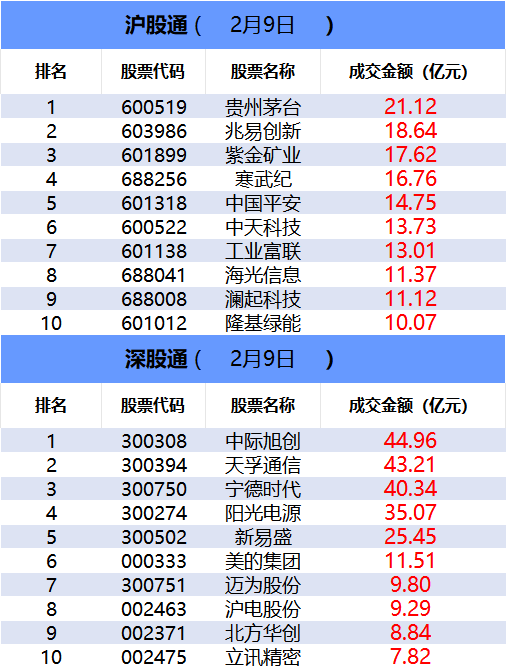
Group 1 - The total trading volume of the Shanghai and Shenzhen Stock Connect today reached 273 billion, with Kweichow Moutai and Zhongji Xuchuang leading in trading volume for the Shanghai and Shenzhen markets respectively [1][2] - The electronic sector saw the highest net inflow of funds, while the oil and gas sector experienced significant declines [3][5] - AI application stocks, particularly Jiecheng Co., Ltd., hit the daily limit up, attracting a total of 341 million in purchases from three major funds [1][14] Group 2 - The top ten stocks by trading volume in the Shanghai Stock Connect included Kweichow Moutai at 21.12 billion, followed by Zhaoyi Innovation and Gaoteng [2] - In the Shenzhen Stock Connect, Zhongji Xuchuang led with 44.96 billion, followed by Tianfu Communication and Ningde Times [2] - The electronic sector had the highest net inflow of 75.51 billion, while the pharmaceutical sector saw the largest outflow of 19.31 billion [4][5] Group 3 - The top ten ETFs by trading volume included A500 ETF Fund at 141.83 billion, followed by Gold ETF at 124.18 billion [7] - The A500 ETF Fund saw a decrease of 5.21% compared to the previous trading day, while the Gold ETF experienced a significant drop of 34.76% [7] - The largest decrease in ETF shares last week was seen in the Nonferrous Metals ETF, which lost 25.11 billion shares [10]





食品饮料行业跟踪报告:线上i茅台数据亮眼,线下茅台量价超预期
Shanghai Aijian Securities· 2026-02-09 08:12
Investment Rating - The industry is rated as "Outperform the Market" [4][19]. Core Insights - The liquor industry is entering a phase of rapid performance clearing, with demand expected to show weak recovery as policy pressures ease. The industry is currently at a low valuation, and pessimistic expectations are fully priced in. The direction of industry clearing is becoming clearer, and the bottom is increasingly defined. The control of volume and stable pricing is driving the recovery of wholesale prices, with recent acceleration in the price of mainstream products showing positive signals. Leading liquor companies are increasing dividend ratios, enhancing yield attractiveness. Long-term, it is recommended to focus on high-quality leading companies with strong performance certainty, particularly Guizhou Moutai, which has stable pricing and a solid competitive moat [3][4]. Summary by Sections Industry Performance - The food and beverage industry increased by 4.31% in the week of February 2-6, outperforming the Shanghai Composite Index, which decreased by 1.27%. Among 31 sub-industries, food and beverage ranked first [4][5]. - The sub-sectors within food and beverage, ranked by performance, are as follows: liquor (+5.29%), soft drinks (+4.71%), beer (+4.48%), seasoning and fermented products (+3.81%), dairy (+2.62%), snacks (+1.86%), pre-processed foods (+1.58%), meat products (+1.28%), baked goods (+0.61%), other alcoholic beverages (-0.44%), and health products (-1.36%) [4]. Guizhou Moutai Insights - Online sales data for i Moutai is impressive, with offline sales exceeding expectations, driving up wholesale prices. As of February 2, i Moutai reported over 15.31 million monthly active users, with 6.28 million new users and over 2.12 million orders, of which over 1.43 million were for mainstream products, accounting for about 67% [4]. - The establishment of direct sales channels for i Moutai has effectively shortened the distribution chain, reaching previously underserved C-end consumers, particularly in self-consumption and family consumption. This has systematically released suppressed C-end demand [4]. - The recent performance indicates that Moutai's market-oriented transformation strategy is receiving positive feedback from the market, with the direct sales channel and distribution system achieving initial collaborative success in customer segmentation and service functions [4].
史上最长春节假期有望激活消费热情!港股通消费ETF汇添富(159268)收涨1.4%再创阶段新高!消费ETF(159928)震荡飘红!
Xin Lang Cai Jing· 2026-02-09 07:49
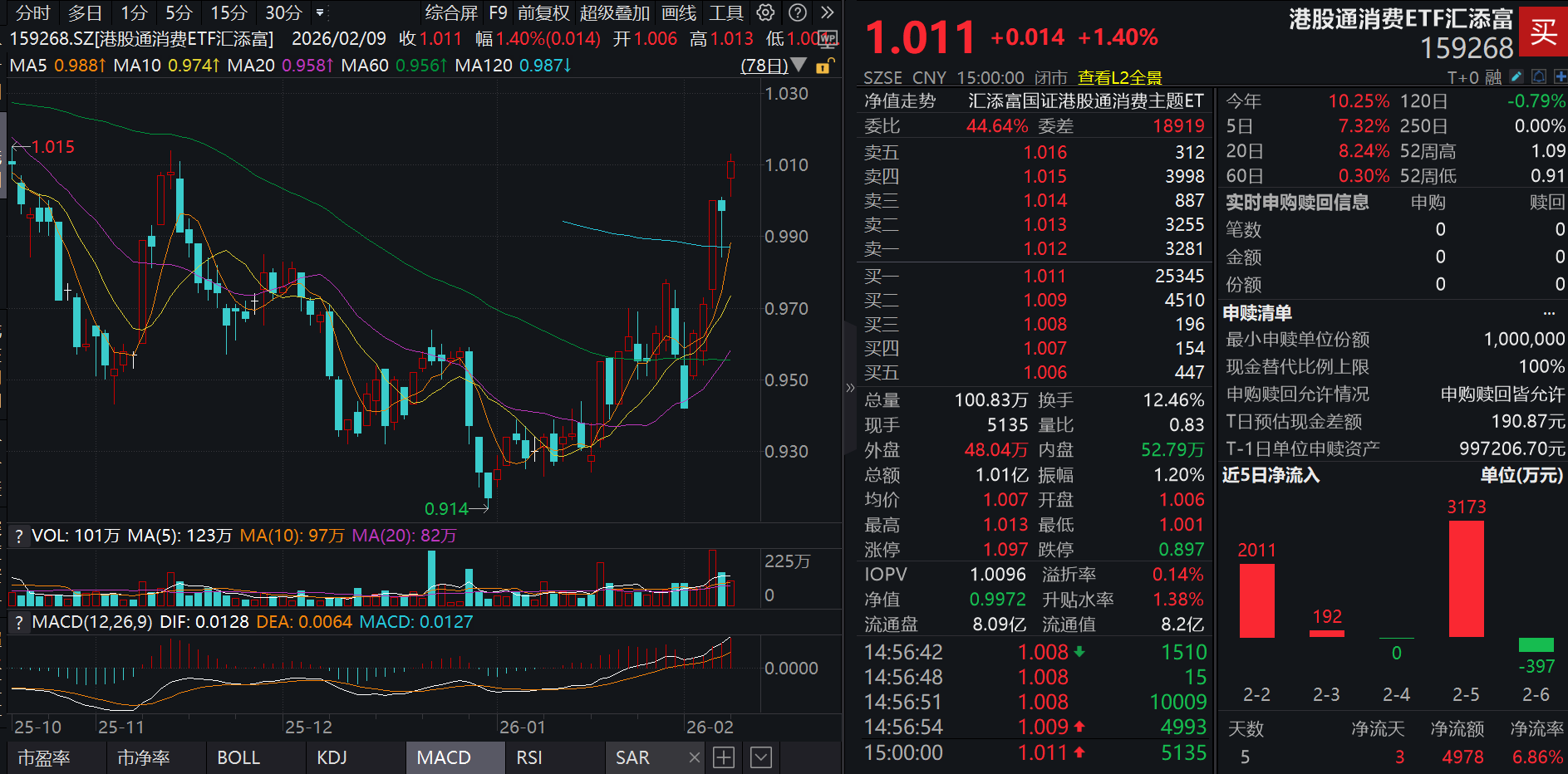
Group 1: Market Performance - The Hong Kong Stock Connect Consumption ETF (159268) rose by 1.4%, reaching a new high, with net inflows of nearly 50 million yuan over the past five days [1] - The A-share leading consumption ETF (159928) experienced a flat trading day with a total transaction volume exceeding 570 million yuan [3] - Popular constituent stocks such as China Duty Free and Pop Mart saw significant gains, with increases of over 8% and 5% respectively [1][3] Group 2: Consumer Trends and Policies - As the Spring Festival approaches, the A-share consumer sector is becoming more active, with expectations for increased retail in gold, travel, and dining services [5] - A new policy for Hainan Free Trade Port allows residents to purchase imported goods tax-free, enhancing consumer sentiment [5] - The "2026 'Happy Shopping Spring' Special Activity Plan" aims to stimulate consumption across various sectors, including digital and green consumption [5] Group 3: Alcohol and Beverage Industry Insights - The price of Moutai has rebounded, with a recent increase from 1570 yuan to 1610 yuan, reflecting a 2.5% rise [6] - The white liquor sector is showing signs of weak recovery, with expectations for a gradual improvement in demand due to better economic forecasts [6][9] - The beer market is projected to face pressure in 2025, but a mild recovery is anticipated in 2026 due to the growth of non-traditional retail channels [6] Group 4: Food and Beverage Sector Developments - The National Standard for Pre-prepared Dishes is under review, which is expected to enhance the development of the pre-prepared food industry [7][10] - The dairy sector is expected to stabilize, with a potential rebound in milk prices as supply and demand reach a turning point [7] - The snack food segment is experiencing growth, driven by the expansion of discount snack stores and innovations in social e-commerce channels [6][7] Group 5: Livestock and Meat Products - The profitability of self-bred pigs has turned negative, with a 26.4% decline in profits from purchased piglets [8] - Prices for white feather chickens and egg-laying hens have shown slight week-on-week declines [8]

食品饮料周报(26年第6周):白酒春节动销渐起,预制菜国标公开征求意见
Guoxin Securities· 2026-02-09 05:45
Investment Rating - The report maintains an "Outperform the Market" rating for the food and beverage sector [4][5]. Core Insights - The food and beverage sector has shown a cumulative increase of 4.48% this week, with A-shares rising by 4.44%, outperforming the CSI 300 by approximately 5.77 percentage points [1]. - The report highlights the ongoing differentiation in the fundamentals of various categories, with liquor outperforming food and beverages [2]. - Key investment recommendations include leading companies such as Kweichow Moutai, Shanxi Fenjiu, and Luzhou Laojiao in the liquor segment, as well as Yili in dairy and Nongfu Spring in beverages [2][3]. Summary by Sections Liquor - The report notes a gradual increase in sales leading up to the Spring Festival, with Kweichow Moutai performing particularly well. It suggests that the overall decline in sales is expected to narrow to around 10% during the festive period [10]. - Investment recommendations include Kweichow Moutai, Luzhou Laojiao, and Shanxi Fenjiu, with a focus on their growth potential and market recovery [10][11]. Beer - The beer industry is experiencing healthy inventory levels, with expectations for demand recovery. The report recommends Yanjing Beer and China Resources Beer as key players to watch [11]. Snacks - The report emphasizes the importance of strong alpha stocks in the snack category, particularly focusing on the growth potential of konjac snacks. Leading companies like Wei Long and Yan Jin Pu Zi are highlighted for their innovative product offerings [12][18]. Dairy - The dairy sector is seeing orderly preparations for the Spring Festival, with a recommendation for Yili as a leading company with a favorable valuation margin. The report anticipates a gradual recovery in demand and a potential balance in supply and demand by mid-2026 [14]. Beverages - The beverage segment is primarily focused on inventory reduction during the off-season, with stable preparations for the Spring Festival. The report continues to recommend Nongfu Spring and Dongpeng Beverage for their growth strategies [15]. Supply Chain - The report discusses the public consultation on national standards for prepared dishes, which may accelerate the clearing of inefficient suppliers in the industry. Recommendations include leading companies like Yihai International and Haidilao [13].


食品饮料周报(26年第6周):白酒春节动销渐起,预制菜国标公开征求意见-20260209
Guoxin Securities· 2026-02-09 05:07
Investment Rating - The report maintains an "Outperform the Market" rating for the food and beverage sector [4][5][18] Core Views - The food and beverage sector is expected to perform well in 2026, driven by several key themes including cost benefits, efficiency improvements, innovation, and potential recovery opportunities in the liquor segment [3][10][11] - The report highlights the ongoing differentiation in the fundamentals of various categories, with liquor outperforming food and beverages [2][10] Summary by Relevant Sections Liquor - The report indicates that the sales of liquor, particularly high-end brands like Moutai, are showing positive trends as the Spring Festival approaches, with Moutai expected to see double-digit growth [2][10] - Investment recommendations include Moutai, Shanxi Fenjiu, and Luzhou Laojiao, with a focus on brands that are gaining market share despite overall market challenges [2][10][11] Beer - The beer industry is currently managing inventory well and is poised for recovery as demand is expected to improve [11] - Recommended companies include Yanjing Beer and China Resources Beer, which are seen as strong players in the market [11] Snacks - The report emphasizes the importance of focusing on companies with strong growth potential in the snack sector, particularly those involved in konjac products, which are expected to continue their growth trajectory [12][18] - Key players in this segment include Weidong and Yanjinpuzi, which are noted for their innovative product offerings [12][18] Prepared Dishes - The report discusses the public consultation on national standards for prepared dishes, which may lead to a clearer industry structure and the elimination of less compliant players [13][14] - Recommended companies in this space include Yihai International and Haidilao, which are expected to benefit from improved compliance and operational efficiency [13][14] Dairy Products - The dairy sector is experiencing a steady recovery, with a focus on leading companies like Yili, which are expected to benefit from improved margins and reduced inventory pressures [14][15] - The report suggests that the demand for dairy products will continue to improve, particularly in the second half of 2026 [14][15] Beverages - The beverage sector is currently in a seasonal inventory reduction phase, with stable preparations for the Spring Festival [15] - Companies like Nongfu Spring and Dongpeng Beverage are highlighted for their strong operational performance and market expansion strategies [15][16]
白酒春节旺季迟到,头部酒企带头“砸钱”促销
第一财经· 2026-02-09 04:32
Core Viewpoint - The traditional peak season for liquor sales around the Spring Festival has been delayed by nearly one month this year, leading to increased promotional efforts by companies to help distributors clear inventory [3][4]. Group 1: Market Trends - The peak sales period for liquor this year began in early February, compared to previous years when it typically started around New Year's [3]. - Many distributors reported a double-digit decline in overall sales volume since January 2026, with significant market and brand differentiation emerging [4]. - The overall sales performance during the Spring Festival is expected to be challenging, with difficulty in surpassing last year's figures [3]. Group 2: Promotional Strategies - Liquor companies have intensified promotional activities, such as offering cash red envelopes and lottery draws, to stimulate consumer purchases [4][5]. - Major brands like Fenjiu and Guojiao 1573 have launched specific promotional campaigns aimed at increasing consumer engagement and actual sales [4]. - The focus of these promotions is to enhance the "opening bottle" strategy, encouraging consumers to consume more [5]. Group 3: Inventory and Distribution - There is a notable disparity in inventory levels, with top brands like Moutai and Wuliangye maintaining stable inventory and distribution, while many mid-tier and regional brands face cautious stocking and ongoing inventory pressure [5]. - The shift in strategy among leading liquor companies is moving from merely increasing cash flow to emphasizing actual sales and inventory reduction [5].
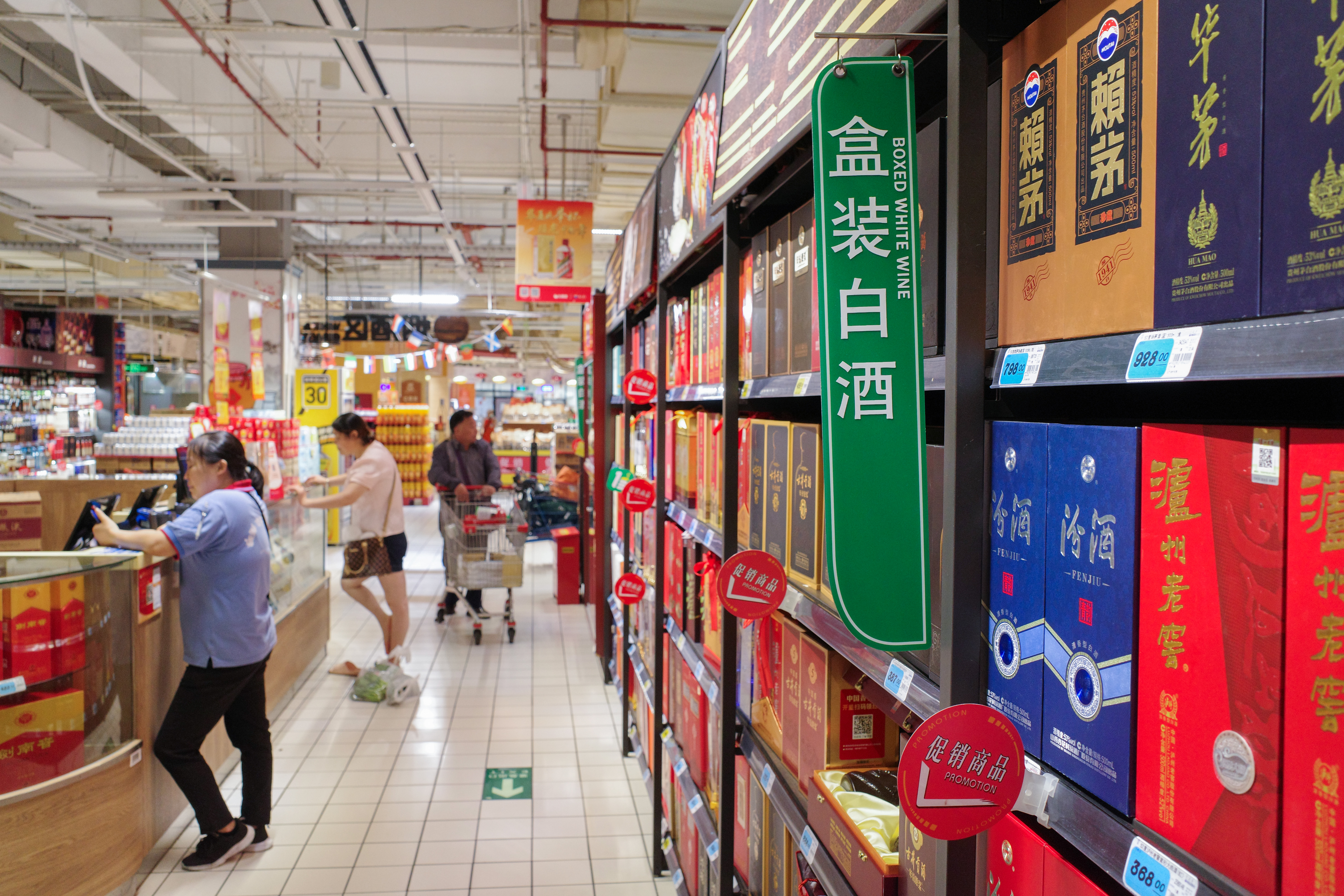
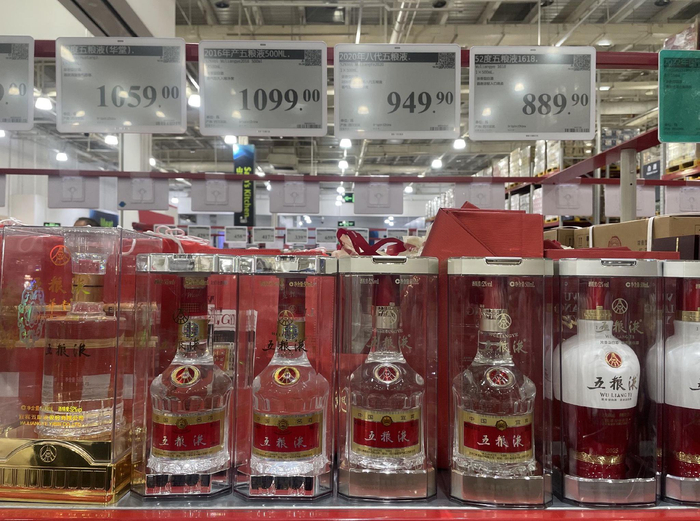
山姆刺破年份酒泡沫
Xin Lang Cai Jing· 2026-02-09 04:18
Core Viewpoint - The recent changes in the display and pricing of vintage liquor at Sam's Club indicate a shift towards transparency and standardization in the retail of aged spirits, challenging traditional distribution models and pricing mechanisms in the liquor industry [1][3][4]. Group 1: Changes in Retail Strategy - Sam's Club has reorganized its liquor shelves to display products by vintage year, marking a significant shift from traditional methods that relied on flavor or series categorization [1]. - The pricing of vintage liquors has become more accessible, allowing consumers to purchase older, higher-value products within similar budget constraints as before [1][4]. - The direct supply model employed by Sam's Club, bypassing traditional multi-tier distribution, reduces price markups and enhances price transparency for consumers [4][5]. Group 2: Impact on Traditional Distribution - The traditional distribution model of vintage liquor, which relied on a closed network of dealers and collectors, is facing unprecedented challenges due to increased price transparency [3][4]. - The shift to a more transparent pricing system is compressing profit margins for traditional distributors, as consumers can easily compare prices online [4][5]. - The emergence of new sales channels, such as direct partnerships between online platforms and liquor manufacturers, is further disrupting the traditional distribution landscape [5]. Group 3: Market Dynamics and Consumer Behavior - The overall liquor market is experiencing a downturn, with a significant increase in inventory turnover days and many companies facing price inversions [7]. - The demand for high-end liquor, particularly in business settings, has sharply declined, impacting sales volumes for brands like Moutai and Wuliangye [8]. - Despite the challenges, the vintage liquor market is still expanding, with projections indicating growth from 628 billion yuan in 2019 to 1,285 billion yuan in 2023 [10]. Group 4: Consumer Preferences and Market Trends - The preference for sauce-flavored liquor is dominant in the vintage market, with 43% of consumers favoring this type over others [11]. - Liquors produced after 2000 are the most popular among consumers, reflecting a balance between flavor enhancement and affordability [11]. - The lack of a unified and transparent certification system for vintage liquor remains a fundamental challenge, hindering the establishment of a stable valuation system in the market [12].
透视基金第一重仓股“魔咒”:发生概率不足五成,三招避开“光环陷阱”
券商中国· 2026-02-09 04:11
2025年四季度末,光模块龙头中际旭创以1.28亿股持股总量、782.32亿元持股市值,首次超越宁德时代登顶主动权益基金第一大重仓股,1100多只持仓基金的"抱 团"态势一度成为市场焦点。但登顶仅月余,该股便开启回调模式,截至2月6日,年内累计下跌超10%,单日最大跌幅达8.94%,多只重仓基金净值同步回撤超 5%,再度引发市场对"基金第一重仓股魔咒"热议。 要客观研判"基金第一重仓股魔咒"这一市场现象,需依托长期、大样本的实证数据。基于Wind平台2003年至2025年共92个报告期的统计显示,在成为第一重仓股 后,39只登顶标的在后续3个月跑输沪深300指数,占92个报告期的42.39%;6个月、12个月跑输比例分别为45.65%、46.74%。这一量化结果,为理性分析该现象的 统计规律提供了客观依据。 | | | | 部分主动权益基金第一大重仓股登顶后的市场表现一览 | | | | --- | --- | --- | --- | --- | --- | | 主动权益基金第一大 重仓股名称 | | 报告期归母净利 润同比增长率 | 报告期后3个月相对于沪深 300指数的涨幅(%) | 报告期后6个月相对于 ...

节假日消费观察|白酒春节旺季迟到,头部酒企带头“砸钱”促销
Di Yi Cai Jing· 2026-02-09 03:46
Group 1 - The traditional peak season for liquor sales around the Spring Festival has been delayed this year, starting nearly one month later than usual, with significant promotional efforts from companies to help distributors clear inventory [1][5] - Sales activity for the Spring Festival began to show signs of improvement only in mid-January, which is at least one month later than previous years, indicating a slower market response [1][5] - The overall sales volume from January to now has shown a double-digit decline, with a notable differentiation in performance among regional markets and brands, where top brands like Moutai are experiencing shortages while others like Wuliangye are seeing stable sales [5][6] Group 2 - Companies are increasing promotional activities targeting end consumers, focusing on strategies to encourage actual consumption, such as "scan to redeem" campaigns and festive giveaways [5][6] - The market is currently characterized by a "strong at both ends, weak in the middle" inventory situation, where high-end brands maintain stable inventory levels while many mid-tier and regional brands face cautious stocking and ongoing inventory pressure [6]