
Shanxi Xinghuacun Fen Wine Factory (600809)

Search documents
食品饮料中报前瞻暨板块最新观点:白酒逢低配置龙头,食品关注结构性机遇-20250713
CMS· 2025-07-13 15:36
Group 1: Core Views - The report suggests that the food and beverage industry is expected to see a valuation recovery as market sentiment improves, with a focus on low-priced leading companies in the liquor sector and structural opportunities in the food sector [2][7][10]. Group 2: Liquor Sector - The liquor sector is experiencing a phase of demand decline due to seasonal factors and regulatory impacts, leading to pressure on high-end liquor prices, while mass consumption remains stable [7][13]. - Major companies like Moutai are expected to maintain their performance due to strong brand positioning, while others are entering an adjustment phase, with varying adjustment speeds among companies [7][14]. - Q2 performance forecasts for major liquor companies indicate a range of revenue and profit changes, with Moutai expected to see a 9% increase in both revenue and profit [14][15][16]. Group 3: Food Sector - The food sector shows signs of recovery, with segments like beverages, snacks, and pet food experiencing upward trends, while beer and restaurant supply chains face structural challenges [21][24]. - The beverage industry remains vibrant with new product launches and a clear trend towards reduced sugar options, while competition intensifies [24][30]. - Dairy products are seeing mixed performance, with some segments like low-temperature dairy and cheese growing, while others face challenges [24][33]. Group 4: Investment Recommendations - The report recommends focusing on leading liquor companies with a safety margin for investment, as well as food companies that are expected to exceed mid-year performance expectations [10][28]. - Specific companies highlighted for potential investment include Nongfu Spring, Uni-President China, and Tianwei Foods, among others [10][28].





食品饮料周观点:中报窗口期,预期回归、分化加剧-20250713
GOLDEN SUN SECURITIES· 2025-07-13 14:28
Investment Rating - The report maintains an "Increase" rating for the food and beverage industry, indicating a positive outlook for selected companies within the sector [4]. Core Insights - The report highlights a significant differentiation within the industry, particularly in the liquor segment, where companies are actively seeking transformation amid market pressures. It emphasizes three main investment themes: leading brands, high-certainty regional brands, and flexible companies benefiting from recovery [1][2]. - In the beer and beverage sector, companies like Yanjing and Zhujiang are expected to show strong profit growth, with Yanjing projected to achieve a net profit of 1.06 to 1.14 billion yuan, reflecting a year-on-year increase of 40% to 50% [3]. Summary by Sections Liquor Industry - The liquor industry is experiencing a challenging half-year, with demand and policy impacts leading to a slowdown in sales. The report anticipates that the performance expectations for the mid-year and the entire year of 2025 have been largely adjusted [2]. - Key players like Kweichow Moutai and Wuliangye are focusing on service enhancement and transformation strategies to navigate the current market conditions. The report suggests that the upcoming month of September will be critical for assessing the impact of policies and consumer demand [2]. Beer and Beverage Sector - Yanjing Beer is expected to achieve a net profit of 1.06 to 1.14 billion yuan for the first half of 2025, marking a year-on-year increase of 40% to 50%. Zhujiang Beer is also projected to see a profit increase of 15% to 25% [3]. - Eastroc Beverage is forecasted to generate revenue of 10.63 to 10.84 billion yuan, with a net profit of 2.31 to 2.45 billion yuan, reflecting a growth of 33% to 42% year-on-year [3]. Consumer Goods - The report notes that companies like Youyou Foods and Miaokelando are expected to report significant profit increases, with Youyou Foods projecting a revenue growth of 40.91% to 50.77% [7]. - The overall consumer goods sector is highlighted as a space to watch for growth, particularly for companies that are innovating and expanding their market reach [7].


行业周报:白酒布局机会渐显,新消费择优长期持有-20250713
KAIYUAN SECURITIES· 2025-07-13 14:07
Investment Rating - The industry investment rating is "Positive" (maintained) [1] Core Viewpoints - The food and beverage index increased by 0.8% from July 7 to July 11, ranking 23rd among 28 sectors, performing in line with the CSI 300 index. The sub-sectors of liquor (+1.4%), health products (+1.4%), and beer (+1.2%) showed relatively strong performance [11][12] - The current liquor market is experiencing downward pressure due to unexpected restrictions on alcohol consumption, leading to a decline in demand. However, it is anticipated that the liquor sector will find a bottom in the second half of the year, presenting potential investment opportunities [11][12] - The report suggests focusing on leading liquor companies such as Kweichow Moutai, Luzhou Laojiao, Shanxi Fenjiu, and others for strategic investments. Additionally, it recommends identifying high-quality new consumption companies that align with industry trends for long-term holding [11][12] Summary by Sections Weekly Insights - Strategic focus on leading liquor companies and maintaining high-quality new consumption stocks. The liquor sector is expected to stabilize and present investment opportunities in the second half of the year [11][12] Market Performance - The food and beverage index's performance is consistent with the broader market, with specific sub-sectors like liquor and health products outperforming [12][13] Upstream Data - Some upstream raw material prices are declining, with whole milk powder prices showing a year-on-year increase of 19.9%, while fresh milk prices have decreased by 6.5% year-on-year [15][20] Liquor Industry News - The market price of Kweichow Moutai has been steadily increasing, indicating a recovery in market confidence. Other companies are also taking measures to stabilize their pricing strategies [39] Recommended Portfolio - Recommended stocks include Kweichow Moutai, Shanxi Fenjiu, Ximai Food, and others, focusing on companies with strong growth potential and favorable market conditions [4][45]


食品饮料行业周报:茅台完成半年经营任务,食品中期业绩分化-20250712
Shenwan Hongyuan Securities· 2025-07-12 15:37
Investment Rating - The report maintains a positive outlook on the food and beverage industry, particularly highlighting the long-term investment value of leading traditional consumer companies after adjustments [4][8]. Core Views - The report emphasizes that the head enterprises in traditional consumption have adjusted and now possess long-term investment value from a dividend and yield perspective. It notes that the performance of food stocks with new consumption characteristics will diverge in the future, focusing on companies with genuine long-term competitiveness and improvement potential [4][8]. - In the liquor sector, it is anticipated that sales pressure will remain significant due to slow macro demand recovery and limited consumption scenarios. The report recommends key companies such as Kweichow Moutai, Shanxi Fenjiu, and Luzhou Laojiao, while keeping an eye on Wuliangye, Jiansu Yanjia, and Yingjia Gongjiu [4][8]. - For the mass consumer goods sector, the report suggests that cost advantages will support profitability, and new products and channels will drive growth. It recommends leading companies in mature sectors like dairy and beer, and highlights growth opportunities in new retail formats and categories driven by consumer trends towards self-care, health, and convenience [4][8]. Summary by Sections 1. Weekly Insights on Food and Beverage - The food and beverage sector saw a 0.84% increase last week, with liquor rising by 1.41%. However, it underperformed the broader market by 0.25 percentage points, ranking 26th among 31 sub-industries [7][43]. 2. Market Performance of Food and Beverage Sectors - The report indicates that the food and beverage industry underperformed the Shenwan A index by 0.73 percentage points from July 7 to July 11, 2025. The sub-industries, including liquor, beer, and snacks, also showed varying degrees of underperformance [43][44]. 3. Key Company Updates - Yanjing Beer expects a net profit of 1.06 to 1.14 billion yuan for H1 2025, a year-on-year increase of 40% to 50% [12]. - Dongpeng Beverage anticipates a net profit of 2.31 to 2.45 billion yuan for H1 2025, reflecting a growth of 33.5% to 41.6% [13]. - Youyou Foods projects a net profit of 105 to 112 million yuan for H1 2025, marking a growth of 37.91% to 47.57% [14]. 4. Price Trends and Cost Changes - The average price of fresh milk in major production areas is 3.04 yuan/kg, down 6.5% year-on-year. The report also notes price trends for various agricultural products, including pork and soybeans [24][39][40].


情况有点不对啊!外资持续抛售白酒行业了
Sou Hu Cai Jing· 2025-07-12 03:28
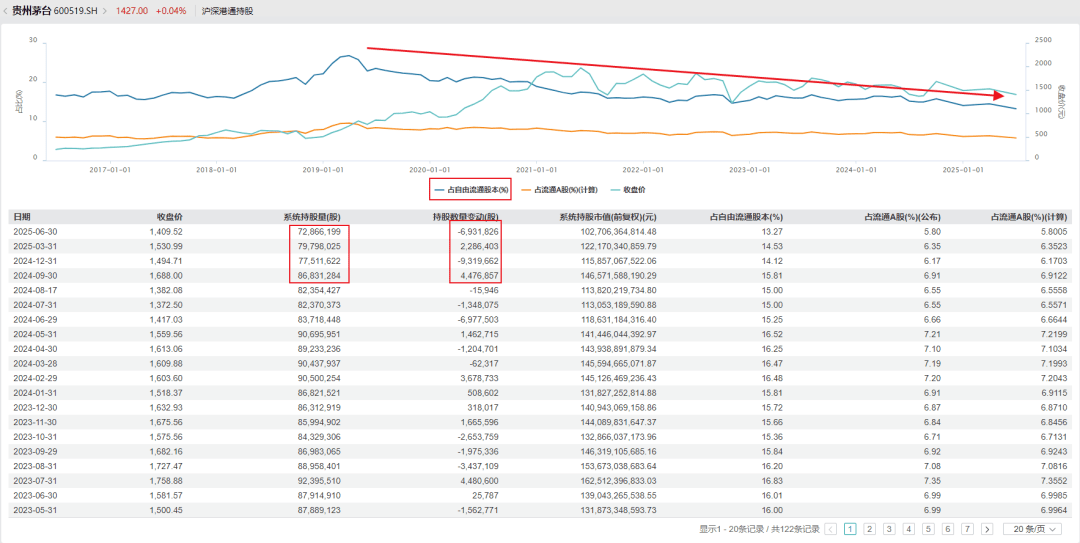
Group 1: Foreign Investment Trends in Baijiu Sector - Foreign investment in the baijiu sector has been decreasing, with Kweichow Moutai's foreign ownership dropping from 26% to nearly 13% over the past five years, representing a reduction of about 50% [1] - Other major baijiu companies have also seen significant reductions in foreign holdings, with Luzhou Laojiao decreasing from 8.1% to 4.5% (44% reduction), Yanghe from 27.4% to 3.5% (87% reduction), and Gujing Gong from 10.3% to 3.8% (63% reduction) [2] - Wuliangye has experienced a similar trend, with foreign ownership decreasing from 26% to approximately 7%, equating to a 73% reduction over the last five years [3] Group 2: Recent Performance and Forecasts - Recent quarterly data indicates that Kweichow Moutai had two quarters of net buying and two quarters of net selling, with total shares held decreasing from 87 million to 73 million, a 16% reduction over the past year [1] - Forecasts for the first half of 2025 suggest Kweichow Moutai will see a revenue growth of 9%, while Wuliangye is expected to grow by 1-2%, and Luzhou Laojiao is projected to decline by 6-10% [10] - Shanxi Fenjiu is an exception, with foreign holdings increasing from 36 million to 49 million shares over the past year, indicating a 36% increase in foreign investment [12] Group 3: Overall Industry Sentiment - The overall sentiment in the baijiu industry appears cautious, with many companies experiencing declines in foreign investment, suggesting that the industry's fundamentals may not have fully bottomed out [9] - The baijiu index has been one of the worst-performing indices this year, raising concerns about whether the actual earnings will meet broker expectations [10]



白酒,还能喝吗?
虎嗅APP· 2025-07-11 09:33
Core Viewpoint - The article discusses the transformation of the Chinese liquor market, particularly the shift from high-end baijiu to more accessible options, reflecting changing consumer preferences and social dynamics [3][4][5]. Group 1: Market Trends - The baijiu market has seen a significant shift from high-end products to more affordable options, with a growing preference for light and accessible "light bottle" baijiu [4][5]. - The high-end baijiu segment remains strong, but many non-leading brands have seen their prices drop significantly, leading to uncertainty in their value [4][5]. - Predictions indicate that by the second half of 2025, light bottle baijiu priced between 50-100 RMB and mid-range baijiu priced between 250-450 RMB will become the most popular segments [4]. Group 2: Consumer Preferences - There is a notable change in consumer behavior, with a focus on the enjoyment of baijiu itself rather than its status as a social currency, as seen in past business gatherings [3][4]. - Younger consumers are increasingly favoring lower-alcohol options and are less interested in high-end baijiu, leading to a shift in marketing strategies among liquor companies [10][11]. - The article highlights the emergence of new products targeting younger demographics, such as flavored and lower-alcohol baijiu, which align with contemporary lifestyle preferences [10][11]. Group 3: Regional Brands and Innovations - Regional brands like Mingguang liquor have shown impressive growth, with revenue projections increasing from under 300 million RMB in 2021 to over 1 billion RMB by 2024 following a merger [7][8]. - The article emphasizes the unique characteristics of certain regional liquors, such as Jinmen sorghum and Li Du sorghum, which cater to niche markets and have distinct flavor profiles [6][7]. - The article notes that many high-end brands struggle to penetrate lower-tier markets effectively, while regional brands excel in producing mid-range products that resonate well with local consumers [10].

高盛:中国白酒_ 政策风险延长周期,拐点尚不明朗;下调四只股票评级
Goldman Sachs· 2025-07-11 01:05
Investment Rating - The report downgrades four stocks: Fen Wine, Luzhou Laojiao, ZJLD to Neutral from Buy, and Anhui Gujing to Sell from Neutral, while maintaining Buy on Kweichow Moutai and Wuliangye [9][36]. Core Insights - The current cycle for the spirits industry is likely prolonged due to the impact of the new austerity policy, with uncertainties on when the cycle will bottom out [1][14]. - The report anticipates policy headwinds to persist from 2Q25 to 2Q26, followed by a modest impact in 2H26 as improper dining restrictions for civil servants normalize [2][14]. - The spirits industry is expected to see a decline in total addressable market (TAM) by 10% to 14% in 2025-27E, with a forecasted decline of over 6% in 2025 and a -2% decline in 2026 [2][14]. Summary by Sections Risk Profiling - A policy impact ranking analysis indicates that upper mid-end and commercial banquet-focused products will face greater pressure, while Moutai is expected to remain resilient due to its gifting demand and limited exposure to government-related banquet consumption [2][12]. Earnings and Valuation Analysis - The report projects +1%/+5% aggregated topline growth for 2025/26E, down from previous estimates of +6%/+9%, with high-end spirits expected to grow by +5%/+5% and upper-mid-high end spirits facing declines of -10%/+2% [2][14]. - A bear case analysis suggests potential earnings downside risks of 6% to 18% for most spirits names compared to the base case [2][14]. Industry Growth Forecast - The spirits industry growth forecast has been revised down to a greater than 6% decline in 2025 and a -2% decline in 2026, compared to prior forecasts of +4%/+3% growth [2][14]. - The report highlights that the spirits industry has been consolidating, with leading players gaining market share, particularly in the super premium segment [2][25]. Company-Specific Insights - Moutai's wholesale price stability is supported by various measures, and the report suggests that a price below RMB 1,800 could hurt distributor profits, leading to market volatility [8][14]. - The report revises down sales and net profit estimates for various companies, including a 1% to 19% reduction for most names, reflecting the impact of the new policy [36][37].
食品饮料周报:白酒消费场景仍有压力,乳制品关注育儿补贴政策催化-20250710
Tianfeng Securities· 2025-07-10 13:44
Investment Rating - Industry rating is maintained at "Outperform" [6] Core Insights - The liquor sector is experiencing pressure from graduation banquets, but the stabilization of Moutai prices may boost confidence [2][13] - The approval of D-allohexose and the implementation of childcare subsidies are key investment opportunities in the consumer goods sector [4][15] Summary by Sections Market Performance Review - From June 30 to July 4, the food and beverage sector increased by 0.62%, while the Shanghai and Shenzhen 300 index rose by 1.54% [1][24] - Specific segments include meat products (+1.22%), liquor III (+1.20%), baked goods (+0.92%), and beverages (-1.64%) [1][24] Liquor Sector Insights - The liquor sector saw a 1.20% increase, outperforming the overall food and beverage industry but underperforming the Shanghai and Shenzhen 300 index [2][13] - The price of 25-year Moutai (original) is 1935 yuan, up by 65 yuan from the previous week, indicating a potential recovery in industry confidence [2][13] Consumer Goods Sector Insights - The approval of new food raw materials and the rollout of childcare subsidies are expected to catalyze growth in the health products, soft drinks, snacks, and dairy sectors [4][15] - The childcare subsidy program provides 3600 yuan per child annually, which may positively impact the dairy sector [4][15] Investment Recommendations - For the liquor sector, focus on companies benefiting from concentration and strong alpha, such as Shanxi Fenjiu and Guizhou Moutai [5][22] - In the consumer goods sector, recommend companies that align with cost reduction and market share growth strategies, including Lihigh Food and Dongpeng Beverage [5][22]

白酒再“降度” 年轻人会为“微醺”买单吗?
Sou Hu Cai Jing· 2025-07-10 09:55
Core Viewpoint - The low-alcohol liquor segment is gaining significant attention in the Chinese market, with major liquor companies like Wuliangye, Luzhou Laojiao, Yanghe, and Shui Jing Fang announcing plans to launch low-alcohol products, reflecting a shift in consumer preferences and market dynamics [1][2][6]. Group 1: Industry Trends - Major liquor companies are responding to the trend of low-alcohol beverages, with Wuliangye set to launch a 29-degree product and Luzhou Laojiao developing a 28-degree variant of its popular offerings [2][6]. - Yanghe is targeting younger consumers with a range of low-alcohol products, including fashionable white liquor (33.8 degrees) and fruit wines (15-28 degrees), indicating a strategic shift towards appealing to a younger demographic [2][5]. - The market is witnessing a transformation in consumption patterns, with younger consumers favoring personalized, low-alcohol, and social drinking experiences, leading to a decline in traditional high-alcohol consumption [7][9]. Group 2: Historical Context - The concept of low-alcohol liquor has been explored for years, with the China Alcoholic Drinks Association advocating for lower alcohol content since around 2017, and companies like Wuliangye and Yanghe having initiated low-alcohol product development as early as the 1970s and 2014, respectively [5][6]. - Wuliangye has a long history of low-alcohol product development, having successfully created various low-alcohol variants since the late 20th century, positioning itself as a pioneer in this segment [5][6]. Group 3: Market Challenges - The low-alcohol liquor segment faces challenges such as maintaining flavor saturation and product shelf life, as the dilution process can lead to a loss of aroma and taste [10][11]. - Analysts highlight that while low-alcohol products are gaining traction, the primary consumer base for traditional liquor remains older demographics, who may not find low-alcohol options satisfying [10][11].

食品饮料行业2025年度中期投资策略:中流击水,革故鼎新
Changjiang Securities· 2025-07-10 05:04
Overview - The food and beverage industry is currently facing a dual impact of oversupply and insufficient demand, leading to a restructuring of the overall pricing and competitive landscape [3][6][21] - Despite the pressure on prices and downward revisions of profit growth expectations in some sectors, the intense competition is driving innovation and reform, resulting in new business models and investment opportunities [3][6][21] Baijiu Industry - Since 2025, profound changes have occurred on both the supply and demand sides of the baijiu industry, with a coexistence of consumption upgrades and downgrades [7][22] - Some mid-range baijiu brands are under pressure, while certain local brands continue to grow rapidly, indicating a shift in consumer preferences [22][30] - Baijiu companies have proactively adjusted their supply strategies, leading to a significant slowdown in revenue growth to match demand changes [22][23] - The industry is undergoing a transformation in product and pricing strategies, suggesting a cyclical change, with recommendations to focus on companies with balanced product structures and healthy inventories [22][32] Consumer Goods - The consumer goods sector is entering a new phase where channel efficiency is paramount, driven by the rise of new retail formats such as discount stores and membership supermarkets [8][36] - New business models are disrupting traditional channel barriers and providing better value-for-money options, leading to structural growth opportunities [8][36][37] - The focus for investment should be on channel enterprises and related manufacturing companies, as new retail formats continue to gain traction [8][37] - The market for snacks and beverages is expanding rapidly, with the retail value in the lower-tier markets reaching 2.3 trillion yuan in 2024 [52][56] New Product Trends - There is still room for innovation in certain niche markets, with segments like leisure konjac products experiencing rapid growth [9][70] - The demand for high-quality products remains strong, with a significant portion of consumers willing to pay more for better quality [42][43] Market Structure - The industry is witnessing a consolidation phase, particularly in sectors like dairy, beer, and yeast, where competition intensity is decreasing and leading brands are gaining long-term competitive advantages [10][36] - Traditional sectors like yellow wine are also stabilizing, with improved profitability and potential for revaluation as market dynamics shift [10][36] Retail Channel Dynamics - The rise of membership supermarkets and discount retail channels is reshaping consumer purchasing behavior, with a notable increase in the number of snack retail outlets [48][56] - Companies like Youyou Foods and Lihigh Foods are effectively leveraging these new channels to drive growth and improve profitability [48][70]
