Shanxi Xinghuacun Fen Wine Factory (600809)

Search documents
金十图示:2025年07月18日(周五)富时中国A50指数成分股今日收盘行情一览:银行、保险、酿酒等多数板块全天保持强劲,消费电子板块表现不佳
news flash· 2025-07-18 07:03
Market Overview - The FTSE China A50 Index components showed strong performance in sectors such as banking, insurance, and liquor, while the consumer electronics sector underperformed [1][6]. Banking Sector - Everbright Bank had a market capitalization of 254.068 billion with a trading volume of 609 million, closing at 4.30, up by 0.03 (+0.70%) [3]. Insurance Sector - China Ping An and China Life Insurance had market capitalizations of 1,039.258 billion and 356.818 billion respectively, with trading volumes of 24.93 billion and 6.12 billion. Their stock prices increased by 0.42 (+1.15%) and 0.03 (+0.36%) [3]. Liquor Industry - Kweichow Moutai, Shanxi Fenjiu, and Wuliangye had market capitalizations of 1,805.156 billion, 220.936 billion, and 480.465 billion respectively. Their trading volumes were 59.85 billion, 25.98 billion, and 30.62 billion, with stock price increases of 5.03 (+2.86%), 20.65 (+1.46%), and 1.13 (+0.92%) [3]. Semiconductor Sector - Northern Huachuang, Cambricon Technologies, and Hygon had market capitalizations of 234.658 billion, 243.739 billion, and 318.365 billion respectively. Their trading volumes were 26.40 billion, 29.85 billion, and 16.55 billion, with stock price changes of +6.59 (+2.07%), -1.03 (-0.75%), and +0.22 (+0.04%) [3]. Oil Industry - Sinopec and PetroChina had market capitalizations of 271.538 billion and 705.647 billion respectively, with trading volumes of 8.53 billion and 6.48 billion. Their stock prices increased by 0.09 (+1.57%) and remained unchanged [3]. Coal Industry - China Shenhua and Shaanxi Coal and Chemical Industry had market capitalizations of 743.083 billion and 185.562 billion respectively, with trading volumes of 7.78 billion and 9.61 billion, with stock price increases of 0.27 (+0.73%) and 0.17 (+0.90%) [3]. Automotive Sector - BYD had a market capitalization of 1,808.349 billion with a trading volume of 44.82 billion, closing at 329.11, up by 1.09 (+0.33%) [3]. Shipping and Port Sector - No specific data provided for this sector in the document [4]. Power Industry - No specific data provided for this sector in the document [4]. Securities Sector - CITIC Securities had a market capitalization of 420.014 billion with a trading volume of 18.87 billion, closing at 28.34, up by 0.09 (+0.32%) [4]. Battery Sector - CATL had a market capitalization of 1,236.485 billion with a trading volume of 59.82 billion, closing at 271.20, up by 5.70 (+2.15%) [4]. Consumer Electronics - Industrial Fulian and Luxshare Precision had market capitalizations of 538.390 billion and 280.871 billion respectively, with trading volumes of 35.27 billion and 53.15 billion, with stock price decreases of -0.39 (-1.42%) and -0.67 (-1.70%) [4]. Home Appliances - Haidilao and Gree Electric Appliances had market capitalizations of 268.195 billion and 241.985 billion respectively, with trading volumes of 10.06 billion and 8.44 billion, with stock price changes of +0.32 (+0.67%) and -0.02 (-0.08%) [4]. Chemical and Pharmaceutical Sector - Hengrui Medicine had a market capitalization of 251.506 billion with a trading volume of 38.81 billion, closing at 47.71, up by 1.35 (+2.91%) [4]. Logistics Sector - SF Holding had a market capitalization of 241.541 billion with a trading volume of 11.63 billion, closing at 46.04, up by 0.76 (+1.68%) [4]. Non-ferrous Metals - Mindray Medical had a market capitalization of 273.187 billion with a trading volume of 25.08 billion, closing at 225.32, up by 8.14 (+3.75%) [4].








中国烈酒品牌霸榜前四!吃喝板块强势拉升,食品ETF(515710)上探1.16%!
Xin Lang Ji Jin· 2025-07-18 05:42
Group 1 - The food and beverage sector is performing well, with leading liquor stocks showing significant gains, such as Luzhou Laojiao rising over 3% and Yanghe Co. increasing over 2% [1] - The Food ETF (515710) reached a maximum intraday price increase of 1.16%, closing up 0.83% [1][3] - A report from Brand Finance revealed that six Chinese liquor brands made it to the top ten of the world's most valuable liquor brands, with Moutai, Wuliangye, Luzhou Laojiao, and Fenjiu ranking among the top four [1] Group 2 - The current valuation of the food and beverage sector is favorable, with the food ETF's price-to-earnings ratio at 20.01, which is at a low point compared to the past decade [3] - The food and beverage sector is expected to see improved demand as national economic stimulus policies take effect, leading to a potential recovery in the sector's overall performance [4] - By 2025, revenue growth for food and beverage listed companies is anticipated to remain in single digits, slightly above the industry average, with a friendly cost environment supporting profit margins [4][5] Group 3 - The Food ETF (515710) tracks the CSI segmented food and beverage industry theme index, with approximately 60% of its holdings in high-end and mid-range liquor stocks [5] - The top ten weighted stocks in the ETF include leading brands such as Moutai, Wuliangye, Luzhou Laojiao, and Yili [5]





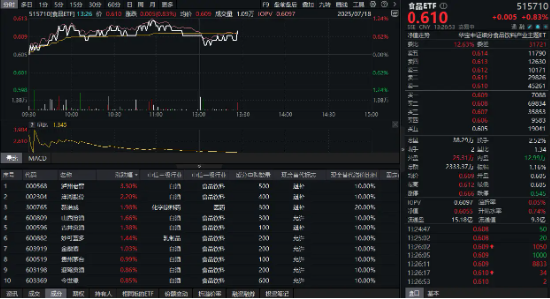
金十图示:2025年07月18日(周五)富时中国A50指数成分股午盘收盘行情一览:多数板块飘红,消费电子、互联网服务板块下跌
news flash· 2025-07-18 03:33
Group 1: Market Overview - The FTSE China A50 Index components showed a mixed performance with most sectors in the green, while the consumer electronics and internet services sectors experienced declines [1][6]. Group 2: Sector Performance - The banking sector, represented by Everbright Bank, had a market capitalization of 255.25 billion with a trading volume of 392 million, showing a slight increase of 1.17% [3]. - In the liquor industry, Kweichow Moutai led with a market cap of 1,797.53 billion and a trading volume of 3.923 billion, increasing by 1.37% [3]. - The semiconductor sector saw Northern Huachuang with a market cap of 233.94 billion and a trading volume of 1.908 billion, rising by 1.76% [3]. - In the oil sector, Sinopec had a market cap of 703.22 billion with a trading volume of 552 million, increasing by 1.22% [3]. - The coal industry was represented by China Shenhua with a market cap of 743.88 billion and a trading volume of 709 million, rising by 0.83% [3]. - In the automotive sector, BYD had a market cap of 1,793.90 billion with a trading volume of 516 million, but saw a decrease of 0.47% [3]. - The battery sector was led by CATL with a market cap of 4,189.77 billion and a trading volume of 1.153 billion, increasing by 0.88% [4]. - The consumer electronics sector, represented by Hon Hai Precision, had a market cap of 540.97 billion with a trading volume of 2.376 billion, decreasing by 0.74% [4]. - In the home appliance sector, Gree Electric had a market cap of 267.47 billion with a trading volume of 446 million, showing a slight decrease of 0.31% [4]. - The pharmaceutical sector was led by Hengrui Medicine with a market cap of 387.15 billion and a trading volume of 2.654 billion, increasing by 2.36% [4]. - The logistics sector, represented by SF Holding, had a market cap of 240.58 billion with a trading volume of 737 million, increasing by 1.04% [4].







相继入局低度白酒赛道 低度酒能否成为头部酒企穿越周期的良药?
Sou Hu Cai Jing· 2025-07-17 10:54
Core Viewpoint - The Chinese liquor industry is facing challenges such as shrinking competition, declining prices, and increasing inventory pressure, prompting leading liquor companies to enter the low-alcohol liquor market to seek growth opportunities [2][6]. Group 1: Industry Trends - Major liquor companies like Wuliangye, Luzhou Laojiao, and Jiugui Liquor are actively discussing the trend towards low-alcohol products during their annual shareholder meetings [2][3]. - The low-alcohol liquor segment is expected to become a new growth area for leading liquor companies, as they adapt to the younger consumer demographic and the trend of lower alcohol content [2][3][6]. Group 2: Company Strategies - Wuliangye plans to reintroduce a 29-degree liquor product after 20 years, with market research already underway for three different flavors, expected to launch in September [3][5]. - Luzhou Laojiao has successfully developed a 28-degree product and is testing even lower alcohol content options [3][5]. - Other companies like Moutai, Shanxi Fenjiu, and Yanghe are also increasing their focus on low-alcohol products, with various new offerings in development [3][5]. Group 3: Market Dynamics - The low-alcohol segment is seen as a potential second growth curve for some liquor companies, with Luzhou Laojiao reporting that the proportion of low-alcohol products in their portfolio has increased from 15% to around 50% [6][8]. - The overall revenue growth for liquor companies has been declining, with only two out of twenty companies achieving double-digit revenue growth in the first quarter of 2025 [6][7]. Group 4: Historical Context - The low-alcohol trend in the Chinese liquor market has historical precedents, with previous waves of low-alcohol product launches occurring in the 1970s and 1980s, but the market has predominantly favored high-alcohol products [8][9][10]. - The introduction of low-alcohol products has often faced challenges, as seen in past attempts where many low-alcohol offerings did not meet market expectations and were eventually discontinued [9][11]. Group 5: Consumer Preferences - A survey indicated that among young consumers aged 25 to 35, only 19% prefer traditional liquor, while 52% favor beer, highlighting the need for liquor companies to adapt to changing consumer preferences [3][6]. - The pricing strategy for low-alcohol products is critical, as companies must balance affordability for younger consumers with maintaining a premium brand image [13][15].


29度五粮液、28度国窖1573……头部酒企为何集体“降度”?
Sou Hu Cai Jing· 2025-07-16 09:08
Core Viewpoint - The low-alcohol liquor market is experiencing a resurgence after nearly 30 years of dormancy, with major companies like Kweichow Moutai, Wuliangye, Luzhou Laojiao, and Yanghe actively entering this segment to attract younger consumers [3][4][6]. Group 1: Market Trends - The market share of low-alcohol liquor has been rapidly increasing, with its production accounting for approximately 15% in 2022 and projected to exceed 25% by 2024 [3]. - Some companies report that low-alcohol products have captured over 50% of their regional market share, indicating a significant shift in consumer preferences towards younger demographics [3][4]. - The demand for low-alcohol liquor is driven by changing consumer habits, with lower alcohol content products showing better sales performance compared to traditional high-alcohol options [4][19]. Group 2: Company Strategies - Wuliangye plans to launch a new mid-to-high-end 29-degree product named "Yijian Qingxin" in September, while Yanghe will introduce fruit wines and low-alcohol trendy drinks in August and September [6][9]. - Luzhou Laojiao has successfully developed a 28-degree version of its flagship product, Guojiao 1573, and will introduce additional low-alcohol options [6][8]. - Guizhou Moutai is accelerating its low-alcohol beverage brand, Youmi, with 14 new products launched at a recent trade fair and plans for online and offline distribution [13]. Group 3: Industry Challenges - The low-alcohol liquor segment faces challenges such as maintaining flavor balance and quality control, as reducing alcohol content can disrupt the equilibrium of flavor compounds [16]. - There is a risk of market homogenization, with many brands adopting similar "fruit flavor + bubbles" formulas, which may lead to consumer fatigue and a lack of brand loyalty [16][19]. - The industry must focus on technological innovation and cultural engagement to ensure sustainable growth and avoid being trapped in a highly competitive market [19].

青花汾酒入驻克里姆林宫,中国汾酒对话俄罗斯伏特加
Qi Lu Wan Bao· 2025-07-16 07:14
Core Viewpoint - The "2025 Qinghua Fenjiu Tea Road Wine Aroma" brand event in Moscow marks a significant step in promoting Chinese liquor culture and enhancing Sino-Russian cultural exchanges through the introduction of Qinghua Fenjiu to the Kremlin Museum [1][2]. Group 1: Event Highlights - The event included a forum titled "Dialogue between Chinese Fenjiu and Russian Vodka," which facilitated discussions on cultural heritage and industry collaboration between China and Russia [8][9]. - A collection ceremony took place where the Shanxi Xinghuacun Fenjiu Group officially transferred Qinghua Fenjiu to the Kremlin Museum, symbolizing a historical connection to the ancient Tea Road [2][4]. - The event featured a promotional night for Qinghua Fenjiu, held in the historic Red Hall of the Metropol Hotel, where over 50 Russian liquor companies and media representatives participated [11]. Group 2: Cultural Significance - Qinghua Fenjiu, with a brewing history of 6,000 years and a reputation as the ancestor of Chinese light-flavor liquor, aims to use this event to promote the living heritage of Chinese agricultural civilization in Russia [4][6]. - The event is seen as a continuation of the historical trade routes established by Jin merchants, who transported tea and liquor to Europe 300 years ago, thus reinforcing cultural ties [2][13]. - The opening of the first "Qinghua Fenjiu Moscow Specialty Store" represents a milestone in the internationalization of Fenjiu, further embedding it in the global market [14]. Group 3: Future Prospects - The event is part of a broader initiative that began in Wuyi Mountain, China, and will continue to various locations in Russia, emphasizing the ongoing cultural journey and the brand's commitment to global integration [13]. - The collaboration between Fenjiu and Russian partners is expected to foster deeper cultural exchanges and enhance the international presence of Chinese liquor [9][12].

6月社零增速环比放缓,内需消费仍待提振
KAIYUAN SECURITIES· 2025-07-16 06:16
Investment Rating - The industry investment rating is "Overweight" [1] Core Viewpoints - The report highlights that the food and beverage sector is expected to benefit from potential domestic policy adjustments and a recovery in consumer demand in the second half of the year [3][4] - The report suggests strategic positioning in leading liquor companies due to their low valuation and favorable market conditions [3][6] - The snack food segment shows strong growth potential, driven by product innovation and emerging sales channels [6] Summary by Sections Industry Overview - The food and beverage sector is currently experiencing a slowdown in retail sales growth, with June 2025 retail sales increasing by 4.8% year-on-year, a decrease of 1.6 percentage points from May [4][8] - The report notes that the decline in consumer spending on dining and discretionary items has impacted overall sales performance [4][5] Liquor Sector - The liquor industry is in a bottoming phase, with consumption scenarios limited by recent policy changes and promotional activities affecting pricing [6] - The report recommends focusing on top liquor brands such as Kweichow Moutai, Luzhou Laojiao, and Shanxi Fenjiu for potential investment opportunities [3][6] Snack Food Sector - The snack food segment, particularly products like konjac, is experiencing robust growth due to health trends and diverse flavor offerings [6] - The report emphasizes the importance of identifying quality companies in the snack food sector that align with industry development trends for long-term investment [3][6]


食品饮料行业主题报告
2025-07-16 06:13
Summary of Conference Call Notes Industry Overview - The report focuses on the food and beverage industry, analyzing new consumer demands, products, and channels [1][2][3]. Key Points and Arguments New Consumer Demands - The emerging consumer base primarily consists of Generation Z (post-1995), characterized by a heightened self-awareness and faster development compared to previous generations [1]. - Government policies aimed at boosting consumption have been introduced, including the "Special Action Plan to Boost Consumption" and "Consumer Service System Benefit Action 2025" [2]. - Consumer behavior is diversifying, with Generation Z and affluent groups showing more optimistic consumption attitudes, while middle-class and rural older consumers exhibit weaker consumption willingness [3]. Changes in Consumption Patterns - There is a notable shift towards value-for-money products, with consumers increasingly prioritizing cost-effectiveness [4]. - The market has identified four potential growth categories: education, food and beverages, health products, and travel, while three risk categories include home appliances, tobacco, and certain consumables [3]. - The health consciousness among consumers is rising, leading to increased demand for health-related products, with the health food market projected to reach 836.2 billion by 2027, reflecting a 42% growth from 2022 [5]. Innovations in Products and Channels - Companies are innovating to meet health demands, introducing products like konjac, seaweed, and quail eggs [6]. - The focus on cost-effectiveness has led to supply chain optimization, reducing intermediaries to lower prices for consumers [7]. - The beverage market is witnessing significant growth in sugar-free teas and plant-based drinks, with growth rates of 19% and 32% respectively [8]. New Sales Channels - The rise of temporary retail channels has transformed the market, with the temporary retail industry expected to grow from 211 billion in 2019 to 1.5 trillion by 2027 [12]. - Membership warehouse stores are gaining traction, with the market size increasing from 20 billion in 2012 to 36.4 billion in 2023 [14]. - Online sales are rapidly growing, with a 56% year-on-year increase in online sales across nine categories, surpassing 120 billion in 2023 [18]. Recommendations and Risks - The report suggests focusing on new products, channels, and consumer demands as key investment themes, maintaining a strong rating for the food and beverage industry [20]. - Specific recommendations include companies like Three Squirrels, Yili, and Qingdao Beer, while highlighting the potential for profitability recovery in dairy and seasoning sectors [21][22]. - Risks include raw material price fluctuations and intensified industry competition [23]. Additional Important Insights - The emotional value of consumption is increasing, with service-related spending rising from 43% in 2020 to 46% in 2024 [5]. - The shift in consumer purchasing habits is leading to a more significant online presence for traditional products, including liquor, which is becoming a focus for major brands [17].



一瓶几十元,白酒巨头狂卷光瓶酒
Xin Lang Cai Jing· 2025-07-16 05:50
Group 1 - The core viewpoint of the article highlights the growing popularity of low-priced "light bottle" liquor in the Chinese market, as high-end liquor brands struggle with price declines and sales challenges [1][14][16] - Major liquor companies are launching new products in the light bottle segment, with notable examples including Yanghe's "Yanghe Daqu High Line Light Bottle Liquor" priced at 59 yuan, which sold over 10,000 bottles in 48 hours [1][4] - The light bottle liquor market has reached a scale of approximately 1.5 trillion yuan in 2024, with continued growth expected in 2025, making it one of the most dynamic segments in the liquor industry [3][10] Group 2 - Consumer behavior is shifting towards more rational choices, with a significant portion of consumers prioritizing cost-effectiveness and practicality in their liquor purchases [10][11] - The traditional light bottle liquor market, represented by brands like Niulanshan and Baijiu, has established a strong presence, while new entrants are emerging to capture market share amid changing consumer preferences [7][9] - The competitive landscape is intensifying as more companies enter the light bottle segment, leading to concerns about market saturation and the ability to maintain quality and differentiation [17][18] Group 3 - The high-end liquor market, particularly brands priced above 1,000 yuan, is experiencing significant price declines, with major brands like Moutai and Wuliangye seeing their market prices drop below their official guidance prices [16][17] - The shift towards light bottle liquor reflects a broader trend in the industry where companies are adapting to consumer demands and seeking new growth opportunities in a challenging market environment [15][17] - The light bottle segment is increasingly viewed as a mainstream choice, moving away from its previous perception as a low-end product, and is now seen as a potential growth engine for liquor companies [17][18]



经导调查|降“度”抢市场!低度酒能否撑起白酒未来?
Da Zhong Ri Bao· 2025-07-16 04:35
Core Viewpoint - The low-alcohol liquor market in China has seen a resurgence after nearly 30 years of dormancy, with major companies like Kweichow Moutai, Wuliangye, Luzhou Laojiao, and others actively entering this segment to attract younger consumers [1][2][4]. Industry Trends - The market share of low-alcohol liquor has been rapidly increasing, with its production accounting for approximately 15% in 2022 and projected to exceed 25% by 2024 [1][2]. - Companies are launching new products with lower alcohol content to cater to changing consumer preferences, such as Wuliangye's 29-degree "Yi Jian Qing Xin" and Luzhou Laojiao's 28-degree Guojiao 1573 [4][10]. Consumer Preferences - There is a growing preference among consumers for low-alcohol liquor, which is perceived to have better sales performance compared to high-alcohol liquor, especially in daily consumption scenarios [2][11]. - The trend towards low-alcohol products is seen as a response to the demand for healthier drinking options and a younger demographic [6][16]. Product Innovation - Companies are focusing on product innovation to meet the demand for low-alcohol and flavored beverages, with strategies including the introduction of fruit-flavored and sparkling options [1][10]. - The industry is facing challenges in maintaining the quality and taste of low-alcohol products, as the reduction in alcohol content can affect the balance of flavors [13][16]. Market Dynamics - The low-alcohol liquor market is experiencing significant growth in regions like Guangdong and Jiangsu, while other areas such as Shandong and Henan require further development [16]. - The competition in the low-alcohol segment is intensifying, with many brands adopting similar flavor profiles, leading to concerns about market saturation and differentiation [13][16].