GUJING(000596)

Search documents
酒价内参1月9日价格发布 市场普遍反弹整体价格温和回升
Xin Lang Cai Jing· 2026-01-09 00:57
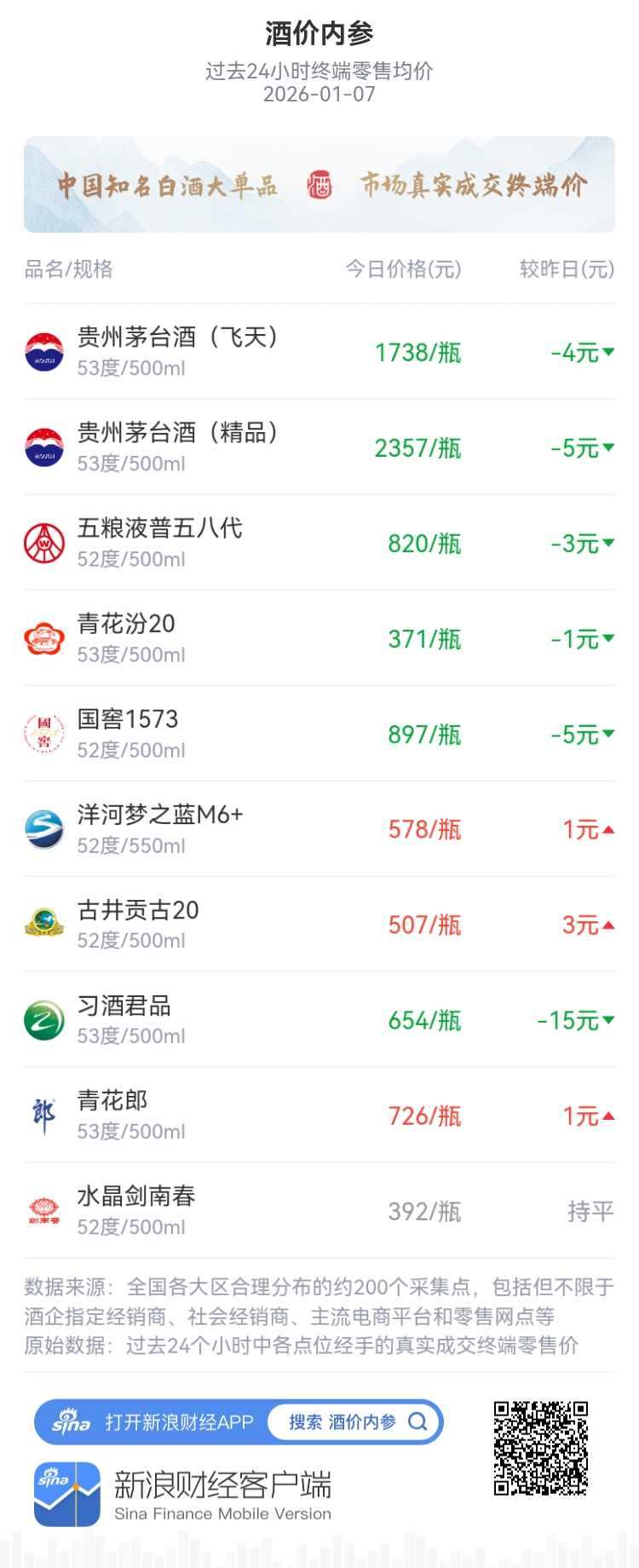
Core Viewpoint - The Chinese liquor market has experienced a rebound in retail prices for the top ten products after a period of decline, indicating a stabilization in market sentiment and pricing recovery [1]. Price Trends - The overall retail price for a bundled package of the top ten liquor products is 8998 yuan, reflecting an increase of 16 yuan from the previous day [1]. - Most products have shown signs of stabilization after reaching temporary low points, with a general upward trend in prices observed [1]. Notable Price Increases - Wuliangye Pu Wubai (五粮液普五八代) saw the most significant price increase, rising by 8 yuan per bottle [1][3]. - Guojiao 1573 (国窖1573) increased by 7 yuan per bottle [1][3]. - Both Guqingong 20 (古井贡古20) and Xijiu Junpin (习酒君品) rose by 6 yuan per bottle [1][4]. - Qinghua Fen 20 (青花汾20) increased by 3 yuan per bottle, while Yanghe Dream Blue M6+ (洋河梦之蓝M6+) saw a slight increase of 1 yuan per bottle, marking five consecutive days of price increases [1][4]. Price Decreases - Feitian Moutai (飞天茅台) experienced a decrease of 7 yuan per bottle [1][3]. - Premium Moutai (精品茅台) dropped by 670 yuan per bottle, indicating a significant decline [3]. - Qinghua Lang (青花郎) fell by 2 yuan per bottle [1][4]. Market Sentiment - The overall market is showing a rebound with most brands experiencing price recovery and moderate volume increases, suggesting a calming of market sentiment compared to previous days [1].







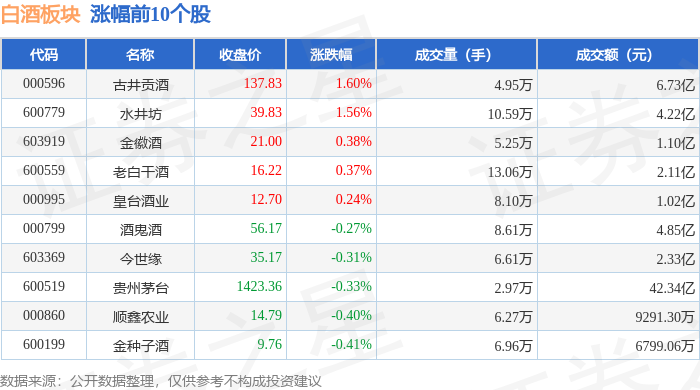
白酒板块1月8日跌0.64%,古井贡酒领跌,主力资金净流出6.98亿元
Zheng Xing Xing Ye Ri Bao· 2026-01-08 08:51
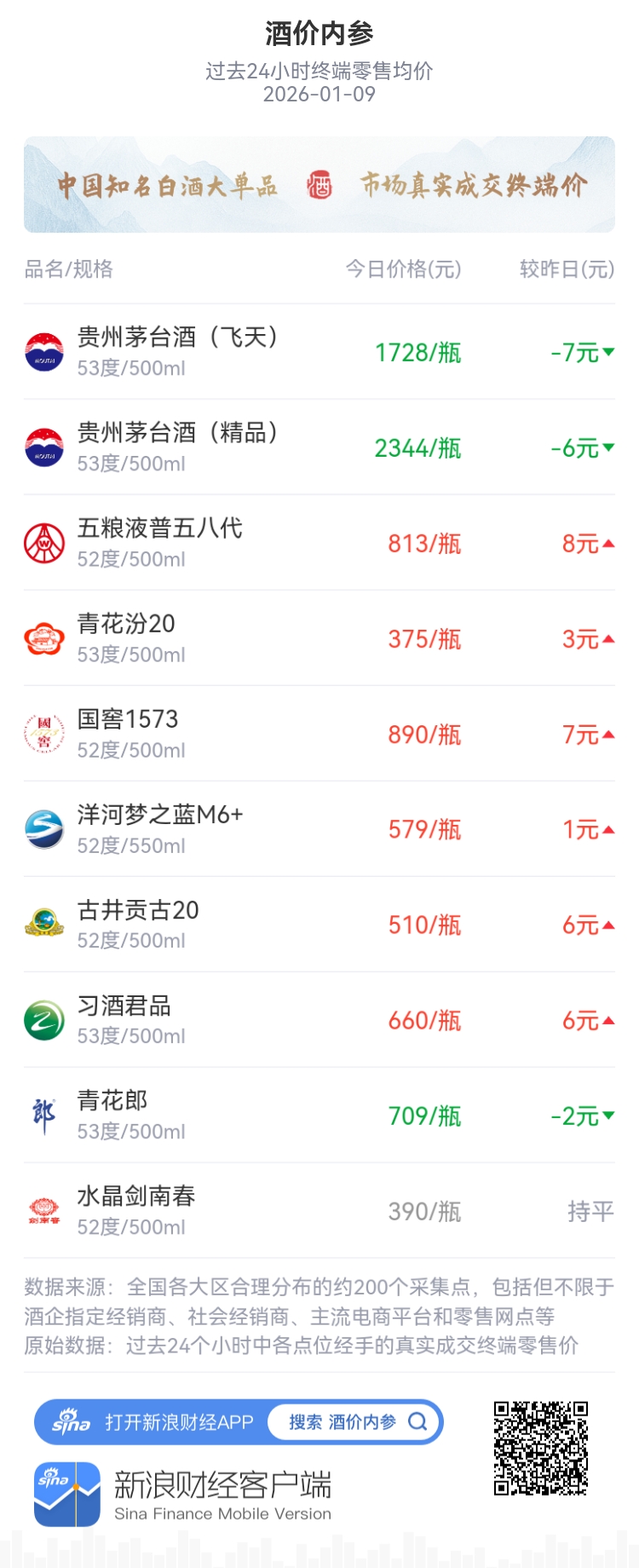
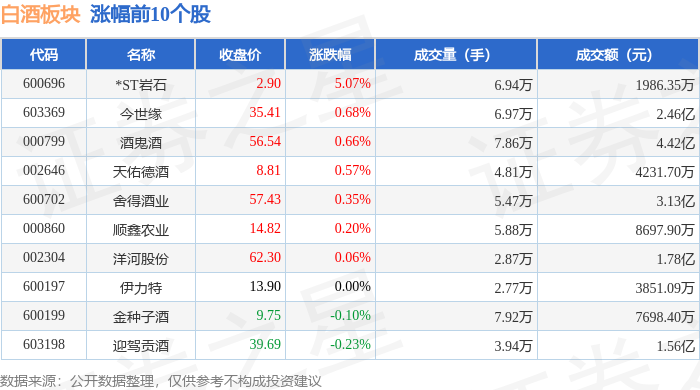
证券之星消息,1月8日白酒板块较上一交易日下跌0.64%,古井贡酒领跌。当日上证指数报收于 4082.98,下跌0.07%。深证成指报收于13959.48,下跌0.51%。白酒板块个股涨跌见下表: | 代码 | 名称 | 主力净流入(元) | 主力净占比 游资净流入 (元) | | 游资净占比 散户净流入 (元) | | 散户净占比 | | --- | --- | --- | --- | --- | --- | --- | --- | | 600696 | *ST岩石 | = 477.49万 | 24.04% | -9.06万 | -0.46% | -468.43万 | -23.58% | | 002646 天佑德酒 | | 70.31万 | 1.66% | -338.89万 | -8.01% | 268.58万 | 6.35% | | 600197 | 伊力特 | -162.35万 | -4.22% | -364.81万 | -9.47% | 527.16万 | 13.69% | | 603369 | 今世缘 | -204.99万 | -0.83% | 587.93万 | 2.39% | -382.94万 ...
预见2026|白酒经历更艰难一年后,消费者和场景重构刚刚开始
Di Yi Cai Jing Zi Xun· 2026-01-08 08:13
Core Insights - The white liquor industry is experiencing a significant downturn, with 2025 being particularly challenging due to rational consumption and ongoing anti-corruption efforts, prompting companies to reassess their market strategies [1][4] Group 1: Market Conditions - Many liquor businesses, including those in Tianjin, reported losses in 2025, with sales figures dropping significantly compared to previous years, indicating a severe market contraction [2][4] - The average retail price of major liquor brands has decreased by 30% in 2025, with 99% of premium liquor prices falling [3][4] - The industry is facing a deep adjustment period, with many companies experiencing double-digit declines in revenue and net profit in the third quarter of 2025 [4] Group 2: Changes in Business Strategy - Liquor companies are shifting their focus from traditional sales models to consumer-centric approaches, emphasizing supply-demand matching and price balance [6][8] - There is a notable trend of companies avoiding long-term contracts with suppliers to mitigate financial risks associated with unsold inventory [3][4] - New growth models are emerging, with companies like Moutai and Fenjiu focusing on consumer engagement and exploring new consumption scenarios [6][7] Group 3: Consumer Behavior and Preferences - The demand for liquor is declining, particularly in corporate gifting and festive occasions, leading to increased competition and pressure on distributors [3][5] - The industry is witnessing a shift towards lower-alcohol products and innovative offerings to attract younger consumers and diversify market reach [7][8] - The implementation of new regulations against wasteful consumption has further altered drinking scenarios, compelling companies to adapt their strategies [7][8]


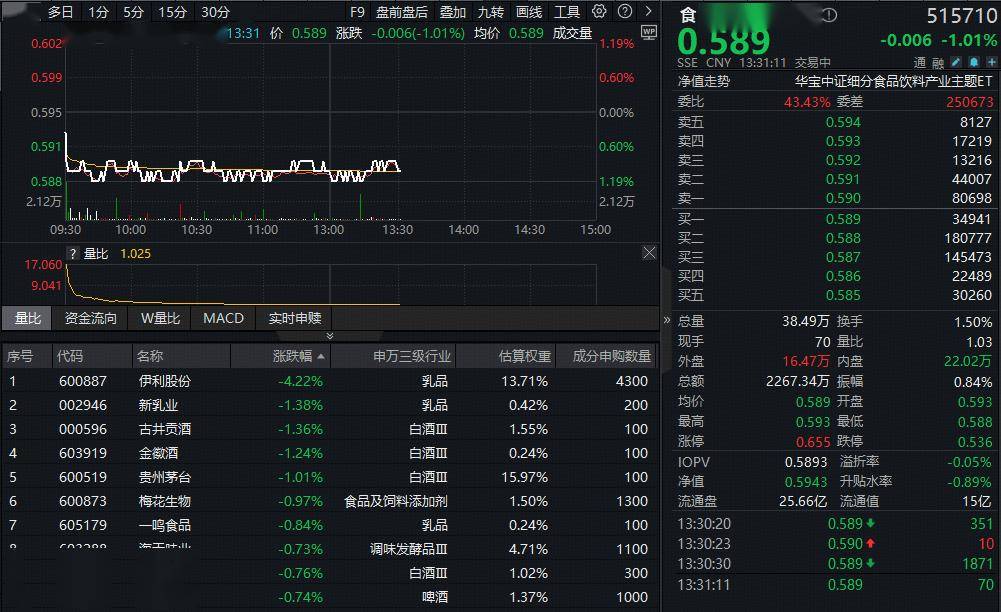
ETF盘中资讯|白酒龙头重挫!吃喝板块全线回调,食品饮料ETF华宝(515710)跌超1%!机构:白酒基本面接近底部
Sou Hu Cai Jing· 2026-01-08 06:01
Group 1 - The food and beverage sector is experiencing a downturn, with the Huabao Food and Beverage ETF (515710) showing a decline of 1.01% as of the latest report [1] - Major stocks in the sector, particularly leading liquor and dairy companies, are facing significant drops, with Yili Co. falling over 4% and other companies like Kweichow Moutai and Gujing Gongjiu also declining [1] - The current consumption industry is entering a strategic opportunity period supported by policies, with a focus on domestic demand as a core economic task, which is expected to benefit the food and beverage sector [1][3] Group 2 - Pacific Securities notes that upcoming policies aimed at boosting domestic demand are anticipated to improve consumption, particularly in high-end luxury goods, which may positively impact the broader consumer market [3] - The food and beverage sector's valuation is at a historical low, with the Huabao ETF's underlying index PE ratio at 20.27 times, indicating a favorable entry point for long-term investments [3] - The liquor industry is nearing a bottom in its fundamentals, with major companies like Moutai and Wuliangye implementing market-driven adjustments, suggesting potential for recovery in sales during the 2026 Spring Festival [3][4] Group 3 - Citic Construction points out that some food and beverage stocks are expected to exceed performance expectations due to their differentiated advantages, despite a temporary slowdown in revenue growth [4] - The liquor sector is seeing major companies managing inventory and optimizing channel structures, which may lead to improved profitability despite short-term challenges [4] - The Huabao Food and Beverage ETF is heavily weighted towards leading high-end liquor stocks and also includes significant positions in dairy and beverage companies, making it a key asset for investors in the sector [4]

酒价内参1月8日价格发布 青花郎环比下跌15元/瓶
Xin Lang Cai Jing· 2026-01-08 01:25
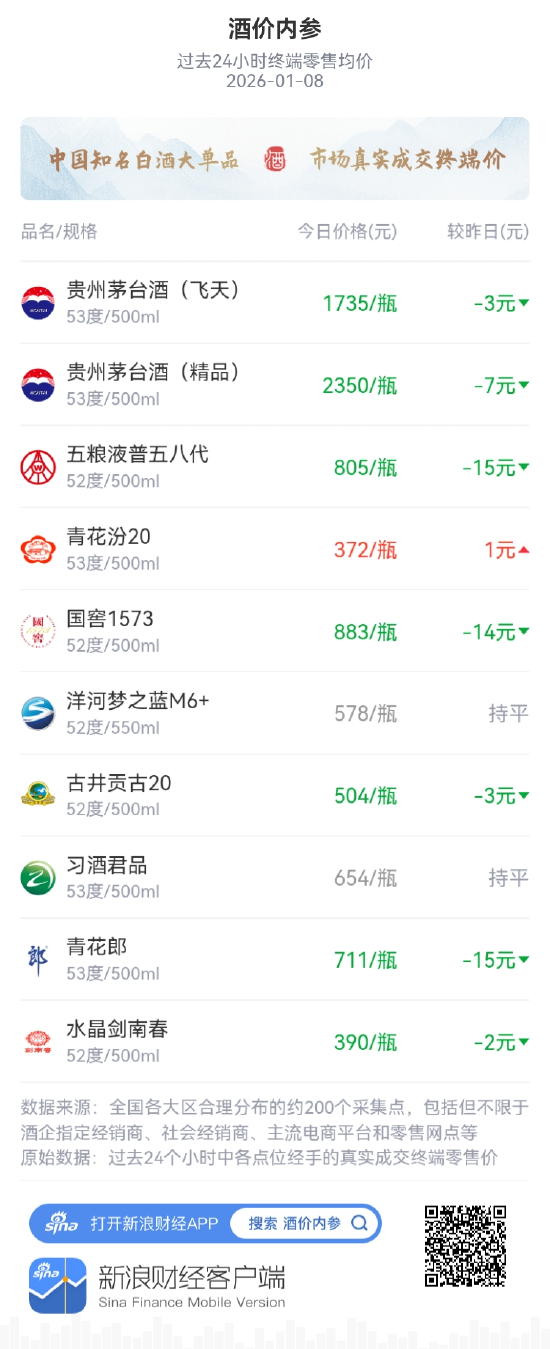
Core Insights - The core viewpoint of the news is that the Chinese liquor market, particularly the top ten liquor products, has experienced a significant decline in retail prices, indicating a downward pressure on the market and a lack of confidence among consumers [1][6][7]. Price Trends - The average retail price of the top ten liquor products dropped to 8,982 yuan on January 8, down 58 yuan from the previous day, marking the lowest point since November 18 of the previous year [1][6]. - Seven out of the ten products saw price declines, with notable drops including Wuliangye (down 15 yuan) and Qinghua Lang (down 15 yuan) [7][9]. - Other products that experienced price reductions include Guojiao 1573 (down 14 yuan), boutique Moutai (down 7 yuan), and others with smaller declines [7][10]. Market Sentiment - The overall market is characterized by a widespread decline, reflecting insufficient confidence among consumers and investors [7][8]. - Only one product, Qinghua Fen 20, saw a slight increase of 1 yuan, while others remained stable [7][9]. Data Collection Methodology - The data for the liquor price reference is sourced from approximately 200 collection points across various regions, including designated distributors, social distributors, major e-commerce platforms, and retail outlets, ensuring a comprehensive and objective representation of market prices [2][7]. ESG Rankings - Five liquor companies were included in the "2025 China ESG Top 100" list published by Sina Finance, with rankings as follows: Kweichow Moutai (27th), Wuliangye (53rd), Gujing Gongjiu (74th), Shanxi Fenjiu (89th), and Shede Jiuye (97th) [2][7]. - The rankings are based on a comprehensive evaluation of ESG performance among over 5,000 A-share listed companies and Hong Kong-listed mainland enterprises, aiming to promote sustainable development in the industry [2][7].
酒价内参1月8日价格发布 精品茅台价格下跌7元/瓶
Xin Lang Cai Jing· 2026-01-08 01:25
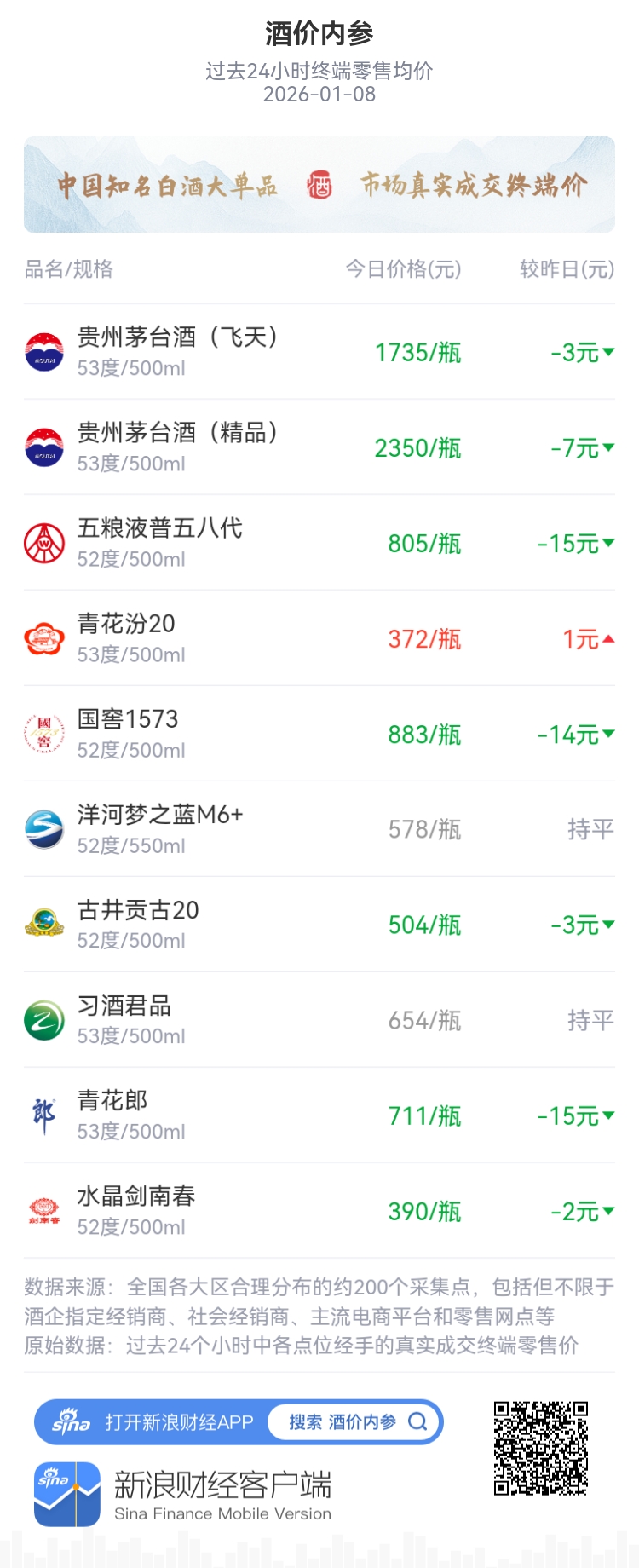
Core Insights - The core viewpoint of the news is that the Chinese liquor market, particularly the top ten liquor products, has experienced a significant decline in retail prices, indicating a downward pressure on the market and a lack of confidence among consumers [1][6]. Price Trends - The average retail price of the top ten liquor products has decreased, with a total price of 8982 yuan for a bundled sale, down 58 yuan from the previous day, marking a new low since November 18 of the previous year [1][6]. - Seven out of the ten products have seen price declines, with notable drops including Wuliangye (down 15 yuan/bottle) and Qinghua Lang (down 15 yuan/bottle) [7][1]. - Other products such as Guojiao 1573 and premium Moutai also experienced price reductions of 14 yuan and 7 yuan per bottle, respectively [7][1]. Market Sentiment - The overall market is characterized by a broad decline, reflecting insufficient confidence among consumers, as indicated by the simultaneous price drops of leading brands and core products [7][1]. Data Collection Methodology - The data for the liquor price reference is sourced from approximately 200 collection points across various regions, including designated distributors, social distributors, mainstream e-commerce platforms, and retail outlets, aiming to provide objective and traceable market price data [2][7]. ESG Rankings - Five liquor companies were included in the "2025 China ESG Top 100" list published by Sina Finance, with rankings as follows: Kweichow Moutai (27th), Wuliangye (53rd), Gujing Gongjiu (74th), Shanxi Fenjiu (89th), and Shede Jiuye (97th) [2][7]. - The rankings are based on a comprehensive evaluation of ESG performance among over 5,000 A-share listed companies and Hong Kong-listed mainland enterprises, utilizing 18 industry-specific ESG evaluation models [2][7].
酒价内参1月8日价格发布 市场普跌探底整体价格创新低
Xin Lang Cai Jing· 2026-01-08 01:01
Core Insights - The Chinese liquor market is experiencing a significant decline in retail prices for the top ten products, with an overall drop in market confidence [1] - The total retail price for a bundled sale of the top ten products is 8,982 yuan, marking a decrease of 58 yuan from the previous day, the lowest since November 18 of the previous year [1] Price Movements - Seven out of the ten major liquor products saw price declines, with notable drops including: - Wuliangye (普五八代) down 15 yuan per bottle - Qinghua Lang (青花郎) down 15 yuan per bottle - Guojiao 1573 (国窖1573) down 14 yuan per bottle - Premium Moutai (精品茅台) down 7 yuan per bottle - Feitian Moutai (飞天茅台) down 3 yuan per bottle - Ancient Liquor (古井贡古20) down 3 yuan per bottle - Crystal Jiananshun (水晶剑南春) down 2 yuan per bottle [1][3][4] - The only product to see a price increase was Qinghua Fen (青花汾20), which rose by 1 yuan per bottle [1] Market Sentiment - The overall market is characterized by a downward trend, reflecting a lack of confidence among consumers and investors [1] - The price adjustments across leading brands indicate a broader issue within the industry, as multiple core products are experiencing simultaneous price declines [1]
古井贡酒:截至2025年12月31日股东人数为53135户
Zheng Quan Ri Bao· 2026-01-07 12:38
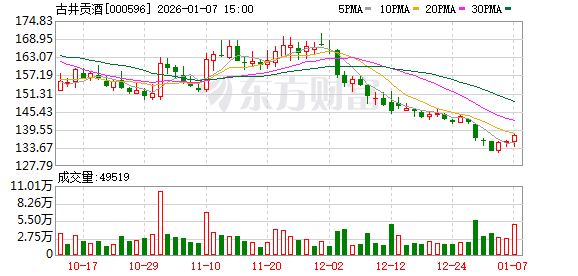
Core Insights - The company Gujinggong Liquor announced that as of December 31, 2025, the number of its shareholders will reach 53,135 households [2] Company Summary - Gujinggong Liquor is actively engaging with investors through interactive platforms [2] - The projected increase in shareholders indicates a growing interest in the company's stock [2]
白酒板块1月7日跌0.47%,*ST岩石领跌,主力资金净流出2.44亿元
Zheng Xing Xing Ye Ri Bao· 2026-01-07 08:58
Core Viewpoint - The liquor sector experienced a decline of 0.47% on January 7, with *ST Rock leading the drop, while the Shanghai Composite Index rose by 0.05% and the Shenzhen Component Index increased by 0.06% [1]. Group 1: Market Performance - The closing prices and performance of key liquor stocks showed mixed results, with Guizhou Moutai at 1423.36 yuan (-0.33%), and Wuliangye at 107.52 yuan (-0.60%) [1][2]. - The total net outflow of main funds from the liquor sector was 244 million yuan, while retail investors saw a net inflow of 437.07 thousand yuan [2]. Group 2: Trading Volume and Value - Guizhou Moutai had a trading volume of 29,700 hands and a transaction value of 4.234 billion yuan, while Wuliangye had a trading volume of 123,100 hands and a transaction value of 1.326 billion yuan [1][2]. - The trading volume for the liquor sector was highlighted, with notable transactions including Luzhou Laojiao at 93,700 hands and a transaction value of 1.102 billion yuan [2]. Group 3: Fund Flow Analysis - Guizhou Moutai saw a main fund inflow of 76.40 million yuan, while *ST Rock experienced a main fund outflow of 4.17 million yuan [3]. - The fund flow analysis indicated that retail investors contributed positively to some stocks, such as Tianyoude Liquor, which had a retail net inflow of 121.59 thousand yuan [3].


酒价内参1月7日价格发布 市场全线回调整体酒价创近期新低
Xin Lang Cai Jing· 2026-01-07 01:03
Core Viewpoint - The Chinese liquor market is experiencing a significant price decline, with the average retail price of the top ten liquor products dropping, indicating a bearish market sentiment and a further downward adjustment in price levels [1]. Price Trends - The total price for a bundled sale of the top ten liquor products is 9040 yuan, down 28 yuan from the previous day, marking a new low in two months [1]. - Six monitored products showed price declines, with notable drops including: - Xijiu Junpin down 15 yuan per bottle - Guojiao 1573 and Jingpin Moutai down 5 yuan per bottle - Feitian Moutai down 4 yuan per bottle - Wuliangye Pu 58th generation down 3 yuan per bottle - Qinghua Fen 20 down 1 yuan per bottle [1][3][4]. Price Movements of Specific Products - The following products experienced price changes: - Feitian Moutai (53 degrees, 500ml) priced at 1738 yuan, down 470 yuan - Jingpin Moutai (53 degrees, 500ml) priced at 2357 yuan, down 570 yuan - Wuliangye Pu 58th generation (52 degrees, 500ml) priced at 820 yuan, down 370 yuan - Guojiao 1573 (52 degrees, 500ml) priced at 897 yuan, down 5 yuan [3][4]. - Conversely, some products saw price increases: - Guqingong Gu 20 up 3 yuan to 507 yuan - Yanghe Dream Blue M6+ up 1 yuan to 578 yuan - Qinghua Lang up 1 yuan to 726 yuan [4].