
WLY(000858)

Search documents
“老登”板块曙光乍现?!白酒ETF是否布局正当时?
Sou Hu Cai Jing· 2025-11-11 09:28
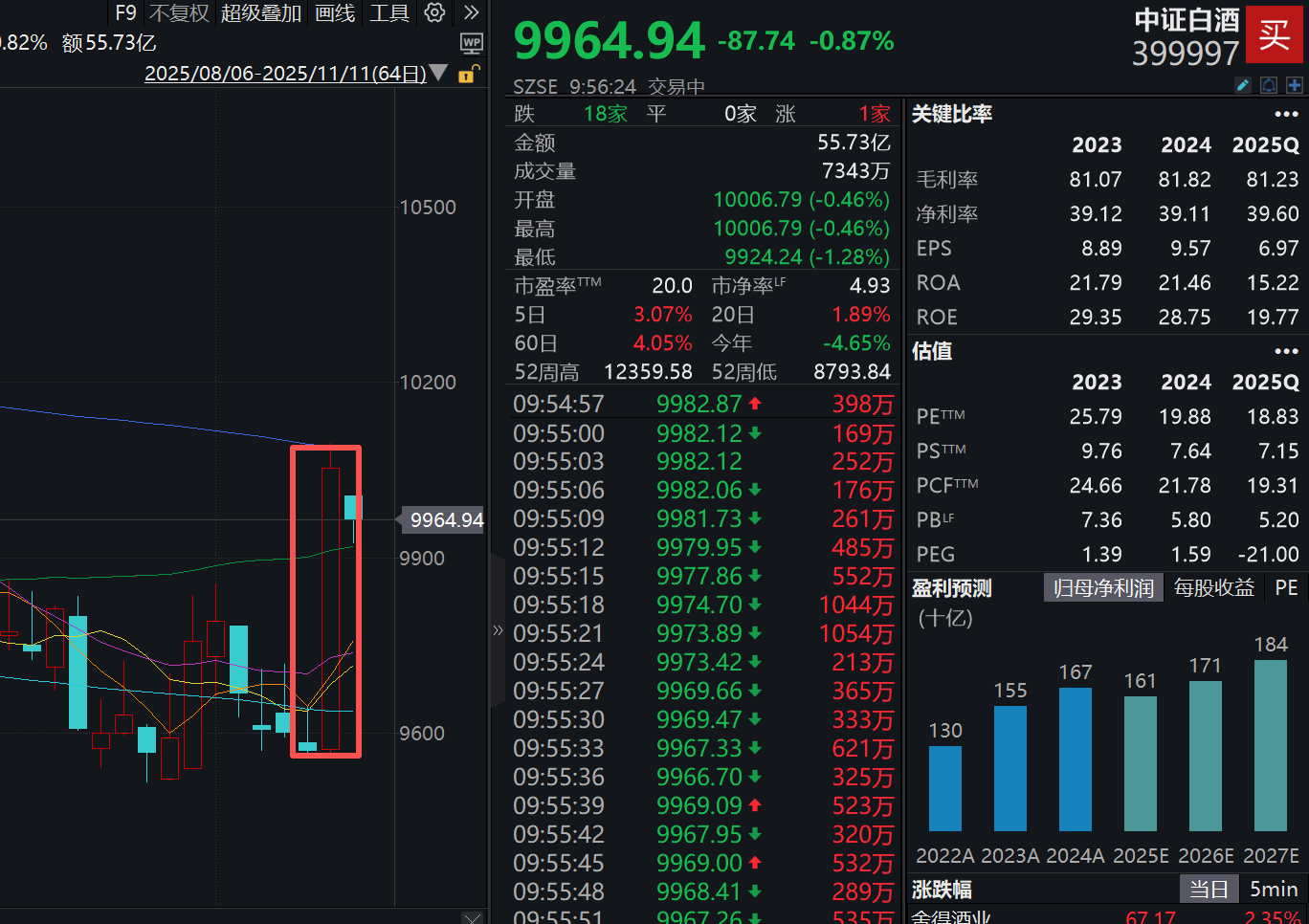
Core Viewpoint - The white liquor sector is experiencing a resurgence, with the Zhongzheng White Liquor Index showing significant gains, indicating renewed investor interest and confidence in the market [1][3]. Group 1: Market Performance - On November 10, the Zhongzheng White Liquor Index saw all constituent stocks rise, with notable gains from Shede Liquor and Jiugui Liquor, both hitting the daily limit, while leading brands like Luzhou Laojiao and Gujing Gongjiu rose over 5% [1]. - The current price-to-earnings ratio (PE-TTM) for the white liquor sector is approximately 18.7 times, which is at a low level compared to the past five years, indicating a clear valuation advantage [6]. Group 2: Economic Indicators - In October, the Consumer Price Index (CPI) rose by 0.2% month-on-month and year-on-year, while the Producer Price Index (PPI) also saw its first month-on-month increase of the year, suggesting a reduction in deflationary pressures and a mild recovery in consumer demand [3]. Group 3: Investment Opportunities - Analysts believe that the most challenging period for the white liquor industry has passed, with external constraints on consumption expected to ease, making it a favorable time for investment [6][15]. - The white liquor sector is seen as a more stable investment compared to other high-risk stocks, with expectations of steady performance and recovery in stock prices as inventory levels normalize and prices rebound [6][15].




1499元买飞天茅台!2025双11高端白酒价格“大跳水”
Guan Cha Zhe Wang· 2025-11-11 09:08
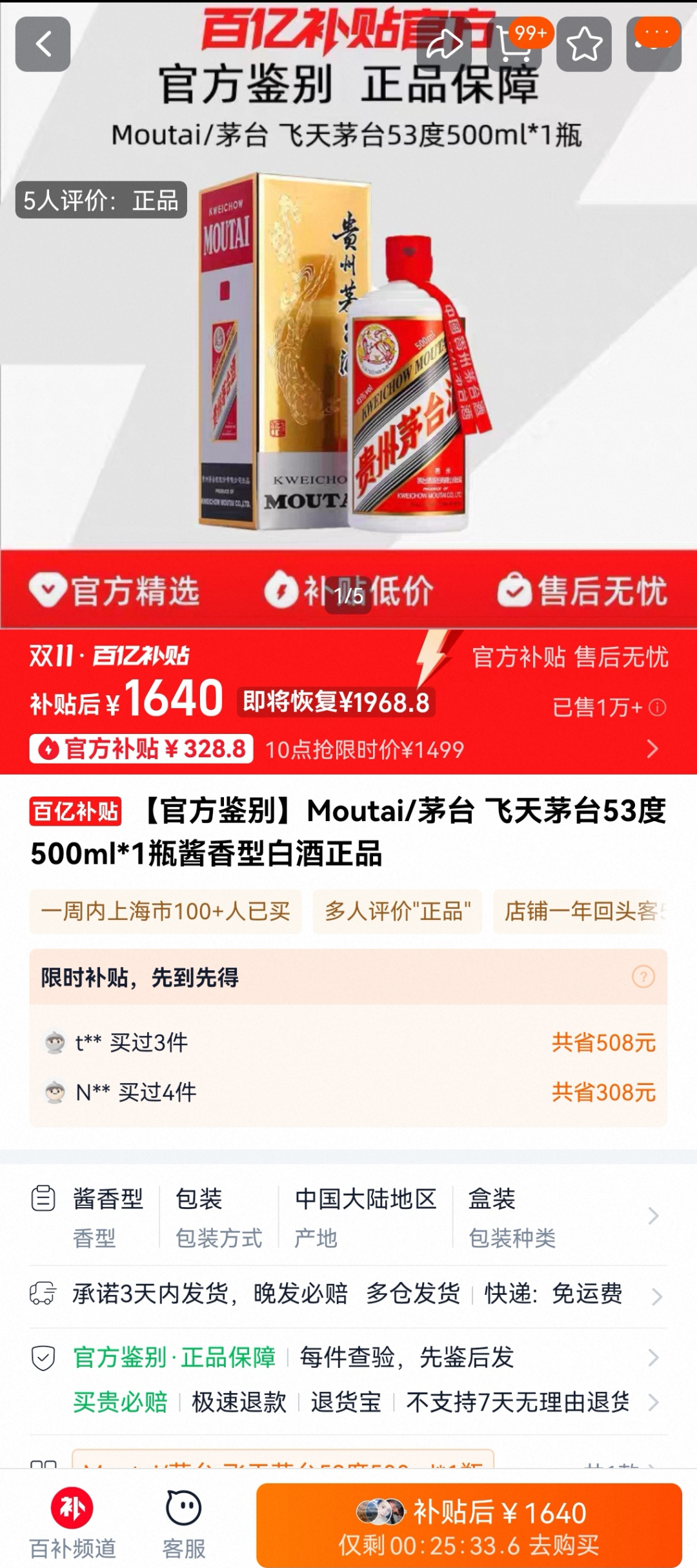
Core Viewpoint - The price of Feitian Moutai has significantly declined during the 2024 and 2025 Double Eleven shopping festivals, driven by aggressive discounting strategies from e-commerce platforms, leading to a perception that the "Moutai myth" has fallen apart [1][2][12]. Price Trends - During the 2024 Double Eleven, Feitian Moutai was priced at approximately 2036 yuan on Taobao, 2061 yuan on Pinduoduo, and 2499 yuan on JD [1][18]. - In 2025, prices dropped further, with Taobao listing it at 1640 yuan and Pinduoduo at 1499 yuan, marking a significant decline from previous years [2][7]. - The price of loose Feitian Moutai has shown a downward trend, with reports of prices falling below 1600 yuan during the promotional period [5][6]. Market Dynamics - The extended promotional period for Double Eleven has led to a "price drop" phenomenon, with prices fluctuating daily and reaching new lows [5][6]. - The price of loose Feitian Moutai fell to 1715 yuan by October 27, 2024, and continued to decline, breaking the psychological barrier of 1700 yuan shortly after [6][12]. - E-commerce platforms are engaged in a fierce subsidy war, further driving prices down and impacting the profit margins of offline distributors [12][13]. Consumer Sentiment - Consumer reactions indicate a divide, with some expressing disappointment over the falling prices, suggesting that the prestige associated with Moutai is diminishing [2][12]. - The perception of Moutai as a high-value product is being challenged as prices approach cost levels, leading to concerns about the brand's market position [12][22]. Industry Context - The decline in Moutai prices is part of a broader trend affecting the high-end liquor market, with other brands like Wuliangye and Guojiao 1573 also experiencing significant price drops [22][26]. - The overall market for high-end liquor is under pressure due to changing consumer preferences, economic conditions, and stricter drinking policies [21][22]. Future Outlook - Analysts predict that the price of Moutai may continue to align closer to the official guidance price of 1499 yuan, reflecting ongoing market adjustments [21][22]. - The white liquor industry is expected to undergo a prolonged period of adjustment, with inventory issues and pricing pressures becoming the norm [48][49].

白酒板块11月11日跌0.18%,水井坊领跌,主力资金净流出4.97亿元
Zheng Xing Xing Ye Ri Bao· 2025-11-11 08:37
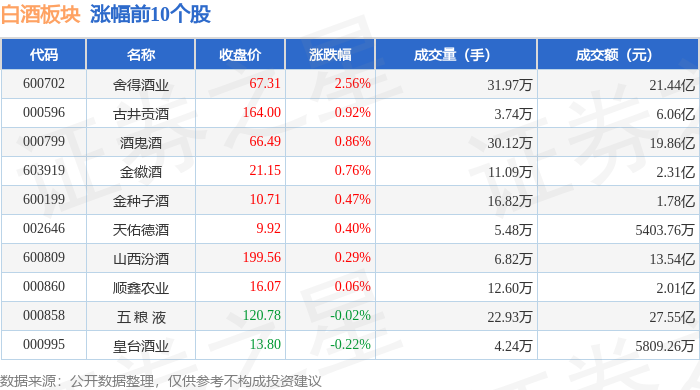
Market Overview - The liquor sector experienced a decline of 0.18% on November 11, with Shui Jing Fang leading the drop [1] - The Shanghai Composite Index closed at 4002.76, down 0.39%, while the Shenzhen Component Index closed at 13289.0, down 1.03% [1] Individual Stock Performance - Shede Liquor (600702) rose by 2.56% to a closing price of 67.31, with a trading volume of 319,700 shares and a transaction value of 2.144 billion [1] - Gujing Gongjiu (000596) increased by 0.92% to 164.00, with a trading volume of 37,400 shares and a transaction value of 606 million [1] - Shui Jing Fang (600779) fell by 1.13% to 42.87, with a trading volume of 48,200 shares and a transaction value of 206 million [2] - Moutai (600519) decreased by 0.23% to 1458.99, with a trading volume of 26,700 shares and a transaction value of 3.883 billion [2] Capital Flow Analysis - The liquor sector saw a net outflow of 497 million from institutional investors, while retail investors contributed a net inflow of 244 million [2] - The main capital inflow and outflow for selected stocks showed varied trends, with Shanxi Fenjiu (600809) experiencing a net inflow of 1.06 billion from main capital [3] - Shede Liquor (600702) had a net inflow of 46.2 million from main capital, while it faced a net outflow of 90.1 million from speculative capital [3]





12只白酒股下跌 贵州茅台1458.99元/股收盘
Bei Jing Shang Bao· 2025-11-11 07:41
Core Viewpoint - The liquor sector showed mixed performance with a slight overall increase, while individual stocks experienced varied movements, indicating a potential recovery in the industry by 2026 according to CICC's forecast [1] Industry Summary - On November 11, the Shanghai Composite Index closed at 4002.76 points, down 0.39%, while the liquor sector index closed at 2359.06 points, up 0.39% [1] - CICC predicts that the liquor industry will see a gradual improvement starting in the first half of next year, with leading companies benefiting the most due to their strong fundamentals and market share logic [1] Company Summary - Kweichow Moutai closed at 1458.99 CNY per share, down 0.23% [1] - Wuliangye closed at 120.78 CNY per share, down 0.02% [1] - Shanxi Fenjiu closed at 199.56 CNY per share, up 0.29% [1] - Luzhou Laojiao closed at 141.64 CNY per share, down 0.60% [1] - Yanghe Brewery closed at 70.80 CNY per share, down 1.05% [1]

直播间卖“超低价”茅台将被罚?最新回应
Xin Lang Cai Jing· 2025-11-11 06:20
Core Viewpoint - The article discusses the significant price fluctuations of premium liquor brands like Moutai and Wuliangye during the recent "Double 11" shopping festival, highlighting the impact of e-commerce promotions on the liquor market and the responses from liquor companies to regulate pricing and sales channels [2][8][9]. Price Trends and Promotions - During the "Double 11" period, the price of 53-degree/500ml Moutai dropped below 1700 yuan, reaching as low as 1399 yuan in some promotions, while Wuliangye's price fell to 759 yuan [3][9]. - In comparison, last year's "Double 11" saw Moutai prices around 2000 yuan and Wuliangye prices above 850 yuan [5][7]. Regulatory Actions and Market Responses - E-commerce platforms like Douyin have initiated actions against sellers offering Moutai at prices below market value, responding to consumer complaints about false advertising and potential health risks [2][8]. - Liquor companies, including Moutai and Wuliangye, are actively working to establish official sales channels and combat counterfeit products, with Moutai's management emphasizing the importance of purchasing from recognized sources [16][17]. Industry Challenges - The liquor industry is currently facing significant challenges, including inventory clearance, price discrepancies, and pressure on distribution channels, leading to some companies reporting their worst quarterly performance in a decade [8][19]. - Analysts suggest that the aggressive discounting strategies employed during e-commerce events could undermine long-term brand value and disrupt established pricing structures [7][19]. Market Outlook - The industry is undergoing a deep adjustment phase, with expectations of a gradual recovery as companies manage inventory and pricing strategies more effectively [19][20]. - Recent data indicates that Moutai's wholesale prices have been consistently declining, reflecting broader market trends and pressures [18][19].
直播间卖茅台低于市场价将被罚?抖音:个别商家售价低于官方出厂价,重点治理虚假低价为噱头的违规引流行为
Xin Lang Cai Jing· 2025-11-11 05:33
Group 1 - The article discusses the recent controversy surrounding the pricing of Moutai on e-commerce platforms, particularly the claims of low prices leading to penalties for sellers [1][2] - Douyin's e-commerce team has initiated a campaign to combat false advertising and suspiciously low pricing of alcoholic beverages, resulting in the banning of over 100 abnormal price listings and restrictions on 52 sellers [1] - The promotional period for this year's "Double 11" sales has been extended to a month, with Moutai's prices dropping significantly compared to last year, indicating a trend of aggressive discounting in the market [2] Group 2 - Moutai's e-commerce subsidized prices have fallen below 1700 yuan, with some instances reaching as low as 1399 yuan, which is a significant decrease from last year's minimum price of around 2000 yuan [2] - The company is actively working with major online platforms to establish channels for addressing counterfeit and infringement issues, emphasizing the importance of purchasing from official and legitimate sources [2]
白酒股普跌
Ge Long Hui A P P· 2025-11-11 03:49
Core Insights - The article highlights a significant decline in the stock prices of major Chinese liquor companies, with many experiencing drops of over 1% in a single trading session [1] Company Performance - Luzhou Laojiao (泸州老窖) saw a decrease of 1.87%, with a market capitalization of 205.8 billion [2] - Water Margin (水井坊) dropped by 1.45%, with a total market value of 20.8 billion [2] - Yanghe Brewery (洋河股份) fell by 1.24%, holding a market cap of 106.4 billion [2] - Moutai (贵州茅台) experienced a smaller decline of 0.67%, with a substantial market capitalization of 1,818.8 billion [2] - Other notable declines include Wuliangye (五粮液) at -0.54% and Gujing Gongjiu (古井贡酒) at -0.62% [2] Market Trends - The overall trend indicates a bearish sentiment in the liquor sector, with many companies showing negative year-to-date performance, such as Water Margin at -18.34% and Yanghe Brewery at -11.94% [2] - The article suggests that the recent launch of a new pricing reference for liquor may impact market dynamics, as investors seek to understand true market prices [1]


中国白酒追踪 - 品牌对 2026 年春节仍持谨慎展望;聚焦持续严格的发货管控-China Spirits Tracker_ Brands still cautious outlook on 2026CNY; focus on continued stringent shipment control
2025-11-11 02:47
Summary of China Spirits Tracker Conference Call Industry Overview - The spirits industry is currently facing challenges due to weakening demand influenced by anti-extravagance policies and a shift in the Mid-Autumn festival calendar, leading to a tough quarter for many companies in Q3 2025 [1][1][1]. - Companies are adopting a cautious outlook for the upcoming Chinese New Year (CNY) sales and earnings performance, primarily due to a high base effect and lingering policy impacts, resulting in low visibility on demand recovery [1][1][1]. Company-Specific Insights Kweichow Moutai - Moutai is pursuing growth targets mainly through wholesale channels, reporting a 14% year-over-year increase in sales for Q3 2025, despite a 15% decline in direct sales [1][1][1]. - The company is likely to adjust its growth targets for 2026 to be more rational due to pressures on wholesale prices from competitors [1][1][1]. Wuliangye - Wuliangye anticipates back-ended growth in 2026, with the first half of the year facing headwinds from a high comparative base [1][1][1]. - The wholesale price of Common Wuliangye has remained relatively stable, with a slight decrease of RMB 5 to RMB 855 per bottle [2][2][2]. Luzhou Laojiao - Laojiao is also expected to maintain stringent shipment controls, focusing on channel health and pricing strategies into the first half of 2026 [1][1][1]. Feitian Moutai - The wholesale price of Original case Feitian Moutai has decreased by RMB 25 to RMB 1,675, while unpacked Feitian Moutai's price dropped by RMB 40 to RMB 1,640 [2][2][2]. - Various SKUs of Moutai have seen price reductions ranging from RMB 60 to RMB 120 per bottle [2][2][2]. Guojiao 1573 - The wholesale price for Guojiao 1573 has remained stable at RMB 850 per bottle, indicating a lack of significant price movement in the current market [2][2][2]. Market Dynamics - The spirits market is characterized by stringent shipment controls among leading premium brands, with a focus on maintaining channel health and pricing systems [1][1][1]. - The overall sentiment in the spirits industry remains cautious, with companies preparing for potential challenges in the upcoming quarters due to regulatory impacts and market conditions [1][1][1]. Performance Metrics - The stock performance of select spirits companies shows mixed results, with Kweichow Moutai and ZJLD being relatively better performers, while others like Jiangsu Yanghe and Jiugui Liquor have faced significant declines [35][35][35]. Key Risks - Potential risks include regulatory changes, such as consumption tax hikes, and a slower-than-expected macroeconomic recovery, which could impact the spirits market significantly [41][41][41]. This summary encapsulates the key points discussed in the conference call regarding the spirits industry and specific company performances, highlighting the cautious outlook and market dynamics as of Q3 2025.
白酒深度汇报:当下我们如何看待白酒行业
2025-11-11 01:01
Summary of the Baijiu Industry Conference Call Industry Overview - The Baijiu industry is expected to reach a turning point around the second quarter of 2026, with stock prices typically responding ahead of fundamentals, indicating a current bottoming expectation for the sector, which presents good absolute return potential [1][4] - The industry has undergone six quarters of adjustment, likely to bottom out by the second quarter of 2026, with a subsequent recovery in income and stock prices anticipated [1][13][16] Key Insights and Arguments - The current market structure for Baijiu has significantly changed compared to the 2013-2016 cycle, with increased industry concentration and improved market management capabilities among leading companies [1][3][14] - The wholesale price of Moutai has dropped to 1,650 RMB, which is equivalent to 34 bottles purchasable with the annual income of urban residents, indicating sufficient economic capacity for high-end Baijiu consumption [1][11] - The Baijiu sector is currently under pressure but is expected to enter a phase of recovery as new products and channels contribute to growth, creating a resonance effect between alpha and beta returns [1][5] Future Trends - The Baijiu industry is projected to see a recovery in revenue growth by the second quarter of 2026, with a potential for excess returns compared to the CSI 300 index [13][16] - The rise of sauce-flavored Baijiu and its increasing penetration rate are noted as significant trends, despite recent adjustments in this segment [14][15] Investment Recommendations - Companies are categorized into three main development lines: 1. Those that meet family demand and have competitive advantages in regional markets, such as Jinwei and Gujing [17] 2. Large enterprises with strong brand positions and operational capabilities, like Luzhou Laojiao and Moutai [17] 3. Companies that innovate in products and channels, such as Shede and Li Du, which are exploring new growth points [17] Challenges and Opportunities - Current challenges include inventory buildup and downward pricing pressures across the industry, but a recovery in demand and normalization of inventory levels are expected to lead to a turning point in revenue stabilization [20] - The valuation of Baijiu companies is at historical lows, suggesting significant upside potential once the market recovers, particularly for high-end products that remain in demand [19][21] Conclusion - The Baijiu industry is in a transitional phase, with expectations of recovery and growth in the coming years. The current low valuations present a favorable long-term investment opportunity as the market stabilizes and consumer demand rebounds [19][20]

消费赛道复苏预期升温 多只消费股估值具备优势
Zheng Quan Shi Bao· 2025-11-10 23:10
Core Viewpoint - The consumer sector is experiencing a collective rebound, driven by government policies aimed at boosting consumption and supporting key industries [1][3]. Group 1: Market Performance - As of November 10, 2023, various consumer indices, including food and beverage, beauty care, and retail, have shown less than 10% growth year-to-date, underperforming the Shanghai Composite Index [2]. - The food and beverage sector has been the weakest performer, with its index in a downward trend for the year [2]. Group 2: Institutional Outlook - Institutions are becoming increasingly optimistic about the future performance of the consumer sector, with several brokerages identifying potential investment opportunities [3]. - Open Source Securities notes that the food and beverage sector is nearing a bottom, with recovery expectations rising as negative factors have largely been released and policy impacts are slowing [3]. - Huachuang Securities highlights that service consumption is in a transformative phase, with strong policy support expected to make it a key investment theme [3]. - Galaxy Securities emphasizes the importance of enhancing consumer power and expanding quality consumption supply during the 14th Five-Year Plan period, as new consumption trends emerge [3]. Group 3: Valuation and Stock Performance - Many consumer stocks are currently seen as undervalued, with 123 stocks having a rolling P/E ratio below 30 and underperforming the Shanghai Composite Index year-to-date [4]. - Notable large-cap stocks include Kweichow Moutai, Midea Group, and Wuliangye, among others [4]. - 23 stocks have seen a cumulative decline of over 10% this year, with Ganyuan Food experiencing the largest drop at 33.79% [4]. Group 4: Future Growth Potential - From an institutional perspective, 43 of the 123 identified consumer stocks have an upside potential exceeding 20% based on consensus target prices [5]. - Proya Cosmetics leads with a projected upside of 49.05%, supported by its international expansion plans [5]. - Xueda Education follows with an expected upside of 48.6%, driven by its clear business expansion strategy in personalized education [5][6].


