
SUN PAPER(002078)

Search documents
1月外盘浆价上涨,关注美国对等关税裁决结果:轻工制造
Huafu Securities· 2026-01-11 07:50
Investment Rating - The report maintains an "Outperform" rating for the industry [4] Core Insights - In January, international pulp prices increased, with Arauco softwood pulp rising by $10 to $710 per ton and hardwood pulp by $20 to $590 per ton, providing cost support and potential stabilization in paper prices [3][5] - The report highlights the upcoming announcement from the U.S. regarding the tariff decision related to Trump's global tariff measures, which could impact the export chain [3][5] - E-commerce performance in December for personal care products showed overall weakness, with some emerging brands maintaining rapid growth [3] Summary by Sections Export Chain - The U.S. is expected to announce the tariff decision next week, with a predicted 28% chance of supporting current tariffs. If rejected, tariffs imposed in 2025 may be lifted [5] - The postponement of tariffs on upholstered furniture and cabinets until 2027 may alleviate CPI increases in the U.S. and support demand recovery [5] - Companies like Dream Lily and Fashion Bed Group are expanding into the Canadian market, while Zhongxin Co. plans to establish a factory in the U.S. to enhance global competitiveness [5] Home Furnishing - The furniture manufacturing industry's revenue from January to November 2025 decreased by 9.1% year-on-year, with a widening decline in residential sales [5] - IKEA announced the closure of several stores in China while shifting focus to smaller stores and online channels [5] - The report suggests that despite the ongoing adjustment period in the home furnishing and real estate sectors, valuations are at historical lows, presenting potential investment opportunities [5] Paper and Packaging - As of January 9, 2026, prices for various paper types showed mixed trends, with some prices remaining stable while others decreased [5] - The report recommends focusing on companies with strong production capacity and fiber supply, such as Nine Dragons Paper and Shanying International [5] Consumer Goods - Sales growth for sanitary napkins on major e-commerce platforms showed a decline, while some brands on Douyin experienced rapid growth [5] - The report highlights strategic collaborations and product launches by companies like Morning Glory and the potential for recovery in the stationery sector [5] New Tobacco Products - New regulations regarding non-combustible nicotine products will take effect in April 2026, indicating a shift towards a more concentrated market structure [5] - Companies like Smoore International are expected to benefit from the global rollout of their products [5] Textile and Apparel - The textile and apparel sector underperformed the market, with a reported increase in net profit for companies like Bailong Oriental, driven by strong order volumes [5]


西南证券:紧扣顺周期复苏与成长 四大主线布局结构性机会
Zhi Tong Cai Jing· 2026-01-09 01:33
Core Viewpoint - The report from Southwest Securities indicates that the performance of the light industry sector in 2025 is expected to be flat, with cyclical and traditional manufacturing valuations under pressure, while packaging, exports, and personal care sectors show differentiated performance [1] 2025 Sector Review - In 2025, the light industry sector experienced relatively flat performance, with traditional cyclical and manufacturing companies facing valuation pressure. However, the packaging and printing sectors benefited from price increases and cross-industry transformations, leading to better stock performance [1] - The export sector showed some differentiation due to tariff policy disruptions, with companies that have balanced production capacity, strong demand resilience, and low tariff impact performing better [1] - The personal care sector achieved excess returns in the first half of the year but entered a valuation digestion phase in the second half due to intensified competition in e-commerce channels. However, domestic brands are expected to continue their growth trajectory due to product structure optimization and channel expansion [1] 2026 Stock Selection Strategy - The focus will be on undervalued cyclical assets as valuation recovery is anticipated amid changes in the bulk commodity cycle, gradually realizing allocation value [2] - There is a need to balance the valuation and growth potential of new consumption and export sectors, favoring high-growth or low-valuation, high-safety stocks [2] - Four main lines of focus for stock selection include: 1. Gradually emphasizing undervalued cyclical stocks, particularly in the paper sector, which is expected to see price increases driven by "anti-involution" and traditional peak season factors, with net profit per ton likely to recover [2] 2. Export stocks with strong demand resilience and manufacturing capabilities are still considered valuable for allocation, especially those with good growth potential in niche categories and minimal tariff impact [2] 3. Domestic personal care brands are expected to see upward trends in market share and growth potential due to rapid product iteration and competitive pricing [2] 4. New consumption trends in AI glasses, new tobacco products, pet supplies, and trendy toys are expected to continue their upward trajectory, contributing to the growth of the consumption sector [2] Recommended Stocks - Recommended stocks include Sun Paper, Bohui Paper, Weigao Medical, Baiya Co., Nobon Co., Yiyi Co., Mengbaihe, and Gujia Home [3]





中金 | 纸浆系列专题(三):一体化重构价值锚点
中金点睛· 2026-01-08 23:59
Core Viewpoint - The company continues to be optimistic about the performance of "forestry-pulp-paper integration" leaders by 2026, emphasizing that integration is key to achieving cost hedging and resource revaluation amid resource constraints and cost fluctuations. Focus should be on "value integrators" with high fiber self-sufficiency and resource barriers [2]. Industry Overview - After the paper industry bull market in 2021, profit distribution has tilted towards the pulp end, with a "long tail effect" in paper capacity clearance. The industry chain currently shows characteristics of "high concentration at the resource end and dispersed competition at the processing end," with pulp being a scarce resource commanding strong pricing power. The midstream paper sector is squeezed by high pulp prices and weak demand, leading to a continuous narrowing of profit margins [5][7]. - The strategic paradigm has shifted from capacity expansion to industry chain integration. Chinese paper companies have entered a mature phase of stock competition, where growth driven solely by capital expenditure is unsustainable. The core strategy has shifted to using self-owned fiber to hedge against volatile pulp prices, transforming leading companies from "global resource movers" to "value integrators" [5][8]. Market Dynamics - A short-term supply gap for wood chips is expected in 2026, with a potential recovery in pulp price levels. The domestic market has seen large-scale production of self-made pulp, but the construction cycle for quality wood chip resources lags behind equipment production. This is anticipated to push up cost levels as demand marginally improves [6]. - The competition landscape is characterized by heavy asset attributes and slow clearance. The investment per ton of paper exceeds 5,000 yuan, while pulp investment is over 2,000 yuan, leading to a long payback period. High depreciation necessitates maintaining high capacity utilization for cash flow, but the supply exceeds demand, and the core contradiction lies in the slow clearance efficiency at the bottom of the cycle [7]. Strategic Evolution - The industry has transitioned from a demand-driven phase to a mature phase of stock competition. Due to a lack of quality forest resources for pulp production, paper companies are in a "strong manufacturing, weak resource" decoupling state, making them vulnerable to global pulp price and exchange rate fluctuations. The strategic focus of leading companies has shifted to "forestry-pulp-paper integration," allowing them to convert unstable processing profits into certain resource premiums [8][9]. Global Comparison - Compared to emerging markets like Brazil, which are still in a dual growth phase of resources and consumption, the valuation logic of Chinese paper companies is undergoing reconstruction. Future focus will shift from capacity growth to the self-sufficiency rate of the entire industry chain. Leading companies are moving away from being "global resource movers" and are enhancing their cost control capabilities, which is crucial for maintaining stable ROE and achieving valuation recovery [9].



轻工行业2026年投资策略:掘金情绪消费,重估周期价值
Southwest Securities· 2026-01-08 12:34
Core Insights - The report emphasizes the importance of capitalizing on emotional consumption trends and reassessing cyclical value in the light of the 2026 investment strategy for the light industry sector [1][3]. 2025 Sector Review - In 2025, the light industry sector experienced relatively flat performance, with traditional cyclical and manufacturing companies facing valuation pressure. However, packaging and printing sectors benefited from price increases and cross-industry transformations, leading to better stock performance [4]. - The export sector showed some differentiation due to tariff policy disruptions, with companies that had balanced production capacity and strong demand performing better. The personal care sector saw excess returns in the first half of the year but faced valuation digestion in the second half due to intensified e-commerce competition [4][5]. - The report suggests a dual focus for stock selection in 2026: on one hand, to pay attention to undervalued cyclical assets for valuation recovery; on the other hand, to balance the valuation and growth potential of new consumption and export sectors [4]. Stock Selection Strategy - The report recommends four main lines for stock selection: 1. Gradually focus on undervalued cyclical stocks, particularly in the paper sector, which is expected to see price increases driven by seasonal demand and low channel inventory [4]. 2. Maintain a high allocation to export stocks with strong demand resilience and manufacturing capabilities, especially those less affected by tariffs [4]. 3. Invest in high-quality domestic personal care brands benefiting from product structure optimization and channel expansion [4]. 4. Explore new consumption trends in categories like AI glasses, new tobacco products, pet supplies, and trendy toys, which are expected to see significant growth [4]. Recommended Stocks - The report lists several recommended stocks, including: - Sun Paper Industry (002078.SZ) - Bohui Paper Industry (600966.SZ) - Weigao Medical (300888.SZ) - Baiya Co., Ltd. (003006.SZ) - Nobon Co., Ltd. (603238.SH) - Yiyi Co., Ltd. (001206.SZ) - Mengbaihe (603313.SH) - Gujia Home (603816.SH) [4]. 2025 Sector Performance Data - As of December 31, 2025, the SW light industry manufacturing sector had an overall increase of 20.1%, outperforming the Shanghai Composite Index by 1.7 percentage points. The packaging and printing sector performed particularly well with a 35.4% increase [12]. - The report highlights that the packaging sector benefited from price increases and cross-industry transformations, while the home and entertainment sectors also saw significant gains [12][14]. Export Sector Insights - The report notes that from November 2025, the U.S. reduced tariffs on Chinese imports to 20%, leading to a gradual recovery in orders. The fluctuations in tariff policies had previously caused delays in orders from U.S. buyers [76]. - The report indicates that the export sector is expected to see a return to competitive pricing against ASEAN countries following the tariff adjustments, which may accelerate industry consolidation [76][81]. Personal Care Sector Trends - The personal care sector is experiencing product structure upgrades and channel benefits, with brands focusing on high-demand segments such as oral care and women's hygiene products [31][50]. - The report forecasts that the market for women's hygiene products will reach 1079.6 billion yuan in 2025, with a compound annual growth rate (CAGR) of 3.0% from 2025 to 2029 [50][51]. Baby Care Market Dynamics - The baby care market is projected to grow at a CAGR of 3.1% from 2025 to 2029, with a focus on premiumization and specialized products to counteract declining birth rates [59][66]. - The report highlights that single-child consumption is increasing, which helps mitigate the impact of declining birth rates on the market [69].


造纸板块1月8日跌0.09%,博汇纸业领跌,主力资金净流出8240.14万元
Zheng Xing Xing Ye Ri Bao· 2026-01-08 08:51
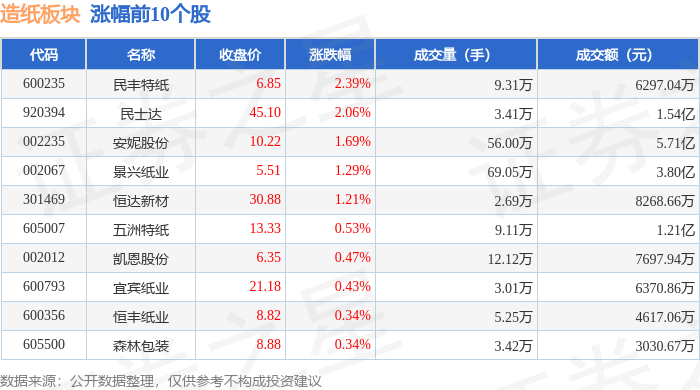
Market Overview - The paper sector experienced a slight decline of 0.09% on January 8, with Bohui Paper leading the drop [1] - The Shanghai Composite Index closed at 4082.98, down 0.07%, while the Shenzhen Component Index closed at 13959.48, down 0.51% [1] Individual Stock Performance - Minfeng Special Paper (600235) saw an increase of 2.39%, closing at 6.85 with a trading volume of 93,100 shares and a turnover of 62.97 million yuan [1] - Minshida (920394) rose by 2.06%, closing at 45.10 with a trading volume of 34,100 shares and a turnover of 154 million yuan [1] - Anni Co., Ltd. (002235) increased by 1.69%, closing at 10.22 with a trading volume of 560,000 shares and a turnover of 571 million yuan [1] - Bohui Paper (600966) declined by 1.78%, closing at 6.64 with a trading volume of 174,600 shares and a turnover of 116 million yuan [2] Capital Flow Analysis - The paper sector saw a net outflow of 82.40 million yuan from institutional investors, while retail investors had a net inflow of 117 million yuan [2] - Among individual stocks, Sun Paper (002078) experienced a significant net outflow of 40.44 million yuan from institutional investors [3] - Xianhe Co., Ltd. (603733) had a net inflow of 13.49 million yuan from institutional investors, indicating some positive interest [3]

【行业深度】一文洞察2026年中国秸秆行业发展前景及投资趋势研究报告
Sou Hu Cai Jing· 2026-01-07 02:34
Core Viewpoint - The straw industry in China is deeply integrated with agriculture, energy, chemicals, and building materials, forming various industrial chains that enhance rural employment and farmers' income while creating indirect economic value through the substitution of petrochemical and wood resources [2][10]. Market Policy - The Chinese government has implemented a series of policies to promote comprehensive utilization of straw, including subsidies, market construction, and incentive measures, providing a favorable policy environment for the development of the straw recycling and processing industry [2][10][12]. - Key policies include the "Air Quality Continuous Improvement Action Plan," which emphasizes the comprehensive utilization of straw and the prohibition of burning, aiming to stabilize the comprehensive utilization rate of straw above 86% [12][10]. Utilization Volume and Rate - The comprehensive utilization of straw in China is projected to increase from 555 million tons in 2024 to 647 million tons, with feed usage accounting for approximately 18.4%, raw material and substrate fields about 1.8%, edible fungus substrate around 2.3%, and fuel fields about 8.2% [2][10]. - The comprehensive utilization rate of straw is expected to rise from 77.7% in 2024 to 88.3%, with the market size growing from 147.63 billion yuan to 205.10 billion yuan [2][10]. Industry Chain - The straw industry chain in China consists of three levels: upstream resource supply and equipment manufacturing, midstream processing and technology conversion, and downstream diversified applications, moving towards scale, high value, and intelligence [13][14]. - The upstream includes straw resource sources, collection, storage, and machinery, while the midstream focuses on processing and technology conversion, leading to applications in agriculture, energy, building materials, and environmental protection [13][14]. Related Companies - Listed companies involved in the straw industry include Sierte (002538), Yili Group (600887), Huarui Agriculture (833462.NQ), Xuerong Biological (300511), Shouxiangu (603896), Disen Co. (300335), Changqing Group (002616), Sun Paper (002078), and Shengquan Group (605589) [2].




造纸板块1月6日涨1.4%,仙鹤股份领涨,主力资金净流出1.77亿元
Zheng Xing Xing Ye Ri Bao· 2026-01-06 08:56
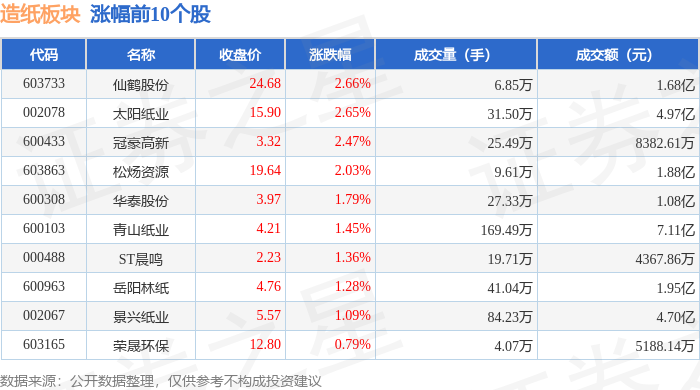
Group 1 - The paper sector experienced a 1.4% increase on January 6, with Xianhe Co., Ltd. leading the gains [1] - The Shanghai Composite Index closed at 4083.67, up 1.5%, while the Shenzhen Component Index closed at 14022.55, up 1.4% [1] - Key stocks in the paper sector showed various performance metrics, with Xianhe Co., Ltd. closing at 24.68, up 2.66%, and Sun Paper Industry at 15.90, up 2.65% [1] Group 2 - The paper sector saw a net outflow of 177 million yuan from institutional investors, while retail investors contributed a net inflow of 156 million yuan [2] - The trading volume for Sun Paper Industry was 315,000 hands, with a transaction value of 497 million yuan [2] - The net inflow from retail investors for Qing Shan Paper Industry was 5.23 million yuan, despite a net outflow from institutional and speculative investors [3]


中金:中国纸企战略核心已转向利用自有纤维对冲金融属性强的浆价波动
智通财经网· 2026-01-06 08:40
Core Viewpoint - The paper industry chain is currently characterized by "high concentration at the resource end and decentralized competition at the processing end," with pulp being a scarce resource that holds strong pricing power [2][3] Industry Characteristics - After the paper bull market in 2021, profit distribution has tilted towards the pulp end, while the paper production capacity clearance shows a "long tail effect" [2] - The industry is experiencing a slow clearance speed due to high single-ton investment costs and significant depreciation pressure, leading to a reliance on effective cost transmission for profitability stability [2] Strategic Shift - The strategic paradigm has shifted from capacity expansion to industry chain integration, with companies now focusing on using their own fiber to hedge against the volatility of pulp prices [3] - This integration essentially transforms unstable processing profits into stable resource premiums, allowing leading companies to transition from "global resource movers" to "value integrators" [3] Market Outlook - A short-term supply gap for wood chips is expected to emerge by 2026, as the construction cycle for quality wood chip resources lags behind equipment production [4] - As demand marginally improves, the price center for pulp is anticipated to recover in 2026, with leading companies possessing full industry chain self-sufficiency continuing to capitalize on the premium opportunities from "manufacturing" to "resource revaluation" [4] Recommended Companies - Companies to watch include Sun Paper (002078.SZ), Nine Dragons Paper (02689), and Suzano (SUZ.US) [5]

造纸板块2026年年报
Yin He Qi Huo· 2025-12-31 10:05
Report Industry Investment Rating No information provided in the content. Core Viewpoints - In 2025, the paper pulp market showed a pattern of "increasing foreign supply, decreasing domestic supply, strong broadleaf, and weak softwood." The supply increment will significantly narrow in 2026, with global commodity pulp slightly increasing and China's imports expected to remain flat. The demand for cultural paper will decline further, while that for tissue paper and white cardboard will perform well. The cost of domestic broadleaf pulp will rise, and the price will range from 4,000 to 4,600 yuan, showing a "high in the front, low in the back, strong broadleaf, and stable softwood" trend [5][75][76]. - The supply - demand situation of offset paper in 2025 was "increasing quantity but not profit." In 2026, new production capacity will be put into operation, but the output is expected to continue to decline, the utilization rate will drop below 50%, and the market competition will intensify. The apparent consumption may decline further, and the cost will be pushed up by high - price pulp. The old production lines will be forced to exit [5][78][80]. Summary by Directory 1. 2025 Paper Pulp Futures and Spot Price Trends Review - From January to early February, the prices of paper pulp futures and spot rose synchronously, driven by factors such as continuous price support from the external market, "hoarding and price support" by traders after the festival, and the boost from the futures market sentiment [10]. - From mid - February to April, the price of paper pulp entered a downward channel, mainly due to the less - than - expected recovery of downstream demand, high port inventory, and the price inversion between the external market and domestic spot [11]. - From May to the end of July, the paper pulp market fluctuated widely, with the core contradiction being the game between short - term benefits and long - term weak reality [11][13][14]. - From August to mid - October, the paper pulp market showed a significant differentiation pattern of "weak softwood and stable broadleaf," which was caused by the difference in supply - demand structure [15]. - From late October to the end of December, the market differentiation further intensified, showing a pattern of "weak softwood and strong broadleaf," and the price gradually stabilized in shock at the end of the year [16]. 2. Paper Pulp Supply: High Imports, Increased Domestic Production, and Overall High Inventory - **Global Import Situation Analysis**: In 2025, the total import of wood pulp increased, with a significant increase in broadleaf pulp and a moderate increase in softwood pulp. The import price fluctuated downward. In 2026, the import volume will decline slightly year - on - year, and the proportion of broadleaf pulp is expected to continue to increase [30][33][35]. - **Domestic Capacity Change Analysis**: In 2025, the actual domestic pulp production capacity reached 425 tons, with a profit ranking of "chemi - thermomechanical pulp > broadleaf pulp > softwood pulp." In 2026, the planned production capacity is 345 tons, mainly concentrated in the fourth quarter, with broadleaf pulp as the core incremental source. The cash cost will become the bottom line of the spot price [37][38][40]. - **Domestic Inventory Change Analysis**: As of December 2025, the domestic paper pulp inventory showed a differentiated situation of "de - stocking in ports and passive inventory accumulation upstream." In the first quarter of 2026, the port inventory is expected to stop falling and rise, but the overall inventory center is expected to be lower than that in the same period of 2024 [43]. - **Summary of Core Features of the Supply Pattern**: The overall supply will remain loose, the structural differentiation will intensify, and the inventory pressure will still exist [44][45][46]. 3. Paper Pulp Demand: Weak Cultural Paper, Improved Packaging and Tissue Paper - **White Cardboard**: In 2025, the production and sales of white cardboard increased, and the export was outstanding. In 2026, the demand for paper pulp is expected to increase steadily [50][51]. - **Cultural Paper**: In 2025, the demand for cultural paper was weak, dragging down the consumption of paper pulp. In 2026, it will still be in a weak recovery state, and it is difficult to significantly improve [51][52]. - **Tissue Paper**: In 2025, the demand for paper pulp in the tissue paper industry increased rapidly. In 2026, it will continue to grow steadily, becoming a key force to offset the decline in cultural paper demand [52][53]. 4. Cultural Paper Market Review - **Spot Price Market**: The price of offset paper fluctuated downward throughout 2025, and stabilized at a low level at the end of the year. There was no obvious regional differentiation, and the market trading was light [54]. - **Futures Price Market**: The newly - listed cultural paper futures showed a weak trend of range - bound fluctuations, with low trading volume and volatility, and were affected by both capital sentiment and spot prices [55][58]. 5. Cultural Paper Supply Analysis - In 2025, the offset paper industry had a large increase in production capacity but a decline in demand, with low capacity utilization, high inventory, and poor profitability. In 2026, new production capacity will be put into operation, but the output is expected to decline further, and the industry will still be in the "capacity - reduction" stage [60][62][63]. 6. Cultural Paper Demand Analysis - **Import and Export**: In 2025, the import of cultural paper continued to be sluggish, and the export showed a structural differentiation. The overall role of export in making up for domestic demand was limited [70]. - **Downstream Demand**: In 2025, the demand for cultural paper was mainly supported by the publishing industry, but the support was weak, and the commercial printing demand was weak [71]. 7. Paper Pulp Fundamental Comprehensive Analysis - In 2025, the paper pulp supply - demand pattern was "increasing foreign supply, decreasing domestic supply, strong broadleaf, and weak softwood." In 2026, the supply increment will narrow, the demand structure will change, and the cost will rise [75][76]. 8. Paper Pulp Futures Strategy Analysis - Unilateral trading: Pay attention to the pressure of South American shipments in the second quarter and domestic production capacity release in the fourth quarter, and appropriately arrange short positions at high prices [77]. - Arbitrage: Pay attention to the positive arbitrage opportunities under the impact of the near - month market [77]. - Options: Wait and see [77]. 9. Offset Paper Fundamental Comprehensive Analysis - In 2025, the offset paper industry had "increasing quantity but not profit." In 2026, the production capacity will increase, but the output is expected to decline, and the market competition will intensify [78][80]. 10. Offset Paper Strategy Analysis - Unilateral trading: The market is likely to fluctuate widely around the cost line of large - scale enterprises. Generally, the idea of shorting at high prices should be adopted [81]. - Arbitrage: Wait and see. Appropriate attention can be paid to the pulp - offset paper arbitrage of shorting papermaking profits [81]. - Options: Pay attention to the opportunity of selling call options [81].
轻工制造行业2026年投资策略:适应新变局
GF SECURITIES· 2025-12-30 23:30
Group 1: Core Insights - The light industry manufacturing sector is expected to experience a recovery in 2026, driven by external macroeconomic stabilization and internal demand adjustments, although the recovery will show differentiation among companies [5][6] - Investment strategies should focus on growth-oriented companies that are expanding overseas, as well as on the supply-side changes in the paper packaging sector and new consumer brands showing marginal improvements [5][6] Group 2: Home Furnishing Sector - The home furnishing industry is currently facing a downturn, with ongoing pressures from consumption and housing handovers, and limited benefits from national subsidies [13][19] - The market environment is expected to remain stable in 2026, with a focus on individual company performance, as the sector is significantly influenced by consumer sentiment and real estate policies [34][40] - The expected decline in new housing completions in 2026 is projected at 21%, which will continue to impact demand for home furnishings [34][40] Group 3: Essential Consumer Goods - The essential consumer goods market is adapting to new dynamics, with established brands facing challenges from evolving channels and increased competition [52] - The growth potential in mature markets remains stable, but the overall consumption environment has weakened, leading to increased competition among leading brands [52][53] - New consumption trends are emerging from changes in consumer sentiment and technological innovations, which are reshaping market dynamics [52][53] Group 4: Light Industry Exports - The light industry export sector has shown strong growth among leading companies, despite fluctuations due to economic cycles and inventory levels [5][6] - The outlook for 2026 suggests continued growth for top companies, supported by stable macroeconomic conditions and ongoing trends such as capacity relocation and cost reduction [5][6] - The overall recovery in the light industry export sector is anticipated to stabilize, with a focus on expanding product categories and niche markets [5][6] Group 5: Paper Packaging Sector - The paper packaging sector is expected to see a gradual recovery, with stable pricing anticipated for cultural paper and improved profitability driven by demand from the consumer electronics and AI sectors [5][6] - The profitability of the paper industry is projected to stabilize, with key factors including supply-demand dynamics and cost efficiencies playing a crucial role [5][6] - Leading companies in the metal packaging sector are expected to benefit from increased market concentration and enhanced pricing power [5][6]
