Yanghe(002304)

Search documents
民族舞剧《红楼梦》荣膺文华奖,洋河梦之蓝助力经典绽华彩
Zhong Jin Zai Xian· 2025-11-07 04:58
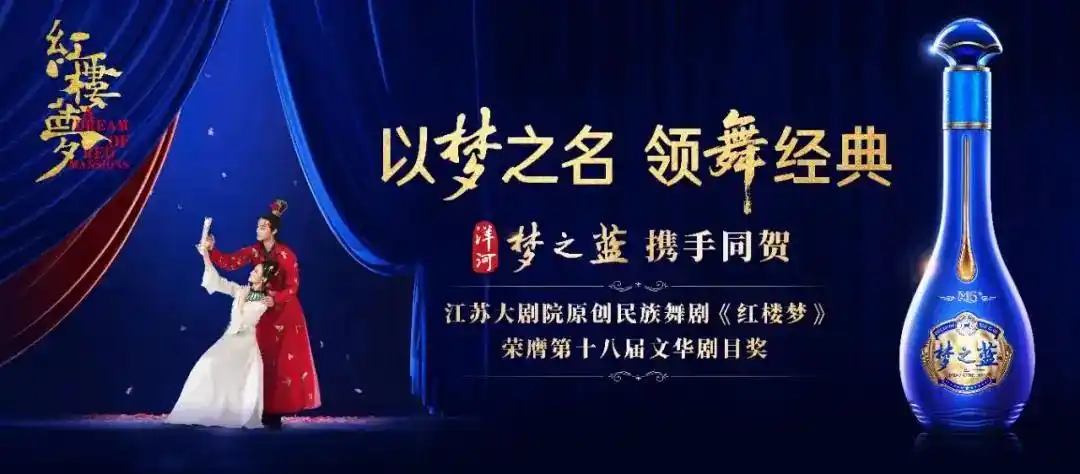
Core Insights - The 14th China Arts Festival concluded in Chongqing, revealing the winners of the 18th Wenhua Award, with the original ethnic dance drama "Dream of the Red Chamber" presented by Yanghe Mengzhilan M6+ winning the Wenhua Drama Award for its cultural depth and artistic excellence [1][3] Group 1: Cultural Significance - "Dream of the Red Chamber" is recognized as a pinnacle of Chinese classical literature, celebrated for its profound philosophical insights and artistic achievements, making it a treasure in the world literary canon [3] - The ethnic dance drama creatively integrates dance, costumes, scenery, and music, vividly bringing classic scenes from "Dream of the Red Chamber" to life on stage, creating a familiar yet novel "Red Chamber" world for audiences [3] Group 2: Performance and Reach - Since its trial performance in September 2021, the dance drama has been staged over 400 times in 41 cities, attracting nearly 600,000 viewers [5] - In 2023, the production also won the 13th China Dance "Lotus Award" for dance dramas, further solidifying its acclaim [5] Group 3: Brand and Cultural Integration - Yanghe has been actively exploring and innovating to revitalize classics and convey cultural confidence, collaborating with cultural programs and integrating traditional culture into contemporary contexts [6] - As a strategic partner for the dance drama, Yanghe Mengzhilan M6+ enhances audience engagement with classic literature through immersive experiences and scene-based marketing, merging the aesthetics of the drama with the qualities of its products [10][12]


手握4700亿家底,白酒抗跌能力变强
21世纪经济报道· 2025-11-07 04:00
Core Viewpoint - The 2025 Q3 report for the liquor industry indicates it is the worst quarter in the past decade, with most companies experiencing significant declines in performance, while only a few, like Guizhou Moutai and Shanxi Fenjiu, managed to maintain positive growth [1][4]. Group 1: Performance Comparison - Among the 21 A-share liquor companies, only 15 have fully experienced the previous adjustment period, showing improved resilience against downturns [2]. - In 2025 Q3, the revenue and net profit of these 15 companies fell by 4.5% and 5.5%, respectively, compared to more severe declines in 2013 and 2014 [4]. - The number of leading liquor companies maintaining positive growth has increased, with Guizhou Moutai and Shanxi Fenjiu being the only ones to achieve this in 2025 Q3 [5]. Group 2: Profitability and Financial Resilience - The total net profit of the 15 liquor companies in 2025 Q3 exceeded 110 billion, significantly higher than the less than 28 billion in 2013 [10]. - The accumulated undistributed profits of these companies reached 468.8 billion, five times that of 2013, indicating a stronger financial cushion [10][12]. - The profitability of leading companies has improved, with Moutai maintaining a gross margin above 90% and Wuliangye's gross margin rising to over 80% [13][14]. Group 3: Sales and Marketing Strategies - Unlike the previous cycle, companies have been more restrained in their sales expenditures, with many reducing their sales expense ratios compared to 2013 and 2014 [17][19]. - Guizhou Moutai's sales expense ratio remains low at around 3-4%, reflecting strong brand recognition and market confidence [20]. Group 4: Channel Confidence and Cash Flow - The confidence of distributors has improved, with contract liabilities for the 15 companies increasing by 3.6% in 2025 Q3, contrasting sharply with the declines seen in the previous cycle [22][24]. - However, some non-leading companies have reported negative cash flow from operating activities, indicating potential financial strain [28].





拆解白酒十年来“最惨三季报”!
Xin Lang Cai Jing· 2025-11-07 03:46
Core Viewpoint - The 2025 Q3 report for the liquor industry indicates a significant downturn, with most companies experiencing substantial profit declines, reminiscent of the previous low cycle in 2013-2014. Only a few companies like Kweichow Moutai and Shanxi Fenjiu managed to maintain positive growth [1][2]. Group 1: Performance Comparison - Among the 21 A-share liquor companies, only 15 have fully experienced the previous adjustment period, including Kweichow Moutai, Shanxi Fenjiu, and Wuliangye [2][4]. - The overall decline in revenue and net profit for these 15 companies in 2025 Q3 was 4.5% and 5.5%, respectively, compared to larger declines in the previous cycle [4][6]. - The number of leading companies maintaining positive growth has increased, with Kweichow Moutai and Shanxi Fenjiu achieving both revenue and profit growth in 2025 Q3 [6][7]. Group 2: Profitability and Financial Resilience - The total net profit for the 15 companies exceeded 110 billion yuan in 2025 Q3, significantly higher than the previous cycle's figures [11][13]. - The accumulated undistributed profits for these companies reached 468.8 billion yuan, five times that of 2013, indicating a stronger financial cushion [13][15]. - Kweichow Moutai's undistributed profits are seven times higher than in 2013, showcasing its robust financial health [15]. Group 3: Cost Management and Sales Strategy - Companies have learned from past experiences and are controlling sales expenses more effectively, with many reducing their sales expense ratios compared to the previous cycle [28][30]. - Kweichow Moutai maintains a remarkably low sales expense ratio, reflecting strong brand recognition and market confidence [32][33]. - The confidence of distributors has improved, with contract liabilities for the 15 companies increasing by 3.6% in 2025 Q3, contrasting sharply with the previous cycle's declines [35][38]. Group 4: Cash Flow and Operational Challenges - The net cash flow from operating activities for these companies declined by 19% in 2025 Q3, indicating challenges in cash collection from distributors [40][42]. - Some non-leading companies have reported negative cash flow, with specific firms like Shunxin Agriculture facing severe cash flow issues [42][43]. - The overall inventory of finished liquor has increased by nearly 4%, suggesting heightened selling difficulties in the current market [43].
解读白酒“最差三季报”:至暗时刻的破与立(二)| 逆势增长4.54%,20家上市白酒企业合同负债达390亿元!渠道信心从何而来?
Mei Ri Jing Ji Xin Wen· 2025-11-07 02:35
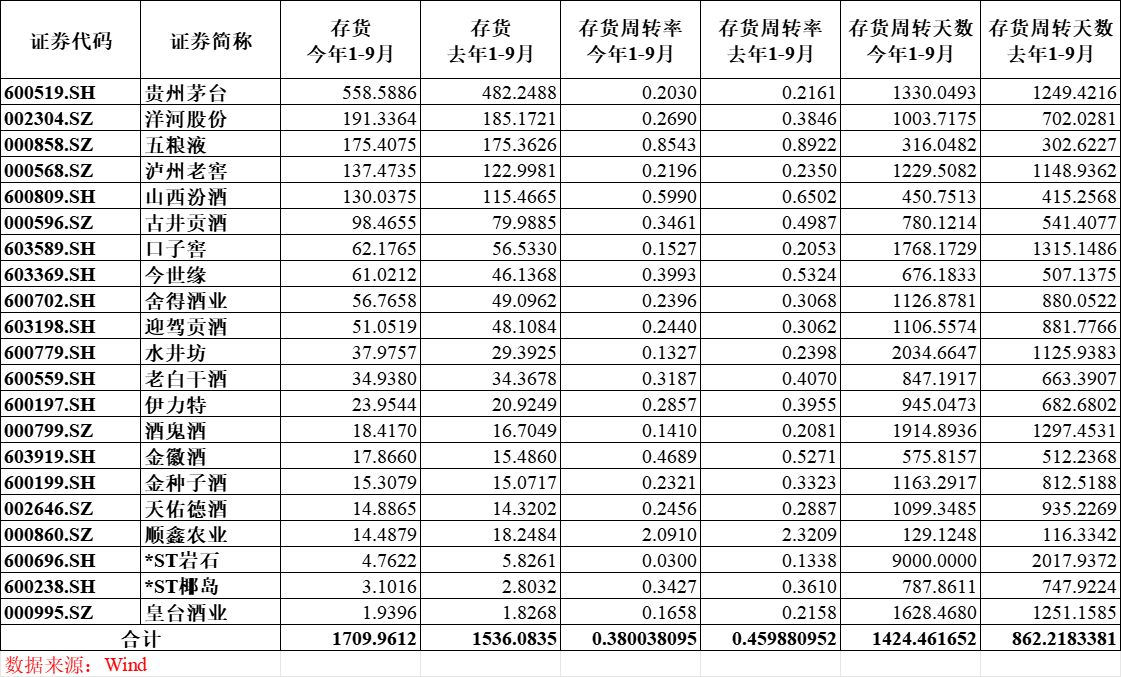
Core Viewpoint - The A-share liquor industry reported its worst performance in a decade for Q3 2025, with 20 listed companies (excluding Shunxin Agriculture) achieving a total revenue of 312.09 billion yuan and a net profit of 122.49 billion yuan, both down approximately 7% year-on-year [1][2] Financial Performance - The total revenue and net profit of the liquor industry have significantly declined, indicating a pronounced pressure on the industry [1] - Only Kweichow Moutai and Shanxi Fenjiu managed to maintain growth in both revenue and net profit amidst the overall decline [1] - The total contract liabilities for 20 liquor companies reached 39 billion yuan, reflecting a year-on-year increase of 4.54%, despite the overall performance downturn [1][6] Inventory and Turnover - The total inventory of 21 listed liquor companies rose to 170.99 billion yuan, a year-on-year increase of 11.32%, with an average inventory turnover period extending to 1424 days, up 65.21% from the previous year [2][4] - The increase in inventory turnover days signals significant pressure on channel inventory [4] Market Response - The market reacted calmly to the poor performance reports, with the China Securities Liquor Index rising by 1.72% on October 31, indicating that investors have already digested the performance pressures [1] - The stability in contract liabilities suggests that confidence in the industry and companies remains intact, despite the challenges [2][7] Channel Dynamics - The increase in contract liabilities is primarily driven by leading liquor companies, with four out of six major firms reporting year-on-year growth [7] - Companies are shifting from a simple sales model to a service-oriented approach, focusing on channel health and profitability for distributors [8][9] Innovative Sales Models - New sales models are emerging, such as the "Wan Shang Alliance" by Zhenjiu Li Du, which emphasizes no stockpiling and allows for returns, thereby reducing inventory risks [10][11] - The introduction of commission-based systems and unified pricing strategies aims to alleviate financial pressure on distributors and ensure transparent profit distribution [12] Conclusion - The growth in contract liabilities and the evolving relationships between manufacturers and distributors highlight the industry's resilience and potential for recovery, as companies prioritize channel health and collaborative strategies [12][13]
解读白酒“最差三季报”:至暗时刻的破与立(一)丨“老登”白酒迎最难拷问:业绩失速之下,股息率破纪录+低估值,最佳布局期来了?
Mei Ri Jing Ji Xin Wen· 2025-11-07 02:32
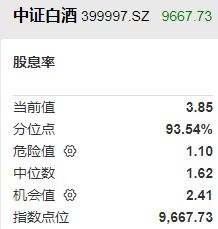
Core Viewpoint - The Chinese liquor industry is experiencing a significant downturn, with a 18% year-on-year decline in quarterly revenue, marking the worst performance since the 2012-2015 adjustment period, leading to a "de-inventory" phase across the sector [1][2]. Industry Performance - In Q3 2025, the liquor industry's revenue, net profit attributable to shareholders, and cash collection were 78.7 billion yuan, 28 billion yuan, and 83.9 billion yuan, respectively, reflecting declines of 18.4%, 22.2%, and 26.7% year-on-year [2][3]. - The high dividend yield of the liquor sector, which has reached 3.85% as of November 4, 2025, is seen as a stabilizing factor during this challenging period [3][5]. Market Sentiment - Market sentiment is fluctuating between "worry" and "expectation," with both corporate valuations and institutional holdings at historical lows [2][7]. - The current market environment is characterized by a significant withdrawal of capital, with public funds reducing their holdings in the liquor sector [1][11]. Dividend Insights - Over the past decade, the total cash dividends in the liquor industry have increased from 15.81 billion yuan in 2015 to 119.03 billion yuan in 2024 [4]. - Eleven liquor companies have a dividend yield exceeding 3%, with Yanghe Co. leading at 6.59% [5][6]. Valuation and Investment Outlook - The current price-to-earnings (P/E) ratio of the liquor index is 19.52, significantly lower than the 10-year average of 31.1, indicating a high safety margin for valuations [8][10]. - Analysts suggest that the liquor sector may no longer be viewed as a cyclical growth stock, with future price appreciation expected to come from stable earnings growth and dividends [7][10]. Fund Holdings and Strategy - As of Q3 2025, active equity funds have shown a trend of "overall reduction and structural differentiation" in their liquor stock holdings, with high-end liquor companies facing sell-offs while mid-tier brands gain traction [11][14]. - Notably, funds have increased their positions in companies like Luzhou Laojiao and Shanxi Fenjiu, while reducing holdings in leading brands like Kweichow Moutai and Wuliangye [14][17].
白酒两轮周期全扫描:行业家底更厚 头部抗跌能力更强
2 1 Shi Ji Jing Ji Bao Dao· 2025-11-07 01:56
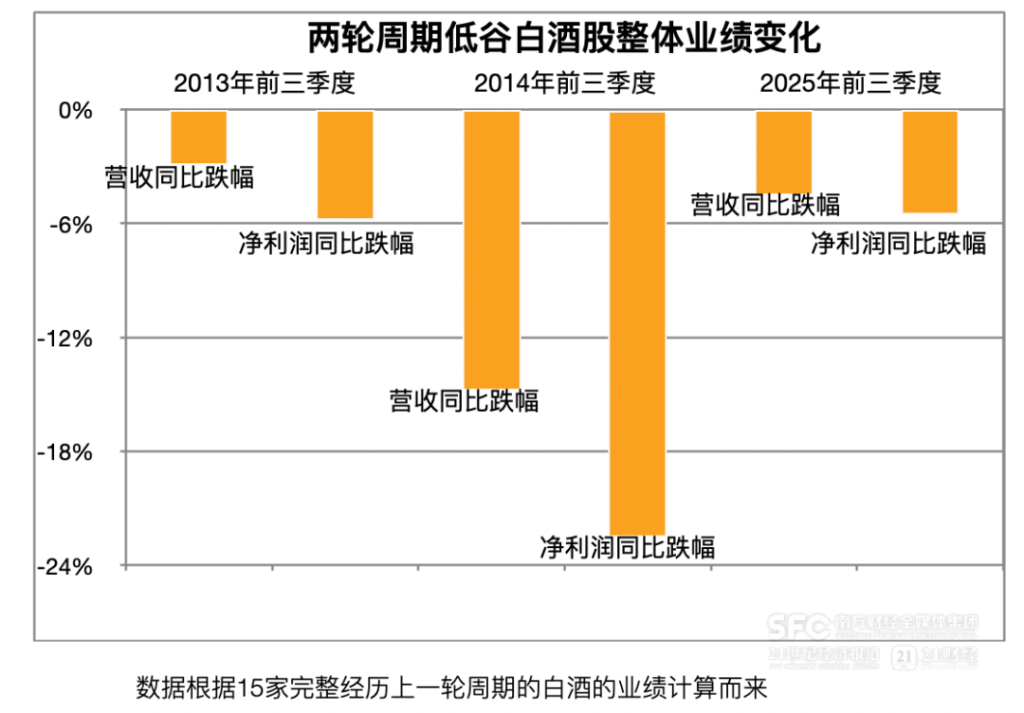
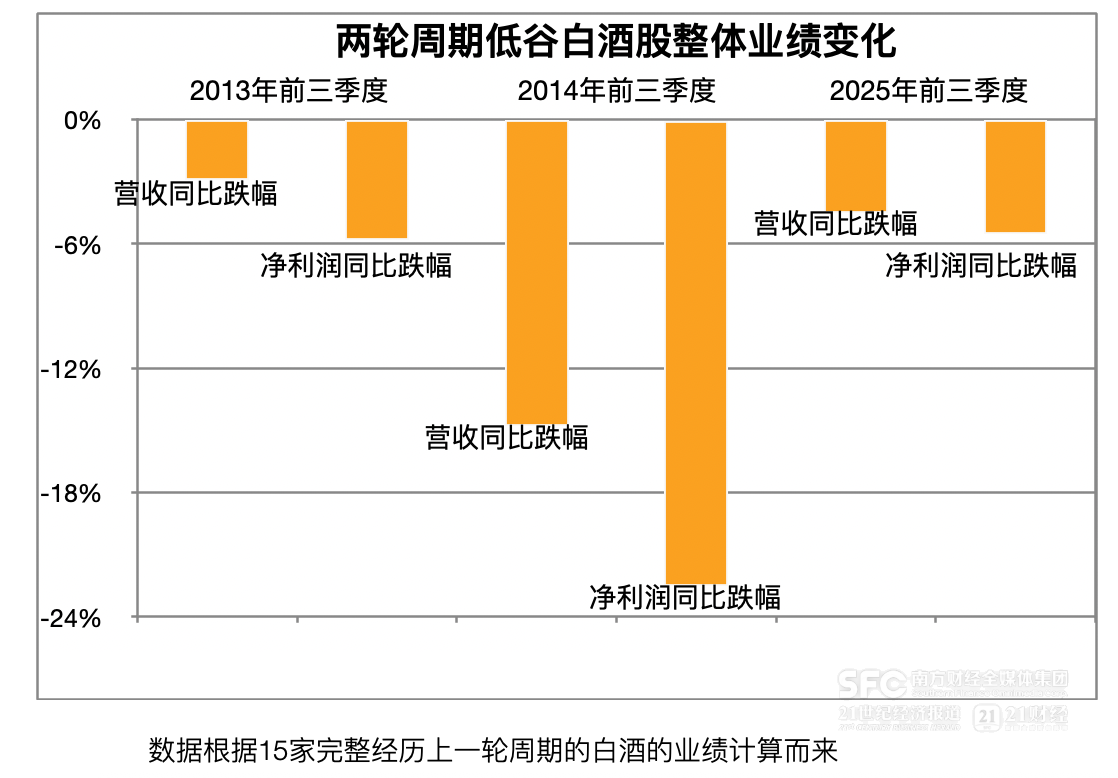
Core Viewpoint - The 2025 Q3 report for the liquor industry indicates a significant downturn, marking the worst quarter in the past decade, with most companies experiencing substantial profit declines, while only a few, like Kweichow Moutai and Shanxi Fenjiu, managed to maintain positive growth [1] Group 1: Performance Comparison - Among the 21 A-share liquor companies, only 15 have fully experienced the previous downturn, including Kweichow Moutai, Shanxi Fenjiu, and Wuliangye [2] - The overall resilience of these 15 companies has improved, with revenue and net profit declines of 4.5% and 5.5% respectively in 2025, compared to larger declines in the previous cycle [3] Group 2: Company-Specific Insights - In 2025, Kweichow Moutai and Shanxi Fenjiu are the only companies showing both revenue and profit growth, contrasting with the previous cycle where only one company managed to do so [6] - Wuliangye's net profit decline is limited to under 14%, while Shanxi Fenjiu has returned to positive growth [7] - Luzhou Laojiao has significantly improved its performance, with revenue and profit declines controlled to single digits in 2025, compared to much larger declines in the previous cycle [7][8] Group 3: Profitability and Financial Health - The total net profit of the 15 companies exceeded 1100 billion in 2025, significantly higher than the previous cycle's total of under 280 billion [10] - The accumulated undistributed profits of these companies reached 4688 billion, five times that of 2013, providing a strong financial cushion [13][15] - Kweichow Moutai's undistributed profits are seven times higher than in 2013, indicating robust financial health [15] Group 4: Cost Management - Many companies have reduced their sales expense ratios compared to the previous cycle, indicating a more restrained approach to spending [29] - Kweichow Moutai maintains a very low sales expense ratio, consistently around 3-4%, reflecting strong brand recognition and market confidence [33] Group 5: Channel Confidence and Cash Flow - The confidence of distributors in head companies has improved, with many reporting increases in contract liabilities, indicating better cash flow management [38] - However, some non-head companies are experiencing negative cash flow, with five companies reporting negative net cash flow from operating activities for two consecutive years [42]
21特写|白酒两轮周期全扫描:行业家底更厚 头部抗跌能力更强
2 1 Shi Ji Jing Ji Bao Dao· 2025-11-07 01:51
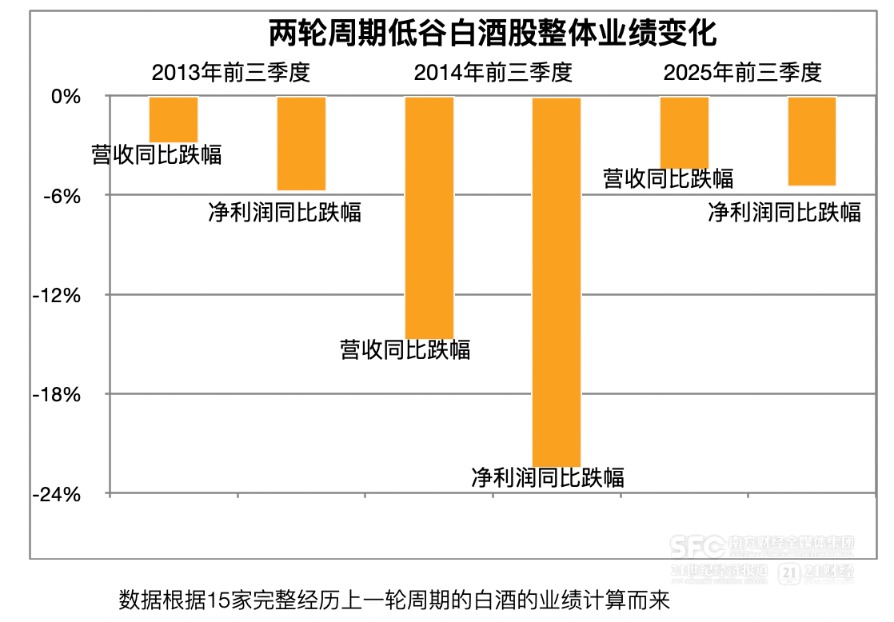
Core Viewpoint - The 2025 Q3 report for the liquor industry is the worst in the past decade, with most companies experiencing significant declines in performance, while only a few, like Kweichow Moutai and Shanxi Fenjiu, managed to maintain positive growth [1] Group 1: Performance Comparison - Among the 21 A-share liquor companies, only 15 have fully experienced the previous adjustment period, including Kweichow Moutai, Shanxi Fenjiu, and Wuliangye [2][3] - The overall decline in revenue and net profit for these 15 companies in 2025 Q3 was 4.5% and 5.5%, respectively, compared to larger declines during the previous cycle [4] - The number of leading liquor companies showing positive growth has increased, with Kweichow Moutai and Shanxi Fenjiu both achieving revenue and profit growth in 2025 Q3 [7] Group 2: Profitability and Financial Resilience - The total net profit for the 15 companies exceeded 110 billion yuan in 2025 Q3, significantly higher than the previous cycle's figures [12] - The accumulated undistributed profits for these companies reached 468.8 billion yuan, five times that of 2013, indicating a stronger financial cushion [13][15] - Kweichow Moutai's undistributed profits are seven times higher than in 2013, showcasing its robust financial health [15] Group 3: Cost Management and Sales Strategy - Liquor companies have learned from past experiences and are controlling sales expenses more effectively, with many reducing their sales expense ratios compared to the previous cycle [26][28] - Kweichow Moutai maintains a low sales expense ratio of around 3-4%, reflecting strong brand recognition and market confidence [31] Group 4: Channel Confidence and Cash Flow - The confidence of distributors has improved, with contract liabilities for the 15 companies increasing by 3.6% in 2025 Q3, contrasting sharply with the previous cycle's declines [33] - However, some non-leading companies are experiencing negative cash flow, with five companies reporting negative net cash flow from operating activities for two consecutive years [39]
白酒黄金时代终结?十年最差三季报来了
3 6 Ke· 2025-11-06 12:25
Core Viewpoint - The Chinese liquor industry, particularly the baijiu sector, is experiencing a significant downturn, with major companies reporting their worst third-quarter financial results in a decade, indicating a shift into a new cycle of challenges and market dynamics [1][6]. Industry Performance - In the first three quarters of the year, 20 A-share baijiu companies reported a total revenue of approximately 317.8 billion yuan, a year-on-year decline of 5.90%, and a net profit of about 12.26 billion yuan, down 6.93% [1]. - The overall revenue for the third quarter was around 77.98 billion yuan, reflecting an 18.47% year-on-year decrease, while net profit fell to approximately 28.01 billion yuan, a decline of 22.22% [1]. Market Dynamics - The baijiu industry is entering a phase of differentiation, with top brands like Moutai and Wuliangye showing weak growth, and regional brands experiencing severe declines in performance [3][4]. - The traditional strategies of price increases and inventory control are losing effectiveness as consumer preferences shift towards value and taste rather than brand prestige [4][5]. Consumer Behavior Changes - There is a notable decline in high-end gifting demand and a shift in consumer confidence, leading to reduced sales in high-end dining and business banquet scenarios [2][8]. - Younger consumers are increasingly favoring lower-alcohol beverages and are less inclined to participate in traditional drinking culture, with over 60% preferring non-alcoholic options in social settings [8][9]. Inventory and Pricing Issues - The industry is facing significant inventory challenges, with many companies reporting extended inventory turnover periods, leading to increased pressure on cash flow and necessitating promotional discounts [11][14]. - The reliance on price increases for profit has backfired as demand slows, resulting in a rapid erosion of previously established profit margins [12][13]. Future Outlook - The baijiu sector is transitioning from a period of guaranteed growth to a more competitive landscape where companies must adapt to changing consumer preferences and market conditions [6][10]. - The traditional high-margin structure of the industry is under threat, with many smaller brands struggling to survive amid rising costs and declining sales [14][15].


白酒2025年三季报总结:加速纾压,底部渐明
Soochow Securities· 2025-11-06 11:05
Investment Rating - The report maintains an "Accumulate" rating for the liquor industry [1] Core Viewpoints - The liquor industry is currently in a phase of pressure relief and clearing, with expectations for performance recovery in the future. The focus should be on companies that show early signs of a turning point and have leading growth elasticity [3] - The overall revenue of the liquor sector has declined, with a 5.5% year-on-year drop in total revenue for the first three quarters of 2025, and an 18.3% decline in Q3 alone. Net profit also saw a significant decrease of 21.9% in Q3 [12][24] - The high-end liquor segment is under pressure, with a need for macroeconomic recovery to achieve a balance in volume and price. Companies with strong brand positioning and national expansion potential are recommended for investment [3][12] Summary by Sections 1. Q3 Performance and Market Conditions - The Q3 performance of the liquor sector shows a slow recovery in consumption scenarios, with overall sales continuing to face pressure. The high-end and next-high-end liquor demand remains under pressure, particularly in business and personal dining scenarios [12][13] - The overall revenue for the liquor sector in Q3 dropped by 18.3% year-on-year, with net profit down by 21.9%, indicating a significant acceleration in the decline compared to previous quarters [12][24] 2. Revenue Trends - The liquor sector's revenue has been on a downward trend, with a 5.5% year-on-year decline in the first three quarters of 2025. The Q3 revenue decline is particularly sharp at 18.3% [12][24] - High-end liquor companies are experiencing a shift in their financial reports, with revenue declines driven by pressure on major brands like Moutai and Wuliangye [30][41] 3. Profitability Analysis - The gross profit margin for the liquor sector has decreased, with Q3 margins at 81.7%, down 0.7 percentage points year-on-year. The decline in profitability is attributed to structural issues and increased costs [2][3] - The report highlights that the majority of liquor companies have seen an increase in sales expenses, while management expenses have also risen slightly due to weaker revenue realization [2][3] 4. Investment Recommendations - The report suggests prioritizing investments in companies that are likely to recover first, such as Luzhou Laojiao and Shanxi Fenjiu, which have strong governance and dividend yields. Other companies to watch include Zhenjiu Lidu and Shede Liquor [3][12] - The focus should be on companies that can maintain channel stability and show early signs of marginal recovery, as the market is expected to support valuations for these firms [12][13]


江苏共有上市公司715家
Sou Hu Cai Jing· 2025-11-06 06:52
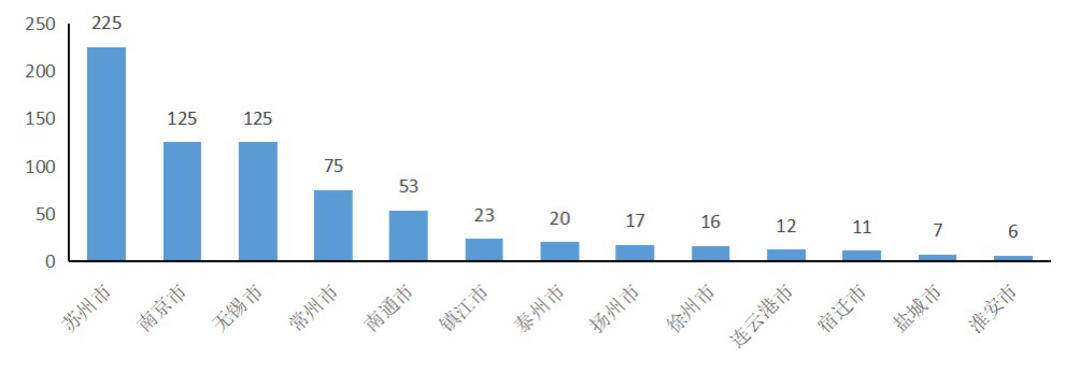
Group 1 - As of October 31, 2025, Jiangsu has a total of 715 listed companies, including 220 on the Shanghai Stock Exchange Main Board, 114 on the Sci-Tech Innovation Board, 125 on the Shenzhen Stock Exchange Main Board (including one pure B-share), 203 on the Growth Enterprise Market, and 53 on the Beijing Stock Exchange [1] - In October 2025, Jiangsu added one new listed company (Changjiang Nengke), bringing the total number of new listings in 2025 to 21 [1] - The total market capitalization of the 714 listed companies in Jiangsu is 85,985.35 billion yuan, accounting for 13.12% of the total number of A-share listed companies and 8.01% of their total market capitalization [3] Group 2 - As of October 31, 2025, the companies in Jiangsu with a market capitalization exceeding 100 billion yuan (excluding the Beijing Stock Exchange) include Hengrui Medicine, WuXi AppTec, Jiangsu Bank, Guodian Nari, Huatai Securities, Nanjing Bank, Huidian Co., S. Hengli Hydraulic, Dongshan Precision, Xugong Machinery, Tianfu Communication, and Yanghe Brewery [5] - The bottom ten ranked A-share listed companies in Jiangsu (excluding the Beijing Stock Exchange) are Yangzi New Materials, Nanwei Co., Guangge Technology, Xuelang Environment, Zhongshe Co., *ST Hengjiu, Ailong Technology, Jinpu Garden, *ST Tianlong, and *ST Suwu [7] - In October 2025, Jiangsu's A-share listed companies had a total of 3 financing events, raising a total of 1.269 billion yuan, while the total financing events for the year reached 49, raising a total of 61.438 billion yuan [7]