BYD(002594)

Search documents
韩媒称韩国“唯一领先战略技术”二次电池,被中国反超
Guan Cha Zhe Wang· 2026-02-22 10:27
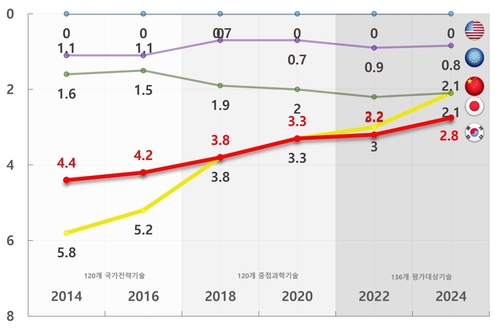
Core Insights - The technology gap between South Korea and China in key strategic sectors is widening, particularly in the secondary battery field, where China has overtaken South Korea as of 2024 [1][3] - South Korea's overall technology level is assessed at 82.8% compared to the United States, with a significant gap of 2.8 years, while the gap with China has increased to 0.7 years [3] Group 1: Technology Assessment - In the secondary battery sector, South Korea was leading by 0.9 years in 2022 but has fallen behind China by 0.2 years in 2024 [1] - The evaluation covered 136 core technologies across 11 sectors, analyzing papers and patents from South Korea, China, Japan, Europe, and the United States [1] - South Korea's semiconductor and display sectors have also seen a decline, with a lag of 0.7 years behind the U.S. and 0.8 years behind China as of 2024 [3] Group 2: Market Dynamics - The global market share of South Korean electric vehicle battery manufacturers has decreased from 35% in 2020 to 23% in 2023, with projections of further decline to 16% by October 2025 [5] - Despite the growth in global electric vehicle sales, the growth rate is expected to drop significantly from 25%-28% to around 15% by 2025 [4] - South Korean battery companies are facing intense competition from Chinese firms like CATL and BYD, which have a substantial market presence [5] Group 3: Domestic Market Disparities - The domestic market for South Korean secondary batteries is only about 2% of China's, with the energy storage market at approximately 1% [6] - South Korean companies have over 90% of their production facilities located overseas, while Chinese firms like CATL and BYD have about 97% of their capacity concentrated domestically [6] - The market share of South Korean companies in Europe has dropped from over 60% in 2022 to below 40% recently due to strong competition from Chinese firms [6] Group 4: Material Dependency - South Korean battery manufacturers are heavily reliant on China for core materials that constitute 60% of secondary battery costs, with Chinese companies controlling around 80% of the global market for these materials [7]



崔东树:1月我国电池供需逐步改善 重卡电池暴增
智通财经网· 2026-02-22 06:12
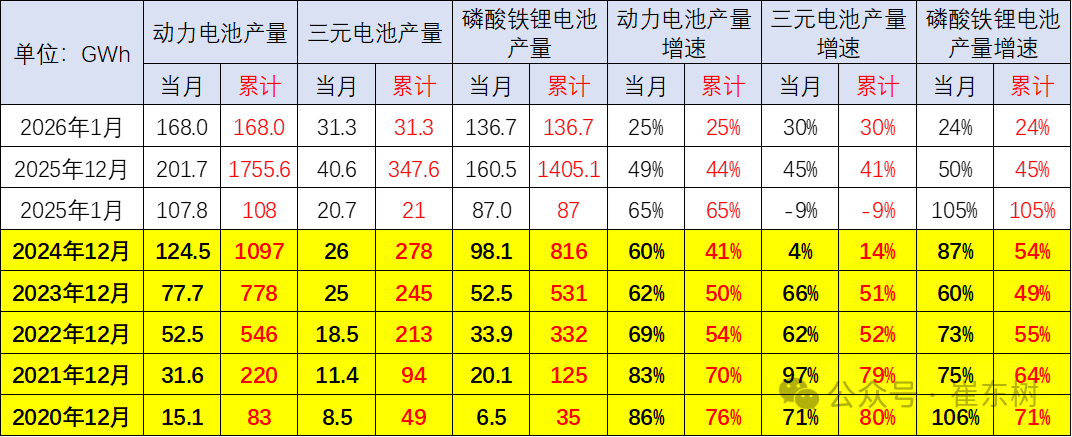
Core Insights - The overall performance of the power battery market in January 2026 is weak, with both exports and domestic sales showing mediocre results, leading to a decline in the growth rate of battery production from over 40% to 25% year-on-year [1][3][9] Group 1: Battery Production and Demand - In January 2026, the total production of power and other batteries reached 168 GWh, marking a 25% increase year-on-year [1] - The demand for installed batteries is heavily reliant on the surge in heavy-duty vehicle batteries due to high subsidies [1][3] - The installation rate of power batteries has decreased significantly, dropping to 25% in January 2026, with ternary batteries at 30% and lithium iron phosphate batteries at 24% [2][4] Group 2: Market Trends and Changes - The demand for batteries in the energy storage sector has increased rapidly, influenced by the global energy crisis stemming from the Russia-Ukraine conflict, leading to a notable decline in the proportion of installed batteries [3][8] - The growth rate of power batteries has lagged behind the growth of complete vehicles in 2021 and 2022, with a low installation rate expected for 2023 and 2024 [3][4] - The market for pure electric passenger vehicles continues to dominate, while plug-in hybrid passenger vehicles have risen to second place in terms of battery demand [7][8] Group 3: Competitive Landscape - The competitive landscape of battery manufacturers remains relatively stable, with the number of supporting battery companies at a low of 33 in January 2026 [10][11] - CATL's market share increased to 50.1% in the first quarter of 2026, while BYD's share decreased to 17.5%, indicating a significant concentration of market power among leading manufacturers [15] - The trend of vehicle manufacturers increasingly collaborating with battery producers is becoming more pronounced, suggesting a shift towards integrated supply chains in the industry [12][15]
26股获机构上调评级至“买入”:汽车、食品饮料、电子等板块多只个股上榜
Xin Lang Cai Jing· 2026-02-22 00:25
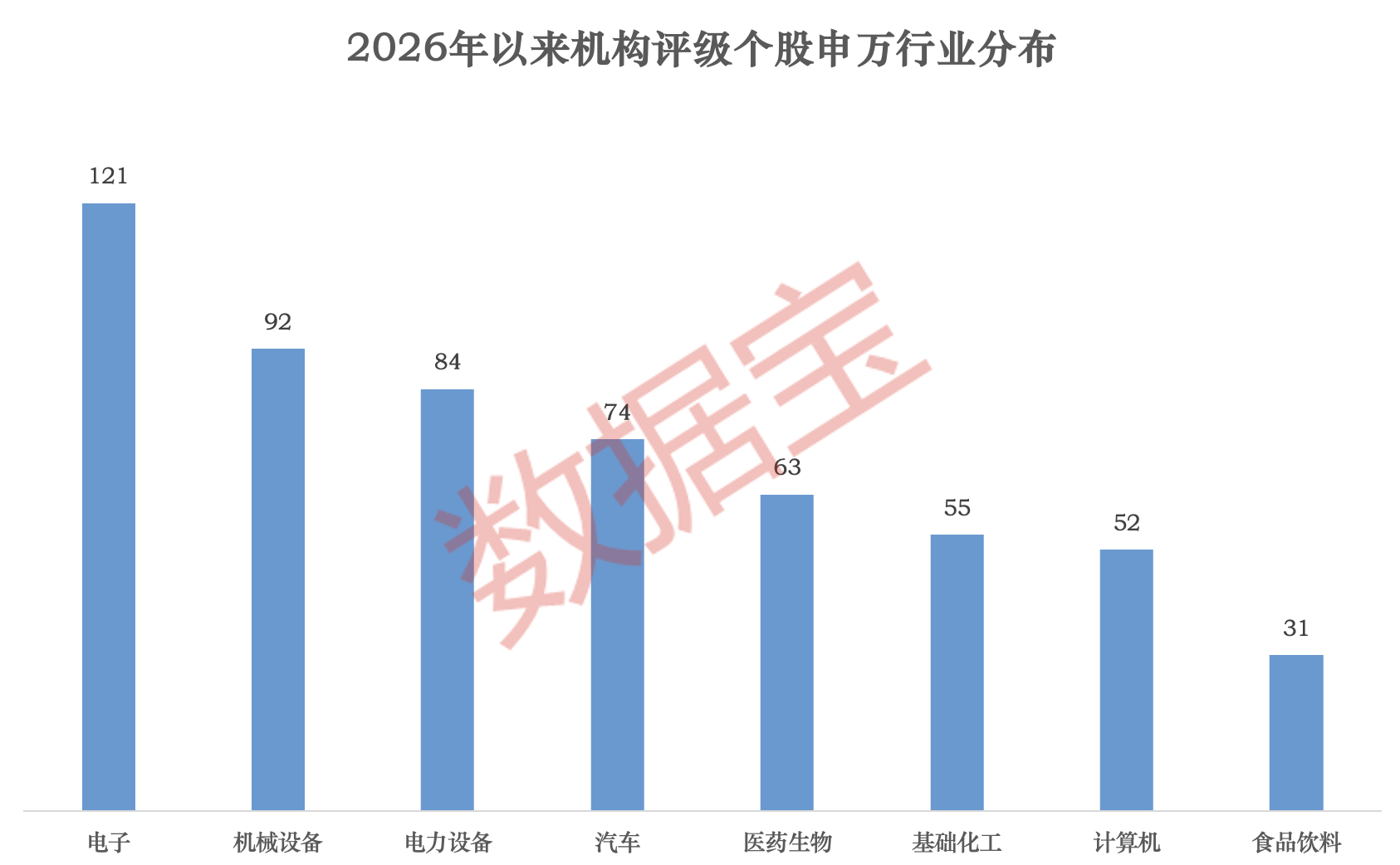
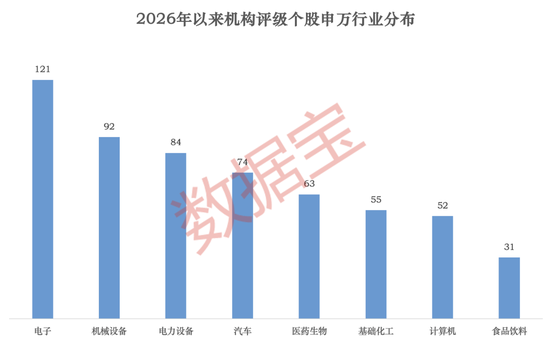
Group 1 - Since 2026, a total of 63 institutions have conducted 1,827 ratings, with 932 stocks receiving a "buy" rating from brokerage reports, including buy, overweight, strong buy, and recommend [1] - The stocks rated by institutions are primarily concentrated in the electronics, machinery equipment, and power equipment industries, with 121, 92, and 84 stocks respectively [1] - The automotive, pharmaceutical, basic chemicals, and computer sectors follow closely, each with over 50 rated stocks [1] Group 2 - Among the stocks rated by five or more institutions, Dongpeng Beverage, BYD, Wancheng Group, Kweichow Moutai, and China Duty Free rank highest, with 16, 15, 14, 14, and 14 institutions respectively [1] - A total of 26 stocks have had their ratings upgraded, including Weichai Power, Seres, Jianghuai Automobile, and Lin Tai New Materials from the automotive sector, as well as Wancheng Group, New Dairy, and Quanyuan Spring from the food and beverage sector [1] Group 3 - The companies with the highest institutional attention since 2026 include Dongpeng Beverage with a net profit of 4.465 billion yuan, a year-on-year increase of 34.22% [5] - BYD's net profit data is not specified, while Wancheng Group is projected to have a net profit of 1.315 billion yuan, a significant increase of 244.66% [5] - Kweichow Moutai and China Duty Free both received ratings from 14 institutions, but their net profit data is not disclosed [5] Group 4 - Weichai Power has a total market value of 235.07 billion yuan and has seen a price increase of 55.76% since 2026 [6] - Jianghuai Automobile has a market value of 128.85 billion yuan with a price increase of 15.47% [6] - Wancheng Group has a market value of 39.79 billion yuan with a modest price increase of 3.45% [6]



马年启新程|26股获机构上调评级至“买入”!
Xin Lang Cai Jing· 2026-02-21 23:47
Core Viewpoint - The report highlights the increasing institutional interest in various sectors, particularly in electronics and automotive, with a significant number of stocks receiving "buy" ratings from analysts. Group 1: Institutional Ratings - A total of 63 institutions conducted 1,827 ratings since 2026, with 932 stocks receiving "buy" ratings, including buy, accumulate, strong recommendation, and recommendation [1][12]. - The electronics sector has the highest number of rated stocks, followed by machinery, power equipment, automotive, pharmaceuticals, basic chemicals, and computers, with each having over 50 rated stocks [2][13]. Group 2: Electronics Sector Performance - The electronics index has risen by 8.41% this year, significantly outperforming the Shanghai Composite Index, with the semiconductor index showing the highest increase of 13.93% [4][14]. - Key semiconductor companies like Baiwei Storage, Zhaoyi Innovation, SMIC, and Jiangfeng Electronics have received ratings from five or more institutions, indicating strong market interest [4][14]. Group 3: Notable Stocks - 67 stocks have received attention from five or more rating agencies, with Dongpeng Beverage, BYD, Wancheng Group, Kweichow Moutai, and China Duty Free leading the list [5][15]. - Dongpeng Beverage is projected to achieve revenue of 20.76 billion to 21.12 billion yuan in 2025, with a year-on-year growth of 31.07% to 33.34%, and a net profit of 4.34 billion to 4.59 billion yuan, reflecting a growth of 30.46% to 37.97% [5][15]. - BYD's sales in January were 210,100 units, a year-on-year decrease of 30.11%, attributed to inventory reduction and a transitional policy period [5][15]. Group 4: Future Growth Prospects - Baiwei Storage is expected to achieve revenue of 10 billion to 12 billion yuan in 2025, with a year-on-year growth of 49.36% to 79.23%, and a net profit of 850 million to 1 billion yuan, reflecting a growth of 427.19% to 520.22% [10][19]. - The company is focusing on AI storage solutions and has strong competitive advantages through self-developed chips and advanced packaging capabilities [11][19].
2026年1月新能源车销量:比亚迪第一,小米力压问界跃升至第二
Hang Zhou Ri Bao· 2026-02-21 10:20
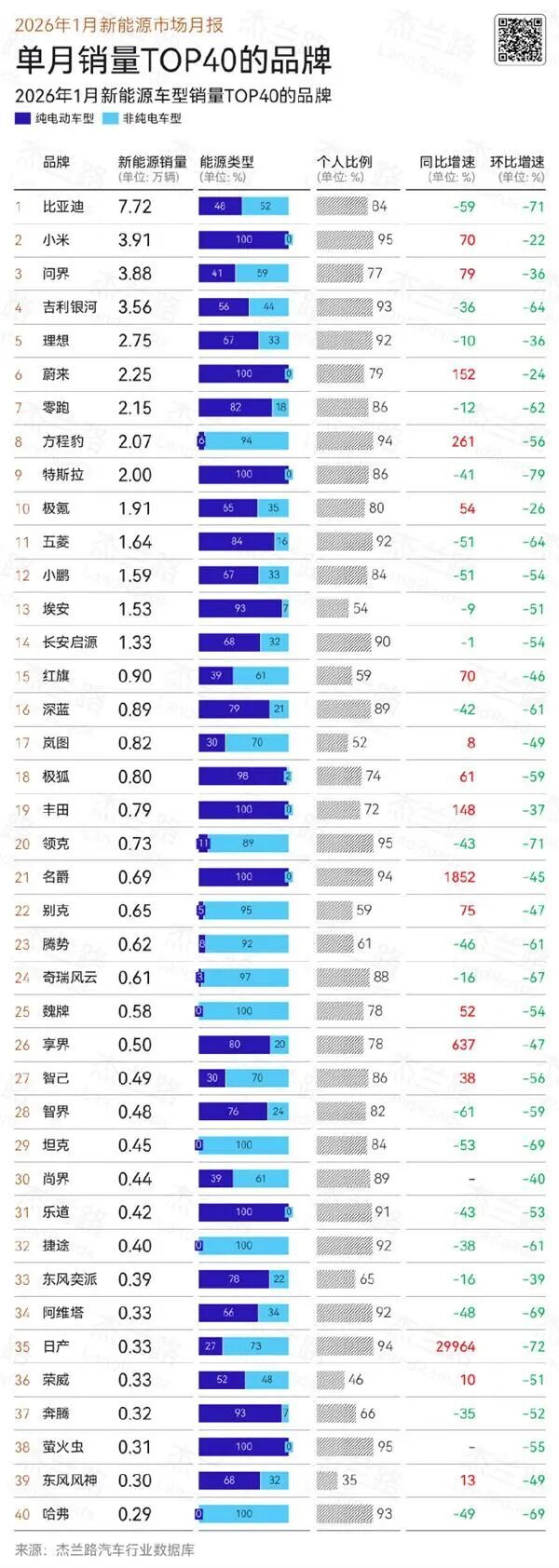
Core Insights - The report from LandRoads indicates that Xiaomi has risen to the second position in the domestic new energy passenger vehicle market as of January 2026 [1]. Market Overview - Total sales of new energy passenger vehicles in January 2026 reached 563,000 units, representing a year-on-year decline of 20% and a month-on-month decline of 58% [2]. - The penetration rate of new energy vehicles in the passenger car market was 36.3%, down from 57.4% the previous month and slightly lower than 38.5% in January 2025 [2]. Sales Breakdown by Vehicle Type - Pure electric vehicle sales totaled 344,000 units, down 11% year-on-year and 56% month-on-month [2]. - Plug-in hybrid vehicle sales were 152,000 units, down 35% year-on-year and 63% month-on-month [2]. - Range-extended vehicle sales reached 67,000 units, down 15% year-on-year and 52% month-on-month [2]. Top Selling Models - The top-selling new energy sedan in January was the Geely Galaxy Star Wish, with sales of 14,900 units [2]. - The best-selling new energy SUV was Xiaomi YU7, with sales of 37,900 units, making it the overall sales champion for the month [2][3]. Company Rankings - BYD maintained its leading position with sales of 77,200 units, while Xiaomi sold 39,100 units, surpassing Aion's 38,800 units [3]. - The sales rankings for new energy vehicle manufacturers in January were as follows: 1. BYD: 77,200 units 2. Xiaomi: 39,100 units 3. Aion: 38,800 units [4][3]. Detailed Sales Data - The detailed sales data for January 2026 shows that BYD's sales decreased by 59% year-on-year and 71% month-on-month [4]. - Xiaomi's sales increased by 70% year-on-year but decreased by 22% month-on-month [4]. - Other notable manufacturers included Geely with 35,600 units and Ideal with 27,500 units [4].

比亚迪股份股价下跌,受市场环境与业绩压力影响
Jing Ji Guan Cha Wang· 2026-02-21 09:48
Core Viewpoint - BYD's stock price decline on February 20, 2026, is attributed to a combination of overall market conditions, industry performance, and recent fundamental factors affecting the company [1]. Market Environment - The Hong Kong stock market weakened on that day, with the Hang Seng Index dropping by 1.10% and the Hang Seng Tech Index falling by 2.91%. The automotive sector showed overall weakness, declining by 2.24%, which negatively impacted BYD as a key component stock in the sector [2]. Performance and Operating Conditions - According to a report from Guolian Minsheng Securities published on February 3, 2026, BYD's wholesale sales of new energy passenger vehicles in January 2026 were 205,000 units, representing a year-on-year decline of 30.7% and a month-on-month decrease of 50.5%, indicating significant short-term sales pressure. Additionally, the Q3 2025 financial report showed a revenue decrease of 3.05% year-on-year and a net profit decline of 32.6%, raising ongoing concerns about the company's profitability [3]. Financial and Technical Aspects - In terms of capital flow, despite a net inflow of HKD 56.736 million from major funds on that day, the stock price remained under selling pressure. Technically, the stock price was below key moving averages such as the 5-day and 30-day averages, with the Bollinger Band middle line (HKD 96.51) acting as resistance. Although the MACD histogram was positive, the momentum was limited, reflecting short-term adjustment pressure [4]. Company Status - The decline in BYD's stock price is a result of market sentiment, weak industry performance, and short-term pressures on sales and earnings [5].
比亚迪公布国际专利申请:“封装结构及其制备方法以及电路板和电子设备”
Sou Hu Cai Jing· 2026-02-21 01:05
证券之星消息,根据企查查数据显示比亚迪(002594)公布了一项国际专利申请,专利名为"封装结构 及其制备方法以及电路板和电子设备",专利申请号为PCT/CN2025/113682,国际公布日为2026年2月19 日。 专利详情如下: 今年以来比亚迪已公布的国际专利申请343个,较去年同期增加了547.17%。结合公司2025年中报财务 数据,2025上半年公司在研发方面投入了295.96亿元,同比增50.84%。 数据来源:企查查 以上内容为证券之星据公开信息整理,由AI算法生成(网信算备310104345710301240019号),不构成 投资建议。 图片来源:世界知识产权组织(WIPO) ...

比亚迪公布国际专利申请:“一种车辆”
Sou Hu Cai Jing· 2026-02-21 00:18
证券之星消息,根据企查查数据显示比亚迪(002594)公布了一项国际专利申请,专利名为"一种车 辆",专利申请号为PCT/CN2025/096080,国际公布日为2026年2月19日。 专利详情如下: 图片来源:世界知识产权组织(WIPO) 今年以来比亚迪已公布的国际专利申请343个,较去年同期增加了547.17%。结合公司2025年中报财务 数据,2025上半年公司在研发方面投入了295.96亿元,同比增50.84%。 数据来源:企查查 以上内容为证券之星据公开信息整理,由AI算法生成(网信算备310104345710301240019号),不构成 投资建议。 ...
比亚迪汽车:辅助驾驶车辆保有量超256万辆
Bei Ke Cai Jing· 2026-02-20 15:04
Group 1 - The core point of the article is that BYD has reported significant growth in its autonomous driving vehicle fleet and data generation capabilities [1] Group 2 - BYD's auxiliary driving vehicle ownership has exceeded 2.56 million units [1] - The "Tian Shen Zhi Yan" auxiliary driving system generates over 160 million kilometers of data daily [1]
今日新闻丨春节假期前3天高速充电超140万次!比亚迪RACCO预计今年夏季在日本销售!
电动车公社· 2026-02-20 00:36
Group 1 - The core point of the article highlights the significant increase in electric vehicle charging during the Spring Festival holiday, with over 1.4 million charging sessions recorded on highways, representing a 63.05% increase compared to the same period last year [2][3]. - The average daily charging volume reached 11.8 million kilowatt-hours during the holiday, indicating a growing demand for charging services as the number of electric vehicles increases [2][3]. - The expansion of fast charging stations and improvements in charging speed have effectively met the needs of consumers traveling during the holiday season [3]. Group 2 - BYD is set to launch the RACCO model in Japan during the summer of 2026, specifically designed to cater to the Japanese market with a popular K-Car design [4][5]. - The RACCO will feature front-wheel drive and utilize lithium iron phosphate batteries, incorporating BYD's latest three-electric technology [5]. - The vehicle's design aligns with Japanese market preferences, and if priced appropriately, it is expected to receive positive market feedback [8].