Goldman Sachs(GS)

Search documents
过山车一夜?全球市场今晚“好戏连场”
Hua Er Jie Jian Wen· 2026-01-09 06:48
Core Viewpoint - Global investors are preparing for a highly volatile "Super Friday," with significant events that could reshape short-term pricing logic in the bond, stock, and commodity markets [1]. Economic Data - The U.S. non-farm payroll report for December will be released at 21:30 Beijing time, serving as a crucial reference for assessing economic health and influencing the Federal Reserve's interest rate decisions [1][3]. - Economists predict a job increase of 70,000 in December, with the unemployment rate expected to drop from 4.6% to 4.5% [6]. Federal Reserve Policy - The non-farm payroll data is viewed as a "deciding hammer" for the Fed's policy, with a weak report potentially increasing the likelihood of a rate cut in January to 50% [6]. - Current market pricing indicates only a 10% chance of a rate cut this month, with the next expected in June [6]. Supreme Court Ruling - The market is closely watching the Supreme Court's decision on the legality of Trump’s tariffs, which could have a binary effect on the stock and bond markets [7]. - If tariffs are overturned, the S&P 500 could rise by 0.75%-1%, while maintaining tariffs could lead to a decline of 30-50 basis points [7][8]. Commodity Market Dynamics - The commodity market is facing a "double storm" with the upcoming results of the "232 clause" tariff investigation and significant index rebalancing trades [2][10]. - The annual rebalancing of the Bloomberg Commodity Index has begun, with an expected influx of approximately $7.7 billion in silver sell orders, equating to 13% of total COMEX silver open interest [12]. Market Reactions - Analysts warn that the combination of tariff rulings and commodity market adjustments could lead to extreme volatility, particularly in precious metals like palladium and silver [10][12]. - The potential for a liquidity vacuum could trigger severe repricing in the market, with differing views on whether prices will continue to rise or face significant downward risks once liquidity improves [12][13].


高盛:预计2026年全球经济将实现2.8%的稳健增长,高于市场普遍预期的2.6%
Sou Hu Cai Jing· 2026-01-09 06:44
钛媒体App 1月9日消息,高盛研究部预测2026年全球经济预计将实现2.8%的稳健增长,高于市场普遍 预期的2.6%。美国经济表现将尤为突出,预计增长2.8%(市场预期2.0%),主要得益于关税拖累减 弱、减税政策以及更为宽松的金融环境。中国经济也将保持良好势头,预计增长4.8%(市场预期 4.5%),强劲的出口将有效抵消国内需求疲软的影响。尽管面临长期挑战,欧元区经济前景依然乐 观,预计增长1.3%(市场预期1.1%),得益于德国的财政刺激和西班牙的强劲增长。(广角观察) ...
高盛:预计2026年全球经济将实现2.8%的稳健增长 高于市场普遍预期的2.6%
Sou Hu Cai Jing· 2026-01-09 06:39
来源:金融界AI电报 高盛研究部预测2026年全球经济预计将实现2.8%的稳健增长,高于市场普遍预期的2.6%。美国经济表 现将尤为突出,预计增长2.8%(市场预期2.0%),主要得益于关税拖累减弱、减税政策以及更为宽松 的金融环境。中国经济也将保持良好势头,预计增长4.8%(市场预期4.5%),强劲的出口将有效抵消 国内需求疲软的影响。尽管面临长期挑战,欧元区经济前景依然乐观,预计增长1.3%(市场预期 1.1%),得益于德国的财政刺激和西班牙的强劲增长。 ...
上证指数站上4100点
Sou Hu Cai Jing· 2026-01-09 06:39
Core Viewpoint - Goldman Sachs predicts that the MSCI China Index and the CSI 300 Index will rise by 20% and 12% respectively by 2026 [6] Group 1: Market Performance - On January 9, 2026, the Shanghai Composite Index broke through the 4100-point mark, marking a significant milestone not seen in ten years [3] - The Shanghai Composite Index achieved a fifteen-day consecutive rise, reaching a high of 4095.33 points, up 0.30% on January 9 [3] - The market showed strong trading activity with a half-day turnover exceeding 2 trillion yuan [3] Group 2: Factors Driving Market Growth - The recent rise in A-shares is attributed to a combination of positive factors, including high liquidity, favorable policy expectations, and investor sentiment [4] - The liquidity outlook improved due to anticipated interest rate cuts by the Federal Reserve and a dual easing monetary policy set by the domestic central economic work conference [4] - The central economic work conference emphasized expanding domestic demand and technological innovation as key focuses for 2026, providing structural investment opportunities [4] Group 3: Institutional Outlook - Citic Securities forecasts a continued bull market in 2026, driven by policy shifts and improved liquidity, alongside a focus on technology sector growth [5] - The investment community is optimistic about the Chinese market, with Goldman Sachs maintaining an overweight rating on A-shares and H-shares [6] - Morgan Stanley also raised its rating on the Chinese market to "overweight," citing reasonable valuations and light positioning by international investors [6] Group 4: Earnings Growth Expectations - Goldman Sachs anticipates that corporate earnings in China will grow by 14% and 12% in 2026 and 2027 respectively, with overseas revenue growth contributing to performance [6] - UBS projects that the overall A-share earnings growth rate will increase from 6% in 2025 to 8% in 2026, driven by GDP growth and supportive policies [7]


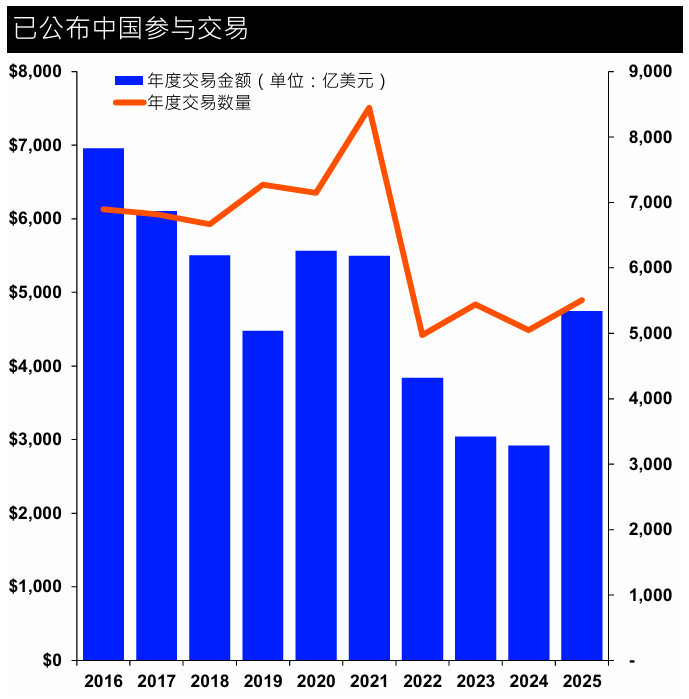
LSEG:2025年度全球涉及中国内地的并购交易总额达4743亿美元 同比增长62.6%
智通财经网· 2026-01-09 06:37
Group 1: Overall M&A Trends - In 2025, the total value of M&A transactions involving mainland China reached $474.3 billion, representing a year-on-year increase of 62.6% and a quarter-on-quarter increase of 81.1% [1] - The number of announced transactions was 5,504, which is a 9.1% increase year-on-year and a 12.4% increase quarter-on-quarter [1] Group 2: Domestic and Foreign M&A Activity - The total value of outbound M&A transactions from mainland China was $24.4 billion, showing a year-on-year growth of 5.2% [3] - The value of foreign acquisitions of mainland Chinese companies was $24 billion, which is a slight decline of 0.7% year-on-year [3] - Domestic M&A transactions in mainland China reached $412.1 billion, marking a significant year-on-year increase of 82.8% [3] Group 3: Sector-Specific Insights - The financial sector dominated M&A transactions, accounting for 22.62% of the market share with a total transaction value of $107.3 billion, which surged by 121% year-on-year [5] - The raw materials sector ranked second with a market share of 16.39%, experiencing a year-on-year growth of 158.2% [5] - The high-tech sector ranked third, holding a market share of 15.26% and a transaction value of $72.4 billion, reflecting a year-on-year increase of 77.3% [5] Group 4: Financial Advisors and Rankings - In 2025, China International Capital Corporation (CICC) topped the financial advisor rankings for announced M&A transactions involving mainland China, with a market share of 18.91% and a transaction value of $89.7 billion [9] - CITIC Securities ranked second with a market share of 15.12%, while Goldman Sachs ranked third with a market share of 9.69% [9] - By transaction volume, the top three financial advisors were Industrial and Commercial Bank of China (ICBC), CITIC Securities, and CICC [10] Group 5: Legal Advisors and Rankings - The top three legal advisors by transaction value in 2025 were King & Wood Mallesons, AllBright Law Offices, and Zhong Lun Law Firm, with respective market shares of 16.1%, 10.9%, and 9.8% [11] - By transaction volume, the leading legal advisors were Fangda Partners, King & Wood Mallesons, and Zhong Lun Law Firm [11]

2026年首个非农夜:今晚美国就业数据会出“幺蛾子”吗?
Sou Hu Cai Jing· 2026-01-09 06:21
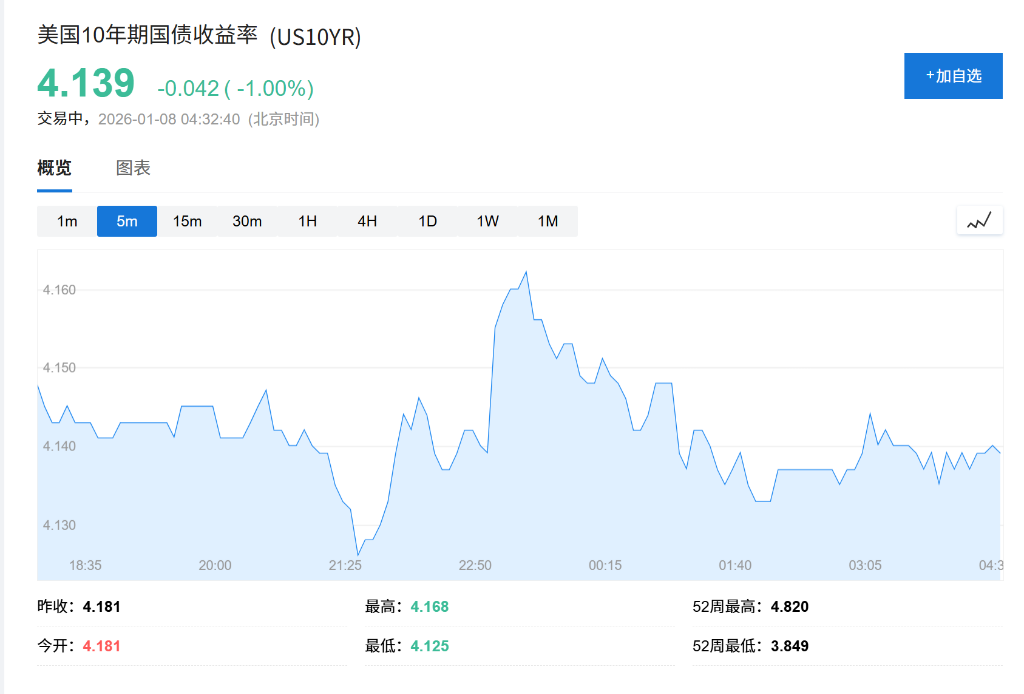
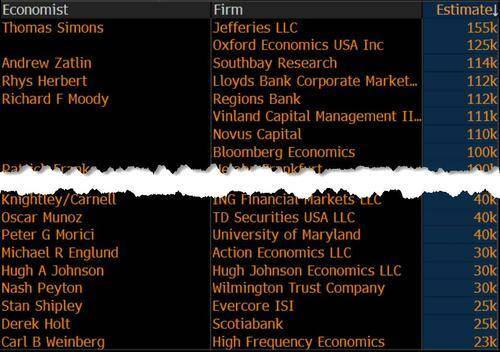
智通财经1月9日讯(编辑 潇湘)2026年全球市场开局强劲。但投资者可能会在本周五面临今年第一个 真正的考验——美国劳工部将于北京时间今晚21点半公布12月就业数据。而在同一天,美国最高法院还 将就美国总统特朗普大部分关税的合法性做出最终裁决。 期权市场的交易员们目前正严阵以待,准备迎接可能是今年迄今为止波动性最大的一个交易日——标普 500指数预计将出现大幅波动。根据盈透证券首席市场策略师Steve Sosnick的说法,以周五到期的平值 合约的定价估算,标普500指数周五预计将出现上下至少0.9%的波动。 Sosnick还质疑投资者是否已足够谨慎。他在一则评论中表示,"相对平静的市场意味着仍有一些意外发 生的可能性。" 非农前瞻:两个多月来最"靠谱"的美国就业数据要来了? 今晚这份非农报告之所以备受瞩目,在一定程度上或许是因为在不少业内人士看来,这或许是美国政府 去年10月经历史上最长停摆以来所出炉的"第一份相对靠谱的就业数据"。这也令这份报告的重要性不言 而喻——今晚数据要么会巩固市场对美联储本月维持利率不变的预期,要么会增强市场对美联储可能连 续第四次降息的看法…… Natixis北美美国利率策略主管 ...
高盛:特朗普政府推迟铜关税决定可能性加大,通胀在中期选举前受关注
Ge Long Hui· 2026-01-09 06:13
格隆汇1月9日|高盛认为,鉴于通胀关切将是中期选举前的关键问题,特朗普政府将铜进口关税的决定 推迟到明年的风险加大。该行的基准预期仍是2026年年中宣布15%的关税,并于2027年落实,但对这一 预期的信心水平降低。高盛将第一季度LME铜价平均价格预期从每吨11550美元上调至13000美元;但 预计到年底价格仍将回落至每吨11000美元。 (责任编辑:宋政 HN002) 【免责声明】本文仅代表作者本人观点,与和讯网无关。和讯网站对文中陈述、观点判断保持中立,不对所包含内容 的准确性、可靠性或完整性提供任何明示或暗示的保证。请读者仅作参考,并请自行承担全部责任。邮箱: news_center@staff.hexun.com ...

高盛前瞻非农:数据需“大幅意外”才能撼动美联储4月降息预期
Jin Rong Jie· 2026-01-09 05:28
来源:金十数据 从市场角度看,高盛将非农就业数据落在7万至10万区间描述为对股市最有利的结果,这与经济持续扩 张、既不会重新引发通胀担忧、也不会威胁降息周期的情形相符。这样的结果将支持美国经济正在逐步 放缓而非突然停滞的观点。 相比之下,非农就业数据若低于5万人,则将被解读为低于经济维持稳定的就业增长估计水平,可能因 引发对增长急剧放缓的担忧而令投资者不安。 高盛表示,周五晚间即将发布的美国2025年12月份的非农就业报告不太可能实质性改变市场对美联储政 策的预期,除非数据出现重大意外,因为当前的市场定价已稳固锚定在年中开启宽松政策的路径上。 在致客户的研究报告中,高盛预计这份非农的就业人数增长量约为7万人,与普遍预期基本一致。尽管 非正式的市场"私下预测"暗示存在小幅上行风险,但该行认为,一份接近预期的结果将强化而非打乱现 有的宏观经济叙事。 市场目前定价美联储今年将进行两次25个基点的降息,首次25个基点的降息预计在4月下旬左右。 高盛表示,需要劳动力数据出现"相当戏剧性"的上行或下行意外,才能显著地将这一时点提前或推后。 另一个极端是,高盛表示,若数据高于12.5万人,则可能促使市场重新评估美联储首次降 ...
高盛中国经济展望_2026 年 1 月 -GS China Economic Outlook_ January 2026 [Presentation]
Goldman Sachs· 2026-01-09 05:13
Investment Rating - The report projects a real GDP growth of 4.8% for 2026, which is above the consensus expectation of 4.5% [7]. Core Insights - China's manufacturing competitiveness and rare earth controls are expected to drive export volumes growth of 5-6% annually [7]. - The current account surplus is projected to be 4.2% of GDP, significantly higher than the consensus of 2.5% [7]. - Although the property market has not yet bottomed, its negative impact on GDP growth is expected to lessen [7]. - Government consumption growth is anticipated to increase, compensating for weak household consumption in 2026 [7]. - Investment is expected to rebound from 2025 to 2026 [7]. Economic Growth - The report anticipates a gradual reflation process in China, with PPI inflation expected to rise from -2.6% in 2025 to -0.7% in 2026 and headline CPI inflation increasing from 0% in 2025 to 0.6% in 2026 [7]. - The fiscal deficit is projected to widen by 1.2 percentage points of GDP, reaching 12.2% in 2026 [33]. Policy Outlook - The report expects a 20 basis points cut in policy rates and a year-end USDCNY exchange rate of 6.85 [7]. - The 15th Five-Year Plan continues to prioritize manufacturing, technology, and security [7]. Investment Trends - Investment growth is expected to rebound in 2026 due to policy support and a low base effect [42]. - The report highlights that the high-tech sector is projected to contribute an average of 1 percentage point to real GDP growth over the next five years [59].
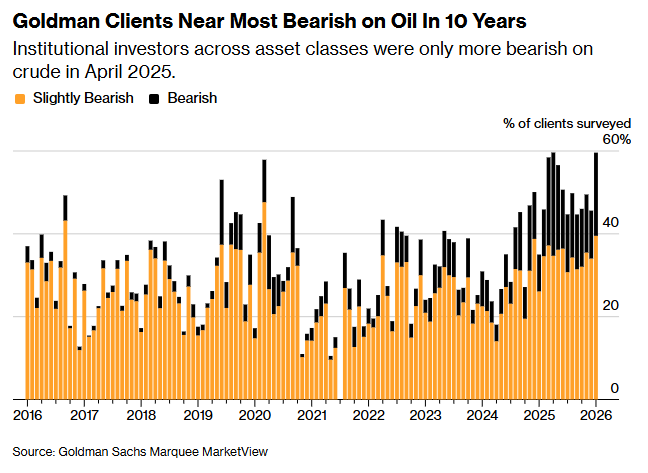
近十年最悲观!高盛:供应过剩格局下地缘因素施压 近6成机构投资者看空原油
智通财经网· 2026-01-09 03:44
Group 1: Market Sentiment - A Goldman Sachs survey indicates that geopolitical factors are driving institutional investors' bearish sentiment on crude oil to near a decade-high level, with over 59% of respondents holding a bearish or slightly bearish view [1] - This sentiment level is close to historical lows recorded in January 2016, with only a slightly higher pessimism noted in April of the previous year when trade tensions escalated [1] - The proportion of institutional investors considering crude oil as their most preferred short position has reached an all-time high, further intensifying overall bearish sentiment [1] Group 2: Oil Price Forecast - Due to increased supply from OPEC+ and competitors, alongside slowing global demand growth, oil prices are projected to decline nearly 20% cumulatively by 2025, marking the largest annual drop since 2020 [3] - The average forecast from major banks suggests that Brent crude oil prices, currently around $61 per barrel, may further decrease to approximately $59 per barrel by 2026 [3] Group 3: Venezuela's Oil Market Impact - Venezuela, holding the world's largest proven oil reserves at 303 billion barrels, could negatively impact future oil markets if U.S. energy companies invest billions to revive its oil production [4] - If a pro-U.S. regime is established in Venezuela, U.S. oil companies may return to the market, potentially increasing the country's oil exports by 3 million barrels per day, which could suppress long-term oil price increases [4] - Experts suggest that the future of Venezuela's oil production is likely to exert a bearish influence on the market, as any increase in output would add to the already ample global supply [6] Group 4: U.S. Government's Role - The Trump administration is considering a significant plan to dominate Venezuela's oil industry, which may include exerting control over the state oil company PDVSA and selling a substantial portion of its oil production [6] - U.S. Energy Secretary Chris Wright stated that the U.S. aims to stabilize and grow Venezuelan oil production while facilitating the entry of major U.S. oil companies into the market [6] - However, the potential for increased production in Venezuela hinges on substantial investments and a stable political environment, which remains uncertain [7] Group 5: Investment Considerations - U.S. oil companies may weigh the necessity of investing billions in Venezuela against the backdrop of already ample global oil supply [7] - The stability of the Venezuelan government and the legal and financial frameworks are critical factors for U.S. energy giants, as energy investments typically span 30 years [7] - The possibility of a return to a regime similar to Maduro's, which previously nationalized oil assets, poses a significant risk for U.S. oil companies [7]