小米汽车

Search documents
11月新势力销量解析:鸿蒙智行破8万 蔚小理陷3万瓶颈
Zhong Guo Zhi Liang Xin Wen Wang· 2025-12-04 03:56
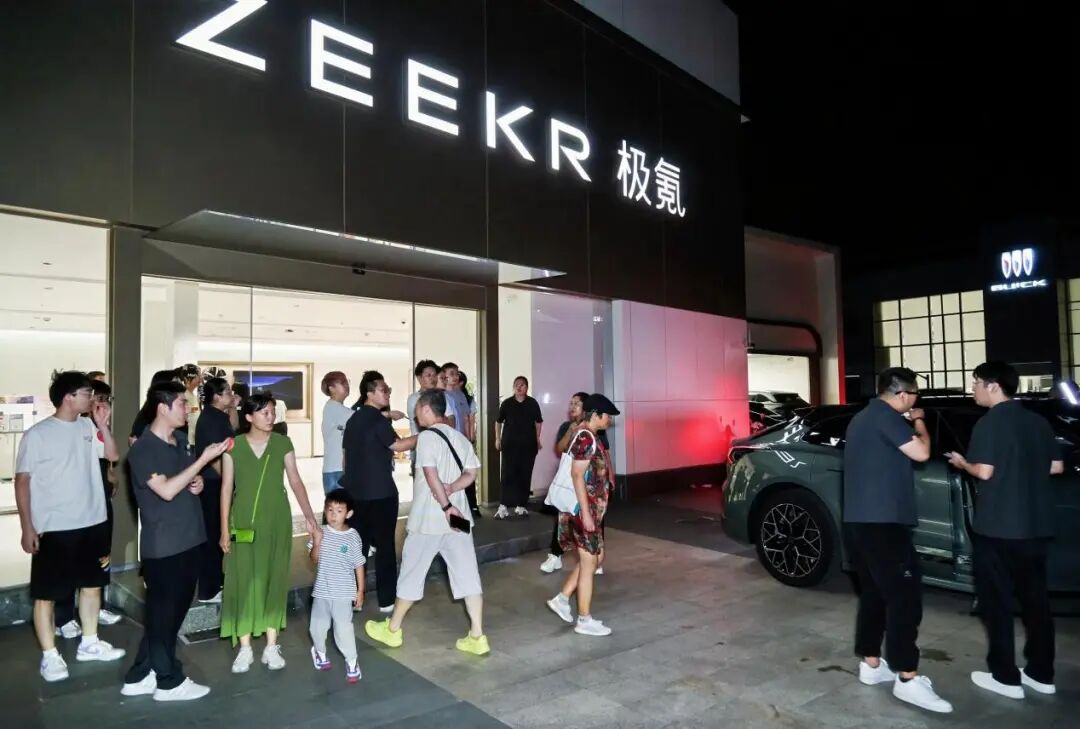
Core Insights - The competition landscape for China's new energy vehicle market is becoming clearer as various automakers disclose their sales data for November 2025, with a focus on efficiency and technological innovation reshaping the industry dynamics [1] Group 1: Sales Performance - Hongmeng Zhixing and Leap Motor both surpassed 70,000 units in deliveries, showcasing over 75% year-on-year growth, significantly widening the gap with traditional leading brands [3] - Hongmeng Zhixing achieved a record delivery of 81,864 vehicles in November, marking a 90% increase year-on-year, with the Aion brand being the main contributor [5] - Leap Motor delivered 70,327 vehicles, maintaining its position as the single brand champion in the new energy vehicle sector, with a 75% year-on-year increase [7] - Xiaomi Auto delivered over 40,000 vehicles, achieving a 100% year-on-year growth, and has exceeded its annual target of 350,000 vehicles [7] - Changan Qiyuan reported 46,909 vehicles delivered, with a 31% year-on-year increase, driven by strong product positioning [9] - NIO delivered 36,275 vehicles, reflecting a 76.3% year-on-year increase, with the ES8 model being a key contributor [10] - Ideal Auto's deliveries were 33,181 vehicles, showing a 31.92% year-on-year decline, attributed to market competition and product transition [12] - Deep Blue Auto delivered 33,060 vehicles, maintaining a steady performance despite market pressures [12] - Zeekr brand achieved 28,843 vehicles delivered, benefiting from improved production efficiency [13] - Lantu Auto reached a new high with 20,005 vehicles delivered, supported by product innovation and manufacturing capabilities [14] - Avita and Zhiji both set new sales records, with 14,057 and 13,577 vehicles delivered respectively, indicating their emergence as stable mainstream brands [16] Group 2: Market Trends and Outlook - The new energy vehicle market is expected to continue its growth in December 2025, driven by seasonal consumption peaks, tax incentives, and promotional activities from automakers [16] - The performance of different brand tiers is anticipated to show significant differentiation, influenced by the delivery rhythm of new models and promotional efforts [16]


崔东树:1-10月世界新能源乘用车同比增30% 中国占世界新能源车份额68%
Zhi Tong Cai Jing· 2025-12-04 02:29
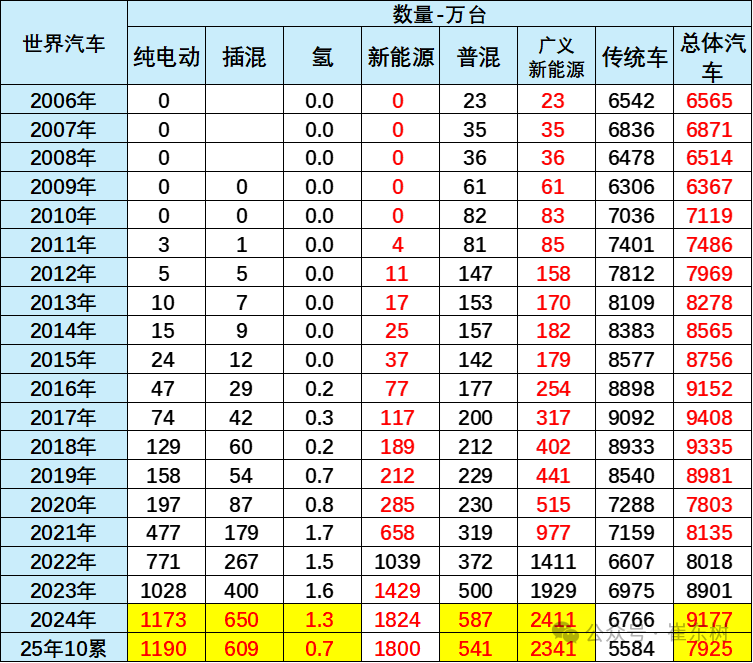
Core Insights - The global sales of new energy passenger vehicles reached 17.36 million units from January to October 2025, representing a year-on-year increase of 30% [1][8] - In October 2025, global sales of new energy passenger vehicles were 2.11 million units, showing a year-on-year increase of 17% but a month-on-month decrease of 3% [1][8] - The market share of new energy vehicles in China is projected to be 68% by 2025, with a significant share of 75% in October 2025 [1][25] - The penetration rate of new energy vehicles globally is expected to reach 25.2% by the fourth quarter of 2025, with China leading at 49% [1][20] Global Market Performance - The contribution of China to the global increase in new energy vehicles from January to October 2025 is 68%, while Germany and the UK contribute 5% and 4% respectively [2][23] - The overall penetration rate of new energy vehicles in the world has been rapidly increasing, reaching 13% in 2022, 16% in 2023, and projected to reach 19.5% in 2024 [1][20] Regional Insights - The U.S. new energy vehicle sales reached 1.4 million units from January to October 2025, with a growth rate of 10%, but saw a significant drop in October with sales of 93,000 units, down 32% year-on-year and 51% month-on-month [18][1] - In Europe, new energy vehicle sales for the same period reached 2.91 million units, a year-on-year increase of 28% [19][1] Company Performance - BYD continues to lead the global market with a share of 22.3% in 2025, while Tesla's share has declined to 8.6% [26] - Geely and Changan are showing strong performance in the new energy sector, while traditional automakers like Volkswagen and BMW are facing challenges [27][26] Export Trends - The share of Chinese autonomous new energy vehicles in overseas markets increased from 8.7% in 2024 to 13.8% in 2025, with a notable rise to 17.7% in October 2025 [12][1]



粤港澳大湾区为何要办一场全球电子展?
2 1 Shi Ji Jing Ji Bao Dao· 2025-12-03 13:16
Core Viewpoint - The emergence of the AIE (Global Intelligent Machinery and Electronic Products Expo) addresses the needs of Chinese companies for a platform that integrates technology display, trade connections, and industry collaboration, particularly in the context of evolving global technology competition [1][4][7]. Group 1: AIE Overview - AIE is positioned as a solution to the limitations of existing international exhibitions like CES and IFA, which primarily focus on consumer electronics, by providing a comprehensive platform for technology demonstration and market expansion [1][2]. - The event is expected to attract over 1,000 participating companies, including major industry players such as GAC Aion, TCL, and Xiaomi, along with more than 2,700 buyers and 5,000 professional visitors [2][5]. - AIE aims to facilitate the rapid commercialization of innovative technologies, serving as a hub for supply chain collaboration and market development [4][6]. Group 2: Regional Advantages - The Greater Bay Area (GBA) offers a robust manufacturing base and competitive advantages in the electronics industry, supported by clear policy incentives and global market connectivity [2][6]. - Guangdong province is a significant contributor to global electronics manufacturing, producing 40% of the world's smartphones and 70% of consumer-grade drones, making it an ideal location for AIE [6][7]. - The unique "one exhibition, two cities" model of AIE leverages the strengths of Macau and Zhuhai, combining internationalization with manufacturing capabilities to create a seamless connection between cutting-edge technology and practical applications [7][9]. Group 3: Industry Context - The global technology landscape is undergoing significant transformation, with disruptive technologies like AI and quantum computing driving competition in the intelligent machinery and electronics sectors [3][4]. - Chinese companies are increasingly capable of competing on a global scale, particularly in AI, IoT, and robotics, with many having established a complete ecosystem from core technologies to application scenarios [3][4]. - AIE is designed to meet the pressing need for a platform that showcases innovation and facilitates direct connections with professional buyers, addressing a critical gap in the current exhibition landscape for Chinese enterprises [4][5].


销量狂欢的B面:车企忙着发战报,经销商忙着去库存
Tai Mei Ti A P P· 2025-12-03 06:33
Core Insights - The Chinese automotive market in November 2025 showcased a stark contrast between the booming sales of new energy vehicles (NEVs) and rising inventory warning indices, indicating a potential disconnect between reported sales and actual consumer demand [2][9][12]. Sales Performance - Several companies, including Li Auto and Xiaopeng Motors, have reported significant year-on-year growth, with Xiaopeng achieving a 156% increase in deliveries from January to November 2025, surpassing its annual target [3][5]. - Leap Motor emerged as a standout performer, announcing over 500,000 units sold in 2025, significantly exceeding industry expectations [2][3]. - NIO's multi-brand strategy is paying off, with total deliveries reaching 36,275 units in November, driven by the new ES8 and the recently launched Le Dao brand [4][5]. Inventory Concerns - The inventory warning index for automotive dealers rose to 55.6% in November, indicating increased pressure on the distribution channel and suggesting that some of the reported sales figures may be due to inventory transfers rather than actual consumer purchases [9][10][12]. - The rising inventory levels reflect a shift in market dynamics from supply-driven growth to demand-constrained conditions, highlighting the need for companies to focus on genuine consumer demand rather than just sales figures [12][13]. Market Dynamics - The market is experiencing a transition from broad growth to a phase of "stock competition," where the ability to innovate and create demand through product offerings becomes increasingly critical [6][7]. - Companies are employing various strategies to navigate this competitive landscape, with some relying on flagship models to drive sales while others are transitioning from hybrid to fully electric vehicles [7][10]. Conclusion - The juxtaposition of high delivery numbers against rising inventory levels suggests that the automotive market is undergoing a significant transformation, necessitating a focus on channel health and sustainable demand rather than merely chasing sales figures [14][15].
交银国际每日晨报-20251203
BOCOM International· 2025-12-03 01:59
Consumer Industry - The consumer market in mainland China has shown a mild recovery since 2025, with cautious consumer sentiment expected to continue into 2026, leading to a new normal characterized by moderate growth and structural differentiation in demand [1] - Companies can seize growth opportunities by focusing on product positioning, channel layout, and technology application, while also exploring overseas markets as a strategic path for growth [1] - The report suggests a dual strategy for investment: allocate to defensive sectors with stable cash flow and strong demand resilience, while also actively pursuing high-growth structural opportunities [2] Automotive Industry - In November, BYD's passenger car sales reached 474,921 units, showing a year-on-year increase of 8.7% but a month-on-month decline of 5.8% [3] - NIO delivered 36,275 new cars in November, marking a significant year-on-year increase of 76.3% and a month-on-month increase of 10.2% [4] - Xpeng Motors delivered 36,728 units in November, reflecting a year-on-year increase of 18.9% but a month-on-month decline of 12.6% [5] - Li Auto delivered 33,181 new cars in November, with a year-on-year decrease of 31.9% and a month-on-month increase of 4.5%, impacted by supply chain bottlenecks [8] - Leap Motor achieved total deliveries of 70,327 units in November, a year-on-year increase of 75.1% [8] - The report emphasizes the importance of maintaining caution regarding short-term fluctuations while focusing on structural opportunities in the automotive sector [11]
新势力洗牌鸿蒙智行月销8万夺冠 零跑“单打独斗”再售7万辆连增9月
Chang Jiang Shang Bao· 2025-12-02 23:32
Core Viewpoint - The delivery volumes of leading new energy vehicle manufacturers in China are showing positive trends, with significant competition for monthly sales leadership among companies like Hongmeng Zhixing, Leap Motor, and Xiaomi Auto [2][4]. Group 1: Hongmeng Zhixing - In November, Hongmeng Zhixing achieved a record delivery of 81,900 vehicles, marking a year-on-year increase of 89.61% [3][4]. - This delivery volume not only set a historical high for Hongmeng Zhixing but also surpassed Leap Motor, allowing it to claim the title of monthly sales champion [3][4]. - The company has a diverse product lineup, including models from Seres, Chery, BAIC, and JAC, collectively branded under the "Hongmeng Zhixing" series [5]. Group 2: Leap Motor - Leap Motor reported a delivery of 70,300 vehicles in November, reflecting a year-on-year growth of over 75% and a month-on-month increase [8]. - The company has achieved a cumulative sales target of over 500,000 vehicles since 2025, ahead of its annual goal [9]. - Leap Motor's third-quarter financial report indicated a revenue of 19.45 billion yuan, a 97.3% increase year-on-year, with a gross margin of 14.5% [10]. Group 3: Xiaomi Auto - Xiaomi Auto has emerged as the third-largest player in the new energy vehicle sector, with a cumulative delivery of over 500,000 vehicles since its launch in April 2024 [11][12]. - In November, Xiaomi Auto maintained a monthly delivery volume of over 40,000 vehicles for the third consecutive month [12]. - The company has already met its annual target of 350,000 vehicles for 2025 [13]. Group 4: Other Competitors - Xpeng Motors delivered 36,700 vehicles in November, a year-on-year increase of 19%, with a total of 391,900 vehicles delivered in the first eleven months of 2025 [15]. - NIO delivered 36,300 vehicles in November, showing a year-on-year growth of 76.3% [18]. - Lantu Motors achieved a monthly delivery of 20,000 vehicles in November, marking an 84% year-on-year increase and setting a new record for the company [18].


部分车企11月交付数据丨零跑超7万辆 “小蔚理”均超3万辆
Cai Jing Wang· 2025-12-02 23:11
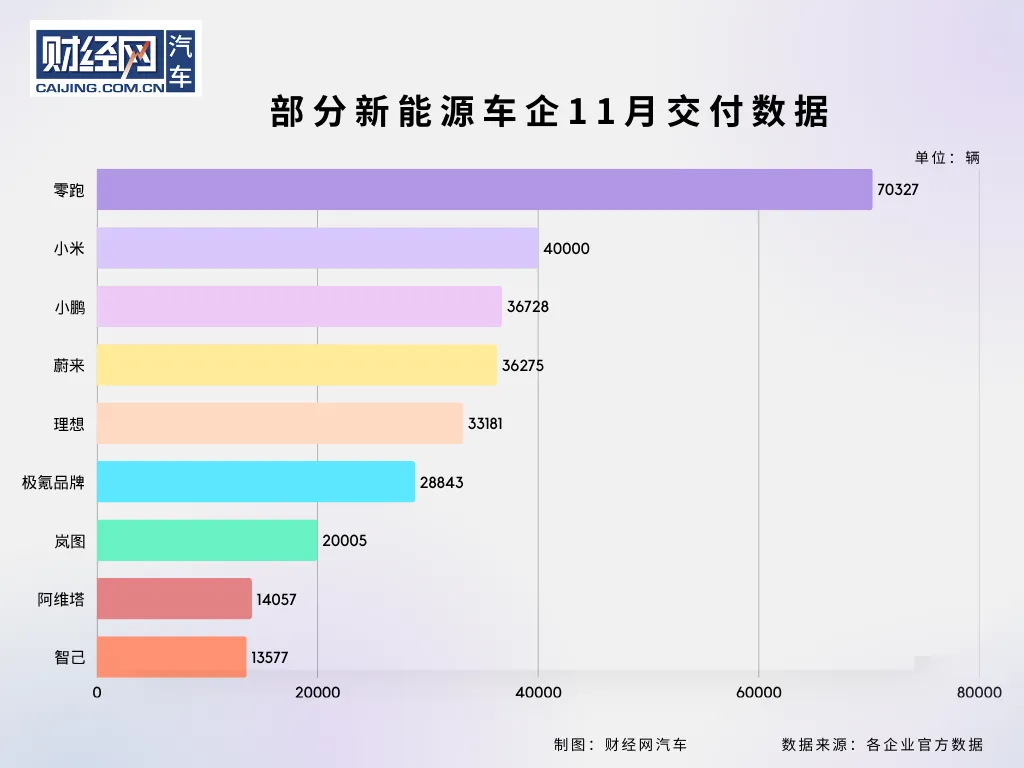
Core Insights - In November, several new energy vehicle companies reported their delivery data, with Leap Motor leading the sales with over 70,000 units delivered, followed by Xiaomi with over 40,000 units [1][4]. Delivery Performance - Leap Motor achieved a monthly delivery of 70,327 units, marking a year-on-year increase of over 75%, and has surpassed 500,000 cumulative sales for the year [4]. - Xiaomi's deliveries exceeded 40,000 units for the third consecutive month, with a total of over 500,000 units delivered since April 2024 [5]. - Xpeng and NIO both delivered over 30,000 units, with Xpeng at 36,728 units and NIO at 36,275 units, reflecting a year-on-year growth of 19% and 76.3% respectively [6][9]. - Li Auto's deliveries fell to 33,181 units, a year-on-year decline of 34.1%, attributed to product line adjustments and increased market competition [10]. Market Trends - The overall retail market for passenger vehicles in China saw a decline of 11% year-on-year in November, with a slight month-on-month decrease of 2% [3]. - The new energy vehicle market maintained growth, but the year-on-year growth rate slowed to 3% [3]. Historical Performance - Zeekr and Lantu both achieved significant milestones, with Zeekr delivering 28,843 units and Lantu surpassing 20,000 units for the first time, marking a historical high [11][12]. - Avita and Zhiji also set new records with deliveries of 14,057 and 13,577 units respectively, showing year-on-year increases of 21% and 35.7% [12]. Financial Performance - Xpeng reported a total revenue of 20.38 billion yuan for the third quarter, a year-on-year increase of 101.8%, with a gross margin of 20.1% [8]. - Leap Motor's financial performance improved significantly, with a revenue of 19.45 billion yuan for the third quarter, a 97.3% increase year-on-year [4].
新势力阵营展开“体系化能力”比拼
Zheng Quan Ri Bao Zhi Sheng· 2025-12-02 16:10
Core Insights - The Chinese new energy vehicle (NEV) market is experiencing a robust growth phase, with new force car manufacturers achieving record-high deliveries in November, indicating a maturation of the market [1] - The competition among NEV companies has shifted from relying on single popular models to a more systemic capability supporting multi-brand expansion [2][3] Group 1: Leading Brands - Leading new force car manufacturers continue to show strong growth, with a shift in growth logic towards systemic capabilities and multi-brand strategies [2] - Hongmeng Zhixing delivered 81,900 vehicles in November, benefiting from a comprehensive brand matrix and technological expansion, covering a price range from 150,000 to 1,000,000 yuan [2] - Leap Motor has consistently surpassed 70,000 deliveries for two consecutive months, focusing on cost structure optimization through self-research and electric drive platforms, establishing sustainable competitive advantages [2] Group 2: Emerging Players - Second-tier new force car manufacturers have also shown impressive performance, with several achieving historical best results, reflecting a clearer market segmentation [4] - Brands like Lantu, Zhiji, and Avita have seen significant growth, with Lantu surpassing 20,000 deliveries for the first time in November, indicating a broader acceptance of products centered around intelligent driving [5] - The competition is evolving from a head-dominated market to a multi-layered competition, with second-tier brands leveraging differentiated positioning to capture market share [5] Group 3: Market Dynamics - The expansion of the consumer base for NEVs is leading to a clear segmentation in user demand, with increasing interest in mid-to-large-sized vehicles, personalization, and intelligent driving features [4] - As the year-end approaches, manufacturers are expected to optimize sales through inventory control and rights management, with delivery capabilities and supply chain assurance becoming critical for year-end performance [5] - The core of competition is shifting towards building long-term, stable systemic capabilities, which will determine the leaders in the next phase of the market [5]
车市消失的“翘尾”
Hua Er Jie Jian Wen· 2025-12-02 12:03
Core Insights - The Chinese automotive market is experiencing a "folding sensation," with significant disparities in sales performance among major players, indicating a shift towards a more competitive environment [1][2][4] Group 1: Market Performance - In November, BYD achieved sales exceeding 480,000 units, with overseas sales surpassing 130,000 units, alleviating concerns about domestic sales pressure [2] - Geely's sales reached 310,000 units in November, with a 53% year-on-year increase in new energy vehicle sales, indicating a successful transition to new energy [2] - Leap Motor reported a 75% year-on-year increase in sales, aiming for one million units next year, while Hongmeng Zhixing sold 81,864 units, marking a record high for monthly deliveries [1][2] Group 2: Market Dynamics - The overall retail data for the passenger car market showed a decline in sales year-on-year and month-on-month from November 1 to 23, indicating a cooling market despite strong performances from leading companies [1][4] - The disappearance of the year-end sales surge is a concerning signal, as traditional strategies like price cuts and promotions failed to boost sales [4] - The shift in consumer psychology is evident, with a decrease in demand for hybrid models and diminishing effects of price wars, leading to a more challenging environment for lower-end models [4][6] Group 3: Future Outlook - The automotive market is expected to face intensified competition by 2026, with the reintroduction of a 5% purchase tax on new energy vehicles, increasing consumer costs [6][7] - UBS predicts that the overall growth rate for passenger car wholesale will slow to 3% by 2026, while electric vehicle growth will decelerate to 15%, indicating a shift in market dynamics [6][7] - Companies are urged to consolidate resources to withstand the upcoming challenges, as the era of rapid growth is over, and survival will depend on efficiency and market positioning [7][8]
增程车遭遇双面夹击:不仅纯电车卖得好,燃油车也“复苏”了
3 6 Ke· 2025-12-02 10:28
Core Insights - NIO and Li Auto's Q3 financial reports reflect a structural adjustment in the domestic electric vehicle market, indicating a significant decline in consumer interest for small battery range-extended vehicles [1] - In October, Li Auto delivered 31,767 vehicles, while NIO surpassed 40,000 deliveries for the first time this year, with expectations to maintain this momentum in Q4 [1] - The end of tax exemptions for electric vehicles starting in 2026 is expected to accelerate market reshuffling, influenced by policy changes and shifting consumer demand [1] Group 1: Electric Vehicle Market Trends - The majority of new models launched this year are hybrid, with notable exceptions like NIO's ET9 being fully electric [3] - The trend towards larger battery capacities in hybrid models is evident, with some achieving pure electric ranges exceeding 500 km [3] - The sales of range-extended and plug-in hybrid vehicles have been declining, with a 12% drop in sales year-on-year for range-extended vehicles [9] Group 2: Charging Infrastructure Development - By the end of 2024, charging infrastructure in China is expected to achieve county-level coverage across all provinces, with significant growth in the number of charging stations [5] - As of October, the number of charging facilities reached 18.645 million, with a 49.1% year-on-year increase [5] - Companies like Xpeng and NIO are actively expanding their charging networks to enhance accessibility [5][7] Group 3: Performance of Electric Vehicle Manufacturers - Xpeng's sales grew by 190% in the first three quarters, while NIO and Zeekr also reported significant increases [7] - In contrast, Li Auto's sales decreased by approximately 13% year-on-year, with a notable drop of over 30% in monthly deliveries from October to November [7][9] - Li Auto plans to upgrade its L series to enhance battery capacity and pure electric range, responding to user preferences for electric driving [9][10] Group 4: Traditional Fuel Vehicle Market Dynamics - Traditional fuel vehicle sales have seen a temporary resurgence, with a 1.7% increase in sales year-to-date compared to the previous year [11] - Despite this growth, the market share of traditional fuel vehicles is declining, with projections indicating a drop to 49.9% in the first nine months of this year [11] - The long-term outlook suggests that electric vehicles will continue to replace traditional fuel vehicles, particularly in the high-end market segment [11][13]