拓普集团

Search documents
汽车行业2026年策略:L3商用在即,智能底盘有望批量应用
Dongxing Securities· 2025-12-18 08:54
Investment Summary - The automotive industry is benefiting from the acceleration of smart technology and the development of the robotics industry, with the parts sector outperforming the vehicle sector. From January 1 to December 12, 2025, the CITIC passenger car index fell by 0.40%, while the CITIC automotive parts index rose by 34.76%, indicating a significant difference in performance between the two sectors [4][18][25]. Group 1: 2025 Market Performance and Earnings Review - The automotive parts sector achieved a revenue of 7,541.60 billion yuan in the first three quarters of 2025, a year-on-year increase of 8.75%, and a net profit of 460.10 billion yuan, up 19.60% year-on-year [49]. - The passenger vehicle sector's revenue reached 15,203.16 billion yuan, growing by 8.68% year-on-year, while the net profit decreased by 15.72% to 391.90 billion yuan [31][49]. - The performance of passenger vehicle companies varied, with most showing revenue growth, but some, like BYD and Great Wall Motors, experienced profit declines [39][42]. Group 2: Outlook for 2026 - The automotive market in 2026 is expected to see a decline in policies, while exports and new energy vehicles (NEVs) will continue to rise. The "old-for-new" policy is anticipated to drive high growth in vehicle sales in 2025, but its absence in 2026 may lead to a demand shortfall [5][62][66]. - The penetration rate of NEVs is expected to continue increasing, with smart and high-end vehicles becoming new growth drivers. By 2025, the penetration rate of NEVs reached 46.7% [72][73]. - The L3 commercial application is expected to reach a critical point in 2026, with smart chassis technology anticipated to be applied in large quantities [5][6]. Group 3: Investment Strategy - The investment strategy focuses on the smart automotive sector, particularly as the industry transitions from L2 to L3 autonomous driving. Companies that continue to invest in this area are expected to benefit significantly [6][8]. - Recommended companies in the vehicle sector include SAIC Motor, Jianghuai Automobile, and Chery Automobile, which are positioned to leverage advancements in smart driving technology [6][8]. - In the parts sector, companies like Baolong Technology and Top Group are highlighted for their potential to benefit from the implementation of line control steering and braking systems, which are set to enter mass application in 2026 [8][49].





机器人公司,排队冲港股
投中网· 2025-12-18 06:45
Core Viewpoint - The article discusses the increasing trend of robotics companies seeking to go public on the Hong Kong Stock Exchange (HKEX), highlighting the challenges and opportunities within the industry, particularly for companies like Ledong Robotics, which is facing significant losses despite revenue growth [5][6][17]. Group 1: Company Overview - Ledong Robotics has submitted its IPO application to HKEX twice within six months, indicating a strong interest in public listing despite ongoing financial losses [5][8]. - The company reported revenues of 234 million yuan, 277 million yuan, and 467 million yuan for 2022, 2023, and 2024 respectively, with a 97% year-on-year revenue growth in the first half of 2023 [8][9]. - Despite revenue growth, Ledong Robotics has faced net losses of 73.13 million yuan, 68.49 million yuan, and 56.48 million yuan for the same years, with a loss of 1.378 million yuan in the first half of 2023 [6][9]. Group 2: Market Dynamics - Over 30 robotics companies have submitted IPO applications to HKEX, with only a few successfully listing, indicating a competitive and challenging environment for new entrants [5][15]. - The HKEX offers a more flexible listing process for unprofitable tech companies, making it an attractive option for robotics firms that require significant upfront investment [15][16]. - The international appeal of HKEX enhances the brand image of listed companies, potentially aiding in global partnerships and talent acquisition [16]. Group 3: Investment Landscape - Ledong Robotics has attracted notable investors, including prominent venture capital firms and Alibaba's CEO, indicating strong market confidence in its technology and growth potential [11][13]. - The company is focusing on developing its visual perception technology, which is crucial for its product offerings, including various types of service robots [9][10]. - The influx of robotics companies into HKEX raises concerns about the overall self-sustainability of the industry, as many firms struggle with profitability despite high levels of investment [17].


同一基金经理操盘:两基金“拖后腿”超19% 一基金却大赚24%!
Hua Xia Shi Bao· 2025-12-18 03:12
Core Viewpoint - The performance differentiation of fund managers, particularly Li You from Chuangjin Hexin Fund, has become a focal point in the context of ongoing salary reforms in the fund industry, highlighting the impact of performance on compensation assessments [1][5]. Performance Disparity - The significant performance differences among the funds managed by Li You stem from contrasting portfolio structures, with Chuangjin Hexin Industry Select A underperforming its benchmark by 26.86% and 19.49% for Chuangjin Hexin Industrial Cycle Select A, while Chuangjin Hexin Resource Theme A achieved a 24.75% excess return [1][2]. - The underperformance of Chuangjin Hexin Industry Select A is attributed to its heavy concentration in manufacturing sectors like new energy and semiconductors, which faced valuation adjustments and increased competition from 2022 to 2024 [2]. - The lithium price decline in 2023 pressured the profitability of midstream material companies, and despite gradual reductions in holdings, the adjustment lagged behind market turning points, leading to sustained net value losses [2]. Investor Confidence and Fund Stability - The performance pressure has directly affected the stability of fund sizes, as seen with Chuangjin Hexin Industry Select A, which experienced net outflows despite a significant rebound in net value in Q3 2025 [3]. - The high volatility and valuation elasticity of high-growth sectors demand precise judgment and trading timing from fund managers, with concentrated holdings amplifying potential losses during market downturns [3]. Recent Performance Improvements - Recent data indicates improvements in excess returns for Chuangjin Hexin Industry Select A and Chuangjin Hexin Industrial Cycle, with respective one-year excess returns of 19.02% and 3.35% as of December 15, 2025 [3][5]. Salary Reform and Performance Assessment - The ongoing salary reform in the fund industry emphasizes a longer assessment period of over three years and a comprehensive view of all products managed by fund managers, which may lead to stricter evaluations for those with significant performance disparities [5][6]. - This reform is expected to encourage fund managers to distribute their research efforts more evenly across all products, rather than focusing solely on high-profile funds [5]. Implications for Fund Managers - Fund managers are required to reassess their investment capabilities within a more integrated and long-term evaluation framework, potentially leading to a focus on areas where they can consistently generate alpha [6]. - The core objective of the salary reform is to align individual capabilities, product positioning, and investor interests more accurately through optimized incentive mechanisms [6].
航天智造(300446):双轮驱动打造航天七院优质上市平台
Xin Lang Cai Jing· 2025-12-18 00:35
Core Viewpoint - The company is initiating coverage on Aerospace Intelligent Manufacturing with a "Buy" rating and a target price of 26.00 yuan, based on a 20x PE valuation for 2026, driven by "technological barriers + policy dividends" for growth [1] Group 1: Company Overview - Aerospace Intelligent Manufacturing has undergone a significant asset restructuring, becoming the core listed platform of the Aerospace Seventh Academy by acquiring 100% stakes in Aerospace Energy and Aerospace Molding [1] - The company is expected to achieve revenues of 58.60 billion yuan and 77.81 billion yuan in 2023 and 2024, respectively, representing year-on-year growth of 20.10% and 32.78% [1] - The net profit attributable to shareholders is projected to be 4.23 billion yuan and 7.92 billion yuan for 2023 and 2024, with year-on-year increases of 61.36% and 87.02% [1] Group 2: Automotive Components Business - Aerospace Molding, established in 2000, focuses on the development and production of automotive interior and exterior parts, smart cockpit components, and lightweight engine parts [2] - The company provided components for 10.95 million vehicles in 2023, accounting for 42% of the total passenger car sales in China [2] - The new energy vehicle segment is expected to contribute 72% of new products in 2024, surpassing industry penetration rates, with successful entries into the supply chains of new car manufacturers like NIO and AITO [2] - Revenue for the automotive components business is projected to grow at a CAGR of 20.96% from 2025 to 2027 [2] Group 3: Oil and Gas Equipment Business - Aerospace Energy, founded in 2013, specializes in the research and manufacturing of perforating tools and high-end completion equipment for the oil and gas sector [3] - The company holds over 60% market share in unconventional oil and gas extraction and approximately 35% in conventional oil and gas extraction as of 2021 [3] - The business is expected to benefit from increasing domestic oil and gas production and the development of deep-sea and deep-earth resources, with a projected revenue CAGR of 17.94% from 2025 to 2027 [3] Group 4: Market Perspective - The market underestimates the company's long-term growth potential, particularly in the automotive components sector, which benefits from the electrification, connectivity, and intelligence transformation of downstream customers [4] - The oil and gas equipment business is expected to gain from policy support for deep-sea and deep-earth technologies, leading to increased demand for perforating tools and completion equipment [4] Group 5: Profit Forecast and Valuation - The company is expected to achieve net profits of 9.48 billion yuan, 11.02 billion yuan, and 12.76 billion yuan from 2025 to 2027 [5] - Comparable companies in the automotive and oil and gas sectors have an average PE of 30x for 2026, while Aerospace Intelligent Manufacturing is assigned a target PE of 20x, leading to a target price of 26.00 yuan [5]

同一基金经理操盘:两基金“拖后腿”超19%,一基金却大赚24%!
Hua Xia Shi Bao· 2025-12-17 13:53
Core Viewpoint - The performance of fund managers and their compensation assessment have become focal points in the context of ongoing reforms in the fund industry, highlighted by the significant performance divergence of fund manager Li You's products [2][5]. Performance Discrepancy - The stark differences in performance among the funds managed by Li You stem from their contrasting portfolio structures, with the underperforming funds heavily invested in manufacturing sectors like new energy and semiconductors, which faced valuation adjustments and competitive pressures from 2022 to 2024 [3]. - The fund "Chuangjin Hexin Industry Smart Selection A" lagged its benchmark by 26.86%, while "Chuangjin Hexin Industrial Cycle Selection A" underperformed by 19.49%, whereas "Chuangjin Hexin Resource Theme A" achieved a 24.75% excess return [2][3]. Impact of Market Conditions - The decline in lithium prices in 2023 pressured the profitability of midstream material companies within the new energy sector, leading to a delayed adjustment in the fund's holdings compared to market trends [3]. - The fund manager acknowledged a mismatch between their foresight regarding the cyclical nature of new energy and the actual timing and extent of the market adjustments [3]. Fund Size and Investor Confidence - The performance pressure has directly affected the stability of fund sizes, as seen with "Chuangjin Hexin Industry Smart Selection A," which experienced net outflows despite a significant rebound in net value in Q3 2025 [4]. - Rebuilding investor trust is a major challenge for fund managers, especially after prolonged periods of underperformance [4]. Resource Stocks vs. Manufacturing Stocks - In contrast, "Chuangjin Hexin Resource Theme A" benefited from strong performance in resource stocks, with top holdings like Xinyi Silver, Zijin Mining, and Luoyang Molybdenum seeing gains exceeding 20% in three months, driven by global inflation expectations and supply-demand gaps [4]. - The allocation decisions made by fund managers significantly influence the degree of performance divergence among funds [4]. Compensation Assessment Reforms - The fund company noted improvements in excess returns for its products over the past year, with "Chuangjin Hexin Industry Smart Selection A" achieving a 30.97% increase compared to its benchmark's 11.95% [5]. - New assessment guidelines emphasize sustainability and a holistic view of fund managers' performance across all products, which may lead to stricter evaluations for those with significant performance disparities [6]. Long-term Focus for Fund Managers - Fund managers are now required to reassess their investment capabilities within a more comprehensive and long-term evaluation framework, which may encourage them to focus on areas where they can consistently generate alpha [7]. - The core objective of the industry’s compensation reform is to align individual capabilities, product positioning, and investor interests more accurately through optimized incentive mechanisms [7].

L3级自动驾驶驶入快车道,把握千亿产业链的投资机遇!
市值风云· 2025-12-17 10:07
Core Viewpoint - The commercialization of Level 3 (L3) autonomous driving in China marks a new era for investment opportunities in the automotive industry, with significant policy developments and the approval of L3 vehicles for road testing [3][4]. Policy Breakthrough - The Ministry of Industry and Information Technology approved the first L3 conditional autonomous driving vehicle licenses on December 15, 2025, allowing Changan and BAIC models to operate in designated areas [4]. - The approval signifies a shift from "testing demonstration" to "commercial application" in China's autonomous driving industry, with more companies expected to receive similar licenses in the future [4]. Technology and Responsibility Shift - The fundamental difference between Level 2 (L2) and Level 3 (L3) autonomous driving lies in the shift of responsibility; in L2, the driver must be ready to take control, while in L3, the responsibility shifts to the vehicle manufacturer in specific scenarios [5][6]. - The realization of L3 autonomous driving relies on a complex supply chain and stringent safety standards, necessitating a reliable closed-loop system for perception, decision-making, and execution [6]. Investment Tools and Strategies - For ordinary investors, the high technical barriers and volatility in the smart automotive industry make investing through fund products a more prudent choice [7]. - Currently, there are only two smart automotive ETFs with a scale greater than 100 million: the Smart Automotive ETF (515250.SH) and the Smart Driving ETF (516520.SH), both tracking the CS Smart Automotive Index [7][8]. ETF Performance and Composition - The CS Smart Automotive Index includes leading companies across various segments of the smart automotive industry, reflecting the overall performance of the sector [9][10]. - The top ten weighted stocks in the index include companies like Luxshare Precision (6.11%), Chipone (5.37%), and iFlytek (4.95%), covering the entire hardware and software support chain for smart vehicles [10][11]. Market Trends and Volatility - The largest smart automotive ETF traded around 1.10 yuan as of mid-December, showing signs of short-term pressure due to the high volatility of the smart automotive sector [11][12]. - The smart automotive sector has experienced significant fluctuations, with a maximum drawdown exceeding 30% in the past year, highlighting its sensitivity to market conditions [12]. Long-term Investment Logic - The long-term investment rationale for smart automotive ETFs is rooted in the irreversible trend of automotive intelligence, while short-term performance is influenced by market sentiment and volatility [15]. - Current market adjustments may present opportunities for investors to gradually accumulate positions, with a focus on long-term industry benefits and monitoring developments in L3 autonomous driving commercialization [15].

L3商用加速落地,有望推动智能底盘批量应用 | 投研报告
Zhong Guo Neng Yuan Wang· 2025-12-17 02:04
Core Viewpoint - The recent approval of L3-level conditional autonomous driving vehicles by the Ministry of Industry and Information Technology (MIIT) marks a significant step towards the commercialization of advanced autonomous driving technology in China [2][5]. Group 1: L3 Autonomous Driving Approval - Changan Automobile and BAIC BluePark Magna Automotive have submitted applications for L3-level conditional autonomous driving vehicles, which have been approved by MIIT in the 401st batch of announcements [2][3]. - L3 autonomous driving allows for conditional self-driving within a limited operational range, differing fundamentally from L2 assistance systems [2][3]. Group 2: Impact on Intelligent Chassis - The approved vehicles include Changan's Deep Blue product and BAIC's Arcfox Alpha S (L3 version), which features a high-performance redundant sensor system with 34 sensors, including three LiDARs [3][4]. - The commercialization of L3 is expected to accelerate the application of intelligent chassis technologies, such as active suspension, electronic brake-by-wire (EMB), and steer-by-wire (SBW) systems [3][4]. Group 3: Investment Strategy - The approval of L3 vehicles provides policy support for the popularization of high-level autonomous driving, benefiting companies actively engaged in this sector [5]. - Key investment areas include vehicle application, where leading companies are establishing advantages in training data and smart driving ecosystems, and the intelligent chassis sector, which is expected to see rapid mass application by 2026 [5].




东兴证券:汽车行业L3商用加速落地 有望推动智能底盘批量应用
智通财经网· 2025-12-17 01:35
Core Viewpoint - The approval of L3-level autonomous driving vehicles by the Ministry of Industry and Information Technology (MIIT) marks a significant step towards the commercialization of L3 autonomous driving in China, which is expected to accelerate the adoption of smart chassis technologies [1][2][3]. Group 1: Event Summary - The MIIT has granted conditional approval for Changan Automobile and BAIC BluePark Magna Automotive to produce L3-level autonomous vehicles, following the submission of their applications [2]. - The approval is part of the 401st batch of announcements by the MIIT, indicating a regulatory framework supporting the introduction of L3 autonomous driving products in the market [2][3]. Group 2: L3 Commercialization Impact - L3 autonomous driving allows for conditional self-driving capabilities, where the system controls vehicle movement and responds to environmental stimuli within a limited operational range, requiring driver intervention outside this range [3]. - The vehicles approved include Changan's Deep Blue model and BAIC's Arcfox Alpha S (L3 version), which features a high-performance sensor system with 34 sensors, including three LiDARs, ensuring comprehensive safety and redundancy [4]. Group 3: Smart Chassis Development - The commercialization of L3 driving is expected to drive the mass application of smart chassis technologies, including active suspension, electronic brake-by-wire (EMB), and steer-by-wire (SBW) systems [4][5]. - Active suspension systems will integrate air springs and variable damping to enhance vehicle handling and comfort, while EMB represents the future direction of braking systems, supported by mandatory national standards set to take effect in 2026 [4][5]. Group 4: Investment Strategy - The approval of L3 vehicles provides policy support for the widespread adoption of advanced autonomous driving technologies, benefiting companies that are actively investing in this sector [6]. - Key investment opportunities include automakers collaborating with Huawei, such as Seres, JAC Motors, BAIC BluePark, SAIC Group, and Changan, as well as companies in the smart chassis supply chain like Baolong Technology and Top Group [6].

汽车行业:L3商用加速落地,有望推动智能底盘批量应用
Dongxing Securities· 2025-12-16 14:56
Investment Rating - The report maintains a "Positive" investment rating for the automotive industry, indicating an expectation of performance that exceeds the market benchmark by more than 5% [3][19]. Core Insights - The commercial application of L3 level conditional autonomous driving is expected to accelerate, with more vehicles equipped with L3 features likely to receive regulatory approval in the future [1][2]. - The introduction of L3 systems is anticipated to drive the mass application of intelligent chassis technologies, including active suspension, electronic brake-by-wire (EMB), and steer-by-wire (SBW) systems, which are crucial for higher levels of autonomous driving [2][9]. - The report highlights the significant advancements in hardware and software for automotive intelligence, suggesting a robust growth trajectory for companies involved in these technologies [2][9]. Summary by Sections Industry Overview - The automotive industry consists of 232 listed companies, with a total market capitalization of approximately 46,540.79 billion and a circulating market value of about 36,782.9 billion [4]. - The average price-to-earnings ratio for the industry stands at 31.78 [4]. Key Developments - The report notes that the recent approval of L3 autonomous vehicles by the Ministry of Industry and Information Technology marks a significant step towards the commercialization of advanced driving technologies in China [1][2]. - The intelligent chassis is seen as the final piece in the puzzle for L3 and higher-level autonomous driving, with a focus on the upcoming mass production of active suspension, EMB, and SBW systems [2][9]. Investment Strategy - The report suggests focusing on two main areas for investment: the complete vehicle application sector, where leading companies are establishing advantages in training data and ecosystems, and the intelligent chassis sector, which is poised for rapid growth due to regulatory support and technological advancements [2][9].
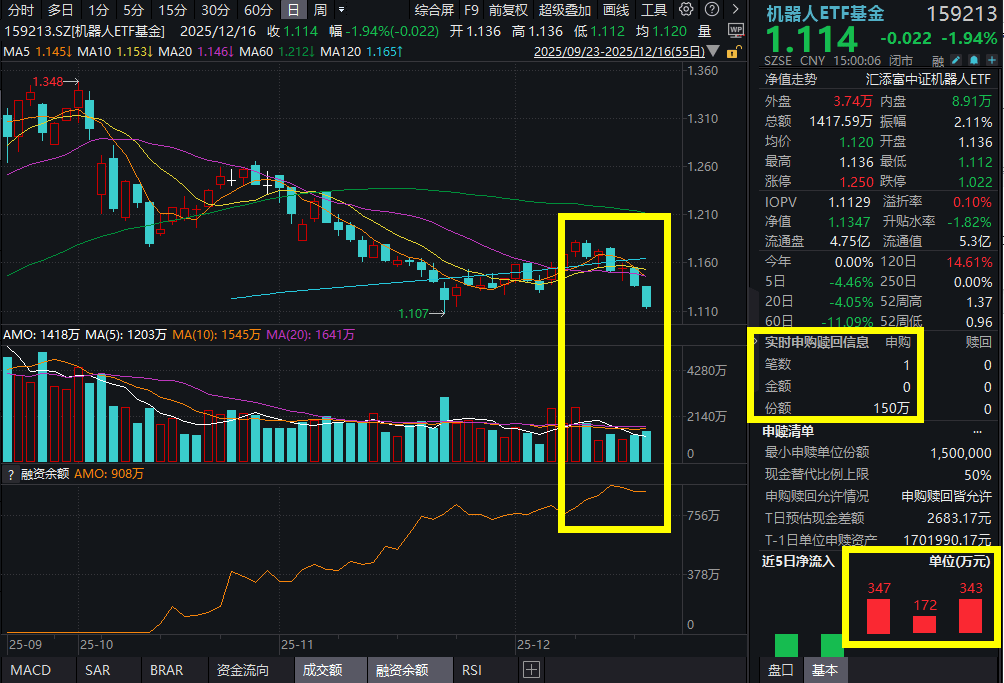
机器人再回调!拓普集团跌近2%,机器人ETF基金(159213)连续4日强势吸金超1000万元!大摩:2050年我国将掌控全球超60%人形机器人供应链!
Sou Hu Cai Jing· 2025-12-16 10:10
Core Viewpoint - The A-share market experienced significant declines, particularly in the robotics sector, with the Robotics ETF (159213) falling by 1.94% and continuing a downward trend for two consecutive days. Despite this, the ETF attracted nearly 2 million yuan in net subscriptions, marking over 10 million yuan in inflows over the past four days [1][3]. Group 1: Market Performance - The Robotics ETF (159213) has seen a decline, with major component stocks like Zhongkong Technology dropping over 3%, and others such as Dazhu Laser and Keda Xunfei falling more than 2% [3][4]. - The ETF's top ten component stocks mostly experienced declines, with Keda Xunfei down by 2.25% and Huichuan Technology down by 1.69% [4]. Group 2: Industry Growth and Projections - According to the National Bureau of Statistics, China's industrial robot production saw a growth of 20.6% in November, indicating a robust industrial performance [5]. - Morgan Stanley forecasts that global sales of robotics hardware will surge from $100 billion in 2025 to $5 trillion by 2030, and eventually exceed $25 trillion by 2050. China is expected to capture 26% of the global robotics market by 2050, with a dominant position in industrial robots and drones [5]. Group 3: Technological Advancements - Yushutech launched the world's first humanoid robot-specific "AppStore," allowing users to easily install skill packages for robots, which lowers the technical barriers for robot functionality development [5]. - The humanoid robot industry is accelerating its implementation, with policies and standards being established to support commercialization and B-end order validation [6][7]. Group 4: Market Dynamics and Opportunities - The market is witnessing a shift towards standardized technology and industrialization, with companies like Ubtech securing significant contracts, such as a 143 million yuan project for a humanoid robot data collection and training center [7]. - The industry is focusing on various application scenarios, including industrial logistics, elderly care, and specialized environments, indicating a broadening of market opportunities [8].