专项债

Search documents
格林大华期货钢矿期货月报:2月钢矿供需双减,价格料震荡运行-20260130
Ge Lin Qi Huo· 2026-01-30 11:10
1. Report Industry Investment Rating - No relevant content provided 2. Core Views of the Report - The report anticipates that in February 2026, steel and iron ore will generally experience a volatile market. Steel products may be volatile and weak, while iron ore may be volatile and strong. Specifically, hot-rolled coils may outperform rebar. The main range for rebar is expected to be between 3050 - 3200, and for hot-rolled coils, between 3300 - 3450. The iron ore price will follow the rhythm of steel product profits and molten iron production, with the main range between 730 - 830 [6]. 3. Summary by Directory Part 1: Review - In January 2026, rebar prices were range-bound with limited fluctuations, failing to break above 3200 at the highest and reaching a low of 3085 [9]. - Compared to steel products, iron ore prices were more volatile, showing an inverted V-shaped trend during the month. The main iron ore contract reached a high of 831.5 and a low of 778.0 [12][13]. Part 2: Current Analysis 2.1 Macro Logic - In the long run, GDP is the "anchor" for steel prices. The quality and speed of economic growth determine the long - term central level of steel prices. In 2024, China's GDP growth rate was 5.2%, with positive fixed - asset investment, a narrowing decline in the real estate sector, and strong resilience in infrastructure and manufacturing. Steel prices showed an inverted V - shape, and GDP had a weak positive correlation with steel prices. In 2025, China's GDP growth rate was 5.0%, just meeting the target. Fixed - asset investment growth turned negative, and the decline in the real estate sector widened. Economic growth relied more on consumption, high - end manufacturing, and exports (not the main steel - using sectors). The "basic support" of GDP for steel prices failed, and the steel price center directly shifted downward, showing a weak pattern [17]. 2.2 Supply - Demand Logic - **Real Estate**: Real estate is the core demand source for construction steel, accounting for over 60% of construction steel demand and 25% - 30% of the total national steel demand, but its proportion in total steel demand is decreasing. Since 2021, real estate investment and other indicators have turned negative, and steel prices have been in a downward cycle since then. In 2025, key indicators such as new construction area, construction area, and completion area were all weak, with the cumulative year - on - year growth rate of new construction area at - 20.4%, construction area at - 10.0%, and completion area at - 18.1%. The land transaction area also decreased by 10.4% year - on - year, indicating continued weak demand for construction steel such as rebar [21][24]. - **Infrastructure**: In 2025, the total issuance of special bonds reached a record high, with about 4.59 trillion yuan in new special bonds (45% of the total local bond issuance of 10.29 trillion yuan) and about 3.09 trillion yuan in refinanced special bonds. Special bonds were front - loaded and accelerated in the fourth quarter. They were mainly invested in infrastructure, including urban, transportation, and industrial park projects, accounting for about 46%. In 2025, infrastructure investment decreased by 2.2% year - on - year. In 2026, about 4.6 trillion yuan in new special bonds are expected, along with about 1.5 trillion yuan in ultra - long - term special treasury bonds. The early issuance and accelerated allocation of special bonds in the first quarter will provide financial support for demand recovery in March [27][31]. - **Manufacturing**: In 2025, national manufacturing investment increased by 0.6% year - on - year, a significant decline from 2024. High - end manufacturing such as automobiles, new energy equipment, and ships had high - growth investment, driving demand for high - strength steel, electrical steel, and automotive sheets. In 2025, China's automobile production reached 30.2 million units, a year - on - year increase of 11.5%. In February 2026, production is expected to decline month - on - month due to the Spring Festival, but it will rebound in March [35]. - **Shipbuilding and Machinery**: In 2025, China's shipbuilding completion volume was 42.6 million deadweight tons, a year - on - year increase of 12.4%, with a global share of over 50%. New orders and year - end orders were at high levels. In 2025, the production of excavators, loaders, and other machinery increased. In February 2026, production is expected to decline due to the Spring Festival, but it will recover in March [36]. - **Home Appliances**: In 2025, the overall production of home appliances increased moderately. In February 2026, the planned production of major home appliances decreased by 22.1% year - on - year. In March, production is expected to increase by 15% - 20% month - on - month [36]. - **Steel Exports**: In 2025, China's steel exports reached a record high of 119.019 million tons, a year - on - year increase of 7.5%, while imports decreased by 11.1%. In February 2026, exports are expected to continue to decline and may turn negative year - on - year. Exports are expected to recover in March, but the rebound will be limited [39]. - **Steel Production**: In 2025, China's crude steel production was 961 million tons, a year - on - year decrease of 4.4%. In February 2026, due to the Spring Festival, steel production decreased significantly. In March, production is expected to rebound significantly, but it will be restricted by various factors and may not exceed the same - period high in 2025 [40]. - **Iron Ore Supply**: In 2025, China imported 1.259 billion tons of iron ore, a year - on - year increase of 1.8%. In February 2026, iron ore demand decreased due to steel mill maintenance. In March, demand is expected to increase as steel mills resume production. Australian and Brazilian mines are in the traditional shipping peak season from February to March, and new mines such as Simandou will gradually increase supply in 2026. In 2025, China's iron ore production decreased by 2.8% year - on - year. In February 2026, production decreased due to the Spring Festival, and it is expected to recover in March, but the production increase is limited [44][47]. 4. Operation Suggestions - **Rebar**: Mainly wait and see. Try to go long lightly at 3050 - 3100 and take profit above 3200; try to go short lightly at 3200 - 3250 with a stop - loss at 3300 [6]. - **Hot - rolled Coils**: Try to go long lightly at 3300 - 3350 and take profit at 3450 - 3500; try to go short lightly above 3450 with a stop - loss at 3500 [5]. - **Iron Ore**: Try to go long lightly at 730 - 750 and take profit above 800; try to go short lightly above 830 with a stop - loss at 900 [5]. - **Spread Trading**: Go long on rebar and short on hot - rolled coils (usually an opportunity appears after the Spring Festival). Layout when the spread is 100 - 120, take profit around 200, and set a stop - loss at 70 [5].
沥青价格重心或继续上移
Qi Huo Ri Bao· 2026-01-30 01:01
Group 1 - The core driving force behind the recent rise in asphalt prices is the geopolitical event of the U.S. raid on Venezuela, which has raised concerns about oil supply [1] - Venezuela's oil, particularly from the Maracaibo Lake region and the Orinoco heavy oil belt, is crucial for U.S. refineries that primarily process medium crude oil, making it an important supplement to shale oil [1] - In 2025, China's total asphalt production was 28.7 million tons, a year-on-year increase of 9.1%, with refineries using or blending with Maracaibo crude producing approximately 15.13 million tons, up 13.7% year-on-year [1] Group 2 - The domestic refinery raw material issues are still under negotiation, and the changes in heavy oil premium will be a key variable moving forward [2] - Currently, during the winter storage season, refineries in Hebei and Shandong have launched winter storage contracts for January to March, with initial prices ranging from 2,920 to 3,000 yuan per ton [4] - The geopolitical disturbances continue to support crude oil prices, which have raised asphalt costs by approximately 400 yuan per ton [5]
2026政府平台融资新政:专项债+特别国债发力,6大工具+4大模式合规指南
Sou Hu Cai Jing· 2026-01-29 08:58
Core Viewpoint - The financing landscape for government platform companies in 2026 is undergoing significant adjustments, focusing on market-oriented transformations and compliance requirements, supported by proactive fiscal and moderate monetary policies [1]. Group 1: Government Bond Financing - Local government special bonds will see a major breakthrough in quota, usage, and duration, serving as a cornerstone for platform company financing [3]. - The new special bond quota will be determined by the Ministry of Finance, with early allocations expected to meet the funding needs of key projects [3]. - The proportion of project capital that can be covered by special bonds remains stable at 30%, effectively leveraging market financing [3]. Group 2: Policy and Market Tools - Policy-driven financial tools will provide over 1 trillion yuan in credit and 500 billion yuan in structural tools, targeting key strategic projects [8]. - New regulations for trust financing will introduce four compliant products, allowing white-listed enterprises to access funds within one month [9]. - Bank loans will benefit from reduced interest rates and innovative collateral options, with guarantee fees dropping below 1% [10]. Group 3: Innovative Financing and Industry Empowerment - The focus on "stock activation" and "industry empowerment" will drive new financing models, including REITs and data asset financing [11]. - Infrastructure REITs will expand rapidly, with new asset classes being included and approval processes streamlined [12]. - Industry funds will target strategic emerging industries, leveraging government and social capital partnerships to enhance investment [13]. Group 4: Debt Resolution and Credit Enhancement - A plan for replacing 2.8 trillion yuan of hidden debt will be implemented, emphasizing the use of various channels for debt optimization [17]. - Government financing guarantees will be enhanced, allowing for a tenfold increase in support for market-oriented projects [18]. - State-owned capital operations will focus on integrating quality assets to improve financing capabilities [20]. Group 5: Compliance Requirements for Financing - Platform companies must meet six core compliance requirements to secure financing, including a minimum credit rating of AA- and restrictions on financing purposes [21]. - The focus areas for financing are limited to compliant sectors such as infrastructure and urban renewal, with strict prohibitions on real estate investments [21]. - Clear repayment sources and robust credit enhancement measures are essential for compliance with market financing requirements [21].


开源证券晨会纪要-20260120
KAIYUAN SECURITIES· 2026-01-20 14:42
Macro Economic Overview - The structure of special bond expenditures in 2025 reflects the fiscal strategies of different local governments, indicating a shift in focus towards debt repayment rather than infrastructure investment [3][4][5] - The total issuance of special bonds in 2025 reached 4.59 trillion yuan, an increase of approximately 590 billion yuan compared to 2024, marking the highest absolute scale in five years [4] - The proportion of special bonds allocated for debt repayment has increased significantly, with 21 provinces raising the share of funds used for debt repayment, particularly in economically significant provinces [5][6] Industry Insights - The chemical industry, particularly companies like Xinxiang Chemical Fiber, is positioned as a leader in the spandex and viscose filament sectors, with expectations for significant profit growth due to rising demand and the elimination of outdated production capacity [32][33] - Xinxiang Chemical Fiber plans to expand its production capacity, with new projects expected to generate substantial additional revenue and profit, indicating a strong growth trajectory in the coming years [34] Investment Trends - The demand for spandex is on the rise, with its penetration in the textile industry continuously increasing, supported by the ongoing elimination of outdated production capacity [33] - The company is expected to benefit significantly from the anticipated upturn in spandex market conditions, with projected net profits for 2025-2027 being 1.53 billion, 3.10 billion, and 5.48 billion yuan respectively [32]
2025年经济增长数据点评:5.0%后的新序章
Guolian Minsheng Securities· 2026-01-19 08:23
Economic Growth Overview - In 2025, China's GDP reached 14,018.79 billion yuan, growing by 5.0% year-on-year[5] - Quarterly GDP growth rates were 5.4% in Q1, 5.2% in Q2, 4.8% in Q3, and 4.5% in Q4, with Q4 showing a 1.2% quarter-on-quarter increase[5] Industrial Performance - Industrial capacity utilization has been improving since Q2 2025, particularly in coal mining, electrical machinery, and automotive sectors[3] - December 2025 industrial production growth accelerated to 5.2% year-on-year, up from 4.8% in November[5] Investment and Consumption Trends - Investment and consumption growth slowed in December 2025, with investment showing a decline of -10.6% year-on-year[5] - However, high-frequency data indicates early signs of stabilization in investment, supported by new policy financial tools and increased special bond issuance[5] Export and Government Consumption - Exports are expected to be a key support for economic growth in Q1 2026, with net exports showing improvement[5] - Government consumption is also anticipated to play a significant role in boosting the economy, with recent policy measures aimed at promoting consumption[5] Real Estate Sector - Real estate investment saw a further decline to -17.2% year-on-year in December 2025, reflecting high base effects from the previous year[8] - Despite the current downturn, a gradual recovery in real estate investment is expected as the high base effect diminishes[8] Risks and Future Outlook - Potential risks include policy measures falling short of expectations and unexpected changes in domestic economic conditions[8] - The first quarter of 2026 is anticipated to show a recovery in infrastructure investment, supported by a higher proportion of special bonds directed towards infrastructure projects[7]
资金覆盖率逐步提升,专项债成关键驱动力
Haitong Securities International· 2026-01-12 05:07
Investment Rating - Investment advice emphasizes high-quality development in the real estate sector, with low-valuation real estate showing potential for gains. The sector is expected to experience valuation recovery in 2026 due to improved regulations and policies [20]. Core Insights - The Fifteenth Five-Year Plan focuses on high-quality development in real estate, with market enthusiasm on the rise. The current total market cap of the AH real estate sector is misaligned with its economic position, indicating potential investment opportunities [20]. - The report highlights a decrease in planned land reserve acquisitions, with a total planned reserve exceeding RMB 700 billion. By 4Q25, 5,364 idle land plots are planned for acquisition, covering 290 million square meters, totaling RMB 706 billion [20][3]. - Special bond issuance remains high, with over RMB 300 billion in land reserve special bonds issued by 4Q25, covering 43% of planned reserves, an increase of 11 percentage points from the previous quarter [20][3]. Summary by Sections Land Reserve Planning - In 4Q25, the new planned land reserve amount is RMB 79.8 billion, down 44.4% quarter-on-quarter. The top three regions by reserve scale are Zhejiang (RMB 90.7 billion), Guangdong (RMB 88.4 billion), and Chongqing (RMB 67 billion) [20][3]. - The average discount rate for land acquisition is 0.8, with 77.6% of the new plots acquired being from the 2020-2024 period [20][3]. Special Bonds - By 4Q25, the issuance of special bonds for land reserve has reached over RMB 3,000 billion, with a coverage rate of 43% for planned reserves. The new issuance in 4Q25 is RMB 109.5 billion, maintaining a high pace [20][3]. - Local governments plan to issue RMB 4.58 trillion in new special bonds in 2025, with 6.6% allocated for acquiring idle land [20][3]. Key Companies to Watch - Key targets for investment include development companies such as Poly Developments, China Merchants Shekou, and Gemdale, as well as property management firms like China Resources Mixc and Poly Property Services [20][3].




助力经济平稳开局地方债“早发早用早见效”
Zhong Guo Zheng Quan Bao· 2026-01-08 20:50
Core Viewpoint - The issuance of local government bonds is expected to accelerate in 2026, with a focus on effective investment and stimulating domestic demand, which will support a stable economic start in the first quarter of 2026 [1][2][3] Group 1: Local Government Bond Issuance - Ningbo issued 25.372 billion yuan in local bonds on January 8, while Shandong was the first province to issue local bonds in 2026, totaling 72.381 billion yuan on January 5 [1] - As of January 8, 27 regions, including Beijing, Hebei, and Shanxi, have disclosed bond issuance plans for the first quarter, with a total scale of approximately 2 trillion yuan [1] Group 2: Investment Focus and Economic Impact - The newly disclosed special bonds are primarily directed towards new infrastructure and urban renewal, which are expected to enhance effective investment and boost domestic demand [1][2] - The first quarter of 2026 is anticipated to see a concentrated issuance of special bonds, with an estimated issuance scale of around 670 billion yuan [2] Group 3: Policy and Management Trends - The Ministry of Finance plans to advance the issuance of local government bonds and has indicated that the new debt limit for 2026 will be announced early to facilitate project funding [1][3] - There is a growing need for local governments to increase investment in major projects in transportation, energy, and urban renewal to meet the demands of domestic consumption and economic growth [3][4] Group 4: Evaluation and Oversight - The expansion of the scope of special bonds will increase the complexity of evaluating project profitability, necessitating more specialized personnel for oversight [4] - A more scientific performance evaluation system for special bond projects is recommended, including mechanisms for pre-, mid-, and post-evaluation [4]
稳增长政策发力显效 制造业PMI自4月以来首次升至扩张区间
Zhong Guo Jing Ying Bao· 2025-12-31 15:45
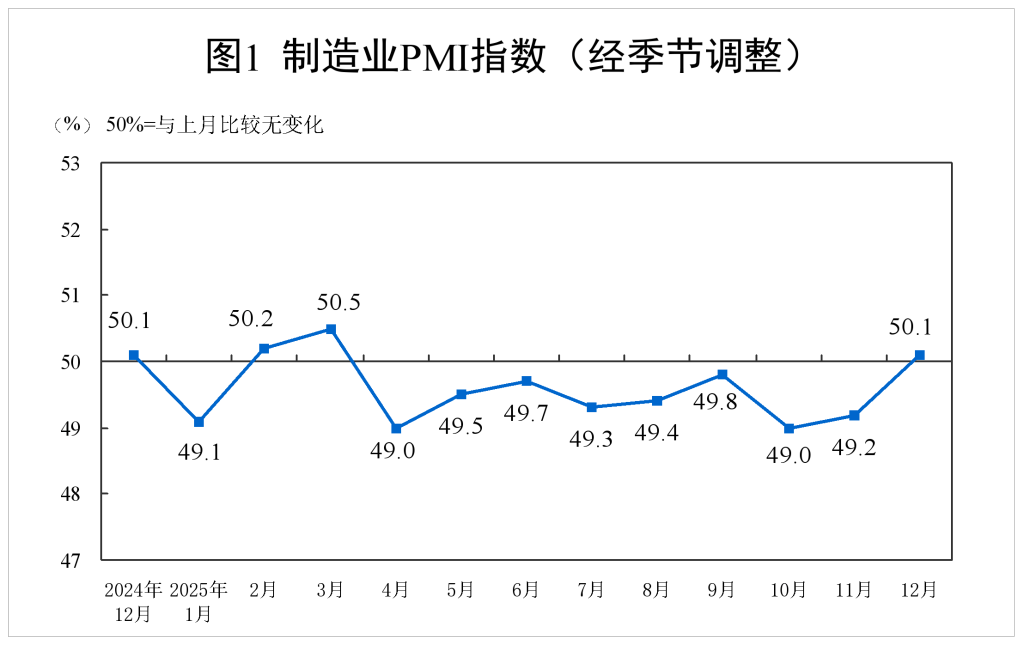
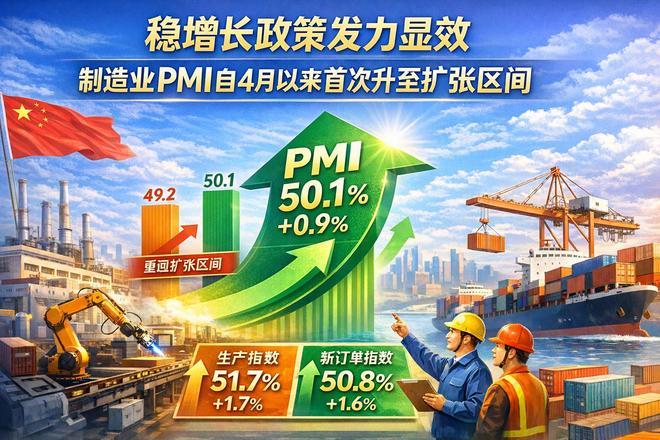
Core Viewpoint - The manufacturing PMI has returned to the expansion zone, indicating a recovery in both production and demand in the manufacturing sector, driven by steady growth policies and resilient exports [2][3]. Manufacturing PMI Overview - In December, the manufacturing PMI was reported at 50.1%, an increase of 0.9 percentage points from the previous month, marking the first return to the expansion zone since April [2]. - The non-manufacturing business activity index also improved to 50.2%, up by 0.7 percentage points from the previous month, reflecting a simultaneous improvement in non-manufacturing activity [2]. Factors Driving Recovery - The recovery in the manufacturing PMI is attributed to the ongoing implementation of growth-stabilizing policies and resilient export performance [2]. - The "two 500 billion" growth-stabilizing policies introduced in late September and early October have begun to show effects, with 500 billion yuan in new policy financial tools fully deployed by October, boosting infrastructure and manufacturing investments [2][4]. Production and Demand Indices - The production index and new orders index for December were reported at 51.7% and 50.8%, respectively, both showing significant increases of 1.7 and 1.6 percentage points from the previous month [2][3]. - The new orders index has risen above the critical point for the first time since the second half of the year, indicating expansion in both production and demand [3]. Enterprise Size Analysis - Large enterprises saw a PMI of 50.8%, up by 1.5 percentage points, returning to the expansion zone, while medium-sized enterprises had a PMI of 49.8%, up by 0.9 percentage points, indicating a slight recovery [4]. - Small enterprises, however, experienced a decline in PMI to 48.6%, down by 0.5 percentage points, reflecting greater pressure due to weak consumer demand [4][5]. Future Outlook - The production and business activity expectation index rose to 55.5%, an increase of 2.4 percentage points, indicating growing confidence among manufacturing enterprises regarding market development [5]. - The support from growth-stabilizing policies is expected to continue to bolster manufacturing sentiment, with projections suggesting that the manufacturing PMI may remain in the expansion zone into January 2026 [5].
年度盘点丨2025年中国创投:重拾向上动能,奔赴投资新程
Zheng Quan Shi Bao Wang· 2025-12-31 11:43
Group 1 - In 2025, China's venture capital industry emerged from a two-year downturn, showing signs of recovery across the entire "fundraising, investment, management, and exit" chain [1] - The government issued a significant policy document aimed at promoting the high-quality development of government investment funds, focusing on controlling new fund setups and optimizing investment policies [2] - Bank-affiliated financial asset investment companies (AICs) accelerated their entry into the primary market, with a notable increase in capital contributions since the policy announcement [3] Group 2 - Local governments have begun issuing special bonds to support government-guided funds, with a total of 52 billion yuan issued across nine provinces and cities this year [4] - New government-guided funds are being established with extended durations, some lasting up to 20 years, providing long-term support for projects [5] - Venture capital institutions and startups are increasingly acquiring listed companies, indicating a trend towards using public companies as exit strategies [6] Group 3 - Top domestic private equity firms are actively acquiring overseas consumer brands' operations in China, driven by their financial resources and local operational expertise [7] - Venture capital institutions are eagerly issuing technology innovation bonds, with significant interest from private firms leading to successful issuances [8] - Mainland venture capital and private equity firms are establishing offices in Hong Kong, attracted by the region's supportive environment for technology innovation [9][10] Group 4 - Dollar limited partners (LPs) are returning to the Chinese venture capital market, with several firms successfully raising dollar-denominated funds amid a booming AI sector [11] - The National Entrepreneurship Investment Guidance Fund has officially begun investing in three regional funds, marking a strategic deployment in key economic areas [12]
分析|产需两端明显回升,12月制造业PMI时隔8个月回升至扩张区间
Sou Hu Cai Jing· 2025-12-31 09:15
Group 1: Manufacturing Sector - In December, the Manufacturing Purchasing Managers' Index (PMI) rose to 50.1%, an increase of 0.9 percentage points from the previous month, marking the first time it has entered the expansion zone since April [8] - The production index reached 51.7%, up 1.7 percentage points, and the new orders index increased to 50.8%, up 1.6 percentage points, indicating significant improvement in manufacturing demand [8] - The new export orders index also improved to 49.0%, up 1.4 percentage points, suggesting a recovery in external demand [8] Group 2: Non-Manufacturing Sector - The Non-Manufacturing Business Activity Index rose to 50.2%, an increase of 0.7 percentage points, returning to the expansion zone [10] - The service sector's business activity index was at 49.7%, indicating it remains in the contraction zone despite a slight increase [11] - The construction sector showed improvement with a business activity index of 52.8%, up 3.2 percentage points, attributed to favorable weather and policy-driven infrastructure investments [12] Group 3: Economic Outlook - The overall economic activity in December showed signs of recovery, with both domestic and external demand improving due to effective growth stabilization policies [13] - The price indices showed mixed results, with the main raw material purchase price index decreasing by 0.5 percentage points to 53.1%, while the factory price index increased by 0.7 percentage points to 48.9%, indicating potential for improved corporate profits [9] - Looking ahead, the manufacturing PMI is expected to remain in the expansion zone into early 2026, supported by ongoing growth policies and a recovering market demand [13][14]