
二次通胀

Search documents
策略周末谈:康波萧条期的全面加速
Western Securities· 2026-03-01 12:07
策略周报 康波萧条期的全面加速 策略周末谈(0301) 核心结论 2026 年,萧条期的"三不变"决定了趋势正式进入加速阶段—— 一不变:RMB 升值的方向不变,调控的是节奏 离岸汇率创新高是跨境资金加速回流的结果。即便央行下场调控,更多调控 的是斜率而非方向。历史上出台类似的调控政策都基本不会改变实际的汇率 变动趋势。对市场的影响也相对有限。从结果看,升值带动外资流入,已初 现端倪。面对趋势渐弱的美股,年初以来我们观察到了主动资金开始陆续的 流入。这是康波萧条期中,属于追赶国股市的机遇。 丙午之年,大争之世。1978 年底,伊朗伊斯兰革命爆发,并引发第二次石 油危机;而 2026 年美以对伊战争爆发,也将带动商品超级周期走向新的阶 段。对 A 股而言,温和通胀将在 2026 年兑现为一轮属于追赶国的繁荣(炼 化、贵金属、有色金属、煤炭、油运等)。 风险提示:国际局势变化风险,美债利率超预期上行,产业政策变化风险等。 1 | 请务必仔细阅读报告尾部的投资评级说明和声明 分析师 曹柳龙 S0800525010001 13817664054 caoliulong@research.xbmail.com.cn 徐嘉 ...
料垒库幅度放缓
Chuang Yuan Qi Huo· 2026-01-12 05:15
1. Report Industry Investment Rating - Not provided in the document. 2. Core View of the Report - Since mid-December 2025, the black commodity sector has shown a pattern where coking and steel mill profits on the futures market have been compressed. The prices of coking coal and iron ore have increased more, while finished steel products and coke have followed. The key factors are the expectation and realization of the bottoming - out and rebound of hot metal production, the strong performance of non - ferrous metals, and news of coal mine production capacity contraction. After the New Year's Day, the raw material supply - demand situation has improved, and coking coal inventory accumulation has slowed down, entering a state of "raw material valuation repair"[8][9]. 3. Summary by Relevant Catalogs 3.1 Market Review - Since the report on October 21st, the black sector has seen compressed coking and steel mill profits on the futures market. Before January, the black market was in a situation of weak steel demand, declining hot metal production, and a loose raw material supply - demand pattern, with continuous inventory accumulation of coking coal as the core trading point. After the New Year's Day, hot metal production rebounded as expected, and the supply - demand situation of raw materials improved, with coking coal inventory accumulation slowing down. The strong performance of non - ferrous metals and equity assets also led to an optimistic sentiment spill - over, driving the rebound of low - price varieties[8][9]. 3.2 Coking Coal Delivery - The delivery volume of jm2601 was the second - largest in 2025, second only to jm2505. More futures companies participated in the delivery, especially on the receiving side. The delivery parties were still mainly concentrated in Guotai Junan Futures, CITIC Futures, and Donghai Futures. The increasing activity of coking coal delivery participants is a positive development trend for the effectiveness of coking coal monthly spread and basis pricing, reflecting the essence of financial services for the real economy[11][12][13]. 3.3 Reality of Double Coking (Coking Coal and Coke) - **Weekly Coking Coal Supply**: Domestic mines' production has recovered, while the growth of external supply has slowed down[16]. - **Coking Coal Inventory**: The pattern of coking coal inventory accumulation continues, but the amplitude has slowed down, and the inventory is still concentrated in the mid - stream[21]. - **Coke Inventory**: Coke has turned to de - stocking, and the number of available days is at a neutral level[28]. - **Direct Demand for Double Coking since New Year's Day**: The negative growth of direct demand for double coking has narrowed[34]. 3.4 Coking Coal Inventory in January - **Import Profit Compression**: The import profit of coking coal has been compressed, and the future arrival of overseas coking coal is expected to decrease[43]. - **Expected Increase in Hot Metal**: Hot metal production is expected to continue to rise[55]. - **Steel Demand**: Steel demand is hard to be optimistic, but it should not be overly pessimistic. If domestic mine production decreases seasonally and imports decline, coking coal inventory accumulation may slow down[57][61].
2026,美股从“估值狂欢”到“盈利长征”?
3 6 Ke· 2026-01-05 23:46
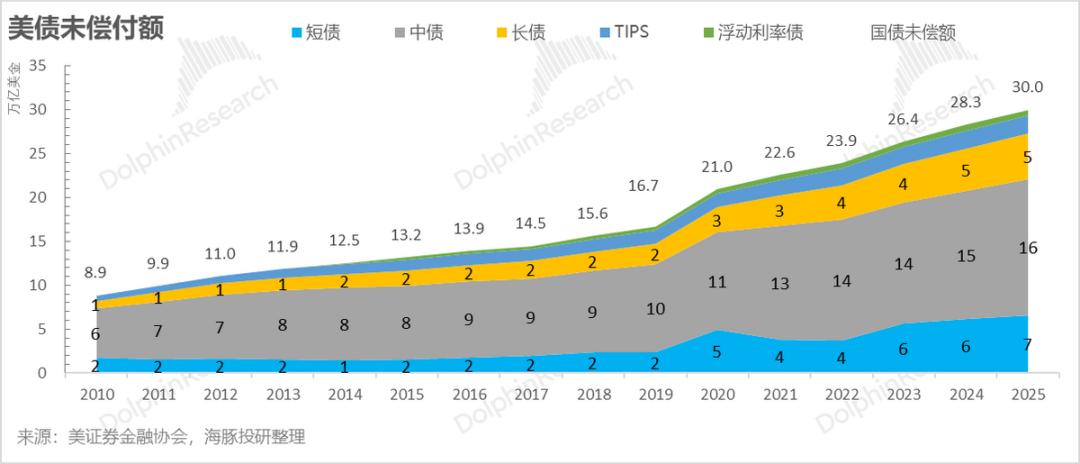
Group 1 - The article discusses the completion of a full fiscal, monetary, and economic cycle in the U.S. since 2020, questioning whether the stock market will thrive in the new cycle starting in 2026 [1] - The U.S. economy's growth over the past few years has been driven by debt expansion and increased productivity due to AI, but the efficiency of debt-driven growth appears to be declining [6] - By 2025, the U.S. national debt is projected to reach approximately $32 trillion, with a macro debt ratio of 257%, indicating a structural increase compared to pre-pandemic levels [1][6] Group 2 - In 2026, the Federal Reserve is expected to adopt a "fiscalized" approach, releasing short-term liquidity to address tightening conditions in the banking system [7] - The U.S. Treasury is projected to issue around $2 trillion in net debt in 2026, corresponding to a fiscal deficit of approximately $2 trillion and a need for liquidity support from the Federal Reserve [9] - The long-term bond market is expected to remain under pressure with rates above 4%, while short-term debt instruments may become more attractive due to favorable rates [11][14] Group 3 - The Federal Reserve may continue to lower interest rates and implement "small-scale quantitative easing" to support the financing needs of the Treasury, particularly in light of the "Beautiful America" plan [14][15] - The economic growth in 2026 is anticipated to be driven by a combination of government debt and private sector AI investment, leading to a scenario of a depreciating dollar and inflationary pressures [15]

一夜狂泻!金银高台跳水,发生了什么?
Sou Hu Cai Jing· 2025-12-30 03:05
Core Viewpoint - The recent sharp decline in precious metal prices, including gold and silver, has caused significant panic among investors, driven by increased margin requirements and market speculation [1][4][5]. Price Decline Analysis - The primary trigger for the price drop was the CME Group's decision to raise margin requirements for gold and silver contracts, significantly increasing trading costs for investors [4]. - Prior to the decline, precious metals had experienced substantial price increases, with silver rising by 173% and gold by over 71% since 2025, creating a speculative bubble that was unsustainable [5]. - Market rumors regarding a major bank's potential default due to silver futures positions further exacerbated investor panic, leading to increased selling pressure [6]. Impact on Market Participants - Investors faced severe asset losses, particularly those who bought at high prices, with many accounts experiencing significant reductions in value [8]. - The decline in precious metal prices triggered a domino effect in financial markets, leading to sharp declines in mining company stocks and related ETFs, as well as broader impacts on major stock indices like the S&P 500 and Nasdaq [9]. - The volatility in precious metal prices has raised concerns about macroeconomic expectations, with fears of inflation control and potential deflation affecting market confidence [10]. Future Outlook and Investment Recommendations - Experts suggest that precious metal prices may experience further fluctuations, with potential for excess returns in 2026 due to factors such as a weakening dollar and increased demand for industrial silver [11]. - However, there are warnings about the current overbought conditions in silver, which may lead to a rapid correction or prolonged consolidation [11]. - Investors are advised to maintain a diversified asset allocation strategy and to stay informed about macroeconomic indicators and central bank policies that could influence precious metal prices [12].
中邮证券:黄金多次创造历史新高 贵金属为有色金属板块亮眼品种
Zhi Tong Cai Jing· 2025-12-18 02:00
Core Viewpoint - The report from Zhongyou Securities indicates that gold is expected to be the standout performer in 2025, driven by a shift from U.S. Treasury bonds. Gold prices are currently stable above $4,000 per ounce, while silver has seen a higher percentage increase compared to gold due to liquidity factors [1]. Group 1: 2025 Market Outlook for Precious Metals - The precious metals market in 2025 is anticipated to unfold in two phases: the first phase involves a diversified asset allocation driven by tariff expectations from the Trump administration, leading to a correlation between U.S. Treasury yields and gold prices, with London gold surpassing $3,500 per ounce in April 2025 [2]. - In the second phase, starting in mid-August, a rate cut cycle is expected as the market begins to price in the Federal Reserve's rate cuts, resulting in significant inflows into Western gold ETFs. During this phase, gold is projected to break through $4,300 per ounce, setting a new historical high, while silver is expected to exceed $55 per ounce, outperforming gold and leading to a decrease in the gold-silver ratio [2]. Group 2: 2026 Market Outlook for Gold - The outlook for gold in 2026 suggests continued upward momentum, potentially exceeding expectations due to several factors: the perceived weakening of U.S. dollar credibility following the U.S. National Security Strategy report, which acknowledges the limitations of U.S. power in a multipolar world, thereby reinforcing gold's role as an alternative to U.S. Treasury bonds [3]. - The likelihood of secondary inflation is increasing, with expectations of further rate cuts from the Federal Reserve, which could drive up gold prices as inflation metrics rise alongside persistently high long-term Treasury yields [3]. - Historical trends indicate that following rate cuts, there is typically an influx into ETFs in the U.S. and Europe, which, combined with dovish expectations and the Fed's balance sheet expansion, is likely to encourage continued investment in gold ETFs [3]. Group 3: 2026 Market Outlook for Silver - Silver is expected to continue its upward trajectory in 2026, primarily due to its supply-demand imbalance, which has persisted for five consecutive years, making it potentially stronger than copper despite a large existing market [4]. - The anticipated rate cuts from the Federal Reserve are expected to drive silver prices higher, as the metal has shown greater elasticity in response to market conditions, particularly following its outperformance against gold after April 2025 [4]. - Continuous supply shortages are likely to create tension in the physical market, with some countries considering silver as a reserve asset, thereby enhancing its monetary attributes and increasing its investment value [4].
贵金属牛市的下半场 | 投研报告
Sou Hu Cai Jing· 2025-12-18 01:26
Core Viewpoint - The report from Zhongyou Securities indicates that gold is expected to be the standout investment in 2025, driven by a shift from U.S. Treasury bonds. Gold prices have stabilized above $4,000 per ounce, with silver experiencing higher percentage gains due to liquidity factors [1][2]. Investment Highlights - In 2025, the precious metals market was characterized by two phases: the first phase involved diversification driven by tariff expectations under the Trump administration, leading to a correlation between U.S. Treasury yields and gold prices, with gold surpassing $3,500 per ounce in April 2025 [2]. - The second phase began in mid-August with expectations of interest rate cuts, resulting in significant inflows into Western gold ETFs and a surge in gold prices, which reached over $4,300 per ounce, while silver exceeded $55 per ounce, outperforming gold during this phase [2][3]. 2026 Market Outlook - For 2026, gold is anticipated to continue its upward trend, supported by a potential decline in U.S. dollar credibility and ongoing supply-demand pressures in the long-term Treasury market, reinforcing gold's role as an alternative asset to U.S. Treasuries [2][3]. - The likelihood of a second wave of inflation is increasing, with the Federal Reserve's rate cuts expected to elevate gold prices, as high long-term Treasury yields suggest inflationary pressures [3]. - Continued inflows into ETFs are expected, as historically, such inflows follow interest rate cuts, and the Fed's balance sheet expansion is likely to suppress short-term rates, encouraging investment in gold ETFs [3]. Silver Outlook - Silver's outperformance relative to gold post-April 2025 is attributed to its recovery in risk appetite and its physical trading attributes, with ongoing supply-demand imbalances expected to strengthen its market position [3]. - The anticipated continued rise in silver prices is supported by declining inventories and its increasing status as a reserve asset in certain countries, which enhances its monetary attributes and investment appeal [3].
2026年度策略:贵金属牛市的下半场
China Post Securities· 2025-12-17 09:03
Industry Overview - The report maintains a strong market rating for the non-ferrous metals sector, with a closing index of 7715.84, a 52-week high of 7846.97, and a low of 4280.14 [1]. Investment Highlights - In 2025, precious metals, particularly gold, were highlighted as the best-performing assets, with gold prices stabilizing above $4000 per ounce and silver outperforming gold due to liquidity factors [4][5]. - The precious metals market in 2025 was characterized by two phases: the first phase involved diversification in asset allocation driven by tariff expectations from the Trump administration, leading to a significant rise in gold prices, while the second phase saw a rally due to anticipated interest rate cuts by the Federal Reserve [5][15]. - The outlook for 2026 suggests that gold prices may continue to rise, supported by weakening dollar credibility, increasing inflation expectations, and continued inflows into gold ETFs [6][37]. Silver Market Analysis - Silver outperformed gold in 2025, particularly after April, due to a recovery in risk appetite and ongoing supply-demand imbalances, with prices reaching historical highs above $60 per ounce by December [39][50]. - The silver market is expected to continue its upward trend in 2026, driven by declining inventories and some countries designating silver as a reserve asset, enhancing its investment appeal [50][51]. Supply and Demand Dynamics - The report indicates a persistent supply-demand imbalance in the silver market, with significant inventory pressures observed in Shanghai and London, and CME market dynamics reflecting speculative trading [43][44]. - The total supply of silver is projected to remain constrained, with mine production and recycling rates showing modest growth, while demand from industrial applications continues to rise [42]. ETF Inflows and Market Trends - In 2025, there was a notable increase in gold ETF holdings, particularly from Western investors, which played a crucial role in driving gold prices above $4000 per ounce [30][33]. - The inflow of ETFs from North America and Europe significantly contributed to the gold market's performance, marking a shift in investment patterns compared to previous years [31][33].
铁矿石2025年四季度展望:海外需求主导,上下空间有限
Nan Hua Qi Huo· 2025-09-30 10:24
Group 1: Report Industry Investment Rating - No information provided about the report industry investment rating Group 2: Core Viewpoints of the Report - In Q4 2025, supported by increased supply and high molten iron production for export, the fundamentals of iron ore are decent. The price is expected to show no strong trend and maintain a moderately bullish oscillating pattern. Domestic demand remains stable overall, while overseas demand is strong. However, long - positions should pay attention to overseas risks [3][88] - The price range in Q4 is expected to be between 90 and 115 for Platts 62 and between 700 and 900 for the iron ore index [4][89] - Industrial risk management suggestion: interval trading [5][90] Group 3: Summary by Relevant Catalogs 1. 2025 H1 Iron Ore Price Review - From January 15 to February 21: Pessimistic expectations were reversed, and supply disruptions supported the price increase. The black market followed the stock market, and both domestic and overseas macro - sentiments were positive. Hurricanes affected iron ore shipments, and the spot was in short supply [5] - From February 22 to April 8: Both expectations and fundamentals weakened. After the hurricane, shipments returned to normal, and the relationship between the stock market and the black market diverged. Tariffs and anti - dumping concerns, along with the expectation of crude steel reduction, pushed the price down [6] - From April 9 to June 18: After the risk release, there was a temporary balance. The iron ore valuation was low, but the actual demand was stable. The Geneva Agreement led to a price increase, but then the market entered a low - volatility state [7] - From June 19 to the present: The iron ore price bottomed out and then rose. The reasons were the promotion of anti - involution and the repair of pessimistic expectations under high molten iron production [8] 2. Supply - **Overall Supply in 2025**: The supply of iron ore in the first three quarters of 2025 was tight at first and then loosened. The global shipment volume in the first three quarters was about 1.133 billion tons, a year - on - year increase of 0.78%. It is expected that the shipment in Q4 will be relatively sufficient, with a year - on - year growth rate of about 1% [11] - **China's Supply**: From January to August, the cumulative import of iron ore and its concentrates was 801.618 million tons, a year - on - year decrease of 1.6%. In August, the import was 10.5225 million tons, a month - on - month increase of 0.6% [17] - **Shipment by Country**: Australia and Brazil are still the top two suppliers, but their shipment volumes declined. India's exports to China dropped significantly, while Russia's and Mongolia's exports increased [19][20] - **Four Major Mines**: In H1 2025, the four major mines generally overcame adverse factors, and their production remained stable or increased slightly. Vale and Rio Tinto are expected to be the main contributors to the incremental production in H2 [24] - **Domestic Mines**: From January to August, the iron concentrate output of 332 mines was 172.55 million tons, a year - on - year decrease of 2.5%. The annual output is expected to be lower than last year, with a year - on - year growth rate of about - 2% [48] 3. Demand - **Demand Revision**: The view on demand in the semi - annual report needs to be revised. Currently, external demand is the dominant factor. Domestic demand in infrastructure and real estate remains weak, while exports, both direct and indirect, are becoming the leading force in black demand [51][52] - **Molten Iron Production**: In the first three quarters of 2025, the average daily molten iron production was 237210 tons, a year - on - year increase of 3.73%. It is expected that the production in Q4 may first remain stable and then decline [58] - **Steel Mill Supply Adjustment**: In the first three quarters, downstream steel mill demand was decent supported by exports. Building materials demand declined, while plate demand maintained positive growth. Steel mills adjusted their supply through production transfer [63][64] - **Export Support**: In the context of weak domestic demand, overseas exports are an important support for steel demand. Although the cost advantage is weakening, the export volume is expected to be supported in the second half of the year [68] 4. Inventory - **Port Inventory**: Due to hurricane disruptions and high molten iron production in the first three quarters, port inventory decreased. However, with the recovery of shipments and low steel mill profits, port inventory may start to accumulate again [73] - **Steel Mill Inventory**: Steel mills adhere to the low - inventory strategy for raw materials, and the proportion of trading ore is relatively high [75] - **Global Seaborne Inventory**: The global seaborne inventory of iron ore is high, and the shipping speed has returned to normal, which may accelerate the arrival of iron ore at ports [77] 5. Valuation - **Term Structure**: The term structure of iron ore remains in a back structure, but the contango of far - month contracts has significantly shrunk. In Q4, attention should be paid to steel mill production cuts for reverse arbitrage [79] - **Iron - Scrap Price Difference**: Scrap steel has been less cost - effective compared to iron ore in the past year. The scrap addition ratio in blast furnaces has decreased [82] - **Coking Coal/Iron Ore Seesaw Effect**: In 2025, the price seesaw effect between coking coal and iron ore is more significant. If coking coal prices remain strong in Q4, it may continue to suppress iron ore prices [84] - **Volatility**: The implied volatility of iron ore options decreased in H1 2025 and then rebounded after the anti - involution trading in late June [86]



帮主郑重:美联储突然集体放鹰!鲍威尔讲话前夜,A股要小心这把“双刃剑”?
Sou Hu Cai Jing· 2025-08-22 01:49
Group 1 - The U.S. stock market experienced a decline, with the S&P 500 facing five consecutive days of losses, while Chinese electric vehicle stocks like Xpeng and NIO saw significant gains, indicating foreign investors' long-term confidence in China's new energy vehicles [3] - The recent hawkish comments from three Federal Reserve officials have reduced the probability of a rate cut in September from 80% to 75%, highlighting concerns over inflation due to increased tariffs [3] - The Atlanta Fed's report suggests that tariffs could lead to "secondary inflation," and the Cleveland Fed's president warned of a potential price increase wave, complicating the Fed's decision-making regarding interest rates [3] Group 2 - In the A-share market, the Shanghai Composite Index stabilized at 3,771 points, with net inflows of 3.86 billion from northbound funds, indicating foreign capital's search for certainty amid market volatility [4] - Domestic capital is shifting from high-tech stocks to defensive sectors like utilities and liquor, suggesting a strategy of risk management among local investors [4] - The Chinese government has initiated a third batch of 83 billion long-term special bonds focused on new energy and infrastructure, which is a positive signal for sectors like new energy vehicles and smart grids [5] Group 3 - Long-term investors are advised to focus on opportunities in hard technology sectors supported by policy, such as new energy vehicles and semiconductors, viewing pullbacks as buying opportunities [5] - Defensive sectors like liquor and utilities are recommended for risk-averse investors due to their stability and dividend potential [5] - Short-term trading strategies should consider catalysts like the computing power conference and potential interest rate cuts from the central bank, as seen with the record trading volume in ZTE [5]

流动性宽松与风险偏好共振,A股有望再创新高
Tong Guan Jin Yuan Qi Huo· 2025-08-18 10:49
Report Title - The report is titled "Macro and Major Asset Semi-Annual Report: Loose Liquidity and Risk Appetite Resonance, A-shares Expected to Reach New Highs" [1] Investment Rating - No investment rating for the industry is provided in the report Core Views - In the first half of 2025, under the impact of Trump's domestic and foreign policies, global major asset fluctuations intensified. Stocks performed the best, followed by bonds. Commodities were divided, with externally-driven varieties outperforming domestic-demand products. The currencies of the G2 countries were under pressure, with both the US dollar and the RMB weakening [2][3][8] - In the domestic market, equities (+5.83%) > bonds (+0.87%) > commodities (-2.09%) > RMB (-6.03%). A-shares' performance was centered around China's AI breakthroughs and Trump's tariff disruptions. AI利好 catalyzed the technology and growth sectors to lead in stages, boosting risk appetite. Tariff uncertainties dragged down the export chain, suppressing the valuation repair of the cyclical and manufacturing sectors. Bonds mainly fluctuated based on tight liquidity, tariff-induced risk aversion, and their gains significantly converged compared to 2024. The RMB appreciated against the US dollar and depreciated against non-US currencies. Commodities were divided, with precious metals shining and domestic-demand commodities such as black metals and industrial products remaining weak [3][8] - In the overseas market, bonds (+7.27%) > equities (+6.07%) > commodities (+5.96%) > US dollar (-10.79%). In the first half of the year, global risk appetite fluctuated significantly. Trump's tariff policies once triggered a sharp market shock, but the recession remained at the expected level. Global stock markets quickly recovered after a sharp decline, with the Hong Kong, German, and South Korean stock markets rising by over 20%. Global bonds generally rose, led by emerging markets and US bonds, while European bonds were weaker. Commodities generally rose slightly, led by livestock and oils, with metals and industrial raw materials having moderate increases. The US dollar index fell by over 10%, dragged down by cooling soft data, tariff impacts on credit, and doubts about the Fed's independence [3][8] - Looking ahead, A-shares are expected to reach new highs due to the continuation of loose global central bank liquidity and the approaching of the profit bottom. In the bond market, treasury bond yields may decline further but with weak odds. Gold prices are bullish in the medium to long term, supported by global loose liquidity, geopolitical risks, and anti-globalization. Copper prices are expected to rise as the global economy is expected to recover and the supply of concentrates is expected to tighten. Oil prices are expected to be weak in the second half of the year due to oversupply and weak demand [3] Summary by Directory 1. Major Asset Performance - In the first half of 2025, under the impact of Trump's domestic and foreign policies, global major asset fluctuations intensified. Stocks performed the best, followed by bonds. Commodities were divided, with externally-driven varieties outperforming domestic-demand products. The currencies of the G2 countries were under pressure, with both the US dollar and the RMB weakening [8] - In the domestic market, equities (+5.83%) > bonds (+0.87%) > commodities (-2.09%) > RMB (-6.03%). A-shares' performance was centered around China's AI breakthroughs and Trump's tariff disruptions. AI利好 catalyzed the technology and growth sectors to lead in stages, boosting risk appetite. Tariff uncertainties dragged down the export chain, suppressing the valuation repair of the cyclical and manufacturing sectors. Bonds mainly fluctuated based on tight liquidity, tariff-induced risk aversion, and their gains significantly converged compared to 2024. The RMB appreciated against the US dollar and depreciated against non-US currencies. Commodities were divided, with precious metals shining and domestic-demand commodities such as black metals and industrial products remaining weak [8] - In the overseas market, bonds (+7.27%) > equities (+6.07%) > commodities (+5.96%) > US dollar (-10.79%). In the first half of the year, global risk appetite fluctuated significantly. Trump's tariff policies once triggered a sharp market shock, but the recession remained at the expected level. Global stock markets quickly recovered after a sharp decline, with the Hong Kong, German, and South Korean stock markets rising by over 20%. Global bonds generally rose, led by emerging markets and US bonds, while European bonds were weaker. Commodities generally rose slightly, led by livestock and oils, with metals and industrial raw materials having moderate increases. The US dollar index fell by over 10%, dragged down by cooling soft data, tariff impacts on credit, and doubts about the Fed's independence [8] 2. Equity Market 2.1 A-shares - In the first half of 2025, A-shares performed well, with broad-based indices generally rising. The Beizheng 50, CSI 1000, and CSI 2000 led the gains, showing a significant structural market. The performance of large-cap blue-chip indices such as the SSE 50 and CSI 300 was relatively limited. Overall, the market fluctuated greatly in the first half of the year, and risk appetite fluctuated between "China's AI narrative" and "Trump's tariffs." The market generally trended upward, with a decent profit-making effect. The market can be roughly divided into four stages [13] - Stage 1 (January 1 - January 13): The market declined weakly due to a lack of economic data, weakening policy effects from the fourth quarter of 2024, and rising overseas uncertainties ahead of Trump's inauguration. During this period, most indices adjusted, with the ChiNext Index leading the decline and the growth sector performing weakly [16] - Stage 2 (January 14 - March 18): The market rose significantly as the strong expectations for China's AI industry outweighed the weak economic reality. The market's pessimistic sentiment was significantly repaired after the China-US presidential call in mid-January, and risk appetite recovered. The popularity of DeepSeek in late January triggered strong expectations for China's AI innovation, becoming the core driver of the market. The "strong expectations" for China's AI industry outweighed concerns about Trump's tariffs and the "weak reality" of economic data, driving the market's trading volume to an average of 1.8 trillion yuan and the margin trading balance to a 10-year high of 1.9 trillion yuan. During this period, most indices rose, with small-cap growth stocks such as the Beizheng 50 and CSI 2000 leading the gains [17] - Stage 3 (March 19 - April 7): Risk appetite declined as the market shifted from strong industry expectations to economic reality. The market's expectations for a Q1 reserve requirement ratio (RRR) cut and interest rate cut were disappointed, and the liquidity remained tight until the end of March. The 10-year treasury bond yield rose, and overseas liquidity tightened marginally, putting pressure on valuations. The market's trading volume declined. On April 7, Trump's announcement of "reciprocal tariffs" far exceeded market expectations, triggering a global risk-off sentiment. The A-share market tumbled after the Tomb-Sweeping Festival holiday, with the Shanghai Composite Index falling by more than 7% and thousands of stocks hitting the daily limit down [18][19] - Stage 4 (April 8 - June 30): The market gradually recovered as policy support and a stabilization of global risk appetite boosted investor confidence. Trump's decision to delay the implementation of reciprocal tariffs for 90 days helped to stabilize global risk appetite. In response to the US tariffs, the Chinese government quickly introduced a series of policies to support the economy and counter the US measures. The central bank injected liquidity through a stabilization fund, helping to restore market confidence. The market entered a structural recovery phase with strong support at the bottom [19] - Looking ahead to the second half of the year, A-shares still have upward momentum. On the earnings side, policy support is expected to improve the economic fundamentals, and the "earnings bottom" is approaching. On the valuation side, loose monetary policies at home and abroad are expected to continue, providing support for equity valuations. Policy support is expected to strengthen market expectations, and the A-share market is expected to reach new highs this year, breaking through the high set on September 24 last year. The market's performance will depend on the timing of the Fed's interest rate cuts and the recovery of domestic risk appetite [20][21][22] 3. Bond Market 3.1 Treasury Bonds - In the first half of 2025, the bond market entered an adjustment phase after a unilateral upward trend at the end of 2024. The market's pricing of the weak domestic economic momentum became more comprehensive, and tight liquidity, tariff policies, and the recovery of risk appetite became the core variables driving interest rate fluctuations. The bond market can be roughly divided into three stages [27] - Stage 1 (January 1 - March 19): Interest rates rose as the market's expectations for loose monetary policies were revised, liquidity tightened, and the stock market strengthened. In early 2025, the 10-year treasury bond yield quickly fell below 1.6% due to the continued impact of loose policy expectations at the end of 2024. Subsequently, tight liquidity, disappointed expectations for a Q1 RRR cut and interest rate cut, and the recovery of risk appetite driven by the revaluation of technology stocks led to a rebound in interest rates. The yield curve showed a "bear flattening" trend. By mid-March, the 10-year treasury bond yield approached 1.9%, reaching a new high for the year [30] - Stage 2 (March 20 - April 7): Interest rates declined as the central bank shifted its focus to supporting the economy, risk aversion increased due to Trump's tariff policies, and regulatory guidance was introduced. As economic data weakened and external risks increased, the central bank shifted its policy focus from "risk prevention" to "growth stabilization." The tight liquidity in the first quarter gradually eased, and the equity market entered an adjustment phase. The 10-year treasury bond yield declined to 1.8%. In early April, Trump's tariff policies far exceeded market expectations, triggering a global stock market crash. Risk aversion drove funds into the bond market, and the 10-year treasury bond yield dropped to 1.6% [30] - Stage 3 (April 8 - June 30): Interest rates fluctuated within a narrow range as the market balanced the recovery of risk appetite, the implementation of loose monetary policies, and the increase in bond supply. In the second quarter, the bond market generally fluctuated within a narrow range as the market weighed the recovery of risk appetite, RRR cuts and interest rate cuts, and the supply of government bonds. The market mainly focused on two factors: 1) The China-US trade talks in Geneva reached an unexpected consensus, boosting market sentiment. The resilience of exports in the second quarter also provided some support for the economy and put pressure on the bond market. 2) The central bank announced RRR cuts and interest rate cuts in early May, leading to a marginal easing of liquidity. Despite the large supply of government bonds, the central bank's open market operations showed a strong intention to support liquidity, providing some support for interest rates [31] - Looking ahead to the second half of the year, treasury bond yields may break through their previous lows, but the odds are weak. The economic fundamentals have not reversed, and the bond market is still likely to benefit from loose monetary policies. However, the recovery of risk appetite and the increasing attractiveness of risk assets may limit the downside potential of bond yields. The bond market may face some challenges in the second half of the year, including a potential increase in inflation expectations and the uncertainty of Trump's domestic and foreign policies [32][34][35] 4. Commodity Market 4.1 Gold - In the first half of 2025, the gold price continued its upward trend from last year, rising by more than 25%. The price increase was mainly driven by the risk aversion sentiment triggered by Trump's policies, increasing recession expectations, and doubts about the US dollar's credit. The gold market can be roughly divided into three stages [43] - Stage 1 (January 1 - April 2): The gold price rose as Trump's inauguration increased trade tensions, and weak US economic data and rising recession expectations drove investors to seek safe-haven assets. The US dollar index and the US treasury bond yield declined, and central banks around the world continued to increase their gold reserves, driving the gold price higher. During this period, the gold price trended upward [44][47] - Stage 2 (April 3 - April 21): The gold price reached a new high as Trump's tariff policies triggered a global risk-off sentiment and a crisis of confidence in the US dollar. The global market was shocked by Trump's announcement of "reciprocal tariffs," which far exceeded market expectations. The initial sell-off of gold due to liquidity shortages and panic was quickly reversed as investors sought the safe-haven properties of gold. The gold price reached a record high of over $3,500 per ounce on April 22 [47] - Stage 3 (April 22 - June 30): The gold price fluctuated within a narrow range as the market's risk appetite recovered, and geopolitical risks increased. The US government's decision to ease its tariff policies and the strong US economic data put pressure on the gold price. However, the escalating geopolitical tensions in the Middle East provided some support for the gold price. During this period, the gold price fluctuated between $3,175 and $3,450 per ounce [48] - Looking ahead to the second half of the year, the gold price is expected to continue its upward trend, supported by loose global liquidity, rising geopolitical risks, and the acceleration of anti-globalization. However, the narrowing of macro uncertainties and the increasing odds of a price correction may limit the upside potential of the gold price. The gold market may face some challenges in the second half of the year, including the implementation of Trump's tariff policies, the Fed's interest rate cuts, and the geopolitical situation in the Middle East [49] 4.2 Copper - In the first half of 2025, the copper price generally trended upward, with a brief correction in April due to Trump's tariff policies. The copper market can be roughly divided into three stages [51] - Stage 1 (January 1 - March 26): The copper price rose as the global manufacturing sector recovered, and the expectation of fiscal expansion in China and Europe supported the copper demand. The supply of copper concentrates tightened, and the spot treatment charge (TC) price reached a record low, putting upward pressure on the copper price. The expectation of copper tariffs and the US government's investigation into copper imports also contributed to the increase in the copper price [53] - Stage 2 (March 27 - April 9): The copper price declined as Trump's tariff policies triggered a global risk-off sentiment, and the demand for copper decreased. The copper price dropped by more than 20% in a short period, reaching its lowest level of the year [53] - Stage 3 (April 10 - June 30): The copper price recovered as the market's risk appetite improved, and the supply of copper concentrates continued to tighten. The decision to delay the implementation of reciprocal tariffs and the weakening of the US dollar supported the copper price. The supply-demand balance of the copper market remained tight, and the spot TC price continued to trade below $40 per ton, providing strong support for the copper price [54] - Looking ahead to the second half of the year, the copper price is expected to be supported by loose global monetary and fiscal policies and the tightening of the copper concentrate supply. The global central banks are still in the process of cutting interest rates, and the fiscal expansion plans of China, the US, and Europe are expected to boost the copper demand. The supply of copper concentrates is expected to remain tight, and the spot TC price is expected to stay at a low level, providing support for the copper price. Overall, the copper price is expected to trend upward in the second half of the year [54][55] 4.3 Crude Oil - In the first half of 2025, the crude oil price fluctuated significantly, mainly driven by geopolitical tensions and Trump's tariff policies. The supply-demand imbalance in the crude oil market put downward pressure on the oil price. The crude oil market can be roughly divided into five stages [59] - Stage 1 (January 1 - January 15): The oil price reached a new high for the year as the US government's sanctions on Russian oil and the tense situation in the Middle East increased the market's concerns about supply disruptions. The OPEC+ countries reaffirmed their commitment to the production cut agreement, and the cold weather in the US and Europe increased the demand for heating oil. The West Texas Intermediate (WTI) crude oil price approached $80 per barrel [61] - Stage 2 (January 16 - March 10): The oil price declined as the market's concerns about the supply-demand imbalance increased, and the weak US economic data and Trump's tariff policies put pressure on the oil price. The OPEC+ countries postponed their planned production increase until April, but the increasing production from non-OPEC countries such as the US, Brazil, and Canada deepened the oversupply situation. The demand for oil was also weak due to the weak global economic growth and the increasing trade tensions. The oil price dropped by 16% from its high to around $65 per barrel [61] - Stage 3 (March 11 - March 31): The oil price fluctuated within a narrow range as the market balanced the expectation of an increase in oil supply and the recovery of the oil demand in Asia. The OPEC+ countries confirmed their plan to gradually exit the production cut agreement in April, and the increasing US crude oil inventory put pressure on the oil price. However, the strong economic data from China and the expectation of policy stimulus increased the demand for oil in Asia, providing some support for the oil price [62] - Stage 4 (April 1 - May 5): The oil price dropped sharply as the market's concerns about the supply-demand imbalance increased, and the weak global economic data and Trump's tariff policies put pressure on the oil price. The OPEC+ countries prematurely lifted some of the voluntary production cuts, and the increasing production from non-OPEC