
地缘政治风险

Search documents
周末前 受伊朗局势影响 油价小幅回升
Xin Lang Cai Jing· 2026-01-16 14:24
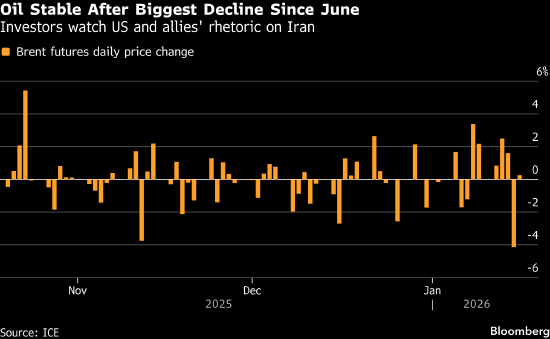
在经历了震荡波动的一周后,油价尾盘小幅走高,交易员正权衡伊朗局势紧张程度与整体市场的积极情 绪。 布伦特原油价格在周四暴跌4.2%(创下6月以来最大单日跌幅)后,回升至每桶64美元上方。据报道, 以色列总理本雅明・内塔尼亚胡已请求美国总统唐纳德・特朗普推迟袭击伊朗的计划。此举降低了美国 针对伊朗境内暴力抗议活动迅速采取回应措施的可能性——这类回应原本可能导致伊朗石油生产或运输 出现中断。 不过,美国正加大其在中东地区的军事部署力度。据媒体援引军方消息人士的话报道,至少已有一艘航 空母舰正向该地区移动,未来数日乃至数周内,预计还有其他军事装备也将被调往此地。在地缘政治风 险加剧的时期,交易员以往常会在周末来临前平仓空头头寸。 布伦特原油价格在周四暴跌4.2%(创下6月以来最大单日跌幅)后,回升至每桶64美元上方。据报道, 以色列总理本雅明・内塔尼亚胡已请求美国总统唐纳德・特朗普推迟袭击伊朗的计划。此举降低了美国 针对伊朗境内暴力抗议活动迅速采取回应措施的可能性——这类回应原本可能导致伊朗石油生产或运输 出现中断。 不过,美国正加大其在中东地区的军事部署力度。据媒体援引军方消息人士的话报道,至少已有一艘航 空母舰 ...

格陵兰会是下一个“黑天鹅”吗?德银总结了未来走向的四种情景
Hua Er Jie Jian Wen· 2026-01-16 12:15
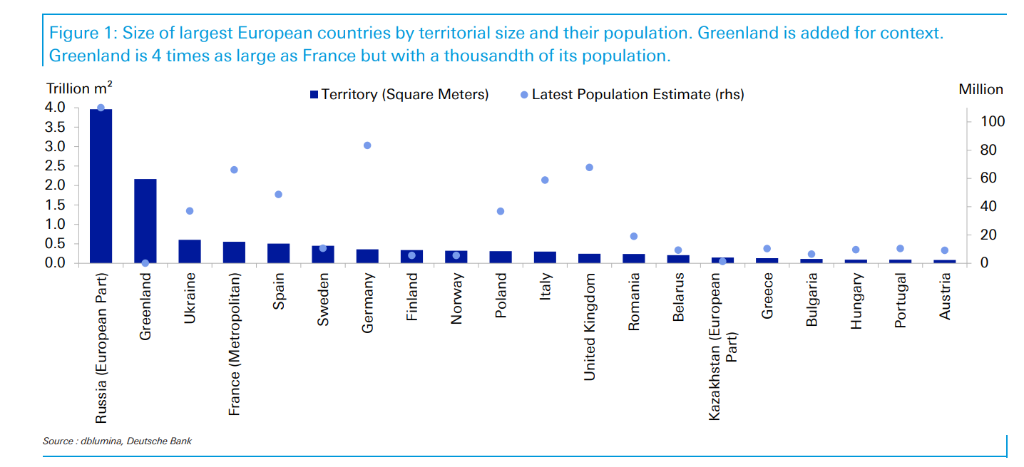
Core Viewpoint - Deutsche Bank considers Greenland as a potential "black swan" that could impact global markets due to its strategic geopolitical significance and the rising tensions surrounding it [1][4]. Group 1: Geopolitical Context - President Trump has reiterated the U.S. interest in acquiring or controlling Greenland, which is set against a backdrop of recent unilateral military actions by the U.S. [1] - A meeting between U.S. officials and Danish and Greenlandic leaders failed to resolve core sovereignty disputes, highlighting political divisions and increasing tail risks for investors [3]. Group 2: Strategic Assets and Motivations - Deutsche Bank identifies three main drivers for U.S. interest in Greenland: national security, critical minerals, and Arctic trade routes [4]. - Greenland's strategic location offers unique Arctic advantages, including proximity to key missile tracking systems and emerging shipping routes that could reduce transit times between Asia and Europe by up to 50% [4]. - The island is estimated to have significant rare earth reserves, potentially up to 1.5 million tonnes, which is crucial for the U.S. as it seeks to reduce dependence on Chinese mineral dominance [4]. Group 3: Future Scenarios - Deutsche Bank outlines four potential scenarios for Greenland's future that could influence market risk pricing: 1. A negotiated security agreement that enhances U.S. presence without altering sovereignty [5]. 2. A long-term lease arrangement granting the U.S. effective control while avoiding direct sovereignty transfer [5]. 3. A free association agreement granting Greenland semi-independence but with U.S. control over defense and foreign affairs [5]. 4. A military coercion scenario, which poses significant risks of escalation and could lead to severe crises within NATO, impacting economic relations and causing market volatility [5].

能化板块周度报告-20260116
Xin Ji Yuan Qi Huo· 2026-01-16 11:26
Report Industry Investment Rating - Not provided in the content Core Viewpoints Polyester Sector - In the short - term, the supply - demand outlook for the polyester sector has worsened. PX and PTA should be treated with an adjustment mindset, and attention should be paid to the risk of crude oil price fluctuations due to unstable geopolitical situations. The sector lacks fundamental support and will follow the general trend of commodities, fluctuating in a low - level range. - In the long - term, the polyester sector will show a differentiated trend. With supply expected to remain relatively tight, the operating centers of PX and PTA will tend to move up. Due to increasing supply pressure, ethylene glycol will perform relatively weakly. [30] Methanol - In the short - term, affected by the geopolitical situation in Iran, the price fluctuations of methanol have increased, maintaining a wide - range oscillation pattern. Methanol is in a deep game between strong expectations and weak reality, with limited upward space and potential for a slight adjustment. - In the long - term, the import volume of methanol is expected to decrease in February, but demand recovery is weak. Methanol will likely continue to oscillate widely until there is obvious recovery momentum in demand. [58] Plastic - In the short - term, the supply - demand situation of plastic has marginally improved this week, and the price has continued to rebound due to strong macro - sentiment. However, as geopolitical concerns ease, the cost - side support weakens, and plastic may return to fundamental operation, with a possible weak and oscillatory trend. - In the long - term, the supply pressure of plastic is unlikely to decrease due to new capacity releases, and overall demand is in the off - season. Plastic is expected to continue its weak trend. [59] Summary by Relevant Catalogs Macro and Crude Oil Important Information - Iran's short - term possibility of blocking the Strait of Hormuz has significantly decreased, and the risk premium has been quickly squeezed out. The US has imposed sanctions on multiple Iranian individuals, entities, and foreign companies associated with Iran. The US has completed the first - batch sale of Venezuelan crude oil as part of a $2 billion deal, and plans to continue selling Venezuelan crude oil indefinitely. [3] - The EIA has slightly revised up its future oil - price forecast, expecting the average price of WTI crude oil in 2026 to reach $52.21 per barrel, and maintaining the 2027 forecast at $50.36. US crude - oil production is expected to decline from a peak of 13.61 million barrels per day in 2025 to 13.59 million barrels per day in 2026 and 13.25 million barrels per day in 2027. The rebound in Venezuelan crude - oil production may exacerbate market oversupply. [4] - As of the week ending January 9, 2026, US commercial crude - oil inventories increased by 3.39 million barrels to 422.447 million barrels. The US refinery operating rate was 95.3%, up 0.6 percentage points from the previous week, while gasoline inventories surged by 8.977 million barrels to 251.013 million barrels. [4] Polyester Sector Spot and Futures Price Trends - Futures prices: WTI crude oil continuous increased by 0.03%, PX603 decreased by 0.53%, TA605 decreased by 0.75%, EG605 decreased by 0.75%, PF602 decreased by 1.21%, and PR603 decreased by 0.03%. - Spot prices: Naphtha increased by 2.87%, PX CFR: Taiwan decreased by 0.68%, PTA spot benchmark price decreased by 0.49%, ethylene glycol East China mainstream price decreased by 0.57%, polyester staple fiber East China mainstream price decreased by 0.84%, and polyester bottle - chip East China mainstream price increased by 0.50%. - Basis: PX basis decreased by 10.64 yuan/ton, PTA basis increased by 13 yuan/ton, ethylene glycol basis increased by 8 yuan/ton, short - fiber basis increased by 23 yuan/ton, and polyester bottle - chip basis increased by 32 yuan/ton. - Polyester filament prices: POY150D/48F increased by 2.29%, FDY150D/96F increased by 1.47%, and DTY150D/48F increased by 1.29%. [6] Supply and Demand Analysis of Polyester Sector PX - Last week, the restart of Fujia Dahua's 1 - million - ton PX plant increased supply. As of January 15, the domestic weekly average PX capacity utilization rate was 91.95%, up 2.83 percentage points, and the PX output was 760,600 tons, up 1.46%. - South Korea's GSCX Line 3's 550,000 - ton PX plant has restarted, and Asia's PX load has slightly rebounded. As of January 15, Asia's weekly average PX capacity utilization rate was 79.84%, up 0.66%. - There are no planned plant changes next week, and domestic PX supply is expected to remain stable. [12] PTA - During the week, Yisheng New Materials shut down for maintenance, and Xin Fengming restarted. As of January 15, the domestic PTA weekly capacity utilization rate was 77.22%, down 0.19 percentage points, and the weekly output was 1.4504 million tons, down 1,800 tons. - This week, the pace of PTA social inventory reduction has slowed. As of January 15, PTA in - plant inventory days were 3.62 days (+0.02 days), polyester factory PTA inventory was 7.5 days (+0 days), and PTA social inventory was about 2.8674 million tons (-16,800 tons). - There are maintenance plans for plants in South China next week, and domestic supply is expected to decline slightly. [15][16] Ethylene Glycol - This week, Yongcheng Yongjin restarted, and some plants increased their loads, while Sinopec Sichuan Petrochemical had a short - term shutdown, and some plants decreased their loads. As of January 15, the domestic weekly average ethylene glycol capacity utilization rate was 62.69% (-0.37 percentage points), with the integrated plant capacity utilization rate at 62.51% (-1.14 percentage points) and the coal - based ethylene glycol capacity utilization rate at 62.98% (+0.89 percentage points); the weekly output was 395,600 tons (-2,300 tons). Sinopec Sichuan Petrochemical will undergo maintenance next week, and domestic supply will decrease. - This week, port inventories increased. As of January 15, the total inventory at East China ports was 728,000 tons, down 9,000 tons from Monday and up 38,000 tons from last Thursday. Although the arrival of imported goods will decrease next week, considering the decline in shipments, port inventories are expected to increase slightly. [17] Polyester End - The weekly capacity utilization rate of the polyester end decreased by 0.5 percentage points to 86.7%. [18] Polyester Inventory - This week, the inventory of short - fiber and long - fiber polyester decreased slightly. [22] Terminal - As of January 15, the operating rate of Jiangsu and Zhejiang looms was 54.94% (-2.95 percentage points), the order days of Chinese weaving sample enterprises were 7.73 days (-0.95 days), and the坯布 inventory days were 28.27 days (+0.7 days). [27] Methanol and Polyolefin Spot and Futures Price Trends - Futures: MA2605 decreased by 1.50%, MA basis increased by 54.84%, L2605 increased by 0.31%, and L basis increased by 158.51%. - Methanol prices: Methanol (Taicang) increased by 0.40%, and methanol CFR increased by 0.65%. - Plastic prices: LLDPE increased by 2.58%, HDPE increased by 2.88%, and LDPE increased by 2.22%. [33] Supply and Demand Analysis of Methanol Supply Side - As of January 15, the domestic methanol operating rate was 91.11%, down 0.31 percentage points, and the output was 2.0353 million tons, down 6,990 tons (0.34%) from the previous period. - This week, Xinxiang Zhongxin's plant was under maintenance, with a loss of 300,000 tons/year of production capacity, and Inner Mongolia Jiuding's plant resumed operation, with a recovery of 100,000 tons/year of production capacity. - There are still some maintenance plans next week, and the operating rate is expected to continue to decline slightly. [40] Demand Side - As of January 15, the MTO operating rate decreased by 2.29 percentage points to 85.77%. Ningbo Fude continued to be shut down, and Zhejiang Xingxing shut down on January 12 due to economic pressure. Sierbang has a maintenance plan in February, and the support for coastal olefins is weakening. Other traditional downstream sectors are in the off - season, and although there is a slight increase in plant restarts, there is no obvious positive news. Olefins may continue to weaken in the next period. [43] Inventory - As of January 14, port inventories were 1.4353 million tons, down 101,900 tons (6.63%) from the previous period, and inland inventories were 450,900 tons, up 3,270 tons (0.73%). - The overall unloading volume this period was not large, and port inventories decreased. Although coastal olefins in Zhejiang weakened due to plant shutdowns, inventories also decreased significantly due to less unloading. However, this inventory reduction was mainly driven by unloading volume, and there was no obvious positive news on the demand side. There is still a large risk of inventory accumulation in the next period, and the turning point for effective inventory reduction has not yet arrived. Inland inventories are higher than in previous years due to high operating pressure and seasonal weakening of demand, and there is still pressure to reduce inventories. [46] Supply and Demand Analysis of Plastic Supply Side - As of January 15, the domestic plastic operating rate was 81.6%, down 2.07 percentage points, and the output was 669,800 tons, down 17,000 tons (2.47%) from the previous period. - This week, plants such as Guangdong Petrochemical and Dushanzi Petrochemical were under maintenance, with a total loss of about 480,000 tons/year of production capacity, and plants such as Yangzi Petrochemical and Dushanzi Petrochemical resumed operation, with a total recovery of about 280,000 tons/year of production capacity. - Next week, there are many plants resuming operation, with a total recovery of about 1.5 million tons/year of production capacity, and the operating rate is expected to increase. [49] Demand Side - As of January 15, the downstream plastic operating rate was 40.93%, down 0.28 percentage points. The agricultural film sector continued to weaken seasonally, with the operating rate continuing to decline (-0.91%), and the packaging film sector was slightly boosted by post - holiday replenishment demand, but order follow - up was weakening. [54] Inventory - As of January 13, social inventories were 484,300 tons, down 500 tons (0.1%) from the previous period, and two - oil enterprise inventories were 302,000 tons, down 23,000 tons (7.08%). - This period, the macro - news was positive, market sentiment was strong, and prices continued to rise. However, after the downstream had completed phased inventory replenishment, the trading atmosphere was stalemate. Two - oil enterprises successfully reduced inventories, but overall inventories fluctuated little. [57]
华尔街对白银后市看法
Sou Hu Cai Jing· 2026-01-16 08:57
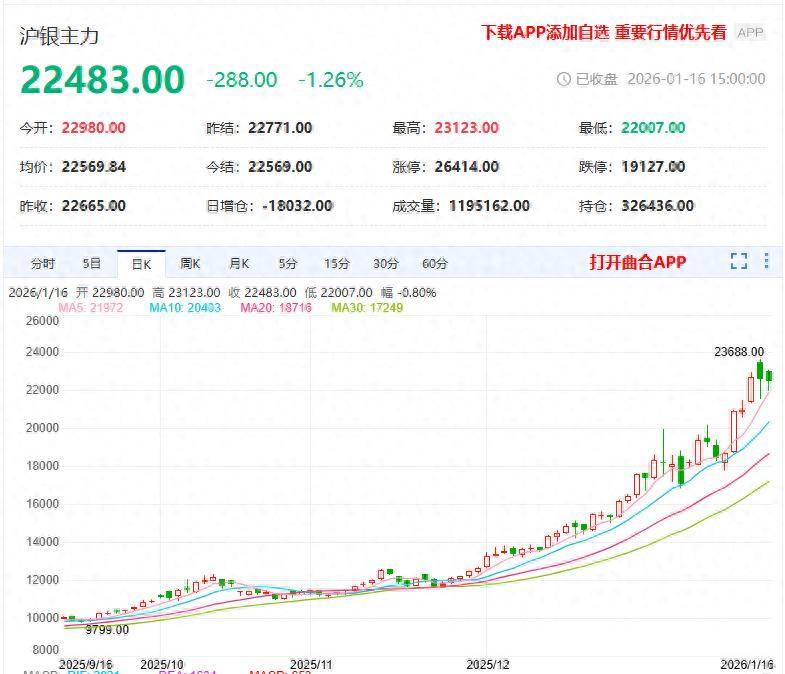
Group 1 - Citigroup has significantly raised its silver price target for the next 0-3 months from $62/oz to $100/oz, while also bullish on gold at $5000/oz, driven by escalating geopolitical risks, persistent physical market shortages, and expectations of easing monetary policy due to doubts about the Federal Reserve's independence [1] - UBS predicts that silver may outperform gold by 2026, driven by industrial demand growth in sectors like renewable energy and AI, with a forecast of reaching $100/oz in the first half of the year, but potentially falling to around $75/oz by year-end due to the nearing end of the Fed's easing cycle [1] - Goldman Sachs emphasizes that silver is more sensitive to capital flows due to the lack of central bank reserve demand, predicting continued price increases but with significantly higher volatility and uncertainty compared to gold [1] Group 2 - JPMorgan maintains a cautious outlook, projecting an average silver price of $40.1/oz for 2026, acknowledging that geopolitical risks and global debt issues will support silver prices, but the pace of increase may be slower [2] - Bank of America provides a wide price range forecast for silver, suggesting it could peak between $135 and $309/oz, based on the expectation that gold reaching $5000/oz will drive silver's rise, alongside supply-demand gaps and industrial demand growth, though no specific timeline is given [2] Group 3 - GF Futures notes that bullish funds are significantly increasing their positions in silver through ETFs and physical delivery, driving prices higher, while global inventory tightness has not truly eased, potentially suppressing industrial demand [5] - The firm warns that the current high price levels may lead to a correction due to irrational price movements driven by short-term capital sentiment, suggesting a cautious approach with light long positions above $70/oz [5]


金价直指5000美元?ATFX 2026 Q1《交易杂志》解析金价飙升背后的秘密
Sou Hu Cai Jing· 2026-01-16 08:51
Core Viewpoint - The ATFX Q1 2026 Trading Magazine highlights that the overall opportunities in the gold market outweigh the challenges, driven by global central bank gold purchasing trends, potential interest rate cuts, and safe-haven demand, with gold prices expected to challenge the $5000 mark [1][4]. Economic Context - The global economy is entering a phase of heightened uncertainty due to escalating geopolitical tensions, diverging monetary policies among major central banks, and rising fiscal pressures [3]. - The differentiation in global central bank monetary policies is reshaping capital flows, with some economies maintaining a tightening stance to combat inflation while others are initiating rate cuts to stimulate growth [3]. Gold Market Analysis - Opportunities for gold are supported by macroeconomic factors such as global economic slowdown, advancing central bank easing policies, increasing fiscal deficits, and frequent geopolitical risks [4]. - 43% of global central banks plan to increase their gold holdings, with 95% of reserve managers expecting an increase in global central bank gold reserves, providing long-term support for gold prices [5]. Challenges in the Gold Market - Key challenges include uncertainty in monetary policy, where a resilient U.S. economy and stubborn inflation could lead the Federal Reserve to maintain a hawkish stance, potentially suppressing gold prices [5]. - The AI-driven surge in risk assets like U.S. stocks may divert funds away from gold and other safe-haven assets [5]. - Geopolitical developments, such as the pace of peace agreements in Ukraine, could impact central bank gold purchasing speed, weakening upward momentum for gold prices [5]. Technical Analysis - Gold prices breaking above $4600 could lead to a potential challenge of the $5000 mark if favorable fundamental conditions exceed expectations [6]. - A key support level during fluctuations is identified at the $4000 mark, which serves as an initial defense line [7]. Magazine Content Overview - The magazine provides a professional analytical framework to dissect the interplay between policy divergence, key economic data, and geopolitical risks, capturing core variables driving short-term market volatility [8]. - It includes a comprehensive asset allocation guide covering stocks, CFDs, commodities, and indices, outlining key investment themes and predicting potential market reactions [8]. - Insights into global regional markets focus on the U.S., Europe, Asia-Pacific, and emerging markets, comparing fundamental differences across regions to identify cross-market investment opportunities [8]. - Practical risk management strategies are offered through scenario simulations and strategy development, equipping traders with position management plans before and after significant data releases [8].

央行结构性降息落地,伊朗局势暂时降温
Hua Tai Qi Huo· 2026-01-16 05:03
Report Industry Investment Rating - The investment rating for commodities and stock index futures is neutral [5] Core Viewpoints - Inflation is a prominent narrative. China will continue to boost consumption and promote "anti-involution." The central bank has cut the interest rates of various structural monetary policy tools by 0.25 percentage points and there is still room for reserve requirement ratio and interest rate cuts this year. The RMB exchange rate is expected to continue to float bidirectionally [2] - There is a certain differentiation in domestic and overseas economic climates. Overseas economic climate has been declining since October, while China's exports and new orders remain positive. China's foreign trade is accelerating its recovery, and its economic data in December is generally better. The US economic data is mixed, with increasing expectations of interest rate cuts [3] - Currently, focus on non-ferrous metals and precious metals with high certainty. There are opportunities for low-valued commodities to catch up in price. Pay attention to the short - term emotional risks of the new energy sector, the development of the Iranian situation, the "anti-involution" space of chemical products, weather conditions for agricultural products, and opportunities to buy precious metals at low prices [4] Summary by Related Catalogs Market Analysis - The Central Economic Work Conference emphasized boosting consumption and "anti-involution." The 2026 PBOC work conference focused on promoting high - quality economic development and reasonable price recovery, and cut the interest rates of structural monetary policy tools. The geopolitical situation between Iran and Venezuela has tightened, and the CME will change the margin setting method for precious metal contracts [2] - There is a differentiation in domestic and overseas economic climates. China's foreign trade is improving, with exports and imports in December exceeding expectations. The official manufacturing and non - manufacturing PMIs in December are in the expansion range. The US economic data is mixed, with the ISM manufacturing index falling, non - farm payrolls missing expectations, but overall economic improvement according to the Fed's Beige Book. There are increasing expectations of US interest rate cuts [3] Commodity Analysis - Focus on non - ferrous metals and precious metals. Non - ferrous metals have long - term supply constraints, and aluminum and nickel are preferred within the sector. Pay attention to short - term emotional risks in the new energy sector. The US will "sell on behalf" of Venezuelan oil, and the Iranian situation has temporarily cooled. There is "anti - involution" space in the chemical sector, and agricultural products are affected by weather and pig diseases. There are opportunities to buy precious metals at low prices [4] Strategy - The strategy for commodities and stock index futures is neutral [5] Important News - As of the end of December, M2, M1, and M0 have different year - on - year growth rates, and there is a net cash injection for the whole year. The balance of local and foreign currency loans and RMB loans has increased year - on - year [7] - The PBOC has cut the interest rates of re - loans and rediscounts by 0.25 percentage points since January 19, 2026. There is still room for reserve requirement ratio and interest rate cuts this year [7] - The US Supreme Court has not ruled on the legality of Trump's tariff policy. Fed officials have different stances on interest rates. Trump has no current plan to fire Powell, but the situation is still uncertain. The Iranian situation has temporarily cooled, and international oil prices have fallen [7] - Japan's largest opposition party, the Constitutional Democratic Party, has decided to form a new political party with the Komeito Party [7]
特朗普犹豫了?国际油价跳水,黄金白银亦调整
Sou Hu Cai Jing· 2026-01-16 04:12
Group 1: Oil Market Impact - The announcement of Trump delaying a decision on military action against Iran led to a significant drop in international crude oil prices, with Brent crude futures falling approximately 4% on January 15 [1] - As of January 16, Brent crude futures continued to exhibit a weak and volatile trading pattern [1] Group 2: Precious Metals Adjustment - International gold and silver prices experienced a pullback due to reduced geopolitical tensions and profit-taking after previous gains driven by heightened risk aversion [2] - Trump's announcement regarding key mineral imports, which did not include new tariffs, contributed to investor decisions to exit positions in silver after its price increase [2] Group 3: Military and Defense Developments - The White House indicated that military action against Iran remains a potential option, with the Trump administration closely monitoring the situation [2] - The U.S. is increasing military presence in the Middle East, including deploying at least one aircraft carrier and additional missile defense systems, with ongoing troop deployments expected in the coming days to weeks [2] Group 4: Naval Construction Costs - The estimated cost for the first "Trump-class" battleship is projected to be as high as $22 billion, potentially making it one of the most expensive warships in U.S. history [3] - The final cost will depend on various factors such as tonnage, crew size, and weapon configurations, with a minimum cost estimate of $15.1 billion [3] - Challenges in the U.S. shipbuilding industry, including labor shortages and supply chain issues, may further increase the final price of the battleship [3] Group 5: Federal Reserve Political Dynamics - Several Federal Reserve officials have publicly supported Chairman Powell, emphasizing the importance of the Fed's independence for economic and financial stability [4] - Trump stated he has no current plans to dismiss Powell despite the Justice Department's threats of a criminal investigation against him [4]
现货黄金、白银价格双双走低
Xin Lang Cai Jing· 2026-01-16 04:05
来源:上海证券报·中国证券网 来源:上海证券报·中国证券网 上证报中国证券网讯(记者 张骄)1月16日,现货黄金、白银价格双双走低。伦敦现货黄金再次失守 4600美元/盎司关口;伦敦现货白银盘中进一步走弱,日内跌超2%。截至10时30分,伦敦金报4598.76美 元/盎司,跌约0.35%;伦敦银报90.037美元/盎司,跌约2.5%。 华西证券首席经济学家刘郁在研报中表示,贵金属长线逻辑坚挺,但白银面临过热修正风险,黄金相对 配置价值提升。尽管地缘政治风险与"弱美元"逻辑共同支撑贵金属板块"易涨难跌",但短期白银投机过 热信号已十分显著:金银比跌破50并不断刷新14年以来低点、芝商所保证金动态调整抬升持仓成本,以 及租赁利率回落叠加内外价差畸高验证逼空或将退潮。这些迹象共同指向白银短期波动可能处于高位, 博弈难度加大,而黄金走势相对更为稳健。 上证报中国证券网讯(记者 张骄)1月16日,现货黄金、白银价格双双走低。伦敦现货黄金再次失守 4600美元/盎司关口;伦敦现货白银盘中进一步走弱,日内跌超2%。截至10时30分,伦敦金报4598.76美 元/盎司,跌约0.35%;伦敦银报90.037美元/盎司,跌约2. ...
综合晨报-20260116
Guo Tou Qi Huo· 2026-01-16 02:29
Group 1: Energy and Metals Crude Oil - Iran tensions ease, geopolitical risk premium declines, and short - term oil price increase is limited due to significant inventory pressure in Q1 2026 [1] Precious Metals - US economic data shows resilience, Fed officials oppose short - term rate cuts, and precious metals remain strong due to the tense Iran situation [2] Copper - Copper price adjusts overnight, with an increase in SHFE copper warehouse receipts. The strategy of selling call options at high levels is preferred [3] Aluminum - Shanghai aluminum continues to adjust. There is a short - term fundamental divergence, and caution is advised for speculation. Aluminum plants can consider selling hedging [4] Cast Aluminum Alloy - It fluctuates with Shanghai aluminum, with low market activity. The spread between it and Shanghai aluminum is weaker than in previous years [5] Alumina - Domestic alumina operating capacity remains around 95 million tons, in significant surplus. Sell on rallies when the spread is low [6] Zinc - LME's decision triggers a short - term bull market, but the supply - demand relationship remains unchanged. There is a need for volatility reduction, and opportunities to sell call options and short on rallies are recommended [7] Lead - The market is bullish, but the upside of Shanghai lead is constrained. It is expected to oscillate between 17,000 - 17,800 yuan/ton [8] Nickel and Stainless Steel - Shanghai nickel is strongly oscillating, and stainless - steel market is active. Short - term sentiment is high, and buying on dips is recommended [9] Tin - Shanghai tin declines with reduced positions. Observe its adjustment resilience, and continue to sell call options with high strike prices near expiration [10] Lithium Carbonate - The market is active, with a change in the sales strategy of upstream lithium salt plants. The futures price is strong but highly uncertain [11] Industrial Silicon - There are expectations for the technological transformation of 12,500kva furnaces. It is expected to oscillate mainly due to weak demand [12] Polysilicon - It oscillates around 48,000 yuan/ton. The trading logic has changed, and caution is advised [13] Group 2: Steel and Related Products Rebar and Hot - Rolled Coil - Steel prices oscillate at night. Supply - demand contradiction is not significant, and the market will continue to oscillate in the short term [14] Iron Ore - The supply is seasonally decreasing, and demand is expected to oscillate at a low level in the short term. It will mainly oscillate with high - level volatility risks [15] Coke - The price oscillates. Carbon supply is abundant, and the price is likely to oscillate strongly [16] Coking Coal - The price oscillates. Carbon supply is abundant, and the price is likely to oscillate strongly [17] Manganese Silicon - The price rebounds from the bottom. Manganese ore prices rise, and buying on dips is recommended [18] Silicon Iron - The price rebounds from the bottom. Affected by policies, demand is resilient, and buying on dips is recommended [19] Group 3: Shipping Container Freight Index (European Line) - Airlines are reducing prices to compete for cargo, and the 04 contract is driven by expectations. It will oscillate with spot sentiment [20] Group 4: Fuels and Chemicals Fuel Oil and Low - Sulfur Fuel Oil - Fuel oil drops with crude oil due to eased Iran tensions. Geopolitical factors will continue to affect the market, and high - sulfur cracking spreads may remain strong [21] Asphalt - Asphalt follows crude oil with limited amplitude. Pay attention to Venezuelan crude oil arrivals [22] Urea - The spot price rises continuously, and the market is expected to oscillate strongly [23] Methanol - The geopolitical risk eases, and the market has intensified long - short competition [24] Pure Benzene - It follows the oil price decline. Supply is sufficient, and it will oscillate in the short term with large de - stocking resistance in the long term [25] Styrene - Supply - demand is in tight balance, and exports are good. Pay attention to the oil - price risk [26] Polypropylene, Plastic, and Propylene - Supply is tight, and downstream demand is good. However, pay attention to the oil - price risk [27] PVC and Caustic Soda - PVC weakens at night. It may go through capacity reduction in 2026. Caustic soda is weak with high inventory [28] PX and PTA - They decline with the oil price. PX can be allocated long after adjustment, and PTA's processing margin is moderately restored [29] Ethylene Glycol - Supply is expected to increase domestically and decrease overseas. It is recommended to focus on波段行情 [30] Short - Fiber and Bottle Chip - Short - fiber demand weakens, and bottle - chip price follows the raw - material decline with capacity pressure [31] Glass - It is weak. It is expected to have seasonal inventory accumulation, and buying on dips can be considered in the long term [32] 20 - Rubber, Natural Rubber, and Butadiene Rubber - Demand recovers, natural rubber supply decreases, and synthetic rubber supply increases. Adopt a wait - and - see strategy [33] Soda Ash - It is weak with high supply pressure. Adopt a strategy of shorting on rallies [34] Group 5: Agricultural Products Soybean and Soybean Meal - The US may determine biofuel quotas in March. South American harvest is expected to be good. Observe the US biofuel policy and South American weather [35] Soybean Oil and Palm Oil - They are expected to oscillate in a range. The upper and lower limits are affected by supply expansion and bio - diesel demand, respectively [36] Rapeseed Meal and Rapeseed Oil - The market is optimistic about the improvement of China - Canada rapeseed trade, and rapeseed prices are expected to be weak this week [37] Domestic Soybean - It stops falling and rebounds. The supply of high - quality soybeans is tight, and demand is cautious [38] Corn - Dalian corn futures oscillate at a high level, and the main driving factor is unclear. It will oscillate widely in the short term [39] Pig - The futures price oscillates. Pig prices may hit a low in H1 2027. Watch the supply - demand game before the Spring Festival [40] Egg - The egg futures price rises with reduced positions. Supply is expected to decrease and demand to increase in H1 2026, and long - near and short - far strategies are recommended [41] Cotton - US cotton falls slightly, and Zhengzhou cotton oscillates at a high level. It may continue to adjust, and a wait - and - see approach is recommended [42] Sugar - International sugar production varies. Zhengzhou sugar rebounds, but the rebound may be limited due to a strong production increase expectation [43] Apple - The futures price is high. The market focuses on demand, and the de - stocking speed may be affected [44] Timber - The price is low. Low inventory provides some support, and a wait - and - see strategy is recommended [45] Pulp - The futures price falls. The short - term fundamentals are average, and a wait - and - see approach is recommended [46] Group 6: Financial Products Stock Index - A - shares oscillate with reduced volume. The "Spring Market" may continue, and pay attention to the shift of the upward driver [47] Treasury Bond - Treasury bond futures perform differently. The bond market may oscillate, and consider the opportunity to flatten the yield curve [48]
伊朗局势暂时平息,原油带动化?同步调整
Zhong Xin Qi Huo· 2026-01-16 02:29
投资咨询业务资格:证监许可【2012】669号 中信期货研究|能源化⼯策略⽇报 2026-01-16 伊朗局势暂时平息,原油带动化⼯同步 调整 美国对伊朗采取军事行动的风险减弱,油价创出2025年6月以来最大 跌幅。彭博报道,伊朗承诺不会处决抗议者,以色列总理要求美国总统特 朗普推迟对伊朗的军事打击计划。这一消息降低了美国立即采取军事行动 的可能性,全球三大基准原油下跌超过4%。海关总署数据显示,中国12月 原油进口量为5597.3万吨,1-12月累计进口量同比增加4.4%。中国原油进 口需求仍维持较高增长。伊朗局势暂时平息,未来俄乌的扰动仍需关注。 板块逻辑: 化工期价震荡加剧,普遍跟随原油大幅回调。CCF报道,本周聚酯开 工持稳,PTA开工下滑,EG开工环比走高,合成气制(工艺)是开工提升 的主力;聚酯终端织造开工的季节性下行趋势较慢。苯乙烯链条则显示自 身开工持稳,下游开工提升对EB需求环比增长3.16%,产业相对健康。聚 烯烃的反弹也没有引发开工的大幅走高,PE开工环比下行,PP开工环比略 增。化工此次调整空间将不会达到12月的低点,因供应并未与价格同步走 高,投资者仍以震荡思路对待市场。 原油:伊朗 ...