
供强需弱

Search documents
7月经济:“供强需弱”延续(申万宏观·赵伟团队)
申万宏源宏观· 2025-08-15 09:49
Core Viewpoints - Consumption and investment data have significantly weakened, but industrial production remains relatively resilient [3][88] - The economic indicators for July reflect some mid-term risks, but policies are being intensified, and economic growth is expected to remain within a reasonable range in the second half of the year [5][90] Consumption - In July, the year-on-year growth of social retail sales was 3.7%, down 1.1 percentage points from the previous value, primarily due to the slow disbursement of national subsidy funds [9][88] - The sales of furniture and home appliances saw significant declines, with furniture down 8.1 percentage points to 20.6% and home appliances down 3.7 percentage points to 28.7% [3][9] - Service consumption showed relative stability, with restaurant income slightly improving to 1.1% and cumulative service retail sales maintaining a high level at 5.2% year-on-year [3][9] Investment - Fixed asset investment in July fell sharply, reflecting short-term weather disturbances and mid-term impacts such as declining investment prices and the end of the equipment renewal cycle [4][13] - The year-on-year decline in fixed asset investment was 4.6 percentage points to -4.7%, marking the lowest level since Q1 2020 [4][13] - The construction progress was affected by extreme weather, with infrastructure and real estate investments experiencing greater declines than overall fixed investment [4][13] Real Estate - In July, real estate sales continued to decline, with corporate financing weakening and a lagging impact from reduced projects [4][89] - The growth rate of corporate credit financing dropped significantly by 13.5 percentage points to -15.8%, the lowest in nearly two years [4][89] - The sales area of commercial housing fell by 2.4 percentage points to -7.8%, indicating a slowdown in the release of pent-up demand [4][89] Production - Despite significant weaknesses in consumption and investment, industrial production maintained relative resilience, primarily due to improvements in export chain production [4][33] - The industrial added value year-on-year in July fell by 1.1 percentage points to 5.7%, but still remained at a high level [4][33] - Strong performance was noted in industries with robust export, such as black metal rolling and transportation equipment, while production in sectors like metal products and electrical machinery declined due to equipment renewal and internal competition [4][33] Summary - The economic indicators for July reflect some mid-term risks, with a continued pattern of weak domestic demand and strong external demand [5][90] - The second half of the year may see further declines in manufacturing and real estate investment, making it crucial to enhance service and infrastructure investment and stabilize consumer demand [5][90]


大越期货碳酸锂期货早报-20250806
Da Yue Qi Huo· 2025-08-06 02:56
1. Report Industry Investment Rating No information about the industry investment rating is provided in the report. 2. Core Viewpoints of the Report - The supply of lithium carbonate decreased by 7.31% week - on - week, higher than the historical average. The demand side showed a decrease in inventory for some sample enterprises, and the cost side had different trends for different raw materials. The market is expected to see strengthened demand next month, with potential inventory reduction, and the supply - demand pattern is shifting towards demand - driven. The lithium carbonate 2511 contract is expected to fluctuate in the range of 66,200 - 69,480 [8]. - The main logic is that capacity mismatch leads to strong supply and weak demand, and the downward trend is difficult to change. There are also some利多 factors such as manufacturers' production cut plans and a decrease in imports from Chile, while利空 factors include high - level supply from ore/salt lake ends and insufficient demand from the power battery end [9][10][11]. 3. Summary by Relevant Catalogs 3.1 Daily Viewpoints - **Supply**: Last week, lithium carbonate production was 17,268 tons, with a week - on - week decrease of 7.31% [8]. - **Demand**: The inventory of phosphoric acid iron - lithium sample enterprises was 93,672 tons, a week - on - week decrease of 1.27%. The inventory of ternary material sample enterprises was 16,499 tons, a week - on - week decrease of 0.32% [8]. - **Cost**: The cost of purchased lithium spodumene concentrate was 68,421 yuan/ton, a daily decrease of 0.02%, with a production profit of 1,755 yuan/ton. The cost of purchased lithium mica was 75,292 yuan/ton, unchanged daily, with a production loss of 6,997 yuan/ton. The production cost of the recycling end is close to that of the ore end, and the production enthusiasm is average. The quarterly cash production cost of the salt lake end is 31,745 yuan/ton, with sufficient profit margins and high production enthusiasm [8]. - **Base Difference**: On August 5th, the spot price of battery - grade lithium carbonate was 71,200 yuan/ton, and the basis of the 11 - contract was 3,360 yuan/ton, with the spot at a premium [8]. - **Inventory**: The smelter inventory was 51,958 tons, a week - on - week decrease of 6.18%, lower than the historical average. The downstream inventory was 45,888 tons, a week - on - week increase of 7.18%, higher than the historical average. Other inventories were 43,880 tons, a week - on - week decrease of 2.42%. The total inventory was 141,726 tons, a week - on - week decrease of 1.00%, higher than the historical average [8]. - **Disk Surface**: The MA20 of the disk surface is upward, and the price of the 11 - contract closed below the MA20 [8]. - **Main Force Position**: The net short position of the main force decreased [8]. - **Expectation**: In July 2025, lithium carbonate production was 81,530 physical tons, and it is predicted to be 84,200 physical tons next month, a month - on - month increase of 3.27%. The import volume in July was 18,000 physical tons, and it is predicted to be 18,500 physical tons next month, a month - on - month increase of 2.78%. Demand is expected to strengthen next month, with potential inventory reduction. The CIF price of 6% concentrate is flat daily and lower than the historical average. The supply - demand pattern is shifting towards demand - driven, and the lithium carbonate 2511 contract is expected to fluctuate in the range of 66,200 - 69,480 [8]. 3.2 Market Overview - **Futures Closing Price**: The futures closing prices of different contracts showed a downward trend, with the decline ranging from 0.86% to 2.75% [14]. - **Base Difference**: The base difference of different contracts showed an upward trend, with the increase ranging from 35.43% to 81.40% [14]. - **Registered Warehouse Receipts**: The number of registered warehouse receipts was 14,443, a 14.60% increase from the previous value [14]. - **Upstream Prices**: The prices of lithium ore, lithium salt, and other upstream products had different trends, with some remaining unchanged and some showing slight decreases or increases [14]. - **Prices of Cathode Materials and Lithium Batteries**: The prices of cathode materials and lithium batteries also had different trends, with most showing only slight changes [14]. 3.3 Supply - Demand Data Overview - **Supply - Side Data**: The weekly and monthly operating rates of lithium carbonate showed different changes, and the production and processing costs of lithium spodumene also had corresponding trends [16]. - **Demand - Side Data**: The production and inventory of phosphoric acid iron - lithium and ternary materials showed different changes, and the monthly production and export of phosphoric acid iron also had corresponding trends [16]. 3.4 Other Supply - Related Data - **Lithium Ore Supply**: The price, production, import, and self - sufficiency rate of lithium ore had different trends over time [22]. - **Lithium Carbonate Supply**: The production, import, and capacity of lithium carbonate from different sources and grades showed different trends over time [27]. - **Lithium Hydroxide Supply**: The production, export, and capacity utilization rate of lithium hydroxide from different sources showed different trends over time [34]. 3.5 Cost - Profit Data - **Lithium Compound Cost - Profit**: The cost and profit of different lithium compounds, including lithium carbonate, lithium hydroxide, and recycled lithium, showed different trends over time [39][42][45]. 3.6 Inventory Data - **Lithium Carbonate Inventory**: The weekly and monthly inventories of lithium carbonate from different sources showed different trends over time [47]. - **Lithium Hydroxide Inventory**: The monthly inventory of lithium hydroxide from different sources showed different trends over time [47]. 3.7 Demand - Related Data - **Lithium Battery Demand**: The price, production, shipment, and export of lithium batteries showed different trends over time [50]. - **Ternary Precursor Demand**: The price, cost, profit, production, and supply - demand balance of ternary precursors showed different trends over time [56][59]. - **Ternary Material Demand**: The price, cost, profit, production, and inventory of ternary materials showed different trends over time [62][64]. - **Phosphoric Acid Iron/Phosphoric Acid Iron - Lithium Demand**: The price, cost, profit, production, export, and inventory of phosphoric acid iron and phosphoric acid iron - lithium showed different trends over time [66][69]. - **New Energy Vehicle Demand**: The production, sales, export, and penetration rate of new energy vehicles showed different trends over time [74][75].
大越期货碳酸锂期货早报-20250804
Da Yue Qi Huo· 2025-08-04 05:14
1. Report Industry Investment Rating - Not provided in the content 2. Core Viewpoints of the Report - The supply - demand pattern of lithium carbonate is shifting towards demand - led. Although there are some positive factors such as factory production cuts and reduced imports from Chile, the overall market is still affected by over - supply due to high - level supply from ore/salt lake ends and weak demand from the power battery end. The downward trend is difficult to change [8][9][10][11]. 3. Summary by Relevant Catalogs 3.1 Daily Views - **Supply Side**: Last week, lithium carbonate production was 17,268 tons, a 7.31% week - on - week decrease, but still higher than the historical average. In July 2025, the production was 81,530 tons, and it is predicted to reach 84,200 tons next month, a 3.27% increase [8]. - **Demand Side**: Last week, the inventory of sample enterprises of lithium iron phosphate was 93,672 tons, a 1.27% week - on - week decrease, and that of ternary material sample enterprises was 16,499 tons, a 0.32% week - on - week decrease. Next month, demand is expected to strengthen and inventory may decline [8]. - **Cost Side**: The cost of purchased lithium spodumene concentrate is 68,189 yuan/ton, a 1.02% daily decrease, with a production profit of 2,136 yuan/ton. The cost of purchased lithium mica is 75,292 yuan/ton, a 1.21% daily decrease, with a production loss of 6,850 yuan/ton. The production cost of the recycling end is close to that of the ore end, and the enthusiasm for production scheduling is average [8]. - **Base Difference**: On August 1st, the spot price of battery - grade lithium carbonate was 71,350 yuan/ton, and the base difference of the 09 contract was 2,430 yuan/ton, with the spot at a premium to the futures [8]. - **Inventory**: The smelter's inventory was 51,958 tons, a 6.18% week - on - week decrease, lower than the historical average. The downstream inventory was 45,888 tons, a 7.18% week - on - week increase, higher than the historical average. The overall inventory was 141,726 tons, a 1.00% week - on - week decrease, higher than the historical average [8]. - **Market**: MA20 is upward, and the price of the 09 contract closes below MA20. The net short position of the main contract is increasing [8]. - **Expectation**: The CIF price of 6% concentrate has a daily decrease and is lower than the historical average. The 2509 contract is expected to fluctuate between 67,360 - 70,480 [8]. 3.2 Lithium Carbonate Market Overview - **Price Changes**: The prices of lithium ore, lithium carbonate, and other related products showed different degrees of increase or decrease. For example, the price of lithium ore 01 increased by 0.61% from 69,140 to 69,560, and the base difference of 01 decreased by 37.41% from 2,860 to 1,790 [13]. - **Supply - Side Data**: The weekly operating rate was 63.92%, a 2.77% increase. The monthly production of lithium carbonate was 81,530 tons, a 4.41% increase. The monthly import of lithium concentrate decreased by 17.25%, and the monthly import of lithium carbonate decreased by 16.31% [17]. - **Demand - Side Data**: The monthly production of lithium iron phosphate was 290,700 tons, a 1.86% increase. The monthly export of lithium iron phosphate was 2,031,541 kg, a 115.75% increase. The monthly production of ternary materials was 68,640 tons, a 5.75% increase [17]. 3.3 Supply - Lithium Ore - **Price and Production**: The price of lithium ore has fluctuated over time. The production of lithium spodumene mines and lithium mica in China has also shown different trends in different years [24]. - **Supply - Demand Balance**: The supply - demand balance of domestic lithium ore shows different situations in different months. For example, in July 2025, the balance was 2,816 tons [26]. 3.4 Supply - Lithium Carbonate - **Production and Capacity**: The production of lithium carbonate from different raw materials (lithium spodumene, lithium mica, salt lake, and recycling) has different trends. The monthly production in July 2025 was 81,530 tons. The monthly capacity also shows different levels [29]. - **Supply - Demand Balance**: The supply - demand balance of lithium carbonate varies monthly. In July 2025, the balance was 2,682 tons [33]. 3.5 Supply - Lithium Hydroxide - **Production and Utilization Rate**: The weekly capacity utilization rate of domestic lithium hydroxide has different trends in different years. The production from different sources (smelting and causticizing) also shows different situations [36]. - **Supply - Demand Balance**: The supply - demand balance of lithium hydroxide shows different values in different months. In July 2025, the balance was - 3,149 tons [38]. 3.6 Lithium Compound Cost - Profit - **Cost and Profit of Different Raw Materials**: The cost and profit of producing lithium carbonate from purchased lithium spodumene concentrate, lithium mica, and recycled materials have different trends. For example, the profit of producing lithium carbonate from purchased lithium spodumene concentrate is positive, while that from lithium mica is negative [8][41][44]. - **Profit of Different Processes**: The profit of processes such as purifying industrial - grade lithium carbonate, carbonizing lithium hydroxide to lithium carbonate also shows different trends [44]. 3.7 Inventory - **Lithium Carbonate Inventory**: The inventory of lithium carbonate in smelters, downstream, and other aspects shows different trends. The overall inventory is higher than the historical average [8][49]. - **Lithium Hydroxide Inventory**: The inventory of lithium hydroxide in downstream and smelters also shows different trends [49]. 3.8 Demand - Lithium Battery - **Price and Production**: The price of batteries and the production of battery cells show different trends over time. The monthly production of battery cells and the monthly loading volume of power batteries also change [53]. - **Inventory and Export**: The inventory of lithium battery cells and the export volume of lithium batteries also show different trends [53][56]. 3.9 Demand - Ternary Precursor - **Price and Production**: The price of ternary precursors and the production capacity utilization rate show different trends. The monthly production of ternary precursors also changes [59]. - **Supply - Demand Balance**: The supply - demand balance of ternary precursors shows different values in different months. In July 2025, the balance was - 6,410 tons [62]. 3.10 Demand - Ternary Material - **Price and Cost - Profit**: The price of ternary materials and the cost - profit trend show different situations. The weekly operating rate and inventory of ternary materials also change [65][67]. 3.11 Demand - Phosphoric Acid Iron/ Lithium Iron Phosphate - **Price and Production**: The price of phosphoric acid iron/lithium iron phosphate and the production capacity and production volume show different trends. The monthly production of phosphoric acid iron and lithium iron phosphate also changes [69][72]. - **Inventory**: The weekly inventory of lithium iron phosphate shows different trends [73]. 3.12 Demand - New Energy Vehicle - **Production, Sales, and Penetration Rate**: The production, sales, and sales penetration rate of new energy vehicles show different trends over time. The retail - wholesale ratio and dealer inventory index also change [77][78][81].
工业硅期货早报-20250804
Da Yue Qi Huo· 2025-08-04 03:45
1. Report Industry Investment Rating - Not provided in the report 2. Core Views of the Report - For industrial silicon, supply increased last week, demand remained weak, costs in Xinjiang decreased during the wet season, and it is expected to oscillate between 8305 - 8695 [6]. - For polysilicon, supply is expected to increase in August, demand shows signs of decline but may rebound later, and it is expected to oscillate between 47790 - 50610 [9][11]. - The main logic for the market is that capacity mismatch leads to strong supply and weak demand, making the downward trend difficult to change [16]. 3. Summary by Relevant Catalogs 3.1 Daily Views 3.1.1 Industrial Silicon - Supply: Last week's supply was 81,000 tons, a 3.85% week - on - week increase [6]. - Demand: Last week's demand was 70,000 tons, a 1.40% week - on - week decrease. Demand is persistently low [6]. - Cost: In Xinjiang, the production loss of sample oxygen - passed 553 was 2354 yuan/ton, and cost support weakened during the wet season [6]. - Basis: On August 1st, the spot price of non - oxygenated silicon in East China was 9550 yuan/ton, and the basis of the 09 contract was 1050 yuan/ton, with the spot at a premium to the futures [6]. - Inventory: Social inventory was 540,000 tons, a 0.93% week - on - week increase; sample enterprise inventory was 171,450 tons, a 3.40% week - on - week decrease; major port inventory was 119,000 tons, a 0.83% week - on - week decrease [6]. - Disk: MA20 is upward, and the price of the 09 contract closed below MA20 [6]. - Main Position: The main position is net short, with an increase in short positions [6]. - Expectation: Supply production scheduling is decreasing and remains at a low level, demand recovery is at a low level, cost support is increasing, and it is expected to oscillate between 8305 - 8695 [6]. 3.1.2 Polysilicon - Supply: Last week's output was 26,500 tons, a 3.92% week - on - week increase. The scheduled production in August is expected to be 130,500 tons, a 22.76% increase compared to the previous month [9]. - Demand: Last week's silicon wafer output was 11GW, a 1.78% week - on - week decrease; inventory was 181,500 tons, a 1.56% week - on - week increase. Silicon wafer production is currently in a loss state. The scheduled production in August is 53.29GW, a 1.02% increase compared to the previous month [10]. - Cost: The average cost of N - type polysilicon in the industry is 36,500 yuan/ton, and the production profit is 9500 yuan/ton [10]. - Basis: On August 1st, the price of N - type dense material was 46,000 yuan/ton, and the basis of the 09 contract was - 2200 yuan/ton, with the spot at a discount to the futures [13]. - Inventory: Weekly inventory was 229,000 tons, a 5.76% week - on - week decrease, remaining at a high level compared to the same period in history [13]. - Disk: MA20 is upward, and the price of the 09 contract closed above MA20 [13]. - Main Position: The main position is net long, with a decrease in long positions [13]. - Expectation: Supply production scheduling continues to increase, demand shows signs of decline but may rebound later, cost support remains stable, and it is expected to oscillate between 47790 - 50610 [11]. 3.2 Market Overview 3.2.1 Industrial Silicon - Futures prices of most contracts decreased, with the 09 contract down 2.97% week - on - week [19]. - Spot prices of some products remained stable, while the price of East China oxygen - passed 553 silicon decreased by 1.02% [19]. - Social inventory increased by 0.93% week - on - week, sample enterprise inventory decreased by 3.41% week - on - week, and major port inventory decreased by 0.83% week - on - week [19]. 3.2.2 Polysilicon - Futures prices of some contracts decreased, and the prices of silicon wafers, battery cells, and components remained mostly stable [21]. - Weekly silicon wafer output increased by 5.74% week - on - week, and inventory decreased by 22.06% week - on - week [21]. - Monthly battery cell output increased by 1.90% month - on - month, and the export volume increased by 24.25% [21]. - Monthly component output increased by 1.73% month - on - month, and the export volume decreased by 8.44% [21]. 3.3 Other Aspects - Industrial silicon price - basis and delivery product price difference trends show historical price and basis changes [23]. - Industrial silicon inventory trends show the historical inventory changes of different regions and ports [27]. - Industrial silicon production and capacity utilization trends show the historical production and capacity utilization changes of sample enterprises [29]. - Industrial silicon component cost trends show the historical price changes of main production areas' electricity prices, silica prices, graphite electrodes, and some reducing agents [34]. - Industrial silicon cost - sample region trends show the historical cost and profit changes of 421 in Sichuan and Yunnan and oxygen - passed 553 in Xinjiang [37]. - Industrial silicon weekly and monthly supply - demand balance sheets show the historical supply, demand, import, export, and balance situations [38][41]. - Industrial silicon downstream - organic silicon trends show the production, price, import - export, and inventory trends of DMC and its downstream products [44]. - Industrial silicon downstream - aluminum alloy trends show the price, supply, inventory, production, and demand trends of aluminum alloys [52]. - Industrial silicon downstream - polysilicon trends show the cost, price, supply - demand balance, and trends of silicon wafers, battery cells, components, and other aspects of polysilicon [62]. - Industrial silicon downstream - polysilicon - component composition cost - profit trends (210mm) show the cost and profit trends of 210mm component compositions [80]. - Industrial silicon downstream - polysilicon - photovoltaic grid - connected power generation trends show the trends of new power generation capacity, power generation composition, and solar power generation [81].
大越期货碳酸锂期货早报-20250801
Da Yue Qi Huo· 2025-08-01 02:24
1. Report Industry Investment Rating - No relevant content found. 2. Core Viewpoints of the Report - The lithium carbonate market shows a situation of supply exceeding demand, with the downward trend difficult to change due to capacity mismatch. The 2509 contract of lithium carbonate is expected to fluctuate in the range of 66,740 - 69,820. It is predicted that the demand will strengthen next month, inventory may be reduced, and the supply - surplus situation will intensify [8]. - There are both positive and negative factors in the market. Positive factors include manufacturers' production suspension and reduction plans, a month - on - month decrease in the amount of lithium carbonate imported from Chile, and a decline in the import volume of spodumene. Negative factors are the continuous high supply at the ore/salt lake end with limited decline, and insufficient willingness of the power battery end to take delivery [9][10]. 3. Summaries According to Relevant Catalogs 3.1 Daily Viewpoints - **Supply Side**: Last week, the lithium carbonate production was 18,630 tons, a month - on - month decrease of 2.53%, higher than the historical average. The predicted production for next month is 81,150 tons, a month - on - month increase of 3.57%, also higher than the historical average. The 6% spodumene CIF price decreased daily and is lower than the historical average [8]. - **Demand Side**: Last week, the inventory of lithium iron phosphate sample enterprises was 93,672 tons, a month - on - month decrease of 1.27%, and the inventory of ternary material sample enterprises was 16,552 tons, a month - on - month increase of 1.40%. It is expected that the demand will strengthen next month [8]. - **Cost Side**: The cost of imported spodumene concentrate is 68,893 yuan/ton, a daily decrease of 0.87%, with a production profit of 2,075 yuan/ton; the cost of imported lepidolite is 76,215 yuan/ton, a daily decrease of 0.75%, with a production loss of 7,136 yuan/ton. The cost of the recycling end is close to that of the ore end, and the production scheduling enthusiasm is average. The salt lake end has sufficient profit margins and strong production scheduling motivation [8]. - **Inventory**: The total inventory is 143,170 tons, a month - on - month increase of 0.39%, higher than the historical average. The smelter inventory is 55,385 tons, a month - on - month decrease of 4.57%, lower than the historical average; the downstream inventory is 42,815 tons, a month - on - month increase of 3.74%, higher than the historical average [8]. - **Position**: The net short position of the main contract has decreased, showing a bearish signal [8]. - **Expected Market**: The import volume of lithium carbonate in June 2025 was 17,698 physical tons, and the predicted import volume for next month is 22,000 physical tons, a month - on - month increase of 24.31%. The 2509 contract of lithium carbonate is expected to fluctuate in the range of 66,740 - 69,820 [8]. 3.2 Fundamental/Position Data - **Market Overview**: The prices of most lithium - related products showed a downward trend. For example, the price of battery - grade lithium carbonate decreased from 72,950 yuan/ton to 72,000 yuan/ton, a decrease of 1.30% [14]. - **Supply - Side Data**: The weekly operating rate of lithium carbonate decreased by 0.80% to 62.2%. The monthly production of lithium carbonate in June 2025 was 78,090 tons, a year - on - year increase of 8.34%. The import volume of lithium concentrate decreased by 17.25% month - on - month [18]. - **Demand - Side Data**: The monthly production of lithium iron phosphate increased by 2.09% to 229,900 tons, and the monthly production of lithium iron phosphate lithium increased by 2.30% to 68,360 tons. The monthly power battery loading volume increased by 1.93% to 58,200 GWh [18].
五矿期货能源化工日报-20250731
Wu Kuang Qi Huo· 2025-07-31 00:22
Report Industry Investment Rating No relevant content provided. Core Viewpoints - The current fundamental market is healthy. With low inventories in Cushing, combined with hurricane expectations and Russia-related events, crude oil has upward momentum. However, the off-season in mid-August will limit the upside potential of crude oil. A short-term target price of $70.4/barrel for WTI is given, suggesting short-term long positions with profit-taking on dips, and left-side ambush for Russian geopolitical expectations in September and the hurricane supply disruption season when oil prices plunge [2]. Summary by Commodity Crude Oil - **Market Quotes**: WTI main crude oil futures rose $1.05, or 1.52%, to $70.3/barrel; Brent main crude oil futures rose $0.71, or 0.98%, to $73.47/barrel; INE main crude oil futures fell 1.30 yuan, or 0.24%, to 529.7 yuan [1]. - **Inventory Data**: U.S. commercial crude oil inventories increased by 7.70 million barrels to 426.69 million barrels, a 1.84% increase; SPR increased by 0.24 million barrels to 402.74 million barrels, a 0.06% increase; gasoline inventories decreased by 2.72 million barrels to 228.41 million barrels, a 1.18% decrease; diesel inventories increased by 3.64 million barrels to 113.54 million barrels, a 3.31% increase; fuel oil inventories decreased by 0.20 million barrels to 20.04 million barrels, a 0.97% decrease; aviation kerosene inventories decreased by 2.11 million barrels to 43.39 million barrels, a 4.63% decrease [1]. Methanol - **Market Quotes**: On July 30, the 09 contract fell 15 yuan/ton to 2419 yuan/ton, and the spot price rose 8 yuan/ton, with a basis of -9 [4]. - **Fundamentals**: Upstream开工率 has bottomed out and rebounded, and enterprise profits are still good. Supply pressure is expected to increase marginally. MTO profits have declined again, port开工率 remains stable, and traditional demand is still in the off-season. The market may shift to a pattern of increasing supply and weakening demand, and methanol may face downward pressure. Port inventories have increased, year-on-year inventories are low, and overall inventory levels have decreased. It is recommended to wait and see [4]. Urea - **Market Quotes**: On July 30, the 09 contract fell 2 yuan/ton to 1742 yuan/ton, and the spot price remained unchanged, with a basis of +18 [6]. - **Fundamentals**: Domestic开工率 continues to decline, and enterprise profits have rebounded but are still at a relatively low level. As the sentiment in the domestic commodity market improves, the cost support for urea gradually strengthens. The开工率 of compound fertilizers has rebounded slowly, demand is weak, and finished product inventories are at a relatively high level. Exports are progressing steadily, and port inventories continue to increase. It is recommended to pay attention to going long on dips [6]. Rubber - **Market Quotes**: NR and RU have oscillated downward after a significant correction. Supply concerns have eased [9]. - **Fundamentals**: Bulls believe that weather conditions in Southeast Asia, especially in Thailand, and the current situation of rubber plantations may lead to a reduction in rubber production. Rubber prices usually rise in the second half of the year, and China's demand is expected to improve. Bears believe that macroeconomic expectations are uncertain, demand is in the seasonal off-season, and the reduction in supply may be less than expected. It is recommended to wait and see for now and consider a long-short spread operation on RU2601 and RU2509 [9][11]. PVC - **Market Quotes**: The PVC09 contract rose 43 yuan to 5192 yuan, the spot price of Changzhou SG-5 was 5060 (+40) yuan/ton, the basis was -99 (+73) yuan/ton, and the 9-1 spread was -137 (-13) yuan/ton [11]. - **Fundamentals**: The overall开工率 of PVC is 76.8%, a 0.8% decrease from the previous period. The demand side is weak, and downstream开工率 is at a five-year low and still in the off-season. Exports are affected by India's anti-dumping policy. The cost support has weakened. The market is currently in a situation of strong supply, weak demand, and high valuations. It is necessary to observe whether exports can exceed expectations and reverse the domestic inventory accumulation pattern [11]. Styrene - **Market Quotes**: Spot and futures prices have both risen, and the basis has strengthened [13]. - **Fundamentals**: After the successful convening of the Politburo meeting, short-term macroeconomic positive expectations have been realized, and cost support still exists. The BZN spread is at a relatively low level compared to the same period in previous years, with significant room for upward repair. The开工率 of pure benzene has declined slightly, but supply remains ample. The开工率 of styrene has continued to increase. Port inventories have increased significantly, and demand is in the seasonal off-season. It is expected that the BZN spread will repair in the short term, and styrene prices may follow the cost side and oscillate upward after port inventories are reduced [13][14]. Polyolefins Polyethylene - **Market Quotes**: Futures prices have risen [16]. - **Fundamentals**: After the successful convening of the Politburo meeting, short-term positive expectations have been realized, and cost support still exists. Spot prices have risen, and PE valuations have limited downward space. Trader inventories are oscillating at a high level, and the support for prices has weakened. Demand is in the seasonal off-season, and the overall开工率 is oscillating downward. The short-term contradiction has shifted from cost-driven downward movement to high maintenance boosting inventory reduction. There is a large capacity release pressure in August, and polyethylene prices may be determined by the game between the cost side and the supply side in the short term. It is recommended to hold short positions [16]. Polypropylene - **Market Quotes**: Futures prices have fallen [17]. - **Fundamentals**: The profits of Shandong refineries have stopped falling and rebounded, and the开工率 is expected to gradually recover. The demand side is in the seasonal off-season, and downstream开工率 is oscillating downward. There is only 450,000 tons of planned capacity to be put into operation in August. In the context of weak supply and demand, the cost side may dominate the market. It is expected that polypropylene prices will follow crude oil and oscillate higher in July [17]. PX & PTA & MEG PX - **Market Quotes**: The PX09 contract rose 42 yuan to 6984 yuan, and PX CFR rose 9 dollars to 866 dollars. The basis was 147 yuan (+25), and the 9-1 spread was 106 yuan (-2) [19]. - **Fundamentals**: PX开工率 remains high, but the PTA maintenance season has also ended, and the开工率 of the downstream is relatively high. Inventory levels are low, and the negative feedback pressure on PX is still small in the short term. New PTA plants are planned to be put into operation soon, and PX is expected to continue to reduce inventories. Valuations are currently at a neutral level. It is recommended to pay attention to the opportunity to go long on dips following crude oil [19][21]. PTA - **Market Quotes**: The PTA09 contract rose 26 yuan to 4838 yuan, and the spot price in East China rose 30 yuan to 4860 yuan. The basis was -10 yuan (-5), and the 9-1 spread was 2 yuan (-4) [22]. - **Fundamentals**: The PTA开工率 is 79.7%, unchanged from the previous period. Downstream开工率 has increased, and terminal开工率 has also recovered. Inventories have increased slightly. PTA processing fees have limited room for operation. It is recommended to pay attention to the opportunity to go long on dips following PX [22]. MEG - **Market Quotes**: The EG09 contract rose 31 yuan to 4467 yuan, and the spot price in East China rose 17 yuan to 4527 yuan. The basis was 66 yuan (+4), and the 9-1 spread was -28 yuan (-3) [23]. - **Fundamentals**: The supply side has increased, and downstream开工率 has also increased. Port inventories have decreased. Valuations are relatively high compared to the same period in previous years. The maintenance season is coming to an end, and the fundamentals are expected to weaken. Saudi Arabian plants have all restarted, and the expected arrival volume will gradually increase. It is recommended to be cautious in the short term [23].
纯苯、苯乙烯日报:EB供强需弱,关注宏观会议方向指引-20250724
Tong Hui Qi Huo· 2025-07-24 09:22
Group 1: Report Summary - Report title: Pure Benzene & Styrene Daily Report [1] - Date: July 24, 2025 [1] - Core view: Styrene is in a "supply - strong, demand - weak" structure, and its short - term trend may be more affected by the macro - level. Attention should be paid to the tone of the domestic macro - meeting at the end of July and the emotional impact brought by the dynamics of Sino - US trade policies. Pure benzene has a "supply - strong, demand - stable" pattern, and its price trend may be under pressure [3] Group 2: Daily Market Summary Fundamentals - Price: On July 23, the main contract of styrene closed down 1.12% at 7397 yuan/ton, with a basis of 53 (+49 yuan/ton); the main contract of pure benzene closed down 0.67% at 6196 yuan/ton [2] - Cost: On July 23, the Brent crude oil main contract closed at 65.3 dollars/barrel (-0.6 dollars/barrel), the WTI crude oil main contract closed at 68.6 dollars/barrel (-0.6 dollars/barrel), and the spot price of East China pure benzene was 6030 yuan/ton (+0 yuan/ton) [2] - Inventory: Styrene sample factory inventory was 20.8 tons (-0.1 tons), a month - on - month destocking of 0.7%; Jiangsu port inventory was 13.9 tons (+2.7 tons), a month - on - month stocking of 24.2%, and styrene overall stocked [2] - Supply: Styrene maintenance devices returned, and the overall supply was stable. Currently, the weekly output of styrene remained at 35.9 tons (-0.4 tons), and the factory capacity utilization rate was 78.3% (-0.9%) [2] - Demand: The operating rates of downstream 3S varied. Among them, the EPS capacity utilization rate was 53.2% (+2.1%), the ABS capacity utilization rate was 65.9% (+0.9%), and the PS capacity utilization rate was 50.6% (-0.5%), and the overall operating rate recovered [2] Views - Pure benzene: Last week, the supply of the pure benzene market increased month - on - month. It is expected that the supply pressure will increase. The downstream overall operating rate remains high, and short - term demand is expected to remain strong, but there may be a marginal weakening of demand in the long run. The port inventory is expected to gradually stock, and the price trend may be under pressure [3] - Styrene: The supply is expected to increase significantly. The demand is in the traditional off - season, with limited demand resilience. The port inventory continues to stock, and the spot basis continues to weaken. The short - term trend may be more affected by the macro - level [3] Group 3: Industrial Chain Data Monitoring Styrene & Pure Benzene Prices - Styrene prices: The main continuous contract of styrene decreased by 0.15% from July 21 to July 22, and the spot price increased by 0.05%. The basis decreased by 912% [5] - Pure benzene prices: The price of pure benzene in East China remained unchanged, the FOB price in South Korea increased by 0.5%, the FOB price in the US decreased by 0.35%, and the CFR price in China increased by 0.4% [5] - Spreads: The spread between domestic pure benzene and CFR decreased by 1155%, and the spread between East China and Shandong pure benzene decreased by 2091% [5] - Upstream prices: Brent crude oil decreased by 0.15%, WTI crude oil decreased by 0.10%, and naphtha remained unchanged [5] Styrene & Pure Benzene Production and Inventory - Production: China's styrene production decreased by 1.1149% from July 11 to July 18, and pure benzene production increased by 0.81% [6] - Inventory: Jiangsu port inventory of styrene increased by 24.22%, domestic factory inventory of styrene decreased by 0.66%, and the national port inventory of pure benzene decreased by 5.75% [6] Operating Rate - Downstream of pure benzene: The capacity utilization rate of styrene decreased by 0.91%, and that of caprolactam decreased by 4.00%. The capacity utilization rate of phenol increased by 3.33%, and that of aniline increased by 4.88% [7] - Downstream of styrene: The capacity utilization rate of EPS increased, that of ABS increased by 0.90%, and that of PS decreased by 0.50% [7] Group 4: Industry News - Trump and Xi Jinping will meet before or during the APEC Summit in South Korea [8] - The establishment conference of China Yajiang Group Co., Ltd. was held in Beijing [8] - Trump plans to impose 15% or 20% general tariffs on most trading partners [8] Group 5: Industrial Chain Data Charts - The report includes charts of pure benzene prices, styrene prices, styrene - pure benzene spreads, SM import pure benzene cost vs. domestic pure benzene cost, styrene port inventory, styrene factory inventory, pure benzene port inventory, ABS inventory, PS inventory, EPS inventory, caprolactam weekly capacity utilization, phenol weekly capacity utilization, and aniline weekly capacity utilization [9][14][15]
工业硅期货早报-20250724
Da Yue Qi Huo· 2025-07-24 02:27
Report Industry Investment Rating - Not provided in the document Core Viewpoints - For industrial silicon, the supply side's production schedule has decreased and remains at a low level, demand recovery is at a low level, and cost support has increased. It is expected to fluctuate in the range of 9360 - 9690 [6]. - For polysilicon, the supply - side production schedule continues to increase, while the demand side shows continuous decline in silicon wafer, cell, and component production. Overall demand is in a continuous recession, and cost support has strengthened. It is expected to fluctuate in the range of 49105 - 51055 [11]. - The main logic is that capacity mismatch leads to a situation of strong supply and weak demand, and the downward trend is difficult to change [15]. Summary by Directory 1. Daily Viewpoints Industrial Silicon - Supply: Last week, the supply was 77,000 tons, a 2.67% increase from the previous week [6]. - Demand: Last week, the demand was 74,000 tons, a 3.89% decrease from the previous week. Demand remains sluggish. Polysilicon inventory is 249,000 tons, at a high level; organic silicon inventory is 78,100 tons, at a high level with a production profit of 373 yuan/ton and a comprehensive operating rate of 71.38%, flat compared to the previous week and higher than the historical average; aluminum alloy ingot inventory is 37,200 tons, at a high level [6]. - Cost: In Xinjiang, the production loss of sample oxygen - passing 553 silicon is 2789 yuan/ton, and cost support has weakened during the wet season [6]. - Basis: On July 23, the spot price of non - oxygen - passing silicon in East China was 9750 yuan/ton, and the basis of the 09 contract was 225 yuan/ton, with the spot at a premium to the futures [6]. - Inventory: Social inventory is 547,000 tons, a 0.72% decrease from the previous week; sample enterprise inventory is 173,050 tons, a 0.60% decrease; major port inventory is 120,000 tons, a 3.22% decrease [6]. - Market: MA20 is upward, and the price of the 09 contract closes above MA20 [6]. - Main Position: The main position is net short, and short positions are increasing [6]. Polysilicon - Supply: Last week, the production was 23,000 tons, a 0.87% increase from the previous week. The estimated production schedule for July is 106,800 tons, a 5.74% increase from the previous month [9]. - Demand: Last week, silicon wafer production was 11.1GW, a 3.47% decrease from the previous week, and inventory was 160,200 tons, an 11.63% decrease. Currently, silicon wafer production is in a loss state. In June, cell production was 56.19GW, a 6.73% decrease from the previous month, and last week, the inventory of cell external sales factories was 9.94GW, a 37.71% decrease. Currently, cell production is in a loss state. In June, component production was 46.3GW, a 10.61% decrease from the previous month. The estimated component production for July is 45.45GW, a 1.83% decrease. Currently, component production is profitable [10]. - Cost: The average cost of N - type polysilicon in the industry is 36,010 yuan/ton, and the production profit is 8990 yuan/ton [10]. - Basis: On July 23, the price of N - type dense material was 45,000 yuan/ton, and the basis of the 09 contract was - 4080 yuan/ton, with the spot at a discount to the futures [12]. - Inventory: Weekly inventory is 249,000 tons, a 9.78% decrease from the previous week, at a high level compared to the same period in history [12]. - Market: MA20 is upward, and the price of the 09 contract closes above MA20 [12]. - Main Position: The main position is net long, and long positions are decreasing [12]. 2. Market Overview Industrial Silicon - Futures prices of most contracts have decreased, with the 09 contract closing at 9525 yuan/ton, a 1.35% decrease from the previous day [18]. - Spot prices of various types of silicon in East China have generally increased, with the price of non - oxygen - passing 553 silicon increasing by 3.17% to 9750 yuan/ton [18]. - Social inventory has decreased by 0.73% to 547,000 tons, and sample enterprise inventory has decreased by 0.60% to 173,050 tons [18]. Polysilicon - Futures prices of most contracts have increased, with the 09 contract closing at 50,080 yuan/ton, a 1.99% increase from the previous day [21]. - Silicon wafer production has increased by 0.7GW to 12.9GW, and inventory has decreased by 7.5GW to 26.5GW [21]. - Cell external sales factory weekly inventory has decreased by 6.02GW to 9.94GW, a 37.72% decrease [21]. - Component monthly production has decreased by 5.5GW to 46.3GW, and domestic inventory has decreased by 26.54GW to 24.76GW, a 51.73% decrease [21]. 3. Other Aspects - Industrial silicon price - basis and delivery product price difference trends show the historical changes in basis and the price difference between 421 and 553 silicon [23]. - Industrial silicon inventory trends show the historical changes in delivery warehouse, port inventory, and sample enterprise inventory [26]. - Industrial silicon production and capacity utilization trends show the historical changes in sample enterprise weekly production, monthly production by specification, and sample enterprise operating rate [30]. - Industrial silicon component cost trends show the historical changes in power prices, silica prices, graphite electrode prices, and some reducing agent prices in major production areas [35]. - Industrial silicon cost - sample area trends show the historical changes in cost and profit of 421 silicon in Sichuan, 421 silicon in Yunnan, and oxygen - passing 553 silicon in Xinjiang [37]. - Industrial silicon weekly and monthly supply - demand balance sheets show the historical changes in supply, demand, and balance of industrial silicon [39][42]. - Industrial silicon downstream - organic silicon - DMC price and production trends show the historical changes in DMC capacity utilization, profit, cost, production, and price [45]. - Industrial silicon downstream - organic silicon - downstream price trends show the historical changes in the prices of 107 glue, silicone oil, raw rubber, and D4 [47]. - Industrial silicon downstream - organic silicon - import - export and inventory trends show the historical changes in DMC import, export, and inventory [50]. - Industrial silicon downstream - aluminum alloy - price and supply trends show the historical changes in waste aluminum recycling, social inventory, aluminum scrap import, un - forged aluminum alloy import - export, SMM aluminum alloy ADC12 price, and import ADC12 cost and profit [53]. - Industrial silicon downstream - aluminum alloy - inventory and production trends show the historical changes in the monthly production of primary aluminum - based aluminum alloy ingots and recycled aluminum alloy ingots, the weekly operating rate of primary and recycled aluminum alloys, and the social inventory of aluminum alloy ingots [56]. - Industrial silicon downstream - aluminum alloy - demand (automobile and wheel hub) shows the historical changes in automobile monthly production and aluminum alloy wheel hub export [58]. - Industrial silicon downstream - polysilicon - fundamental trends show the historical changes in polysilicon industry cost, price, inventory, production, operating rate, and demand [63]. - Industrial silicon downstream - polysilicon - supply - demand balance sheet shows the historical changes in polysilicon supply, demand, and balance [66]. - Industrial silicon downstream - polysilicon - silicon wafer trends show the historical changes in silicon wafer price, production, inventory, demand, and net export [69]. - Industrial silicon downstream - polysilicon - cell trends show the historical changes in cell price, production, inventory, operating rate, and export [72]. - Industrial silicon downstream - polysilicon - photovoltaic component trends show the historical changes in component price, inventory, production, and export [75]. - Industrial silicon downstream - polysilicon - photovoltaic accessory trends show the historical changes in photovoltaic coating price, photovoltaic film import - export, photovoltaic glass production and export, high - purity quartz sand price, and solder strip import - export [78]. - Industrial silicon downstream - polysilicon - component component cost - profit trends (210mm) show the historical changes in the silicon material cost, silicon wafer cost, and profit of 210mm double - sided double - glass components [81].
7.21尿素日评:期货领涨现货跟风,需求谨慎压制上行空间
Sou Hu Cai Jing· 2025-07-22 04:50
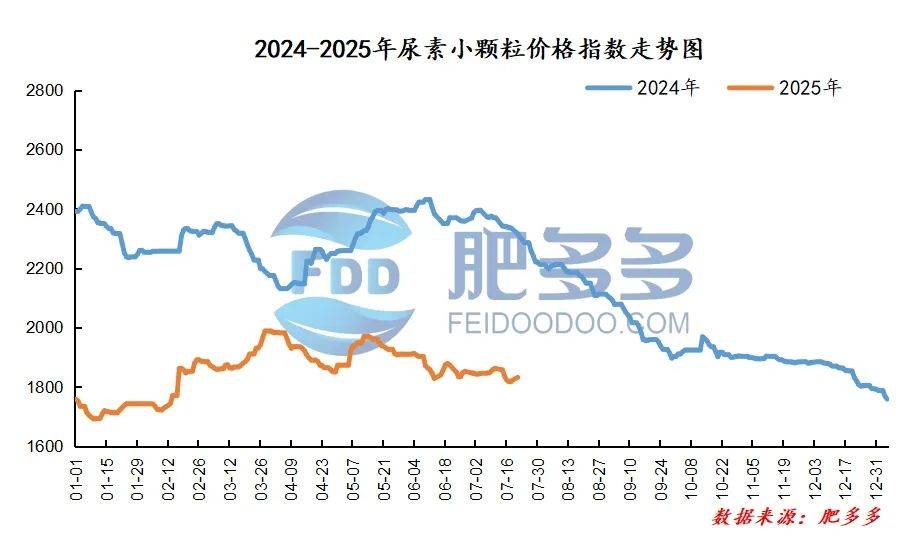
Core Viewpoint - The urea market is experiencing a slight price increase, driven by strong futures prices and improved demand from downstream buyers, although overall demand remains cautious and supply pressures persist [3][4][5]. Urea Futures Market - On July 21, the urea UR509 futures contract opened at 1790, reached a high of 1818, and closed at 1812, reflecting an increase of 54 compared to the previous trading day's settlement price, a rise of 3.07% [3]. - The futures market is buoyed by macroeconomic policies from the Ministry of Industry and Information Technology and a generally strong commodity market atmosphere, which has positively influenced spot market transactions [3]. - The release of new export quotas and replenishment of fall compound fertilizer factories are expected to marginally improve market demand, easing some supply-demand tensions [3]. Spot Market Analysis - The domestic urea market saw a slight price increase, with improved purchasing willingness from mid and downstream sectors, although overall supply remains strong against weak demand expectations [4]. - Price ranges in various regions include: Northeast (1750-1790 CNY/ton), East China (1810-1860 CNY/ton), Central China (1790-1950 CNY/ton), North China (1720-1810 CNY/ton), South China (1840-1950 CNY/ton), Northwest (1900-1910 CNY/ton), and Southwest (1750-2030 CNY/ton) [4][6]. Market Dynamics - The market is characterized by a cautious approach from buyers, with prices expected to remain under pressure due to strong supply and weak demand [5]. - The overall sentiment in the market is influenced by macroeconomic policies and expectations of increased exports, which may provide some emotional support for prices [5]. - Current supply levels remain high, with daily production slightly down but still at elevated year-on-year levels, indicating a surplus in the market [5]. Price Adjustments - Specific price adjustments on July 21 include: Guangdong (1900-1920 CNY/ton), Guangxi (1840-1850 CNY/ton), and Hebei (1760-1780 CNY/ton) [7][8].
“双焦”供需偏弱形势未变 对煤价仍有拖累
Zhong Guo Chan Ye Jing Ji Xin Xi Wang· 2025-07-14 01:12
Group 1 - The overall trend of "double coke" futures prices continued to decline since October last year, with a rebound observed in June 2025 [1] - The coking coal market faced supply pressure leading to a continuous drop in prices, while coke prices followed suit due to cost collapse [1][2] - In the first quarter, domestic coal production was high, but a seasonal decline occurred during the Spring Festival, followed by a rapid recovery in production [1][2] Group 2 - The second quarter saw an oversupply of coke capacity and weak bargaining power, leading to continuous price reductions [2] - International trade tensions exacerbated market pessimism, further driving down commodity prices [2] - By the latter half of the second quarter, environmental policies and safety production measures led to production cuts in some regions, which, combined with low coal prices, improved market sentiment and prices began to rebound [2] Group 3 - In the first five months of the year, domestic coking coal production maintained a rapid growth rate, with a cumulative production increase of approximately 9.72 million tons, a 4.5% year-on-year rise [2][3] - Despite production cuts in May and June, the overall situation of oversupply and loose supply in the coal industry remained unchanged [3] - The majority of coal mines are still profitable, which is a key reason for their reluctance to cut production [3] Group 4 - The current coal industry policy focuses on stable production and supply to ensure energy security, with plans to implement a coal capacity reserve system by 2025 [3][4] - The approach to managing excess capacity has shifted from aggressive elimination to a more regulated exit of outdated capacity [4] Group 5 - Coking coal imports have decreased, alleviating supply pressure, with May imports down 17% month-on-month and 23% year-on-year [5][6] - The decline in Mongolian coal imports is attributed to the overall drop in domestic coal prices, reducing the cost-effectiveness of imported coal [6] Group 6 - Coking coal prices are at relatively low levels, with recent inventory levels at coking plants increasing slightly due to accelerated procurement [7] - Although there is a short-term inventory reduction, overall inventory levels remain high compared to previous years [7] - The production cuts driven by environmental and safety factors are not expected to be sustainable, and coal production is likely to remain high [7]