
流动性

Search documents
——金属周期品高频数据周报(2026.1.12-2026.1.18):M1 M2增速差已连续三个月回落-20260120
EBSCN· 2026-01-20 07:47
Investment Rating - The report maintains an "Accumulate" rating for the steel and non-ferrous metals sector [5] Core Insights - The M1 and M2 growth rate difference has been declining for three consecutive months, reaching -4.7 percentage points in December 2025, indicating a tightening liquidity environment [10][18] - The average daily crude steel production of key steel enterprises in early January has rebounded to levels close to mid-October 2025 [21][42] - The report highlights that the prices of titanium dioxide and glass are at low levels, with titanium dioxide priced at 13,200 CNY/ton and glass at 1,124 CNY/ton [79] Summary by Sections Liquidity - The M1 and M2 growth rate difference is -4.7 percentage points as of December 2025, a decrease of 1.60 percentage points month-on-month [10][18] - The BCI small and medium enterprise financing environment index was 47.15 in December 2025, down 10.19% from the previous month [10][18] - The current price of London gold is 4,599 USD/ounce, reflecting a 2.00% increase [10] Infrastructure and Real Estate Chain - The average daily crude steel production for key steel companies in early January is approximately 1.903 million tons, a 21.55% increase compared to the previous month [42] - The national high furnace capacity utilization rate is 85.48%, down 0.56 percentage points [42] - The price changes for various materials include rebar up 1.22%, cement price index down 0.94%, and rubber down 1.26% [21] Industrial Chain - The operating rate of semi-steel tires is at 73.44%, an increase of 7.55 percentage points [2] - Copper spot prices have reached a historical high, while tungsten concentrate prices have also hit a new high since 2012 [2] - The price of electrolytic aluminum is 24,000 CNY/ton, with a profit margin of 6,787 CNY/ton [2] Price Relationships - The price ratio of London spot gold to silver has reached a new low since 2013 [3] - The price difference between rebar and iron ore is currently 3.99 [3] - The price difference between small rebar (used in real estate) and large rebar (used in infrastructure) is 200 CNY/ton, a 31.03% decrease from the previous week [3] Export Chain - The new export orders PMI for China in December was 49.00%, an increase of 1.4 percentage points [3] - The CCFI composite index for container shipping rates is 1,209.85 points, up 1.25% [3] - The capacity utilization rate for U.S. crude steel is 75.70%, an increase of 1.30 percentage points [3] Valuation Percentiles - The CSI 300 index decreased by 0.57%, while the industrial metals sector performed best with a 2.81% increase [4] - The PB ratio of the steel sector relative to the CSI 300 is currently at 0.50, with a historical high of 0.82 [4] - The report suggests that the supply of steel may be reasonably constrained, leading to a potential recovery in sector profitability to historical average levels [4]
流动性跟踪与地方债策略专题:为何地方债供给依然偏慢?
Guolian Minsheng Securities· 2026-01-20 07:15
Group 1 - The report indicates that the liquidity environment may face pressure due to the upcoming expiration of nearly 1 trillion yuan in pledged reverse repos, accelerated government bond issuance, and tax payment deadlines around January 20, which is a significant tax month [6][9][12] - The central bank has stated it will continue to increase liquidity injection and flexibly use various tools in open market operations to maintain ample liquidity, aiming to guide overnight rates close to the policy rate level of 1.40% [6][9][12] - The report highlights that local government bond issuance plans for January to March 2026 total 21,180 billion yuan, with 8,145 billion yuan planned for January, 4,424 billion yuan for February, and 8,611 billion yuan for March [14][37] Group 2 - The report notes that local bond supply has been notably slow, attributed to the delayed timing of local legislative sessions, which affects the actual issuance of new bonds [14][37] - As of January 18, 2026, local government bonds issued totaled 4,241 billion yuan, with 2,458 billion yuan in ultra-long bonds, accounting for 58% of the total, and 1,799 billion yuan in debt-restructuring bonds, accounting for 42% [14][37] - The report suggests that the current market conditions may lead to a focus on market-oriented issuance for ultra-long bonds, particularly in regions like Xinjiang, where the bidding spread is set significantly higher than secondary market spreads [41][43]
流动性和机构行为周度观察:资金利率先上后下,关注税期扰动-20260120
Changjiang Securities· 2026-01-19 23:30
Report Industry Investment Rating No information about the industry investment rating is provided in the report. Core Viewpoints - From January 12 - 16, 2026, the central bank conducted short - term reverse repurchase net investment, with 6M outright reverse repurchase operations of 90 billion yuan and a net investment of 30 billion yuan. From January 12 - 18, 2026, the net payment scale of government bonds decreased, most of the maturity yields of inter - bank certificates of deposit declined, and the average leverage ratio of the inter - bank bond market decreased slightly. From January 19 - 25, 2026, the expected net payment of government bonds is 20.65 billion yuan, and the maturity scale of inter - bank certificates of deposit is about 70.64 billion yuan. On January 16, 2026, the median durations of medium - long - term and short - term interest - style pure bond funds increased by 0.06 years and decreased by 0.01 years week - on - week respectively [2]. Summary by Directory 1. Funds - **Fund Investment and Maturity**: From January 12 - 16, 2026, the central bank's 7 - day reverse repurchase investment was 951.5 billion yuan, and the repurchase was 138.7 billion yuan, achieving a net investment of 812.8 billion yuan. On January 15, the central bank conducted 90 billion yuan of 6M outright reverse repurchase, with 60 billion yuan of 6M outright reverse repurchase maturing this month, resulting in a net investment of 30 billion yuan. From January 19 - 23, 2026, the maturity scale of 7 - day reverse repurchase is 951.5 billion yuan, and 15 billion yuan of treasury cash fixed - term deposits will mature [6]. - **Fund Interest Rates**: From January 12 - 16, 2026, the average values of DR001 and R001 were 1.36% and 1.43% respectively, up 9.3 and 9.1 basis points compared with January 5 - 9, 2026; the average values of DR007 and R007 were 1.51% and 1.55% respectively, up 5.5 and 4.3 basis points compared with January 5 - 9, 2026. The short - term disturbing factors for the funds in the future include tax payment, capital freezing for new share subscriptions on the Beijing Stock Exchange, and a month - on - month increase in the net payment scale of government bonds [7]. 2. Government Bonds - **Net Financing Scale**: From January 12 - 18, 2026, the net financing of government bonds was about - 48.5 billion yuan, about 481.2 billion yuan more reduction compared with January 5 - 11, 2026. Among them, the net financing of treasury bonds was about - 119.2 billion yuan, and the net financing of local government bonds was about 70.7 billion yuan. From January 19 - 25, 2026, the expected net financing of government bonds is about 20.65 billion yuan, among which the net financing of treasury bonds is about - 10.7 billion yuan, and the net financing of local government bonds is about 217.2 billion yuan [8]. 3. Inter - bank Certificates of Deposit - **Maturity Yields**: As of January 16, 2026, the maturity yields of 1M and 3M inter - bank certificates of deposit were 1.5200% and 1.5950% respectively, down 1.3 basis points and basically unchanged compared with January 9, 2026; the maturity yield of 1Y inter - bank certificates of deposit was 1.6250%, down 0.8 basis points compared with January 9, 2026 [9]. - **Net Financing Amount**: From January 12 - 18, 2026, the net financing of inter - bank certificates of deposit was about - 254.9 billion yuan. From January 19 - 25, 2026, the expected maturity repayment amount of inter - bank certificates of deposit is 70.64 billion yuan, and the maturity renewal scale decreased slightly compared with the previous week [9]. 4. Institutional Behavior - **Leverage Ratio**: From January 12 - 16, 2026, the average leverage ratio of the inter - bank bond market was 107.88%, compared with 108.14% from January 5 - 9, 2026 [10]. - **Duration of Bond Funds**: On January 16, 2026, the median duration (MA5) of medium - long - term interest - style pure bond funds was 4.95 years, up 0.06 years week - on - week, at the 93.5% quantile since the beginning of 2022; the median duration (MA5) of short - term interest - style pure bond funds was 1.87 years, down 0.01 years week - on - week, at the 58.8% quantile since the beginning of 2022 [10].
避险需求给予金价支撑:贵金属周报-20260119
Bao Cheng Qi Huo· 2026-01-19 09:08
期货研究报告 贵金属 姓名:龙奥明 宝城期货投资咨询部 从业资格证号:F3035632 投资咨询证号:Z0014648 投资咨询业务资格:证监许可【2011】1778 号 贵金属 | 周报 · 2026 年 1 月 19 日 贵金属周报 专业研究·创造价值 避险需求给予金价支撑 核心观点 上周金价上行后呈现高位震荡运行,纽约金于 4600 美元一线震 荡。1 月上旬白银较黄金上涨明显,金银比值下行明显,后半周白银 逐渐走弱,短期资金了结意愿较强。目前已处于 50 左右,为近 14 年 以来的低位,这很大程度上将促使套利资金向黄金流入。短期可关注 金银比值的向上修复。 拉长周期来看,本轮金价上涨的主要动力来自于流动性,内外宏 观宽松的背景下,12 月以来流动性持续上升,白银和有色持续上升, 做多氛围浓厚,黄金也随之上行。短期宏观氛围冷却,资金了结意愿 上升,流动性下降,金价或有所回落,但盘面走弱导致全市场的避险 需求升温,将给予金价支撑。此外,可关注月底美联储议息会议。 (仅供参考,不构成任何投资建议) 电话:0571-87006873 邮箱:longaoming@bcqhgs.com 作者声明 本人具有中国期 ...
核心是能够找到多少“预期差”!淡水泉赵军与陶冬最新对话,细谈2026年投资机会
Xin Lang Cai Jing· 2026-01-19 07:08
Core Insights - The dialogue between Zhao Jun and Tao Dong focuses on investment opportunities for 2026, highlighting a positive sentiment towards Chinese assets and a shift in market logic from valuation recovery to profit-driven growth [6][7][11]. Market Outlook - The sentiment towards Chinese assets is warming, with expectations for a "slow bull" market and more sustainable trends emerging [7][11]. - The market logic is shifting from valuation recovery to a focus on profit-driven growth, necessitating a more nuanced understanding of industry and company performance [7][11]. - The liquidity environment is seen as a significant supportive factor for the stock market, with potential inflows from both domestic and foreign investors [16][48]. Investment Opportunities - The concept of "expectation difference" is emphasized as a key opportunity in the next 6-12 months, particularly in low-attention assets that have not been fully recognized by the market [8][40][49]. - Key sectors for investment include AI, innovative pharmaceuticals, new consumption trends, and commodities, with a focus on structural opportunities and supply-demand constraints [8][40][55]. - The AI sector is highlighted for its potential, with a focus on domestic market opportunities and applications in various industries, including autonomous driving and robotics [50][51][52]. Structural Changes in Consumption - The consumption landscape is evolving, with new structural opportunities emerging as demographics shift, particularly among younger and older populations [56][58]. - The "new consumption" trend is characterized by a focus on sustainable growth drivers rather than mere volume increases, with an emphasis on understanding consumer behavior and market connections [57][58]. Challenges and Risks - The competitive landscape is marked by "involution" among Chinese enterprises, leading to price wars and constrained profitability, which the "anti-involution" policies aim to address [46][47]. - The market is experiencing a shift towards short-term perspectives in asset pricing, necessitating a focus on risk management and scenario planning [60][61].

核心是能够找到多少“预期差”!淡水泉赵军与陶冬最新对话,细谈2026年投资机会
聪明投资者· 2026-01-19 07:03
Core Viewpoint - The dialogue emphasizes a pragmatic and optimistic investment approach, focusing on identifying and leveraging "expectation gaps" in low-attention assets as key investment opportunities for 2026 [4][6]. Group 1: Market Outlook for 2026 - Investor sentiment towards Chinese assets is warming, with expectations for a "slow bull" market emerging as macroeconomic and geopolitical concerns become less pressing [5][9]. - The market logic is shifting from valuation recovery to profit-driven growth, necessitating a more nuanced understanding of industry and company performance [5][9]. - Liquidity is expected to be a significant supportive factor for the stock market, with both institutional and individual investors showing increased willingness to allocate funds to equities [13][14]. Group 2: Investment Opportunities - The focus for the next 6-12 months is on identifying "expectation gaps" in various sectors, particularly in low-attention assets that have not been fully recognized by the market [6][16]. - Key areas of interest include AI applications, innovative pharmaceuticals, and new consumer trends, with a particular emphasis on structural opportunities that arise from supply-demand constraints [7][22]. - The commodity bull market narrative is being driven by AI and material demand, with potential investment opportunities in mining and exploration sectors expected to yield significant returns [25]. Group 3: Consumer Trends - The concept of "new consumption" is evolving, with structural changes in consumer demographics and preferences creating new investment opportunities [27][28]. - The "people, place, and goods" framework is used to analyze consumption opportunities, highlighting the importance of understanding consumer behavior and market connections [28][29]. - Sustainable growth in consumer sectors is anticipated, particularly in areas that cater to younger and older demographics, as well as products that enhance personal satisfaction [30][31]. Group 4: Risk Management and Investment Strategy - The importance of recognizing crowded trades and consensus risks is emphasized, as these can lead to market volatility when expectations shift [32]. - Developing investment contingency plans and maintaining a proactive approach to market changes are crucial for navigating uncertainties [33]. - The company advocates for a team-based investment approach, leveraging diverse expertise to adapt to complex market scenarios [37].

国联民生:流动性交易会如何变盘?
Xin Lang Cai Jing· 2026-01-18 15:03
Core Viewpoint - The article discusses the contrasting performance of global markets in early 2023, highlighting a broad rise in international stock markets while the U.S. market, particularly large-cap stocks, lagged behind, indicating a preference for small-cap stocks amidst a backdrop of liquidity and sentiment recovery [3][20]. Group 1: Market Trends - Global stock markets, including Japan, South Korea, and Singapore, have reached historical highs, while the Shanghai Composite Index has hit a 10-year peak [3][20]. - The U.S. market has shown a notable divergence, with large-cap stocks underperforming compared to small-cap stocks, suggesting a selective investment approach despite overall liquidity [3][20]. Group 2: Liquidity and Sentiment - The article emphasizes the importance of distinguishing between "big expectations" and "small certainties" regarding market liquidity and sentiment recovery [5][22]. - A significant drop in market trading activity was observed after the "Quadruple Witching Day" in December, marking the fastest decline in five years, which coincided with liquidity risk events [5][22]. - Following the year-end holidays, trading activity rebounded, leading to a notable market recovery [23]. Group 3: Fiscal and Monetary Policy - Fiscal expansion remains a key theme across major economies, driven by election-year dynamics in the U.S. and new leadership in Japan, alongside a revival in European fiscal efforts [7][25]. - The Federal Reserve's monetary policy adjustments, including the initiation of Reserve Management Purchases (RMP), are expected to enhance liquidity in the market [9][27]. - The anticipated scale of net purchases by the Federal Reserve over the next 12 months is projected to be $220 billion, with a monthly average of around $40 billion from January to April [9][27][28]. Group 4: Market Expectations and Risks - The market's expectations for fiscal and monetary stimulus are likely to be a significant source of volatility throughout the year [12][32]. - There is a cautious outlook on unconventional fiscal policies, such as direct payments to residents, due to potential legislative hurdles [12][32]. - The article outlines four potential scenarios for market dynamics based on the interplay of Federal Reserve policies and the strength of the U.S. dollar, indicating varying impacts on global assets [14][34].


流动性与机构行为周度跟踪260118:投放漏出错位带来波动降准落空无碍资金宽松-20260118
Huafu Securities· 2026-01-18 10:46
1. Report Industry Investment Rating No information provided in the document. 2. Core Viewpoints of the Report - The marginal tightening of funds this week may be due to the misalignment between exogenous disturbances and central bank injections. Despite the low excess reserve ratio in December and the large - scale net withdrawal of OMO in the first week of January, the funds remained relatively loose, possibly because of the abundant non - bank liquidity. Although the central bank did not announce a reserve requirement ratio cut this week, it is likely to take measures to maintain liquidity. A rate cut condition is maturing, and a reserve requirement ratio cut is likely to be implemented in March. It is expected that the DR001 central value in January will be around 1.3% - 1.35% [4][29][45]. - Next week, the reverse repurchase maturity scale will rise significantly, the government bond payment pressure will increase, and the tax - period capital demand will further increase. However, considering the central bank's intention to guide the overnight interest rate to run near the policy interest rate, the probability of a significant tightening of the capital market is limited [67]. 3. Summary According to the Directory 3.1 Money Market 3.1.1 This Week's Capital Market Review - OMO had a net injection of 81.28 billion yuan this week. The 6 - month repurchase expired on Tuesday, and the central bank over - renewed 30 billion yuan on Thursday. After the large - scale net withdrawal of OMO and government bond payments after the New Year, the inter - bank water level dropped significantly. The government bond payments were mainly concentrated on Monday, and the repurchase renewal was delayed, causing the funds to tighten marginally in the first half of the week. After the repurchase was implemented on Thursday, the funds gradually loosened, and the DR001 fell to 1.32% on Friday [3][16]. - The trading volume of pledged repurchase decreased in the middle of the week and recovered in the second half. The average daily trading volume increased by 1.12 trillion yuan to 8.62 trillion yuan compared with last week. The overall scale of pledged repurchase decreased first and then increased, but it was still below 13 trillion yuan on Friday. The net lending of large - scale banks and small - and medium - sized banks decreased first and then increased. The net lending of non - bank institutions increased first and then decreased, and the net borrowing maintained a shock. The capital gap index rose to - 363.9 billion on Wednesday and then gradually fell to - 762 billion on Friday, slightly higher than last week but still below the neutral level [3][23]. - The marginal tightening of funds may be due to the misalignment between exogenous disturbances and central bank injections. The decline in government deposits in December was only 1 trillion yuan, resulting in an excess reserve ratio of only 1.6%, lower than expected. The large - scale net withdrawal of OMO in the first week of January and government bond payments may have reduced the excess reserve ratio to 0.9%. The government bond payment and repurchase expiration at the beginning of this week, combined with equity market fluctuations and new stock subscriptions on the Beijing Stock Exchange, led to a temporary increase in DR001, but the central bank's attitude did not change, and the funds loosened again after the repurchase on Thursday [4][29][35]. 3.1.2 Next Week's Capital Outlook - This week, the actual net payment of government bonds was - 4.85 billion yuan. Next week, the payment scale of government bonds is expected to be about 20 billion yuan, and the local bond issuance scale of 5 regions is 231.6 billion yuan. Due to the decrease in the maturity volume, the overall net payment scale of government bonds will rise to 246.5 billion yuan [46]. - As of now, 11 regions have issued local bonds worth 424.1 billion yuan in January. The issuance of new general bonds, new special bonds, and refinancing bonds is 21.6 billion yuan, 174.6 billion yuan, and 227.9 billion yuan respectively, with replacement bonds worth 170.4 billion yuan. The overall issuance of local bonds in January is roughly in line with the plan. It is expected that the government bond issuance scale in January, February, and March 2026 will be 2.12 trillion yuan, 1.81 trillion yuan, and 2.77 trillion yuan respectively, and the net financing scale will be 1.22 trillion yuan, 1.05 trillion yuan, and 1.26 trillion yuan respectively. The cumulative net financing scale of government bonds in the first quarter may be lower than that in the same period of 2025 [55][62]. - Next week, the 7 - day reverse repurchase maturity scale will increase significantly, the government bond payment pressure will increase, and the tax - period capital demand will further increase. Although the new stock subscription on the Beijing Stock Exchange may have a certain impact on the exchange capital price, it is generally controllable. Considering the central bank's attitude, the probability of a significant tightening of the capital market is limited [67]. 3.2 Inter - Bank Certificates of Deposit - The 1 - year Shibor rate rose 0.4 BP to 1.65% compared with January 9. The secondary rate of 1 - year AAA - rated inter - bank certificates of deposit fell 0.8 BP to 1.63% compared with last week [71]. - This week, the increase in the issuance scale of inter - bank certificates of deposit was less than the maturity scale, with a net repayment of 28.04 billion yuan, an increase of 12.27 billion yuan compared with last week. The net financing scale of state - owned banks, joint - stock banks, city commercial banks, and rural commercial banks was - 14.03 billion yuan, - 20.43 billion yuan, 5.97 billion yuan, and - 0.07 billion yuan respectively. The 1 - year certificates of deposit were still the largest issuance variety, but the issuance proportion decreased by 15 percentage points to 30% compared with last week [74]. - The issuance success rates of inter - bank certificates of deposit of state - owned banks, joint - stock banks, city commercial banks, and rural commercial banks all increased compared with last week. Except for the relatively low issuance success rate of joint - stock banks, the issuance success rates of other banks were close to the average level in recent years. The issuance spread of 1 - year certificates of deposit between city commercial banks and joint - stock banks narrowed [75][78]. - The new - caliber relative supply - demand strength index of certificates of deposit dropped to 28.7%, a decrease of 13.6 percentage points compared with last week, mainly due to the decreased willingness of money market funds to increase their holdings of certificates of deposit, especially the increased willingness to reduce holdings in the secondary market. However, this decline is seasonal, and the current index is roughly the same as in previous years [86][89]. 3.3 Bill Market This week, the bill interest rate declined overall. As of January 16, the 3 - month and 6 - month bill interest rates of state - owned and joint - stock banks decreased by 7 BP and 9 BP respectively compared with January 9, to 1.43% and 1.13% [94][96]. 3.4 Bond Trading Sentiment Tracking - This week, the sentiment of interest - rate bonds was strong, and the yields declined slightly overall, while the credit was generally stable [99]. - Large - scale banks tended to increase their bond holdings overall, with an increased willingness to hold inter - bank certificates of deposit, 1 - 3 - year and 10 - year policy financial bonds, and a decreased willingness to hold short - term commercial paper. However, they tended to reduce their holdings of 1 - 3 - year treasury bonds and 5 - year policy financial bonds [99]. - The overall willingness of trading - type institutions to reduce bond holdings decreased. Among them, the willingness of securities companies, other institutions, and products to reduce holdings decreased, while fund companies tended to increase their holdings [99]. - The overall willingness of allocation - type institutions to increase bond holdings decreased significantly. Among them, the willingness of small - and medium - sized banks to increase holdings decreased significantly, while the willingness of insurance companies and wealth management products to increase holdings increased [99].
财通证券:预计DR001中枢仍将低于政策利率的水平,资金面系统性收敛的概率不大
Sou Hu Cai Jing· 2026-01-18 05:38
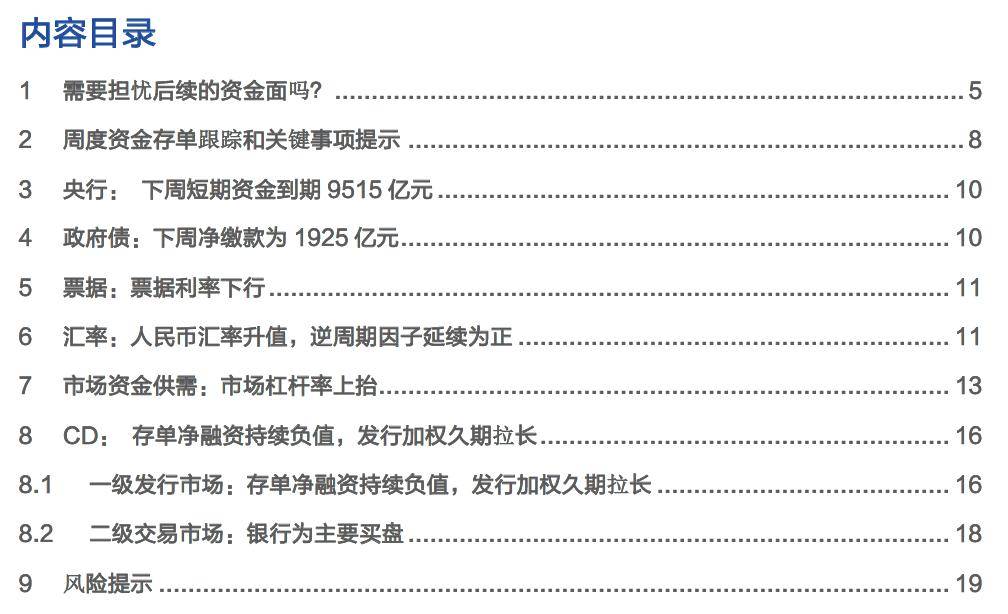
Group 1 - The core viewpoint suggests that from December 2025 to January 2026, there may be a liquidity easing due to factors such as government bonds and accelerated credit, leading to a potential increase in bank deposits [1][3][18] - The central bank emphasizes maintaining liquidity and guiding overnight rates to operate near policy rates, indicating a flexible approach to monetary policy [3][12][18] - The market is experiencing increased volatility in funding prices due to the gradual consumption of bank reserves and the lagging effect of six-month reverse repos [3][13][18] Group 2 - The outlook for certificates of deposit (CDs) remains unchanged, with future adjustments dependent on funding conditions and expectations of easing [2][4] - Recent data shows that net financing for CDs continues to be negative, particularly for state-owned banks, while secondary market demand is primarily driven by banks [20][68] - Upcoming weeks will see significant maturities of CDs, with a total of 7,061.70 billion yuan maturing in the next week, indicating potential funding disturbances [5][56][70] Group 3 - The central bank's operations indicate a net injection of 8,128 billion yuan, with a focus on short-term liquidity management [26][28] - Government bonds are expected to have a net repayment of 1,925 billion yuan next week, which may influence market liquidity [31] - The overall market leverage ratio is increasing, with banks showing a decrease in lending while non-bank financial institutions are adjusting their borrowing strategies [41][49]

国债周报:结构性降息后,降准降息空间仍存-20260117
Wu Kuang Qi Huo· 2026-01-17 15:06
结构性降息后,降准降息空间仍存 国债周报 2025/01/17 蒋文斌(宏观金融组) 0755-23375128 jiangwb@wkqh.cn 从业资格号:F3048844 交易咨询号:Z0017196 程靖茹(联系人) chengjr@wkqh.cn 从业资格号:F03133937 CONTENTS 目录 01 周度评估及策略推荐 04 流动性 02 期现市场 05 利率及汇率 03 主要经济数据 01 | 国债基本面评估 | 估值 驱动 | | | | | | --- | --- | --- | --- | --- | --- | | | 基差 经济 | 价格 | 政策 | 流动性 | 贴水 | | 多空评分 | -1 0 | 0 | 0 | 1 | -1 | | 简评 | 基本面改善仍需观 净基差偏低 察 | 价格适中 | 政策空档期 | 流动性压力有望缓 解 | 贴水偏低 | | | 近期经济数据显示内需仍有待修复,外需在关税扰动下有所承压。当前债市向下调整空间有限,往后看资金面有望延续宽 | | | | | | 小结 | 松,随着关税扰动及外需的不确定性增强,后续经济稳增长压力仍存。宽货币政策的方 ...