
反内卷

Search documents
快递行业11月数据点评:行业增速放缓,顺丰、圆通继续跑赢行业;中通11月并表丹鸟,期待网络协同
Huachuang Securities· 2025-12-20 13:11
Investment Rating - The report maintains a "Recommendation" rating for the express delivery industry, expecting the industry index to outperform the benchmark index by over 5% in the next 3-6 months [28]. Core Insights - The express delivery industry is experiencing a slowdown in growth, with SF Express and YTO Express continuing to outperform the industry [2]. - The report emphasizes investment opportunities under the "anti-involution" trend, highlighting the potential for revenue and performance elasticity in the upcoming verification period [3]. - The report recommends YTO Express and Shentong Express, noting their strong performance metrics and resilience in a slowing industry [3]. - Jitu Express is also recommended due to its significant growth in Southeast Asia, which supports stable profitability in the domestic market [3]. - SF Express is viewed positively despite short-term performance pressure, with effective operational activation mechanisms driving business scale expansion [4]. Summary by Sections Industry Performance - In November, the industry completed a business volume of 18.06 billion pieces, a year-on-year increase of 5.0%, with a cumulative volume of 180.74 billion pieces for the year, up 14.9% [6]. - Industry revenue in November was 137.65 billion yuan, down 3.7% year-on-year, while cumulative revenue for the year reached 1,355.06 billion yuan, up 7.1% [6]. - The average revenue per piece in November was 7.62 yuan, down 8.3% year-on-year, with a cumulative average of 7.50 yuan, down 6.8% [6]. Company Performance - In November, SF Express led the industry with a business volume growth rate of 20.1%, followed by Shentong Express at 14.7% and YTO Express at 13.6% [6]. - Shentong Express reported the highest revenue growth in November at 33.1%, while YTO Express and SF Express had growth rates of 11.1% and 9.9%, respectively [6]. - The average revenue per piece for Shentong Express was 2.41 yuan, up 15.9% year-on-year, while SF Express reported 13.47 yuan, down 8.5% [6]. Market Dynamics - The report highlights the ongoing "anti-involution" trend as a key driver for performance elasticity among express delivery companies [3]. - The report notes that the capital expenditure peak for SF Express has passed, leading to a stabilization in depreciation and amortization [4]. - The industry concentration ratio (CR8) stands at 86.9%, indicating a high level of market concentration [9].



明年看好四大投资主题!摩根大通刘鸣镝:消费板块,估值有吸引力
证券时报· 2025-12-20 11:18
Core Viewpoint - Morgan Stanley's target points for MSCI China Index, CSI 300 Index, and MSCI Hong Kong Index for 2026 are set at 100 points, 5200 points, and 16000 points respectively, indicating a potential double-digit upside from current levels [1][7]. Investment Themes - Four key investment themes for 2026 are identified: "anti-involution," growth in global AI infrastructure spending, the positive impact of developed countries' easing policies on exports, and the "K-shaped" recovery in consumption benefiting food and beverage and ultra-premium consumption sectors [2][7]. - A potential fifth theme is the stabilization of the real estate market [7]. Market Outlook - The MSCI China Index, CSI 300, and MSCI Hong Kong Index are expected to see increases of approximately 22%, 13.5%, and 17.8% respectively by 2026 [7]. - The current economic cycle in China is characterized as "summer," with expectations of a "spring sprint" in 2026, leading to renewed interest in growth stocks [7]. Sector Analysis - Semiconductor valuations are currently considered high, while sectors such as photovoltaics and energy storage are viewed more favorably [8][10]. - The consumer sector is seen as having attractive valuations, particularly in essential consumption, which is expected to perform well relative to other sectors [11][12]. Consumer Behavior Insights - The primary reason for current consumer weakness is not a lack of funds but rather concerns over income and employment, which are suppressing spending [12]. - The disposable income growth in most provinces is outpacing consumption growth, indicating a recovery in household balance sheets [12]. Valuation Comparisons - The MSCI China Consumer Staples Index has a lower price-to-earnings ratio compared to markets like India, the US, and Japan, making it an attractive investment opportunity [12].


中国经济透视 11月经济:社零减速,投资疲弱,出口稳健
2025-12-20 09:54
Summary of Key Points from the Conference Call Industry Overview - The conference call discusses the **Chinese economy**, focusing on economic performance indicators for November and expectations for December 2023 and beyond. Core Insights and Arguments 1. **Economic Slowdown in November**: - Retail sales growth slowed to **1.3%** year-on-year, significantly below expectations of **2.9%**. This slowdown is attributed to high base effects from last year's trade-in subsidies for appliances and vehicles, which led to a notable decline in sales in these categories [1][9]. - Fixed asset investment continued to decline, with a year-on-year drop of **11.1%** in November, slightly better than the **11.2%** decline in October. Manufacturing investment fell by **4.5%**, while infrastructure investment decreased by **11.9%** [1][7]. 2. **Real Estate Sector Weakness**: - Real estate investment saw a significant year-on-year decline of **30.3%** in November, worsening from **23%** in October. Sales and new construction remained at historically low levels, indicating ongoing challenges in the sector [1][6][7]. 3. **Export Performance**: - Exports rebounded with a year-on-year growth of **5.9%**, exceeding expectations of **4%** and improving from a **1.1%** decline in October. This growth was driven by strong demand for automobiles and integrated circuits, although exports to the US showed a significant decline [1][10]. 4. **Industrial Production**: - Industrial production growth slightly slowed to **4.8%**, down from expectations of **5%**. High-tech manufacturing sectors continued to show robust growth, with specific sectors like industrial robots growing by **21%** year-on-year [1][11]. 5. **Policy Support Measures**: - The government is implementing moderate fiscal policies, including the introduction of **500 billion yuan** in new policy financing tools and an additional **500 billion yuan** in local government bonds to stabilize economic growth [3][23]. - Monetary policy is expected to remain balanced, with potential interest rate cuts anticipated by the end of 2026 [3][24]. 6. **Future Economic Outlook**: - The economic slowdown is expected to persist into December, with retail consumption remaining weak due to high base effects. Without significant policy stimulus, real estate activity is likely to continue its downward trend [2][22]. - GDP growth for the fourth quarter is projected to slow to around **4.2%**, with an average growth rate of **4.9%** expected for 2025, aligning with the government's target of around **5%** [2][4]. Other Important but Potentially Overlooked Content - The central economic work conference set a moderate support and balanced policy tone, with a GDP growth target for 2026 expected to be in the range of **4.5%-5%**. The focus remains on stabilizing consumption and investment while addressing structural reforms [4][24]. - The report highlights the importance of innovation and social security improvements, indicating a shift towards more sustainable economic practices [4][24]. This summary encapsulates the key points discussed in the conference call, providing insights into the current state and future expectations of the Chinese economy.
明年看好四大投资主题!摩根大通刘鸣镝:消费板块,估值有吸引力
券商中国· 2025-12-20 08:39
Core Viewpoint - The target points for MSCI China Index, CSI 300 Index, and MSCI Hong Kong Index for 2026 are set at 100 points, 5200 points, and 16000 points respectively, indicating a potential double-digit upside from current levels [1][5]. Investment Themes - Four key investment themes for 2026 are identified: "anti-involution," growth in global AI infrastructure spending, the positive impact of developed countries' easing policies on exports, and the "K-shaped" recovery in consumption benefiting food and beverage and ultra-high-end consumption sectors [2][5]. - A potential fifth theme is the stabilization of the real estate market, with expectations of clearer signals from policy changes in early 2024 [5]. Market Outlook - The outlook for 2026 is optimistic, with expectations of a "spring sprint" in the market, particularly for growth stocks, as the current economic cycle is in the "summer" phase, which is typically followed by a recovery phase [3]. - The investment strategy suggests a shift from crowded growth and momentum sectors to value, defensive, and high-yield stocks, with the current market dynamics expected to continue into early next year [3]. Sector Analysis - Semiconductor valuations are currently considered high, while sectors such as photovoltaics and energy storage are viewed more favorably [6]. - The AI capital expenditure growth is expected to benefit Chinese companies, with a focus on the energy storage and photovoltaic sectors, which are still in the recovery phase [6][7]. Consumer Sector Insights - The consumer sector is seen as having attractive valuations, with the MSCI China Consumer Staples Index having a lower price-to-earnings ratio compared to markets like India and the U.S. [10]. - The current consumer spending slowdown is attributed more to confidence and employment concerns rather than a lack of funds, indicating potential for recovery as confidence improves [9][10].

磷酸铁锂涨价潮背后,锂电产业的“反内卷”博弈
经济观察报· 2025-12-20 05:21
Core Viewpoint - The recent price surge of lithium iron phosphate (LFP) contrasts sharply with the three-year downward price trend in the lithium battery industry, raising questions about whether this increase is a temporary relief for companies or a sign of a fundamental shift in the industry [2][4]. Price Increase Drivers - The primary driver of the recent price increase in LFP is the rise in costs of upstream raw materials, including lithium salts and various auxiliary materials [3]. - Lithium carbonate, which constitutes over 40% of the cost of LFP, has seen its price rise significantly, with market prices reaching between 97,200 to 100,000 yuan per ton, marking an increase of over 50% from mid-year lows [4]. - Other chemical raw materials for LFP production have also experienced price increases, with phosphoric acid and other components rising by 6.9% to 8.5% in November [4]. Demand and Market Dynamics - The demand for LFP is primarily driven by the electric vehicle (EV) and energy storage markets, with the latter expected to see substantial growth [6][7]. - In 2025, China's energy storage lithium battery shipments are projected to reach 580 GWh, with a growth rate exceeding 75% [7]. - The Chinese automotive industry has reported significant growth in EV production and sales, with a year-on-year increase of 31.4% in production and 31.2% in sales from January to November 2025 [6]. Industry Challenges and Responses - Despite the price increases, many LFP manufacturers are still operating at a loss, with only 16.7% of companies in the sector reporting profitability [10]. - The recent price hikes provide a much-needed respite for struggling LFP manufacturers, with some companies reporting positive outcomes from negotiations with clients [10]. - The industry is also witnessing a shift towards higher-quality products, with companies focusing on high-pressure density LFP products that offer better profitability [10]. Future Outlook - Analysts predict that lithium prices may continue to rebound in 2026, driven by a tightening supply-demand balance in the lithium market [6]. - The market for LFP in the energy storage sector is expected to grow significantly, with policies supporting the expansion of new energy storage capacity [8]. - The competitive landscape is shifting, with companies needing to focus on technology, capital, and supply chain integration rather than just production capacity and pricing strategies [11].


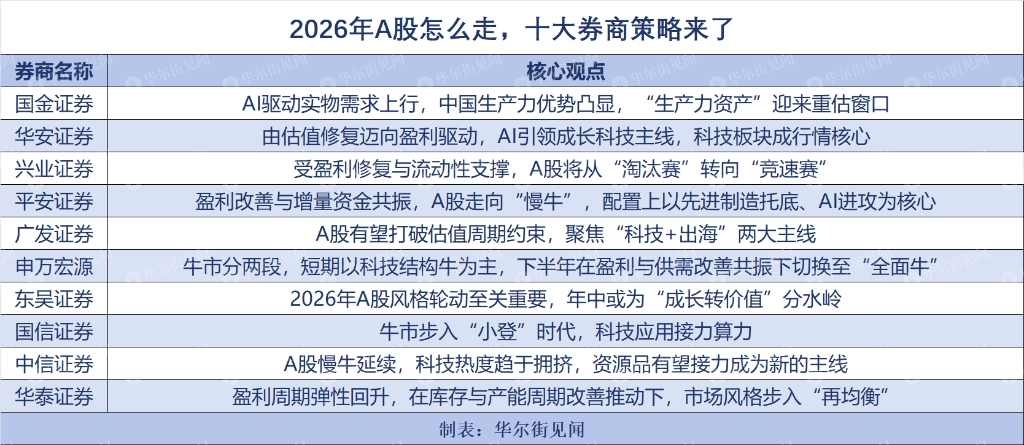
科技领跑、周期接力、慢牛到全面牛……2026年A股怎么走,十大券商策略来了
Hua Er Jie Jian Wen· 2025-12-20 04:57
Core Viewpoint - The A-share market is transitioning from a liquidity and valuation-driven phase to a new stage that emphasizes fundamentals and profit recovery, with a projected double-digit profit growth for the entire A-share market in 2026 [1][2][4]. Group 1: Market Outlook - Most major domestic securities firms believe that the A-share market will remain in a bull market in 2026, with profit recovery being a key variable for market sustainability [1][2]. - The overall profit growth for the A-share market is expected to rise from 8.2% in 2025 to 10.3% in 2026, with the growth rate for non-financial sectors projected at 7.7% [12][64]. - The first half of 2026 is anticipated to maintain market momentum, but a significant transition may occur mid-year, particularly for sectors that have seen substantial gains [1][2][27]. Group 2: Sector Focus - The technology sector remains a consensus direction for 2026, with a shift from infrastructure investment to application and performance realization in AI, focusing on areas like robotics and smart driving [2][21]. - The "anti-involution" policy is expected to drive profit recovery in sectors such as steel, chemicals, and new energy, while resource products may present opportunities as they follow the technology sector [2][27]. - The report highlights four main areas for investment opportunities: AI, new energy, military industry, and innovative pharmaceuticals, with a focus on sectors that are expected to benefit from the "15th Five-Year Plan" [34][40][79]. Group 3: Investment Strategies - The investment strategy should prioritize "manufacturing as a shield and technology as a sword," emphasizing advanced manufacturing and AI as core components [40][44]. - The report suggests a rotation in market style from growth to value, particularly around mid-2026, as the market may shift focus based on liquidity and industry trends [68][69]. - The report emphasizes the importance of identifying high-performance sectors within the "future industries" and suggests a focus on resource security and energy [79][91]. Group 4: Financial Metrics and Predictions - The overall A-share market is expected to see a significant recovery in profitability, with non-financial net profit growth projected to rebound from 6.5% in 2025 to 16.5% in 2026 [33][64]. - The report predicts that the supply-side reforms will lead to a more balanced market, with a focus on sectors that have undergone significant price recovery and demand stimulation [27][92]. - The report indicates that the current market valuation structure remains healthy, with no signs of overheating, suggesting further upward potential [80][89].




大摩邢自强:提消费、稳楼市、强社保……2026中国经济要走得远,关键还在“投资于人” | Alpha峰会
华尔街见闻· 2025-12-20 04:40
Core Viewpoint - The key to reversing the economic situation in China lies in the policy shift since September 2024, showcasing the resilience and innovation of Chinese enterprises amid complex geopolitical and regulatory challenges [2][4]. Group 1: Economic Policy and Resilience - The policy shift since September 2024 is crucial for reversing the economic situation, with Chinese enterprises demonstrating strong resilience and innovation in various technology sectors [4]. - Relying solely on certain industries' productivity highlights and companies going abroad may not sufficiently drive the economic cycle of a large economy [5]. - To effectively address the low-price cycle, efforts should focus on three areas: resolving existing issues, supporting domestic demand, and reforming to stabilize confidence [5][39]. Group 2: Fiscal and Social Reforms - The fiscal spending structure should shift from "investment in material" to "investment in people," enhancing social security to encourage consumer spending [5][45]. - Strengthening social security and balancing it can help unleash consumption potential, with fiscal burdens addressed through "opening up" and transformation [6][93]. - The current social security expenditure in China is only 10% of GDP, significantly lower than developed countries, indicating substantial room for improvement [93][94]. Group 3: Real Estate Market Dynamics - The real estate sector plays a critical role in China's economy, contributing nearly 30% of GDP at its peak, and its stabilization is essential for overall economic recovery [48][66]. - The adjustment in the real estate market has been significant, with sales and construction volumes dropping by 60%, indicating that the adjustment phase is nearing completion [61]. - The proposal of "fiscal interest subsidies" aims to narrow the gap between rental returns and mortgage costs, which is crucial for market recovery [78][82]. Group 4: Innovation and Technology - Chinese enterprises have achieved significant advancements in various technology sectors, including robotics, electric vehicles, and next-generation batteries, positioning themselves as global leaders [18][19]. - The scale effect of China's industrial clusters is unmatched by any other single economy, emphasizing that "there is no next China" [21]. - The talent pool in China, particularly in STEM fields, is vast, with approximately 11 million university graduates annually, providing a strong foundation for continuous innovation [22]. Group 5: Consumer Behavior and Economic Outlook - Consumer sentiment has shifted positively since the policy changes in September 2024, with increased interest from both international and domestic investors in diversified asset allocations [10][9]. - The high savings rate in China is attributed to an insufficient and unbalanced social security system, which needs reform to enhance consumer confidence and spending [96][97]. - The expectation is that by 2027, with further consensus and policy implementation, the economy will see significant improvements in consumer spending and overall stability [89][105].

经观月度观察|“反内卷”下出现新信号 政策加力稳投资促消费
Sou Hu Cai Jing· 2025-12-20 01:27
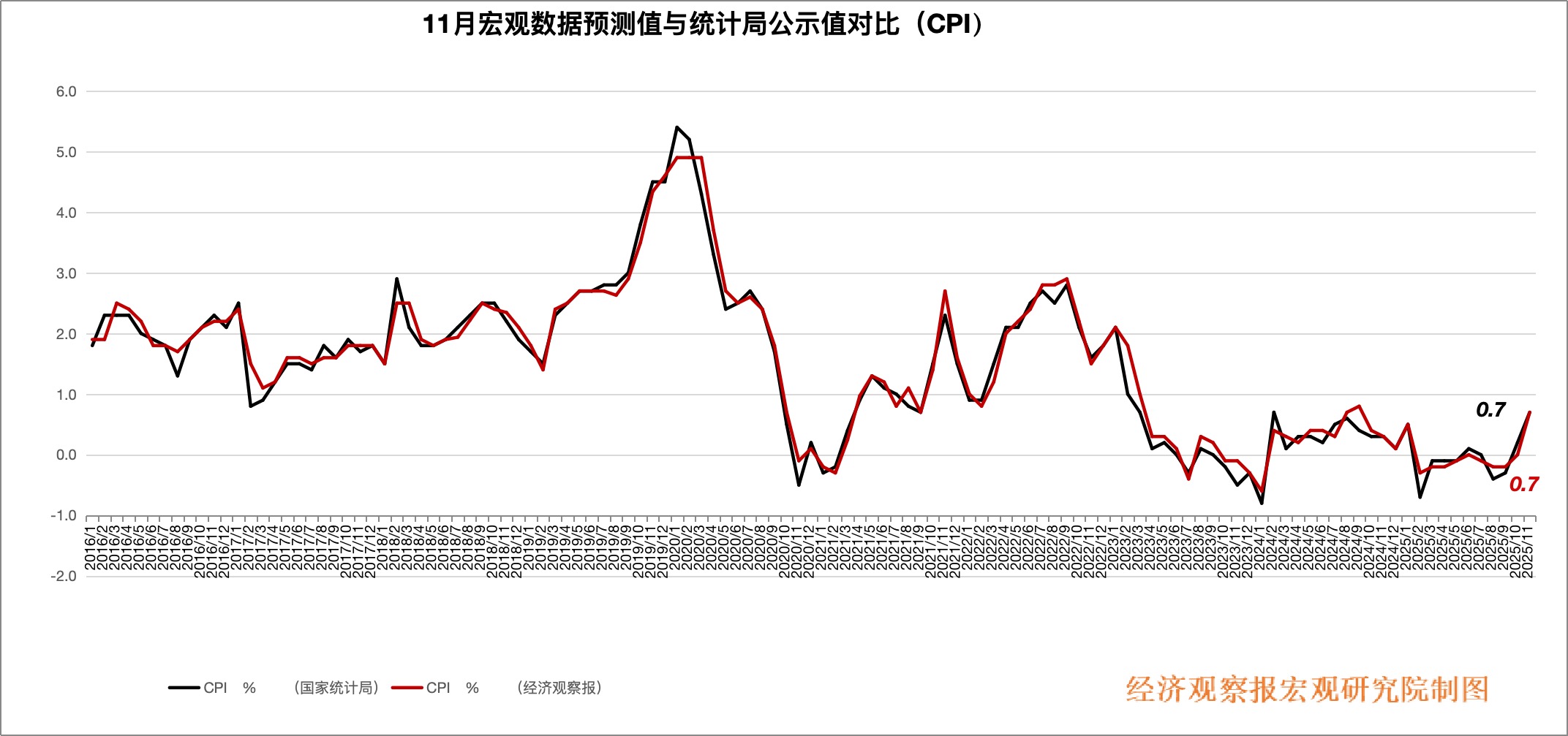
Economic Overview - "Anti-involution" has become a significant factor affecting economic operations, with fluctuations in economic data for November 2025 reflecting adjustments in industry prices and profit patterns during efforts to curb inefficient competition and promote structural optimization [2] - The current uneven pace of domestic demand recovery highlights the need for policies to focus on investment and consumption to stabilize growth [2] CPI Analysis - The CPI for November 2025 increased by 0.7% year-on-year, up from 0.2% in the previous month, marking the highest level since March 2024 [6] - Food prices rose by 0.2% year-on-year, while non-food prices increased by 0.8%, with core CPI remaining stable at 1.2% [6] - The month-on-month core CPI saw a slight decline of 0.1%, indicating a mixed trend in consumer prices [6] PPI Analysis - The PPI for November 2025 recorded a year-on-year decline of 2.2%, a slight increase in the rate of decline compared to the previous month [8] - The decrease in production materials and living materials prices reflects the impact of high base effects from the previous year [8] - The PPI remained stable month-on-month, indicating a balance in price movements across various sectors [8] PMI Insights - The manufacturing PMI for November 2025 was reported at 49.2%, showing a marginal improvement of 0.2 percentage points from the previous month [12] - Key drivers of this improvement include increases in production and new orders, alongside better external demand conditions [12] - The raw material purchase price index has been in an expansion zone for five consecutive months, suggesting a potential for improved profitability for manufacturing firms [12] Fixed Asset Investment - Fixed asset investment for January to November 2025 decreased by 2.6% year-on-year, reaching the lowest level since June 2020 [15] - The central economic work conference has proposed measures to increase central budget investments and optimize project management to reverse the declining trend in infrastructure investment [15] Credit Market - New RMB loans in November 2025 totaled 390 billion, a decrease from 220 billion in the previous month [19] - Short-term loans for residents fell significantly, reflecting weakened consumer confidence and employment expectations [19] - The real estate market continues to face challenges, with a notable decline in transaction volumes across major cities [19] M2 and Monetary Policy - The M2 growth rate for November 2025 was 8.0%, down from 8.2% in the previous month, indicating a tightening monetary environment [23] - The widening gap between M1 and M2 suggests a shift in deposit behaviors, with businesses moving funds from demand deposits to time deposits [23]

“反内卷”下出现新信号 政策加力稳投资促消费
Jing Ji Guan Cha Wang· 2025-12-20 01:18
Core Viewpoint - The "anti-involution" policy is significantly impacting economic operations, with November 2025 economic data showing fluctuations that reflect adjustments in industry pricing and profit structures, as well as uneven recovery in domestic demand, indicating a need for policy support to stabilize growth [1] CPI - November CPI year-on-year growth increased to 0.7%, up from 0.2% in October, marking the highest level since March 2024 [4] - Food prices rose by 0.2% year-on-year, while non-food prices increased by 0.8%, with core CPI remaining stable at 1.2% [4] PPI - November PPI year-on-year decline expanded to -2.2%, primarily due to a high base from the previous year [7] - The "anti-involution" policy is showing effects, with price declines in certain industries narrowing [7] PMI - November manufacturing PMI recorded at 49.2%, indicating a slight improvement from the previous month, driven by increases in production and new orders [10] - External demand has improved, potentially linked to positive outcomes from recent trade discussions [10] Fixed Asset Investment - Fixed asset investment decreased by 2.6% year-on-year, the lowest level since June 2020, prompting calls for increased central budget investment and optimization of project management [14] - The real estate sector continues to face challenges, with measures aimed at stabilizing the market [14] Credit - New loans in November totaled 390 billion yuan, a decrease from 220 billion yuan in October, reflecting weak consumer confidence and employment expectations [18] - Short-term loans decreased significantly, indicating a cautious approach among consumers regarding borrowing [18] M2 - M2 growth rate fell to 8.0%, down from 8.2%, while M1 growth rate decreased to 4.9% [22] - The widening gap between M1 and M2 suggests a shift in deposit behavior, with more funds moving to fixed deposits [22]
“反内卷”升格制度治理:汽车价格战走向“硬约束”时代
Zhong Guo Jing Ying Bao· 2025-12-19 20:29
在中央经济工作会议明确提出"深入整治'内卷式'竞争"后,监管层迅速给出制度回应。 中经记者 陈靖斌 广州报道 在推进全国统一大市场建设的政策语境下,"反内卷"正从一项行业共识上升为具有制度约束力的宏观治 理议题。 12月10日至11日召开的中央经济工作会议明确提出,要"纵深推进全国统一大市场建设,深入整治'内卷 式'竞争",并首次提出制定全国统一大市场建设条例,强调推动要素自由流动和规则统一。与以往侧 重"综合整治"不同,此次表述将"反内卷"升级为"深入整治",政策指向更为清晰——引导产业竞争逻辑 由低水平价格博弈,转向以技术、效率和服务为核心的价值竞争。 这一信号在汽车行业率先得到呼应。12月12日,国家市场监督管理总局发布《汽车行业价格行为合规指 南(征求意见稿)》(以下简称《合规指南》),对汽车生产企业和销售企业的价格行为作出系统规 范,直指近年来行业内频繁出现的恶性价格战、变相降价、价格欺诈等问题。从时间节点看,该文件被 视为中央经济工作会议精神在重点行业的具体化落地。 《中国经营报》记者从比亚迪、小鹏汽车、长安汽车等多家车企相关负责人处获悉,上述企业已明确表 态支持相关政策方向。在行业层面,"反内卷 ...



