
信用利差

Search documents
收益新“债”见,公司债ETF(511030)实现8连涨
Sou Hu Cai Jing· 2025-11-04 01:15
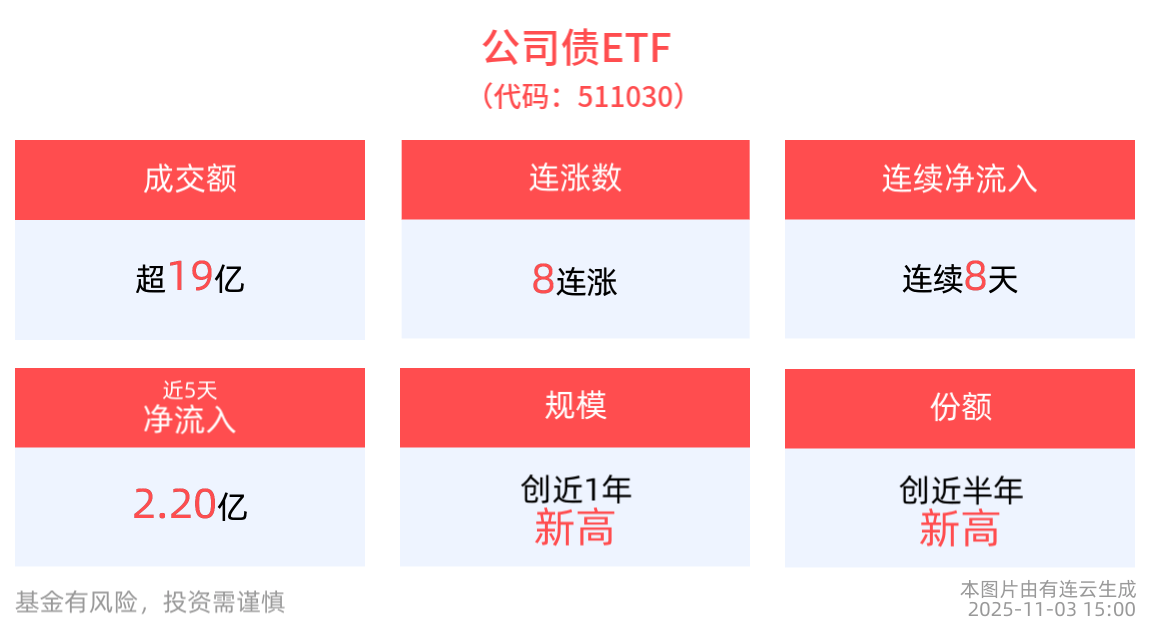
Group 1 - The bond market showed strong performance last week, primarily due to the central bank's resumption of bond purchases, which boosted market confidence [1] - This week, aside from potential impacts from new fund redemption regulations, most negative factors have been exhausted, allowing for a more optimistic outlook for the bond market [1] - Historical data indicates a higher probability of bond market declines in November, with a core focus on the potential restart of interest rate cuts, suggesting a strategy of extending duration [1] Group 2 - As of November 3, 2025, the company bond ETF (511030) rose by 0.03%, marking its eighth consecutive increase, with a latest price of 106.56 yuan and a year-to-date increase of 1.39% [4] - The company bond ETF's liquidity showed a turnover rate of 8.41% with a transaction volume of 1.972 billion yuan, and an average daily transaction volume of 2.189 billion yuan over the past month [4] - The latest scale of the company bond ETF reached 23.453 billion yuan, a new high in nearly a year, with the latest share count at 220 million, also a six-month high [4] Group 3 - Over the past five years, the net value of the company bond ETF has increased by 13.34%, with a maximum monthly return of 1.22% and a longest consecutive increase of nine months [5] - The company bond ETF has a historical annual profit percentage of 83.33% and a monthly profit probability of 78.94%, with a 100% probability of profit over a three-year holding period [5] - As of October 31, 2025, the company bond ETF's one-month Sharpe ratio was 1.81, and the maximum drawdown over the past six months was 0.28% [5] Group 4 - The company bond ETF closely tracks the China Bond - Medium to High Grade Corporate Bond Spread Factor Index, which reflects the trends in the RMB bond market [6] - The index is based on AAA-rated corporate bonds listed on the Shanghai Stock Exchange and is segmented by implied ratings, serving as a benchmark for investment performance in medium to high-grade corporate bonds [6]

11月信用,有点鸡肋
HUAXI Securities· 2025-11-03 15:23
Report Industry Investment Rating No relevant content provided. Core Views of the Report - In October, credit bonds outperformed interest rate bonds, with credit spreads narrowing across the board, and medium- to long-term, low-rated varieties showing significant recovery. The buying power of credit bonds increased, and the trading volume share of 1-3 year and 3-5 year bonds rose. [1][10][11] - Looking ahead to November, the central bank's bond purchases provide a strong market stability expectation, and interest rates are more likely to decline. However, the cost-effectiveness of short- to medium-term credit spreads in credit bonds is relatively low, which may limit their market performance. [2][18] - In November, credit bonds may underperform interest rate bonds. Accounts with unstable liability ends can appropriately reduce their credit bond positions and adjust to interest rate and Tier 2 capital bonds and perpetual bonds of large banks, which have good liquidity. For accounts with stable liability ends, they can prefer medium- to high-rated 3-5Y steeper entities to increase holding returns through riding the yield curve. [3][26][30] Summary by Relevant Catalogs 1. Grasp the trading opportunities of 4-5 year Tier 2 capital bonds and perpetual bonds of large banks, and prefer medium- to high-rated 3-5Y steeper entities - In October, the bond market was affected by Sino-US tariff shocks and bond market redemption fee rate regulations, with interest rate fluctuations intensifying. Credit bonds outperformed interest rate bonds, and credit spreads narrowed across the board. The buying power of credit bonds increased significantly, and the trading volume share of 1-3 year and 3-5 year bonds rose. [10][11] - Products with stable liability ends may be the important buyers of credit bond duration varieties in October. On the one hand, the opening scale of amortized cost method bond funds was relatively large in October, and some of them increased their investment in 3-5 year medium- to high-rated credit bonds. On the other hand, 3-5 year low-rated credit bonds were also bought by securities company asset management products with a 1-3 year closed period. [15] - Looking ahead to November, the central bank's bond purchases provide a strong market stability expectation, and interest rates are more likely to decline. However, the cost-effectiveness of short- to medium-term credit spreads in credit bonds is relatively low, and the potential compression space is small. [18] - In November, credit bonds may underperform interest rate bonds. Accounts with unstable liability ends can appropriately reduce their credit bond positions and adjust to interest rate and Tier 2 capital bonds and perpetual bonds of large banks, which have good liquidity. For accounts with stable liability ends, they can prefer medium- to high-rated 3-5Y steeper entities to increase holding returns through riding the yield curve. [26][30] 2. Urban investment bonds: Net financing turned positive, and medium- to long-term, low-rated bonds showed significant recovery - In October, the net financing of urban investment bonds turned positive but decreased year-on-year. The issuance sentiment was good, and the proportion of issuance multiples above 3 times increased week by week. The weighted average issuance interest rates of urban investment bonds declined across the board, with a larger decline in the medium- to long-term. [33] - The performance of net financing in each province was differentiated in October, with most provinces in a net inflow state. The yields of urban investment bonds declined across the board, and the medium- to long-term, low-rated varieties that had experienced significant adjustments earlier showed significant recovery. [35][37][40] - From the perspective of broker transactions, the buying sentiment of urban investment bonds warmed up in October. The overall TKN ratio and low valuation ratio increased month-on-month. In the last week of October, the number of transactions of medium- to long-term urban investment bonds increased significantly, and the AA(2) rating remained relatively active in transactions. [44] 3. Industrial bonds: Supply increased, and yields declined across the board - In October, the issuance and net financing scale of industrial bonds increased significantly year-on-year. The net financing scale of the comprehensive and public utilities sectors was relatively large, and the net financing of the non-bank financial sector was also above 300 million yuan. The issuance sentiment of industrial bonds improved significantly starting from the third week of October. [47] - In terms of term structure, the issuance proportion of long-term industrial bonds over 5 years increased in October, and the issuance interest rates of 1-3 year and 3-5 year bonds increased, while those of other terms declined. [48] - The yields of industrial bonds declined across the board in October, and the spreads also narrowed. The 5-year varieties performed better. The yields of public bonds in each industry declined by 3-17bp, and the medium- to long-term varieties performed better. [50][53] 4. Bank capital bonds: Net financing decreased year-on-year, and trading sentiment improved significantly No relevant content provided in the given text for this part.
债市升温,4-5y信用配置情绪较好:——信用周报20251103-20251103
Huachuang Securities· 2025-11-03 07:33
1. Report Industry Investment Rating - No information provided in the content 2. Core Views of the Report - This week, credit bond yields declined significantly, and spreads showed a divergent trend, with 4 - 5y varieties outperforming. Although the SSE Composite Index breaking through 4000 points had an impact on the bond market, the central bank's announcement of restarting treasury bond trading and the unexpected decline in the October manufacturing PMI led to a relatively strong performance in the bond market. The improvement in institutional sentiment towards credit bond allocation drove the relatively strong performance of 4 - 5y credit varieties, with a large narrowing in spreads, while most 1 - 2y varieties and medium - term notes over 5y widened passively [1][7]. - Key policies and hot events included the release of the "Administrative Measures for Asset Management Trusts (Draft for Comment)" by the Financial Regulatory Administration, Vanke receiving a loan of up to 2.2 billion yuan from its major shareholder Shenzhen Metro Group, Vanke's Q3 2025 report showing a decline in operating income and a net loss, and the central bank's report on the financial work situation indicating a significant reduction in the number of financing platforms and the scale of operating financial debts [1][2][10]. 3. Summaries According to the Table of Contents 3.1 Credit Bond Market Review: Most Yields Declined, 4 - 5y Varieties Performed Better - Credit bond yields declined significantly this week, and spreads showed a divergent trend, with 4 - 5y varieties outperforming. The central bank's announcement of restarting treasury bond trading and the unexpected decline in the October manufacturing PMI led to a relatively strong performance in the bond market. The improvement in institutional sentiment towards credit bond allocation drove the relatively strong performance of 4 - 5y credit varieties, with a large narrowing in spreads, while most 1 - 2y varieties and medium - term notes over 5y widened passively [1][7]. 3.2 Key Policies and Hot Events: Vanke Received Another Loan from Shenzhen Metro Group, and the "Administrative Measures for Asset Management Trusts (Draft for Comment)" was Released - On October 31, the Financial Regulatory Administration released the "Administrative Measures for Asset Management Trusts (Draft for Comment)" to strengthen supervision, prevent risks, and standardize the development of the trust industry [10]. - On October 30, Vanke announced that its major shareholder Shenzhen Metro Group would provide a loan of up to 2.2 billion yuan to repay the principal and interest of its publicly - issued bonds. As of the announcement date, Shenzhen Metro Group had provided a cumulative loan of 26.93 billion yuan (excluding this time) [2][10]. - On October 30, Vanke released its Q3 2025 report. In the first three quarters, the company's total operating income was 161.388 billion yuan, a year - on - year decrease of 26.61%, and the net profit attributable to the parent company was a loss of 28.016 billion yuan, a year - on - year decrease of 56.14%. Although Vanke's self - repayment ability was weak, it had received support from its major shareholder and financial institutions [2][11]. - On October 28, the central bank released the State Council's report on the financial work situation, stating that as of the end of September 2025, the number of national financing platforms and the scale of operating financial debts had decreased by 71% and 62% respectively compared to the end of March 2023, and risks had been significantly mitigated. The central bank emphasized continuing to support the debt - resolution work of financing platforms and their market - oriented transformation [2][12]. 3.3 Secondary Market: Credit Bond Yields Generally Declined, and Credit Spreads Showed a Divergent Trend - Yields of medium - and short - term notes generally declined by 2 - 13BP, with spreads of 4 - 5y varieties narrowing by 4 - 8BP, and spreads of most other maturities widening by 0 - 4BP [14]. - For urban investment bonds, yields of various varieties generally declined by 4 - 11BP, with 4 - 5y varieties performing better. Credit spreads showed a divergent trend, with spreads of most varieties narrowing by 1 - 6BP [14]. - For real estate bonds, except for the 1y and 3y AAA varieties, yields of other varieties generally declined by 3 - 12BP. Spreads of most varieties generally narrowed by 0 - 8BP [15]. - For cyclical bonds, yields of coal bonds generally declined by 2 - 12BP, and spreads of most varieties narrowed by 0 - 9BP. Yields of steel bonds generally declined by 3 - 12BP, and spreads of most varieties narrowed by 0 - 8BP [15]. - For financial bonds, yields of bank secondary capital bonds and perpetual bonds of various maturities declined by 5 - 12BP, and spreads of most varieties narrowed by 1 - 8BP. Yields of securities firm sub - bonds generally declined by 1 - 9BP, and spreads of most varieties generally narrowed by 0 - 3BP. Yields of insurance sub - bonds generally declined by 5 - 11BP, and spreads of most varieties generally narrowed by 1 - 4BP [15]. 3.4 Primary Market: Net Financing of Credit Bonds and Urban Investment Bonds Declined Month - on - Month - This week, the issuance scale of credit bonds was 224.8 billion yuan, a month - on - month decrease of 246.7 billion yuan, and the net financing was - 12.6 billion yuan, a month - on - month decrease of 148.5 billion yuan. The issuance scale of urban investment bonds was 105.6 billion yuan, a decrease of 5.83 billion yuan from last week, and the net financing was - 36.6 billion yuan, a decrease of - 4.96 billion yuan from last week [4]. 3.5 Trading Liquidity: Trading Activity in the Inter - bank Market Decreased, and Trading Activity in the Exchange Market Increased - This week, the trading activity of credit bonds in the inter - bank market decreased, and the trading volume decreased from 586 billion yuan last week to 580.7 billion yuan. The trading activity in the exchange market increased, and the trading volume increased from 381.7 billion yuan last week to 435.8 billion yuan [4]. 3.6 Rating Adjustment: One Entity's Rating was Upgraded, and No Entity's Rating was Downgraded - This week, the rating of one entity was upgraded, and no entity's rating was downgraded [4].

债市日报:10月29日
Xin Hua Cai Jing· 2025-10-29 07:46
Core Viewpoint - The bond market experienced volatility on October 29, with short-term instruments performing better initially, but long-term bonds weakened towards the end of the trading day. The People's Bank of China (PBOC) injected a net amount of 419.5 billion yuan into the market, indicating a focus on liquidity management and potential monetary easing [1][6]. Market Performance - The majority of government bond futures closed higher, with the 30-year main contract down 0.27% at 115.83, while the 10-year contract rose 0.13% to 108.57. The 5-year and 2-year contracts also saw slight increases [2]. - The interbank bond yield initially decreased before rising again, with the 10-year China Development Bank bond yield up 0.7 basis points to 1.8875% [2]. International Market Trends - In North America, U.S. Treasury yields showed mixed results, with the 2-year yield up 0.37 basis points to 3.486% and the 10-year yield down 0.01 basis points to 3.976% [3]. - In Asia, Japanese bond yields mostly increased, with the 10-year yield rising 0.7 basis points to 1.652% [4]. Primary Market Activity - Agricultural Development Bank of China issued financial bonds with yields of 1.4811% for 1.074 years, 1.7549% for 3 years, and 1.9480% for 10 years, with bid-to-cover ratios indicating strong demand [5]. Liquidity and Funding - The PBOC conducted a 557.7 billion yuan reverse repo operation at a fixed rate of 1.40%, resulting in a net injection of 419.5 billion yuan after accounting for maturing repos [6]. - Short-term Shibor rates declined across the board, with the overnight rate down 5.5 basis points to 1.414% [6]. Institutional Insights - Different institutions exhibit varying preferences for bond allocations, with banks focusing on interest rate bonds and insurance companies favoring low-risk bonds to meet liability requirements [7][8]. - The resumption of government bond trading by the PBOC is seen as a move to support fiscal efforts and enhance liquidity for financial institutions, confirming a loose monetary stance [8].
低利差环境下的信用债投资策略 - 中金固收2025债市宝典系列
中金· 2025-10-28 15:31
Investment Rating - The report indicates a focus on high-quality corporate long-duration bonds and suggests a flexible investment strategy to adapt to market conditions. Core Insights - The Chinese credit bond market has formed with non-financial credit bonds accounting for approximately 32 trillion RMB, presenting potential arbitrage opportunities, particularly in medium-term notes and corporate bonds [1][2] - Historical asset shortages have occurred during periods of loose monetary policy and insufficient real financing demand, with the current environment requiring close attention to policy changes [1][5] - Key investment strategies include focusing on high-quality long-duration products, exploiting regulatory arbitrage opportunities, and increasing allocations to high-grade products for stable returns [1][9] Summary by Sections Current Market Changes - The credit bond market has seen significant changes, with credit spreads remaining low amid an asset shortage and a decrease in default events, limiting trading opportunities based on spread fluctuations [2][11] Major Categories and Characteristics - Credit bonds are categorized into financial and non-financial types, with non-financial bonds primarily comprising short-term financing, medium-term notes, and corporate bonds, which may present arbitrage strategies [3][4] Rating Agency Impact - Rating agencies operate under issuer-paid and investor-paid models, with the latter primarily covering certain bonds in the interbank market. The actual practice still favors rated bonds despite regulatory changes allowing for the cancellation of mandatory ratings [4] Historical Asset Shortages - Four historical phases of asset shortages are identified, characterized by loose monetary policy and insufficient real financing demand, with varying influences from demand and supply factors [5] Feasible Investment Strategies - Current feasible investment strategies include focusing on high-quality long-duration bonds, utilizing arbitrage opportunities between different regulatory systems, and considering undervalued assets during severe asset shortages [7][9] Indicators of Rate Downturn Reversal - Key indicators for potential reversals during rate downturns include changes in fundamentals, stringent financial regulations, and institutional behaviors [8] Credit Spread Volatility - Credit spread volatility is influenced by central bank monetary policy, fundamental changes, and institutional behaviors, with historical events illustrating these impacts [10][12] Future Influencing Factors - Future factors affecting the credit bond market include central bank monetary policy changes, actual or expected fundamental changes, and institutional behaviors such as potential redemption waves [12] Risk Preference Influences - In adverse market conditions, risk preferences for credit bonds are influenced by default events, investor characteristics, liquidity compensation, and leverage operation convenience [13][14] Supply Pressure Impact - Credit bond supply pressure is influenced by corporate financing willingness, cost advantages of financing channels, and regulatory policies, with recent trends indicating a shift towards bond financing due to cost advantages [19][20] Common Investment Strategies - Common investment strategies in the credit bond market include regional and industry rotation, product selection based on market volatility, duration selection based on interest rate trends, and monitoring changes in wealth management product behaviors [21][22]
固定收益专题:二永债如何配
GOLDEN SUN SECURITIES· 2025-10-28 09:40
Report Industry Investment Rating No information provided in the content. Core Viewpoints of the Report - Recently, the market risk appetite has declined, and the high - elasticity secondary and perpetual (Er Yong) bonds have seen dual benefits of falling interest rates and narrowing spreads. Since October, the yields of 10 - year treasury bonds and 5 - year AAA - secondary capital bonds have both declined, with the latter having a significantly larger decline. The spreads have also narrowed, with the secondary capital bond spreads compressing more significantly [1][8]. - The supply of Er Yong bonds remains weak, and the background of asset shortage continues. The issuance of Er Yong bonds has decreased this year, and the net financing scale is expected to decline further next year. Meanwhile, the demand for Er Yong bonds may fluctuate due to factors such as regulations on public fund redemption fees and new accounting standards for insurance [10][14]. - The amplifying effect of Er Yong bonds as "interest rate amplifiers" has weakened recently, mainly due to the reduced trading attribute. The main demand force for Er Yong bonds has changed, deepening their allocation characteristics and weakening trading attributes [2][15]. - The credit spreads of 5 - year Er Yong bonds have a large compression space. The current credit spreads of Er Yong bonds are only slightly lower than those of ultra - long credit bonds, and their investment value should not be ignored [3][24]. - The pricing fitting model estimates that the yield of 5 - year AAA - secondary capital bonds may decline to around 2.07% next year. There are three investment ideas based on the scale - valuation bubble chart: band - trading of state - owned bank Er Yong bonds, extending duration for high - rated Er Yong bonds, and credit - sinking with controlled duration [4][42]. Summary According to Related Catalogs Supply and Demand Analysis - **Supply**: This year, with treasury bonds supplementing the core tier - one capital of large state - owned commercial banks, the issuance of Er Yong bonds has decreased. For example, the net financing of Bank of Communications and Bank of China's secondary capital bonds from January to October 24 was - 40 billion yuan and - 10 billion yuan respectively. The overall net financing scale of Er Yong bonds from January to September was lower than that of the same period last year. Next year, the maturity scale of Er Yong bonds will remain at a high level of 1.12 trillion yuan, and the net financing scale is expected to decline further [10]. - **Demand**: Regulations on public fund redemption fees may have a negative impact on bond funds, leading to the sale of Er Yong bonds. Although the new regulations have not been officially implemented, the adjustment range may be limited. In the future, in the context of asset shortage, funds will still increase bond allocation, but the redemption and allocation process will have a phased impact on the market. Also, from 2026, non - listed insurance companies will implement new accounting standards, which may affect their enthusiasm for allocating Er Yong bonds [14]. Er Yong Bond Turnover Statistics - From January to September this year, the monthly turnover rate of Er Yong bonds remained relatively stable. The average monthly turnover rate of secondary capital bonds was 18.14%, with an average monthly trading volume of 769.1 billion yuan, and the average monthly turnover rate increased by 0.8% compared to last year. The average monthly turnover rate of bank perpetual bonds was 20.35%, with an average monthly trading volume of 519.2 billion yuan, and the average monthly turnover rate decreased by 1.00% compared to last year [2][18]. - Among state - owned banks, Industrial and Commercial Bank of China and China Construction Bank had relatively high trading activity; among joint - stock banks, China Minsheng Bank, Shanghai Pufa Bank, Ping An Bank, China Merchants Bank, and China CITIC Bank were more active; among city and rural commercial banks with assets over one trillion yuan, Bank of Jiangsu, Bank of Hangzhou, Bank of Beijing, and Huishang Bank had relatively high trading activity [2][20]. Credit Spread Compression Space - As of October 23, the credit spreads of 1 - year, 3 - year, and 5 - year AAA - secondary capital bonds were 8.81bp, 19.99bp, and 41.29bp respectively, at historical percentiles of 0.6%, 14.2%, and 79.7% since 2024. The credit spreads of 1 - year, 3 - year, and 5 - year AA - secondary capital bonds were 15.2bp, 31.2bp, and 63.7bp respectively, at historical percentiles of 0.0%, 18.0%, and 64.1% since 2024 [3][24]. - The current credit spread of 5 - year AAA - secondary capital bonds is only slightly lower than that of 7 - year AA + medium - term notes. Since the end of 2024, the credit spread of 5 - year AAA - secondary capital bonds has mostly been lower than that of 7 - year AA + medium - term notes, and the two have been relatively close since September [3][26]. Pricing Fitting Model - The pricing fitting model uses five variables: the funding price R007, weekly net financing of Er Yong bonds, weekly net financing of urban investment bonds, secondary weekly demand for Er Yong bonds, and the turnover rate of Er Yong bonds to fit the yield of secondary capital bonds [29]. - Assuming different scenarios for R007, weekly net financing of Er Yong bonds, weekly net financing of urban investment and industrial bonds, secondary weekly demand, and turnover rate, the yield center of 5 - year AAA - secondary capital bonds may be at 1.91%, 2.07%, or 2.23% [4][38]. Full Review of Er Yong Bond Scale and Valuation - The outstanding scale of AAA - secondary capital bonds accounts for 96%, with an average valuation of 2.12%. The outstanding scale of AAA - bank perpetual bonds accounts for 96.2%, with an average valuation of 2.35% [4][39]. - There are three investment ideas based on the scale - valuation bubble chart: band - trading of state - owned bank Er Yong bonds, extending duration for high - rated Er Yong bonds (e.g., those of Ping An Bank, Minsheng Bank, Everbright Bank, and Bohai Bank), and credit - sinking with controlled duration (e.g., those of Yingkou Bank, Shengjing Bank, and Great Wall Huaxi Bank) [4][42].
信用债2025年四季度策略:暂避锋芒
Ping An Securities· 2025-10-27 10:11
Core Insights - The report indicates that the credit bond market is expected to face increased supply and weakened demand in the fourth quarter of 2025, leading to potential widening of credit spreads [2][38] - It suggests a strategy of focusing on short to medium-term bonds, particularly in sectors with weaker supply and relatively higher yields, such as local government bonds and financial bonds [2][42] Part 1: Market Overview - In Q3 2025, the yield on government bonds rose, and credit bond yields generally increased, with credit spreads widening [9][14] - The supply of credit bonds increased year-on-year, while the net financing of government bonds decreased, contributing to the widening of credit spreads [14][18] Part 2: Q4 Strategy - The report recommends a downward strategy for short to medium-term bonds in Q4, as the current interest rate environment favors short-term debt [42][43] - It highlights that the credit spread may widen due to low demand and the impact of new regulations on public fund redemptions [38][39] Part 3: Sector-Specific Strategies Local Government Bonds - Focus on local government bonds in regions with better credit quality, as policies aimed at debt clearance are expected to alleviate credit risks [3][49] - The report notes that the yield on local government bonds in better regions is currently higher than in poorer regions [55] Financial Bonds - Attention is drawn to the value of older financial bonds, as their after-tax returns are expected to be higher than new issues due to discrepancies in implied tax rates [59][62] - The consolidation of rural commercial banks is seen as a structural opportunity to enhance their risk resilience [62][69] Industrial Bonds - The report emphasizes the potential for returns in state-owned real estate and construction bonds, driven by policies aimed at debt clearance and recovery [70][73] - It notes that the government’s focus on preventing defaults in the real estate sector is beneficial for state-owned enterprises [73]
信用利差周度跟踪 20251025:信用利差压缩向中长端传导,二永债重回震荡格局-20251025
Xinda Securities· 2025-10-25 15:20
Report Industry Investment Rating No relevant content provided. Core Viewpoints - Credit spread repair has spread to the medium and long - ends. Interest - rate bonds continued to fluctuate. Credit bond yields at all maturities and ratings decreased significantly, with larger declines at medium and long - ends. Credit spreads at all ratings converged, with more significant compression in 5Y and above varieties [2][5]. - Urban investment bond spreads generally declined by 5 - 6BP. Spreads of external rating AAA, AA +, and AA platforms decreased. By administrative level, provincial and municipal platform spreads decreased by 5BP, and district - county platform spreads decreased by 6BP [2][9]. - Most industrial bond spreads declined, while spreads of mixed - ownership and private real - estate bonds continued to rise. Central and state - owned enterprise real - estate bond spreads decreased, while those of mixed - ownership and private real - estate bonds increased. Coal, steel, and some chemical bond spreads decreased [2][18]. - The yields of secondary and perpetual bonds returned to a fluctuating pattern, with low - grade secondary bonds making up for losses. Yields and spreads of different maturities and ratings showed different changes [2][27]. - The 3Y excess spreads of industrial and urban investment perpetual bonds diverged, while the 5Y excess spreads were stable [2][31]. Summary by Directory 1. Credit Spread Repair Spreads to the Medium and Long - Ends - Interest - rate bonds fluctuated. 1Y, 7Y, and 10Y Guokai bond yields rose by 2BP, 3BP, and 1BP respectively, while 3Y and 5Y yields remained flat. Credit bond yields at all maturities and ratings decreased significantly, with larger declines at medium and long - ends. Credit spreads at all ratings converged, with more significant compression in 5Y and above varieties. Rating and term spreads also showed different changes [5]. 2. Urban Investment Bond Spreads Generally Decline by 5 - 6BP - By external rating, AAA platform spreads decreased by 5BP, AA + and AA by 6BP. Different provinces showed different decline ranges. By administrative level, provincial and municipal platform spreads decreased by 5BP, and district - county platform spreads decreased by 6BP [9][13][15]. 3. Most Industrial Bond Spreads Decline, while Spreads of Mixed - Ownership and Private Real - Estate Bonds Continue to Rise - Central and state - owned enterprise real - estate bond spreads decreased by 3 - 4BP, mixed - ownership real - estate bond spreads increased by 17BP, and private real - estate bond spreads increased by 37BP. Coal, steel, and some chemical bond spreads decreased [18]. 4. The Yields of Secondary and Perpetual Bonds Return to a Fluctuating Pattern, with Low - Grade Secondary Bonds Making up for Losses - 1Y AA + and AAA - grade secondary capital bond yields rose by 1 - 2BP, AA grade remained flat, and all - grade perpetual bond yields rose by 1BP, with spreads compressing by 0 - 2BP. 3Y AAA - grade secondary bond yields rose by 3BP, AA + grade by 1BP, AA - grade decreased by 2BP, and all - grade perpetual bond yields remained flat. 5Y AA + and above - grade secondary bond yields and spreads changed within 1BP, AA - grade spreads and yields decreased by 5BP; all - grade perpetual bond yields rose by 1 - 2BP, and spreads rose by 0 - 1BP [27]. 5. The 3Y Excess Spreads of Industrial and Urban Investment Perpetual Bonds Diverge, while the 5Y Excess Spreads are Stable - The 3Y excess spread of industrial AAA perpetual bonds decreased by 1.62BP to 13.89BP, at the 35.51% quantile since 2015. The 5Y excess spread remained flat at 12.39BP, at the 26.19% quantile. The 3Y excess spread of urban investment AAA perpetual bonds increased by 1.67BP to 6.64BP, at the 8.51% quantile; the 5Y excess spread decreased by 0.08BP to 11.00BP, at the 16.51% quantile [31]. 6. Credit Spread Database Compilation Instructions - Market - wide credit spreads, commercial bank secondary and perpetual spreads, and urban investment/industrial perpetual bond spreads are based on ChinaBond medium - short - term notes and ChinaBond perpetual bond data. Urban investment and industrial bond spreads are compiled and statistically analyzed by the R & D center of Cinda Securities. Historical quantiles are calculated since the beginning of 2015 [36]. - The calculation methods for individual bond spreads, excess spreads, and sample selection criteria are provided [38].
信用债周度观察(20251020-20251024):信用债发行量环比增长,各行业信用利差整体下行-20251025
EBSCN· 2025-10-25 09:29
Report Industry Investment Rating No relevant information provided. Core Viewpoints - Credit bond issuance volume increased month-on-month, and industry credit spreads generally declined [1][24] Summary by Directory 1. Primary Market 1.1 Issuance Statistics - From October 20 to October 24, 2025, a total of 545 credit bonds were issued, with a total issuance scale of 578.28 billion yuan, a month-on-month increase of 33.45% [1][11] - Industrial bonds: 267 were issued, with a scale of 310.475 billion yuan, a month-on-month increase of 30.60%, accounting for 53.69% of the total issuance scale [1][11] - Urban investment bonds: 232 were issued, with a scale of 152.105 billion yuan, a month-on-month increase of 49.66%, accounting for 26.30% of the total issuance scale [1][11] - Financial bonds: 46 were issued, with a scale of 115.7 billion yuan, a month-on-month increase of 23.12%, accounting for 20.01% of the total issuance scale [1][11] - The average issuance period of credit bonds was 2.61 years, with industrial bonds at 2.09 years, urban investment bonds at 3.27 years, and financial bonds at 2.09 years [1][14] - The average issuance coupon rate of credit bonds was 2.24%, with industrial bonds at 2.14%, urban investment bonds at 2.40%, and financial bonds at 1.98% [2][18] 1.2 Cancellation of Issuance Statistics - Two credit bonds cancelled their issuance this week [3][23] 2. Secondary Market 2.1 Credit Spread Tracking - By industry, among Shenwan primary industries, the largest increase in AAA - grade industry credit spreads was in electronics (up 0.9BP), and the largest decrease was in communications (down 9.3BP); for AA + - grade, the largest increase was in textile and apparel (up 52.9BP), and the largest decrease was in steel (down 56.4BP); for AA - grade, the largest increase was in machinery and equipment (up 2.7BP), and the largest decrease was in media (down 17.4BP) [3][24] - By region for urban investment bonds, this week, the largest increase in AAA - grade credit spreads was in Yunnan (up 6.4BP), and the largest decrease was in Liaoning (down 9.7BP); for AA + - grade, the largest increase was in Yunnan (up 11.1BP), and the largest decrease was in Sichuan (down 10.8BP); for AA - grade, the largest decrease was in Hebei (down 11.7BP) [3][26] - Coal and steel credit spreads both declined. AAA and AA + - grade coal credit spreads decreased by 4.2BP and 4.4BP respectively; AAA and AA + - grade steel credit spreads decreased by 4.7BP and 56.4BP respectively [25] - Credit spreads of urban investment and non - urban investment at all levels declined. The three levels of urban investment credit spreads decreased by 6.2BP, 4.6BP, and 5.7BP respectively; the three levels of non - urban investment credit spreads decreased by 5.3BP, 5.7BP, and 5.2BP respectively [25] - Credit spreads of state - owned enterprises and private enterprises both declined. The three levels of central state - owned enterprise credit spreads decreased by 3.2BP, 3.1BP, and 5.3BP respectively; the three levels of local state - owned enterprise credit spreads decreased by 5.4BP, 5.7BP, and 5.6BP respectively; AAA and AA + - grade private enterprise credit spreads decreased by 5.3BP and 3.7BP respectively [25] 2.2 Trading Volume Statistics - The total trading volume of credit bonds was 1426.37 billion yuan, a month-on-month decrease of 2.16%. The top three in trading volume were corporate bonds, medium - term notes, and commercial bank bonds [4][27] - Commercial bank bonds: trading volume reached 354.669 billion yuan, a month-on-month decrease of 6.75%, accounting for 24.87% of the total trading scale [4][27] - Corporate bonds: trading volume reached 436.845 billion yuan, a month-on-month increase of 7.45%, accounting for 30.63% of the total trading scale [4][27] - Medium - term notes: trading volume reached 357.797 billion yuan, a month-on-month decrease of 0.91%, accounting for 25.08% of the total trading scale [4][27] 2.3 This Week's Actively Traded Bonds - According to DM client data, the top 20 urban investment bonds, industrial bonds, and financial bonds in terms of trading volume this week are provided for investors' reference [29]
信用利差周报2025年第39期:上交所明确绿色金融四大发展方向,熊猫债累计发行规模突破万亿-20251024
Zhong Cheng Xin Guo Ji· 2025-10-24 02:07
1. Report Industry Investment Rating There is no information about the report industry investment rating provided in the content. 2. Core Viewpoints of the Report - The Shanghai Stock Exchange clarifies four development directions to promote the standardized development of green finance, aiming to optimize the policy environment and guide capital to the green - low - carbon field. China's green bond market is in a rapid development stage, but still faces challenges such as term mismatch and insufficient participation of small and medium - sized enterprises [3][11]. - The cumulative issuance scale of panda bonds has exceeded one trillion yuan, with continuous enrichment of issuers and optimization of the institutional environment. Although the market has expanded, there is still room for improvement in market scale, secondary - market liquidity, and foreign - institution participation [4][15]. - In the third quarter, GDP growth slowed down slightly, while import and export data in September exceeded expectations. The central bank net - withdrew funds last week, and the money market maintained a balanced state. The primary market of credit bonds saw a significant recovery in issuance scale and a decline in most issuance costs. The secondary market of credit bonds had significantly increased trading activity, with bond yields showing a mixed trend [5][20][24]. 3. Summary According to the Table of Contents Market Hotspots - **Shanghai Stock Exchange Promotes Green Finance**: On October 16, the Shanghai Stock Exchange announced four directions for green finance development, including supporting green enterprises' equity and bond financing, strengthening sustainable information disclosure of listed companies, enhancing investment - end construction in the sustainable field, and deepening international cooperation. China's green bond market has the largest scale globally, and the exchange is promoting standardized construction in multiple aspects. However, challenges such as term mismatch and insufficient SME participation remain [3][11][12]. - **Panda Bonds' Scale Exceeds One Trillion**: As of October 17, the cumulative issuance scale of panda bonds has exceeded one trillion yuan. The market has grown rapidly since 2023, with diversified issuers. The expansion is driven by low domestic interest rates and optimized regulatory policies. Although it has enhanced the market's depth and internationalization, there is still room for improvement in market scale, liquidity, and foreign - institution participation [4][15][16]. Macroeconomic Data - **GDP Growth**: The year - on - year GDP growth rate in the third quarter was 4.8%, slightly higher than the annual target. The growth rate of the secondary industry slowed down, while that of the primary industry increased [20]. - **Import and Export**: In September, the export volume was $328.57 billion, with a year - on - year growth of 8.3%, and the import volume was $238.12 billion, with a year - on - year growth of 7.4%, both showing significant improvements compared to August [5][20]. - **Social Financing Scale**: The stock of social financing scale in September was 424 trillion yuan, with a year - on - year growth of 8.7%. The new - added social financing scale decreased year - on - year, mainly due to weak credit demand and a slowdown in government - bond issuance [20][21]. - **Money Supply**: In September, M1 reached 7.2%, and M2 was 8.7%. The "scissors gap" between M1 and M2 narrowed to a new low for the year [5][21]. Money Market - The central bank net - withdrew 813.9 billion yuan through open - market operations last week. Although funds were withdrawn, the money market remained balanced, with fluctuating capital prices. The pledged - repo rates of various tenors had both increases and decreases, and the spread between the 3 - month and 1 - year Shibor narrowed to 9bp [6][24]. Primary Market of Credit Bonds - The issuance scale of credit bonds last week was 339.359 billion yuan, a significant recovery compared to the previous period. The issuance scale of each bond type and industry increased. The infrastructure investment and financing industry had a net outflow of 6.067 billion yuan in financing, while half of the industrial bonds had a net inflow. Most of the average issuance costs of credit bonds decreased, with a range of 6bp - 49bp, except for a 5bp increase in the issuance rates of 5 - year AA + and 3 - year AA bonds [7][29]. Secondary Market of Credit Bonds - The secondary - market trading volume of bonds last week was 9.166734 trillion yuan, with the average daily trading volume increasing by 88.1725 billion yuan to 183.3347 billion yuan, indicating a significant increase in trading activity. Bond yields showed a mixed trend. Interest - rate bond yields mostly increased, while credit - bond yields mostly decreased. Credit spreads generally showed a short - term decline and long - term increase, and rating spreads fluctuated within a narrow range of 3bp [37][39][41].