贸易战

Search documents
超长债周报:贸易战形势扑簌迷离,超长债成交量保持高位-20250603
Guoxin Securities· 2025-06-03 05:54
1. Report Industry Investment Rating No relevant content provided. 2. Core Viewpoints of the Report - Last week, the situation of the trade war was uncertain, causing the bond market to fluctuate. With a loose funding environment and the overnight interest rate dropping back to 1.4%, ultra-long bonds were slightly pressured, showing a V-shaped trend throughout the week. The trading activity of ultra-long bonds increased slightly, and both the term spread and the variety spread widened [1][11]. - For the 30-year treasury bond, as of May 30, the spread between the 30-year and 10-year treasury bonds was 23BP, at a historically low level. Considering domestic economic data, the economy in April still showed resilience. The estimated year-on-year GDP growth rate in April was about 4.1%, a 0.8% decline from March but still higher than the annual economic growth target. In terms of inflation, the CPI in April was -0.1% and the PPI was -2.7%, indicating obvious deflation risks. With the recent easing of Sino-US trade frictions and the dissipation of investors' pessimistic expectations, the short-term focus will shift to the domestic economic data of the second quarter. It is expected that as the policy support effect weakens, the bond yield is more likely to decline. However, the current term spread of the 30-year treasury bond is still low, providing limited protection [2][12]. - For the 20-year CDB bond, as of May 30, the spread between the 20-year CDB bond and the 20-year treasury bond was 2BP, at a historically extremely low level. The domestic economic situation in April was similar to that of the 30-year treasury bond. It is also expected that the bond yield will decline as the policy support effect weakens. However, the current variety spread of the 20-year CDB bond is still low, providing limited protection [3][13]. 3. Summary by Relevant Catalogs 3.1 Weekly Review - **Ultra-long Bond Review**: Last week, due to the uncertain trade war situation and a loose funding environment with the overnight interest rate at 1.4%, ultra-long bonds were slightly pressured, showing a V-shaped trend. The trading activity increased slightly, and both the term spread and the variety spread widened [1][11]. - **Ultra-long Bond Investment Outlook**: As analyzed above for the 30-year treasury bond and 20-year CDB bond [2][3]. - **Ultra-long Bond Basic Overview**: As of May 31, the balance of outstanding ultra-long bonds exceeded 21.6 trillion yuan, accounting for 14.4% of the total bond balance. Local government bonds and treasury bonds were the main varieties. By remaining term, the 30-year variety had the highest proportion [14]. 3.2 Primary Market - **Weekly Issuance**: Last week (May 26 - May 30, 2025), the issuance of ultra-long bonds was low, totaling 117.7 billion yuan, a significant decrease compared to the week before last. By variety, local government bonds accounted for 104.9 billion yuan, and by term, 20-year bonds accounted for 56.5 billion yuan [19]. - **Upcoming Issuance This Week**: The announced issuance plan for ultra-long bonds this week totals 108.1 billion yuan, including 71 billion yuan of ultra-long treasury bonds and 37.1 billion yuan of ultra-long local government bonds [26]. 3.3 Secondary Market - **Trading Volume**: Last week, the trading of ultra-long bonds was quite active, with a turnover of 903.9 billion yuan, accounting for 10.4% of the total bond turnover. Compared to the week before last, the trading activity increased slightly, with the turnover increasing by 42.2 billion yuan and the proportion increasing by 0.2% [28][29]. - **Yield**: Affected by the trade war and the funding environment, ultra-long bonds were slightly pressured, showing a V-shaped trend. The yields of different types of ultra-long bonds had different changes, such as the 15-year treasury bond yield decreasing by 2BP to 1.85% [36]. - **Spread Analysis** - **Term Spread**: Last week, the term spread of ultra-long bonds widened but remained at a low absolute level. The spread between the 30-year and 10-year treasury bonds was 23BP, a 6BP increase from the week before last, at the 6% quantile since 2010 [43]. - **Variety Spread**: The variety spread of ultra-long bonds also widened but was at a low absolute level. The spread between the 20-year CDB bond and the treasury bond was 2BP, and the spread between the 20-year railway bond and the treasury bond was 7BP, with changes of 0BP and 2BP respectively from the week before last, at the 2% and 3% quantiles since 2010 [48]. 3.4 30-year Treasury Bond Futures - Last week, the main contract of the 30-year treasury bond futures, TL2509, closed at 119.41 yuan, a decrease of 0.16%. The total trading volume was 408,900 lots (-60,932 lots), and the open interest was 113,500 lots (-15,740 lots), showing a slight decline in both [50].
特朗普关税政策或上诉法院支持,贸易战出现升级信号,黄金具备再度走牛基础
Soochow Securities· 2025-06-03 03:34
Investment Rating - The report maintains an "Overweight" rating for the non-ferrous metals sector [1]. Core Views - The non-ferrous metals sector experienced a decline of 2.40% during the week of May 26 to May 30, ranking low among all primary industries. Precious metals fell by 3.55%, industrial metals by 2.56%, energy metals by 3.18%, small metals by 0.69%, and new materials by 1.09% [1][15]. - The macroeconomic sentiment has weakened due to declining U.S. consumer spending and escalating trade tensions, impacting industrial metals negatively. However, gold is expected to strengthen due to rising inflation expectations in the U.S. [1][4]. Summary by Sections Market Review - The Shanghai Composite Index fell by 0.03%, with the non-ferrous metals sector declining by 2.40%, underperforming the index by 2.38 percentage points [15]. - All sub-sectors within non-ferrous metals saw declines, with precious metals leading the drop [15]. Industrial Metals - **Copper**: Prices remained volatile due to seasonal demand declines and macroeconomic sentiment. As of May 30, LME copper was at $9,497/ton, down 1.22% week-on-week, while SHFE copper was at ¥77,600/ton, down 0.24% [2][34]. - **Aluminum**: Prices decreased slightly, with LME aluminum at $2,449/ton (down 0.71%) and SHFE aluminum at ¥20,070/ton (down 0.42%). Social inventory fell to 549,600 tons, down 6.47% [3][38]. - **Zinc**: LME zinc was at $2,630/ton, down 3.06%, while SHFE zinc was at ¥22,225/ton, up 0.05%. Inventory levels decreased for both exchanges [41]. - **Tin**: Prices fell significantly, with LME tin at $30,230/ton (down 7.45%) and SHFE tin at ¥250,300/ton (down 5.40%). Supply expectations have increased due to resumed operations in certain mines [45]. Precious Metals - **Gold**: The COMEX gold price rose to $3,313.10/oz (up 0.55%), while SHFE gold fell to ¥771.80/g (down 1.06%). The market anticipates a rise in U.S. inflation, providing a bullish outlook for gold [4][50]. Economic Indicators - U.S. durable goods orders fell by 6.3% in April, indicating weakening consumer spending and investment sentiment. The PCE price index showed a year-on-year increase of 2.1%, the lowest since March 2021 [4][28]. Supply and Demand Dynamics - The report highlights a tightening supply for copper due to disruptions in production and a seasonal decline in demand. The macroeconomic environment is expected to exert more influence on copper prices in the short term [2][34]. Inventory Trends - Copper inventories showed mixed trends, with LME stocks at 149,900 tons (down 9.02%) and SHFE stocks at 105,800 tons (up 7.22%) [34]. This summary encapsulates the key insights and data from the industry report, providing a comprehensive overview of the current state and outlook for the non-ferrous metals sector.
特朗普“大漂亮”法案中埋着“资本税地雷”,大摩:参议院若不澄清,市场将面临冲击
华尔街见闻· 2025-06-03 02:57
Core Viewpoint - The article discusses the potential impact of the tax provision 899 in the "Big Beautiful Act," warning that it could lead to the largest capital tax shock in history for Wall Street, particularly affecting foreign investors in U.S. assets [1][3][12]. Group 1: Tax Provision 899 - Provision 899 introduces a punitive tax structure for investors from countries deemed to have "discriminatory" tax policies, starting with a 5% increase in tax rates, escalating by 5% annually, up to a maximum of 20% [3][4]. - The provision's scope is broad, potentially affecting various forms of income, including passive income, real estate investments, and business profits, which could impact previously exempt entities like foreign central banks and sovereign wealth funds [3][4]. Group 2: Market Implications - If the provision applies to U.S. Treasury bonds, it could lead to a steepening of the yield curve, a weakening of the dollar, and an expansion of credit spreads, as foreign investors may react quickly to tax changes [2][8][12]. - The report indicates that foreign investors hold a significant portion of U.S. debt, with total liabilities to foreign entities reaching $39.8 trillion, of which 83% are securities [4][6]. Group 3: Sector-Specific Effects - The tax changes could disproportionately affect corporate bonds, where foreign investors hold about 25% of the market, potentially leading to liquidity pressures and increased volatility [12][13]. - Commercial real estate (CRE) could see greater valuation impacts due to the higher foreign buyer percentage compared to residential real estate [15]. Group 4: Hedge Fund Risks - Hedge funds may face significant challenges as the tax rate increase could eliminate arbitrage opportunities, fundamentally disrupting the business models of those relying on cross-border arbitrage in U.S. markets [17]. Group 5: Legislative Outlook - The Senate is viewed as a critical player in clarifying the applicability of provision 899, with potential adjustments to the scope and implementation timeline [20][21]. - There is uncertainty regarding the worst-case scenario of the provision's implementation, with estimates of revenue generation potentially being significantly underestimated if all foreign-held assets are taxed [18][19].



特朗普“大漂亮”法案中埋着“资本税地雷”,大摩:参议院若不澄清,市场将面临冲击
Hua Er Jie Jian Wen· 2025-06-03 01:20
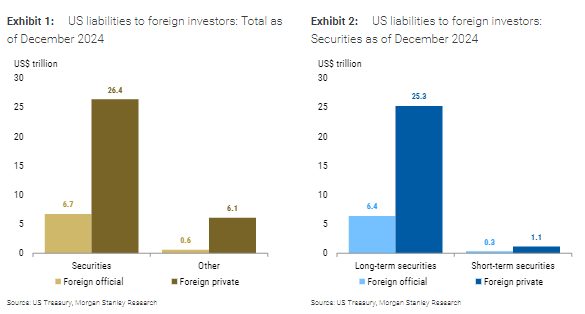
Core Viewpoint - The introduction of Section 899 of the "Big Beautiful Act" poses a significant threat to Wall Street, potentially leading to the largest capital tax impact in history, particularly affecting foreign investors in the U.S. market [1][2]. Tax Implications - Section 899 introduces a "progressive penalty tax" for investors from countries deemed to have "discriminatory" tax policies, starting with a 5% increase in tax rates, escalating by 5% annually, with a maximum additional burden of 20% [2]. - The scope of this tax is extensive, potentially impacting passive income, real estate investments, business profits, and even foreign central banks and sovereign wealth funds that previously enjoyed tax exemptions [2]. Market Impact - The ambiguity surrounding whether financial assets will be included in the tax scope raises concerns among experts, despite current indications suggesting fixed income assets may be excluded [3]. - As of December 2024, U.S. liabilities to foreign entities are projected to reach $39.8 trillion, accounting for 134% of nominal GDP, with securities holdings comprising 83% and long-term securities at 96% [3]. Foreign Investment Dynamics - Foreign official investors hold a significantly larger share of U.S. fixed income markets compared to equities, meaning any tax policy changes could directly affect U.S. Treasury yield curves [6]. - The report indicates that foreign private investors tend to hold longer-term Treasuries, while official investors prefer shorter maturities, suggesting that rising tax costs could lead to greater selling pressure on long-term bonds [8]. Regional Effects - Europe is likely to be the biggest "victim" of these tax changes, with $3.5 trillion of the $5.39 trillion in foreign direct investment in the U.S. coming from Europe, making Eurozone countries the largest holders of U.S. fixed income and equity securities [11]. Currency and Credit Market Effects - The tax implications signal a negative outlook for the U.S. dollar, as the 4% current account deficit heavily relies on foreign capital inflows, and the new tax could deter foreign investment, leading to a weaker dollar against G10 currencies [14]. - In the corporate bond market, liquidity pressures and credit spreads may widen, with foreign investors holding about 25% of U.S. corporate debt, which could face volatility if additional tax burdens are imposed [14]. Securitized Products and Real Estate - Foreign investors show a stronger demand for agency bonds compared to securitized credit; unfavorable tax policies on non-government-backed assets could benefit GNMA mortgage-backed securities (MBS) [15]. - In commercial real estate (CRE), where foreign buyers account for 5-10% of transactions, tax changes could have a more pronounced impact on valuations compared to residential real estate [15]. Hedge Fund Risks - The definition of "applicable persons" in the tax clause could significantly affect hedge funds, as a 20% tax rate increase could eliminate arbitrage opportunities, fundamentally disrupting the business models of quantitative hedge funds reliant on U.S. markets [17]. Legislative Outlook - The likelihood of the worst-case scenario materializing from Section 899 remains uncertain, with the primary aim of the clause being to provide leverage in tax and trade negotiations [18][21]. - The Senate is seen as a potential "lifeline" to clarify the applicability of Section 899, with expectations that it may review the details, including income scope and applicable entities [22].
道指三连阳!美股6月开门红,黄金夺回3400美元
Di Yi Cai Jing Zi Xun· 2025-06-02 23:28
Market Overview - The three major U.S. stock indices rose, with the Nasdaq gaining nearly 0.7% [1] - The benchmark 10-year U.S. Treasury yield increased to 4.61% [1] - The ISM reported that the U.S. manufacturing index fell to 48.5 in May, indicating a contraction for the third consecutive month [3] - Uncertainty remains high in the manufacturing sector due to tariff pressures affecting delivery times [3] Company Performance - Major technology stocks showed mixed results, with Meta Platforms up 3.6%, Nvidia up 1.6%, and Amazon up 0.8%, while Google fell 1.5% [1] - Automotive stocks declined, with General Motors and Ford both down 3.9%, Stellantis down 3.6%, and Tesla down 1.1% following Trump's comments on production requirements [4] - Steel stocks surged, with Steel Dynamics and Nucor rising by 10%, and Cleveland-Cliffs soaring by 23% due to tariff news [4] Commodity Market - International oil prices rebounded significantly, with light crude oil futures rising by $1.73 to $62.52 per barrel, a 2.85% increase [5] - Gold prices reached a three-week high, driven by a weaker dollar and increased demand for safe-haven assets, with COMEX gold futures up 2.7% to $3404.70 per ounce [5]
金十数据全球财经早餐 | 2025年6月3日
Jin Shi Shu Ju· 2025-06-02 23:00
今日优选 外媒:寻求加快谈判,特朗普要求各国周三前提出 "最佳报价" 地缘政治风险加剧,原油大反弹,美国WTI原油盘中涨超5%,最终收涨3.45%,报62.89美元/桶;布伦特原油收涨3.47%,报64.91美元/桶。 美国5月制造业活动连续第四个月萎缩 美媒:美方态度大反转将允许伊朗进行低水平铀浓缩 俄乌第二轮谈判在伊斯坦布尔结束,双方同意交换部分战俘但未达成停火 GDPNow模型预计美国Q2 GDP增速为4.6% 鲍威尔:政府必须理解美元潜在的剧烈波动的影响 市场盘点 周一(6月2日)特朗普政府的"钢铁关税"又使全球贸易紧张局势升级,上周末俄乌冲突加剧也令地缘风险急速上升。欧美股市盘中下跌,黄金和原油大幅反 弹。不过后来,俄乌直接谈判结束、主要大国元首可能直接磋商的消息传出,令情绪有所逆转。 美元指数收跌0.76%,报98.69,美国制造业数据不佳,美元指数承压创近六周新低。美债收益率先跌后涨,基准的10年期美债收益率收报4.445%,2年期美 债收益率收报3.947%。 美元走软加之贸易战风险和地缘政治风险增加,现货黄金大幅收涨2.8%,最高突破3382美元/盎司,最终收报3381.56美元/盎司,创逾 ...

欧美谈判前欧盟警告美国:要谈不拢,反制措施最迟7月14日就生效
Hua Er Jie Jian Wen· 2025-06-02 18:57
Core Viewpoint - The EU is preparing to implement countermeasures against the US steel and aluminum tariffs, with potential impacts exceeding $100 billion on US imports if negotiations fail by mid-July [1][2]. Group 1: EU's Response to US Tariffs - The EU has expressed strong regret over the US decision to raise tariffs on steel and aluminum from 25% to 50%, citing increased uncertainty for the global economy and higher costs for consumers and businesses on both sides of the Atlantic [2][4]. - The EU's countermeasures are structured in two tiers: the first round targets $24 billion worth of US goods, including politically sensitive products like soybeans and motorcycles, while the second round aims at an additional $95 billion, focusing on Boeing aircraft, US-made cars, and bourbon whiskey [4][5]. Group 2: Negotiation Strategies - The EU is prioritizing negotiations to resolve the trade dispute, focusing on key sectors such as semiconductors and pharmaceuticals, which have been affected by US tariffs [5][6]. - The EU has proposed deepening cooperation in these sectors and simplifying regulatory rules to address trade barriers, while also emphasizing the desire to lower tariffs rather than increase them [6].
总统地位不保?特朗普突然被投诉了,微妙时刻,火速喊话要来中国
Sou Hu Cai Jing· 2025-06-02 13:29
Core Viewpoint - California's Governor Newsom has filed a lawsuit against the Trump administration over tariff policies, claiming they are illegal and have severely disrupted the U.S. economy [1][3]. Group 1: Economic Impact on California - California, as the largest importing state and manufacturing hub in the U.S., plays a crucial role in international trade, with a total import and export volume of $675 billion in 2024, and 45% of exports going to Mexico, Canada, and China [3]. - Trump's aggressive tariff policies have significantly impacted California's economy, causing supply chain disruptions, a 12%-15% increase in raw material costs, and hindering 60,000 small businesses from exporting [3]. - The lawsuit against the Trump administration is a direct response to the economic damage caused, including severe losses for farmers and technology companies [3]. Group 2: Financial Sector Reactions - Federal Reserve Chairman Powell has warned that Trump's tariff policies are likely to push inflation up, creating a dilemma for the Fed between controlling inflation and supporting economic growth [5]. - Economic experts and financial institutions are pessimistic about the outlook, with Goldman Sachs predicting a 45% chance of recession if Trump continues trade wars, while JPMorgan estimates the likelihood at 60% [5]. - Standard & Poor's has also warned that the U.S. sovereign credit rating could be downgraded from its current AA+ level due to deteriorating fiscal conditions linked to tariff policies [5]. Group 3: Bond Market and Public Sentiment - The trade war initiated by Trump has caused significant turmoil in the bond market, leading to a record increase in U.S. Treasury yields, with the ten-year yield reaching 4.5% [6]. - The rising yields on U.S. debt, which has reached $36 trillion, could increase annual interest payments by nearly $100 billion, further straining the U.S. fiscal situation [6]. - Public sentiment is largely against Trump's tariff policies, with 72% of respondents in a Quinnipiac University poll believing that tariffs will harm the economy in the short term, and 53% believing the same for the long term [8].
美国法庭立大功,关税政策遭制止,不用中方出手,特朗普被催离职
Sou Hu Cai Jing· 2025-06-02 10:44
Core Viewpoint - A U.S. court has ruled that Trump's tariff policy is invalid, raising questions about presidential authority in trade matters and causing significant market reactions [3][9][10]. Group 1: Background and Context - The tariff policy was announced by Trump on April 2, aimed at addressing perceived unfairness in the global trade system and reducing the trade deficit [5][6]. - The policy imposed varying tariffs on multiple countries, intending to pressure them into renegotiating trade agreements [6][8]. Group 2: Economic Impact - The tariffs have negatively affected global economic stability, leading to rising costs for U.S. companies, particularly those reliant on exports, and increasing consumer prices [6][8]. - Economists and industry associations have warned that high tariffs could disrupt global supply chains and weaken U.S. competitiveness in international markets [8]. Group 3: Legal and Political Reactions - The court's ruling was based on the U.S. Constitution, which assigns tariff authority to Congress, not the president, and deemed Trump's claims of a national emergency unfounded [9][10]. - Despite the ruling, Trump plans to appeal, indicating a potential prolonged legal battle over the tariff policy [10][12]. Group 4: Market Reactions - Following the court's decision, global markets reacted strongly, with U.S. stock futures showing significant gains, reflecting investor optimism about the potential repeal of the tariffs [11][13]. - A successful repeal could restore confidence in global markets, encouraging multinational companies to increase foreign investments and enhancing capital flow [13].
50%关税威胁下,债市暗流涌动!——打开新浪财经APP,全球债市波动一触即知
新浪财经· 2025-06-02 00:56
Core Viewpoint - The article discusses the impact of Trump's threat to impose a 50% tariff on the EU, which has led to significant movements in the global bond market and a surge in safe-haven assets like gold, indicating a reshaping of financial market dynamics [1][4]. Group 1: Bond Market Reactions - Following Trump's tariff threat on May 23, the German bond market reacted sharply, with short-term rates rising due to inflation concerns while long-term rates fell, signaling increased recession risks [4][5]. - The yield curve exhibited a "bear flattening" pattern, with the two-year German bond yield rising by 1.8 basis points to 1.782%, while the 30-year yield dropped by 2.3 basis points to 3.065% [4][3]. Group 2: Safe-Haven Assets - Gold prices surged by 2.1% to $3362.70 per ounce, reaching a six-week high, while the US dollar index fell by 0.83%, reflecting a loss of confidence in US policies [6][7]. - The movements in the bond market and precious metals serve as indicators of capital flows amid trade conflicts [7]. Group 3: EU Countermeasures - The EU's countermeasures include a targeted list of $21 billion in tariffs, focusing on agricultural products that impact key Republican states, while avoiding escalation by removing whiskey tariffs [9]. - Potential retaliatory measures from the EU could disrupt corporate bond issuance and increase credit spread volatility [11]. Group 4: Investment Insights - The article highlights that if the tariff conflict persists until 2028, Germany could face cumulative losses of €250 billion, with the bond market already pricing in these risks [18]. - The risk premium on German bonds has increased by 3-5 basis points, and if negotiations break down before July 9, this premium could potentially double [18].