
供需宽松

Search documents
能源日报-20251021
Guo Tou Qi Huo· 2025-10-21 12:18
Report Industry Investment Ratings - Crude oil: ★☆☆ [1] - Fuel oil: ★☆☆ [1] - Low-sulfur fuel oil: ★☆☆ [1] - Asphalt: ☆☆☆ [1] - Liquefied petroleum gas: ☆☆☆ [1] Core Viewpoints - For crude oil, since September, the global oil inventory accumulation has accelerated, with a 1.5% increase in the fourth quarter (3.3% for crude oil and -1.3% for refined oil). OPEC+ production increase and demand decline after the peak season, along with geopolitical factors, put pressure on the market. But with oil prices near the April low and net long positions at a low level, the downward momentum may slow this week [1]. - For fuel oil and low-sulfur fuel oil, the absolute price of fuel oil is still weakly oscillating. High-sulfur fuel oil has a "strong reality, weak expectation" pattern, and its supply - demand will turn loose. Low-sulfur fuel oil supply remains loose [2]. - For asphalt, the contract prices rose slightly today. The weekly construction rate decreased, demand was affected by weather, and the market is in a tight - balance with price support at the bottom [3]. - For liquefied petroleum gas, the main contract oscillated narrowly, supply increased slightly, chemical demand grew while combustion demand was weak, and the basis changed to a slight premium [3]. Summary by Related Catalogs Crude Oil - Since September, the global oil inventory accumulation has accelerated, especially for in - transit crude oil. In the fourth quarter, global oil inventory increased by 1.5% (3.3% for crude oil and -1.3% for refined oil) [1]. - OPEC+ production increase and post - peak - season demand decline, along with geopolitical factors, brought supply - demand pressure. But the downward momentum may slow this week as oil prices are near the April low and net long positions are low [1]. Fuel Oil & Low - Sulfur Fuel Oil - The absolute price of fuel oil follows the cost end with a weakly oscillating trend. High - sulfur fuel oil has a "strong reality, weak expectation" pattern, and its supply - demand will turn loose due to geopolitical easing and other factors [2]. - Low - sulfur fuel oil supply remains loose, with high arbitrage cargo volume from the West to Singapore and the effect of refinery operation recovery still to be observed [2]. Asphalt - Today, asphalt contracts rose slightly, with near - month contracts relatively stronger. The weekly construction rate decreased, and demand was affected by cold in the north and rain in the south [3]. - The 10 - month demand is expected to be weaker than expected, and the commercial inventory decreased slightly. The market is in a tight - balance with price support at the bottom [3]. Liquefied Petroleum Gas - The main LPG contract oscillated narrowly, with far - month contracts under pressure. Supply increased slightly this week [3]. - Chemical demand grew while combustion demand was weak, and the basis changed from flat to a slight premium [3].
国投期货能源日报-20251021
Guo Tou Qi Huo· 2025-10-21 11:14
Report Industry Investment Ratings - Crude Oil: ★☆☆, indicating a bullish bias but limited operability on the market [1] - Fuel Oil: ★☆☆, suggesting a bullish bias but limited operability on the market [1] - Low-Sulfur Fuel Oil: ★☆☆, showing a bullish bias but limited operability on the market [1] - Asphalt: ☆☆☆, meaning the short-term long/short trend is in a relatively balanced state with poor market operability, and it's advisable to wait and see [1] - Liquefied Petroleum Gas: ☆☆☆, indicating the short-term long/short trend is in a relatively balanced state with poor market operability, and it's advisable to wait and see [1] Core Viewpoints - For crude oil, the global oil inventory accumulation has accelerated since September, with OPEC+ production increase and post-peak demand decline causing supply-demand pressure. However, considering the low oil price and net long positions, the downward momentum may slow this week [1]. - For fuel oil and low-sulfur fuel oil, the absolute price of fuel oil follows the cost side with a weakening trend. High-sulfur fuel oil has a "strong current, weak expectation" pattern, and its supply-demand will turn loose. Low-sulfur fuel oil supply remains loose [2]. - For asphalt, the contract prices rose slightly today, with开工率 decreasing, demand weaker than expected, and the market in a tight balance with price support at the bottom [3]. - For liquefied petroleum gas, the main contract oscillates narrowly, supply increases slightly, chemical demand grows while combustion demand is flat, and inventories decline [3]. Summary by Related Catalogs Crude Oil - Since September, the global oil inventory accumulation has accelerated, especially the in-transit crude oil inventory. In the fourth quarter, global oil inventory increased by 1.5% (crude oil inventory by 3.3% and refined oil inventory decreased by 1.3%) [1]. - OPEC+'s continuous production increase and post-peak demand decline bring supply-demand pressure, and geopolitical factors also weigh on the market [1]. - Considering the low oil price and net long positions, the downward momentum of oil prices may slow this week, and attention should be paid to the China-US and Russia-US talks [1]. Fuel Oil & Low-Sulfur Fuel Oil - The absolute price of fuel oil follows the cost side with a weakening trend [2]. - High-sulfur fuel oil has a "strong current, weak expectation" pattern, and its supply-demand will turn loose as geopolitical tensions ease and other factors change [2]. - Low-sulfur fuel oil supply remains loose, and the impact of the restart of the RFCG device at Dangote Refinery needs further observation [2]. Asphalt - Today, asphalt contracts rose slightly, with near-month contracts relatively stronger [3]. - The weekly national asphalt production rate decreased, demand in October is weaker than expected, and the cumulative shipment volume in mid-October increased 1 percentage point less year-on-year compared to the end of September [3]. - Social inventory is steadily decreasing, factory inventory is decreasing weakly, and the overall commercial inventory decreased slightly. The market remains in a tight balance with price support at the bottom [3]. Liquefied Petroleum Gas - The main LPG contract oscillates narrowly, with far-month contracts under pressure [3]. - This week, supply increased slightly, chemical demand grew while combustion demand was flat, and both refinery and port inventories decreased [3]. - Today, the spot price in Shandong rose while the futures price oscillated, and the basis changed from flat to a slight premium [3].
苯乙烯期价创5年来新低!持续下跌的原因是?
Qi Huo Ri Bao· 2025-10-16 23:38
Core Viewpoint - The significant decline in styrene futures prices since late September is attributed to multiple factors, including a sharp drop in oil prices and weak fundamentals in the styrene market [1][2]. Group 1: Price Decline Factors - Styrene futures prices began to decline from a high of 7831 yuan/ton in late June 2025, reaching a low of 6437 yuan/ton by October 16 [1]. - The drop in oil prices is a major factor affecting styrene prices, driven by geopolitical risks, trade tensions, and an oversupply situation as the demand season ends [1][2]. - The overall chemical product prices have also fallen due to macroeconomic disturbances and OPEC+ production increases, impacting styrene prices [1]. Group 2: Supply and Inventory Dynamics - Styrene's weak fundamentals are reflected in rising port inventories and a marginal weakening in the upstream pure benzene supply-demand balance [2]. - As of mid-October, styrene inventories at East China ports were around 200,000 tons, significantly higher than the approximately 40,000 tons from the same period last year, marking a five-year high [2]. - Despite maintenance activities reducing production slightly, the overall supply remains high, and demand has also decreased, leading to a continued oversupply situation [2][3]. Group 3: Industry Chain Analysis - The basic fundamentals of pure benzene, the direct raw material for styrene, are also weak, with expectations of declining demand due to losses in downstream products [3]. - High hidden inventories of pure benzene, concentrated in styrene plants, are expected to keep production rates high, as plants are unlikely to significantly reduce output to maintain market share [3]. - The entire industry chain, including pure benzene, styrene, and downstream synthetic materials, is experiencing historically high inventory levels, which will take time to alleviate [3]. Group 4: Market Outlook - Short-term reversal of styrene prices is considered difficult, with potential for a temporary rebound due to supply constraints from geopolitical factors [4]. - For a price reversal to occur, improvements in oil prices, upstream pure benzene fundamentals, and downstream orders are necessary [5]. - The likelihood of a decrease in styrene inventory and low valuation suggests that overly bearish views may not be warranted, although new production capacity and oil price declines pose challenges [5].


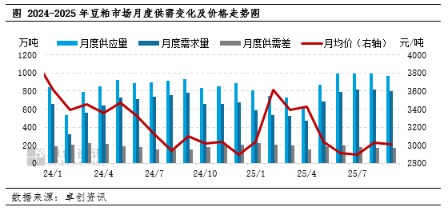
供需宽松局面施压 预计10月豆粕价格或以低位震荡为主
Xin Hua Cai Jing· 2025-10-10 06:45
Core Viewpoint - The removal of soybean export tariffs in Argentina has led to a significant increase in soybean imports by China, alleviating concerns about supply shortages in the fourth quarter, which in turn has caused a decline in domestic soybean meal prices in September [1][3]. Group 1: Market Trends - In September, the average price of 43% protein soybean meal was 3008 yuan/ton, a decrease of 20 yuan/ton (0.67%) from August, and down 88 yuan/ton (2.84%) year-on-year [1]. - Domestic soybean and soybean meal inventories remained high, prompting a focus on inventory clearance, while downstream purchasing sentiment was cautious due to lower import costs from Argentina [1][3]. - The total soybean crushing volume in September was 9.6291 million tons, a decrease of 210,300 tons from August [1]. Group 2: Supply and Demand Factors - For October, soybean arrivals are projected to be 9.23 million tons, 9 million tons, and 8.5 million tons for the months of October to December, indicating a tightening supply outlook, although factory inventory levels remain high [3]. - The international market is influenced by ongoing trade discussions between China and the U.S., with China significantly reducing imports of U.S. soybeans [3]. - The price of Brazilian soybeans remains stable, while Argentine soybean import costs have decreased, although the limited share of imports from Argentina means its impact on domestic soybean meal prices is relatively weak [3]. Group 3: Price Outlook - The overall demand for soybean meal is expected to be negatively impacted by declining prices of downstream livestock products and worsening losses in the livestock sector [4]. - The supply side remains elevated, contributing to a loose supply-demand situation that is likely to exert downward pressure on spot prices [4].
冠通研究:暂无明显驱动
Guan Tong Qi Huo· 2025-09-23 10:00
Report Industry Investment Rating - Not provided in the given content Core Viewpoint of the Report - The supply-demand loosening logic continues. Although the futures price has support, there is no obvious upward driving force in the market. Attention should be paid to the progress and concentration of pre-holiday stocking [1] Summary According to Relevant Catalogs Strategy Analysis - The futures market opened lower and moved higher, closing flat within the day. The spot market remains weak, with limited improvement in trading after low-price order absorption, and there is still pressure to lower prices to attract orders. The daily urea production has risen to over 190,000 tons, and the high production is suppressing the urea price. The downstream is stocking up before the double festivals, mainly buying at low prices. The operating rate of compound fertilizer factories has increased, but the growth rate has slowed down. The terminal demand is weak, and the inventory of finished products in factories is high. The inventory in urea factories is increasing and is significantly higher than the same period in previous years [1] Futures and Spot Market Conditions - Futures: The urea main contract 2601 opened at 1,655 yuan/ton, opened lower and moved higher, closing flat within the day, and finally closed at 1,658 yuan/ton, up 0.00%. The trading volume was 304,900 lots, a decrease of 2,508 lots. Among the top 20 main positions, the long positions decreased by 3,030 lots, and the short positions decreased by 1,876 lots. Some futures companies had net long or net short positions changes [2] - Spot: The spot market remains weak. The ex-factory transaction price range of small-grain urea in Shandong, Henan, and Hebei is mostly between 1,560 and 1,600 yuan/ton. Some factories in Hebei have higher quotes and are mainly fulfilling export orders [1][5] Fundamental Tracking - Basis: The mainstream spot market quotation declined, and the futures closing price decreased. Based on the Henan region, the basis strengthened compared to the previous trading day, with the basis of the January contract at -38 yuan/ton, a decrease of 2 yuan/ton [9] - Supply Data: On September 23, 2025, the national daily urea production was 201,000 tons, an increase of 100 tons compared to the previous day, and the operating rate was 84.93% [11] Warehouse Receipt Data - On September 23, 2025, the number of urea warehouse receipts was 7,535, remaining unchanged compared to the previous trading day [3]
国投期货能源日报-20250805
Guo Tou Qi Huo· 2025-08-05 11:29
Report Industry Investment Ratings - Crude oil: Not explicitly stated, but the symbol implies a neutral state [1] - Fuel oil: ☆☆☆, representing a more distinct bearish trend with a current appropriate investment opportunity [1] - Low - sulfur fuel oil: ☆☆, indicating a bearish view with a relatively clear downward trend and the market is being affected [1] - Asphalt: ☆☆☆, suggesting a more distinct bearish trend and a current appropriate investment opportunity [1] - Liquefied petroleum gas: ☆☆☆, meaning a more distinct bearish trend and a current appropriate investment opportunity [1] Core Views - The international oil price dropped overnight, and the SC09 contract declined by 1.07% during the day. OPEC+ plans to increase production by 547,000 barrels per day in September, pressuring the oil market in the fourth quarter. However, sanctions risks and peak - season demand support the market. There is an upside risk due to secondary sanctions on Russian oil after the price correction this week [2] - Crude oil led the decline in oil - related futures, but the decline of fuel - related futures was limited. The fundamentals of high - and low - sulfur fuel oil markets are weak, and with the recent cost decline, FU and LU are under pressure. The short - term cracking spreads of FU and LU are expected to remain weak [2] - In July, the inflow of Venezuelan crude oil into China increased by 3.8% month - on - month. The August production plan decreased compared to July, but some refineries' actual production exceeded the plan. The overall commercial inventory increased slightly but remained at a relatively low level in recent years. The supply - side growth space of asphalt is considered neutral, and the BU trend mainly follows the crude oil direction with limited volatility [3] - The Middle East CP has been significantly reduced, but the spot discount has shrunk. The domestic demand for LPG has bottom - level support as the PDH operating rate continues to rise. The supply is relatively loose in July, and the refinery gas may continue to follow the decline in import costs. The LPG futures price maintains a low ratio to oil, and the current basis has risen to a relatively high level, remaining in a weak oscillation [4] Summaries by Related Catalogs Crude Oil - The overnight international oil price fell, with the SC09 contract down 1.07% during the day. OPEC+ plans to increase production in September, increasing the supply - demand pressure in the fourth quarter. However, sanctions risks and peak - season demand support the market. There is an upside risk due to secondary sanctions on Russian oil after the price correction this week. Also, attention should be paid to the extension of Sino - US reciprocal tariffs [2] Fuel Oil & Low - Sulfur Fuel Oil - Crude oil led the decline in oil - related futures, but the decline of fuel - related futures was limited, especially the low - sulfur fuel oil with a decline of less than 1%. The fundamentals of high - and low - sulfur fuel oil markets are weak, and with the recent cost decline, FU and LU are under pressure. The short - term cracking spreads of FU and LU are expected to remain weak [2] Asphalt - In July, the inflow of Venezuelan crude oil into China increased by 3.8% month - on - month. The August production plan decreased compared to July, but some refineries' actual production exceeded the plan. The overall commercial inventory increased slightly but remained at a relatively low level in recent years. The supply - side growth space of asphalt is considered neutral, and the BU trend mainly follows the crude oil direction with limited volatility [3] Liquefied Petroleum Gas (LPG) - The Middle East CP has been significantly reduced, but the spot discount has shrunk. The domestic demand for LPG has bottom - level support as the PDH operating rate continues to rise. The supply is relatively loose in July, and the refinery gas may continue to follow the decline in import costs. The LPG futures price maintains a low ratio to oil, and the current basis has risen to a relatively high level, remaining in a weak oscillation [4]
6.16纯碱日评:供需宽松 纯碱延续弱势
Sou Hu Cai Jing· 2025-06-17 02:28
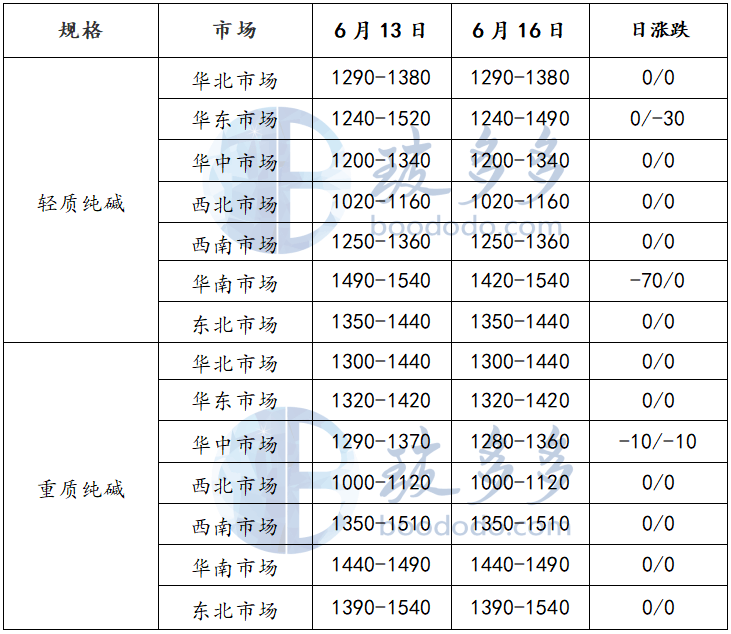
Core Viewpoint - The domestic soda ash market continues to operate under weak conditions, with prices remaining stable or declining slightly across various regions, reflecting a lack of demand and cautious purchasing behavior from downstream buyers [2][3]. Price Analysis - As of June 16, 2023, the price range for light soda ash in North China is 1290-1380 CNY/ton, while heavy soda ash is priced at 1300-1440 CNY/ton. In East China, light soda ash is priced at 1240-1490 CNY/ton, and heavy soda ash at 1320-1420 CNY/ton [2]. - The light soda ash price index on June 16 is 1252.86, down by 10 points or -0.79% from the previous working day. The heavy soda ash price index is 1297.14, down by 1.43 points or -0.11% [3]. Market Dynamics - The overall supply in the industry remains high, with companies like Huachang Chemical returning to normal operations. However, the demand side is weak, with downstream buyers adopting a cautious purchasing strategy, preferring lower-priced sources [2]. - The main futures contract for soda ash (SA2509) opened at 1152 CNY/ton and closed at 1174 CNY/ton on June 16, showing an intraday increase of 0.86%. The total open interest decreased by 59,463 contracts [5]. Future Outlook - The soda ash industry is experiencing a gradual increase in operating rates, leading to further supply expansion. However, persistent weak demand from downstream sectors is causing inventory levels to rise [6]. - In the context of a continuously loose supply-demand balance, soda ash prices are expected to maintain a low and fluctuating trend, with potential for slight declines in certain regions [6].
日度策略参考-20250609
Guo Mao Qi Huo· 2025-06-09 06:36
Group 1: Report Industry Investment Ratings - Bullish: Gold, Silver, Crude Oil, Fuel Oil, Ethanol [1] - Bearish: Polycrystalline Silicon, Lithium Carbonate, Coking Coal, Coke, Logs, PTA, Short - Fiber, PVC [1] - Neutral (Oscillating): Stock Index, Treasury Bonds, Copper, Aluminum, Alumina, Nickel, Stainless Steel, Tin, Industrial Silicon, Rebar, Hot - Rolled Coil, Iron Ore, Manganese Silicon, Silicon Ferrosilicon, Glass, Soda Ash, Palm Oil, Soybean Oil, Rapeseed Oil, Cotton, Sugar, Corn, Soybeans, Pulp, Live Pigs, Asphalt, Natural Rubber, BR Rubber, Ethylene Glycol, Styrene, Urea, Methanol, Seasonal Products, PVC, Caustic Soda, LPG, Container Shipping on European Routes [1] Group 2: Report's Core View - The short - term fluctuations of stock indices are dominated by overseas variables, and they are expected to oscillate strongly in the short term, but be cautious about the repeated signals of Sino - US tariffs [1]. - Asset scarcity and a weak economy are beneficial to bond futures, but the central bank's short - term interest - rate risk warning restricts the upward space [1]. - The prices of various commodities are affected by factors such as supply and demand, policies, and international relations. For example, the price of copper is affected by supply and Sino - US relations; the price of aluminum is affected by inventory and downstream demand [1]. Group 3: Summary by Industry Macro - Finance - Stock Index: Overseas variables dominate short - term fluctuations, expected to oscillate strongly with caution about tariff signal repetitions [1]. - Treasury Bonds: Asset scarcity and weak economy are favorable, but central - bank interest - rate risk warning restricts upward space [1]. Non - Ferrous Metals - Gold: Expected to run strongly in the short term with a solid long - term upward logic [1]. - Silver: Technically broken through, expected to run strongly but beware of a pull - back [1]. - Copper: The Sino - US leaders' call boosts the price, but sufficient supply restricts the upward space [1]. - Aluminum: Low inventory supports the price, but weakening downstream demand may lead to a weakening oscillation [1]. - Alumina: Spot price rising, futures price falling due to increased production [1]. - Nickel: Expected to oscillate in the short term, with long - term surplus pressure [1]. - Stainless Steel: Follows macro - oscillations in the short term, with long - term supply pressure [1]. - Tin: Supply contradiction intensifies in the short term, expected to oscillate at a high level [1]. - Industrial Silicon: High supply in the northwest, resuming production in the southwest, low demand, and high inventory pressure [1]. Ferrous Metals - Rebar and Hot - Rolled Coil: In the window period of peak - to - off - peak season, with loose cost and supply - demand patterns and no upward driving force [1]. - Iron Ore: Expecting the peak of molten iron, with supply increase in June [1]. - Manganese Silicon: Short - term supply - demand balance, with high warehouse - receipt pressure [1]. - Silicon Ferrosilicon: Cost is affected by coal, but production reduction makes supply - demand tight [1]. - Glass: Weak supply and demand, with prices continuing to weaken [1]. - Soda Ash: Direct demand is okay, but terminal demand is weak, with medium - term over - supply and price pressure [1]. - Coking Coal and Coke: Spot prices continue to weaken, and the futures can be shorted [1]. Agricultural Products - Sugar: Brazilian sugar production is expected to hit a record high, but oil prices may affect production [1]. - Corn: Supply - demand tightening supports a strong oscillation, but the increase is limited by substitute grains [1]. - Soybeans: Expected to oscillate due to the lack of strong upward driving force [1]. - Pulp: Demand is weak, but the downward space is limited [1]. - Logs: Supply is loose, demand is weak, and short - selling is recommended [1]. - Live Pigs: Inventory is sufficient, and futures are stable [1]. Energy and Chemicals - Crude Oil and Fuel Oil: Sino - US calls, geopolitical situations, and the summer peak season support the prices [1]. - Asphalt: Affected by cost, inventory, and demand [1]. - Natural Rubber: Futures - spot price difference returns, cost support weakens, and inventory decreases [1]. - BR Rubber: Fundamentals are loose in the short term, and long - term factors need attention [1]. - PTA: Actual production hits a new high, and sales are difficult [1]. - Ethylene Glycol: Coal - to - ethylene glycol profit expands, and inventory is decreasing [1]. - Styrene: Speculative demand weakens, inventory rises, and the basis weakens [1]. - Urea: Expected to rebound due to export demand [1]. - Methanol: Entering the inventory - accumulation stage, with weak traditional demand [1]. - PVC: Supply pressure increases due to the end of maintenance and new device production [1]. - Caustic Soda: Spot is strong in the short term, but the price - reduction expectation is traded in advance [1]. - LPG: Prices are weak and oscillate in a narrow range [1]. Others - Container Shipping on European Routes: The contract in the peak season can be lightly tested for long positions, and attention should be paid to arbitrage opportunities [1].
木浆成本下行,供需宽松,双胶纸价格承压
Yin He Qi Huo· 2025-05-14 11:22
Report Industry Investment Rating No relevant information provided. Core View of the Report The cost of wood pulp is declining, the supply and demand are loose, and the price of offset paper is under pressure. The offset printing paper is expected to be weakly adjusted next week [1][7]. Summary by Related Catalogs Comprehensive Analysis and Trading Strategy - The 70g offset paper enterprise's tax - inclusive average price is 5,128.6 yuan/ton, with a month - on - month decline of 3.0%. The supply side is differentiated with some paper machines being converted and new installations not fully producing. The demand side is weak with limited release of publishing tender orders. The cost of coniferous pulp futures has stopped falling but the weekly average price is still down, and the price of broad - leaf pulp is under pressure [5]. - The offset printing paper is expected to be weakly adjusted next week [7]. Core Logic Analysis - For offset paper, the industry's profitability is still low, factories are converting production, so the supply is stabilizing. The release of autumn publishing orders is slow, social orders are weak, terminal consumption lags behind expectations, and downstream printing factories' operating levels are low. The domestic port inventory of wood pulp is high and the import pulp market has abundant supply, so the wood pulp price is generally weak [6]. Weekly Data Tracking Double - Offset Paper - Supply: The capacity utilization rate of double - offset paper this cycle is 56.3%, a month - on - month increase of 0.2 percentage points; the output is 201,000 tons, a month - on - month increase of 0.5%. The industry's output shows a small month - on - month increase. The raw material price of pulp has fallen from a high, and the paper price has also declined, with the gross profit margin weakening [13]. - Inventory: The inventory of double - offset paper production enterprises this cycle is 1.139 million tons, a month - on - month increase of 2.2%. The on - site inventory continues to increase slightly and is at a high level in recent years [16]. - Price: The domestic double - offset paper market is weakly sorted this cycle, and the transaction has not improved significantly. The 70g double - offset paper enterprise's tax - inclusive average price is 5,128.6 yuan/ton, with a month - on - month decline of 3.0% [31]. Copperplate Paper - Supply: The capacity utilization rate of copperplate paper this cycle is 54.6%, a month - on - month decrease of 2.5 percentage points; the output is 74,000 tons, a month - on - month decrease of 3.9%. The industry's output has decreased slightly this week. The pulp price has fallen from a high, and the copperplate paper's gross profit margin has increased [19]. - Inventory: The inventory of copperplate paper production enterprises this cycle is 332,000 tons, a month - on - month increase of 1.2%. The on - site inventory of copperplate paper continues to rebound [22]. - Price: The domestic copperplate paper market is weakly consolidated this cycle, and the transaction is scarce. The 157g copperplate paper enterprise's tax - inclusive average price is 5,875.0 yuan/ton, with the same price as last month [31]. Pulp Price - The spot tax - inclusive average price of coniferous pulp is 6,193 yuan/ton, a month - on - month decrease of 1.7%; the spot tax - inclusive average price of broad - leaf pulp is 4,129 yuan/ton, a month - on - month decrease of 3.3%; the spot tax - inclusive average price of natural pulp is 5,350 yuan/ton, a month - on - month decrease of 1.3%; the spot tax - inclusive average price of chemical mechanical pulp is 3,900 yuan/ton, the same as last month [36].