
市场需求

Search documents
OEXN:BTC稳势中的隐性疲态
Xin Lang Cai Jing· 2025-12-10 11:23
Core Viewpoint - The current market for BTC is characterized by a lack of strong buying pressure, with prices stabilizing around $92,000 due to reduced selling pressure, but overall demand remains insufficient for a sustained upward trend [1][4]. Market Conditions - BTC is currently trading at approximately $92,214, with a price recovery primarily supported by spot demand, indicating that selling pressure is gradually exhausting [7]. - ETH is trading around $3,296, showing a daily increase of 6%, driven by short covering and improved market sentiment [7]. - The overall market exhibits a "stable yet weak" characteristic, with short-term volatility suppressed but lacking trend momentum and deep structural support [3][7]. ETF and Capital Flows - After experiencing over $1.1 billion in redemptions in November, U.S. ETFs saw a net inflow of approximately $56.5 million on December 9, marking the first stabilization in weeks [2][6]. - Despite this improvement in capital flow, the recovery remains limited, with on-chain activity and derivatives market indicators showing low market participation and demand [2][6]. Technical Indicators - The 14-day RSI has returned to neutral territory, indicating that BTC has moved away from extreme selling conditions, but this only suggests price recovery rather than a trend reversal [2][6]. - Current market indicators, including negative CVD and declining open interest in futures, reflect a low level of market engagement and a lack of genuine demand [2][6]. Future Outlook - The market is likely to remain in a range-bound state unless there is a significant increase in long-term holders and institutional capital, as well as substantial improvements in on-chain activity [4][8]. - Any price recovery is viewed as a natural adjustment following the release of selling pressure rather than a new trend driven by buying activity [4][8].


10月份居民消费价格出现积极变化,A500ETF易方达(159361)等产品助力布局A股核心资产
Sou Hu Cai Jing· 2025-11-14 05:26
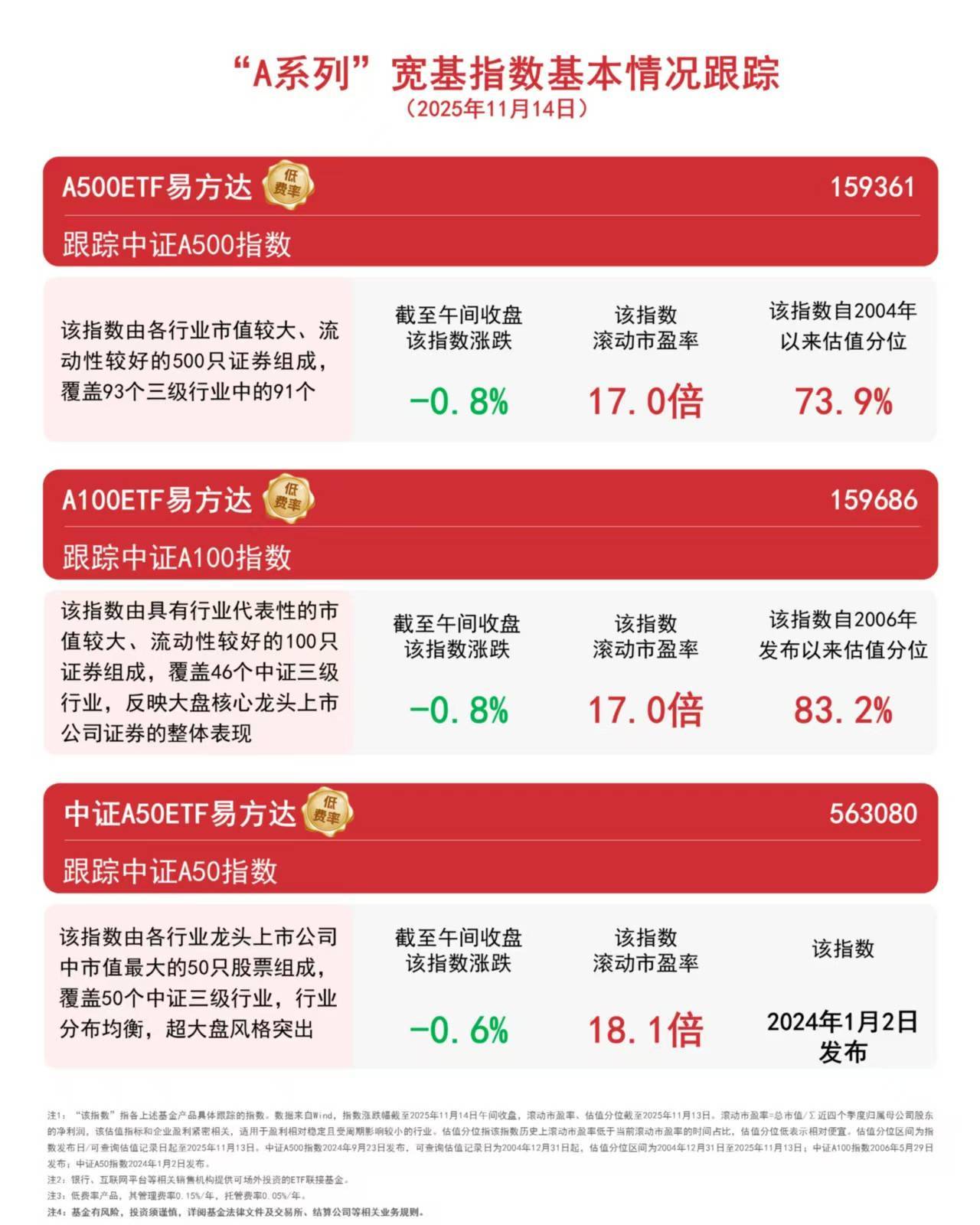
Group 1 - The core viewpoint indicates that the A-shares market is experiencing a decline, with the CSI A500 index and CSI A100 index both down by 0.8%, and the CSI A50 index down by 0.6% [1] - The National Bureau of Statistics reported positive changes in consumer prices for October due to measures promoting reasonable price recovery, although market demand remains insufficient [1] - The next steps include expanding domestic demand, advancing the construction of a unified national market, optimizing the market competition environment, addressing capacity governance in key industries, improving supply-demand relationships, and promoting reasonable price recovery [1]
国金证券:锂电产业链有望迎来价值重估
Di Yi Cai Jing· 2025-11-08 12:20
Core Insights - The lithium battery industry chain is experiencing unprecedented development opportunities driven by a confluence of technological revolution and market demand [1] Technological Developments - Significant breakthroughs in solid-state battery technology are reconstructing the industry's ceiling [1] - The next phase goal for solid-state battery technology is to address the high sensitivity of energy storage systems to cycle life and cost [1] Market Dynamics - The explosive growth of the global energy storage market is providing unexpected capacity space for the lithium battery industry [1] - The vast application scenarios and capital return from the energy storage market are accelerating the research and industrialization of cutting-edge technologies like solid-state batteries [1] Industry Outlook - The lithium battery industry chain is expected to undergo a value reassessment in this wave of technological and market changes [1]

德业股份(605117)2025年三季报点评:汇兑及延迟确收略有影响 工商储及电池包继续发力
Xin Lang Cai Jing· 2025-10-31 00:39
Core Insights - The company reported its Q3 2025 results, showing a revenue of 8.846 billion yuan, a year-on-year increase of 10.36%, and a net profit of 2.347 billion yuan, up 4.79% year-on-year. The gross margin was 38.55%, down 1.60 percentage points year-on-year [1] Group 1: Financial Performance - For Q3 2025, the company achieved a revenue of 3.311 billion yuan, a year-on-year increase of 1.32% and a quarter-on-quarter increase of 11.51%. The net profit for the same quarter was 825 million yuan, down 17.84% year-on-year but up 1.00% quarter-on-quarter. The gross margin was 40.33%, down 4.17 percentage points year-on-year but up 2.62 percentage points quarter-on-quarter [1][2] - The company’s operating cash flow for Q3 2025 was 1.146 billion yuan, a year-on-year decrease of 15.77% but a quarter-on-quarter increase of 10.27%. As of Q3 2025, inventory stood at 1.449 billion yuan, up 4.99% year-on-year, while contract liabilities were 325 million yuan, down 37.90% year-on-year [2] Group 2: Business Outlook - The company expects continued quarter-on-quarter growth in Q4 2025 for its inverter and battery pack businesses, driven by high demand in the Australian market [2] - The company’s inverter shipments in Q3 2025 saw a slight year-on-year decline but an increase quarter-on-quarter, while battery pack shipments experienced growth in both comparisons, particularly due to demand stimulated by Australian subsidy policies [2] Group 3: Profit Forecast and Investment Rating - The company has slightly lowered its profit forecasts for 2025-2027, now expecting net profits of 3.3 billion, 4.0 billion, and 4.8 billion yuan for those years, representing year-on-year growth of 12%, 21%, and 20%, respectively. The corresponding price-to-earnings ratios are projected to be 22, 18, and 15 times [3] - Given the company’s steady growth and the gradual ramp-up of industrial storage, a target price of 110 yuan is set for 2026, maintaining a "buy" rating [3]

Masco Misses Q3 Earnings & Sales Estimates, Slashes '25 EPS Outlook
ZACKS· 2025-10-29 18:06
Core Insights - Masco Corporation (MAS) reported disappointing third-quarter 2025 results, with adjusted earnings and net sales falling short of the Zacks Consensus Estimate and declining year over year [1][9] - The performance was primarily impacted by weak contributions from the Decorative Architectural Products segment, overshadowing the growth in the Plumbing Products segment [1][9] - Ongoing global economic uncertainties and tariff-related risks are limiting the company's near-term outlook [1] Financial Performance - Adjusted earnings per share (EPS) were reported at 97 cents, missing the consensus estimate of $1.02 by 4.9%, and down from $1.08 in the same quarter last year [3] - Net sales totaled $1.92 billion, falling short of the consensus mark of $1.94 billion by 1.1% and declining 3% year over year [3] - North American net sales decreased by 6% in local currency, while international sales remained flat year over year [4] Segment Analysis - **Plumbing Products**: Net sales increased by 2% year over year to $1.25 billion, with an adjusted operating margin contracting by 350 basis points to 16.4% [5] - **Decorative Architectural Products**: Sales were reported at $670 million, down 12% from the prior year, with an adjusted operating margin expanding by 100 basis points to 19.1% [6] Margin Performance - Adjusted gross margin contracted by 210 basis points to 34.6% [7] - Adjusted operating margin decreased by 190 basis points to 16.3% [8] Liquidity and Shareholder Returns - As of September 30, 2025, total liquidity was $1.56 billion, including cash and cash investments of $559 million [10] - The company repurchased 1.8 million shares for approximately $124 million and announced a quarterly dividend of $0.31 per share [11] 2025 Outlook - Masco expects net sales to decline in low single digits year over year, with an adjusted operating margin of approximately 16.5% [12] - Plumbing Products' net sales are anticipated to increase in low single digits, while Decorative Architectural Products' net sales are expected to decrease in low double digits [13] - Adjusted EPS is now projected to be between $3.90 and $3.95, down from the previous range of $3.90-$4.10 [14]


影响金价涨跌的十个因素
Sou Hu Cai Jing· 2025-10-20 11:52
Core Viewpoint - The recent surge in gold prices has caught many investors off guard, with significant gains for those who purchased gold at lower prices [1] Factors Influencing Gold Prices - **Dollar Strength**: The relationship between gold and the US dollar is inversely correlated; a weaker dollar typically leads to higher gold prices, while a stronger dollar results in lower prices [3] - **Federal Reserve's Interest Rate Policy**: Lower interest rates from the Federal Reserve make gold more attractive as a non-yielding asset, leading to price increases, whereas higher rates tend to decrease gold's appeal [4] - **Geopolitical Tensions**: Events such as wars or financial crises increase demand for gold as a safe-haven asset, driving prices up during times of uncertainty [5] - **Economic Conditions**: Economic downturns or uncertainty lead to increased gold purchases as a stable investment, while strong economic performance tends to decrease demand for gold [6] - **Inflation Expectations**: Rising expectations of inflation boost gold's appeal as a hedge, resulting in price increases, while declining inflation expectations can lead to price drops [7] - **Safe-Haven Demand**: Events like pandemics or disasters heighten risk aversion, increasing gold prices, while a return to normalcy can reduce demand [9] - **Global Monetary Policy**: Coordinated global monetary easing, such as interest rate cuts or quantitative easing, tends to increase gold prices, while tightening policies can lead to price declines [10] - **Financial Crises**: During financial crises, gold is viewed as a safe haven, with prices rising in response to increased demand; as crises abate, prices typically fall [11] - **Market Demand**: The overall demand for gold, including purchases by central banks and for jewelry, affects prices; higher demand with limited supply leads to price increases [12] - **US Economic Indicators**: Poor performance in key US economic indicators can drive investors towards gold, resulting in price increases, while strong indicators may lead to price declines [13]

能源化工周报:短期跟随成本运行-20251020
Hong Yuan Qi Huo· 2025-10-20 08:33
1. Report Industry Investment Rating No relevant content provided. 2. Core Viewpoints of the Report 2.1 Weekly Summary - PX prices declined during the week due to lack of cost support. International oil prices dropped continuously because of signs of easing geopolitical conflicts and Sino - US trade frictions. Domestic PX开工 was at a high level for the year, and although there was a fire at a South Korean refinery, the PX device was not affected. Downstream demand did not improve significantly, leading to a price decline under weak cost and fundamentals [9]. - PTA prices also fell during the week due to the lack of cost support and the expectation of new device commissioning. The weakness of crude oil and PX negatively affected the PTA market sentiment. The potential trial - run of 2.7 million tons of new PTA production capacity in East China would increase the supply pressure. Although downstream开工 increased driven by the demand for warm - keeping products, the subsequent upward space was limited, and the fundamental boost to PTA was weakening [9]. 2.2 Market Forecast - Crude oil prices will fluctuate within a narrow range, waiting for the follow - up development of Sino - US trade issues. - For PX, due to sanctions, trade wars and other factors, the short - term production of some factories may be affected, thus affecting PX supply, but the overall开工 will remain at a high level. - For PTA, PTA factories have not further reduced production even under low - efficiency conditions, and the expectation of new device commissioning in East China suppresses market sentiment. It is expected that the开工 will remain at a high level. - For polyester, the polyester开工 load will be generally stable, and there are no planned start - up or shutdowns of polyester devices. At the end of the traditional peak demand season, it is estimated that polyester factories will not actively reduce production to maintain market share. - For the weaving industry, foreign customers are conservative in placing orders due to uncertain factors, resulting in slow placement of recent export orders. Domestic demand has increased, but factories are not optimistic about the subsequent market. - Overall, PX will operate weakly in the range of 6,150 - 6,350 yuan/ton; PTA will also operate weakly in the range of 4,300 - 4,500 yuan/ton. The recommended strategy is to stay on the sidelines [10]. 3. Summary by Relevant Catalogs 3.1 Price Situation 3.1.1 PX - **Futures**: On October 17, the closing price of the PX main contract was 6,292 yuan/ton, down 212 yuan/ton from October 10, a change of - 3.26%. The settlement price on October 17 was 6,334 yuan/ton, down 198 yuan/ton from October 10, a change of - 3.03% [14]. - **Spot**: The market negotiation and trading atmosphere were acceptable, with a differentiated trend in the paper - spot market. From October 13 - 17, the average basis of the main contract was - 131 yuan/ton; the average domestic PX spot price was 6,250 yuan/ton, a decrease of 125.50 yuan/ton from the previous period, a change of - 1.97% [15][17]. 3.1.2 PTA - **Futures**: The price decline was dominated by cost. On October 17, the closing price of the PTA main contract was 4,402 yuan/ton, down 132 yuan/ton from October 10, a change of - 2.91%. The settlement price on October 17 was 4,424 yuan/ton, down 130 yuan/ton from October 10, a change of - 2.85% [19][21]. - **Spot**: The negotiation atmosphere was average, mainly among traders, with individual polyester factories making inquiries. There was concentrated trading on Friday, with an average daily trading volume of about 2 - 3 million tons. From October 13 - 17, the average basis of the main contract was - 70 yuan/ton. The weekly average CIF price of PTA in the Chinese market was 549.2 US dollars/ton, down 17.8 US dollars/ton from the previous period, a change of - 3.13%. The average spot price of PTA in the East China market was 4,371.6 yuan/ton, down 108.07 yuan/ton from the previous period, a change of - 2.41% [22][24]. 3.2 Device Operation Situation 3.2.1 PX Devices - There were changes in the operation of PX devices in different regions. For example, in East China, some enterprises such as Ningbo Daxie, Sheng Hong Refining and Chemical, and Zhejiang Petrochemical had different load - operation conditions. In North China, Urumqi Petrochemical stopped for maintenance on October 14, expected to last for 15 days. The overall domestic PX开工 rate remained at a high level, and the planned maintenance of domestic and foreign PX devices in the fourth quarter was limited [29][33]. 3.2.2 PTA Devices - Some large - scale PTA devices were under maintenance, such as those of Ningbo Taihua, Hainan Yisheng, and Yisheng Dahua. The weekly开工 rate decreased by 1.92% [36][37]. 3.3 Fundamental Analysis 3.3.1 Cost - **Crude Oil**: European and American crude oil futures fell for three consecutive weeks, with a cumulative decline of more than 12%. The WTI crude oil futures settlement price on October 17 was 57.15 US dollars/barrel, down 1.75 US dollars/barrel from October 10. The Brent crude oil futures settlement price on October 17 was 61.29 US dollars/barrel, down 1.44 US dollars/barrel from October 10. The market was concerned about the resolution of the Russia - Ukraine conflict, and the price was affected by factors such as trade relations, supply and demand expectations, and geopolitical situations [42][44]. - **Naphtha**: The price continued to decline this week, and the economy rebounded slightly. The weekly average CFR price of naphtha in Japan was 550.25 US dollars/ton, and the weekly average production profit was 60.72 US dollars/ton. The fundamental situation of naphtha did not change significantly, and the East - West arbitrage window remained open, with European naphtha flowing to Asia. The substitution effect of downstream LPG on naphtha affected some demand expectations, and the subsequent impact of sanctions and trade wars on naphtha remained to be evaluated [47][49]. 3.3.2 Supply - **PX Processing Margin**: The PXN margin rebounded slightly, and the short - process efficiency narrowed. The weekly average PXN was 236.92 US dollars/ton, a change of 7.36% from the previous period. The PX - MX margin remained at a high level, with a weekly average of 98.75 US dollars/ton. Due to the high domestic开工 rate and insufficient demand, the decline of PX was obvious, and the cash flow continued to narrow during the week, with short - process devices near the break - even point [50][52]. - **PTA Processing Fee**: The boost of device short - stops to the processing fee was limited. From October 13 - 17, the average spot processing fee of PTA was 169.05 yuan/ton, compared with 202.90 yuan/ton last week. Although the production reduction plan temporarily increased the processing fee, the demand did not improve significantly, and it was difficult to improve the processing fee under weak cost and demand [54][56]. - **Inventory**: As of October 16, the PTA social inventory was 4.126 million tons, a decrease of 72,000 tons from the previous week, a change of - 0.47% in the month - on - month growth rate. The decrease in inventory was due to device maintenance rather than demand improvement. The inventory days of PTA factories decreased by 0.14 days, while those of polyester factories increased by 1.15 days. As of October 16, the average inventory usage days of domestic PTA manufacturers were 4.08 days, and the raw material inventory days of polyester factories were 7.35 days. It was estimated that the upward space of the polyester开工 rate was limited in the later period, and the inventory - reduction rhythm would slow down [59][65]. 3.3.3 Demand - **Polyester**: The average weekly price of PTA declined, and the overall demand was weak, which was negative for the polyester market. The average market prices of semi - bright POY150D/48F, DTY150D/48F, and FDY150D/96F decreased by 1.47%, 0.82%, and 1.13% respectively from the previous period. The average price of polyester staple fiber in the East China market was 6,326 yuan/ton, a decrease of 93 yuan/ton from the previous period, a change of - 1.45%. The negotiation range of polyester bottle chips in the East China region was 5,600 - 5,730 yuan/ton, and the average weekly price was 5,710.00 yuan/ton, a decrease of 2.14% from the previous period. The average weekly polyester production and sales were estimated to be 70%. The average weekly load of polyester factories was 89.38%, and the average weekly load of Jiangsu and Zhejiang looms was 68.22% [67][75]. - **Weaving**: The new export orders were placed slowly, and the weaving market lacked confidence in the future market. With the significant drop in temperature in the north, the online sales of autumn and winter textile and clothing accelerated, driving the sales of thick fabrics such as autumn and winter velvet and woolen fabrics. The starting rate of warp - knitting enterprises increased steadily. However, there was a risk of escalation of Sino - US trade frictions after the festival, and some export enterprises were accelerating the production of existing orders to avoid potential impacts [81][83].
国泰君安期货·能源化工:石油沥青周度报告-20251019
Guo Tai Jun An Qi Huo· 2025-10-19 11:44
Report Overview - Report Title: Petroleum Asphalt Weekly Report - Report Date: October 19, 2025 - Author: Wang Hanxi from Guotai Junan Futures Research Institute [1] Investment Rating - No investment rating provided in the report Core Views - Asphalt follows the decline of crude oil. After the holiday, the shipment volume increased month - on - month. Attention should be paid to the inventory accumulation in South China [4]. - The supply of asphalt increased slightly, with the capacity utilization rate of 77 domestic heavy - traffic asphalt enterprises reaching 35.8% this week, a month - on - month increase of 1.3% [4]. - The demand showed a month - on - month increase. The sample shipment volume of 54 domestic asphalt enterprises was 39.3 tons, a month - on - month increase of 2.9% [4]. - The spot price of asphalt continued to decline under pressure. The weekly average price of domestic asphalt this period was 3,544 yuan/ton, a decrease of 55 yuan/ton from the previous period [4]. Summary by Directory Overview - Supply: The capacity utilization rate slightly increased due to the rotation to produce residue oil and shutdown for maintenance at some refineries, and the intermittent production at some main refineries in East China and Jiangsu Xinhai [4]. - Demand: The shipment volume increased month - on - month. Both factory and social inventories showed a destocking trend. The actual trading atmosphere was average in East China, and low - priced resources in social inventories were given priority [4]. - Valuation: The spot price of asphalt continued to decline, with the price range widening. All 7 regional prices decreased, with the largest decline of 4.2% in North China [4]. - Strategy: No specific strategies for unilateral, inter - period, or inter - variety trading were provided [4]. Price & Spread - Cost Structure: The cost of asphalt is affected by factors such as Brent, WTI, imported diluted asphalt, and Ma Rui crude oil. Different raw materials have different asphalt yields [7]. - Futures: The disk price and trading volume of asphalt futures are presented, along with the comparison of Brent, WTI, and SC prices [11]. - Spot: The prices of domestic heavy - traffic asphalt in different regions are shown, as well as the price differences between regions and the production profit of asphalt in Shandong [12]. - Spread: The basis and inter - month spread of asphalt are presented, including the basis in Shandong, North China, the Yangtze River Delta, etc. [14][15][16] Fundamental Data - Demand: The consumption of asphalt is mainly in the road market (including highway construction and maintenance), waterproof market, etc. The shipment volume of 54 domestic asphalt enterprises increased by 2.9% week - on - week. The capacity utilization rate of 69 domestic modified asphalt enterprises was 12.6%, a week - on - week decrease of 4.7% and a year - on - year decrease of 2.5% [20][24]. - Supply: The weekly output of domestic asphalt was 618,000 tons, a decrease of 17,000 tons (2.7%) week - on - week and an increase of 139,000 tons (29.0%) year - on - year. As of October 16, 2025, the inventory of 54 asphalt sample factories decreased by 2.4%, and the inventory of 104 social asphalt warehouses decreased by 2.1% [28].
19个月来首次,核心CPI回升至1%
Jing Ji Guan Cha Wang· 2025-10-15 12:51
Economic Indicators - In September, the Consumer Price Index (CPI) decreased by 0.3% year-on-year, a slight improvement from the previous month's decline of 0.4% [1] - The average CPI for January to September showed a decrease of 0.1% compared to the same period last year [1] - The core CPI, excluding food and energy, increased by 1.0% year-on-year, marking the first time in 19 months that it returned to above 1% [1] Food Prices - Food prices fell by 4.4% year-on-year in September, contributing approximately 0.83 percentage points to the CPI decline [1] - Cumulative food price change for the first nine months was -1.8%, while non-food items saw a slight increase of 0.2% [2] - Significant declines in specific food items included pork (-17.0%), fresh vegetables (-13.7%), eggs (-13.5%), and fresh fruits (-4.2%) in September [2] Gold Prices - In contrast, gold prices surged, with gold jewelry and platinum jewelry prices rising by 42.1% and 33.6% year-on-year, respectively [3] - International gold prices increased from approximately $3,500 per ounce at the beginning of September to nearly $3,800 per ounce by the end of the month [3] - Gold investment demand remained strong, with sales of gold bars and coins experiencing a 44% year-on-year increase in the second quarter [3][4] Market Demand and Economic Policy - The low CPI indicates a persistent issue of oversupply in the macroeconomic landscape, necessitating increased counter-cyclical policy measures [2][5] - The government aims for a CPI growth target of around 2% for the year, the lowest since 2004 [5] - To stimulate market demand, experts suggest enhancing stock market performance and improving social security levels to boost consumer confidence [5][6]