流动性宽松

Search documents
2026市场展望:宽幅震荡上行,多重动力支撑价值重估
Sou Hu Cai Jing· 2026-02-09 01:35
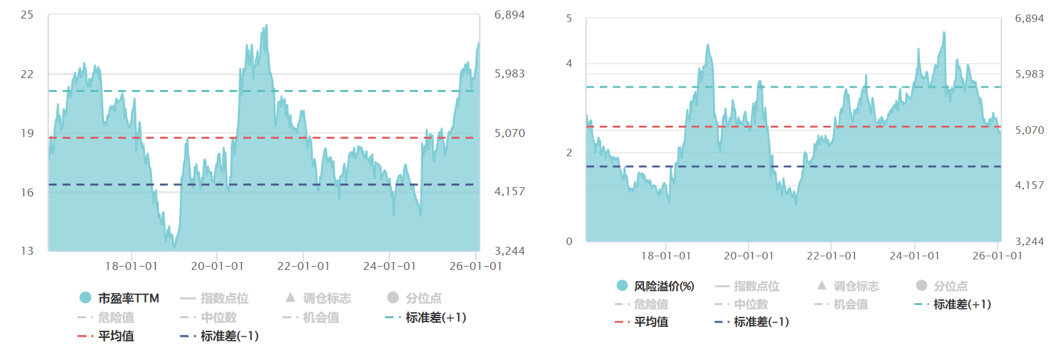
Market Overview - The A-share market has shown strong resilience since the beginning of the year, with broad indices exhibiting a relatively strong and fluctuating trend [1] - Despite this, there is still some selling pressure, as evidenced by redemptions in core broad index ETFs and an increase in financing margin ratios, which may cool the market [1] Valuation Insights - The PE valuation of the Wind All A index is currently at a relatively high level compared to the past 10 years, exceeding the mean plus one standard deviation [1] - However, the risk premium level, indicated by the inverse of the A-share PE minus the 10-year government bond yield, remains around the 10-year average, suggesting potential for value re-evaluation in the A-share market [1] Economic Indicators - The overall performance of the domestic economy in Q4 is relatively weak, with indicators such as retail sales, industrial output, and fixed asset investment showing weakness [4] - The manufacturing PMI has fluctuated, with a recent drop below expectations, indicating a contraction in the manufacturing sector [4] Policy Measures - Domestic macro policies have been actively implemented since the beginning of the year, with significant upgrades in fiscal measures, including extended interest subsidies for personal consumption loans and service industry loans [4] - Monetary policy has also shown structural support, with adjustments in re-lending and re-discount rates, particularly favoring key sectors like technology and small enterprises [4] Global Economic Context - The Federal Reserve's monetary policy direction is a key focus, with expectations of a pause in interest rate cuts in the short term, but conditions for potential cuts later in the year are present due to low inflation and a cooling labor market [5] - The overall liquidity environment is expected to remain loose, supported by domestic fiscal policies, which bodes well for the A-share market [5] Fund Flows and Market Sentiment - A significant trend is the shift of household savings towards the stock market, with a substantial amount of fixed deposits maturing this year, indicating potential inflows into A-shares [7] - The ratio of household savings to A-share market capitalization remains above historical averages, suggesting further room for this ratio to decline and for savings to flow into the stock market [7] Fund Issuance Trends - The issuance of public equity funds remains relatively low compared to the bull market from 2019 to 2021, indicating potential for growth in future fund issuance [9] Investment Outlook - The A-share market is expected to exhibit a wide-ranging upward trend in 2026, supported by multiple factors including risk premium, funding conditions, and policy measures [14] - Key sectors to focus on include technology and cyclical industries, with specific ETFs such as communication, semiconductor equipment, and mining being highlighted as potential investment opportunities [14]

有色集体上涨,镍不锈钢跟随走势
Hua Tai Qi Huo· 2026-02-05 03:17
Report Industry Investment Rating - Not provided Core Viewpoints - The prices of nickel and stainless steel futures both showed upward trends on February 4, 2026, with nickel experiencing a significant rebound and stainless steel showing a milder upward movement. Due to large price fluctuations and the approaching Spring Festival, it is recommended to mainly adopt range trading strategies. However, considering the ongoing supply disruptions of nickel ore, which support the cost side, one can consider buying on dips if the price correction is substantial [1][4][5]. Summary by Related Catalogs Nickel Variety Market Analysis - **Futures**: On February 4, 2026, the main contract of Shanghai nickel 2603 opened at 135,400 yuan/ton and closed at 137,680 yuan/ton, a change of 3.78% from the previous trading day. The trading volume was 481,566 (-181,798) lots, and the open interest was 99,453 (-2,047) lots. The contract showed a strong rebound, maintaining a high - level operation with a significant upward shift in the price center. The previous panic - driven decline led to an oversold situation, creating a need for technical repair. Additionally, the expectation of domestic liquidity easing and the weakening of the US dollar boosted the London nickel market, driving the Shanghai nickel rebound through the linkage of domestic and foreign markets [1]. - **Nickel Ore**: The domestic nickel ore market showed a differentiated consolidation trend. Affected by the price correction of downstream products, the CIF quotes in the domestic market slightly declined, and the trading atmosphere was dull. Philippine mines maintained firm quotes and mainly executed previous orders. However, due to limited downstream acceptance, high - priced resources had difficulty in trading, and buyers generally adopted a wait - and - see attitude, resulting in a slight increase in the actual bargaining space and a decline in CIF prices. In Indonesia, the market price remained stable, and the new benchmark price and premium for the first half of February were still in effect. The market was in an adaptation and wait - and - see period for the new price system, with no new policies or trading information to guide, and overall trading activities were calm [1]. - **Spot**: Jinchuan Group's sales price in the Shanghai market was 145,500 yuan/ton, an increase of 2,100 yuan/ton from the previous trading day. Spot trading was poor, and the spot premiums of various refined nickel brands mostly increased. Among them, the premium of Jinchuan nickel changed by 150 yuan/ton to 9,400 yuan/ton, the premium of imported nickel changed by - 50 yuan/ton to - 100 yuan/ton, and the premium of nickel beans was 2,450 yuan/ton. The previous trading day's Shanghai nickel warehouse receipt volume was 48,072 (-108) tons, and the LME nickel inventory was 286,314 (786) tons [2]. Strategy - It is recommended to mainly adopt range trading strategies, but considering the ongoing supply disruptions of nickel ore, which support the cost side, one can consider buying on dips if the price correction is substantial [3]. - **Single - side**: Mainly range trading [4]. - **Inter - period**: None [4]. - **Inter - variety**: None [4]. - **Futures - spot**: None [4]. - **Options**: None [4]. Stainless Steel Variety Market Analysis - **Futures**: On February 4, 2026, the main contract of stainless steel 2603 opened at 13,620 yuan/ton and closed at 13,825 yuan/ton. The trading volume was 224,029 (+4,598) lots, and the open interest was 59,820 (-4,171) lots. The contract showed a fluctuating upward trend, achieving a recovery driven by Shanghai nickel and cost support. The trading volume moderately increased, and the open interest slightly increased. Overall, it was relatively strong, but the rhythm was weaker than that of Shanghai nickel. The previous continuous decline created a need for technical repair. Additionally, the expectation of domestic liquidity easing and the weakening of the US dollar led to a resonance of domestic and foreign market sentiments, driving the stainless steel rebound [4]. - **Spot**: Trading was light but improved compared to the previous period, and pre - festival restocking orders increased. The stainless steel price in the Wuxi market was 14,100 (+100) yuan/ton, the price in the Foshan market was 14,050 (+0) yuan/ton, and the premium of 304/2B was 310 to 510 yuan/ton. According to SMM data, the ex - factory tax - included average price of high - nickel pig iron changed by - 2.50 yuan/nickel point to 1,030.0 yuan/nickel point [4][5]. Strategy - It is recommended to mainly adopt range trading strategies, but considering the ongoing supply disruptions of nickel ore, which support the cost side, one can consider buying on dips if the price correction is substantial [5]. - **Single - side**: Mainly range trading [5]. - **Inter - period**: None [5]. - **Inter - variety**: None [5]. - **Futures - spot**: None [5]. - **Options**: None [5].
与凯恩斯共进思想午餐:普通人如何抓住十年一遇的财富潮?
Sou Hu Cai Jing· 2026-02-05 02:57
Core Insights - The article discusses the investment strategies and market predictions for 2026, emphasizing the importance of rational decision-making amidst market noise [2] Group 1: Macroeconomic Trends - The new Federal Reserve chair is expected to initiate two interest rate cuts in the first half of 2026, with a possibility of a third cut later in the year, which will significantly alter global capital flows [6] - A weaker US dollar is anticipated, leading to a stronger Chinese yuan, with projections suggesting the yuan could surpass 6.5 against the dollar by 2026 [7] Group 2: Market Predictions - The A-share market is expected to experience a "balanced bull market" in 2026, driven by liquidity, profit improvements, and policy support [9] - Key sectors to watch include emerging industries such as integrated circuits, new displays, and biomedicine, which are set to receive policy and funding support [9] Group 3: Investment Strategies - Investors are advised to focus on "dividend assets" that provide stable returns and valuation recovery, particularly in sectors like banking, insurance, and energy [10] - The overarching investment strategy for 2026 is to align with liquidity easing, follow policy and industry trends, and maintain a balanced portfolio to navigate market fluctuations [11]

政策预期升温 股指“长牛”趋势明确
Qi Huo Ri Bao· 2026-02-04 03:23
Group 1: Market Overview - The market risk appetite was negatively impacted by rising geopolitical tensions, the confirmation of the Federal Reserve Chair nomination, and the dense disclosure of financial reports from China and the US, leading to significant adjustments in precious metals and equity markets [1] - On February 3, the Shanghai Composite Index rebounded, with IC and IM both rising over 2%, while IF and IH saw intraday increases of over 1% [1] Group 2: Economic Indicators - In January, China's manufacturing PMI fell to 49.3% from 50.1%, and the non-manufacturing PMI decreased to 49.4% from 50.2%, both dropping below the expansion threshold, attributed to the approaching Spring Festival [1] - The decline in PMI for labor-intensive industries indicates a weakening production side, with significant drops in consumer goods and high-energy industries' PMIs, down 2.1 and 1 percentage points to 48.3% and 47.9%, respectively [1] - The new orders index fell by 1.6 percentage points to 49.2%, and the non-manufacturing business activity index decreased by 0.8 percentage points to 49.4%, with construction activity notably affected by seasonal factors [1] Group 3: Policy Measures - The government has been actively implementing policies to address insufficient domestic demand, including structural interest rate cuts and targeted financial tools to lower financing costs for key sectors [2] - A comprehensive consumer promotion policy system has been established, focusing on "two new" policies, with an initial fund of 62.5 billion yuan already in place to stimulate the market through subsidies and interest discounts [2] - The removal of restrictions on service industry access is expected to optimize the consumption supply structure, contributing to economic stability [2] Group 4: International Economic Context - In December, the US CPI rose by 2.7% year-on-year, with core CPI increasing by 2.6%, indicating persistent inflation, while non-farm payrolls added only 50,000 jobs, significantly below the expected 180,000 [3] - The US unemployment rate slightly decreased to 4.4%, with the economy showing support from a revised GDP growth rate of 4.4% for Q3, the fastest since 2021 [3] - The Federal Reserve paused interest rate cuts in January, maintaining rates at 5.25% to 5.5%, with market expectations for the first rate cut pushed to June [3]
每日看盘|流动性预期改善,A股或将重返“慢牛”轨道
Sou Hu Cai Jing· 2026-02-03 09:46
Group 1 - The A-share market experienced a strong rebound on Tuesday, with the Shanghai Composite Index showing signs of recovery after initial resistance, driven by active sectors such as space photovoltaic and commercial aerospace [1] - The narrative around "balance sheet reduction" has weakened, as the confirmation of the new Federal Reserve chair nominee has led to a reassessment of global market liquidity, impacting asset prices and causing fluctuations in the dollar index [2][3] - Major Asian stock indices, including the KOSPI and Nikkei 225, saw significant gains of 6.84% and 3.92% respectively, positively influencing the A-share and Hong Kong markets [3] Group 2 - The "balance sheet reduction" narrative is viewed as a trading noise that may alter short-term A-share movements but is unlikely to change the long-term trend of liquidity easing [4] - Despite some noise from discussions regarding VAT in the financial and internet sectors, the overall trend in A-shares remains strong, supported by robust domestic liquidity and a strong appreciation of the RMB [4] - The emergence of new industry catalysts, such as the commercial aerospace and space photovoltaic sectors, provides momentum for trading activities, indicating a potential return to a "slow bull" market trajectory [5]
金价银价反弹!
Jing Ji Ri Bao· 2026-02-03 05:36
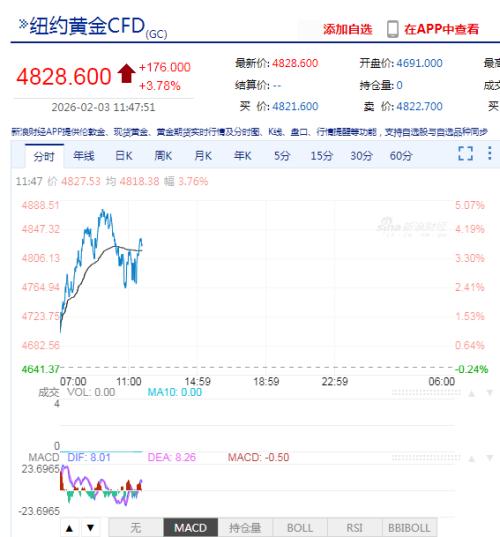
Group 1 - Precious metals prices have rebounded significantly, with gold futures rising above $4,800 per ounce, reported at $4,828.6 per ounce as of 11:47 AM Beijing time [1] - Silver futures are reported at $82.822 per ounce as of 11:48 AM Beijing time [3] Group 2 - Analysts from multiple banks and the Shanghai Gold Exchange have warned investors about market volatility risks, emphasizing the need for rational investment [5] - Nanhua Futures analyst Xia Yingying noted that the recent volatility in precious metal prices has exceeded what fundamentals can explain, with emotional factors becoming dominant. Overcrowded bullish positions led to a rapid activation of negative feedback mechanisms, resulting in a significant sell-off [5] - CITIC Securities indicated that major global economies will continue a loose liquidity stance through 2026, with rising precious metal prices stimulating trading enthusiasm for commodities. Silver, copper, tin, and lithium carbonate may benefit from active trading, leading to price increases beyond expectations. The firm believes that after a significant rally in 2025, the upward momentum for non-ferrous metal prices and stock markets remains strong, supported by supply disruptions, localized high demand, and stockpiling behaviors [5]


沃什不是牛市拐点,且待情绪休整
NORTHEAST SECURITIES· 2026-02-02 06:12
Investment Rating - The industry investment rating is "Outperform" [1] Core Views - Gold prices experienced extreme volatility, with a significant rise followed by a sharp decline due to market sentiment and external factors, but the nomination of Waller is not seen as a turning point for the market [2][12] - Copper prices are expected to stabilize after recent fluctuations, supported by strong fundamentals and low inventory levels, suggesting a buy-and-hold strategy for copper mining stocks [3][13] - Lithium prices have been declining, but demand is expected to increase due to new policies and seasonal factors, indicating potential for future price support [4][14] Summary by Sections 1. Weekly Research Insights - Gold: After a rapid increase, gold prices faced a sharp drop, but the overall upward trend remains intact for long-term investors [2][12] - Copper: The extreme market sentiment has subsided, and the fundamentals for copper remain strong, suggesting a hold on copper mining stocks [3][13] - Lithium: Inventory levels are decreasing, and new demand drivers are emerging, indicating a potential rebound in prices [4][14] 2. Sector Performance - The non-ferrous metals index increased by 3.70%, outperforming the market by 4.14%, ranking 4th among 30 sub-industries [16] - Top performers in the non-ferrous metals sector included gold, copper, and lead-zinc, with individual stocks like Hunan Gold showing significant gains [16][22] 3. Metal Prices and Inventory - New energy metals: Cobalt prices increased, while lithium prices decreased significantly [23][24] - Base metals: Domestic prices for copper, aluminum, and zinc rose, while lead prices slightly declined [33][35] - Precious metals: Gold and silver prices fell sharply, with gold down 4.7% and silver down 22.5% [47][48]





利率市场周度回顾:资金跨月压力可控,10Y国债收益率震荡下行-20260202
East Money Securities· 2026-02-02 05:51
Group 1: Fixed Income Market Overview - The 10Y government bond yield has shown a downward trend, decreasing by 2.10 basis points to 1.8090% compared to the previous week, influenced by discussions on new monetary policy tools and a weakening equity market [2][3] - The overall liquidity in the money market remains stable, with a slight increase in funding rates as the month-end approaches, but the central bank's supportive stance keeps the cross-month pressure manageable [4][11] Group 2: Money Market Analysis - The central bank's net liquidity injection this week was 530.5 billion, with a notable increase in the 7-day reverse repo balance to 17,615 billion, up by 5,805 billion from the previous week [11][12] - Funding rates have slightly increased, with DR007 rising by 9.91 basis points to 1.59% and R007 increasing by 10.41 basis points to 1.64% as of January 30, 2026 [25][26] Group 3: Primary Market Supply - The net supply of interest rate bonds decreased significantly this week to 3,805.14 billion, a drop of 3,544.45 billion from the previous week, with government bonds showing a net supply of -1,133.40 billion [32][34] - The net financing scale of negotiable certificates of deposit (NCD) turned positive this week, totaling 37.30 billion, an increase of 1,544.40 billion from the previous week [32][39] Group 4: Secondary Market Performance - The yield curve for government bonds is flattening, with the 10Y/1Y yield spread narrowing, indicating a shift in market sentiment [42][50] - The absolute level of government bond yields shows a downward trend, with the 10Y yield slightly decreasing, while the 30Y local government bond yield has seen a minor increase [47][49]
分析师:比特币在8 万美元关口下方震荡
Sou Hu Cai Jing· 2026-02-02 03:11
Core Viewpoint - The cryptocurrency market is experiencing divergence, with Bitcoin fluctuating below the critical $80,000 level as investors digest the news of Kevin Walsh being nominated by President Trump for the next Federal Reserve Chair [1] Group 1: Market Reactions - The hawkish reputation of Walsh has led to a significant rise in the dollar, reducing market expectations for liquidity easing, which is crucial support for high-beta assets like cryptocurrencies [1] - Bitcoin is currently up 0.4%, priced at $76,662.54, while Ethereum is down 0.8%, priced at $2,267.74 [1] Group 2: Economic Context - Amid increasing uncertainty in the macroeconomic environment, there is a sustained demand for asset diversification, which may provide medium to long-term support for Bitcoin [1]
中信证券金属|迎接金属的溢价时代:2026年投资策略
Xin Lang Cai Jing· 2026-02-02 01:33
Core Viewpoint - The metal market is expected to enter a premium era in 2026, supported by strong price momentum from supply disruptions, localized high demand, and inventory accumulation, alongside increased trading activity due to loose liquidity and heightened geopolitical tensions [1][7]. Group 1: 2025 Market Performance - In 2025, the non-ferrous metal sector index rose by 98.6%, outperforming the CSI 300 index by 77.4 percentage points [2]. - Key segments leading the gains included tungsten (+144.8%), nickel-cobalt-tin-antimony (+130.7%), and copper (+123.9%) [2]. - Precious metals saw significant price increases, with gold and silver averaging over 70% higher year-on-year [2]. Group 2: Supply and Demand Dynamics - Supply disruptions in the metal industry are becoming more frequent and severe, with cobalt, tin, lithium, copper, and nickel prices significantly impacted [3][11]. - Factors such as resource depletion, insufficient investment, and resource nationalism contribute to a long-term normalization of supply constraints [3][11]. - Despite potential weaknesses in demand from sectors like real estate and home appliances, strong demand is expected from electric grid investments, energy storage batteries, and AI servers [3][11]. Group 3: Trading Activity and Price Elasticity - Increased trading activity is anticipated to amplify price elasticity, with precious metals reaching new highs and benefiting from heightened investor interest [4][12]. - Geopolitical conflicts have intensified, leading to increased risk aversion and price premiums across various metals, including copper, rare earths, tungsten, and natural uranium [4][12]. Group 4: Price Outlook for Major Metals in 2026 - Precious metals are expected to benefit from monetary attributes and risk aversion, with gold projected to reach $6,000 per ounce and silver potentially hitting $120 per ounce [5][12]. - Copper and aluminum prices are forecasted to average $12,000 per ton and 23,000 yuan per ton, respectively, supported by supply constraints and resilient demand [5][12]. - Lithium prices are expected to rise to 120,000-200,000 yuan per ton due to strong demand from energy storage, while cobalt and nickel prices are also projected to increase significantly [5][12].