结构牛

Search documents
金鹰基金杨刚:风偏驱动渐行远 双轮驱动徐开来
Xin Lang Ji Jin· 2025-12-01 03:57
今年以来,A股整体延续牛市走势。主要在流动性、政策面及重要行业催化的共同引领下,A股走出了 以科技创新为最重要主线的"科技牛"行情,AI更成为其中最强的投资主题。同时,在全球地缘变局及外 部宽松条件支持下,上游强周期、海外与国产算力、电力设备及新能源等多个方向均表现出色。 从行业层面上看,大A"新旧"阵营表现严重分化,"小登"们表现优异,"老登"们相对落寞。而从宽基指 数看,代表市场风偏活跃程度的万德微盘股指数与作为此轮全球股市风向标的科创类指数表现最为醒 目,迄今涨幅分别仍有70%+与50%左右。整体而言,A股市场今年以来的"结构牛"特征十分显著。一半 是海水,一半是火焰。 进入11月,A股市场在创出本轮行情阶段新高后,波动有所加大。究其原因,恐怕既有外部地缘政治突 发扰动的"黑天鹅"因素,更有临近岁末绝对收益型机构倾向于兑现收益和暂时的"马放南山",以及相对 收益型机构短期的高低切以争取年度更佳排名等的诸多内部因素的综合考量。 从主流机构观点看,对A股中长期走势相对乐观仍为目前的市场共识,短期震荡不改上行趋势。对此, 我们也基本认同。如果时间线延到明年,个人当下的一个基本判断是,预期A股市场或将有望从风偏 ...
12月金股报告:市场胜率波动而非扭转,震荡期需关注赔率空间
ZHONGTAI SECURITIES· 2025-11-27 10:34
Core Insights - The report indicates that market volatility is driven by fluctuations in win rates rather than a complete reversal, suggesting that the index is expected to remain in a state of oscillation [5][6] - The overall market liquidity remains ample, with margin financing balances at 2.46 trillion yuan, placing it in the 97.5th percentile over the past three years [3] - The report highlights that the recent market decline reflects a phase of win rate logic fluctuations, primarily influenced by external factors such as the Federal Reserve's interest rate decisions and concerns over AI-related debt [3][4] Market Analysis - The technology sector continues to face adjustments primarily due to expectation volatility, with the AI industry chain experiencing high valuations and limited upside potential [4] - Defensive demand and a slight recovery in domestic inflation are benefiting dividend and cyclical styles, as indicated by a 0.2% year-on-year increase in October CPI, marking the first positive change in four months [4] - The report notes that the win rate logic has not shifted, with the Federal Reserve's interest rate trajectory remaining below expectations, while the U.S. economy may require further rate cuts [5] Investment Strategy - The report suggests a focus on sectors with lower crowding within technology, such as gaming and media, while also recommending global pricing resources like gold and copper due to the backdrop of overseas rate cuts and fiscal expansion [6] - The December stock selection includes a mix of ETFs and individual stocks across various sectors, emphasizing a defensive strategy amid market oscillation [9][10]





这轮牛市券商涨不过银行和保险?真相和机会来了
3 6 Ke· 2025-11-19 10:49
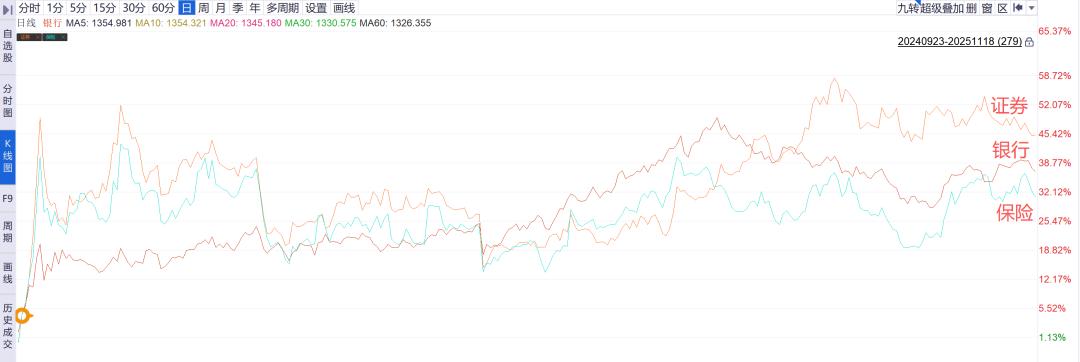
Core Viewpoint - The perception that brokerage stocks are underperforming compared to banks and insurance is a "visual error," as brokerage stocks have actually shown significant gains in recent months [3][4][6]. Group 1: Performance Comparison - From September 24, 2024, to the present, the brokerage sector has increased by over 47%, while the banking sector has risen by over 36% and the insurance sector by slightly over 33% [4]. - Since April 7, 2025, brokerages have gained 14%, outperforming banks at 9% and insurance at 5%, although Agricultural Bank has surged nearly 57% during this period [6][9]. Group 2: Market Dynamics - The brokerage sector is characterized by high beta, meaning it experiences larger fluctuations compared to banks and insurance, which are more stable and provide consistent dividends [6][12]. - The "star stock effect" from individual high-performing bank stocks can skew perceptions of overall sector performance, as many smaller banks have not performed as well [9]. Group 3: Future Outlook - The current market is described as a "slow bull" rather than a full-blown bull market, with a focus on safety leading to the outperformance of banks and insurance [15][16]. - If a comprehensive bull market begins in 2026, brokerages are expected to take the lead due to increased trading volumes and business opportunities [17][18]. Group 4: Seasonal Trends - Historically, brokerages experience a "Spring Festival offensive" with an 80% probability of rising in January and February, making this a strategic time for investment [19].


中泰证券:市场胜率坚实 “结构牛”情形下赔率空间相对有限
Xin Lang Cai Jing· 2025-10-30 23:35
Core Insights - The market odds indicator is currently at a relatively high level under a "structural bull" scenario [1] - The A-share market's securitization rate and median valuation are comparable to the structural bull levels at the end of 2021, with historical exceedance only during the comprehensive bull markets of 2009 and 2015 [1] - The Shanghai Composite Index and CSI 300's equity risk premium (ERP) is below the previous two market peaks, situated at the lower end of the rolling three-year average plus two standard deviations [1] - Overall, under the "structural bull" scenario, the market's odds space is relatively limited, and historical experience suggests that a transition to a comprehensive bull market would require a significant improvement in macro expectations or further liquidity expansion [1]

11月金股报告:科技风格有望持续
ZHONGTAI SECURITIES· 2025-10-30 13:05
Group 1 - The core conclusion of the report indicates a solid market win rate, with limited odds space under a "structural bull" scenario, and a continued focus on technology style [6] - The report highlights that the overall index showed a fluctuating trend in October, with the Shanghai Composite Index breaking through 4000 points by the 28th, and a daily average of 50.1% of stocks in the Wande All A index rising, indicating a recovery in profit-making effects [6] - The report notes that the technology style has seen some convergence, primarily due to trade environment disturbances, but is expected to rebound due to anticipated policy support for emerging industries [2][4] Group 2 - The report identifies three key investment strategies: focusing on less crowded segments within technology, globally priced resource products, and manufacturing related to external demand [7] - Specific recommendations for November include the ChiNext 50 ETF, Huari Precision, Hebei Steel Resources, Top Group, Meihu Co., Xiansheng Pharmaceutical, Tiger Medical, China Eastern Airlines, Kante Optical, and China Pacific Insurance, with a rationale provided for each [11][12] - The report emphasizes that the probability of style switching is low, as the industry valuation differentiation indicator has not triggered any signals for a style switch [5]
十年后沪指再度站上4000点 你赚钱了吗?
经济观察报· 2025-10-29 13:45
Core Viewpoint - The A-share market has significantly changed over the past decade, with the Shanghai Composite Index recently closing above 4000 points for the first time since 2015, indicating the potential start of a new bull market [2][4]. Market Environment Comparison - The current market environment differs from 2015, with the number of listed companies increasing from 2827 to 5452, and total market capitalization rising from 58.40 trillion to 122.05 trillion yuan, reflecting over 100% growth [4]. - The volatility of the market has decreased compared to the previous bull market, with a more stable upward trend observed since the policy shift on September 24, 2022 [4][5]. Investor Structure - In 2015, the market was dominated by retail investors, leading to high volatility. In contrast, the current market has a higher proportion of institutional investors, which contributes to market stability [4][5]. - Margin trading has also changed, with the current margin balance at 2.48 trillion yuan, representing only 2.53% of the circulating market value, compared to 4.7% in 2015 [5]. Sector Performance - The current bull market exhibits a clear structural differentiation, with technology sectors such as AI, chips, and solid-state batteries leading the gains, while traditional sectors lag behind [5][6]. - Investors focusing on technology innovation have seen better returns, while those in traditional stocks have struggled [5][6]. Future Market Outlook - The market is expected to transition from a structural bull market to a more comprehensive bull market as the "profit effect" increases, attracting more capital [6][8]. - The focus on emerging technologies is anticipated to drive future market performance, with a healthy and sustainable transformation of the Chinese stock market [8][9]. Investment Strategy - Investors are advised to pay attention to technology sectors due to their high growth potential, while also being cautious of potential short-term corrections [9]. - Mid-term strategies should focus on TMT and advanced manufacturing sectors, with a watchful eye on consumer sectors during market fluctuations [9].

帮主郑重:4000点是行情终结还是牛市起点?
Sou Hu Cai Jing· 2025-10-28 18:05
Core Viewpoint - The current market situation around the 4000-point mark is characterized by a divide in investor sentiment, with some viewing it as a bullish signal while others see it as a potential peak. The market is not driven by speculative emotions but rather by corporate earnings and supportive policies [1][4]. Market Sentiment - The atmosphere around the 4000-point level is markedly different from previous instances, such as in 2015 and 2021, where there was significant retail investor enthusiasm. Currently, investors are more cautious and hesitant, reflecting a shift in sentiment [3][4]. - There is a notable divergence in behavior between short-term and long-term investors, with short-term traders wary of potential peaks while long-term funds are accumulating shares of stable, high-dividend stocks [4][5]. Market Indicators - Three key indicators suggest that the 4000-point level is not a market peak but rather a pause in a structural bull market: 1. Corporate earnings are recovering, with many sectors reporting improved profit growth in Q3 compared to the first half of the year [5]. 2. Policy support is evident, with measures aimed at stabilizing the market and encouraging investment in quality enterprises [5]. 3. Valuations remain reasonable, with the current price-to-earnings ratio of the CSI 300 around 12 times, significantly lower than the 20+ times seen in 2015 [5]. Investment Strategies - For aggressive investors, focusing on sectors with solid earnings and minimal pullbacks, such as semiconductor equipment and high-end manufacturing, is recommended. Setting strict stop-loss limits is crucial [6]. - Conservative investors should adopt a defensive approach, targeting familiar, stable stocks with reasonable valuations and high dividends, adding to positions during market pullbacks [6]. - Long-term investors are advised to focus on major trends such as domestic substitution in semiconductors and the globalization of renewable energy, using significant market corrections as opportunities to increase positions [6]. Conclusion - The 4000-point mark represents a midpoint in the market's journey, with potential for upward movement while maintaining a cautious approach. Investors should prioritize corporate fundamentals and policy support over short-term market fluctuations [7].

帮主郑重:A股近4000点的两个反常,藏着中长线的真机会
Sou Hu Cai Jing· 2025-10-27 16:49
Core Viewpoint - The current market fluctuations around the 4000-point mark present significant investment opportunities despite apparent volatility [1][3]. Group 1: Market Dynamics - There is a notable divergence in market performance, with technology stocks like storage chips and CPOs experiencing gains, while oil and gas stocks are declining, indicating a search for direction among funds [3]. - The trading volume has increased to 2.34 trillion, up 20% from the previous week, despite the index being "stuck" [3]. - Institutional funds have seen a net inflow of over 70 billion, contrasting with retail investors who are selling off their positions [3]. Group 2: Investment Strategy - A dual investment strategy is emerging, focusing on technology stocks with order support and high-dividend blue-chip stocks for stability [4]. - Investors are advised to avoid stocks that merely ride on concepts or have poor third-quarter reports [4]. - Maintaining current positions is recommended, especially for stocks aligned with favorable policies, as pullbacks without significant volume should be viewed as buying opportunities [4].
策略深度:这是一轮混合牛
Bank of China Securities· 2025-09-25 23:58
Group 1 - The current bull market is expected to evolve into a slow and long bull market, characterized as a mixed bull market similar to the patterns observed in 2013-2014 and 2016-2017, transitioning from a structural bull to a comprehensive bull market [2][3] - Historical analysis of A-share bull markets from 2001 to 2025 reveals six distinct bull market phases, each driven by different macroeconomic conditions and profit dynamics, with valuation expansion being a common factor [9][12][45] - The current bull market is primarily driven by incremental capital, with insurance funds playing a significant role in the first half of 2025, while other funding sources such as retail investor accounts and public funds have not shown significant increases [3][45] Group 2 - The current "structural bull" market is driven by positive feedback from market participants towards AI hardware, but faces challenges related to the capacity of stocks that can be grouped together and the amount of incremental capital available [3][5] - The transition from a structural bull to a comprehensive bull market is anticipated, drawing parallels to the market rotations observed during the macroeconomic recovery phases from 2012 to 2017, where the focus shifted from technology to cyclical blue-chip stocks [3][5] - The report suggests a three-step expansion of the current bull market: first, a focus on AI hard technology; second, a broader technology growth phase; and finally, a comprehensive bull market driven by macroeconomic improvements [3][5][29]
大涨行情下,多只基金业绩告负,什么情况?
券商中国· 2025-08-31 09:54
Core Viewpoint - The article discusses the phenomenon of fund managers "dodging the bull market" amidst a strong market rally, highlighting the challenges faced by active equity products in outperforming indices despite a high percentage of positive returns [1][4]. Group 1: Fund Performance - As of August 29, 98.48% of active equity products recorded positive returns, yet 68 funds underperformed, indicating a mismatch between fund strategies and market trends [2][4]. - The A-share and Hong Kong markets have shown significant structural characteristics, with sectors like innovative drugs, humanoid robots, and artificial intelligence performing well, while others like coal and retail have lagged [4][5]. Group 2: Investment Strategy - Funds that did not align their holdings with market hotspots faced severe "missed opportunities," with some managers adhering strictly to their investment themes, such as coal or high-dividend stocks, leading to underperformance [5][6]. - High cash positions during market uptrends can result in underperformance, as seen with several funds maintaining low positions despite rising indices [5][6]. Group 3: Future Opportunities - Analysts suggest that the previously overlooked dividend and consumer sectors may become new focal points for investment as they offer stability amidst market volatility [8][9]. - The "self-pleasing consumption" trend is gaining traction, driven by changing consumer behaviors and preferences, indicating potential growth in related markets [9][10]. Group 4: Market Dynamics - The article notes that as new high-growth stocks emerge, there may be a valuation reassessment, leading to increased market volatility [8][9]. - The current market environment is seen as suitable for dividend stocks, which can provide a safety net for investors amid fluctuations [8][9].