
供需关系

Search documents
钢材&铁矿石日报:市场情绪转弱,钢矿震荡回落-20251211
Bao Cheng Qi Huo· 2025-12-11 10:01
Report Industry Investment Rating - No relevant content provided Core Viewpoints - The main contract price of rebar weakened again, with a daily decline of 1.32%, and the volume decreased while the open interest increased. Currently, rebar supply has been continuously shrinking at a low level, supporting steel prices, but demand is also weak. In the situation of weak supply and demand, the fundamentals have not improved, and steel prices are under pressure in the off - season. The relatively positive factor is the low valuation. It is expected that the trend will continue to oscillate and seek the bottom. Attention should be paid to the production changes of steel mills [5]. - The main contract price of hot - rolled coil weakened and declined, with a daily decline of 1.19%, and the volume decreased while the open interest increased. At present, both supply and demand of hot - rolled coil have weakened, the industrial contradiction has not been alleviated, and the inventory reduction pressure is relatively large, so the hot - rolled coil price continues to be under pressure. The relatively positive factor is the low valuation. In the weak reality pattern, the hot - rolled coil will continue to operate in a weak oscillation. Attention should be paid to the production situation of steel mills [5]. - The main contract price of iron ore fell from a high level, with a daily decline of 1.30%, and both volume and open interest decreased. Currently, short - term positive factors support the iron ore price to return to a high level, but the demand for iron ore continues to decline while the supply remains at a high level. In the situation of strong supply and weak demand, the fundamentals of the iron ore market are weak, and the upward driving force is not strong. Under the game of multiple and short factors, the iron ore price will maintain a high - level oscillation. Attention should be paid to the performance of steel products [5]. Summary by Directory 1. Industrial Dynamics - According to Mysteel statistics, the total sales of 17 key real - estate enterprises from January to November 2025 were 119.9231 billion yuan, a year - on - year decrease of 21.4%. In November, the total sales were 10.0593 billion yuan, a year - on - year decrease of 32.1% and a month - on - month decrease of 7.5%. In November, there were 14 real - estate enterprises with sales exceeding 10 billion yuan. Poly Developments, Greentown China, and China Overseas Land & Investment ranked in the top three with sales of 240.866 billion yuan, 223.5 billion yuan, and 211.399 billion yuan respectively. From January to November, only China Jinmao achieved year - on - year growth in sales, with a year - on - year increase of 21.3%. The sales of the other 16 real - estate enterprises decreased year - on - year, among which Gemdale Group had the largest decline, with a year - on - year decrease of 56.3% [7]. - According to the latest data released by the China Association of Automobile Manufacturers, in November, China's automobile production and sales continued to perform well, and both production and sales increased month - on - month and year - on - year. In November, China's monthly automobile production exceeded 3.5 million for the first time, setting a new historical high. In the first 11 months of this year, both automobile production and sales exceeded 31 million, with a year - on - year growth of over 10%. From January to November this year, the production and sales of new - energy vehicles in China were both close to 15 million, with a year - on - year growth of over 30%. In terms of exports, new - energy vehicle exports reached 2.315 million, a year - on - year increase of 100% [8]. - Starting from 16:00 on December 11, 2025, Handan City lifted the orange warning level II emergency response for heavy pollution weather as the atmospheric diffusion conditions gradually improved [9]. 2. Spot Market - Rebar: The Shanghai price was 3,240 yuan, down 10 yuan; the Tianjin price was 3,160 yuan, down 20 yuan; the national average price was 3,298 yuan, down 3 yuan [10]. - Hot - rolled coil: The Shanghai price was 3,250 yuan, down 30 yuan; the Tianjin price was 3,200 yuan, up 10 yuan; the national average price was 3,297 yuan, down 10 yuan [10]. - Tangshan billet: The price was 2,960 yuan, unchanged [10]. - Zhangjiagang heavy scrap: The price was 2,070 yuan, down 10 yuan [10]. - PB powder (Shandong port): The price was 777 yuan, down 6 yuan [10]. - Tangshan iron concentrate powder (wet basis): The price was 783 yuan, unchanged [10]. - Ocean freight: The Australian freight was 11.34 yuan, down 0.42 yuan; the Brazilian freight was 24.01 yuan, down 0.82 yuan [10]. - SGX swap (current month): The price was 106.54 yuan, up 0.59 yuan [10]. - Platts Index (CFR, 62%): The price was 106.40 yuan, up 0.90 yuan [10]. 3. Futures Market - Rebar: The closing price of the active contract was 3,069 yuan, a decline of 1.32%. The highest price was 3,118 yuan, the lowest price was 3,061 yuan, the trading volume was 1,360,006 lots, a decrease of 159,246 lots, and the open interest was 1,602,075 lots, an increase of 87,857 lots [14]. - Hot - rolled coil: The closing price of the active contract was 3,238 yuan, a decline of 1.19%. The highest price was 3,283 yuan, the lowest price was 3,236 yuan, the trading volume was 630,010 lots, a decrease of 57,172 lots, and the open interest was 1,148,348 lots, an increase of 42,440 lots [14]. - Iron ore: The closing price of the active contract was 757.0 yuan, a decline of 1.30%. The highest price was 771.0 yuan, the lowest price was 754.5 yuan, the trading volume was 324,951 lots, a decrease of 54,852 lots, and the open interest was 468,056 lots, a decrease of 1,378 lots [14]. 4. Related Charts - The report provides charts on steel inventory (including rebar and hot - rolled coil inventory), iron ore inventory (including port inventory, 247 - steel - mill inventory, and domestic mine iron concentrate powder inventory), and steel - mill production situation (including blast furnace operating rate, capacity utilization rate, profitability ratio, etc.) [16][21][32] 5.后市研判 - Rebar: Supply and demand continue to weaken. The weekly output of rebar decreased by 105,300 tons month - on - month, and supply has continuously shrunk to a low level, supporting steel prices, but the sustainability of short - process steel mill production cuts needs to be tracked. Meanwhile, rebar demand is weak, with the weekly apparent demand decreasing by 138,900 tons month - on - month, and high - frequency daily transactions are weakly stable. Both are at low levels in recent years, and downstream conditions have not improved. It is expected that demand will continue to weaken seasonally, putting pressure on steel prices. Overall, rebar supply is continuously shrinking at a low level, supporting steel prices, but demand is also weak. In the situation of weak supply and demand, the fundamentals have not improved, and steel prices are under pressure in the off - season. The relatively positive factor is the low valuation. It is expected that the trend will continue to oscillate and seek the bottom. Attention should be paid to the production changes of steel mills [42]. - Hot - rolled coil: The supply - demand pattern remains weak. The weekly output of hot - rolled coil decreased by 56,000 tons month - on - month, and supply has continuously shrunk from a high level, but the inventory level is high, and the pressure relief is limited. Meanwhile, hot - rolled coil demand remains weak, with weak weekly apparent demand and high - frequency transactions. The relatively positive factor is that the production of the main downstream cold - rolled products has continued to increase, supporting demand, but there are concerns about external demand due to export policy disturbances. At present, both supply and demand of hot - rolled coil have weakened, the industrial contradiction has not been alleviated, and the inventory reduction pressure is relatively large. The hot - rolled coil price continues to be under pressure. The relatively positive factor is the low valuation. In the weak reality pattern, the hot - rolled coil will continue to operate in a weak oscillation. Attention should be paid to the production situation of steel mills [42]. - Iron ore: The supply - demand pattern continues to weaken. At the end of the year, more steel mills are under maintenance, and the terminal demand for iron ore continues to decline. The average daily hot - metal output and imported ore consumption of sample steel mills decreased again last week, and the decline rate has increased. Moreover, the profitability of steel mills has not improved, and iron ore demand is expected to remain weak, putting pressure on iron ore prices. Meanwhile, the arrival volume at domestic ports has continued to decline, while the shipments of overseas miners have increased month - on - month, and both are still at high levels within the year. Overseas iron ore supply is active. Even though domestic ore supply is seasonally shrinking, iron ore supply remains high. In short, short - term positive factors support the iron ore price to return to a high level, but iron ore demand continues to decline while the supply remains at a high level. In the situation of strong supply and weak demand, the fundamentals of the iron ore market are weak, and the upward driving force is not strong. Under the game of multiple and short factors, the iron ore price will maintain a high - level oscillation. Attention should be paid to the performance of steel products [43].
DRAM现货价格涨跌分化,供应端“撑腰”致使Wafer价格继续上涨
TrendForce集邦· 2025-12-11 09:02
Group 1 - The core viewpoint of the article highlights the recent trends in DRAM and NAND flash memory prices, indicating a mixed market response with some price corrections due to profit-taking by traders as the year-end approaches [2][4]. - DDR5 and DDR3 spot prices have slightly declined this week due to previous rapid increases, while DDR4 prices continue to rise, particularly for the 16Gb products [2][4]. - The wafer market is experiencing a pattern of "converging increases but sustained strong prices," with key support coming from the supply side as manufacturers have not released more wafers despite the year-end [4]. Group 2 - The price of DDR4, especially the 16Gb chips, has seen a significant increase, with a recent price rise of 2.00%, moving from US$ 16.729 to US$ 17.064 [4]. - The 512Gb TLC wafer spot price increased by 0.28%, reaching US$ 9.634, indicating ongoing demand despite market corrections [4].

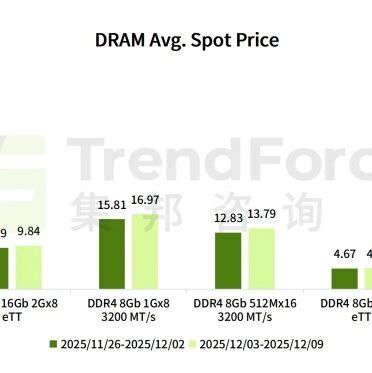
工业硅期货早报-20251211
Da Yue Qi Huo· 2025-12-11 03:17
1. Report Industry Investment Rating - No information provided in the content 2. Core Viewpoints of the Report Industrial Silicon - The fundamentals are bearish, with supply remaining high despite a reduction in production scheduling, and demand recovery at a low level. The cost support has increased slightly. It is expected to fluctuate in the range of 8,150 - 8,350 for the 2605 contract [6]. - Bullish factors include rising cost support and manufacturers' plans to halt or reduce production. Bearish factors are the slow recovery of post - holiday demand and the strong supply but weak demand in the downstream polysilicon market. The main logic lies in capacity clearance, cost support, and demand growth [14][15]. Polysilicon - The fundamentals are bearish. Supply production scheduling is expected to decrease in the short term and recover in the medium term. The overall demand shows a continuous decline as wafer production, cell production, and component production all continue to decrease. The cost support remains stable. It is expected to fluctuate in the range of 55,035 - 56,795 for the 2605 contract [10][11][12]. 3. Summary According to the Directory 3.1 Daily Viewpoints Industrial Silicon - Supply: Last week, the industrial silicon supply was 88,000 tons, a 3.29% decrease from the previous week. - Demand: Last week, the demand was 72,000 tons, a 12.19% decrease from the previous week, with demand remaining low. - Cost: In Xinjiang, the production loss of sample oxygen - passing 553 was 2,874 yuan/ton, and the cost support increased during the dry season. - Basis: On December 10th, the spot price of non - oxygen - passing silicon in East China was 9,200 yuan/ton, and the basis of the 05 contract was 945 yuan/ton, with the spot price at a premium to the futures price [6]. - Inventory: The social inventory was 558,000 tons, a 1.45% increase from the previous week; the sample enterprise inventory was 182,500 tons, a 1.61% increase; the main port inventory was 131,000 tons, a 1.55% increase [6]. - Market trend: The MA20 is downward, and the futures price of the 05 contract closed below the MA20. The main position is net short, and short positions increased [6]. Polysilicon - Supply: Last week, the polysilicon production was 25,800 tons, a 7.50% increase from the previous week. The production scheduling for December is predicted to be 113,500 tons, a 0.95% decrease from the previous month [10]. - Demand: Last week, the wafer production was 11.95GW, a 0.58% decrease from the previous week, and the inventory was 213,000 tons, a 9.23% increase. Currently, wafer production is in a loss state. The production scheduling for December is 45.7GW, a 15.94% decrease from the previous month. In November, the cell production was 55.61GW, a 6.17% decrease from the previous month. Last week, the inventory of cell external sales factories was 9.07GW, a 4.72% decrease. Currently, cell production is in a loss state. The production scheduling for December is 48.72GW, a 12.38% decrease. In November, the component production was 46.9GW, a 2.49% decrease from the previous month. The expected component production for December is 39.99GW, a 14.73% decrease. The domestic monthly inventory is 24.76GW, a 51.73% decrease, and the European monthly inventory is 33.1GW, a 6.49% decrease. Currently, component production is in a profit state [11]. - Cost: The average cost of N - type polysilicon in the industry is 38,700 yuan/ton, and the production profit is 12,300 yuan/ton [11]. - Basis: On December 10th, the price of N - type dense material was 51,000 yuan/ton, and the basis of the 05 contract was - 2,300 yuan/ton, with the spot price at a discount to the futures price [12]. - Inventory: The weekly inventory was 291,000 tons, a 3.55% increase from the previous week, at a high level compared to the same period in history [12]. - Market trend: The MA20 is upward, and the futures price of the 05 contract closed above the MA20. The main position is net short, and short positions increased [12]. 3.2 Market Overview Industrial Silicon - Futures closing prices: All contracts showed a decline compared to the previous day, with the decline rate ranging from 1.08% to 2.08%. - Basis: Most contracts showed an increase compared to the previous day, with the increase rate ranging from 10.47% to 109.67%. - Other indicators: The registered warehouse receipt number was 7,780, a 3.35% increase from the previous day. The weekly DMC production was 49,200 tons, with no change from the previous day. The daily capacity utilization rate was 74.84%, with no change. The daily DMC price was 13,600 yuan/ton, with no change [18]. Polysilicon - Futures closing prices: Some contracts showed an increase, and some showed a decrease compared to the previous day, with the change rate ranging from - 0.71% to 0.55%. - Basis: The change in the basis of each contract was different, with the change rate ranging from - 10.00% to 9.21%. - Other indicators: The daily prices of various types of polysilicon remained unchanged. The weekly total inventory was 291,000 tons, a 3.56% increase from the previous week [20]. 3.3 Price and Inventory Trends - **Industrial Silicon**: The report presents the price - basis and delivery product price difference trends of industrial silicon from 2019 - 2025, as well as the inventory trends of industrial silicon in delivery warehouses and ports, SMM sample enterprises, and the number of registered warehouse receipts from 2018 - 2025 [23][29]. - **Polysilicon**: It shows the price trends of the polysilicon market from 2025, including the main contract price, basis, and inventory trends [26]. 3.4 Production and Cost Trends Industrial Silicon - Production: The report shows the weekly production trends of SMM sample enterprises, monthly production trends by specification from 2023 - 2025, and the production capacity utilization rate trends of different regions [33]. - Cost: It presents the cost - profit trends of sample regions (Sichuan, Yunnan, and Xinjiang) from 2022 - 2025 [40]. Polysilicon - The report shows the cost trends of the polysilicon industry from 2023 - 2025, including the price trends of different types of polysilicon, inventory, monthly production, monthly demand, and monthly capacity utilization rate [68]. 3.5 Supply - Demand Balance Industrial Silicon - Weekly supply - demand balance: It shows the weekly supply - demand balance of industrial silicon from 2024 - 2025, including production, import, export, consumption, and balance. - Monthly supply - demand balance: It shows the monthly supply - demand balance of industrial silicon from October 2024 - October 2025, including production, import, export, actual consumption, and balance [42][45]. Polysilicon - Monthly supply - demand balance: It shows the monthly supply - demand balance of polysilicon from October 2024 - October 2025, including supply, import, export, consumption, and balance [71]. 3.6 Downstream Market Trends Organic Silicon - DMC price and production: It shows the DMC daily capacity utilization rate, profit - cost trends, weekly production trends, and price trends from 2019 - 2025. - Downstream product prices: It shows the price trends of downstream products such as 107 glue, silicone oil, raw rubber, and D4 from 2022 - 2025. - Import - export and inventory: It shows the monthly import - export volume and inventory trends of DMC from 2019 - 2025 [48][50][54]. Aluminum Alloy - Price and supply: It shows the waste aluminum recycling volume, social inventory, aluminum scrap import volume, import - export situation of unwrought aluminum alloy, SMM aluminum alloy ADC12 price, and import ADC12 cost - profit trends from 2019 - 2025. - Inventory and production: It shows the monthly production trends of primary aluminum - based aluminum alloy ingots and recycled aluminum alloy ingots, weekly production start rates of primary and recycled aluminum alloys, and social inventory trends of aluminum alloy ingots from 2019 - 2025. - Demand: It shows the monthly production and sales volume trends of automobiles and the export trends of aluminum alloy wheels from 2018 - 2025 [58][61][63]. Polysilicon Downstream - Wafer: It shows the price, weekly production, weekly inventory, monthly demand, and net export trends of wafers from 2021 - 2025. - Cell: It shows the price, production scheduling and actual production, weekly inventory, production start rate, and export trends of cells from 2022 - 2025. - Photovoltaic component: It shows the price, domestic and European inventory, monthly production, and export trends of photovoltaic components from 2021 - 2025. - Photovoltaic accessories: It shows the price trends of photovoltaic coatings, import - export trends of photovoltaic films and glass, monthly production trends of photovoltaic glass, and import - export trends of welding strips from 2021 - 2025. - Component cost - profit: It shows the cost - profit trends of 210mm double - sided double - glass components, including silicon material cost, silicon wafer cost - profit, cell cost - profit, and component cost - profit from 2024 - 2025. - Photovoltaic grid - connected power generation: It shows the trends of the national new power generation installed capacity, power generation composition and total amount, photovoltaic power station new grid - connected capacity, and solar power generation from 2019 - 2025 [74][77][80].
农产品日报:郑棉持续震荡,糖价依旧承压-20251211
Hua Tai Qi Huo· 2025-12-11 02:52
Group 1: Investment Ratings - All three industries (cotton, sugar, and pulp) are rated neutral [3][6][9] Group 2: Core Views - **Cotton**: In the short - term, Zhengzhou cotton is expected to continue range - bound. In the long - term, with increased domestic cotton consumption and low expected imports, cotton prices are optimistic after seasonal pressure. Attention should be paid to the target price policy for next year's cotton [3] - **Sugar**: The fundamental driving force is downward, but the current valuation is low. At the beginning of the sugar - making season, sugar mills have the intention to support prices. The short - term decline of Zhengzhou sugar is limited, but the impact of capital on the market should be watched [6] - **Pulp**: Due to the digestion of previous negative factors, the pulp futures price has risen strongly recently, but the lack of substantial improvement in supply - demand may limit its upward space. The impact of the remaining Russian needle warehouse receipts on the market should be noted [9] Group 3: Summary of Cotton Market News and Key Data - Futures: The closing price of cotton contract 2601 yesterday was 13,780 yuan/ton, up 40 yuan/ton (+0.29%) from the previous day. Spot: The Xinjiang arrival price of 3128B cotton was 14,830 yuan/ton, down 13 yuan/ton; the national average price was 15,004 yuan/ton, up 5 yuan/ton. The USDA's December report shows a slight decrease in global cotton production and consumption in the 2025/26 season, and a slight increase in ending inventory [1] Market Analysis - Internationally, the concentrated listing of new cotton in the Northern Hemisphere has brought supply pressure, and global textile consumption is weak, so ICE US cotton is under pressure in the short - term. In the long - term, US cotton is in a low - valuation range. Domestically, cotton production in the 2025/26 season is expected to increase. With the end of cotton harvesting in Xinjiang, supply is abundant in the short - term. The downstream demand is weak, but the spinning profit has improved and inventory pressure is acceptable [2] Group 4: Summary of Sugar Market News and Key Data - Futures: The closing price of sugar contract 2601 yesterday was 5328 yuan/ton, down 15 yuan/ton (-0.28%). Spot: The sugar price in Nanning, Guangxi was 5370 yuan/ton, down 40 yuan/ton; in Kunming, Yunnan it was 5340 yuan/ton, down 5 yuan/ton. As of now, 64 sugar mills in Guangxi have started production in the 2025/26 season, 7 less than the same period last year [3] Market Analysis - The global sugar harvest has suppressed the raw sugar market, but the short - term decline is limited. There is no sign of a reversal. Domestically, sugar production is expected to increase for the third year. Sugar mills in Guangxi have started production, and supply is increasing seasonally. The import profit from Brazil is high, and the supply pressure is high [4] Group 5: Summary of Pulp Market News and Key Data - Futures: The closing price of pulp contract 2605 yesterday was 5436 yuan/ton, up 50 yuan/ton (+0.93%). Spot: The price of Chilean Silver Star softwood pulp in Shandong was 5500 yuan/ton, unchanged; the price of Russian softwood pulp was 5005 yuan/ton, unchanged. The import wood pulp spot market is stable, with individual price fluctuations [7] Market Analysis - Supply: Overseas pulp mills are shutting down for maintenance. Domtar has permanently closed a paper mill, and Finnforest has temporarily shut down a pulp mill. Demand: European port pulp inventories have decreased in October, but in China, terminal demand is insufficient, paper mills' operating rates are low, and port inventories are at a historical high [8]
大越期货沥青期货早报-20251211
Da Yue Qi Huo· 2025-12-11 02:29
交易咨询业务资格:证监许可【2012】1091号 沥青期货早报 2025年12月11日 大越期货投资咨询部 金泽彬 从业资格证号:F3048432 投资咨询证:Z0015557 联系方式:0575-85226759 1 重要提示:本报告非期货交易咨询业务项下服务,其中的观点和信息仅作参考之用,不构成对任何人的投资建议 。 我司不会因为关注、收到或阅读本报告内容而视相关人员为客户;市场有风险,投资需谨慎。 目 录 3 3、库存: 社会库存为74.5万吨,环比减少3.74%,厂内库存为58.8万吨,环比增加1.20%,港口稀释沥青库存 为库存为67万吨,环比增加17.54%。社会库存持续去库,厂内库存持续累库,港口库存持续累库。 中性。 4、盘面: MA20向下,02合约期价收于MA20下方。 偏空。 5、主力持仓: 主力持仓净空,空减。 偏空。 每日观点 利多:原油成本相对高位,略有支撑。 利空:高价货源需求不足;整体需求下行,欧美经济衰退预期加强。 1 每日观点 2 基本面/持仓数据 每日观点 供给端来看,根据隆众,2025年12月份沥青总计划排产量为215.8万吨,环比降幅3.24%。本周国内 石油沥青样本 ...
橡胶周报:橡胶受泰缅冲突再起情绪刺激,但冲突依然远离主产区对供应实际影响有限-20251210
Tian Fu Qi Huo· 2025-12-10 14:10
Report Summary 1. Investment Rating The report does not provide an overall industry investment rating. 2. Core View The report analyzes the market conditions of various chemical products, including crude oil, styrene, rubber, and others. It suggests that geopolitical factors are likely to be the main drivers of the market in December. While some products show short - term positive trends, others face supply - demand imbalances and potential risks. Overall, it advises different trading strategies for each product based on their fundamentals and technical analysis [3][5]. 3. Summary by Product Crude Oil - **Logic**: Supply - demand and macro drivers have a weak impact on the market. The mid - term supply surplus is the main trend, but the market still trades based on supply - demand changes. Macro factors are short - term positive, and geopolitical factors are likely to be the main drivers in December. Short - term bullish but difficult to trade due to geopolitical risks; mid - term, look for shorting opportunities after a pulse - type upward movement [4][5]. - **Technical Analysis**: The daily - level shows a mid - term downward structure, and the hourly - level is in a short - term oscillation. Today, it decreased slightly with reduced positions, and the short - term structure remains unchanged. The strategy is to wait and see in the hourly cycle [5]. Styrene - **Logic**: Short - term supply decreased due to increased maintenance after a significant profit decline, and inventory reduction supported the rebound. However, further upward movement requires support from the cost side (crude oil). Mid - term, the port inventory is at a five - year high, and there is a high probability of inventory reaching a new high in February if the demand remains weak after the New Year [8]. - **Technical Analysis**: The hourly - level shows a short - term oscillation structure. Today, it corrected with increased positions, and the structure became unclear. The strategy is to wait and see in the hourly cycle [9]. Rubber - **Logic**: There is no major contradiction in the short - term. Tire demand is unlikely to increase significantly, and the supply side is in the peak tapping season in Southeast Asia. The inventory in Qingdao is seasonally increasing, and there is no obvious upward or downward driver. Consider it as an oscillating market [10]. - **Technical Analysis**: The daily - level shows a mid - term downward structure, and the hourly - level is in a short - term oscillation. Today, it increased with reduced positions, and the hourly - level structure is unclear. The strategy is to wait and see in the hourly cycle [10]. Synthetic Rubber - **Logic**: The core factor is the raw material butadiene. The price of butadiene is low recently, leading to short - term improvement in supply - demand and reduced pressure. However, there is still a risk of liquid chemical inventory over - filling in the mid - term due to high supply and inventory [12]. - **Technical Analysis**: The daily - level shows a mid - term downward structure, and the hourly - level is in a short - term oscillation. Today, it increased with increased positions, and the hourly - level remains in an oscillating state. The strategy is to wait and see in the hourly cycle [12]. PX - **Logic**: The overseas spread has weakened significantly, and the anti - seasonal US aromatics blending oil logic has ended, reducing the upward driving force. However, the supply - demand of PX is still relatively strong among energy - chemical products. Pay attention to the impact of the cost side (crude oil) [17]. - **Technical Analysis**: The hourly - level shows a short - term upward structure. Today, it continued to correct with reduced positions, but the short - term upward structure remains unchanged. The hourly - level support is at 6700. The strategy is to hold long positions in the hourly cycle, with a stop - loss at 6700, and look for secondary entry opportunities for non - entered long positions after the correction ends [17][18]. PTA - **Logic**: The overseas spread has weakened significantly, and the anti - seasonal US aromatics blending oil logic has ended, reducing the upward driving force. PTA continues to reduce inventory, and the short - term supply - demand pressure is not large. Pay attention to the cost side [18]. - **Technical Analysis**: The hourly - level shows a short - term upward structure. Today, it tested the short - term support with reduced positions, and the short - term upward structure remains unchanged. The hourly - level support for the 01 contract is at 4620. The strategy is to hold long positions in the hourly cycle, with a stop - loss at 4620 (01 contract), and look for secondary entry opportunities for non - entered long positions after the correction ends [18]. PP - **Logic**: Supply is at a high level, and demand is weak. The supply - demand is still weak without a reversal driver. Be vigilant about short - term geopolitical risks in crude oil [21]. - **Technical Analysis**: The hourly - level shows a short - term downward structure. Today, it decreased with reduced positions. The short - term downward structure remains, and the short - term pressure above is at 6220. The strategy is to wait and see in the hourly cycle [21]. Methanol - **Logic**: Domestic methanol production is at a high level, and downstream demand is stable but weak. The port inventory has been decreasing, but the rate of decrease slowed down last week, and the inventory is still at a high level. The upward space is limited, and the previous upward driving force has ended. No longer consider short - term long positions [23][25]. - **Technical Analysis**: The daily - level shows a mid - term downward structure, and the short - term is in an oscillation. Today, it oscillated within the day, and the short - term structure is unclear. The 05 contract is weaker than the 01 contract, indicating high inventory pressure. The strategy is to wait and see in the hourly cycle [25]. PVC - **Logic**: There are few future maintenance plans, and high production is maintained. However, the profit has declined, and there are more expectations of production cuts. The demand side (downstream real estate) is not optimistic, and the social inventory is at a high level. The supply - demand has no upward reversal driver, but the valuation is low, so there is no value in chasing short positions [28]. - **Technical Analysis**: The daily - level shows a mid - term downward structure, and the hourly - level shows a short - term downward structure. Today, it decreased with reduced positions. Pay attention to the short - term pressure above at 4445. The strategy is to wait and see in the hourly cycle [28]. Ethylene Glycol - **Logic**: The previous domestic maintenance devices have resumed production, and new production capacity has been put into operation, increasing the supply pressure. Downstream polyester demand is stable, and the inventory accumulation pattern continues. The supply - demand driving force is downward. Be vigilant about short - term geopolitical risks in crude oil [30]. - **Technical Analysis**: The daily - level shows a mid - term downward structure, and the hourly - level shows a downward structure. Today, it oscillated within the day. Pay attention to the short - term pressure above at 3720. The strategy is to wait and see in the hourly cycle [30]. Plastic - **Logic**: Supply is at a high level, and demand is weak. The supply - demand is still weak without a reversal driver. Be vigilant about short - term geopolitical risks in crude oil [32]. - **Technical Analysis**: The daily - level shows a mid - term downward structure, and the hourly - level shows a downward structure. Today, it oscillated within the day. The short - term pressure above is at 6670. The strategy is to wait and see in the hourly cycle [32]. Soda Ash - **Logic**: The high - supply and high - inventory pattern continues, and the downstream glass production lines have cut production, suppressing the demand for soda ash. Although the fundamental downward driving force remains, the cost - performance of holding short positions is reduced [35]. - **Technical Analysis**: The hourly - level shows a downward structure. Today, it decreased with reduced positions, and the downward structure remains unchanged. The short - term pressure above has moved down to 1120. The strategy is to hold the remaining short positions in the hourly cycle cautiously with a stop - profit at 1120 [35]. Caustic Soda - **Logic**: Supply production is at a high level, and the weekly production has increased year - on - year, reaching a new high. It is the off - season for traditional downstream demand, and the demand from alumina has weakened due to reduced production. The inventory has increased for three consecutive weeks, reaching a new historical high year - on - year. The supply - demand driving force is downward without a reversal, but there is no space to chase short - positions before an obvious rebound [37]. - **Technical Analysis**: The hourly - level shows a downward structure. Today, it rebounded with reduced positions, and the downward structure remains unchanged. The short - term pressure above is at 2135. The strategy is to wait and see in the hourly cycle [37].
独家:12/10期市新闻大汇总(附品种关联)
Sou Hu Cai Jing· 2025-12-10 08:48
Group 1 - The Federal Reserve has lowered interest rates by 25 basis points to a range of 3.50%-3.75%, but the dot plot indicates only two rate cuts planned for 2025 [3] - International spot gold peaked at $4230 per ounce before retreating to close at $4198 per ounce, with New York gold futures down 0.23% [3] - The main contract for silver in Shanghai closed at 13920 yuan/ton, up 4.06%, marking a three-month high, driven by a 12% increase in silver procurement by photovoltaic component companies [4] Group 2 - The main contract for焦煤 (coking coal) closed at 1132 yuan/ton, down 1.48%, while焦炭 (coke) closed at 1628 yuan/ton, down 0.19% [6] - The main contract for螺纹钢 (rebar) closed at 3175 yuan/ton, up 0.47%, indicating a slight increase in winter storage demand among steel mills [7] - The main contract for iron ore closed at 775 yuan/ton, down 1.09%, with port inventories rising to 138 million tons, a three-month high [8] Group 3 - The main contract for玉米 (corn) reported at 2312 yuan/ton, up 14 yuan (0.61%), reaching a nearly one-year high [11] - The main contract for大豆 (soybeans) fell by 1.32% to 4020 yuan/ton, influenced by higher-than-expected import volumes and weak demand from pig farming [13] - The main contract for红枣 (red dates) rose 1.82% to 9393 yuan/ton, supported by a confirmed 12% reduction in production from major producing areas [13] Group 4 - WTI crude oil fell by 1.07% to $58.25 per barrel, while Brent crude oil dropped by 0.88% to $61.94 per barrel [15] - The main contract for甲醇 (methanol) closed at 2092 yuan/ton, down 0.71%, with domestic operating rates decreasing to 86.5% [15] - The main contract for多晶硅 (polysilicon) closed at 8560 yuan/ton, down 0.35%, with trading rules adjustments leading to reduced speculative activity [17]

隔夜原油回吐涨幅,仍是震荡等待地缘驱动看待,能化跟随回落下关注相对偏强品种
Tian Fu Qi Huo· 2025-12-09 12:38
Report Industry Investment Rating No relevant information provided. Core Viewpoints - Crude oil overnight retraced its previous gains without any news, remaining in a sideways pattern awaiting geopolitical drivers. The geopolitical situation suggests a pessimistic outlook for a cease - fire in the Russia - Ukraine conflict, and there is an upward revision risk if the negotiation fails again. There is also an expectation of an escalation of risks in the Caribbean region, which could lead to a pulse - like upward movement [1][3]. - For the chemical sector, the aromatics (PX, PTA, EB) that were previously bullish have seen a weakening of the upward drive as overseas crack spreads have declined significantly. However, PX still has a relatively healthy fundamental situation, and styrene has seen short - term supply - demand improvement due to inventory reduction [1]. Summary by Directory Crude Oil - **Logic**: The impact of supply - demand and macro - drivers on the crude oil market is still weak, with a mid - term oversupply expectation. However, there was trading based on supply - demand changes after last week's unexpected inventory build in EIA data. Macro factors are currently bullish, and geopolitical factors may be the main driver in December. Short - term outlook is bullish but difficult to trade, and there will be mid - term short - selling opportunities after a pulse - like upward movement [2][3]. - **Technical Analysis**: The daily chart shows a mid - term downward structure, and the hourly chart shows a short - term sideways pattern. The strategy is to wait and observe on the hourly cycle [3]. Styrene - **Logic**: Short - term supply has decreased due to more maintenance after a significant profit decline, leading to inventory reduction and supply - demand improvement. However, further upward movement requires support from crude oil prices. Mid - term inventory is at a five - year high, and there is a high risk of inventory over - build if demand remains weak after the New Year [6]. - **Technical Analysis**: The hourly chart shows a short - term upward structure. The strategy is to wait for a pull - back without breaking the support at 6520 and then look for a long - entry opportunity [6]. Rubber - **Logic**: There is no major contradiction in the short term. Tire demand has limited growth potential, and the supply side is in the peak tapping season in Southeast Asia, with normal inventory build - up in Qingdao. The market should be viewed with a sideways outlook [9]. - **Technical Analysis**: The daily chart shows a mid - term downward structure, and the hourly chart shows a short - term sideways pattern. The strategy is to wait and observe on the hourly cycle [9]. Synthetic Rubber - **Logic**: The core factor is the price of raw material butadiene. Short - term supply - demand has improved as downstream replenished inventory due to low butadiene prices, but there is still mid - term inventory pressure [11]. - **Technical Analysis**: The daily chart shows a mid - term downward structure, and the hourly chart shows a short - term sideways pattern. The strategy is to wait and observe on the hourly cycle [11]. PX - **Logic**: The upward drive has weakened as the off - season US aromatics blending oil logic has ended. However, PX supply - demand remains strong, with high operating rates, no new plant commissioning in the short term, and rising downstream PTA operating rates. Attention should be paid to the impact of crude oil prices [14]. - **Technical Analysis**: The hourly chart shows a short - term upward structure. The strategy is to hold long positions with a stop - loss at 6700 and look for opportunities to add positions after the pull - back ends [14]. PTA - **Logic**: The upward drive has weakened as the off - season US aromatics blending oil logic has ended. PTA is still reducing inventory, and short - term supply - demand pressure is low. Attention should be paid to the impact of crude oil prices [18]. - **Technical Analysis**: The hourly chart shows a short - term upward structure. The strategy is to hold long positions with a stop - loss at 4620 (01 contract) and look for a second long - entry opportunity after the pull - back ends [18]. PP - **Logic**: Supply is high and demand is weak, with no sign of a reversal. However, short - term geopolitical risks in crude oil need to be watched [20]. - **Technical Analysis**: The hourly chart shows a short - term downward structure. The strategy is to wait and observe on the hourly cycle [20]. Methanol - **Logic**: Domestic methanol operating rates remain high, and downstream demand is weak. Although port inventory has decreased, the rate of decrease has slowed, and inventory is still at a high level. The previous upward drive has ended, and the supply - demand logic is still weak [22][24]. - **Technical Analysis**: The daily chart shows a mid - term downward structure and a short - term sideways pattern. The strategy is to wait and observe on the hourly cycle [24]. PVC - **Logic**: There are few future maintenance plans, and high operating rates are maintained. However, there is an increasing expectation of production cuts due to falling profits. Demand from the downstream real estate sector is weak, and social and factory inventories are high. The valuation is low, and there is no value in short - selling [27]. - **Technical Analysis**: The daily chart shows a mid - term downward structure, and the hourly chart shows a short - term downward structure. The strategy is to wait and observe on the hourly cycle [27]. Ethylene Glycol - **Logic**: Domestic operating rates are high due to the resumption of previously shut - down plants and new capacity additions. Downstream polyester demand is stable, and the inventory build - up pattern continues. However, short - term geopolitical risks in crude oil need to be watched [29]. - **Technical Analysis**: The daily chart shows a mid - term downward structure, and the hourly chart shows a short - term downward structure. The strategy is to wait and observe on the hourly cycle, paying attention to the short - term resistance at 3720 [29]. Plastic - **Logic**: Supply is high and demand is weak, with no sign of a reversal. However, short - term geopolitical risks in crude oil need to be watched [32]. - **Technical Analysis**: The daily chart shows a mid - term downward structure, and the hourly chart shows a short - term downward structure. The strategy is to wait and observe on the hourly cycle, paying attention to the short - term resistance at 6670 [32]. Soda Ash - **Logic**: The high - supply and high - inventory situation continues, and downstream glass production lines have cut production, suppressing demand. Although the downward fundamental drive remains, the cost - effectiveness of holding short positions is decreasing [35]. - **Technical Analysis**: The hourly chart shows a downward structure. The strategy is to hold the remaining short positions cautiously, with a stop - profit at 1155 [35]. Caustic Soda - **Logic**: Supply operating rates remain high, and traditional downstream demand is in the off - season. Alumina demand has weakened due to reduced production, and inventory has reached a new high. The supply - demand drive is downward, but there is no space for short - selling before a significant rebound [37]. - **Technical Analysis**: The hourly chart shows a downward structure. The strategy is to wait and observe on the hourly cycle, paying attention to the short - term resistance at 2135 [37].
黑色金属日报-20251209
Guo Tou Qi Huo· 2025-12-09 11:11
Report Industry Investment Ratings - Thread steel: ☆☆☆ [1] - Hot-rolled coil: ☆☆☆ [1] - Iron ore: ★☆☆ [1] - Coke: ★☆★ [1] - Coking coal: ★☆☆ [1] - Silicon manganese: ☆☆☆ [1] - Ferrosilicon: ★★★ [1] Core Viewpoints - The black series continues the resonance decline under the negative feedback pattern, and the disk is still under pressure in the short term. After a significant adjustment, the volatility may intensify. Attention should be paid to the changes in macro policies [1]. - The iron ore fundamentals are relatively loose. There are short-term liquidity disturbances in some ore types. In the medium and long term, as supply and demand gradually become surplus, the overall trend is under downward pressure [2]. - The coke and coking coal prices may be mainly in a weak shock. The carbon element supply is abundant, the downstream hot metal is seasonally declining, and the steel mills have a strong sentiment of pressing prices on raw materials [3][5]. - The silicon manganese and ferrosilicon prices are mainly in a shock. The silicon manganese inventory is slowly increasing, and the ferrosilicon supply is decreasing and the inventory is slightly decreasing. Attention should be paid to the bottom support strength [6][7]. Summary by Related Catalogs Steel - Today's disk declined. In the off-season, the apparent demand for thread steel decreased month-on-month, and the inventory continued to decline. The supply and demand of hot-rolled coil both decreased, and the inventory slowly declined. The hot metal output continued to decline, and the supply pressure gradually eased. The downstream carrying capacity was insufficient, and the steel mill profits were still poor. The possibility of further blast furnace production cuts in the later stage is relatively large. The real estate investment continued to decline significantly, the infrastructure growth rate continued to decline, the manufacturing PMI improved marginally, and the overall domestic demand was still weak. The steel exports remained high in November [1]. Iron Ore - Today's trend was weak. On the supply side, the global shipment increased month-on-month, much stronger than the same period last year. The domestic arrival volume continued to decline month-on-month, slightly lower than the same period last year. The port inventory continued to accumulate and approached the annual high. On the demand side, the terminal demand was at a low level in the off-season, the steel mill profitability was poor, and the hot metal production continued to decrease last week. It is expected to maintain the seasonal production reduction trend in the future, but the decline rate will slow down. The overseas interest rate cut expectation has increased, and an important domestic meeting is about to be held, and the overall macro atmosphere is warm [2]. Coke - The intraday price was in a weak shock. The market still has expectations for the second round of coke price cuts. The coking profit is average, and the daily output has slightly increased. The coke inventory has slightly decreased, and currently, downstream customers purchase on demand in small quantities, and the inventory change is not large. The carbon element supply is abundant, the downstream hot metal is seasonally declining, and the steel mill profits are average. The steel mills have a strong sentiment of pressing prices on raw materials [3]. Coking Coal - The intraday price was in a weak shock. The coking coal mine output decreased slightly, the spot auction transactions were average, and the transaction prices mainly decreased. The terminal inventory decreased slightly, and the total coking coal inventory increased slightly, and the production end inventory increased slightly. The carbon element supply is abundant, the downstream hot metal is seasonally declining, and the steel mill profits are average. The steel mills have a strong sentiment of pressing prices on raw materials [5]. Silicon Manganese - The intraday price was mainly in a shock. Driven by the disk rebound, the manganese ore spot price has increased. The Comilog quotation has increased slightly month-on-month, and it is reported that the offer volume has decreased month-on-month. Currently, there is a structural problem with the manganese ore port inventory, and the balance is relatively fragile. The silicon manganese smelting end pursues the most cost-effective and changes the manganese ore formula for the furnace. If the reduction of oxidized ore is large, the demand for cheaper semi-carbonate ore will probably increase. The hot metal output is seasonally decreasing, the weekly silicon manganese output has decreased slightly, and the silicon manganese inventory is slowly increasing [6]. Ferrosilicon - The intraday price was mainly in a shock. The market's expectation of coal mine supply guarantee has increased, and there is a certain expectation of a decline in power costs and blue carbon prices. On the demand side, the hot metal output has rebounded to a high level. The export demand has decreased to above 20,000 tons, and the marginal impact is not significant. The metal magnesium output has increased month-on-month, and the secondary demand has increased marginally. The overall demand is still resilient. The ferrosilicon supply has decreased, and the inventory has decreased slightly [7].
瑞达期货铁矿石产业链日报-20251209
Rui Da Qi Huo· 2025-12-09 09:29
数据来源第三方,观点仅供参考。市场有风险,投资需谨慎! 备注:I:铁矿石 铁矿石产业链日报 2025/12/9 | 项目类别 | 数据指标 | 最新 | 环比 数据指标 | 最新 | 环比 | | --- | --- | --- | --- | --- | --- | | | I 主力合约收盘价(元/吨) | 757.50 | -3.00↓ I 主力合约持仓量(手) | 441,754 | +12385↑ | | 期货市场 | I 1-5合约价差(元/吨) | 22.5 | +4.50↑ I 合约前20名净持仓(手) | 13000 | +4133↑ | | | I 大商所仓单(手) | 1,800.00 | 0.00 | | | | | 新加坡铁矿石主力合约截止15:00报价(美元/吨) | 101.8 | -0.26↓ | | | | 现货市场 | 青岛港61.5%PB粉矿 (元/干吨) | 848 | -3↓ 青岛港60.5%麦克粉矿 (元/干吨) | 837 | -3↓ | | | 京唐港56.5%超特粉矿 (元/干吨) | 749 | -5↓ I 主力合约基差 (麦克粉干吨-主力合约) | 79 | ...