反内卷政策

Search documents
高盛:中国股票今年还有20%涨幅空间
3 6 Ke· 2026-01-08 08:10
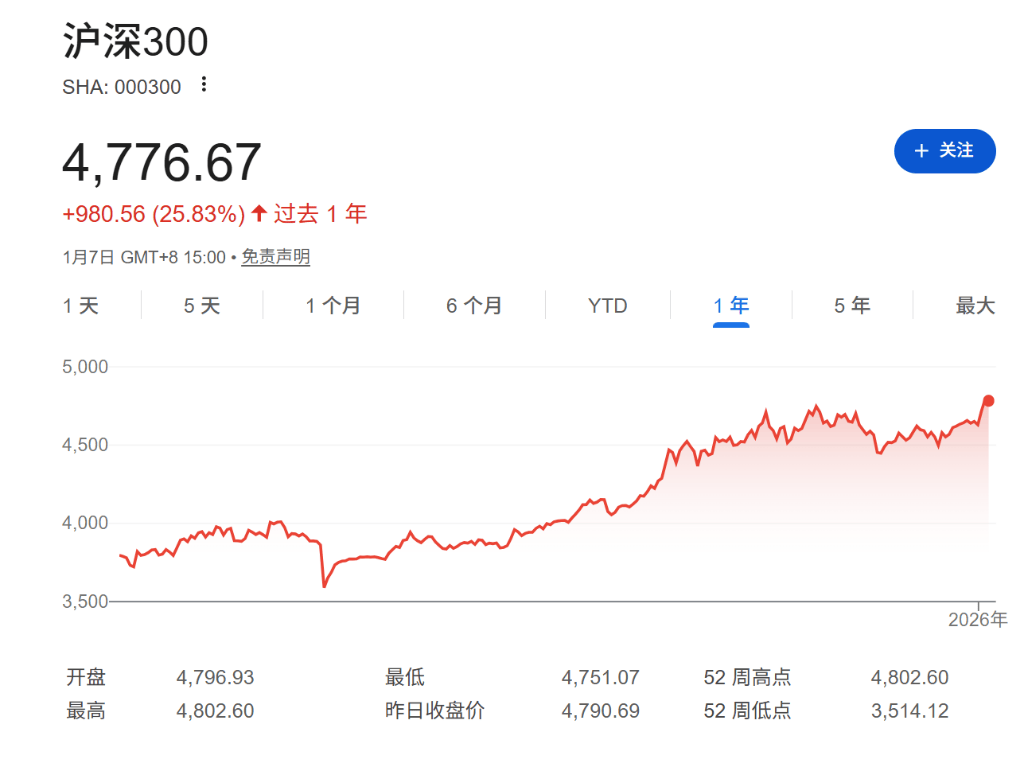
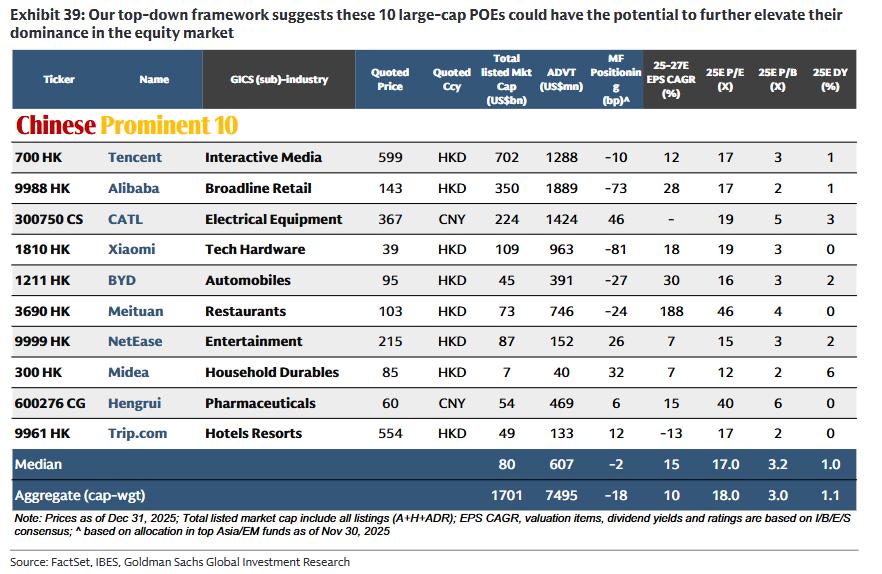
Group 1: Market Outlook - Goldman Sachs predicts that Chinese stocks will be supported by artificial intelligence and policy measures, with the MSCI China Index expected to rise by 20% by the end of 2026, and the CSI 300 Index projected to increase by 12% to 5200 points [1] - As of the first trading day of 2026, the CSI 300 Index has already risen by 3.5%, reaching a four-year high, while the MSCI China Index has increased by approximately 3.6%, outperforming the S&P 500 [1] Group 2: Earnings-Driven Growth - The core argument of Goldman Sachs' report is that returns in 2026 will be primarily driven by earnings growth, supported by artificial intelligence, "going global" strategies, and anti-involution policies [2] - Five major capital flows are expected to support the market: net southbound capital inflows potentially reaching a record $200 billion; domestic asset reallocation bringing about 3 trillion RMB into the stock market; total dividends and buybacks nearing 4 trillion RMB; global active funds possibly increasing their allocation to Chinese stocks; and IPO financing exceeding $100 billion [2] Group 3: Investment Logic - On a macro level, Goldman Sachs has raised its forecast for China's real GDP growth in 2026, citing resilient exports as a key driver, with a trend towards diversification and quality improvement in export destinations [4] - The report indicates that the valuation of the MSCI China Index and CSI 300 has recovered to mid-cycle levels, with forward P/E ratios of 12.4x and 14.5x, respectively, around or slightly above the 10-year average [4] Group 4: Sector and Company Insights - Goldman Sachs expects the TMT sector (technology, media, and telecommunications) to have the highest earnings growth forecast at approximately 20%, driven by AI-related revenue growth and increased capital expenditures [5] - The firm holds an "overweight" view on several sectors, including technology hardware, media/entertainment, internet retail, materials, and insurance, benefiting from various supportive factors [5] - A list of ten leading Chinese companies comparable to the "Big Seven" in the U.S. stock market includes Tencent, Alibaba, CATL, Xiaomi, BYD, Meituan, NetEase, Hengrui Medicine, and Trip.com, with a total market capitalization of $1.7 trillion, accounting for 40% of the MSCI China Index [6]



光伏50ETF(159864)涨超0.7%,行业“反内卷”政策加速推进
Mei Ri Jing Ji Xin Wen· 2026-01-08 06:41
Core Viewpoint - The photovoltaic industry is entering a bottoming phase, with the expectation that "anti-involution" policies will accelerate, leading to a need for continuous cost reduction and efficiency improvement, which will drive demand for new equipment [1] Group 1: Industry Trends - The photovoltaic equipment industry is expected to see a rise in demand for new technologies such as N-type long crystal, Xbc/0BB/HJT/TOPCon, which will also increase the demand for related equipment, core components, and consumables in the short term [1] - In the medium to long term, perovskite battery technology is anticipated to open up new growth avenues for the photovoltaic industry [1] - The photovoltaic sector is part of the broader semiconductor industry, with core equipment and components having the potential to extend into the semiconductor equipment market, thus creating long-term development opportunities [1] Group 2: Market Dynamics - The overseas market is identified as a significant direction for power equipment, with exports related to power and new energy equipment expected to benefit from the resolution of Europe's energy vulnerabilities [1] - The Photovoltaic 50 ETF (159864) tracks the photovoltaic industry index (931151), which selects listed companies involved in silicon materials, silicon wafers, battery cells, modules, and photovoltaic equipment to reflect the overall performance and development trends of China's photovoltaic industry [1] - The index is characterized by high growth potential and volatility, effectively representing the market performance of upstream and downstream companies in the photovoltaic industry chain [1]
单日吸金近7亿元!恒生科技ETF(513130)基金份额升至594亿份,多重利好或助力港股配置机遇
Xin Lang Cai Jing· 2026-01-08 05:48
Core Viewpoint - The recent performance of the Hang Seng Tech ETF (513130) indicates strong investor interest, with significant capital inflows and a favorable market outlook for the Hong Kong tech sector driven by expectations of RMB appreciation and increased foreign investment [1][2][3]. Group 1: Market Performance - The Hang Seng Tech ETF experienced a net inflow of 687 million yuan on January 7, 2026, increasing its fund size to 44.5 billion yuan and total shares to 59.4 billion [1][8]. - The Hong Kong stock market, particularly the tech sector, has shown signs of recovery, with a total net purchase of 27.6 billion HKD by southbound funds in the first three trading days of 2026, reflecting a rebound in confidence from mainland investors [2][9]. Group 2: Valuation and Growth Potential - The Hang Seng Tech Index currently has a price-to-earnings (PE) ratio of 23.68, which is at the lower end of its historical range, suggesting significant potential for valuation recovery [3][10]. - Goldman Sachs projects that Chinese corporate earnings will grow by 14% and 12% in 2026 and 2027, respectively, with an additional estimated 10% potential for valuation recovery, driven by advancements in AI, corporate expansion abroad, and anti-involution policies [4][11]. Group 3: Investment Vehicle Advantages - The Hang Seng Tech ETF offers advantages such as large scale, good liquidity, and support for T+0 trading, with a low management fee of only 0.2% per year [5][12]. - Investors unable to directly trade ETFs can consider related ETF-linked funds for exposure [5][12].
纯碱、玻璃日报-20260108
Jian Xin Qi Huo· 2026-01-08 01:31
行业 纯碱、玻璃日报 日期 2026 年 1 月 8 日 油) 021-60635738 lijie@ccb.ccbfutures.com 期货从业资格号:F3031215 021-60635737 renjunchi@ccb.ccbfutures.com 期货从业资格号:F3037892 硅)028-8663 0631 penghaozhou@ccb.ccbfutures.com 期货从业资格号:F3065843 021-60635740 pengjinglin@ccb.ccbfutures.com 期货从业资格号:F3075681 021-60635570 liuyouran@ccb.ccbfutures.com 期货从业资格号:F03094925 021-60635727 期货从业资格号:F03134307 fengzeren@ccb.ccbfutures.com 能源化工研究团队 研究员:李捷,CFA(原油燃料 研究员:任俊弛(PTA、MEG) 研究员:彭浩洲(尿素、工业 研究员:彭婧霖(聚烯烃) 研究员:刘悠然(纸浆) 研究员:冯泽仁(玻璃、纯碱) 请阅读正文后的声明 #summary# 每日报告 ...
2025年经济运行稳中有进 顺利收官
Sou Hu Cai Jing· 2026-01-07 17:15
Economic Outlook - The global economy in 2026 is expected to exhibit a complex system characterized by non-linearity, path dependence, and adaptability, showing high instability but resilience [1] - The "First Financial Chief Economist Confidence Index" for January 2026 is reported at 50.32, indicating a recovery and maintaining a prosperous state [2][3] Inflation and Price Predictions - The average predicted year-on-year CPI growth for December 2025 is 0.8%, while the PPI is forecasted at -2% [5][6] - CPI predictions range from a minimum of 0.5% to a maximum of 0.9%, indicating a slight increase from November's 0.7% [6] - The PPI predictions range from -2.3% to -1.9%, showing a slight improvement from the previous month's -2.2% [6] Industrial and Investment Growth - The predicted growth rate for industrial added value in December 2025 is 4.9%, slightly above the previous month's 4.8% [9][10] - Fixed asset investment is expected to decline by an average of -2.2%, showing a recovery from November's -2.6% [11] - Real estate development investment is forecasted to decrease by -15.8%, with signs of a narrowing decline in transaction volumes [12] Trade and Export Forecasts - The trade surplus for December 2025 is predicted to be $1113.5 billion, remaining stable compared to the previous month [13][14] - Exports are expected to grow by 2.5%, down from 5.9% in the previous month, while imports are forecasted to increase by 0.7% [14][15] Financing and Monetary Policy - New loans are projected to reach 7182.5 billion yuan in December 2025, recovering from the previous month's 3900 billion yuan [15][16] - The total social financing is expected to average 1.8 trillion yuan, lower than the previous month's 2.5 trillion yuan [16][17] - M2 growth is predicted to remain at 8%, consistent with November's figures [18] Policy Directions - Fiscal policy is anticipated to become more proactive, with an increase in the scale of government debt and continued support for local debt initiatives [20][21] - Monetary policy is expected to remain moderately accommodative, with potential for further interest rate cuts and reserve requirement reductions [20][21]
慢牛行情继续!高盛再次唱多中国股市:盈利驱动,2026年指数再涨20%
Zhi Tong Cai Jing· 2026-01-07 13:57
Core Viewpoint - Goldman Sachs maintains a bullish outlook on the Chinese stock market, predicting a 20% increase in the MSCI China Index and a 12% increase in the CSI 300 Index by 2026, driven entirely by earnings growth [1] Group 1: Fund Inflows - In 2026, net inflows into the Chinese stock market are expected to exceed outflows, with southbound capital net purchases projected to reach $200 billion, setting a new historical high [2][8] - Domestic asset reallocation may accelerate, potentially bringing an additional 3 trillion RMB ($420 billion) into the stock market [7] - The anticipated scale of dividends and buybacks this year could approach 4 trillion RMB ($570 billion) [7] Group 2: Policy Expectations - Monetary policy is expected to further ease through moderate reserve requirement ratio (RRR) and interest rate cuts, despite potential upward pressure on the RMB against the USD [3] - Fiscal policy is projected to rebound, with the general fiscal deficit rate expected to rise from 11% in 2025 to 12.2% in 2026, supporting real estate destocking and infrastructure investments [3] - Regulatory stance towards the private economy is expected to remain supportive, with friendly stock market policies likely to continue unless there are signs of excessive valuations or rampant speculation [4] Group 3: Market Dynamics - The supply of funds is seen as a crucial factor for the slow bull market in Chinese stocks [5] - The "national team" is estimated to hold approximately 6 trillion RMB in Chinese stocks, acting as a stabilizing force during market sell-offs [10] - Corporate buybacks are projected to increase by 20% in 2026, following a strong performance in 2025 [10] Group 4: Investor Behavior - Global long-term investors are expected to reduce their underweight position in Chinese stocks, with a potential buying scale of $10 billion [8][9] - Domestic individual investors have significant room for reallocating assets, with only 11% currently in stocks compared to 54% in real estate and 28% in cash [9] - Institutional investors are anticipated to bring in 30 trillion RMB and 14 trillion RMB into the market, aligning with developed and emerging market averages [9]

万家基金贺方舟:看好“反内卷”政策对有色产业的长期影响
Zhong Zheng Wang· 2026-01-07 13:57
Core Viewpoint - The "anti-involution" policy is expected to have a long-term positive impact on the non-ferrous metal sector by addressing the imbalance of "excess low-end capacity and insufficient high-end capacity" through capacity constraints and structural upgrades [1] Supply Side Summary - The core of the "anti-involution" policy involves strict capacity replacement (e.g., electrolytic aluminum) and stringent control over new capacity in copper smelting and alumina production [1] - A dynamic monitoring mechanism for capacity expansion will be implemented to prevent disorderly growth, leading the industry to shift from "quantity-driven" to "quality-driven" [1] - Low-end capacities in oversupplied sectors such as alumina and copper smelting will gradually exit the market, enhancing the competitive advantage of leading enterprises [1] Price Side Summary - The previous "involution-style" price wars resulted in non-ferrous product prices being consistently below cost, severely compressing corporate profits [1] - The "anti-involution" policy aims to combat low-price disorderly competition, promoting prices to return to a reasonable range [1]
万亿外资巨头,加仓!
Zhong Guo Ji Jin Bao· 2026-01-07 13:52
Group 1 - BlackRock increased its holdings in Haier Smart Home, WuXi Biologics, Midea Group, and Bank of China on January 2, 2026 [1][3] - The shareholding percentage of WuXi Biologics increased from 5.32% to 6.14%, Midea Group from 5.15% to 6.75%, Bank of China from 5.98% to 6.11%, and Haier Smart Home from 7.72% to 8.34% [3] - Previously, on December 29, 2025, BlackRock had reduced its holdings in Midea Group from 7.03% to 5.16% and in Bank of China from 6.07% [3] Group 2 - Goldman Sachs released a report predicting that China's GDP growth in 2026 will exceed market expectations, recommending an overweight position in Chinese stocks [4][5] - The report anticipates a continuation of the bull market in Chinese stocks, with annual growth rates of 15% to 20% in 2026 and 2027, supported by earnings growth and valuation re-rating [5] - UBS Wealth Management expressed optimism for the Chinese market, highlighting advanced manufacturing and technological self-reliance as new growth engines, with a projected 37% earnings growth for the Hang Seng Tech Index in 2026 [5]



人民币汇率,藏着A股的牛市密码
财富FORTUNE· 2026-01-07 13:04
Core Viewpoint - The A-share market has shown a strong performance at the beginning of 2026, characterized by a structural shift where sectors like commercial aerospace, artificial intelligence, and robotics are thriving, while many stocks lack macro and industrial narrative support [1] Group 1: Market Performance and Trends - The A-share market experienced a "14 consecutive days of gains," with the Shanghai Composite Index surpassing 4000 points, marking a ten-year high [1] - The market is witnessing a shift in investment style, driven by a stable RMB exchange rate, which is becoming a key anchor for global capital reassessing the value of Chinese assets [1][3] - In 2025, the RMB appreciated over 4.2% against the USD, and this trend continued into 2026, with the RMB remaining below 7.0 [3] Group 2: Foreign Investment and Capital Flows - Foreign net inflows into the Chinese stock market reached $50.6 billion in the first ten months of 2025, significantly exceeding the total for 2024 [4] - The RMB's appreciation is enhancing the attractiveness of A-shares in global asset portfolios, allowing foreign investors to diversify risks and benefit from China's economic growth [3][4] Group 3: Economic and Policy Outlook - The People's Bank of China aims to maintain the RMB exchange rate's basic stability, indicating a policy that allows for fluctuations but prevents excessive volatility [3] - The macroeconomic backdrop includes uncertainties in global economic policies, with potential risks such as concentrated currency settlement that could lead to an over-appreciation of the RMB [4] Group 4: Sector Focus and Investment Strategies - Investment strategies are increasingly focused on technology innovation, with sectors like AI, commercial aerospace, and high-end manufacturing attracting long-term capital [5] - Analysts predict that China's GDP growth will exceed market consensus, with stock market growth supported by earnings growth and valuation re-rating [5][6] - The current market dynamics suggest a transition from liquidity-driven to fundamentals-driven growth, with institutional investors taking a more significant role [6] Group 5: Future Implications for Investors - The anticipated appreciation of the RMB and the transformation of the Chinese economy are expected to lead to a global revaluation of high-quality core assets priced in RMB [6][7] - Investors are encouraged to shift from a trading mindset focused on market volatility to a holding strategy that embraces industrial trends and focuses on sectors with strong consensus [7]

高盛坚定看好中国股市:AI与出海支撑盈利,MSCI中国今年有望上涨20%
Sou Hu Cai Jing· 2026-01-07 09:13
Core Viewpoint - Goldman Sachs issues a bullish outlook for the Chinese stock market in its 2026 market outlook report, predicting significant gains driven by corporate profit growth [1][2] Market Performance - The MSCI China Index and the CSI 300 Index are expected to rise by 20% and 12% respectively in 2026, with a shift from valuation-driven growth to profit-driven growth [1][2] - The profit growth rate for Chinese listed companies is forecasted to accelerate from 4% in 2025 to 14% in 2026, particularly benefiting the TMT sector [1][4] Key Drivers - The optimistic forecast is based on three main drivers: artificial intelligence (AI), outbound strategies, and anti-involution policies [4] - The TMT sector is particularly favored, with expected profit growth of around 20% due to advancements in AI monetization and increased capital expenditure [4] Fund Flows - Southbound capital is projected to reach a record net inflow of $200 billion in 2026, driven by expanded investment scope and attractive dividend yields [5][6] - Domestic asset reallocation is expected to contribute approximately 3 trillion RMB to the stock market, supported by a decline in risk-free rates [5] - Share buybacks and dividends are anticipated to total nearly 4 trillion RMB, providing substantial cash returns to investors [6] Industry Allocation - Goldman Sachs maintains an overweight rating on internet/media entertainment, online retail, technology hardware, materials, and insurance sectors [7] - The technology hardware sector is upgraded to overweight, seen as a key beneficiary of AI development and self-sufficiency strategies [7] Valuation and Policy - Current valuations for the MSCI China Index and CSI 300 Index are at 12.4x and 14.5x respectively, considered attractive compared to global markets [8] - The market is expected to benefit from supportive monetary and fiscal policies, as well as a favorable regulatory environment for the private sector [8]