
信用利差

Search documents
资金疯狂涌入债券型ETF,规模超百亿的债券ETF达15只
Ge Long Hui· 2025-07-03 06:24
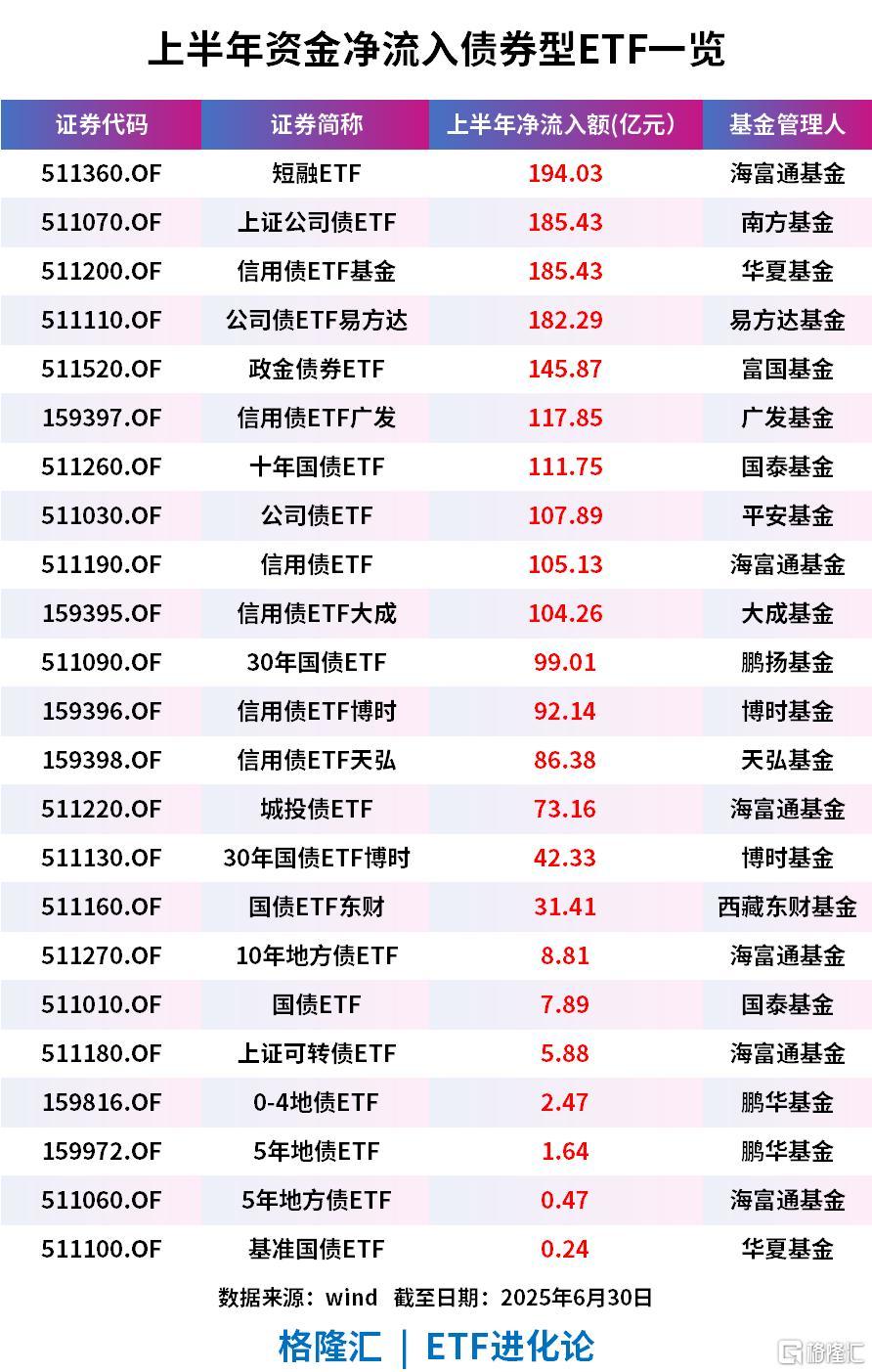
Group 1 - The total scale of ETFs surpassed 4 trillion yuan, reaching 4.31 trillion yuan, representing a growth of 15.57% compared to the end of last year [1] - The largest growth in the first half of the year was seen in bond ETFs, which grew by 120.71% to 383.976 billion yuan [1] - A total of 29 bond ETFs reached a combined scale of 383.976 billion yuan, setting a new historical record [1] Group 2 - Bond ETFs had the highest net inflow in the first half of the year, totaling 175.784 billion yuan [1] - Notable bond ETFs with net inflows exceeding 10 billion yuan include Hai Futong Short-term Bond ETF, Southern Shanghai Stock Company Bond ETF, and others [1] - The top bond ETF by scale is the Government Financial Bond ETF, which reached 52 billion yuan [5][7] Group 3 - There are 15 bond ETFs with a scale exceeding 10 billion yuan, including various types such as policy financial bonds and corporate bonds [5] - The rapid growth of bond ETFs is attributed to factors such as increased market liquidity, lower costs, improved regulatory frameworks, and a shift in investor risk preferences [10] - The credit bond market is experiencing fluctuations in yield, with low-grade credit spreads compressing the most [11] Group 4 - The outlook for the second half of the year suggests that credit bond yields are likely to remain volatile, with potential for credit spreads to widen due to supply-demand mismatches [12][13] - Investment strategies should focus on short to medium-term high-grade credit bonds and consider opportunities in local government bonds [12]

信用债2025年半年度报告:供给分化,择木而栖
Ping An Securities· 2025-07-03 05:21
Group 1 - The report indicates that in the first half of 2025, the market saw an increase in government bond yields, while credit bond yields fluctuated, leading to a compression of credit spreads, particularly in lower-rated bonds [2][8][11] - The overall strategy for credit bonds in the second half of 2025 suggests that yields may follow government bonds downward, but supply could increase while demand weakens, posing a risk of widening credit spreads [2][30][35] - The report recommends focusing on city investment bonds with weakening supply, followed by financial bonds, as potential investment opportunities [2][30][39] Group 2 - For city investment bonds, the report highlights opportunities for spread compression in high-quality regional bonds, supported by policies aimed at alleviating credit risks [3][43][54] - In the industrial bond sector, the report suggests monitoring the recovery of spreads following the resolution of risk events related to state-owned enterprise bonds, as well as opportunities arising from debt collection policies [3][58][63] - The financial bond segment is expected to see a decrease in supply pressure for perpetual bonds, particularly due to the consolidation of rural commercial banks, which may present structural opportunities [3][67][76] Group 3 - The report notes that the supply of credit bonds is expected to increase in the second half of 2025, with government bond net financing projected to be lower than the previous year, while industrial bonds may see a rise in supply [30][32][35] - Demand for credit bonds may weaken, leading to a potential widening of credit spreads, as the report anticipates a decrease in the attractiveness of bank deposits compared to bonds [33][35][36] - Historical data suggests that during periods of widening credit spreads, extending duration and focusing on lower-rated bonds have been effective strategies [36][37][39] Group 4 - The report emphasizes that the city investment bond market is under strict regulatory scrutiny, particularly for lower-rated bonds, which may limit their issuance [54][57] - The industrial bond sector is expected to benefit from government policies aimed at supporting state-owned enterprises, particularly in real estate and construction [63][66] - The financial bond market is likely to experience a shift towards stronger credit profiles, especially in regions undergoing consolidation of rural commercial banks [72][76]
银行理财周度跟踪(2025.6.23-2025.6.29):股债跷跷板效应凸显,银行理财产品收益承压-20250701
HWABAO SECURITIES· 2025-07-01 11:29
Investment Rating - The report does not explicitly provide an investment rating for the banking wealth management industry Core Insights - The report highlights the pressure on bank wealth management product yields due to the stock-bond seesaw effect and seasonal liquidity constraints, indicating a potential long-term decline in yields [4][17] - Regulatory changes are pushing for innovation in financial products to meet household wealth management needs, which is crucial for the banking wealth management sector [10][11] - The report notes that the valuation rectification of bank wealth management products is ongoing, with many institutions completing their mid-year plans by the end of June [11][12] Summary by Sections Regulatory and Industry Dynamics - On June 24, the People's Bank of China and five other departments issued guidelines to support consumption and promote financial products that meet household wealth management needs [3][10] - The valuation rectification of bank wealth management products is a significant focus, with many banks reporting progress in their mid-year plans [11] - As of the end of May, the total net asset value of public funds in China reached 33.74 trillion yuan, reflecting a growth of 6.26 billion yuan from April [12] Yield Performance - For the week of June 23-29, cash management products recorded a 7-day annualized yield of 1.42%, up by 1 basis point, while money market funds reported a yield of 1.32%, up by 2 basis points [4][14] - Most pure fixed income and fixed income+ products saw a decline in annualized yields, influenced by various factors including the stock-bond seesaw effect and geopolitical risks [16][17] Net Asset Value Tracking - The report indicates that the net asset value of bank wealth management products was 0.83%, up by 0.1 percentage points, remaining at a low level [25][26] - Credit spreads have narrowed, indicating limited value, and future trends in credit spreads will be closely monitored as they may impact the net asset value [25][27]
【银行理财】股债跷跷板效应凸显,银行理财产品收益承压(2025.6.23-2025.6.29)
华宝财富魔方· 2025-07-01 11:15
Regulatory and Industry Dynamics - On June 24, the People's Bank of China and six other departments issued guidelines to support consumption, emphasizing the need for innovative financial products that meet household wealth management needs and enhance residents' property income [2][5] - As of May 2025, there are 164 public fund management institutions in China, managing a total net asset value of 33.74 trillion yuan, an increase of 6.26 billion yuan from April [6] Yield Performance - For the week of June 23-29, 2025, cash management products recorded an annualized yield of 1.42%, up 1 basis point, while money market funds reported a yield of 1.32%, up 2 basis points [3][8] - The yield of pure fixed income and fixed income + products generally declined, influenced by factors such as the stock-bond seesaw effect and seasonal liquidity [9][10] Product Innovation and Market Trends - ICBC Wealth Management and China Post Wealth Management participated as cornerstone investors in the IPO of Sanhua Intelligent Control, each acquiring a stake of 20 million USD [7] - The ongoing valuation rectification in bank wealth management is expected to limit product yield potential, as companies shift focus towards low-volatility, high-liquidity assets [10][14]

2025上半年债市回顾:债券同比发行增长逾两成 国债收益率先上后下
Xin Hua Cai Jing· 2025-06-30 23:13
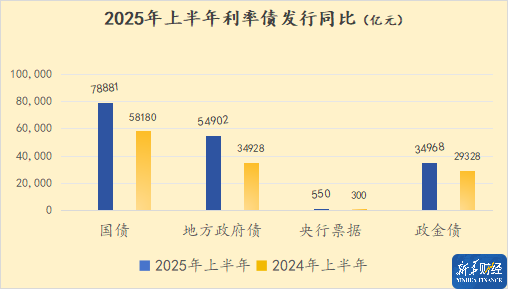
Market Overview - As of June 30, the bond market showed slight weakness influenced by PMI data, cross-quarter funding, and stock market performance, continuing a narrow fluctuation pattern [1] - Overall, the yield on government bonds is expected to rise initially and then decline in the first half of 2025, with credit spreads mostly narrowing [1] - The funding environment is balanced and slightly loose, with a decrease in funding prices compared to June, where the average decline of DR007 is about 10 basis points [1] Bond Issuance - By June 30, the total issuance of various bonds reached 27.29 trillion yuan, a year-on-year increase of nearly 24%, with government bonds accounting for 16.93 trillion yuan and credit bonds 10.35 trillion yuan [2] - In the first half of 2025, 98 government bonds were issued, a decrease of 8 from the previous year, with the issuance scale increasing by over 2 trillion yuan [4] - Local government bonds saw an increase in issuance, with 1,086 bonds issued, up 310 from the previous year, and the average issuance rate down by approximately 55 basis points [6] Trading Volume - The total trading volume of cash bonds in the market was 166.43 trillion yuan, a year-on-year decrease of 6.94%, with credit bonds accounting for 39.63 trillion yuan [16] - The trading volume of interest rate bonds also decreased, with a total of 124.29 trillion yuan traded, down 6.49% year-on-year [17] Yield Trends - The yield curve for government bonds showed an overall decline in the first half of 2025, with significant decreases in the medium to long end, such as a 55.89 basis point drop in the 10-year yield [19] - Local government bonds exhibited similar trends, with the 10-year yield down by 55.51 basis points [21] Institutional Insights - Institutions expect that the funding rates will remain loose in July, but the issuance of local special bonds may create some disturbances in the funding environment [29] - The basic economic trends are still favorable for the bond market, with internal demand needing improvement and external demand facing challenges [30]
信用分析周报:继续关注2%以上的高票息信用债-20250629
Hua Yuan Zheng Quan· 2025-06-29 14:10
Report Industry Investment Rating No relevant content provided. Report's Core View - The logic of being bullish on credit bonds with a yield of over 2% remains unchanged this week. It is recommended to moderately lower the credit quality and extend the duration, especially focusing on medium- to long-term high-coupon urban investment bonds and bank Tier 2 and perpetual bonds with a yield of over 2% and good liquidity [2][43]. Summary by Directory 1. Primary Market 1.1 Net Financing Scale - The net financing of traditional credit bonds (excluding asset-backed securities) was 153.6 billion yuan this week, a decrease of 110.9 billion yuan compared to last week. The total issuance was 427.5 billion yuan, a decrease of 150.7 billion yuan, and the total repayment was 273.9 billion yuan, a decrease of 39.8 billion yuan. The net financing of asset-backed securities was 8.8 billion yuan, a decrease of 24.3 billion yuan [7]. - By product type, the net financing of urban investment bonds was 49.5 billion yuan, an increase of 32.5 billion yuan; the net financing of industrial bonds was 48.9 billion yuan, a decrease of 97.3 billion yuan; and the net financing of financial bonds was 55.2 billion yuan, a decrease of 46.2 billion yuan [7]. - In terms of issuance and redemption quantity, the issuance of urban investment bonds increased by 4, and the redemption decreased by 17; the issuance of industrial bonds decreased by 21, and the redemption remained unchanged; the issuance of financial bonds decreased by 6, and the redemption decreased by 16 [9]. 1.2 Issuance Cost - The issuance rates of AA industrial bonds, AA+ and AAA financial bonds increased significantly, while the issuance rate of AA+ industrial bonds decreased. The issuance rates of other bonds with different ratings changed by no more than 4BP [15]. - Specifically, the issuance rate of AA+ financial bonds increased by 63BP, mainly due to the high issuance costs and large issuance scales of bonds such as "25 Chouzhou Commercial Bank Tier 2 Capital Bond 01" and "25 Chengde Bank Perpetual Bond 01". The issuance rate of AAA financial bonds increased by 20BP, mainly due to the 30 billion yuan issuance of "25 Minsheng Bank Perpetual Bond 01" with an issuance rate of 2.3%. The issuance rate of AA industrial bonds increased by 18BP, mainly due to the high issuance rates of bonds such as "25 Jingjiang Beichen MTN003" and "25 Zhongtou 01". The issuance rate of AA+ industrial bonds decreased by 15BP, mainly due to the large number of bonds issued with a coupon rate below 2.3% [15]. 2. Secondary Market 2.1 Trading Volume - The trading volume of credit bonds (excluding asset-backed securities) decreased by 129.9 billion yuan compared to last week. The trading volume of urban investment bonds was 293.6 billion yuan, a decrease of 4 billion yuan; the trading volume of industrial bonds was 432.1 billion yuan, a decrease of 35.3 billion yuan; the trading volume of financial bonds was 511.6 billion yuan, a decrease of 90.5 billion yuan. The trading volume of asset-backed securities was 26.5 billion yuan, an increase of 5.7 billion yuan [16]. - In terms of turnover rate, the turnover rate of traditional credit bonds decreased overall, while the turnover rate of asset-backed securities increased. The turnover rate of urban investment bonds was 1.89%, a decrease of 0.03 percentage points; the turnover rate of industrial bonds was 2.49%, a decrease of 0.22 percentage points; the turnover rate of financial bonds was 3.54%, a decrease of 0.63 percentage points. The turnover rate of asset-backed securities was 0.75%, an increase of 0.13 percentage points [17]. 2.2 Yield - The yield of credit bonds fluctuated slightly this week, with the long - end performing better than the medium - and short - ends. Specifically, the yields of AA+, AAA - and AAA bonds with a maturity of over 10 years decreased by 2BP, 3BP and 1BP respectively compared to last week. The yields of AA+, AAA - bonds with a maturity of 3 - 5 years and AA+ bonds with a maturity of 5 - 7 years decreased by less than 1BP. The yields of credit bonds with other ratings and maturities increased by 0 - 4BP [21]. - By product type, taking the AA+ 5 - year bonds of each product as an example, the yields of different products showed mixed trends. Among industrial bonds, the yields of privately - issued industrial bonds and extendible industrial bonds decreased by 4BP and increased by 1BP respectively compared to last week. Among urban investment bonds, the yield of AA+ 5 - year urban investment bonds increased by 1BP. Among financial bonds, the yields of commercial bank ordinary bonds and Tier 2 capital bonds decreased by 1BP and increased by 1BP respectively. Among asset - backed securities, the yield of AA+ 5 - year asset - backed securities increased by less than 1BP [22]. 2.3 Credit Spread - Overall, the credit spreads of most industries fluctuated slightly this week, and the credit spread of the AA+ electronics industry contracted significantly. Specifically, the credit spread of the AA real estate industry widened by 14BP; the credit spreads of the AA+ electronics and electrical equipment industries contracted by 62BP and 9BP respectively, and the credit spread of the steel industry widened by 12BP; the credit spread of the AAA electrical equipment industry contracted by 9BP. The fluctuations of credit spreads of bonds in other industries and ratings were no more than 5BP [23]. 2.3.1 Urban Investment Bonds - By maturity, the credit spreads of urban investment bonds within 5 years widened slightly, while those over 5 years compressed slightly. Specifically, the credit spread of 0.5 - 1 - year urban investment bonds was 43BP, an increase of 2BP; the credit spread of 1 - 3 - year urban investment bonds was 44BP, an increase of 2BP; the credit spread of 3 - 5 - year urban investment bonds was 63BP, an increase of 1BP; the credit spread of 5 - 10 - year urban investment bonds was 53BP, a decrease of 1BP; the credit spread of over 10 - year urban investment bonds was 43BP, a decrease of 4BP [27]. - By region, the credit spreads of AA urban investment bonds in Shanxi and AAA urban investment bonds in Jilin widened significantly, while the credit spread of AA urban investment bonds in Liaoning compressed by 6BP. The fluctuations in other regions were relatively small [28]. 2.3.2 Industrial Bonds - The credit spreads of industrial bonds showed mixed trends this week, and the 5 - year industrial bonds performed well overall. Specifically, the credit spreads of 5 - year AAA -, AA+ and AA privately - issued industrial bonds compressed by 1BP, 4BP and 4BP respectively, and the credit spreads of 5 - year AAA - and AA extendible industrial bonds compressed by 2BP and 3BP respectively. The credit spreads of industrial bonds with other maturities and different subject ratings mostly widened compared to last week, with a fluctuation range of 0 - 3BP [31]. 2.3.3 Bank Capital Bonds - The credit spreads of bank Tier 2 and perpetual bonds mostly widened slightly this week. By product and maturity, for bank Tier 2 capital bonds, the credit spreads of AAA -, AA+ and AA bonds with a maturity of 1 year widened by 3BP, 2BP and 2BP respectively, and the credit spreads of AAA -, AA+ and AA bonds with a maturity of 10 years widened by 2BP, 2BP and 2BP respectively. For bank perpetual bonds, the credit spreads of AAA -, AA+ and AA bonds with a maturity of 1 year widened by 3BP, 3BP and 4BP respectively, and the credit spreads of AAA -, AA+ and AA bonds with a maturity of 10 years widened by 2BP, 2BP and 2BP respectively [35]. 3. This Week's Bond Market Sentiment - Due to the concentrated disclosure of bond follow - up rating reports near the end of June, there were many credit negative events this week. - Convertible bond negative sentiment: 16 issuers had their ratings downgraded, and the ratings of 16 convertible bonds they issued were also downgraded; 2 issuers were put on the watch list, and the 2 convertible bonds they issued were also put on the watch list [38]. - Other credit negatives: 3 issuers had their ratings downgraded, 37 bond issues had their ratings downgraded, and 10 bond issues had their implied ratings downgraded. Guizhou Shuicheng Economic Development Zone High - tech Development Investment Co., Ltd. was put on the issuer watch list, and its "18 Shuicheng High - tech Bond" was put on the bond watch list [40]. 4. Investment Suggestion - The central bank achieved a net injection of 126.72 billion yuan this week, and DR001 decreased from 1.35% at the beginning of the week to 1.29%. - Overall, the credit spreads of most industries fluctuated slightly, the credit spread of the AA+ electronics industry contracted significantly. The credit spreads of urban investment bonds within 5 years widened slightly, while those over 5 years compressed slightly. The credit spreads of industrial bonds showed mixed trends, and the 5 - year industrial bonds performed well. The credit spreads of bank Tier 2 and perpetual bonds mostly widened slightly. The yields of credit bonds fluctuated slightly, with the long - end performing better than the medium - and short - ends. - It is recommended to continue to focus on bank Tier 2 and perpetual bonds of banks such as Minsheng Bank, Bohai Bank and Hengfeng Bank, and urban investment bonds in regions such as Yunnan, Shaanxi and Tianjin, such as Yunnan Construction Investment Holding Group Co., Ltd., Xianyang Urban Development Group Co., Ltd. and Tianjin Bohai State - owned Assets Management Co., Ltd., which have relatively high static coupon rates [43].

超长信用债涨势暂歇,3-5年中低等级表现占优
Xinda Securities· 2025-06-28 14:49
Report Industry Investment Rating The document does not provide information about the report industry investment rating. Core Viewpoints - The rally of ultra-long credit bonds has paused, with 3 - 5-year medium and low-grade bonds performing better. Interest rate bond yields have shown narrow fluctuations overall, while credit bond yields have also maintained a volatile pattern. Credit spreads have different changes across various maturities and ratings [2][5]. - Most urban investment bond spreads have increased, with varying trends among different regions and ratings [2][9]. - Industrial bond spreads are generally stable, but the spreads of mixed-ownership real estate bonds continue to rise [2][13]. - Most yields of secondary capital and perpetual bonds (Two-Permanent Bonds) have increased, and the spreads have slightly widened [2][26]. - The excess spreads of industrial perpetual bonds have decreased, while those of urban investment perpetual bonds have slightly increased [2][28]. Summary by Directory 1. The Rally of Ultra-long Credit Bonds Pauses, 3 - 5-year Medium and Low-grade Bonds Perform Better - Interest rate bond yields have narrow fluctuations: 1Y and 5Y Guokai bond yields have decreased by 1BP, 3Y yields remain flat, and 7Y and 10Y yields have increased by 1 - 2BP [5]. - Credit bond yields are volatile: The yields of 7-year and 3 - 5-year high-grade bonds have rebounded, while 3 - 5-year medium and low-grade bonds perform relatively strongly. Yield changes vary by maturity and rating [5]. - Credit spreads: 1Y spreads change between -1 and 1BP; 3Y AAA spreads increase by 3BP, others decrease by 2BP; 5Y AAA spreads increase by 3BP, others decrease by 3 - 4BP; 7Y spreads increase by 0 - 1BP; 10Y spreads of AAA, AA+, and AA change by 2BP, -2BP, and 1BP respectively [2][5]. - Rating and term spreads show obvious differentiation [5]. 2. Most Urban Investment Bond Spreads Increase - External ratings: AAA and AA+ platform spreads increase by 2BP, AA platform spreads increase by 3BP [2][9]. - Provincial platforms: Most AAA platform spreads increase by 1 - 3BP, with Guangxi decreasing by 4BP, Jilin and Liaoning increasing by 5BP; most AA+ platform spreads increase by 1 - 3BP, Jilin increasing by 7BP; most AA platform spreads increase by 1 - 3BP, Liaoning decreasing by 6BP, Xinjiang and Gansu increasing by 4BP [9][10][11]. - Administrative levels: Provincial, prefecture-level, and district-level platform spreads all increase by 2BP, with different trends in different regions [14][15]. 3. Industrial Bond Spreads are Generally Stable, Mixed-ownership Real Estate Bond Spreads Continue to Rise - Real estate bonds: Central and local state-owned enterprise real estate bond spreads are basically flat compared to last week, mixed-ownership real estate bond spreads increase by 8BP, and private enterprise real estate bond spreads increase by 40BP. Spreads of individual real estate companies vary [2][13]. - Other industrial bonds: AAA coal bond spreads increase by 1BP, AA+ remain flat, AA decrease by 1BP; AAA and AA+ steel bond spreads decrease by 1BP and 2BP respectively; spreads of various grades of chemical bonds increase by 0 - 1BP. Spreads of individual companies such as Shaanxi Coal and HBIS decrease by 1BP, while Jinkong Coal Industry increases by 7BP [13]. 4. Most Yields of Two-Permanent Bonds Increase, Spreads Slightly Widen - 1Y bonds: Secondary capital bond yields of all grades increase by 1 - 2BP, perpetual bond yields increase by 2 - 3BP, and spreads generally increase by 2 - 3BP [26]. - 3Y bonds: Secondary capital bond yields of all grades increase by 2 - 4BP, perpetual bond yields increase by 1BP, and spreads increase in line with yields [26]. - 5Y bonds: Yields and spreads of all grades of Two-Permanent Bonds increase by 0 - 1BP [26]. 5. The Excess Spreads of Industrial Perpetual Bonds Decrease, Urban Investment Bond Excess Spreads Slightly Increase - Industrial perpetual bonds: The excess spreads of industrial AAA 3Y perpetual bonds decrease by 2.38BP to 3.81BP, at the 0.07% percentile since 2015; the excess spreads of AAA 5Y perpetual bonds decrease by 2.60BP to 8.51BP, at the 5.80% percentile [2][28]. - Urban investment perpetual bonds: The excess spreads of urban investment AAA 3Y perpetual bonds increase by 0.15BP to 6.14BP, at the 2.86% percentile; the excess spreads of AAA 5Y perpetual bonds increase by 0.44BP to 9.81BP, at the 8.80% percentile [2][28]. 6. Credit Spread Database Compilation Instructions - Market credit spreads are calculated based on ChinaBond Medium and Short-term Notes and ChinaBond Perpetual Bonds data, with historical percentiles since early 2015 [36]. - Credit spreads of industrial and urban investment individual bonds are calculated by subtracting the yield of the same-term Guokai bond from the individual bond's ChinaBond valuation, and then averaged to get the industry or regional credit spreads [36]. - Excess spreads of bank secondary capital and perpetual bonds, as well as industrial and urban investment perpetual bonds, are calculated by subtracting the credit spreads of corresponding benchmark bonds [36]. - Samples of industrial and urban investment bonds are selected from medium notes and public corporate bonds, excluding guaranteed and perpetual bonds. Bonds with remaining maturities below 0.5 years or above 5 years are excluded [36]. - Industrial and urban investment bonds use external entity ratings, while commercial banks use ChinaBond implicit debt ratings [36].
关注运输业产业集群建设
Hua Tai Qi Huo· 2025-06-26 04:57
Industry Overview Investment Rating The report does not mention the industry investment rating. Core View The report provides an overview of various industries, including production, service, upstream,中游, downstream, and market pricing, highlighting recent trends and developments in each sector. Summary by Category Production and Service Industries - Shanghai plans to build a world - class ship and offshore engineering equipment industrial cluster, aiming for an industry added - value of over 45 billion yuan by 2030 and a localisation rate of over 85% for large LNG carriers [1]. - The memory market, led by DDR4, is rapidly warming up, with DDR4 particle prices doubling in just two weeks [1]. - Six departments have issued a guidance on financial support for consumption, setting up a 500 - billion - yuan re - loan for service consumption and elderly care [1]. - Retirement pensions are exempt from personal income tax in Beijing [1]. Upstream - International oil prices decreased significantly compared to the previous day [2]. - Coal inventory in Qinhuangdao decreased [2]. - Egg prices have rebounded recently [2]. Midstream - The polyester operating rate declined, while the PX operating rate increased [3]. - The coal consumption of power plants dropped to a three - year low, and the power plant operating rate decreased [3]. Downstream - The sales of commercial housing in first - and second - tier cities have seasonally declined to a near - three - year low [4]. - The number of domestic flights has decreased cyclically [4]. Market Pricing - The credit spread of the entire industry has slightly declined recently [5]. Industry Credit Spread - The credit spreads of multiple industries, such as agriculture, forestry, animal husbandry and fishery, mining, and chemical industry, have declined this week [48]. Key Industry Price Indicators - The prices of various commodities, including agricultural products, metals, energy, and chemicals, have shown different trends, with some rising and some falling [49].
五矿期货文字早评-20250626
Wu Kuang Qi Huo· 2025-06-26 02:46
Report Investment Ratings No investment ratings for the industries are provided in the report. Core Views - The overall market shows mixed trends across different sectors. The stock index market has a positive performance, with most indices rising. The bond market is expected to be volatile, with a downward trend in interest rates in the long - term. The commodity market, including metals, energy, and agricultural products, also has various trends influenced by factors such as geopolitical risks, supply - demand relationships, and policy changes. [2][7] - It is recommended to take different trading strategies according to different market conditions, such as buying certain stock index futures on dips, and being cautious in the commodity market with a focus on specific opportunities and risks. [4][5] Summary by Categories Macro - financial - **Stock Index**: The previous trading day saw most indices rising, with the Shanghai Composite Index up 1.04%, the ChiNext Index up 3.11%, etc. The trading volume increased by 188.2 billion yuan. The overseas geopolitical risk has cooled down, and domestic policies are expected to support the economy. It is recommended to buy IH or IF futures on dips and consider IC or IM futures related to "new - quality productivity". [2][4] - **Treasury Bonds**: On Wednesday, most treasury bond futures had a slight decline. The economic data shows some disturbances and structural differentiation. The central bank's liquidity injection maintains a loose attitude, and the bond market is expected to be volatile and strong in the short - term, with a downward trend in interest rates in the long - term. [6][7] - **Precious Metals**: Gold and silver prices rose. The market's expectation of the Fed's loose monetary policy has increased, and the change in the bank regulatory bill is beneficial to silver. It is recommended to buy silver on dips. [8][10] Non - ferrous Metals - **Copper**: The copper price oscillated and rebounded. The overseas geopolitical situation has eased, but the uncertainty of the Fed's interest - rate cut suppresses the sentiment. The copper raw material market is tight, and the low inventory may support the price to rise, but the weakening domestic consumption limits the upside. The price is expected to oscillate and rise, and attention should be paid to the import loss for arbitrage. [12] - **Aluminum**: The aluminum price oscillated. The cost - driving force has weakened, and the demand expectation has improved. The low inventory may push the price up, but the price increase and the off - season effect limit the upside. The price is expected to oscillate in the short - term. [13] - **Zinc**: The zinc price rose slightly. The zinc industry is in the process of converting surplus zinc ore into zinc ingots, with a high expectation of zinc ingot output. However, some factors affect the inventory and production, and the geopolitical situation may affect the zinc ore export. [15] - **Lead**: The lead price rose. The lead acid battery export growth has slowed down, and the downstream consumption is weak. But the high - concentration long - position in the LME lead July contract and the reduction of domestic inventory make the price run relatively strongly, with limited upside for Shanghai lead. [16] - **Nickel**: The nickel price rebounded slightly. The cost of downstream iron plants is under pressure, and the nickel ore price may fall. The nickel iron price is also under pressure, and the refined nickel supply - demand is in an oversupply situation, with a risk of price decline. [17] - **Tin**: The tin price fell slightly. The supply of tin ore is short - term tight, but the terminal demand is in the off - season, and the price is expected to oscillate in a certain range. [18] - **Lithium Carbonate**: The lithium carbonate price fluctuated slightly. The marginal variables in supply, demand, and cost are limited, and it is recommended to operate cautiously. [19] - **Alumina**: The alumina price rose slightly. The alumina production capacity is in an oversupply situation, and the price is expected to be weakly volatile. It is recommended to short on rallies. [20] - **Stainless Steel**: The stainless steel price rose slightly. The market supply exceeds demand, and the demand is weak. The planned production cut by steel mills eases the supply - demand contradiction, but the price is expected to be weakly volatile in the short - term. [21][23] Black Building Materials - **Steel**: The steel price oscillated. The real estate demand is weak, and the market is in the off - season. The terminal demand is weakening, and the market confidence is low. Attention should be paid to policy trends, demand repair, and cost support. [25][26] - **Iron Ore**: The iron ore price was slightly down. The supply has increased, and the demand is relatively stable. The price is in a low - volatility state with support from iron production and pressure from supply. [27][28] - **Glass and Soda Ash**: The glass price is expected to be weakly volatile due to the lack of real - estate demand boost. The soda ash supply is expected to be loose, and the price is also expected to be weakly volatile. [29] - **Manganese Silicon and Ferrosilicon**: The prices of manganese silicon and ferrosilicon rose. They are still in a downward trend, and the fundamentals point to a downward price. It is not recommended to buy on dips prematurely, and attention should be paid to price fluctuations caused by market sentiment. [30][31][33] - **Industrial Silicon**: The industrial silicon price rebounded. The supply is in an oversupply situation, and the demand is weak. The price may continue to decline, and it is not recommended to buy on dips. [35][36][37] Energy and Chemicals - **Rubber**: The rubber price oscillated. The bulls expect a price increase due to potential production cuts, while the bears are concerned about weak demand. The tire开工率 is rising, and it is recommended to take a neutral approach and focus on short - term operations. [39][40][43] - **Crude Oil**: The crude oil price fell slightly. The geopolitical risk has been released, and the price is in a reasonable range. It is not recommended to short further. [44][45][46] - **Methanol**: The methanol price rose. The market is expected to return to the supply - demand fundamentals, with high domestic supply and potential weakening demand. It is recommended to wait and see. [47] - **Urea**: The urea price rose. The supply is high, and the demand is relatively weak. The price is expected to have no clear trend in the short - term, and it is recommended to wait and see. [48] - **Styrene**: The styrene price is expected to be oscillated and bearish. The cost is relatively stable, the supply is increasing, and the demand is in the off - season. [49] - **PVC**: The PVC price rose. The supply is strong, and the demand is weak. The price is expected to decline steadily under the background of geopolitical easing. [51][52] - **Ethylene Glycol**: The ethylene glycol price fell. The supply is increasing, and the demand is expected to decline. The inventory is accumulating, and it is recommended to short on rallies with caution. [53] - **PTA**: The PTA price rose. The supply is expected to increase after the end of the maintenance season, and the demand is under pressure. It is recommended to look for opportunities to go long following PX. [54] - **Para - xylene**: The PX price fell. The supply and demand are in a dynamic balance, and the price is expected to be volatile. It is recommended to look for opportunities to go long following the decline. [55][56] - **Polyethylene (PE)**: The PE price rose slightly. The supply pressure may ease, and the demand is in the off - season. The price is expected to oscillate. [57] - **Polypropylene (PP)**: The PP price rose slightly. The supply is expected to increase, and the demand is expected to decline seasonally. The price is expected to be bearish in June. [58] Agricultural Products - **Hogs**: The hog price showed mixed trends. The northern region may raise prices, while the southern region has stable supply. It is recommended to go long on near - term contracts at low prices and short on long - term contracts at high prices. [60] - **Eggs**: The egg price mostly fell. The supply is relatively sufficient, and the demand is average. The price is expected to be mostly stable with a few slight declines. It is recommended to short on rallies. [61] - **Soybean and Rapeseed Meal**: The soybean and rapeseed meal prices fell. The domestic soybean meal inventory is increasing, and the supply is relatively sufficient. It is recommended to go long at the low - end of the cost range and pay attention to supply pressure at the high - end. [62][63] - **Oils and Fats**: The oil and fat prices oscillated. The Brazilian biodiesel policy is beneficial, but there are still some negative factors. The price is expected to oscillate. [64][65][66] - **Sugar**: The sugar price rebounded. The Brazilian sugar production is expected to change, and the import profit window is open. The sugar price is expected to decline steadily. [67] - **Cotton**: The cotton price rose. The market is in the off - season, and the high basis affects consumption. The price is expected to oscillate in the short - term. [68]
中加基金权益周报︱陆家嘴会议召开,债市呈现牛陡行情
Xin Lang Ji Jin· 2025-06-24 02:07
Primary Market Review - The issuance scale of government bonds, local bonds, and policy financial bonds last week was 430.8 billion, 261.8 billion, and 162 billion respectively, with net financing amounts of 135.1 billion, 124.3 billion, and 63.6 billion [1] - Financial bonds (excluding policy financial bonds) had a total issuance scale of 122.5 billion, with a net financing amount of -7.2 billion [1] - Non-financial credit bonds had a total issuance scale of 392.8 billion, with a net financing amount of 107.3 billion [1] - Two new convertible bonds were issued, with an expected financing scale of 0.9 billion [1] Secondary Market Review - Short-term interest rates in the bond market decreased while long-term rates fluctuated, influenced by factors such as liquidity, the Lujiazui conference, institutional behaviors, and geopolitical conflicts [2] Liquidity Tracking - Last week, there was a net injection through OMO, while MLF matured and was withdrawn, with the central bank conducting buyback operations to support the liquidity during the tax period [3] - The R001 and R007 rates decreased by 1.4 basis points and increased by 1 basis point respectively compared to the previous week [3] Policy and Fundamentals - Economic data for May showed stable production, rising consumption, and declining investment, with structural concerns remaining [4] - High-frequency data indicated a month-on-month decline in production, a decrease in both domestic and external consumption, and price differentiation in the production and residential sectors, with the Middle East conflict driving oil prices significantly higher [4] Overseas Market - The Federal Reserve's June FOMC statement was slightly hawkish, but U.S. consumption and production data were disappointing, exacerbating risk aversion in overseas markets [5] - The 10-year U.S. Treasury yield closed at 4.38%, down 3 basis points from the previous week [5] Equity Market - The A-share market experienced a decline in most broad-based indices due to capital outflows from new consumption and innovative pharmaceuticals, as well as the impact of the Israel-Palestine conflict [6] - Specifically, the Wind All A index fell by 1.07%, the Wind Micro-Cap index dropped by 2.18%, the CSI 300 decreased by 0.45%, and the Sci-Tech 50 fell by 1.55% [6] - A-share trading volume decreased, with an average daily turnover of 1.22 trillion, down 156.644 billion week-on-week [6] - As of June 19, 2025, the total financing balance for the entire A-share market was 1,809.167 billion, an increase of 0.188 billion from June 12 [6] Bond Market Strategy Outlook - Factors favorable to the bond market are gradually increasing in the second half of the year, with bond yields likely to face upward pressure [7] - The 10-year government bond yield has already reflected macro expectations to some extent, and short-term long-end rates are unlikely to present significant excess opportunities in the near term [7] - Short-term rates are still some distance from previous lows, and banks are balancing duration pressures, which may accumulate buying power for short-term bonds [7] - The logic of under-allocation in credit bonds continues, with a strategy prioritizing coupon collection in the short term [7] - In the convertible bond market, supply-demand conflicts persist, and liquidity remains relatively loose, with some banks redeeming convertible bonds, making core varieties scarcer [7] - The convertible bond index has reached the upper range of its fluctuation zone, and opportunities in the index require catalysts, necessitating a focus on switching core varieties and monitoring for trading opportunities driven by sentiment [7]
