
供需博弈

Search documents
不锈钢:盘面维持偏强运行 强预期和弱现实博弈
Jin Tou Wang· 2025-12-23 03:06
Core Viewpoint - The stainless steel market is experiencing a mixed sentiment with price fluctuations, driven by supply constraints and weak demand in the downstream sectors [3] Supply - In November, the crude steel output from 43 domestic stainless steel mills is estimated at 3.4592 million tons, a month-on-month decrease of 61,800 tons, representing a decline of 1.6%, but a year-on-year increase of 4.2% [2] - December crude steel production is projected at 3.2258 million tons, a month-on-month decrease of 7.65% and a year-on-year decrease of 6.29% [2] - The overall reduction in steel production is limited, but year-end maintenance and losses may lead more mills to reduce output [2] Inventory - Social inventory is decreasing, but high inventory levels remain a significant concern, with warehouse receipts continuing to trend downward [2] - As of December 19, social inventory of 300 series stainless steel in Wuxi and Foshan is 484,000 tons, a week-on-week decrease of 11,400 tons [2] - On December 18, stainless steel futures inventory stood at 48,855 tons, a week-on-week decrease of 12,523 tons [2] Market Dynamics - The stainless steel market is maintaining a strong performance, with a rising atmosphere for price increases, although high-priced transactions are limited [3] - Nickel ore prices are influenced by news from Indonesia, with expectations of a decline in domestic trade benchmark prices [3] - Nickel iron transaction prices have risen to around 900 yuan per nickel (including tax), indicating a recovery in iron plant profits [3] - Demand remains weak in downstream sectors such as home appliances and construction, leading to limited order releases [3] Short-term Outlook - The market sentiment is expected to improve in the short term, but the fundamental supply-demand dynamics will continue to create fluctuations [3] - The main price reference for stainless steel is set between 12,300 and 13,000 yuan, with attention on nickel ore news and the execution of production cuts by steel mills [3]
2026年度中国期货市场投资报告:聚酯板块:原油低位下的供需博弈
Xin Ji Yuan Qi Huo· 2025-12-22 11:19
Report Industry Investment Rating No relevant content provided. Core Views of the Report - In 2026, the polyester sector will return to the supply - demand fundamentals due to the weakening cost support. There are supply - demand mismatches, and investors should focus on the structural opportunities between varieties [2][97]. - The crude oil market is in a game between "geopolitical risk support" and "loose supply - demand pressure". In 2026, the crude oil price center is expected to move down, with the WTI crude oil fluctuating between $50 - 70 per barrel [2][17][95]. - In the first half of 2026, PX supply is relatively tight, and investors can seize the seasonal rebound opportunities. When the new PX device production expectations are fulfilled, they can try the arbitrage of going long on PTA and short on PX [2][97]. - PTA has no new production pressure in 2026, and its processing profit is expected to improve. The price center is expected to move up. One can try the arbitrage of going long on PTA and short on ethylene glycol [2][49][97]. - The expansion speed of polyester bottle - chip production slows down in 2026. One can focus on the arbitrage opportunity of going long on bottle - chips and short on short - fibers [2][97]. Summary by Directory 2025 Market Review - In 2025, the polyester sector's operating center moved down, and the varieties' trends diverged. PX and PTA fluctuated widely, short - fibers and bottle - chips followed PTA passively, and ethylene glycol showed a downward trend [5]. - From January to April, affected by trade conflicts and other factors, the polyester sector first rose with crude oil and then fell sharply. From May to June, it rebounded due to improved trade relations and supply - demand patterns. From July to August, it was high - running due to "anti - involution" speculation. From September, the trends of varieties diverged [5][6][7]. - By December 17, 2025, compared with December 31, 2024, PX, PTA, ethylene glycol, short - fibers, and bottle - chips all declined, with ethylene glycol having the largest decline of 22.45% [8]. Crude Oil Market Analysis - In 2026, the global crude oil supply surplus pressure increases. EIA, IEA, and OPEC all agree on the trend of supply turning loose, but there are differences in specific forecasts [10]. - Geopolitical risks such as the Russia - Ukraine conflict and the tense US - Venezuela relationship increase market uncertainty. If the situation eases, more supply may be released [14]. - In 2026, the US dollar index is expected to oscillate strongly, which will suppress the prices of international crude oil and other commodities [17]. PX Market Analysis - In 2025, domestic PX production increased slightly, and imports recovered. The annual average domestic PX operating rate was 85.58%, and the annual production was about 3820 tons. The Asian PX operating rate was not high, and domestic PX imports increased slightly [22][23]. - In 2026, the domestic PX production speed will accelerate again, but the pressure is concentrated in the second half of the year, especially in the fourth quarter. There are many new device production plans in the second half of the year [25]. - In 2026, the gasoline blending demand support is limited, and imported PX may decrease slightly. In the first half of the year, PX supply is relatively tight, and the supply pressure may increase in the second half of the year [27][30]. PTA Market Analysis - In 2025, domestic PTA production growth slowed down, and the inventory decreased throughout the year. The annual average processing fee was 258.14 yuan/ton, and the annual production was about 7300 tons [37]. - In 2025, PTA exports showed negative growth, mainly due to overseas capacity expansion and insufficient demand [41]. - In 2026, there is no domestic PTA production pressure, and the processing profit is expected to improve. The supply - demand is in a tight balance, and the price center is expected to move up [43][49]. Ethylene Glycol Market Analysis - In 2025, new ethylene glycol devices were put into production, and the production of domestic ethylene glycol continued to increase. The annual average capacity utilization rate was 63.42%, and the annual production exceeded 2000 tons [51][55]. - In 2025, ethylene glycol imports increased, and the port inventory increased overall. The main import sources were Saudi Arabia, Canada, etc. [60]. - In 2026, ethylene glycol imports may decline slightly, but the domestic capacity continues to expand, and the supply pressure increases. The inventory accumulation pressure is large in the first and fourth quarters [64]. Demand Analysis - In 2025, the domestic polyester capacity expansion speed slowed down slightly, and the production was close to 80 million tons. The annual average polyester operating rate was 87.95% [67][73]. - In 2026, the domestic polyester capacity expansion speed will slow down, with an expected new capacity of 5.16 million tons. The production of polyester bottle - chips slows down, and the production of short - fibers speeds up [85]. - In 2025, the operating rate of Jiangsu and Zhejiang looms declined, and the order situation was worse than in 2024. In 2026, domestic demand is expected to warm up moderately, and external demand will improve slightly [88][89][93]. Outlook for the Future - Crude oil will maintain a low - level oscillation, and OPEC+ policies and geopolitical risks will magnify market fluctuations [95]. - In the first half of 2026, PX is a relatively long - position variety in the industrial chain. PTA's price center is expected to move up, ethylene glycol will run relatively weakly, and the polyester capacity expansion speed will slow down [95][96]. - The terminal demand is expected to improve, waiting for more policy guidance [96].
供需博弈,豆粕延续震荡
Hua Tai Qi Huo· 2025-12-18 02:38
Group 1: Report Investment Ratings - The investment strategy for both the soybean meal and corn sectors is neutral [3][5] Group 2: Core Views - The current supply - demand pattern for soybean meal has not changed, with high oil refinery operating rates and continuous inventory accumulation of soybeans and soybean meal. The overall price of soybean meal is mainly in a volatile state. Attention should be paid to US soybean imports and the weather in the new - season South American production areas [2] - For corn, the grain sales progress in the Northeast is relatively fast, but farmers' reluctance to sell has led to a tight supply. As prices reach a relatively high level and holidays approach, the grain sales progress is expected to accelerate. Deep - processing and feed enterprises have low inventories and replenishment needs, and feed enterprises' demand is rigid [4] Group 3: Market News and Important Data Soybean Meal and Rapeseed Meal - Futures: The closing price of the soybean meal 2605 contract was 2756 yuan/ton, a change of - 21 yuan/ton (- 0.76%) from the previous day; the rapeseed meal 2605 contract was 2331 yuan/ton, a change of - 28 yuan/ton (- 1.19%) [1] - Spot: In Tianjin, the soybean meal spot price was 3090 yuan/ton, unchanged from the previous day; in Jiangsu, it was 3040 yuan/ton, a decrease of 10 yuan/ton; in Guangdong, it was 3040 yuan/ton, a decrease of 20 yuan/ton. In Fujian, the rapeseed meal spot price was 2550 yuan/ton, a decrease of 20 yuan/ton [1] - Market news: As of December 12, the sowing progress of soybeans in Brazil's 2025/26 season was 94.1%, higher than 90.3% a week ago and the five - year average of 90.6%, but lower than 96.8% in the same period last year [1] Corn and Corn Starch - Futures: The closing price of the corn 2601 contract was 2206 yuan/ton, a change of - 14 yuan/ton (- 0.63%) from the previous day; the corn starch 2511 contract was 2512 yuan/ton, a change of + 10 yuan/ton (+ 0.40%) [3] - Spot: In Liaoning, the corn spot price was 2150 yuan/ton, unchanged from the previous day; in Jilin, the corn starch spot price was 2630 yuan/ton, a decrease of 20 yuan/ton [3] - Market news: As of December 11, the sowing of the first - season corn in Brazil's central - southern region in the 2025/26 season was completed. The rainfall in southern Brazil last week relieved the pressure on corn growth. The predicted total corn output in the 2025/26 season is 1.353 billion tons, lower than the record - high output of 1.411 billion tons in the 2024/25 season [3]
国泰君安期货所长早读-20251217
Guo Tai Jun An Qi Huo· 2025-12-17 01:29
所长 早读 国泰君安期货 2025-12-17 期 请务必阅读正文之后的免责条款部分 1 | 板块 | 关注指数 | | --- | --- | | 锌 | ★★★★ | 锌:内外盘共振,锌价震荡下行。昨日 LME 新加坡仓库注册仓单大增,疑似有巨头释放手中 货源。此次集中交仓后盘面集中度明显下降,LME0-3 结构也由 Back 转为 Contango,近 端呈现出宽松状态。我们认为此轮海外逼仓行情已经告一段落,后续出口窗口关闭下,国内 去库节奏也预计放缓,盘面或重新回归空头主导行情。长周期来看,当下正处于锌矿扩产周 期尾声,明年全球锌矿增量项目相对有限,增量集中在前期爬产的几个大型项目。一方面, 矿山产能提升需要一定时间,部分项目明年能否达到满负荷存在疑问。另一方面,矿山增量 存在结构性分化,海外锌矿增量有限,叠加生产扰动增加,锌矿紧平衡或成为常态。这也意 味着 TC 的持续承压,明年 TC 上行空间或低于今年,锌价具备上浮的弹性。整体来看,我们 认为供应侧矛盾将继续主导价格,消费走阔决定价格上方空间,"十五五"开局之年预计政 请务必阅读正文之后的免责条款部分 2 期货研究 期货研究 2025-12-17 ...
建信期货PTA日报-20251209
Jian Xin Qi Huo· 2025-12-09 02:25
Report Information - Report Name: PTA Daily Report [1] - Date: December 09, 2025 [2] Investment Rating - Not provided Core View - On the 8th, the closing price of the PTA main futures contract TA2601 was 4,694 yuan/ton, down 6 yuan/ton or 0.13%. The settlement price was 4,678 yuan, and the daily position decreased by 31,308 lots. With the crude oil market showing a strong and volatile trend, providing cost support for PTA, but the operating rate of downstream polyester decreasing and the PTA de - stocking speed slowing down, after the game between long and short news, the short - term PTA market is expected to be stable [6]. Summary by Directory 1. Market Review and Operation Suggestions - Futures market: TA2601 closed at 4,694 yuan/ton, down 6 yuan/ton, with a trading volume of 494,289 lots and a decrease of 31,308 lots; TA2605 closed at 4,770 yuan/ton, up 2 yuan/ton, with a trading volume of 213,678 lots and an increase of 19,592 lots [6]. 2. Industry News - International oil prices rose for the third consecutive day to a half - month high. The settlement price of WTI crude oil futures for January 2026 on the New York Mercantile Exchange was $60.08 per barrel, up $0.41 or 0.69%. The settlement price of Brent crude oil futures for February 2026 on the London Intercontinental Exchange was $63.75 per barrel, up $0.49 or 0.77% [7]. - The price of PX in the Chinese market was estimated at $840 - 842 per ton, up $3 per ton; the price in the South Korean market was estimated at $820 - 822 per ton, up $3 per ton. There was one deal heard on the day, with any February cargo sold at $842 per ton [7]. - The price of PTA in the East China market was 4,650 yuan/ton, down 20 yuan/ton. The average daily negotiation basis was at a discount of 30 yuan/ton compared to the futures contract 2601, remaining stable [7]. 3. Data Overview - Multiple data charts are provided, including international crude oil futures main contract closing prices, upstream raw material spot prices, PX prices, MEG prices, PTA price summaries, basis differences, PTA processing margins, TA5 - 9 spreads, PTA warehouse receipt quantities, polyester factory load rates, PTA downstream product prices, and PTA downstream product inventories, all with data sources from Wind and the Research and Development Department of CCB Futures [11][13][17]
【硅锰】南方减产举旗,北方增产“搅局”,博弈升级,锰市曙光乍现还是昙花一现??
Xin Lang Cai Jing· 2025-12-06 11:45
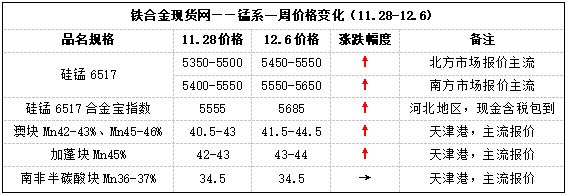
Core Viewpoint - The silicon manganese market is currently characterized by "cost-driven enhancement, increased supply-demand dynamics, and price fluctuations with a wait-and-see attitude" [1] Group 1: Market Dynamics - Cost support for silicon manganese is continuously strengthening [1] - The improvement in the supply-demand structure of silicon manganese itself is limited [1] - As steel procurement gradually unfolds, market sentiment remains cautious [1] Group 2: Price Changes - The price range for silicon manganese 6517 increased from 5350-5500 to 5450-5550 in the northern market and from 5400-5550 to 5550-5650 in the southern market between November 28 and December 6 [2] - The alloy index for silicon manganese 6517 rose from 2555 to 5685 in Hebei region, cash inclusive [2] - Prices for Australian Mn42-43% and Mn45-46% increased from 40.5-43 to 41.5-44.5 at Tianjin Port [2] - Gabonese Mn45% prices rose from 42-43 to 43-44 at Tianjin Port [2] - South African semi-carbonate Mn36-37% prices remained stable at 34.5 at Tianjin Port [2]

玉米供需博弈加剧,盘面再创新高
Zhong Xin Qi Huo· 2025-12-05 00:31
1. Report Industry Investment Ratings - The report does not explicitly provide an overall investment rating for the industry. However, it offers individual outlooks for various agricultural products: - **Corn/Starch**: Oscillating upward [1][7][9] - **Oils & Fats**: Oscillating [5] - **Protein Meal**: Oscillating [6] - **Hogs**: Oscillating downward [9] - **Natural Rubber**: Oscillating [10][11] - **Synthetic Rubber**: Oscillating [12] - **Cotton**: Oscillating upward in the long - term, with short - term pressure [12] - **Sugar**: Oscillating downward in the medium - long term, with short - term support at 5300 yuan/ton [13] - **Pulp**: Oscillating [14] - **Double - Glued Paper**: First rising then falling in December [15] - **Logs**: Oscillating, with potential for a rebound from oversold levels [18] 2. Core Viewpoints - The report analyzes multiple agricultural products, highlighting the complex supply - demand dynamics and market factors influencing each. For example, corn prices are driven by low northern port inventories, while hog prices are pressured by high supply in the short - to - medium term and may see relief in the long term. Each product's price trend is affected by unique factors such as weather, policy, trade, and consumption patterns [1][5][6][8][9]. 3. Summary by Related Catalogs 3.1 Oils & Fats - **Viewpoint**: Pressure for a decline is increasing [5] - **Logic**: Weakness in US soybean futures due to lack of sales information and expected South American soybean harvest. High domestic soybean inventory and slow de - stocking of soybean oil. Mixed production and export data for palm oil, with expected seasonal decline in Indian imports. Tight domestic rapeseed supply currently but expected increase in the future [5] - **Outlook**: Soybean oil, palm oil, and rapeseed oil are all expected to oscillate [5] 3.2 Protein Meal - **Viewpoint**: The discount of South American soybeans makes them cost - effective; attention should be paid to Chinese soybean purchases [6] - **Logic**: International soybean trade price differentials show a significant drop in South American soybean premiums. China is fulfilling its soybean purchase obligations from the US. Brazilian soybean export and production estimates are available. South American climate is crucial for CBOT soybean prices. Domestically, high soybean inventory, slow seasonal de - stocking of soybean meal, and various factors influencing different contract prices [6] - **Outlook**: US soybeans and Dalian soybean meal are both expected to oscillate [6] 3.3 Corn/Starch - **Viewpoint**: The supply - demand game intensifies, and the futures price hits a new high [1][7][8] - **Logic**: Low northern port inventories, policy support, and high - quality grain shortages are the main drivers. Regional differences in corn quality and price lead to increased demand for Northeast corn. Short - term concentrated demand from traders and logistical issues also affect prices. In the short term, the uptrend continues, while in the medium term, it depends on inventory release and downstream demand relief [1][8] - **Outlook**: Oscillating upward. Short - term wait - and - see, with the spot price expected to continue the upward - oscillating trend [1][9] 3.4 Hogs - **Viewpoint**: Sufficient supply, and hog prices are oscillating at a low level [9] - **Logic**: Short - to - medium - term high supply due to previous high sow capacity. Long - term supply pressure may ease as sow capacity declines. Insufficient demand from sporadic southern pickling activities. Increasing average slaughter weight [9] - **Outlook**: Oscillating downward. Near - term contracts are weak, while far - term contracts are supported by capacity reduction expectations [9] 3.5 Natural Rubber - **Viewpoint**: Weak downstream buying, and the futures price shows a weak performance [10][11] - **Logic**: Overall lack of strong driving forces. Weak downstream buying and limited impact from the previous Thai floods. Seasonal increase in overseas supply, with raw material prices providing some support but facing downward pressure. Stable demand in the short term [11] - **Outlook**: Expected to continue oscillating, with no clear trend [11] 3.6 Synthetic Rubber - **Viewpoint**: Insufficient upward - driving factors in the futures market [12] - **Logic**: The hype about butadiene export news has subsided. Stable butadiene trading, and limited downward space for natural rubber prices. Butadiene prices have rebounded after a decline, with improved trading volume but some resistance at high prices [12] - **Outlook**: No upward - driving force, supported by natural rubber prices, and expected to oscillate in a range [12] 3.7 Cotton - **Viewpoint**: Short - term price increase is limited by the concentrated listing of new cotton, but long - term valuation repair is expected [12] - **Logic**: On the supply side, new cotton is being listed in large quantities, with higher production expected. On the demand side, it is entering the off - season but still shows resilience. Commercial inventory is accumulating but is lower than last year. Cost - line, warehouse - receipt speculation, and better - than - expected de - stocking support the price, but also increase hedging pressure [12] - **Outlook**: In the short term, pay attention to the pressure at 13,800 - 14,000 yuan/ton. In the long term, it is expected to oscillate upward, and buying on dips is recommended [12] 3.8 Sugar - **Viewpoint**: The downward pressure is increasing marginally [13] - **Logic**: In the medium - long term, the global sugar market is expected to have a surplus in the 25/26 and 26/27 seasons. The new northern hemisphere sugar - making season has started, and the increase in supply will gradually put downward pressure on prices. The domestic 01 contract is oscillating around 5300 - 5400 yuan/ton, with 5300 yuan/ton providing support [13] - **Outlook**: Oscillating downward in the medium - long term, with short - term support at 5300 yuan/ton. The strategy is to short on rallies [13] 3.9 Pulp - **Viewpoint**: Pulp prices continue to rise, and the spot market has strengthened significantly [13][14] - **Logic**: The rally is driven by the release of negative sentiment after continuous price drops, overseas pulp mill shutdown news, and short - covering. There is some support for pulp prices in the short term, but the fundamental situation has not changed significantly. The supply - demand situation for softwood and hardwood pulp continues to diverge [14] - **Outlook**: Oscillating. The futures market will mainly oscillate in a wide range due to the issue of warehouse receipts [14] 3.10 Double - Glued Paper - **Viewpoint**: The spot price is stable, and the futures price is oscillating [15] - **Logic**: The supply side has limited changes, and dealers are cautious about stocking. Publishing orders have not been fully picked up, and downstream printing factories have weak orders. The price of some high - white double - glued paper has increased, while the price of some white double - glued paper has decreased. The overall price increase is limited by high inventory and the need for dealers to raise funds [15] - **Outlook**: Prices will be supported by publishing house pick - up in December, but there will be medium - term pressure. The market is expected to first rise and then fall [15] 3.11 Logs - **Viewpoint**: New Zealand has entered a phase of reduced shipments, and medium - term supply pressure may ease [18] - **Logic**: The futures price of logs has been low, and the market supply - demand pattern is loose. New Zealand's shipments are expected to decrease from December to January, and the pressure on arrivals in the first quarter will ease. The short - term fundamentals in the domestic market are stable, and the 01 contract has no clear upward or downward driving force. The 03 contract may perform better due to the peak season and expected replenishment after the Spring Festival [18] - **Outlook**: The supply side will remain loose, but due to the low valuation, there is limited downward space. Attention should be paid to the opportunity for a rebound from oversold levels [18]
煤化工策略月报-20251201
Guang Da Qi Huo· 2025-12-01 07:47
1. Report Industry Investment Rating - Not provided in the document 2. Core Views of the Report - In December, the domestic urea market will maintain a state of high supply and low demand, but there are still supporting factors such as rigid demand and reserve demand. The downstream replenishment intensity will be the core factor determining the price trend. It is expected that the urea futures price will remain firm and oscillate, with limited upward space but strong support at the previous low [8]. - In December, the soda ash market may face pressures such as the expected output of new production capacity, the resumption of production of maintenance enterprises, and the continued decline of downstream production capacity. The supply - demand situation will remain loose, and the futures market is expected to maintain a wide - range bottom - oscillating trend [13]. - In November, the decline in glass supply drove the market to rebound, but the terminal demand is still weak, and the high - volume sales of spot need to be further observed. The futures market has limited upward momentum and is expected to oscillate widely at the bottom [17]. 3. Summary by Directory 3.1 Futures Market and Industrial Chain Raw Material Situation - **Futures Prices**: As of November 28, the closing price of the main urea futures contract increased by 3.2%; the main soda ash futures contract decreased by 3.92%; the main glass futures contract decreased by 2.77% [23]. - **Futures - related Varieties**: In November, the futures prices of related varieties showed a differentiated trend, with urea being the most robust and soda ash having the largest decline [25]. - **Coal Prices**: The prices of various types of coal in November increased compared with those in October, strengthening the cost support for the industry [27]. - **LNG Prices**: The LNG prices in most regions decreased in November [31]. - **Two - alkali Raw Material Salt**: In November, the prices of raw salt in most regions remained stable, with a slight increase in some areas, strengthening the cost support for soda ash [32]. 3.2 Urea: Market Focus Returns to Domestic in December, Pay Attention to Supply - demand Game - **Prices**: In November, both urea futures and spot prices increased. As of November 28, the closing price of the main futures contract was 1677 yuan/ton, a 3.2% increase from the end of October; the spot prices in Shandong and Henan increased by 80 yuan/ton [6]. - **Supply**: In November, the urea supply level steadily recovered, with the daily output remaining above 200,000 tons for a long time. In December, the supply reduction may be limited due to the offset of new production capacity [6]. - **Demand**: In November, the downstream demand increased, and the apparent consumption is expected to reach 6.1849 million tons, a 11.48% increase from October. In December, it is the off - season for agricultural demand, but there is still support from reserve demand [7]. - **Inventory**: In November, the urea enterprise inventory decreased by 12.25% compared with that at the end of October, but it is still at the second - highest level in the past five years [56]. - **Export**: In October, the urea export volume decreased by 12.32% compared with that in September. The export volume in November may decrease to the range of 500,000 - 700,000 tons, showing a downward trend in November - December [7]. - **International Market**: India's new round of tender procurement volume is lower than planned, and the international market disturbances may weaken [8]. 3.3 Soda Ash: Loose Situation Continues, Futures Market to Remain at the Bottom in December - **Prices**: In November, the soda ash futures price showed a weak bottom - oscillating trend, with a 3.92% decrease in the main contract closing price compared with the end of October. The spot price showed a differentiated trend, with light soda ash prices mostly increasing and heavy soda ash prices remaining stable [11]. - **Supply**: In November, the soda ash production level and supply decreased to a phased low. In December, the supply may recover to a high level due to the expected output of new production capacity and the resumption of production of maintenance enterprises [11]. - **Demand**: In November, the demand for soda ash was differentiated, with rigid demand decreasing and replenishment demand increasing. In December, the rigid demand may continue to be under pressure [12]. - **Inventory**: In November, the soda ash enterprise inventory decreased by 6.2% compared with that at the end of October, but it is still at the second - highest level in the past five years. In December, the de - stocking pressure is still large [12]. - **Macro Policy**: There is news that China may introduce more incentive real - estate policies, which may have a positive impact on the soda ash - glass industry chain [13]. 3.4 Glass: Supply Decline Drives Sentiment Improvement, but Limited Trend Momentum in the Market - **Prices**: In November, the glass futures price fluctuated widely, with a 2.77% decrease in the main contract closing price compared with the end of October. The spot price continued to decline, with a 6.26% decrease in the average market price [15]. - **Supply**: In November, the glass supply level decreased slightly. The market's expectation of supply decline will continue into December [15]. - **Demand**: The core limiting factor for the glass market is the weak terminal demand. In December, the decline in demand may narrow [16]. - **Inventory**: As of the end of November, the glass enterprise inventory decreased by 5.21% compared with that at the end of October [15]. - **Macro Policy**: There is news that China may introduce more incentive real - estate policies, which may have a positive impact on the soda ash - glass industry chain [17].
生猪行业发展“提质增效”,养殖ETF(159865)近20日净流入超8亿元,关注“含猪量”约60%的养殖ETF
Mei Ri Jing Ji Xin Wen· 2025-11-19 04:52
Group 1 - The current market is in a supply-demand game, with supply pressures easing as large-scale pig farms adopt strategies to control output and raise prices, leading to notable increases in pig prices [1] - The demand side is expected to improve gradually due to colder weather and the arrival of the curing season, which typically boosts demand [1] - The pig farming industry is still in a loss-making state, with self-breeding farms experiencing an average loss of 114.81 yuan per head, and purchased piglets facing an average loss of 205.64 yuan per head, indicating an expansion of losses [1] Group 2 - The industry is actively reducing production capacity under the current losses, and measures to combat internal competition are being implemented, suggesting a potential long-term increase in domestic pig price levels [1] - Future development in the pig farming industry is expected to focus on "quality improvement and efficiency enhancement," leading to the gradual elimination of outdated production capacity and an increase in market share for financially stable and low-cost producers [1] - The Livestock ETF (159865) tracks the China Securities Livestock Index (930707), which reflects the overall performance of listed companies involved in livestock farming, feed processing, and related sectors, indicating strong industry representation [1]
《能源化工》日报-20251029
Guang Fa Qi Huo· 2025-10-29 02:35
Report Investment Ratings - No investment ratings are provided in the reports. Core Views Polyolefin (LLDPE & PP) - Supply: PP supply recovery is slowing due to unplanned maintenance, while PE supply is expected to increase as maintenance peaks. Attention should be paid to the potential impact of expanded international sanctions on domestic refinery loads [2]. - Demand: The demand side is warming up, with downstream开工 rising, especially in the agricultural film sector. Both LLDPE and PP inventories are decreasing [2]. - Strategy: The 01 contract still faces inventory pressure, while the 05 contract has less new capacity. Long - term low - buying opportunities for the 05 contract can be considered, and the impact of sanctions on refinery loads should be continuously monitored [2]. Methanol - Market Situation: The port methanol market is under significant pressure due to high inventories and weak demand. The inland market has deeper price drops as some external procurement stops. Overseas, multiple plants have shut down, and many MTO plants have reduced their loads due to profit issues [5]. - Market Logic: The market is trading on the "weak reality vs. strong expectation" logic, with the core contradiction being the game between high port inventories and potential supply reduction (overseas plant shutdowns/geopolitical factors) [5]. - Strategy: In the short - term, prices may continue to fluctuate. Attention should be paid to the port destocking rhythm and the implementation of overseas gas restrictions [5]. Chlor - alkali (PVC & Caustic Soda) - Price and Spread: There are various price changes in PVC and caustic soda products, including futures and spot prices, as well as spreads between different contracts [8]. - Supply and Demand: Caustic soda industry开工 is stable, while PVC开工 has decreased slightly. Downstream开工 of both products has some positive changes, and PVC inventories are increasing [8]. Pure Benzene - Styrene - Price and Spread: Prices of upstream raw materials such as crude oil, naphtha, and pure benzene have declined, while some spreads have changed. Styrene prices have also decreased, and its cash flow has improved to some extent [9][10]. - Inventory and开工: Both pure benzene and styrene inventories in Jiangsu ports have decreased, and there are changes in the开工 rates of related industries [12][13]. Polyester Industry Chain - PX: Supply is expected to contract due to unplanned maintenance or load reduction of some PX plants. Demand is supported by new PTA plants and improved terminal orders. However, the short - term rebound space of PX is limited due to weak oil price support [14]. - PTA: The spot basis is weak due to increased supply from load recovery and new capacity. The futures market is relatively firm but limited by the lack of substantial policies and weak cost - side expectations [14]. - Ethylene Glycol (MEG): Upward momentum is weakened by factors such as port conditions, plant restarts, and weak cost. The supply structure in the far - month is still weak [14]. - Short - fiber: Supply remains high, and demand has improved, leading to inventory reduction. However, the rebound space is limited due to weak downstream chasing willingness and compressed processing fees [14]. - Polyester Bottle - chip: Demand is weak in the off - season, and it is likely to enter a seasonal inventory accumulation period. The processing fee is expected to decline [14]. Summary by Directory Polyolefin (LLDPE & PP) - Price and Spread: On October 28, L2601 closed at 7051, down 0.56% from the previous day; PP2601 closed at 6657, down 0.63%. The spread between L2509 - 2601 increased by 22.11%, and PP2509 - 2601 increased by 12.68% [2]. - Inventory: PE enterprise inventory decreased by 2.81% to 51.5, and social inventory decreased slightly by 0.04% to 54.5 million tons. PP enterprise inventory decreased by 5.92% to 63.9 million tons, and trader inventory decreased by 15.74% to 22.0 million tons [2]. -开工: PE装置开工率 decreased by 0.37% to 81.5%, and downstream加权开工率 increased by 1.85% to 45.8%. PP装置开工率 decreased by 2.9% to 75.9%, while the powder开工率 increased by 7.1% to 41.4%, and downstream加权开工率 increased by 1.0% to 52.4 [2]. Methanol - Price and Spread: On October 28, MA2601 closed at 2241, down 1.19% from the previous day; MA2605 closed at 2303, down 0.95%. The MA15 spread decreased by 8.77%, and the Taicang basis decreased by 10.00% [3]. - Inventory: Methanol enterprise inventory increased by 0.13% to 36.036, port inventory increased by 1.40% to 151.2 million tons, and social inventory increased by 1.15% to 187.3 [4]. -开工: Upstream domestic enterprise开工 decreased by 0.91% to 75.85, and overseas enterprise开工 decreased by 2.37% to 73.3. Downstream外采MTO装置开工 decreased by 9.48% to 78.1, while some traditional downstream开工 such as formaldehyde and acetic acid increased slightly [5]. Chlor - alkali (PVC & Caustic Soda) - Price and Spread: On October 28, the price of Shandong 32% liquid caustic soda (converted to 100%) remained unchanged at 2500. The price of East China calcium - carbide - based PVC increased by 0.4% to 4620. There are also various changes in futures prices and spreads [8]. - Supply and Demand: Caustic soda industry开工 increased slightly by 0.1% to 85.6, and PVC总开工 decreased by 1.9% to 73.7. Downstream开工 of caustic soda and PVC products has some positive changes, and PVC inventories increased by 14.4% to 63.5 million tons [8]. Pure Benzene - Styrene - Upstream Prices: On October 28, Brent crude oil (December) was at $64.40, down 2.3%; WTI crude oil (December) was at $60.15, down 2.2%. CFR Japan naphtha was at $569, down 2.1%. CFR China pure benzene was at $676, down 2.2% [9]. - Styrene - related Prices: Styrene East China spot price was at 6440, down 1.1%. EB futures 2512 was at 6466, down 1.0%. EB cash flow (non - integrated) improved slightly by 0.8% [10]. - Inventory: Pure benzene inventory in Jiangsu ports decreased by 14.1% to 8.50 million tons, and styrene inventory decreased by 4.7% to 19.30 million tons [12]. -开工: Asian pure benzene开工 remained unchanged at 79.2%, while domestic pure benzene开工 decreased by 3.6% to 72.7%. Some downstream开工 such as phenol remained unchanged, and others had slight changes [13]. Polyester Industry Chain - Upstream Prices: On October 28, Brent crude oil (December) was at $64.40, down 1.9%; WTI crude oil (December) was at $60.15, down 1.9%. CFR Japan naphtha was at $569, down 1.6%. CFR China MX was at $684, down 1.6% [14]. - PX - related Prices: CFR China PX was at $814, down 1.2%. PX spot price (in RMB) was at 6848, down 2.4%. PX basis (01) decreased by 84.0% [14]. - Product Prices and Cash Flows: POY150/48 price increased by 0.2% to 6415, and its cash flow decreased by 5.9%. FDY150/96 price increased by 0.5% to 7100, and its cash flow increased by 4.4% [14]. -开工: Asian PX开工 increased by 0.5% to 78.5%, and Chinese PX开工 increased by 1.0% to 85.9%. PTA开工 increased by 2.1% to 78.8%, and MEG综合开工 decreased by 3.9% to 73.3% [14].