
稳增长政策

Search documents
6月“开门红”,每经品牌100指数再冲1100点
Mei Ri Jing Ji Xin Wen· 2025-06-08 08:49
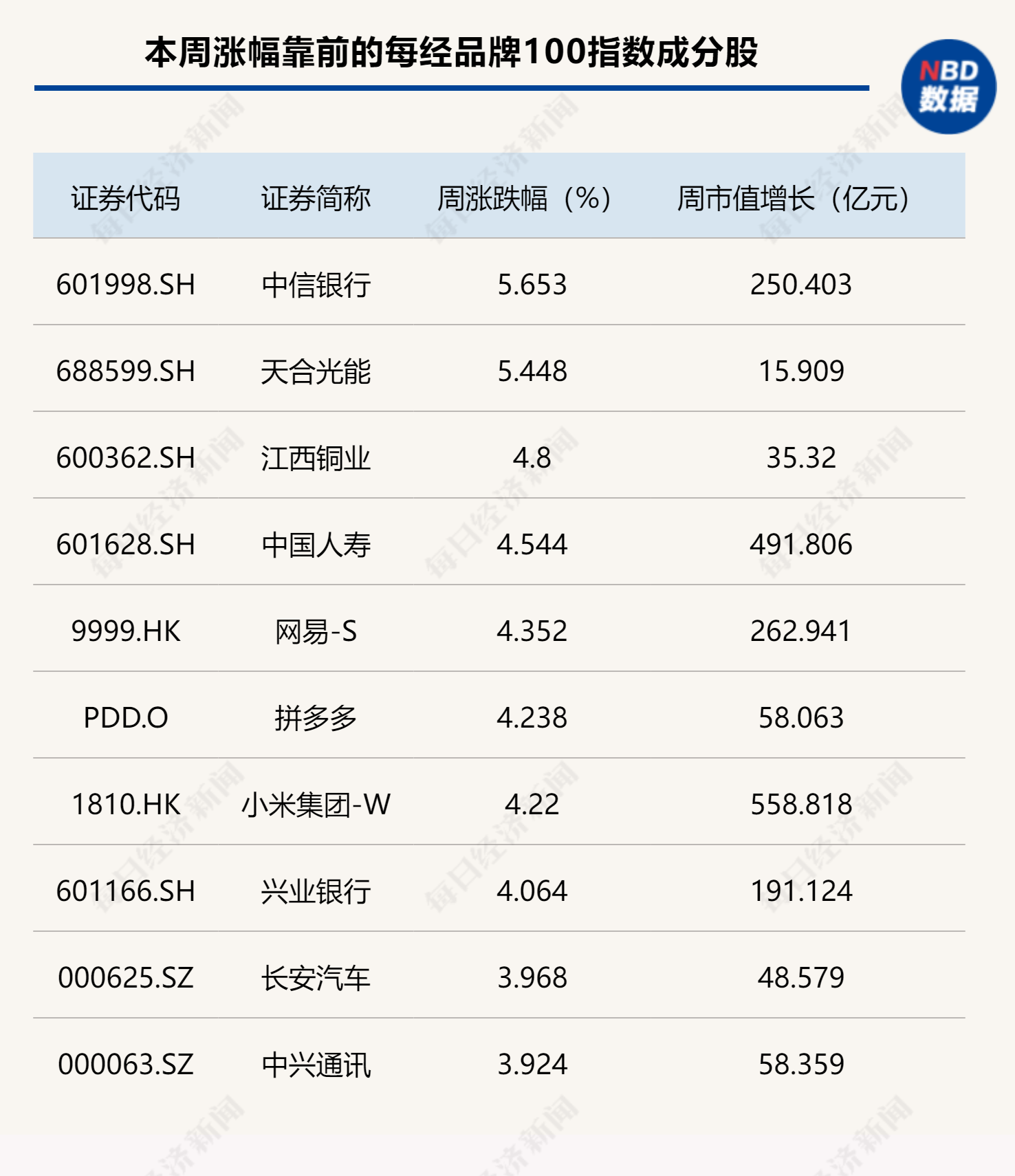
Market Overview - The A-share and Hong Kong stock markets experienced a rebound in the first week of June, with the Every Day Brand 100 Index rising by 1.3% to close at 1077 points, aiming for the 1100-point mark [1][2] - The three major A-share indices all saw weekly gains of over 1%, with 60 out of 99 constituent stocks rising, indicating a broad-based rally [2] Key Stock Performances - Notable performers included CITIC Bank and Trina Solar, both of which saw weekly gains exceeding 5%, while other companies like Jiangxi Copper, China Life, NetEase, Pinduoduo, Xiaomi Group, and Industrial Bank also recorded gains above 4% [2][3] - Tencent Holdings led the market with a market value increase of 154.46 billion yuan, being the only stock in the Every Day Brand 100 Index to surpass a 100 billion yuan increase in market value for the week [4] Economic Indicators - China's Caixin Services PMI for May was reported at 51.1%, a 0.4 percentage point increase from April, while the composite PMI fell to 49.6%, indicating a contraction for the first time in 2023 [4] - The U.S. job growth slowed in May but was better than expected, alleviating concerns about a U.S. economic slowdown and boosting investor sentiment [4] Company-Specific Developments - CITIC Bank announced the approval to establish a financial asset investment company with a registered capital of 10 billion yuan, which will allow it to invest in early-stage technology companies [5][6] - Trina Solar hosted a research meeting with 58 institutions, projecting that global demand for photovoltaic modules will exceed 660 GW by 2025, driven by energy transition and technological advancements [7] Investment Opportunities - The Hong Kong stock market has outperformed the A-share market this year, making it an attractive option for investors, especially with the potential return of Chinese concept stocks to Hong Kong [8] - The China Overseas Internet 50 Index, which tracks 50 Chinese internet companies listed overseas, reflects the investment opportunities in this sector, with major stocks like Tencent, Alibaba, and Xiaomi being significant components [11][12]




内外因素交织,市场或维持整固状态——策略周专题(2025年6月第1期)
EBSCN· 2025-06-08 07:20
Market Performance - The A-share market showed signs of recovery this week, with the ChiNext Index rising by 2.3%, while the Shanghai 50 Index had the smallest increase of 0.4%[1] - The overall valuation of the Wind All A Index is currently at a historical average level since 2010[1] - Among sectors, telecommunications, non-ferrous metals, and electronics performed well, with increases of 5.3%, 3.7%, and 3.6% respectively[1] Economic Factors - Domestic policies aimed at stabilizing growth, such as the launch of the 2025 "Service Consumption Season" and the promotion of new energy vehicles, are being implemented[2] - External factors include a recent phone call between Chinese President Xi Jinping and U.S. President Trump, and the SEC tightening regulations on foreign companies listed in the U.S.[2] - The overall domestic economy remains stable, with a projected resilient economic performance in Q2 due to supportive policies and reduced tariffs between China and the U.S.[2] Investment Strategies - Focus on three main investment lines: - Domestic consumption, which is expected to receive policy support and has shown resilience in earnings[4] - Domestic substitution, targeting industries with high import ratios from the U.S. and strong domestic supply capabilities[4] - Sectors currently underweighted by funds, such as banking and public utilities, which may present long-term investment opportunities[4] Risk Analysis - Potential risks include policy measures falling short of expectations, continued weak consumption data, and significant declines in market sentiment[4] - Concerns over external disturbances, particularly from U.S. policy changes, may hinder market upward movement, especially as the Shanghai Index approaches levels seen in early April[2][3]
策略周专题(2025年6月第1期):内外因素交织,市场或维持整固状态
EBSCN· 2025-06-08 03:45
Group 1 - The A-share market showed signs of recovery this week, with the ChiNext Index rising by 2.3% and the Shanghai 50 Index increasing by 0.4%, indicating a general upward trend in major indices [1][11][12] - The valuation of the entire A-share market is currently at a medium level compared to historical data since 2010 [1][19] - The communication, non-ferrous metals, and electronics sectors performed relatively well, with respective increases of 5.3%, 3.7%, and 3.6%, while sectors like household appliances, food and beverage, and transportation saw declines of 1.8%, 1.1%, and 0.5% [1][14][19] Group 2 - Recent domestic events include the launch of the "Service Consumption Season" and the "New Energy Vehicle Going to the Countryside" initiative, which are part of the government's efforts to stabilize growth [2][20][22] - External events such as the phone call between Chinese President Xi Jinping and US President Trump, and the tightening of regulations by the SEC on foreign companies listed in the US, are significant factors influencing market sentiment [2][20][32] - The overall domestic economy remains stable, supported by growth policies, and is expected to show resilience in the second quarter, which will provide support for the market [2][21][23] Group 3 - The report emphasizes three main investment themes: 1. Domestic consumption, which is expected to receive policy support and has shown resilience in performance [4][43] 2. Domestic substitution, focusing on industries with high import ratios from the US but strong domestic supply capabilities, such as publishing and construction materials [4][44] 3. Sectors that are currently underweighted by funds, including banking, non-bank financials, public utilities, and transportation, which may present long-term investment opportunities [4][45] Group 4 - The report suggests that the market style may shift towards defensive and undervalued sectors, with coal, public utilities, banking, non-bank financials, construction decoration, and oil and petrochemicals being highlighted as sectors worth attention [51]
炉料成本延续下降,钢材价格环比下跌钢铁
Xinda Securities· 2025-06-07 14:23
Investment Rating - The investment rating for the steel industry is "Positive" [2] Core Viewpoints - The steel sector has faced a decline of 0.18% this week, underperforming the broader market, with specific segments showing varied performance [3][11] - The report indicates a decrease in iron and steel production, with a notable drop in the utilization rates of both blast furnaces and electric arc furnaces [3][25] - Steel consumption has also decreased, with a significant drop in the five major steel products [3][30] - Inventory levels for steel products have declined, both in social and factory inventories, indicating a tightening supply [3][43] - Steel prices have shown a downward trend, with both common and special steel price indices decreasing [3][50] Summary by Sections 1. Market Performance - The steel sector's performance this week was a decline of 0.18%, while the broader market (CSI 300) increased by 0.88% [11] - Specific segments such as special steel and plate steel saw declines of 0.28% and 0.77%, respectively, while long products increased by 0.14% [3][13] 2. Supply Data - As of June 6, the average daily molten iron production was 2.418 million tons, a decrease of 0.11 thousand tons week-on-week [25] - The capacity utilization rate for blast furnaces was 90.7%, down by 0.04 percentage points, while electric arc furnaces were at 58.7%, down by 0.33 percentage points [25] - The total production of the five major steel products was 7.711 million tons, a decrease of 0.49% week-on-week [25] 3. Demand Data - The consumption of the five major steel products was 8.822 million tons, down by 3.46% week-on-week [30] - The transaction volume of construction steel by mainstream traders was 106,000 tons, showing a slight increase of 4.33% week-on-week [35] 4. Inventory Levels - Social inventory of the five major steel products was 9.31 million tons, down by 0.16% week-on-week [43] - Factory inventory was 4.328 million tons, also down by 0.06% week-on-week [43] 5. Price Trends - The common steel price index was 3,384.0 CNY/ton, down by 0.33% week-on-week [50] - The special steel price index was 6,624.5 CNY/ton, down by 0.16% week-on-week [50] 6. Profitability - The average molten iron cost was 2,201 CNY/ton, a decrease of 37.0 CNY/ton week-on-week [57] - The profit for rebar produced in blast furnaces was 99 CNY/ton, an increase of 11.24% week-on-week [57] 7. Investment Recommendations - The report suggests that despite current challenges, the steel industry may see a recovery due to government policies aimed at stabilizing growth, particularly in real estate and infrastructure [4] - Companies with strong cost control and high gross margins, such as Shandong Steel and Hualing Steel, are highlighted as potential investment opportunities [4]
年报、一季报分析:回归基本面,产业债行业有哪些变化?
Huachuang Securities· 2025-06-06 11:15
1. Report Industry Investment Rating No relevant content provided. 2. Core Viewpoints of the Report - The overall operation of industrial bond - issuing entities was under pressure in 2024, with differentiated industry performance. The total operating revenue and net profit of industrial bond entities decreased year - on - year, and the proportion of loss - making enterprises increased. In 2025Q1, the overall operating revenue of industrial bond entities decreased year - on - year, while the net profit remained flat. [2][3] - The economic fundamentals are expected to continue the characteristics of domestic demand support, external demand pressure, and policy escort this year. Attention should be paid to the improvement of the fundamentals of entities under the influence of pro - growth policies. [2][13] - For the real estate industry, it is still in the bottom - building stage. Attention can be paid to the income - mining opportunities of central and state - owned enterprise real estate bonds with an implied rating of AA and above within 1 - 2 years. [4] - For the coal industry, there is downward pressure on the industry's prosperity. Short - term medium - and high - grade varieties can be focused on, and institutions with higher income requirements can appropriately invest in 1 - 2y varieties of coal enterprises with an implied rating of AA. [5] - For the steel industry, the problem of over - supply is still serious. Caution should be exercised when investing in lower - quality entities, and 1 - 2yAA + varieties can be focused on. [6] 3. Summary According to the Directory 3.1. How Did the Annual Reports and Q1 Reports of Each Industry Perform? 3.1.1. Overall Situation Analysis: The Overall Profitability Declined - In 2024, the total operating revenue and net profit of industrial bond entities decreased year - on - year, and the proportion of loss - making enterprises increased from 18% in 2023 to 21% in 2024. [13][14] - In 2025Q1, the overall operating revenue of industrial bond entities decreased by 2% year - on - year, while the net profit remained flat. [15] 3.1.2. Industry Performance: A Minority of Industries Had Positive Revenue and Net Profit Growth, and Most Industries Had Positive Growth in Operating Net Cash Flow - In 2024, about one - third of industries had positive revenue growth, and about 40% of industries had positive net profit growth. Nearly half of the industries had an increase in asset - liability ratio, and about 60% of industries had positive growth in operating net cash flow. [3] - Industries with revenue growth of over 5% in 2024 included non - ferrous metals, electronics, etc.; industries with a decline of over 5% included coal, steel, etc. [20] 3.1.3. Situations of Continuously Loss - making and Turnaround Entities - There were 79 bond - issuing industrial entities with net profit losses for 3 consecutive years or more, mainly distributed in transportation, real estate, etc. [36] - There were 20 bond - issuing industrial entities that had net profit losses for 2 consecutive years or more and turned profitable in 2024, mainly in public utilities, social services, etc. [39] 3.2. Financial Analysis of Key Industries: Real Estate, Coal, and Steel 3.2.1. Real Estate Industry: The Industry Is Still in the Bottom - building Stage, and Attention Should Be Paid to the Investment Opportunities of Central and State - owned Enterprises within 1 - 2 Years - **Fundamentals**: Pro - real - estate policies have been actively implemented, and the effect of destocking policies is gradually emerging, but the industry's prosperity is still low. [41] - **Financial Indicator Performance**: The profitability is under continuous pressure, the operating net cash flow is stable, the gaps in investment and financing net cash flows are narrowing, the median asset - liability ratio has decreased slightly, and the short - term solvency has declined. [4][50][51] - **Investment Strategy**: Attention can be paid to the income - mining opportunities of central and state - owned enterprise real estate bonds with an implied rating of AA and above within 1 - 2 years. Some 1 - year central and state - owned enterprise real estate bonds with an implied rating of AA and AA + have yields ranging from 2.2% to 2.7%. [4][61] 3.2.2. Coal Industry: There Is Downward Pressure on the Industry's Prosperity, and Attention Should Be Continuously Paid. Currently, Appropriate Investment in Lower - Grade Entities Can Be Made - **Fundamentals**: Since last year, there has been downward pressure on the coal industry's prosperity. Supply is sufficient but demand is weak, and coal prices have fluctuated downward. There may still be some downward pressure on coal prices this year. [5][63] - **Financial Indicator Performance**: The overall profitability has declined, the operating net cash flow has shrunk, the gap in investment cash flow has widened, the gap in financing cash flow has narrowed, the median asset - liability ratio has decreased, and the short - term solvency has declined. [5][68][71] - **Investment Strategy**: Short - term medium - and high - grade varieties can be focused on. Institutions with higher income requirements can appropriately invest in 1 - 2y varieties of coal enterprises with an implied rating of AA, and medium - and high - grade entities can extend the duration to 3y. [5][77] 3.2.3. Steel Industry: The Problem of Over - Supply in the Industry Is Still Serious. Caution Should Be Exercised When Investing in Lower - Quality Entities - **Fundamentals**: Since 2024, the steel industry has been in the bottom - exploring stage. Although the pro - growth policies have slightly improved the industry's prosperity, the sustainability is weak. The problem of over - supply is still serious. [6] - **Financial Indicator Performance**: The profitability has been under continuous pressure, with a marginal improvement in Q1. The operating net cash flow has shrunk, the gap in investment net cash flow has widened, the financing net cash flow has turned positive, the median asset - liability ratio has increased, and the short - term solvency has slightly declined. [6] - **Investment Strategy**: Caution should be exercised when investing in lower - quality entities. 1 - 2yAA + varieties can be focused on. [6]
震荡市,寻找可能的边际变化
Changjiang Securities· 2025-06-04 14:13
1. Report Industry Investment Rating No relevant content provided. 2. Core View of the Report - The bond market may show an inverted "N" shape. Before the introduction of pro - growth policies, bond yields will generally continue to decline in a volatile manner. It is recommended to allocate 10 - year Treasury bonds when the yield is between 1.65% - 1.7%, and also pay attention to the allocation opportunities of short - term inter - bank certificates of deposit [2][6][26]. 3. Summary According to the Table of Contents 3.1 Bond Market Volatility for a Long Time - The typical feature of the bond market this year is to quickly complete the market trend and then have a long - term narrow - range oscillation. After an unexpected event occurs, the bond market will quickly complete the market trend again. In this market, it is difficult to trade interest - rate bonds, and the mainstream way to make money in the bond market is to explore credit - based coupon assets [5][12]. - The bond market is oscillating because its valuation is relatively high, making it difficult to price general positive information. Since 2020, the 10 - year Treasury bond yield has dropped from 3.15% at the beginning of 2020 to 1.67% on May 30 this year, a cumulative decline of more than 140bps. From the perspective of stock - bond attractiveness, as of May this year, the CSI 300 dividend yield was 3.5%, at a historical high, while the 10 - year Treasury bond yield was around 1.7%, which is not conducive to the trend - based inflow of funds into the bond market [5][16]. 3.2 Possible Marginal Changes in the Bond Market - **Repeated Sino - US trade frictions**: The bond market will gradually become desensitized to trade - friction information. Even if the Sino - US trade friction is completely eased, the 10 - year Treasury bond yield of 1.7% may be close to the upper limit of the current adjustment [5][6][19]. - **Price changes of short - term funds and bond varieties**: The allocation cost - effectiveness of inter - bank certificates of deposit with a yield above 1.7% may have emerged. The upward constraint on capital prices is the need for a relatively loose liquidity environment to maintain asset - price expectations and confidence stability. The downward constraint is the concern about "fund idling". The current capital price is close to the upper limit of the range, and the allocation value of inter - bank certificates of deposit with an interest rate above 1.7% has emerged [6][21][23]. - **The bond market is not very sensitive to fundamental changes**: For a product with a relatively high valuation, greater marginal changes in the fundamentals are required to drive its valuation up. The fundamentals have been relatively resilient this year, so the bond market is not sensitive to them. Pro - growth policies will mainly focus on domestic fundamental changes, and bond yields will first decline and then rebound [6][26].
中银证券研究部2025年6月金股
Bank of China Securities· 2025-06-04 12:28
Core Viewpoints - The market in June is expected to remain in a consolidation phase, with large-cap stocks likely to see a recovery. Domestic demand momentum is anticipated to improve marginally, while April's industrial profits continued to show a recovery trend but experienced a decline in both volume and price. The cost decline was the main driver of profit growth in April. PMI data for May indicates a slight recovery in domestic production demand compared to April. It is expected that growth-stabilizing policies will be implemented alongside resilient external demand, and the trend of weak inventory replenishment is likely to continue in the second quarter. However, global trade policies remain uncertain, compounded by concerns over rising US debt rates, which may pressure market sentiment in the short term. In June, various growth-stabilizing policies are expected to accelerate, maintaining a cautious and oscillating market environment. Key areas to watch for a breakthrough include developments in overseas tariffs and the implementation of domestic growth-stabilizing policies in June [4][10][12]. June Stock Recommendations - The June stock selection by the report includes: - SF Express (Transportation) - Anji Technology (Chemicals) - Bairen Medical (Pharmaceuticals) - Lingnan Holdings (Social Services) - Qingdao Beer (Food and Beverage) - Suochen Technology (Computers) [10][12]. Industry Summaries Transportation Industry: SF Express - SF Express reported a net profit of 2.234 billion yuan in Q1 2025, reflecting a steady growth trend. The company achieved a total express volume of 3.56 billion parcels, a year-on-year increase of 19.7%, with revenue reaching 69.85 billion yuan, up 6.9% year-on-year. The profit growth was primarily driven by the continuous improvement of the product matrix and enhanced service competitiveness. The company also focused on cost control through operational model reforms and network optimization, achieving a gross profit margin of 13.3%, an increase of 0.1 percentage points year-on-year [12][13]. Chemical Industry: Anji Technology - Anji Technology experienced rapid growth in revenue and net profit in 2024 and Q1 2025, driven by increased market coverage and new product introductions. The gross profit margin for 2024 was 58.45%, with a net profit margin of 29.08%. In Q1 2025, the gross profit margin was 55.70%, and the net profit margin was 30.96%. The company is seeing a steady increase in its global market share for polishing liquids, with a projected market size growth for semiconductor CMP polishing materials [14][15]. Pharmaceutical Industry: Bairen Medical - Bairen Medical reported rapid growth in revenue and profit in 2024, with significant increases in its three main business segments. The heart valve replacement and repair segment saw a year-on-year growth of 64.28%. The company is expected to maintain high growth rates in 2025, driven by the approval of its first interventional valve product, which offers significant advantages in terms of operation and safety [17][18]. Social Services Industry: Lingnan Holdings - Lingnan Holdings achieved a revenue of 4.309 billion yuan in 2024, a year-on-year increase of 25.43%, and a net profit of 150 million yuan, up 116.08%. The company’s travel agency operations and hotel management segments are expected to continue growing, particularly with the recovery of inbound tourism and the expansion of hotel management projects [20][21]. Food and Beverage Industry: Qingdao Beer - Qingdao Beer faced pressure on volume and price in Q3 2024, with a year-on-year decline in sales volume of 7.0%. However, the company benefited from a decrease in raw material costs, leading to an improvement in gross profit margins. Future growth is anticipated as restaurant demand recovers, supported by the company's strong brand and distribution network [23][24]. Computer Industry: Suochen Technology - Suochen Technology reported a revenue of 39 million yuan in Q1 2025, a year-on-year increase of 21.73%. The company is focusing on enhancing its CAE software capabilities and exploring AI applications in various fields. The engineering simulation software segment has shown significant growth, contributing to an overall increase in the company's gross profit margin [25][26][27].





6月金股组合:中银证券研究部2025年6月金股
中银证券· 2025-06-04 07:48
Strategy Overview - The market in June is expected to remain in a state of waiting for a breakthrough, with large-cap stocks likely to see a recovery. Domestic demand momentum is anticipated to improve marginally, although April's industrial profits showed a decline in both volume and price, with cost reductions being the main driver for profit growth. The PMI for May indicates a slight recovery in domestic production demand compared to April. It is expected that growth-stabilizing policies will be implemented alongside resilient external demand, continuing the trend of weak inventory replenishment in the second quarter. However, global trade policies remain uncertain, compounded by concerns over rising US debt rates, which may pressure market sentiment in the short term. In June, various growth-stabilizing policies are expected to accelerate, maintaining a volatile consolidation pattern in the market. Key areas to monitor for a breakthrough include overseas tariff developments and the implementation of domestic growth-stabilizing policies in June. [5][7] June Stock Recommendations - The June stock selection by Zhongyin Securities includes: - SF Express (Transportation) - Anji Technology (Chemicals) - Bairen Medical (Healthcare) - Lingnan Holdings (Social Services) - Qingdao Beer (Food and Beverage) - Suochen Technology (Computers) [14][16] Performance Review of May Stock Selection - The stock selection for May outperformed the market, with notable performances from Jiemian Express-W and Yiwei Lithium Energy, both achieving over 10% monthly returns. The absolute return of the May stock selection was 3.87%, outperforming the market benchmark (CSI 300) by 2.02 percentage points. Three stocks achieved excess returns of over 5% compared to the CSI 300. [9] Company-Specific Insights SF Express (Transportation) - In Q1 2025, SF Express reported a net profit of 2.234 billion yuan, reflecting a stable growth trend. The company achieved a total express volume of 3.56 billion parcels, a year-on-year increase of 19.7%, with revenue reaching 69.85 billion yuan, up 6.9% year-on-year. The net profit increased by 16.87% year-on-year, driven by continuous improvement in product matrix and service competitiveness. The gross profit margin was 13.3%, slightly up by 0.1 percentage points. [16][17] Anji Technology (Chemicals) - Anji Technology is expected to see rapid growth in revenue and net profit in 2024, driven by increased market coverage and new product introductions. The gross margin for 2024 is projected at 58.45%, up 2.64 percentage points year-on-year. The company’s polishing liquid revenue reached 1.545 billion yuan in 2024, a year-on-year increase of 43.73%. The global semiconductor CMP polishing materials market is expected to grow from 3.42 billion USD in 2024 to 3.62 billion USD in 2025. [19][20] Bairen Medical (Healthcare) - Bairen Medical reported rapid growth in Q4 2024 and Q1 2025, with significant increases in revenue across all three major business segments. The heart valve replacement and repair segment saw a year-on-year growth of 64.28%. The approval of the TAVR product in August 2024 is expected to drive further growth in 2025. [24][25] Lingnan Holdings (Social Services) - Lingnan Holdings achieved a revenue of 4.309 billion yuan in 2024, a year-on-year increase of 25.43%, with a net profit of 150 million yuan, up 116.08%. The travel agency and hotel management segments are expected to continue growing, particularly with the recovery of inbound tourism. [29][30] Qingdao Beer (Food and Beverage) - Qingdao Beer faced challenges in 2024 with a volume decline of 7.0% and a slight price increase of 0.5%. The company’s gross margin improved due to lower raw material costs, but net profit margin slightly decreased. Future growth is anticipated as restaurant demand recovers. [34][35] Suochen Technology (Computers) - Suochen Technology reported a revenue of 39 million yuan in Q1 2025, a year-on-year increase of 21.73%. The company is focusing on enhancing its CAE software capabilities and exploring AI applications in various fields. [38][39][40]
6月3日A股收评:沪指反弹0.43%:创新药领涨暗藏产业密码,银行股稳如泰山透露资金新动向
Sou Hu Cai Jing· 2025-06-03 17:42
各位老铁,这里是帮主郑重的收评时间。今天这市场啊,就像端午节包粽子——外面看着热闹,里头藏着门道。沪指涨了0.43%,深成指和创业板指也跟着 回暖,但仔细看,近3400只个股上涨的背后,资金明显在玩"抓大放小"的游戏。咱们今天就拆解拆解,这反弹里到底藏着啥玄机。 先说指数反弹的"底气"从哪来 今天市场能反弹,跟政策预期升温脱不了干系。最近市场对稳增长政策的期待越来越强,加上外资回流的迹象,让不少观望资金试探性进场。不过成交量只 放量了4个亿,说明大家还是有点犹豫,就像煮粽子时火候不够,米粒还没完全开花。这时候得盯紧北向资金的动向,它们要是持续加仓,反弹才有持续 性。 创新药板块爆发:政策松绑+研发提速的双击 创新药今天集体嗨了,舒泰神、海南海药这些票涨停,可不是偶然。去年开始,创新药审批流程大幅缩短,加上老龄化带来的刚性需求,这个板块就像压紧 的弹簧。我跟药企研发总监聊过,现在一款创新药从立项到上市周期比三年前快了30%,这就好比做菜从慢炖变成高压锅,效率上去了,利润空间自然就打 开了。不过要提醒老铁们,别光看涨停就追高,得看企业真正的研发管线厚度,有些票可能只是蹭概念。 银行股稳如泰山:高股息成避风港 沪农 ...





5月PMI解读:景气边际回升,政策仍需发力
China Post Securities· 2025-06-03 11:39
Report Industry Investment Rating No relevant content provided. Core Viewpoints - In May, China and the US reached an agreement to suspend the implementation of tariffs, leading to an improvement in Sino-US trade. The import index and new export order index rebounded, driving the recovery of domestic supply and demand, and the manufacturing PMI increased month-on-month. However, considering that the new order index is still below the boom line, enterprises' willingness to expand production is not strong, and the price level continues to decline. The marginal improvement in external demand may have limited impact on boosting the boom level. The US anti-globalization policy has long-term and negative effects on the Chinese economy, and the room for easing domestic fiscal and domestic demand promotion policies may be limited. The expectation of stable growth policies will continue to strengthen [3][26]. Summary by Relevant Catalogs 1. Export Marginally Improves, Manufacturing Boom Rebounds - Manufacturing PMI rebounds, with a month-on-month increase greater than the seasonal average. In May, the manufacturing PMI was 49.5%, up 0.5 percentage points from the previous month, but still below the critical point. From a seasonal perspective, the month-on-month increase of 0.5 percentage points is greater than the average increase of 0.1 percentage points in the past five years. However, the manufacturing PMI is lower than the average of 49.9% in the same period of the past five years, only higher than that in 2023 [12]. - Most sub - indices of the manufacturing PMI increase, and the number of sub - indices in the expansion range remains the same as last month. Among the 13 sub - indices, 9 increase in boom level and 4 decline. Only 2 sub - indices, namely the production and operation activity expectation and production, are in the expansion range [14]. - The price indices have declined for three consecutive months, but the decline has narrowed. In May, the main raw material purchase price index and ex - factory price index of the manufacturing PMI were 46.9% and 44.7% respectively, down 0.1 percentage points from the previous month, and the decline has narrowed by 2.7 and 3.0 percentage points respectively compared with the previous month [16]. - The finished product inventory decreases passively, and enterprises' willingness to expand production increases. The raw material inventory index is 47.4%, up 0.4 percentage points from the previous month; the finished product inventory index is 46.5%, down 0.8 percentage points; the purchase volume index is 47.6%, up 1.3 percentage points from the previous month [16]. - Production returns to expansion, and the new order index approaches the critical point. The production index is 50.7%, up 0.9 percentage points from the previous month, rising above the critical point. The new order index is 49.8%, up 0.6 percentage points from the previous month [19]. - The PMI of large enterprises rises above the critical point, the boom of medium - sized enterprises declines, and the boom of small enterprises improves. The PMI of large enterprises is 50.7%, up 1.5 percentage points from the previous month; the PMI of medium - sized enterprises is 47.5%, down 1.3 percentage points from the previous month; the PMI of small enterprises is 49.3%, up 0.6 percentage points from the previous month [19]. - The high - tech manufacturing industry continues to expand. The PMI of the high - tech manufacturing industry is 50.9%, remaining in the expansion range for four consecutive months [20]. 2. Service Industry Boom Slightly Increases, Construction Industry Boom Declines - The non - manufacturing boom level declines but remains in the expansion range, and the month - on - month performance is weaker than the seasonal average. In May, the non - manufacturing business activity index was 50.3%, down 0.1 percentage points from the previous month, but still above the critical point. From a seasonal perspective, the month - on - month decline of 0.1 percentage points is lower than the average increase of 0.9 percentage points in the past five years [22]. - The service industry boom rebounds, and the boom of holiday - related consumption industries increases. The service industry business activity index is 50.2%, up 0.1 percentage points from the previous month. Driven by the "May Day" holiday effect, industries such as railway transportation, air transportation, accommodation, and catering have significantly rebounded [22]. - The construction industry boom declines but remains in the expansion range. The construction industry business activity index is 51.0%, down 0.9 percentage points from the previous month. The business activity index of civil engineering construction is 62.3%, up 1.4 percentage points from the previous month [23]. - The composite PMI output index slightly rebounds. In May, the composite PMI output index was 50.4%, up 0.2 percentage points from the previous month, indicating that the overall production and operation activities of Chinese enterprises continue to expand [24]. 3. Marginal Recovery of Boom, Policy Still Needs to Be Strengthened - The marginal improvement in external demand has limited impact on boosting the boom level. Although the manufacturing PMI has increased, the new order index is still below the boom line, enterprises' willingness to expand production is not strong, and the price level continues to decline. The US anti - globalization policy has long - term negative effects on the Chinese economy, and the room for easing domestic fiscal and domestic demand promotion policies is limited. Therefore, the expectation of stable growth policies will continue to strengthen [3][26].