牛市

Search documents
中信建投:牛市底层逻辑仍在
Di Yi Cai Jing· 2025-10-20 00:07
Core Viewpoint - The underlying logic of the bull market remains intact, supported by ample liquidity and limited downward adjustments [1] Group 1: Market Conditions - Capital market reforms are stabilizing expectations, with multiple measures promoting market upgrades [1] - Structural prosperity continues to serve as a driving force for the market [1] Group 2: Investment Strategy - A style switch has already begun, with short-term focus on "countermeasures + risk aversion" themes due to US-China tensions [1] - At year-end, profit realization and seasonal effects typically favor dividend and large-cap growth styles [1] - After sufficient adjustment and recovery in the technology sector, a year-end rally is expected in high-prosperity sectors if liquidity remains abundant [1]

【策略】短期调整,无需悲观——策略周专题(2025年10月第2期)(张宇生/王国兴)
光大证券研究· 2025-10-19 23:04
Core Viewpoint - The A-share market has experienced a pullback due to declining risk appetite, increased uncertainty in US-China relations, and a general market sentiment decline, with major indices showing a downward trend [4][5]. Market Performance - The A-share market saw a significant decline this week, with the STAR Market 50 index dropping the most at 6.2%, while the Shanghai 50 index fell the least at 0.2%. The overall valuation of the market is at a historically high level since 2010 [4]. - Market styles have diverged, with value stocks performing better. Large-cap value stocks increased by 2.1%, while mid-cap growth stocks decreased by 5.8% [4]. Short-term Market Outlook - The A-share market has shown notable volatility, with the Shanghai Composite Index briefly surpassing 3900 points, a level not seen since August 2015, before falling back below that threshold [5]. - Increased market volatility is attributed to high valuations and rising uncertainties in US-China relations, with the VIX index also showing a significant increase [5]. - Historically, pullbacks during bull markets are common, typically occurring after 60-80 trading days into a bull market, with a usual retracement of 6-7% before resuming upward movement [5][6]. Current Market Phase - The market is likely still in a bull phase, although it may enter a wide-ranging fluctuation stage in the short term. The maximum drawdown observed so far is 4.01%, which is within historical norms [6]. Sector Focus - In the short term, the focus should be on defensive and consumer sectors, as historically, these sectors perform better during market fluctuations. High-dividend stocks and consumer sectors such as food and beverage, social services, and beauty care are expected to benefit from increased domestic demand [7][8]. - In the medium term, attention should be directed towards TMT (Technology, Media, and Telecommunications) and advanced manufacturing sectors, which may gain traction due to liquidity-driven trends and ongoing developments in AI [8].



【光大研究每日速递】20251020
光大证券研究· 2025-10-19 23:04
Market Strategy - The market is likely still in a bull phase, but may enter a wide fluctuation stage in the short term. The current market correction aligns with historical patterns, with a maximum drawdown of 4.01%, which is within historical levels. Short-term focus should be on defensive and consumer sectors, while mid-term attention should be on TMT and advanced manufacturing [4] Quantitative Analysis - The market is exhibiting a small-cap style, with momentum factors yielding a positive return of 0.43%. Conversely, Beta, market capitalization, and non-linear market capitalization factors recorded negative returns of -1.50%, -0.91%, and -0.54% respectively. The large transaction portfolio achieved an excess return of 1.56% relative to the CSI All Share Index [5] Fixed Income - The convertible bond market and equity market both experienced significant adjustments, with the CSI Convertible Bond Index declining by 2.3% and the CSI All Share Index by 3.5%. Year-to-date, the CSI Convertible Bond Index has increased by 14.4%, while the CSI All Share Index has risen by 19.0%. Despite the convertible bond market underperforming relative to the equity market, it remains a relatively high-quality asset in the long term, although current valuation levels are generally high [5] Commodity Analysis - Global inventories of electrolytic copper at the three major exchanges reached a near five-year high for the same period. Short-term fluctuations in copper prices may arise from changes in US-China trade relations. Freeport's reduction of copper production for 2025-2026 will keep supply tight, while improved production of air conditioning units in Q4 is expected to boost demand [8] Oil and Gas Sector - The outlook for the "Big Three" oil companies remains positive, with oil price resilience expected despite recent declines driven by geopolitical easing and supply-demand concerns. The IEA has lowered global oil demand forecasts, indicating potential oversupply risks. However, the "Big Three" demonstrate strong performance during price downturns, showcasing their ability to navigate through cycles. Anticipated cold weather this winter may enhance natural gas consumption, further supporting the sector [9] Chemical Industry - The supply-demand dynamics for hexafluorophosphate lithium are showing marginal improvement, with prices expected to continue rising. The primary drivers for this price increase are robust demand recovery and tight supply conditions. Downstream demand from electrolyte and battery manufacturers has significantly rebounded, while upstream producers have not expanded capacity significantly during the industry's downturn, leading to most manufacturers operating at full capacity [9]

大摩:美国股票 - 贸易紧张局势还是消退紧张局势?
2025-10-19 15:58
Summary of Conference Call Notes Industry or Company Involved - The discussion primarily revolves around the U.S. stock market and the implications of U.S.-China trade relations on various sectors, particularly focusing on healthcare, finance, and industrial sectors. Core Points and Arguments - **Market Reaction to APEC Meeting**: The market reacted unexpectedly due to unmet expectations from the APEC meeting regarding U.S.-China trade relations, leading to increased volatility [1][3] - **Confidence in Bull Market**: There is maintained confidence in the current bull market, expected to last until 2026, driven by cost structure compression, backlog demand enhancing pricing power, and anticipated interest rate cuts by the Federal Reserve [1][4] - **Potential Risks from Tariffs**: If the U.S. imposes an additional 100% tariff on China and it persists, along with China's rare earth controls, it could pose significant risks to U.S. manufacturing and technology supply chains, potentially negating recovery expectations [1][5] - **Balanced Sector Allocation**: A balanced sector allocation is recommended, favoring defensive large-cap healthcare due to improved earnings expectations, low market cap weight, attractive valuations, and strong biotech performance in a rate-cutting cycle [1][6] - **Positive Outlook for Financial and Industrial Sectors**: The financial sector is expected to benefit from regulatory easing, mergers, and capital market activities, while the industrial sector is supported by re-industrialization initiatives and automation [1][6] - **Key Focus for Q3 Earnings Season**: Attention will be on consumer responses to tariffs (price pass-through or margin compression), shifts in consumer behavior from services to goods, and the performance of large tech companies and AI applications [1][7] Other Important but Possibly Overlooked Content - **High Valuation Levels**: Current valuation levels are high, but strong earnings growth is expected to drive valuation multiples higher. Compared to 1999-2000, large-cap stocks now have higher free cash flow yields and better quality, with current valuations approximately 40% discounted when normalized for profit expectations [2][8]
牛市中非主线行业何时领涨?
Ge Long Hui· 2025-10-19 14:36
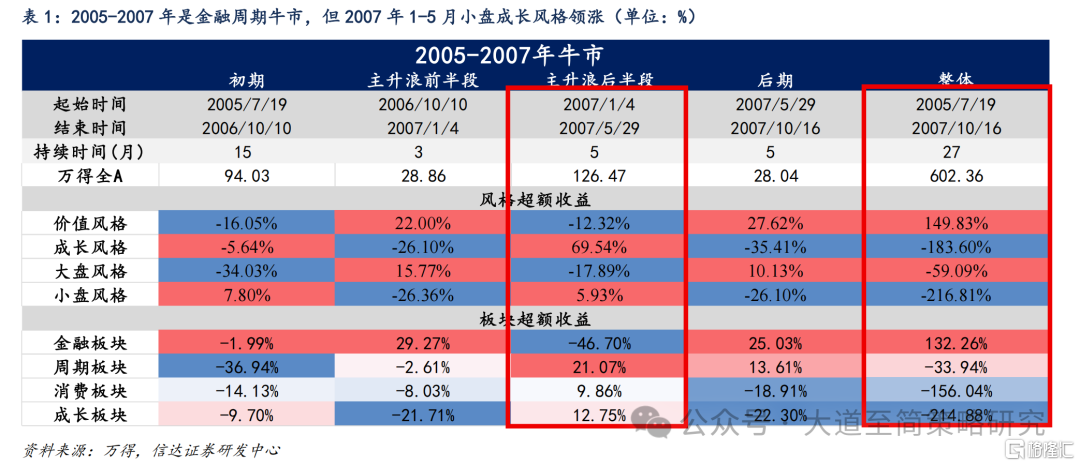
Core Insights - The article discusses the tendency for non-mainstream sectors to lead in bull markets, particularly during the latter stages of market uptrends, influenced by capital inflows and valuation considerations [1][13]. Group 1: Historical Context - In the 2005-2007 financial cycle bull market, small-cap growth stocks outperformed in the latter half of the bull market, with sectors like textiles, environmental protection, and pharmaceuticals leading the gains [2][3]. - The 2013-2015 TMT bull market saw a significant style shift in late 2014, where large-cap value stocks, particularly in non-bank financials, construction, and steel, outperformed while the TMT sector lagged [8][9]. Group 2: Market Dynamics - The shift in market style during bull markets often occurs when incremental capital flows accelerate, leading to a focus on undervalued sectors with high safety margins, rather than performance-driven sectors [1][13]. - Non-mainstream sectors may experience a temporary surge in performance due to factors such as low valuations and the presence of catalysts like mergers and acquisitions [3][13]. Group 3: Current Market Outlook - The current market is expected to continue its upward trend, driven by policy expectations and potential increases in retail investor participation, particularly in low-valuation sectors [15][18]. - Financial sectors, including banks and non-bank financials, are anticipated to benefit from style shifts and may see increased performance in the fourth quarter [17][18].
量化数据告诉你:牛市也能亏大钱!
Sou Hu Cai Jing· 2025-10-19 05:56
Core Insights - The article discusses the disparity between market performance and individual investor experiences, highlighting that even in a bull market, many retail investors face losses due to misconceptions and lack of understanding of market dynamics [1][3]. Group 1: Market Illusions - The first illusion is the belief that individual stocks will always rise, exemplified by Guangju Energy's 50% surge followed by a 60% decline, leading to significant opportunity costs for investors who hold onto losing positions [3][6]. - The second illusion is the notion that market corrections present buying opportunities, which can be misleading as seen in the volatile performance of various sectors like pharmaceuticals and new energy, where short-term gains are often followed by sharp declines [3][6]. Group 2: Institutional Influence - The banking sector has shown resilience and growth despite skepticism, with institutional investors maintaining consistent positions, indicating a strong underlying support for bank stocks [6][10]. - In contrast, the white liquor sector has seen a decline in institutional interest, leading to significant losses for retail investors attempting to time the market, demonstrating the risks of investing without institutional backing [8][10]. Group 3: Investment Strategies - The article emphasizes the importance of understanding market behavior over price levels, suggesting that stock prices are not absolute but rather reflect institutional recognition [10]. - Utilizing tools to analyze trading behaviors can help bridge the information gap, allowing investors to make more informed decisions based on data rather than emotions [10]. - The article warns against the dangers of consensus expectations, where widespread optimism about a sector can signal impending risks, as illustrated by the white liquor market [10].
金融系教授罕见发声:A股目前阶段,还会回到2400点吗,应该加仓还是落袋为安?
Sou Hu Cai Jing· 2025-10-19 04:26
Group 1 - The breakthrough of the 3000-point mark in the A-share market is seen as a significant psychological barrier, indicating a shift in market sentiment rather than just a numerical value [1][2] - The long-term critical level to watch is 3587 points, which, if sustained, would suggest that major players have accumulated enough shares for a potential market rally [2][4] - Historical patterns indicate that after significant bear markets, substantial bull markets typically follow, emphasizing the importance of understanding market cycles rather than timing [4][6] Group 2 - The end of a bear market is characterized by a significant price drop (40%-75%), sufficient duration (often 3-4 years), and a "crazy bear" phase, which has not yet been fully realized in the current market [6] - Current market conditions suggest that A-shares are unlikely to return to the low levels seen at the end of last year (around 2400 points) due to ongoing foreign investment and MSCI index inclusion [6][11] - The MSCI inclusion process is gradual, with a 5% increase in A-share inclusion each quarter, translating to approximately 150 billion yuan in market value being purchased [7][9][11] Group 3 - The total scale of domestic index funds is around 700 billion yuan, and the quarterly MSCI inclusion represents about 20% of this total, indicating a significant impact on the market [11] - Short-term fluctuations in A-shares may occur, but they are expected to remain within a range of about 10% [11]

突发!美军摧毁一艘大型潜艇!10年,伊核协议限制条款已到期!“黑色星期五”后,明天A股怎么“开”?
Qi Huo Ri Bao· 2025-10-18 23:56
Group 1: Iran Nuclear Agreement - Iran's Foreign Ministry announced that the restrictions of the Joint Comprehensive Plan of Action (JCPOA) have expired as of October 18, 2023, marking the end of the 10-year limit set by UN Security Council Resolution 2231 [3] - The Iranian government emphasized that the mechanisms established under the resolution should naturally cease to exist, and Iran's nuclear issue should be removed from the Security Council's agenda [3] - Iran stated that its nuclear program will now be treated equally to that of any non-nuclear weapon state under the Non-Proliferation Treaty, subject to regular oversight by the International Atomic Energy Agency without additional restrictions [3] Group 2: Global Market Trends - Global stock markets faced significant declines, referred to as "Black Friday," with major indices experiencing sharp drops, including a nearly 500-point fall in the Dow Jones and a 4% drop in the Chinese concept stock index [13] - Concerns over regional bank failures in the U.S. and the potential escalation of U.S.-China trade tensions contributed to investor anxiety, leading to widespread sell-offs [14] - The A-share market also reflected volatility, with the Shanghai Composite Index dropping by 1.95% and the ChiNext Index falling by 3.36% [13][14] Group 3: Japanese Political Developments - The ruling Liberal Democratic Party (LDP) and the Japan Innovation Party have reached a basic consensus on a coalition government, expected to sign an agreement on October 20, 2023 [9] - The coalition will involve a 10% reduction in the number of seats in the National Diet, with the Japan Innovation Party participating as an external partner without joining the new cabinet [9] - This alliance is anticipated to secure the election of LDP's new president, Sanae Takaichi, in the upcoming prime ministerial election [10][11]
策略周专题(2025年10月第2期):短期调整,无需悲观
EBSCN· 2025-10-18 12:31
Group 1 - The A-share market experienced a pullback this week, influenced by declining risk appetite and increased uncertainty in US-China relations, with the STAR 50 index dropping 6.2% and the Shanghai 50 index only 0.2% [1][11][20] - The overall market is still in a bull market phase, but may enter a wide fluctuation stage in the short term, with the current maximum drawdown being 4.01%, which is within historical levels [3][39][41] - Short-term focus should be on defensive and consumer sectors, while mid-term attention should be on TMT (Technology, Media, and Telecommunications) and advanced manufacturing sectors [4][43][46] Group 2 - The market style this week favored value stocks, with large-cap value stocks increasing by 2.1%, while mid-cap growth stocks decreased by 5.8% [15][18] - In terms of industry performance, banking, coal, and food and beverage sectors performed relatively well, with respective increases of 4.9%, 4.2%, and 0.9% [15][70] - The TMT sector is expected to become a mid-term focus due to various catalysts, including the ongoing development of AI and the Federal Reserve's interest rate cuts [46][48]
ETF日报:“反内卷”政策的落地节奏和效力决定了中国经济特别是制造业的修复水平,可关注养殖ETF等
Xin Lang Ji Jin· 2025-10-17 12:07
Market Overview - The A-share market experienced a significant decline, with the Shanghai Composite Index dropping by 1.95%, the Shenzhen Component Index by 3.04%, and the ChiNext Index by 3.36% [1] - The trading volume in the Shanghai and Shenzhen markets reached 1.94 trillion, an increase of 6.9 billion compared to the previous trading day [1] - Concerns over the high valuation levels of technology growth stocks have led to a collective sell-off in this sector, which had previously shown strong performance [1][2] Short-term and Long-term Outlook - In the short term, there may be continued downward pressure on the market, but the long-term bull market is not expected to end, and the current pullback may present a good opportunity for active allocation [1][6] - The market has been oscillating around the 3900-point mark, with multiple attempts to break through both upwards and downwards [1][2] Sector Performance - The technology sector has faced significant corrections, with the ChiNext Index's maximum drawdown approaching -12% and the Sci-Tech 50's drawdown exceeding -14% [7] - The "反内卷" (anti-involution) and technology sectors are highlighted as key areas for investment, reflecting market optimism regarding corporate profitability and valuation levels [9][10] Livestock Industry Insights - The livestock sector, particularly pig farming, is showing signs of recovery, with the price of pigs rising from below 14 yuan to around 21 yuan, marking an increase of nearly 50% [12] - The Ministry of Agriculture has initiated measures to control pig production, indicating a shift towards reducing supply, which is expected to support price increases in the future [12][14] - Major pig farming companies like Muyuan Foods and Wens Foodstuffs have reported significant profit improvements, with net profits of 18.9 billion yuan and 9.2 billion yuan, respectively [12] Cost Control and Industry Dynamics - The pig farming industry has seen significant cost optimization, with leading companies reducing their costs to approximately 12-13 yuan per kilogram [17] - The industry is entering a phase of capacity reduction, with the number of breeding sows decreasing, which is expected to support future price increases [14][16] Gold Market Analysis - Gold prices have reached historical highs, with London gold spot prices peaking at 4380 points, driven by ongoing geopolitical tensions and economic uncertainties [19] - The demand for gold as a "safe-haven" asset is expected to remain strong due to concerns over inflation and economic stagnation in the U.S. [20][21]