
贸易摩擦

Search documents
政策与大类资产配置周观察:赛点2.0仍处于第三阶段攻坚
Tianfeng Securities· 2025-06-10 03:43
Group 1: Domestic Policy Developments - The phone call between President Xi Jinping and President Trump on June 5 aimed to recalibrate the direction of China-US relations, emphasizing the importance of dialogue and cooperation to resolve economic issues [10][11][12] - Premier Li Qiang's conversation with Canadian Prime Minister Carney on June 6 highlighted the desire to improve China-Canada relations, focusing on mutual opportunities rather than threats [12][13] Group 2: Economic Outlook - The OECD's latest economic outlook report predicts global economic growth rates of 2.9% for both 2025 and 2026, a downward revision from previous forecasts due to increased trade barriers and economic policy uncertainties [15][22] - The report indicates that the US economy is expected to grow by 1.6% and 1.5% in 2025 and 2026, respectively, with inflation rates projected to be 3.2% and 2.8% for the same years [15][21] Group 3: Equity Market Analysis - Following the easing of trade tensions due to the US-China dialogue, major A-share indices rebounded, with the ChiNext and Shenzhen Composite Index rising by 2.3% and 1.8%, respectively [24] - The net inflow of southbound funds reached 13.681 billion yuan during the week, indicating positive market sentiment [24] Group 4: Fixed Income Market Analysis - The central bank's net withdrawal of 671.7 billion yuan since June has contributed to a more relaxed liquidity environment, with the DR007 rate remaining below 1.6% [46] - The ten-year government bond yield was recorded at 1.66% as of June 6, reflecting stable interest rates in the fixed income market [46] Group 5: Commodity Market Insights - The commodity market saw fluctuations, with non-ferrous metals rebounding and crude oil prices continuing to rise, while pork prices experienced a decline [4] - The IEA has predicted a decline in global oil demand, which may impact related sectors [4] Group 6: Financial Policy Developments - The China Securities Regulatory Commission approved Central Huijin's control over eight companies, enhancing its influence in the financial sector [25] - The Shanghai Stock Exchange held a meeting focused on high dividend returns and enhancing the value of listed companies, indicating a push for improved corporate governance [26][27]
股指价格重心有望缓慢上移
Qi Huo Ri Bao· 2025-06-10 03:10
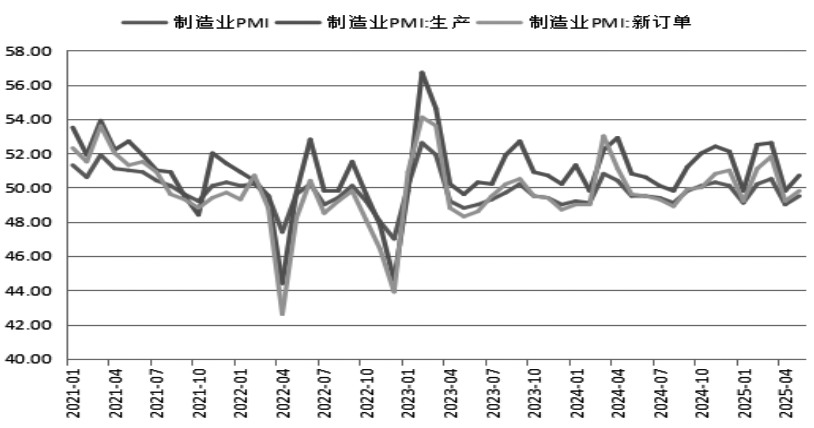
Group 1 - Recent stock index futures have shown a volatile consolidation trend, with the CSI 500 and CSI 1000 indices performing strongly, particularly in new consumption and undervalued dividend sectors [1] - The official manufacturing PMI for May recorded 49.5%, a slight increase of 0.5 percentage points from April, indicating marginal improvement in domestic economic data [2] - Large enterprises' PMI rose to 50.7%, while medium-sized enterprises' PMI fell to 47.5%, marking a new low for 2023, suggesting a disparity in performance across different enterprise sizes [2] Group 2 - The production index increased from 49.8% to 50.7%, while new orders and new export orders recorded 49.8% and 47.5%, respectively, indicating a recovery in industrial production and demand [2] - The consumer price index (CPI) in May decreased by 0.1% year-on-year, primarily due to falling prices of vegetables, fruits, and energy, while the producer price index (PPI) dropped by 3.3%, a larger decline than in April [4] - In May, imports decreased by 3.4% year-on-year, while exports grew by 4.8%, leading to a trade surplus of $103.22 billion, the highest this year [4] Group 3 - The Shanghai Stock Exchange emphasized the need for listed companies to increase dividend payouts and enhance market value management tools, which is expected to attract more long-term capital [5] - Recent communications between the U.S. and China have led to optimism regarding trade negotiations, which may help stabilize market confidence and risk appetite [5] - The European Central Bank announced a 25 basis point reduction in key interest rates, indicating a potential for further easing in response to economic growth risks [6]

日度策略参考-20250609
Guo Mao Qi Huo· 2025-06-09 06:36
Group 1: Report Industry Investment Ratings - Bullish: Gold, Silver, Crude Oil, Fuel Oil, Ethanol [1] - Bearish: Polycrystalline Silicon, Lithium Carbonate, Coking Coal, Coke, Logs, PTA, Short - Fiber, PVC [1] - Neutral (Oscillating): Stock Index, Treasury Bonds, Copper, Aluminum, Alumina, Nickel, Stainless Steel, Tin, Industrial Silicon, Rebar, Hot - Rolled Coil, Iron Ore, Manganese Silicon, Silicon Ferrosilicon, Glass, Soda Ash, Palm Oil, Soybean Oil, Rapeseed Oil, Cotton, Sugar, Corn, Soybeans, Pulp, Live Pigs, Asphalt, Natural Rubber, BR Rubber, Ethylene Glycol, Styrene, Urea, Methanol, Seasonal Products, PVC, Caustic Soda, LPG, Container Shipping on European Routes [1] Group 2: Report's Core View - The short - term fluctuations of stock indices are dominated by overseas variables, and they are expected to oscillate strongly in the short term, but be cautious about the repeated signals of Sino - US tariffs [1]. - Asset scarcity and a weak economy are beneficial to bond futures, but the central bank's short - term interest - rate risk warning restricts the upward space [1]. - The prices of various commodities are affected by factors such as supply and demand, policies, and international relations. For example, the price of copper is affected by supply and Sino - US relations; the price of aluminum is affected by inventory and downstream demand [1]. Group 3: Summary by Industry Macro - Finance - Stock Index: Overseas variables dominate short - term fluctuations, expected to oscillate strongly with caution about tariff signal repetitions [1]. - Treasury Bonds: Asset scarcity and weak economy are favorable, but central - bank interest - rate risk warning restricts upward space [1]. Non - Ferrous Metals - Gold: Expected to run strongly in the short term with a solid long - term upward logic [1]. - Silver: Technically broken through, expected to run strongly but beware of a pull - back [1]. - Copper: The Sino - US leaders' call boosts the price, but sufficient supply restricts the upward space [1]. - Aluminum: Low inventory supports the price, but weakening downstream demand may lead to a weakening oscillation [1]. - Alumina: Spot price rising, futures price falling due to increased production [1]. - Nickel: Expected to oscillate in the short term, with long - term surplus pressure [1]. - Stainless Steel: Follows macro - oscillations in the short term, with long - term supply pressure [1]. - Tin: Supply contradiction intensifies in the short term, expected to oscillate at a high level [1]. - Industrial Silicon: High supply in the northwest, resuming production in the southwest, low demand, and high inventory pressure [1]. Ferrous Metals - Rebar and Hot - Rolled Coil: In the window period of peak - to - off - peak season, with loose cost and supply - demand patterns and no upward driving force [1]. - Iron Ore: Expecting the peak of molten iron, with supply increase in June [1]. - Manganese Silicon: Short - term supply - demand balance, with high warehouse - receipt pressure [1]. - Silicon Ferrosilicon: Cost is affected by coal, but production reduction makes supply - demand tight [1]. - Glass: Weak supply and demand, with prices continuing to weaken [1]. - Soda Ash: Direct demand is okay, but terminal demand is weak, with medium - term over - supply and price pressure [1]. - Coking Coal and Coke: Spot prices continue to weaken, and the futures can be shorted [1]. Agricultural Products - Sugar: Brazilian sugar production is expected to hit a record high, but oil prices may affect production [1]. - Corn: Supply - demand tightening supports a strong oscillation, but the increase is limited by substitute grains [1]. - Soybeans: Expected to oscillate due to the lack of strong upward driving force [1]. - Pulp: Demand is weak, but the downward space is limited [1]. - Logs: Supply is loose, demand is weak, and short - selling is recommended [1]. - Live Pigs: Inventory is sufficient, and futures are stable [1]. Energy and Chemicals - Crude Oil and Fuel Oil: Sino - US calls, geopolitical situations, and the summer peak season support the prices [1]. - Asphalt: Affected by cost, inventory, and demand [1]. - Natural Rubber: Futures - spot price difference returns, cost support weakens, and inventory decreases [1]. - BR Rubber: Fundamentals are loose in the short term, and long - term factors need attention [1]. - PTA: Actual production hits a new high, and sales are difficult [1]. - Ethylene Glycol: Coal - to - ethylene glycol profit expands, and inventory is decreasing [1]. - Styrene: Speculative demand weakens, inventory rises, and the basis weakens [1]. - Urea: Expected to rebound due to export demand [1]. - Methanol: Entering the inventory - accumulation stage, with weak traditional demand [1]. - PVC: Supply pressure increases due to the end of maintenance and new device production [1]. - Caustic Soda: Spot is strong in the short term, but the price - reduction expectation is traded in advance [1]. - LPG: Prices are weak and oscillate in a narrow range [1]. Others - Container Shipping on European Routes: The contract in the peak season can be lightly tested for long positions, and attention should be paid to arbitrage opportunities [1].
高频数据扫描:美国财政前景的变数
Bank of China Securities· 2025-06-09 03:15
1. Report Industry Investment Rating - Not provided in the given content 2. Core Viewpoints of the Report - The binding of the Trump administration's tariff and tax - cut policies will become more obvious, and it is highly likely that the two policies will either pass or be rejected simultaneously [2][11] - The US employment market is operating stably. In May, employment signals were contradictory, but non - farm employment increased by 1.1% year - on - year, and the weekly wage index growth rate is close to the pre - pandemic level, which may not change the downward trend of core inflation [2][14] - The focus of monetary policy lies in the persistence of the impact of tariffs on inflation [2][14] 3. Summary According to the Directory 3.1 High - frequency Data Panoramic Scan - CBO estimates that the OBBBA may lead to a reduction of $3.7 trillion in federal fiscal revenue and $1.3 trillion in expenditure from 2025 - 2034, along with $55.1 billion in debt costs, resulting in an increase of about $3 trillion in government debt. However, tariffs may reduce the deficit by $2.8 trillion from 2025 - 2035, but will also cause negative economic impacts and inflation in the next two years [2][10] - The Trump administration's tariff policy faces legal challenges, and the OBBBA is still under discussion in the Senate. The binding of tariff and tax - cut policies will be stronger [2][11] - In May, the US employment market had contradictory signals. ADP employment increased slightly, while non - farm employment grew strongly. Non - farm employment increased by 1.1% year - on - year, and the non - farm hourly wage growth rate was stable [2][14] - From June 2 - 7, 2025, agricultural product prices mostly declined, and commodity prices showed mixed trends. For example, the average wholesale price of pork decreased by 0.55% week - on - week, and the price of Brent crude oil futures increased by 1.60% week - on - week [2] 3.2 High - frequency Data and Important Macroeconomic Indicators Trend Comparison - Multiple charts show the trend comparison between high - frequency data and important macro - indicators such as PPI, CPI, and export volume, but specific analysis is not provided in the text [22][28][29] 3.3 Important High - frequency Indicators in the US and Europe - Charts display the relationship between US weekly economic indicators and actual economic growth, initial jobless claims and unemployment rate, same - store sales growth and PCE year - on - year, etc., as well as the implied prospects of interest rate hikes or cuts by the Federal Reserve and the ECB, but specific analysis is not provided in the text [83][85][87] 3.4 Seasonal Trends of High - frequency Data - Multiple charts show the seasonal trends of high - frequency data such as 30 - city commercial housing transaction area, LME copper spot settlement price, and production material price index, but specific analysis is not provided in the text [94][96][100] 3.5 High - frequency Traffic Data in Beijing, Shanghai, Guangzhou, and Shenzhen - Charts show the year - on - year changes in subway passenger volume in Beijing, Shanghai, Guangzhou, and Shenzhen, but specific analysis is not provided in the text [147][151]
天风证券晨会集萃-20250609
Tianfeng Securities· 2025-06-09 00:11
Group 1 - The report highlights the impact of trade tensions between the US and China, noting that after the US initiated tariff threats in March 2018, multiple high-level talks occurred, but the US frequently changed its stance, leading to a breakdown in negotiations and escalation of conflicts [2][29] - China's trade surplus has been increasing since 2020, with a projected total trade surplus of $1,105.3 billion by April 2025, compared to an average of $385.1 billion from 2018 to 2019 [2][29] - The report suggests that the domestic industrial production index is recovering, with specific sectors like methanol and polyester filament showing improvement, while others like Shandong refining and tires are declining [2][29] Group 2 - The report discusses the Chinese government's comprehensive financial policies aimed at stabilizing the market and expectations, including initiatives to boost the digital economy, with a target for the core digital economy to account for over 10% of GDP by 2025 [3] - The development of multimodal large models in technology is emphasized, with companies like ByteDance and Alibaba making significant advancements in AI capabilities [3] - The report indicates that the self-sufficiency strategy remains a long-term focus, driven by national policies and the need for domestic supply chain resilience, particularly in sectors heavily reliant on imports from the US [4][6] Group 3 - The report identifies key investment opportunities in sectors with low valuations, particularly in defense, pharmaceuticals, and electronics, while suggesting a focus on the rhythm of industry development [6] - The report notes that the semiconductor industry is expected to see continued growth, driven by advancements in AI and the release of new products, particularly in the context of AI glasses and storage solutions [21][22] - The report highlights the performance of the REITs market, with a focus on infrastructure projects and the increasing activity in the sector, indicating a positive outlook for future growth [32]





港股概念追踪 | 工业需求+避险属性+降息预期三重催化 白银后市表现或超出预期(附概念股)
智通财经网· 2025-06-08 23:20
此外,周三公布的数据显示美国服务业活动收缩,就业增长放缓。国债收益率随之下跌,掉期交易员开 始押注美联储将在10月和12月两次降息。较低的利率环境通常对不产生利息的贵金属构成利好,而白银 由于其更高的价格弹性,往往在这种环境下表现更为突出。 分析认为,这轮白银暴涨或许只是开始——当避险需求遇上工业短缺,再叠加货币宽松预期,这样的组 合往往会产生超出预期的价格冲击。 特朗普政府于6月初加码进口钢铁和铝的关税后,市场开始担忧美国政府可能继续对其他关键金属加 税,从而驱动白银和铂金价格上涨。此外,近期美国公布的多项宏观数据表现不佳,市场对美联储降息 预期迅速发酵,也对白银和铂金等工业属性更强的贵金属产生了利好驱动。 随着关税政策的调整,全球贸易格局面临重塑,金属市场的供应链稳定性受到冲击。投资者为了规避可 能的风险,将资金转移至相对稳定且具有避险属性的贵金属市场,白银作为其中的重要一员,自然成了 资金流入的方向。这种基于宏观政策变动引发的市场行为,直接推动了白银价格在短期内的急剧上升。 国信期货表示,全球贸易摩擦与地缘冲突加剧、美国稳定币法案冲击美元信用、美联储政策分歧较大等 因素导致贵金属获得多重溢价,短期贵金属 ...

5月PMI数据点评:PMI修复,内需仍需重视
Bank of China Securities· 2025-06-08 05:50
固定收益 | 证券研究报告 — 总量点评 2025 年 6 月 8 日 PMI 修复,内需仍需重视 5 月 PMI 数据点评 制造业 PMI 边际回暖,内需相对而言仍需后续政策支持。 相关研究报告 《市场策略更新》20250601 《美国关税政策面临法律挑战》20250530 《策略点评》20250530 中银国际证券股份有限公司 具备证券投资咨询业务资格 固定收益 证券分析师:肖成哲 (8610)66229354 chengzhe.xiao@bocichina.com 证券投资咨询业务证书编号:S1300520060005 ◼ 制造业 PMI 数据在枯荣线下边际回暖,中国国家统计局 5 月 31 日公布, 5 月份,中国制造业采购经理指数(PMI)为 49.5%,比上月上升 0.5 个百分 点。"抢出口"仍在持续,但边际有所放缓;出厂价格、产成品库存、主要 原材料购进价格、供应商配送时间分项指数下降,其余分项较上月有所回 升。 ◼ 分项而言,内需相对外需仍有所不足。PMI 分项中新订单增长相较新出 口订单增长仍有所不足。5 月制造业新出口订单上行 2.8 个百分点至 47.5%,但 5 月制造业新订单仅上涨 ...
美国贸易逆差创纪录收窄,多地家电“国补”暂停 | 财经日日评
吴晓波频道· 2025-06-07 00:47
Group 1: Global Manufacturing PMI - The global manufacturing PMI for May is 49.2%, indicating a slight increase of 0.1 percentage points from the previous month, but it remains below the expansion threshold for three consecutive months, reflecting weak economic momentum [1] - In Asia, the manufacturing PMI returned to the expansion zone at 50.4%, while the Americas, Africa, and Europe remain in contraction [1] - The US manufacturing PMI for May is 48.5%, down 0.2 percentage points from the previous month, marking a four-month decline [2][1] Group 2: US Trade Deficit - The US trade deficit in April narrowed significantly by 55.5% to $61.6 billion, the lowest level in 2023, reversing the trend of widening deficits seen in the first quarter [3] - Imports fell by a record 16.3% in April, while exports increased by 3%, indicating a shift in trade dynamics due to tariff policies [3] - The trade deficit with China decreased to $19.7 billion, the lowest since March 2020, while deficits with Canada and Mexico also shrank [3] Group 3: European Central Bank Actions - The European Central Bank (ECB) announced a 25 basis point cut in key interest rates, marking the eighth rate cut since June of the previous year, with the main refinancing rate now at 2% [5] - Eurozone inflation rates have decreased, with the harmonized CPI for May falling to 1.9%, the first time below 2% since September 2024 [5] - The ECB signaled a potential end to the rate-cutting cycle, as economic conditions stabilize and inflation pressures ease [6][5] Group 4: Domestic Appliance Subsidy Adjustments - Several regions in China have suspended or adjusted the "national subsidy" for replacing old appliances due to the depletion of available funds [8] - The subsidy program has been popular among residents, but its recent suspension may be a temporary measure as new funding is being planned [9] - The impact of the subsidy on stimulating domestic demand has been significant, but broader recovery in consumer spending is still needed [9] Group 5: Didi's Financial Performance - Didi reported a revenue of 53.26 billion yuan for Q1 2025, an 8.5% increase year-on-year, with a net profit of 2.36 billion yuan, up 188.14% from the previous year [10] - The total order volume for Didi's domestic ride-hailing services increased by 10.3% year-on-year, while international orders grew by 24.9% [10] - The improvement in profitability is attributed to higher order volumes and a reduction in losses from overseas operations [11][10] Group 6: Precious Metals Price Surge - Silver prices have surged past $36, reaching the highest level since February 2012, while platinum prices also hit a two-year high at $1,154.73 per ounce [12] - Over the past year, silver and platinum have increased by 19% and 13%, respectively, while gold has risen by 42% [12] - The price increases are linked to industrial demand, with silver being crucial for solar panels and platinum used in automotive catalysts [12] Group 7: Market Overview - The stock market experienced mixed performance, with the Shanghai Composite Index closing at 3,385.36 points, up 0.04%, while the Shenzhen Component Index fell by 0.19% [17] - Market activity was characterized by a lack of clear direction, with various sectors showing both gains and losses [17] - The recent market movements are influenced by expectations of future policy support and ongoing trade negotiations [18]

一周热榜精选:特朗普马斯克反目成仇!美联储降息分歧加大
Jin Shi Shu Ju· 2025-06-06 13:35
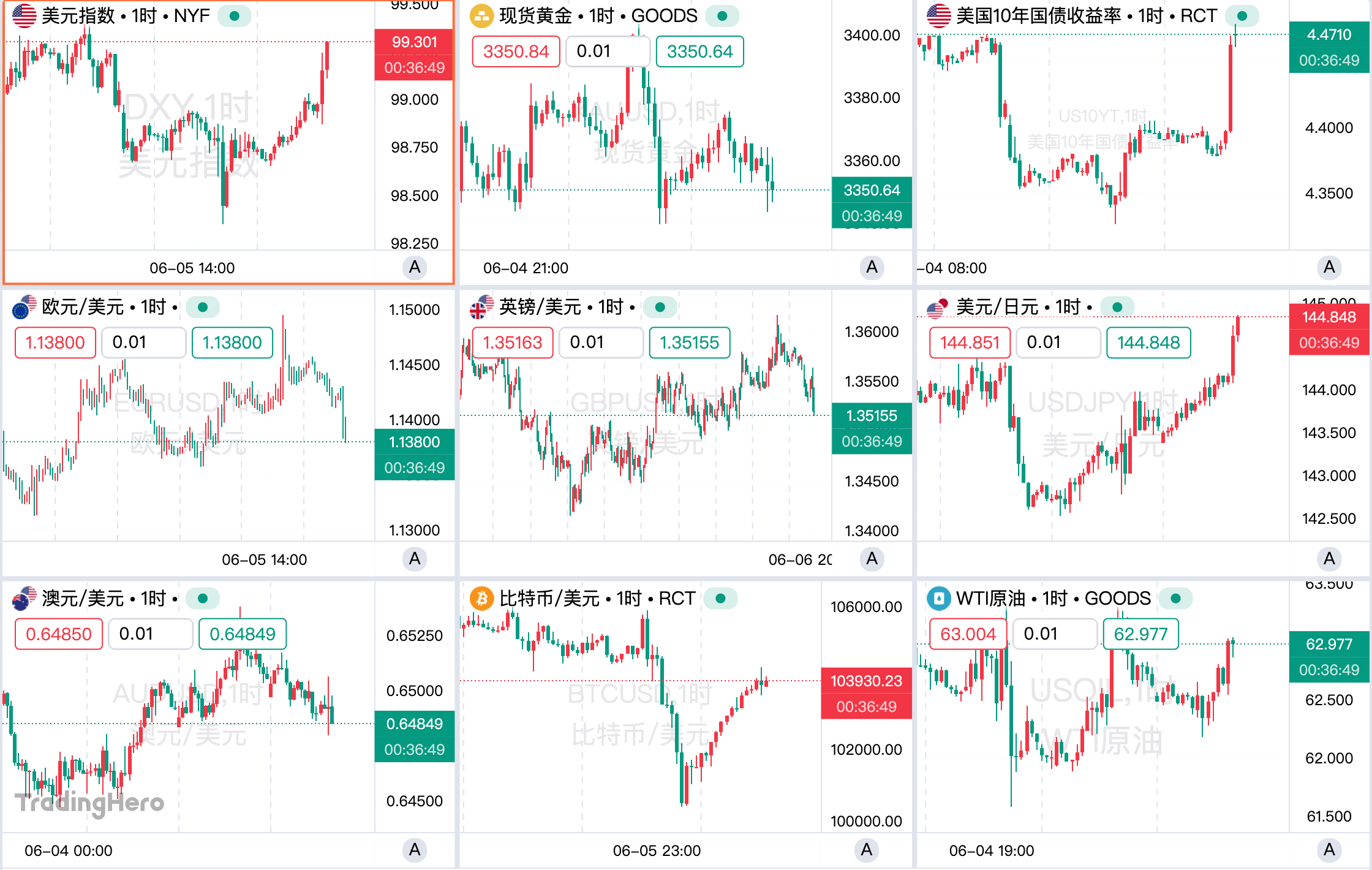
美元指数本周整体走势震荡,继续受到特朗普关税政策和谈判进展的影响。其中,周三,随着美国经济数据疲软推升了降息预期,美元指数跌破99关口,重 回六周低点。周四,中美元首通话提振了市场情绪,美指有所回升。周五非农数据后,美指重回该关口上方,截至发稿报99.3。 现货黄金本周整体走高,主要受到美元走软、贸易和地缘政治风险增加的提振。最刺激的行情出现在周四,金价坐上过山车,盘中触及3400美元/盎司关口 后又急转直下,回吐日内全部涨幅。截至发稿,现货黄金报3350美元/盎司。 另外,贵金属市场近期迎来集体上涨,白银、铂金和钯金价格均表现强劲。白银周四上涨至13年高位,自2012年2月以来首次突破每盎司36美元,铂金也升 至2022年以来的最高水平。 非美货币方面,随着美元走低,欧元、英镑、澳元、加元兑美元均本周整体录得下跌。美元兑日元连续第二周收涨,但本周是其近十周以来波动性最小的一 周。近期日本长期国债收益率的上升凸显了日本央行需要谨慎地收紧政策。 国际油价方面,美布两油本周料将录得三周来首次收涨。俄乌和谈和美伊核谈判前景黯淡,加拿大野火危及石油供应,以及更多贸易协议进展的消息提振了 需求前景,带动油价上涨。但是, ...


瑞达期货宏观市场周报-20250606
Rui Da Qi Huo· 2025-06-06 09:50
Report Industry Investment Rating - Not provided in the content Core Viewpoints - A shares and stock index futures rose collectively this week, with small and medium - cap stocks outperforming large - cap blue - chip stocks. The domestic manufacturing PMI in May slightly rebounded but remained in the contraction range, and the economic fundamentals were still weak. The extension of the exemption period for the 301 investigation by the US and the phone call between the Chinese and US presidents released positive signals for the relaxation of trade relations [9][14]. - This week, the yields of treasury bond cash bonds weakened, and the yields of 10Y and 30Y bonds declined by about 0.5bp. Treasury bond futures rose collectively. The bond market is driven by capital and fundamentals, and it is expected to continue the volatile consolidation pattern [9]. - The commodity market strengthened due to the improvement in import and export expectations, but the subsequent upward momentum needs to be observed. The US economic data weakened comprehensively, the dollar index was volatile and weak, the eurozone cut interest rates, and the euro was boosted by the weakening of the dollar [9]. Summary by Directory 1. This Week's Summary and Next Week's Allocation Suggestions Stocks - The Shanghai and Shenzhen 300 rose 0.88%, and the Shanghai and Shenzhen 300 stock index futures rose 0.91%. A - share major indexes rose collectively this week, with the ChiNext Index rising more than 2%. The four stock index futures also rose collectively, and small and medium - cap stocks were stronger than large - cap blue - chip stocks, with the ranking of gains being IM>IC>IF>IH. The domestic manufacturing PMI in May slightly rebounded but remained in the contraction range, and the economic fundamentals were still weak. The market trading activity rebounded significantly compared with last week. The allocation suggestion is to watch cautiously [9]. Bonds - The yield of treasury bond cash bonds weakened this week. The yields of 10Y and 30Y bonds declined by about 0.5bp to 1.66% and 1.88% respectively. Treasury bond futures rose collectively. The TS, TF, T, and TL main contracts rose 0.10%, 0.27%, 0.45%, and 1.09% respectively. The bond market is driven by capital and fundamentals, and it is expected to continue the volatile consolidation pattern. The allocation suggestion is to watch cautiously [9]. Commodities - The Wind Commodity Index rose 1.46%, and the China Securities Commodity Futures Price Index rose 1.55%. In May, China's manufacturing PMI was 49.5%, a month - on - month increase of 0.5 percentage points. The new export order index and import index increased by 2.8 and 3.7 percentage points respectively. After the easing of the Sino - US tariff dispute, the import and export situation improved, and the commodity market strengthened, but the subsequent upward momentum needs to be observed. The allocation suggestion is to short on rallies [9]. Foreign Exchange - The euro against the US dollar rose 0.77%, and the euro against the US dollar 2506 contract rose 0.65%. The US economic data weakened comprehensively, the employment market faced downward risks, and the debt problem continued to suppress. The dollar index was volatile and weak. The eurozone cut interest rates by 25bps as expected, the inflation data continued to slow down, and the fiscal expansion plan provided support. The euro was mainly boosted by the weakening of the dollar. The allocation suggestion is to watch cautiously [9] 2. Important News and Events - Domestic news includes the implementation of the "Government Data Sharing Regulations", the President's important article on accelerating the construction of an education power, the pilot work on the integration of the human resources service industry and the manufacturing industry, and the participation of the Minister of Commerce in the WTO small - scale ministerial meeting [16]. - International news includes the US raising the import steel and aluminum tariffs to 50%, the pessimistic US economic outlook shown in the Fed's "Beige Book", the OECD lowering the US and global economic growth forecasts, and the number of new jobs created by US enterprises hitting a two - year low [18]. 3. This Week's Domestic and International Economic Data - US economic data: The US May ISM manufacturing PMI was 48.5, the April factory orders month - on - month rate was - 3.7%, the May ADP employment was 3.7 million, the initial jobless claims for the week ended May 31 were 24.7 million, and the April trade balance was - 61.6 billion US dollars [19]. - EU economic data: The eurozone May manufacturing PMI final value was 49.4, the May CPI annual rate initial value was 1.9%, the April unemployment rate was 6.2%, the April PPI month - on - month rate was - 2.2%, and the European Central Bank deposit mechanism interest rate as of June 5 was 2% [19]. - Other countries' economic data: The UK May manufacturing PMI final value was 46.4, and,the German May manufacturing PMI final value was 48.3, the French May manufacturing PMI final value was 49.8 [19]. 4. Next Week's Important Economic Indicators and Economic Events - Next week's important economic indicators include China's May export and import annual rates in US dollars, the CPI annual rate, the UK's May unemployment rate, the US's May unadjusted CPI and core CPI annual rates, etc. [86]