
降息预期

Search documents
白银首破60美元后再刷新高!年内涨幅碾压黄金 多重利好共振下史诗级牛市将继续?
智通财经网· 2025-12-10 04:09
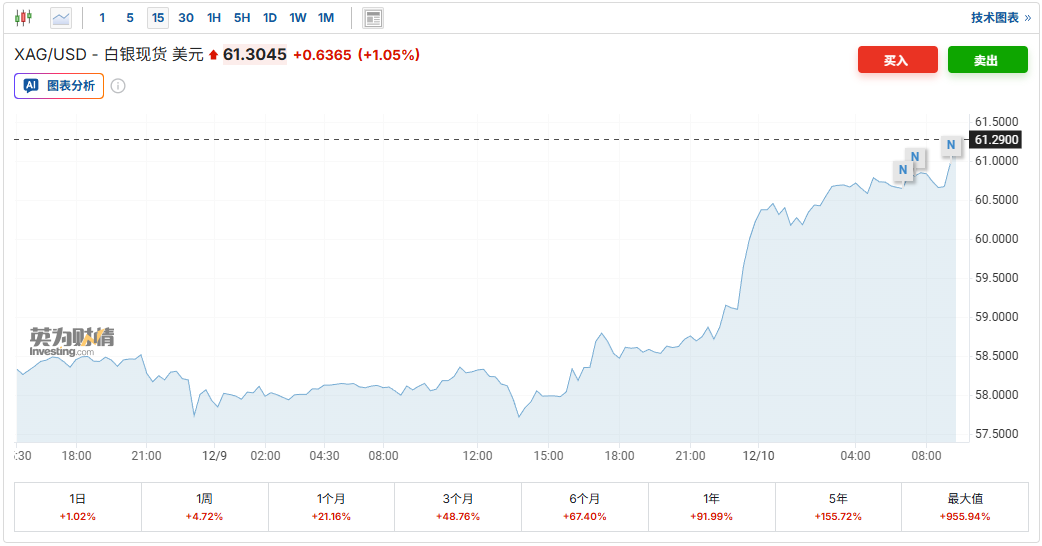
Core Viewpoint - Silver prices have surged over 100% this year, driven by expectations of further monetary easing from the Federal Reserve and ongoing supply shortages [3][4] Group 1: Price Movement and Market Dynamics - Silver prices recently broke the $60 per ounce mark, reaching a record high of $61.30 per ounce [1] - The gold-silver ratio has dropped below 70 for the first time since July 2021, indicating silver's stronger performance compared to gold, which has risen 60% this year [3] - Market expectations are that the Federal Reserve will cut interest rates by 25 basis points, bringing the federal funds rate to 3.5%-3.75% [3] Group 2: Supply and Demand Factors - A record influx of silver into London has created pressure on other trading centers, with Shanghai Futures Exchange inventories at a ten-year low [3] - The global silver mining output has been declining over the past decade, particularly in Central and South America, due to mine closures and resource depletion [4] - Industrial demand for silver is rapidly increasing, particularly in solar energy, electronics, and AI hardware, with expectations of a market deficit for the fifth consecutive year by 2025 [4] Group 3: Investment Sentiment and Future Projections - Significant inflows into silver ETFs have been recorded, indicating strong investor confidence in the continued rise of silver prices [4] - Analysts express mixed sentiments about the sustainability of silver's price surge, with some warning of potential volatility and price corrections [5][6] - Predictions suggest that silver could reach $100 per ounce by mid-2027, with a potential short-term target of $62 per ounce within the next three months [7][8]

新能源及有色金属日报:盘面价格下跌,氧化铝仓单成交平平-20251210
Hua Tai Qi Huo· 2025-12-10 03:34
新能源及有色金属日报 | 2025-12-10 盘面价格下跌氧化铝仓单成交平平 重要数据 铝现货方面:SMM数据,华东A00铝价21880元/吨,较上一交易日变化-40元/吨,华东铝现货升贴水-90元/吨, 较上一交易日变化0元/吨;中原A00铝价21740元/吨,现货升贴水较上一交易日变化10元/吨至-230元/吨;佛山 A00铝价录21770元/吨,较上一交易日变化-40元/吨,铝现货升贴水较上一交易日变化-5元/吨至-200元/吨。 铝期货方面:2025-12-09日沪铝主力合约开于22210元/吨,收于--元/吨,较上一交易日变化-370元/吨,最高价 达22210元/吨,最低价达到21735元/吨。全天交易日成交255735手,全天交易日持仓195726手。 库存方面,截止2025-12-09,SMM统计国内电解铝锭社会库存59.5万吨,较上一期变化-0.1万吨,仓单库存67863 吨,较上一交易日变化127吨,LME铝库存523300吨,较上一交易日变化-2500吨。 氧化铝现货价格:2025-12-09SMM氧化铝山西价格录得2790元/吨,山东价格录得2740元/吨,河南价格录得 2820元/ ...
广发期货《有色》日报-20251210
Guang Fa Qi Huo· 2025-12-10 03:17
Report Industry Investment Ratings No relevant content provided. Core Views of the Report Tin - Considering the strong fundamentals, it is expected that tin prices will remain strong throughout the year. Hold existing long positions and adopt a strategy of buying on dips during price corrections. Monitor macro - level changes and supply - side fluctuations [1]. Zinc - With the improvement of interest - rate cut expectations and the opening of export space, zinc prices are expected to fluctuate with an upward bias. Supply pressure eases, and the price is expected to move higher in the short term. Pay attention to the December FOMC meeting [4]. Copper - In the short term, the imbalance in global copper supply and inventory drives copper prices to rise rapidly, with increased price volatility. In the long term, the supply - demand contradiction supports the upward movement of the price bottom. Focus on the range of 90,000 - 91,000 yuan/ton [6]. Aluminum - Alumina is expected to maintain bottom - level oscillations, with the reference range for the main contract moving down to 2550 - 2800 yuan/ton. The electrolytic aluminum market is expected to remain strong in the short term, but beware of pull - back risks after price surges [8]. Industrial Silicon - It is expected that industrial silicon prices will oscillate at low levels, with the main price fluctuation range between 8500 - 9500 yuan/ton. Consider buying on dips if the price drops to 8500 - 8700 yuan/ton [9]. Polysilicon - Polysilicon futures are likely to oscillate at high levels, but considering the weak demand, the probability of the futures price falling to converge with the spot price is higher. Adopt a wait - and - see trading strategy [10]. Aluminum Alloy - The casting aluminum alloy market is expected to oscillate with an upward bias in the short term, with the main contract reference range of 20,800 - 21,600 yuan/ton. Monitor the improvement in scrap aluminum supply and downstream procurement patterns [11]. Nickel - In the short term, the nickel market is expected to oscillate within a range, with the main contract reference range of 116,000 - 120,000 yuan/ton. Pay attention to changes in macro - expectations and Indonesian industrial policies [13]. Stainless Steel - The stainless - steel market is expected to oscillate and recover in the short term, with the main contract reference range of 12,400 - 12,800 yuan/ton. Monitor the implementation of steel - mill production cuts and raw - material price changes [14]. Lithium Carbonate - The lithium carbonate market is expected to oscillate widely in the short term, with the main contract reference range of 92,000 - 96,000 yuan/ton. Consider the resumption of production by large manufacturers and the sustainability of off - season demand [17]. Summaries by Relevant Catalogs Spot Prices and Basis - **Tin**: SMM 1 tin price decreased by 800 yuan/ton to 314,000 yuan/ton, a decline of 0.25%. SMM 1 tin premium remained unchanged at 50 yuan/ton [1]. - **Zinc**: SMM 0 zinc ingot price remained unchanged at 23,130 yuan/ton, and the premium decreased by 5 yuan/ton to 70 yuan/ton [4]. - **Copper**: SMM 1 electrolytic copper price increased by 715 yuan/ton to 92,300 yuan/ton, a rise of 0.78%. The premium decreased by 40 yuan/ton to 130 yuan/ton [6]. - **Aluminum**: SMM A00 aluminum price decreased by 170 yuan/ton to 21,920 yuan/ton, a decline of 0.77%. The premium decreased by 10 yuan/ton to - 90 yuan/ton [8]. - **Industrial Silicon**: The price of East China oxygen - containing S15530 industrial silicon decreased by 150 yuan/ton to 8300 yuan/ton, a decline of 1.59% [9]. - **Polysilicon**: The average price of N - type re -投料 remained unchanged at 52,300 yuan/kg [10]. - **Aluminum Alloy**: SMM ADC12 aluminum alloy price decreased by 100 yuan/ton to 21,600 yuan/ton, a decline of 0.46% [11]. - **Nickel**: SMM 1 electrolytic nickel price increased by 150 yuan/ton to 120,200 yuan/ton, a rise of 0.12%. The premium increased by 50 yuan/ton to 4950 yuan/ton [13]. - **Stainless Steel**: The price of 304/2B (Wuxi Hongwang 2.0 coil) increased by 100 yuan/ton to 12,800 yuan/ton, a rise of 0.79%. The basis increased by 90 yuan/ton to 460 yuan/ton [14]. - **Lithium Carbonate**: SMM battery - grade lithium carbonate average price decreased by 500 yuan/ton to 92,750 yuan/ton, a decline of 0.54%. The basis decreased by 500 yuan/ton to 92,750 yuan/ton [17]. Inter - monthly Spreads - **Tin**: The spread between 2512 - 2601 contracts increased by 200 yuan/ton to - 350 yuan/ton, a rise of 36.36% [1]. - **Zinc**: The spread between 2512 - 2601 contracts increased by 25 yuan/ton to - 15 yuan/ton [4]. - **Copper**: The spread between 2512 - 2601 contracts increased by 40 yuan/ton to - 20 yuan/ton [6]. - **Aluminum**: The spread between AL 2512 - 2601 contracts decreased by 10 yuan/ton to - 25 yuan/ton [8]. - **Industrial Silicon**: The spread between 2512 - 2601 contracts decreased by 8830 yuan/ton to - 8675 yuan/ton, a decline of 5696.77% [9]. - **Polysilicon**: The spread between the main contract and the first - continuous contract decreased by 525 yuan/ton to 2655 yuan/ton, a decline of 16.51% [10]. - **Aluminum Alloy**: The spread between 2601 - 2602 contracts increased by 5 yuan/ton to - 45 yuan/ton [11]. - **Nickel**: The spread between 2601 - 2602 contracts decreased by 10 yuan/ton to - 170 yuan/ton [13]. - **Stainless Steel**: The spread between 2601 - 2602 contracts decreased by 22 yuan/ton to - 115 yuan/ton [14]. - **Lithium Carbonate**: The spread between 2512 - 2601 contracts increased by 1500 yuan/ton to - 80 yuan/ton [17]. Fundamental Data Tin - In October, tin ore imports increased by 2918 tons to 11,632 tons, a rise of 33.49%. SMM refined tin production in October increased by 2580 tons to 16,090 tons, a rise of 53.09% [1]. Zinc - In November, refined zinc production decreased by 2.20 million tons to 59.52 million tons, a decline of 3.56%. In October, refined zinc imports decreased by 0.38 million tons to 1.88 million tons, a decline of 16.94% [4]. Copper - In November, electrolytic copper production increased by 1.15 million tons to 110.31 million tons, a rise of 1.05%. In October, electrolytic copper imports decreased by 5.22 million tons to 28.21 million tons, a decline of 15.61% [6]. Aluminum - In November, alumina production decreased by 34.6 million tons to 743.94 million tons, a decline of 4.44%. Domestic electrolytic aluminum production decreased by 10.6 million tons to 363.66 million tons, a decline of 2.82% [8]. Industrial Silicon - National industrial silicon production decreased by 5.05 million tons to 40.17 million tons, a decline of 11.17%. The national operating rate decreased by 3.30 percentage points to 64.82% [9]. Polysilicon - Weekly polysilicon production increased by 0.18 million tons to 2.58 million tons, a rise of 7.50%. Monthly polysilicon production decreased by 1.94 million tons to 11.46 million tons, a decline of 14.48% [10]. Aluminum Alloy - In November, the production of recycled aluminum alloy ingots increased by 3.7 million tons to 68.20 million tons, a rise of 5.74%. The production of primary aluminum alloy ingots increased by 1.7 million tons to 30.27 million tons, a rise of 5.84% [11]. Nickel - Chinese refined nickel production decreased by 3453 tons to 33,345 tons, a decline of 9.38%. Refined nickel imports decreased by 18,626 tons to 9741 tons, a decline of 65.66% [13]. Stainless Steel - The production of Chinese 300 - series stainless - steel crude steel (43 manufacturers) decreased by 1.30 million tons to 178.70 million tons, a decline of 0.72%. The production of Indonesian 300 - series stainless - steel crude steel (Qinglong) increased by 0.15 million tons to 42.35 million tons, a rise of 0.36% [14]. Lithium Carbonate - In November, lithium carbonate production increased by 3090 tons to 92,350 tons, a rise of 3.35%. Lithium carbonate demand increased by 6490 tons to 133,451 tons, a rise of 5.11% [17]. Inventory Changes Tin - SHEF weekly inventory increased by 206 tons to 6865 tons, a rise of 1.96%. Social inventory increased by 187 tons to 8012 tons, a rise of 2.39% [1]. Zinc - China's seven - region zinc ingot social inventory decreased by 0.83 million tons to 13.60 million tons, a decline of 5.75%. LME inventory increased by 0.24 million tons to 5.8 million tons, a rise of 4.29% [4]. Copper - Domestic social inventory increased by 0.13 million tons to 16.03 million tons, a rise of 0.82%. Bonded - area inventory decreased by 1.14 million tons to 7.75 million tons, a decline of 12.82% [6]. Aluminum - China's electrolytic aluminum social inventory decreased by 0.1 million tons to 59.50 million tons, a decline of 0.17%. LME inventory decreased by 0.3 million tons to 52.6 million tons, a decline of 0.47% [8]. Industrial Silicon - Xinjiang inventory increased by 0.34 million tons to 12.38 million tons, a rise of 2.82%. Social inventory increased by 0.80 million tons to 55.80 million tons, a rise of 1.45% [9]. Polysilicon - Polysilicon inventory increased by 1.00 million tons to 29.10 million tons, a rise of 3.56%. Silicon wafer inventory increased by 1.80 million tons to 21.30 million tons, a rise of 9.23% [10]. Aluminum Alloy - The weekly social inventory of recycled aluminum alloy ingots decreased by 0.03 million tons to 5.53 million tons, a decline of 0.54% [11]. Nickel - SHFE inventory increased by 1726 tons to 42,508 tons, a rise of 4.23%. Social inventory increased by 1499 tons to 26,848 tons, a rise of 2.71% [13]. Stainless Steel - The 300 - series social inventory (Wuxi + Foshan) decreased by 1.04 million tons to 49.20 million tons, a decline of 2.06%. The 300 - series cold - rolled social inventory (Wuxi + Foshan) decreased by 0.44 million tons to 29.82 million tons, a decline of 1.44% [14]. Lithium Carbonate - In November, lithium carbonate total inventory decreased by 19,674 tons to 64,560 tons, a decline of 23.36%. Downstream inventory decreased by 11,261 tons to 42,030 tons, a decline of 21.13% [17].
供应短缺博弈,降温降息预期支撑金银
Da Yue Qi Huo· 2025-12-10 03:16
1. Report Industry Investment Rating - No relevant information provided 2. Core Viewpoints of the Report - The game of supply shortage has cooled down, and the expectation of interest rate cuts supports the prices of gold and silver [1] - The silver price rally stopped after the sentiment cooled down, but the supply shortage hype will continue to occur repeatedly [59] - Before the Fed's December meeting, the prices of gold and silver will be continuously supported by the interest rate cut expectation and remain strong. After the meeting, the prices may face downward pressure in the short - term [59] - The overall upward trend of gold and silver prices remains unchanged in the long - term, but they may face short - term highs after the Fed meeting [59] 3. Summary According to the Table of Contents 3.1 Market Review - There are various charts showing the historical data of gold and silver, including the position and trading volume of Shanghai gold and silver indices, price spreads, US dollar index, US Treasury yields, and spot gold - silver ratios [13][15][23] 3.2 Logical Analysis - The expectation of a Fed interest rate cut in December continued to rise, reaching 89.2%. The latest "dot plot" showed a stronger dovish signal [33][38] - The supply shortage hype of COMEX silver 12 - contract led to a sharp rise in the silver price, but the possibility of a short squeeze in the New York market is limited [59] - The recovery of the technology sector and the optimistic expectation of the Politburo economic meeting support the silver price [59] 3.3 Fundamental Data - Macroeconomic data of the US, such as GDP growth rate, import and export volume, trade balance, and various PMI indices, are presented [32] - Inflation data including CPI, core CPI, PCE, and core PCE are provided [32] 3.4 Position Data - The long and short positions and net positions of the top 20 in Shanghai gold and silver increased on December 5, 2025, compared with the previous day [42][43] - CFTC data shows that the net long positions of gold and silver decreased significantly as of October 28 [44] - Gold and silver ETF holdings increased overall but decreased the day before [48] - Shanghai gold and silver inventories continued to increase, COMEX gold inventory decreased, and COMEX silver inventory stopped falling and rebounded slightly [53][54] 3.5 Summary - The prices of gold and silver are affected by factors such as interest rate cut expectations, supply shortage hype, and macro - economic conditions [59] - Although the long - term upward trend remains unchanged, they may face short - term downward pressure after the Fed meeting [59]
金ETF(159834)高开涨近1%,最新份额创近半年新高,现货黄金向上突破4220美元/盎司,降息预期支撑金价
Sou Hu Cai Jing· 2025-12-10 02:58
Group 1 - The core viewpoint of the news is that the gold ETF (159834) has seen a recent increase in both price and trading volume, indicating a positive market sentiment towards gold investments [1][2] - As of December 9, the gold ETF's latest share reached 141 million, marking a six-month high, with a net inflow of 2.83 million yuan [1] - In the early morning of December 10, spot gold prices surpassed $4,220 per ounce, reflecting a 0.7% increase, driven by expectations of a potential interest rate cut by the Federal Reserve [2] Group 2 - The market anticipates that the Federal Open Market Committee (FOMC) will meet on December 9-10 to assess economic conditions, with a 90% probability of a rate cut, marking the third cut of the year [2] - Analysts from Dongwu Securities suggest that recent U.S. economic data, which fell below expectations, has increased the likelihood of a rate cut to nearly 100%, supporting the bullish outlook for precious metals [2] - Jintai Futures indicates that the recent economic data points towards continued rate cuts, and with several Federal Reserve officials supporting a December cut, market sentiment has shifted positively towards gold and silver [2]
白银价格突破每盎司60美元大关 供应紧张与降息预期助推涨势
Huan Qiu Wang· 2025-12-10 02:51
Group 1 - Silver prices have recently surged, breaking historical records by reaching $60.4 per ounce, driven by supply shortages and increased investor demand [1] - Since January, silver prices have more than doubled due to persistent supply shortages and strong demand from industrial users and investors, leading to market tightness in October [2] - The upcoming Federal Reserve policy meeting is influencing market sentiment, with interest rate cut expectations boosting precious metal prices [2] Group 2 - Silver's dual role in jewelry and industrial applications, particularly in electronics and solar panels, has contributed to its rising demand [2] - The U.S. has accumulated significant silver inventories due to concerns over potential tariffs, exacerbating supply tightness in other regions [3] - Retail investors are increasingly attracted to silver as prices rise, with it being referred to as "poor man's gold" in North America, drawing more capital into the market [3]

英镑日内窄幅震荡 央行政策分化成关键指引
Jin Tou Wang· 2025-12-10 02:27
Core Viewpoint - The GBP/USD exchange rate is experiencing a narrow fluctuation, influenced by rising expectations of a rate cut by the Federal Reserve, which has led to a decline in the dollar index and provided passive support for the pound [1] Group 1: Economic Indicators - The CME FedWatch tool indicates an approximately 89% probability of a 25 basis point rate cut to 3.50%-3.75%, a significant increase from 63% a month ago, reflecting market sentiment towards monetary easing [1] - The OECD has raised its growth forecast for the UK, enhancing confidence in the medium-term resilience of the UK economy [1] - The UK Chancellor announced a tax adjustment plan of approximately £26 billion per year, which addresses the fiscal gap and provides a risk buffer, improving market confidence [1] Group 2: Inflation and Monetary Policy - The UK's October CPI data decreased from 3.8% to 3.6%, leading to increased market expectations that the Bank of England may initiate a rate cut cycle next week, which limits the upward potential of the pound [1] - The market is currently cautious, awaiting key employment-related data such as the US ADP employment change and JOLTS job openings, which are expected to drive new trading momentum [1] Group 3: Technical Analysis - The GBP/USD has rebounded from the psychological level of 1.3000 and is currently above the 100-day moving average (1.3300), with the moving average system providing support [2] - Resistance is noted in the range of 1.3348 (Bollinger Band upper limit) to 1.3400, while key support levels are at 1.3300 and 1.3260, with a potential decline to 1.3180 if 1.3260 is breached [2] - The short-term outlook for GBP/USD will revolve around the policy differences between the US and UK central banks, with potential for high-level fluctuations or expanded upward movement if the Fed signals a dovish stance [2]
港股科技30ETF(513160)近5日持续“吸金”累超3.1亿元,机构:估值处于低位的港股有望率先反弹
2 1 Shi Ji Jing Ji Bao Dao· 2025-12-10 02:17
Group 1 - The Hong Kong stock market experienced a decline on December 10, particularly in the technology sector, with the Hong Kong Technology 30 ETF (513160) dropping by 0.74% and trading volume exceeding 470 million yuan [1] - Despite the recent downturn, there has been a significant inflow of funds into the Hong Kong Technology 30 ETF, with a net inflow of over 310 million yuan in the past five days as of December 9 [1] - According to China Merchants Securities, the recent pullback in the Hong Kong market is seen as an overreaction influenced by the U.S. market, and it is expected that the market will rebound as interest rate expectations become clearer and concerns over AI bubbles are addressed [1] Group 2 - Alibaba has established a new consumer-facing business group called Qianwen, led by Vice President Wu Jia, which consolidates several existing business units and includes various applications and AI hardware [2] - Guolian Minsheng Securities remains optimistic about the revaluation of AI in China, recommending attention to platform-based internet companies and AI ecosystem enterprises with modeling or application capabilities [2] - The Hong Kong Technology 30 ETF closely tracks the Hang Seng Hong Kong Stock Connect China Technology Index, which includes major technology companies listed in Hong Kong, such as SMIC, Kuaishou, Tencent, Alibaba, and Xiaomi [2]

大越期货贵金属早报-20251210
Da Yue Qi Huo· 2025-12-10 02:13
Report Summary 1. Report Industry Investment Rating No industry investment rating is provided in the report. 2. Core Viewpoints - **Gold**: On the eve of the Fed's interest - rate decision, the number of job openings in the US unexpectedly increased, and risk appetite decreased, causing the gold price to rise slightly. The premium of Shanghai gold has expanded to around - 4.6 yuan/gram. Based on historical performance, the gold price may reach a stage high on the day before the Fed meeting, so cautious operation is recommended [4]. - **Silver**: The market is waiting for the Fed meeting, and risk appetite has decreased. Shanghai silver saw an increase of 50,000 lots at night, pushing the silver price to a new high. The premium of Shanghai silver has converged to 380 yuan/gram, and domestic sentiment remains strong. However, the sustainability of overnight capital inflows is questionable, and attention should be paid to the intraday position changes [5]. 3. Summary by Directory 3.1. Previous Day's Review - **Gold**: The US 10 - year JOLTS job openings unexpectedly increased before the Fed's interest - rate decision. The US three major stock indices closed mixed, European three major stock indices closed mixed, US bond yields rose, the US dollar index rose 0.14% to 99.24, and COMEX gold futures rose 0.45% to $4236.6 per ounce. The basis shows that the spot is at a discount to the futures, the inventory remains unchanged, the 20 - day moving average is upward with the k - line above it, and the main net position is long but the long position is decreasing [4]. - **Silver**: Before the Fed's interest - rate decision, Shanghai silver saw an increase of 50,000 lots at night. The US three major stock indices closed mixed, European three major stock indices closed mixed, US bond yields rose, the US dollar index rose 0.14% to 99.24, and COMEX silver futures rose 4.72% to $61.16 per ounce. The basis is neutral, the inventory of Shanghai silver futures increased, the 20 - day moving average is upward with the k - line above it, and the main net position is long but the long position is decreasing [5]. 3.2. Daily Tips - **Gold**: Pay attention to the Fed's interest - rate decision and Powell's speech early the next morning, and China's November CPI, speeches by the ECB president and officials, and the UK Chancellor of the Exchequer's defense of the tax - increase plan today. The market is waiting for the Fed's meeting decision, and the increase in job openings in October has cooled risk appetite, causing the gold price to rise slightly. Be cautious as the gold price may reach a stage high on the day before the Fed meeting [4]. - **Silver**: The market is waiting for the Fed meeting, and the increase in positions at night has pushed the silver price to a new high. The sustainability of capital inflows is questionable, and attention should be paid to intraday position changes [5]. 3.3. Today's Focus - **Events**: At 09:30, China's November CPI and PPI; the UK Chancellor of the Exchequer will attend a hearing to defend a £26 billion tax - increase budget; at 18:45, the Bank of England Governor Bailey will speak; at 18:55, the ECB President Lagarde will speak in London; at 20:30, ECB Governing Council member Sharon Donnery will host a panel discussion; at 22:45, the Bank of Canada will announce its interest - rate decision; early the next morning, various central bank officials will speak, and the Fed will announce its FOMC interest - rate decision, economic outlook, and the US November government budget, followed by a press conference by Fed Chairman Powell; at 05:30, the Central Bank of Brazil will announce its interest - rate decision [14]. 3.4. Fundamental Data - **Gold**: The basis is - 4.82, indicating that the spot is at a discount to the futures; the inventory of gold futures is 91,299 kg and remains unchanged; the 20 - day moving average is upward with the k - line above it; the main net position is long but the long position is decreasing [4]. - **Silver**: The basis is - 5, the inventory of Shanghai silver futures increased by 18,497 kg to 717,788 kg; the 20 - day moving average is upward with the k - line above it; the main net position is long but the long position is decreasing [5]. 3.5. Position Data - **Gold**: The main net position is long, but the long position is decreasing. The long position of the top 20 holders decreased by 3.02% to 173,310 lots, the short position decreased by 1.39% to 58,766 lots, and the net long position decreased by 3.83% to 114,544 lots [4][29]. - **Silver**: The main net position is long, and the long position of the top 20 holders decreased by 0.70% to 406,455 lots, the short position decreased by 1.81% to 300,238 lots, and the net long position increased by 2.56% to 106,217 lots [5][31]. - **ETF Positions**: The SPDR gold ETF position decreased slightly, while the silver ETF position increased again [33][35]. - **Warehouse Receipts**: The Shanghai gold warehouse receipts increased slightly, the COMEX gold warehouse receipts continued to decrease but remained at a high level, the Shanghai silver warehouse receipts continued to increase and were at the lowest level in the past six years, and the COMEX silver warehouse receipts started to decrease [37][38][40].
黄金:降息预期回升,白银:再创新高,突破60
Guo Tai Jun An Qi Huo· 2025-12-10 01:57
商 品 研 究 2025 年 12 月 10 日 黄金:降息预期回升 白银:再创新高,突破 60 刘雨萱 投资咨询从业资格号:Z0020476 liuyuxuan023982@gtjas.com 【基本面跟踪】 贵金属基本面数据 | | | 昨日收盘价 | 日涨幅 | 昨日夜盘收盘价 | 夜盘涨幅 | | --- | --- | --- | --- | --- | --- | | | 沪金2512 | 961.04 | 0.80% | 958.72 | 0.15% | | | 黄金T+D | 956.00 | 0.80% | 954.99 | 0.20% | | | Comex黄金2512 | 4227.70 | -0.24% | - | | | | 伦敦金现货 | 4196.37 | -0.23% | - | - | | | 沪银2512 | 13687 | 1.94% | 13788.00 | 2.67% | | 价 格 | 白银T+D | 13639 | 1.58% | 13756 | 1.91% | | | Comex白银2512 | 58.800 | 2.21% | - | - | | | 伦敦银现 ...